
Three Pounds: William Goodwin Grant (1816-1867)
On 22nd July 1834, a nineteen-year-old blacksmith from the market town of Eye in Suffolk signed his name for a bounty of three pounds and a place in the Royal Marines — his attestation formally completed three days later, on 25th July [1]. Three pounds was a modest incentive. The Corps had set its levy money at three pounds on its establishment in 1755, raised it to five guineas by the end of the Seven Years War, and kept it there while the Army was offering foot recruits sixteen guineas by 1804; by 1834 the bounty had shrunk further still, more gesture than fortune [2]. But it was, in every respect, the decision that made his life. Had he stayed in Eye, he would have remained a blacksmith in a small Suffolk town, his world bounded by the forge and the market square. Instead, his name in the recruiting ledger set him on a course that would take him to Portugal and Spain during a civil war, to the Syrian coast for the first great naval battle of the steam age, to the turbulent valleys of west Wales during the Rebecca Riots — and, in a workhouse church on a September morning in 1843, to the woman he would marry and the Portsmouth family that would outlast him by generations.
The attestation record describes him as he appeared that day: five feet eight and a quarter inches tall — already a tall man by the standards of the time — dark complexion, brown eyes, brown hair. Against "distinguishing marks" the record notes WONES: the abbreviation for no wounds, no scars, no tattoos. He was unmarked, uninjured, entirely sound. Twenty-two years later, on the day of his discharge, the same column would record four distinguishing marks [3]. The Royal Marines had not left him unchanged.
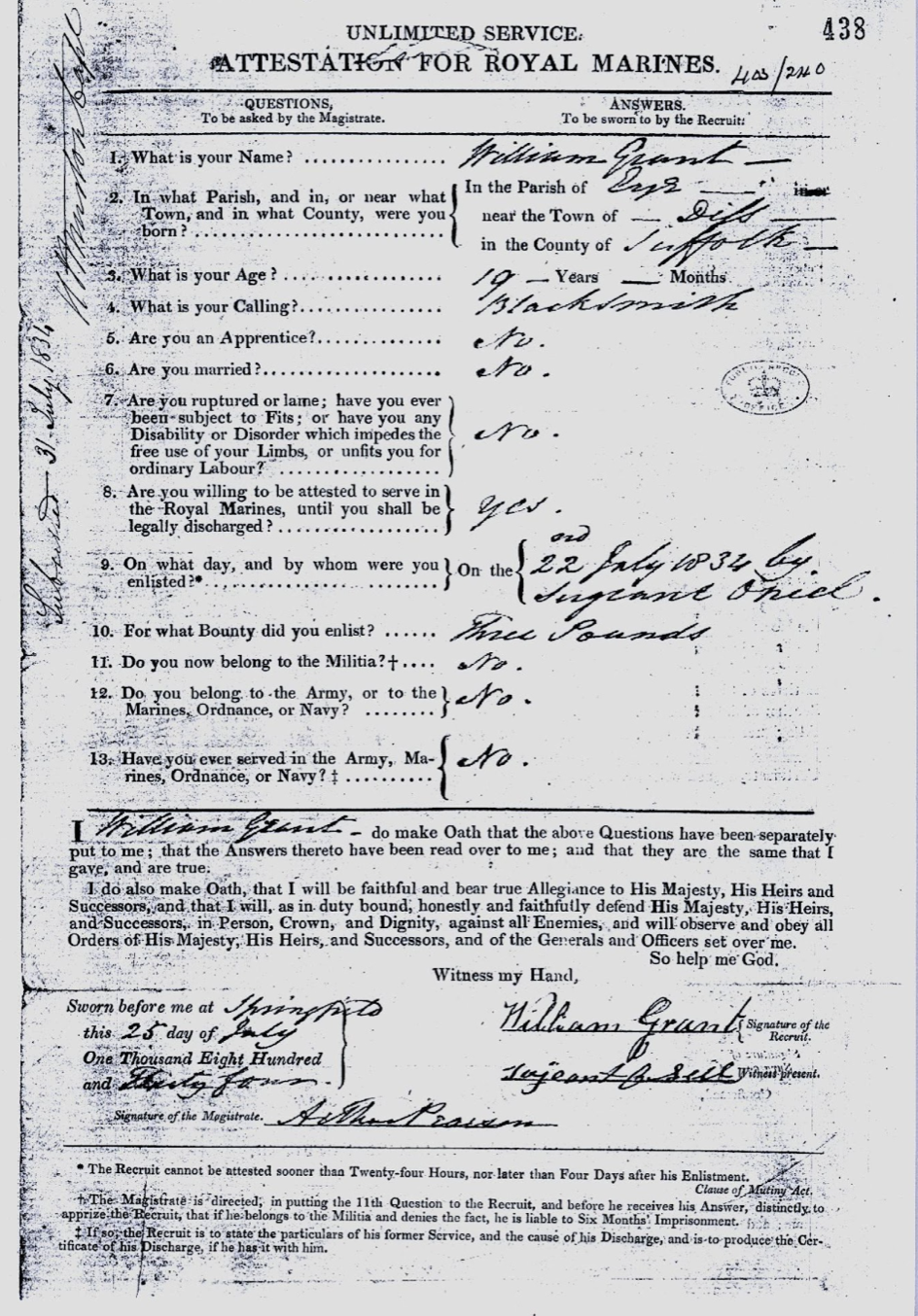
William Goodwin Grant’s Attestation and Military Record (Page 1) [1]
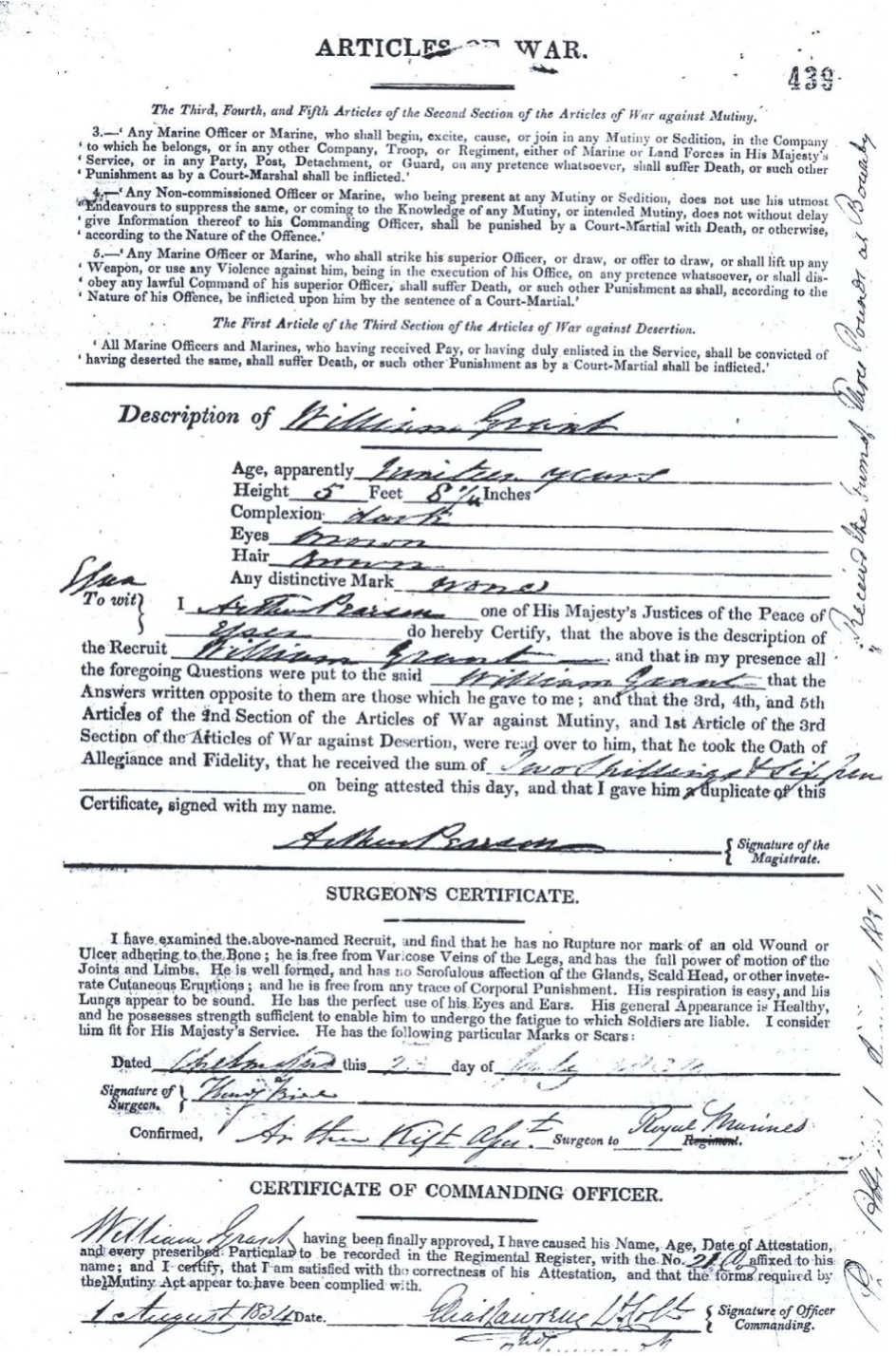
William Goodwin Grant’s Attestation and Military Record (Page 2) [1]
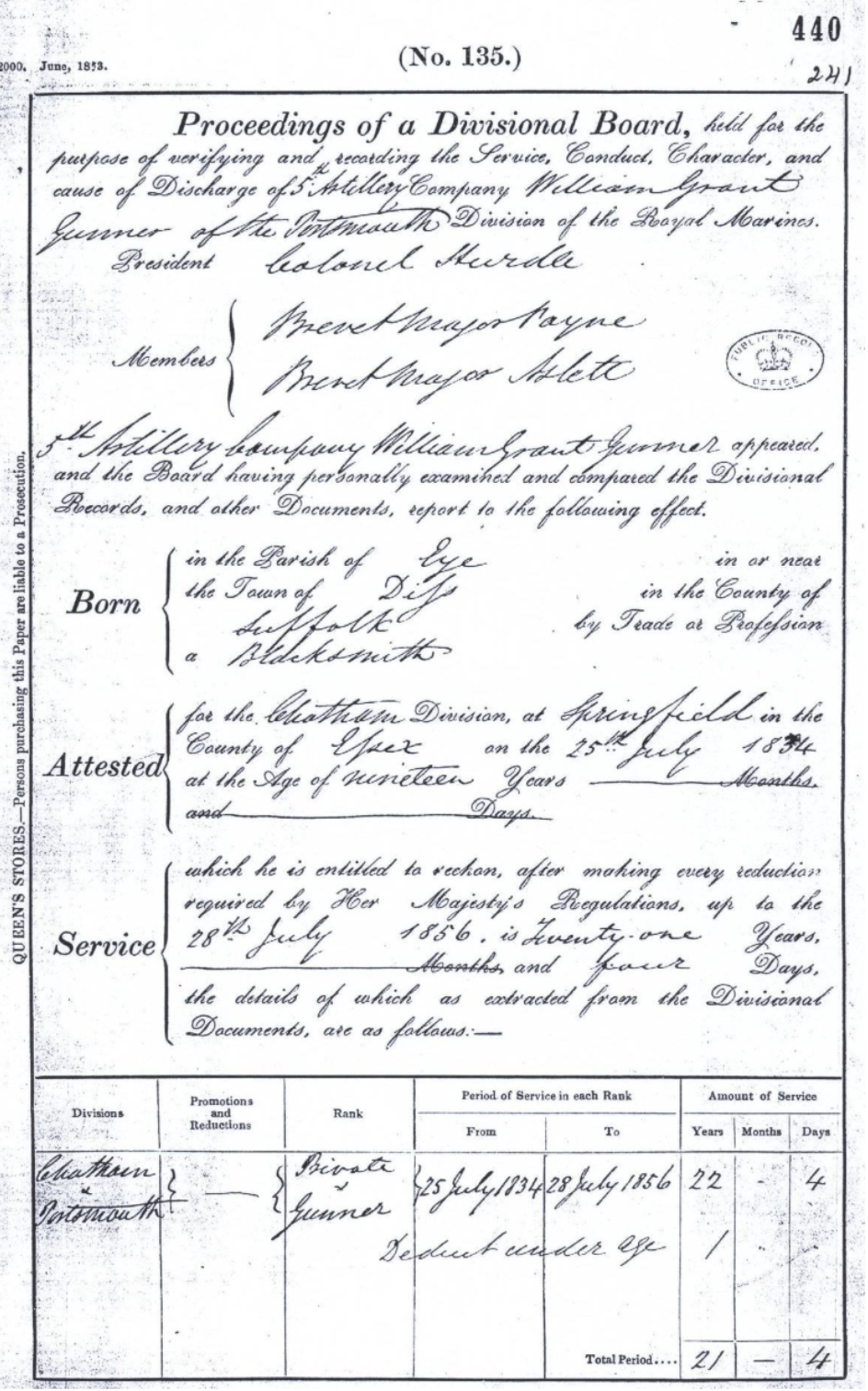
William Goodwin Grant’s Attestation and Military Record (Page 3) [1]
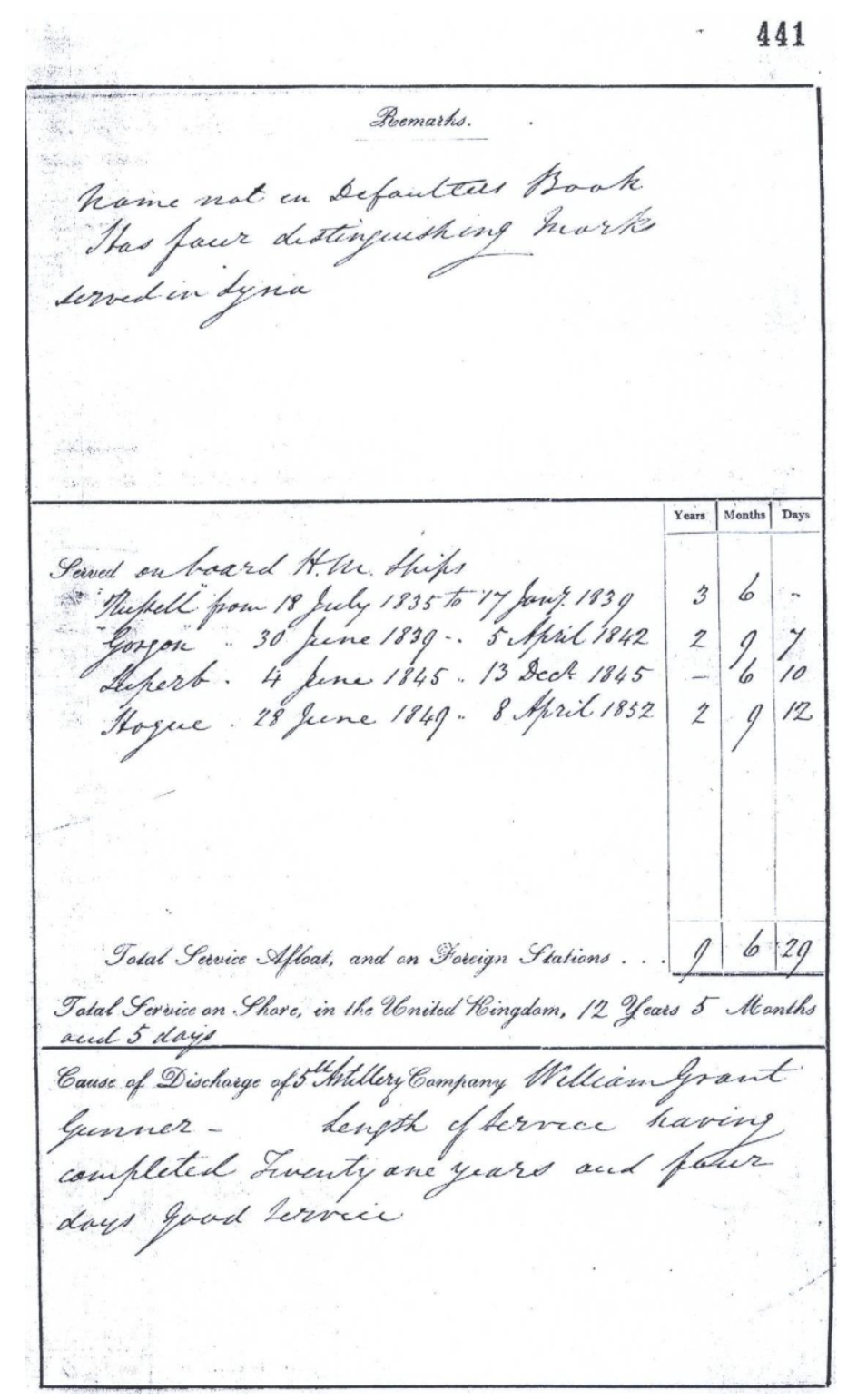
William Goodwin Grant’s Attestation and Military Record (Page 4) [1]
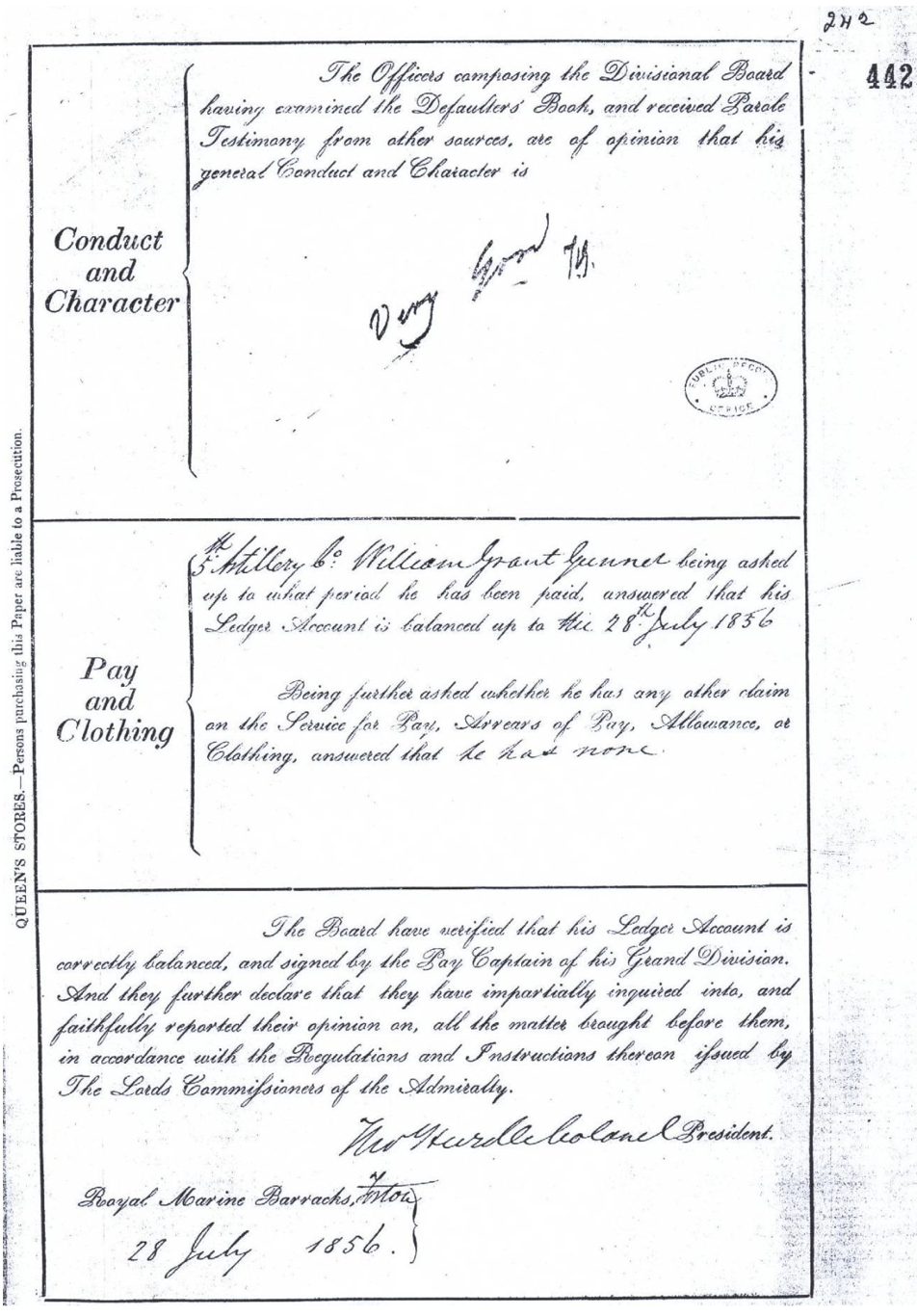
William Goodwin Grant’s Attestation and Military Record (Page 5) [1]
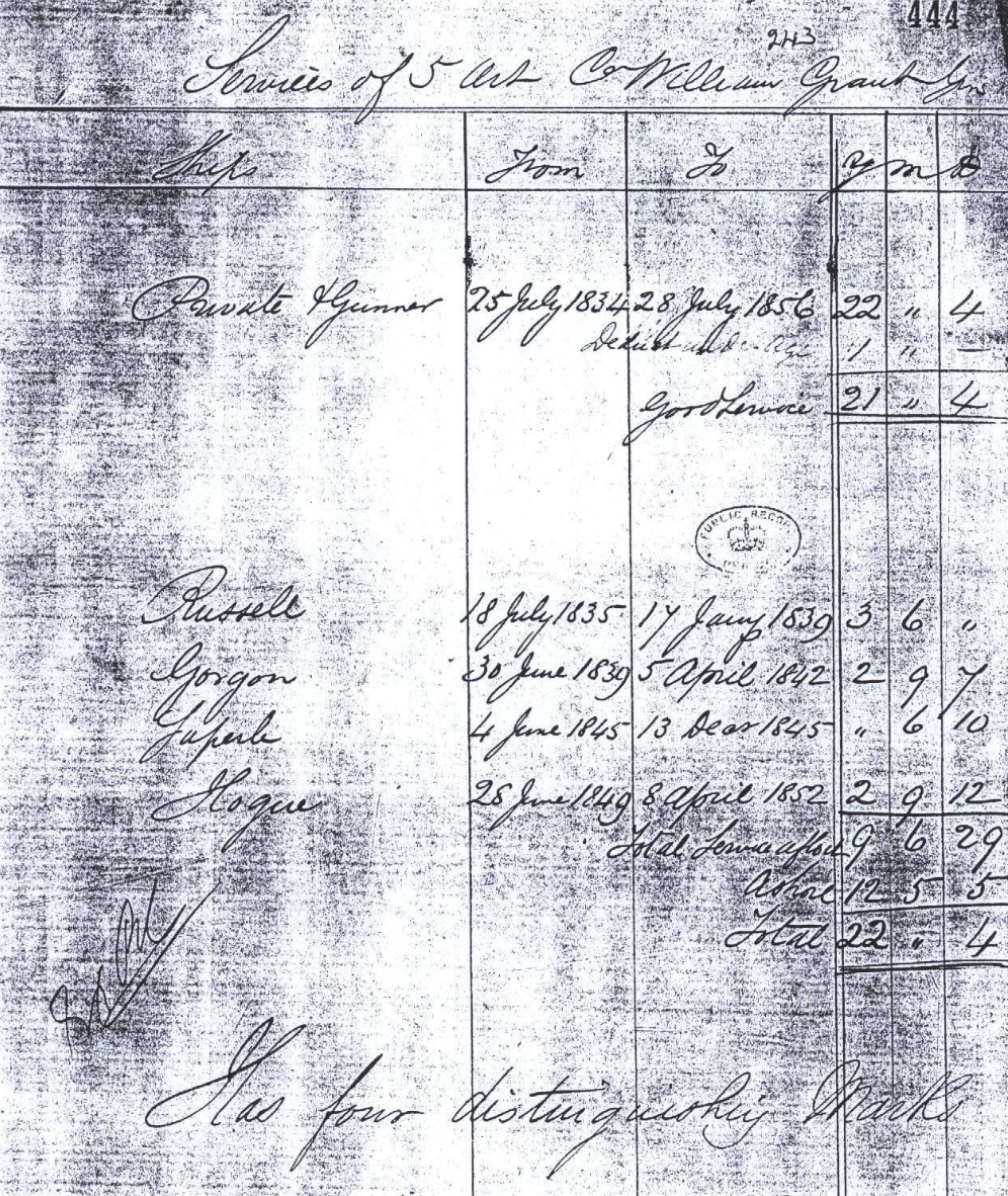
William Goodwin Grant’s Attestation and Military Record (Page 6) [1]
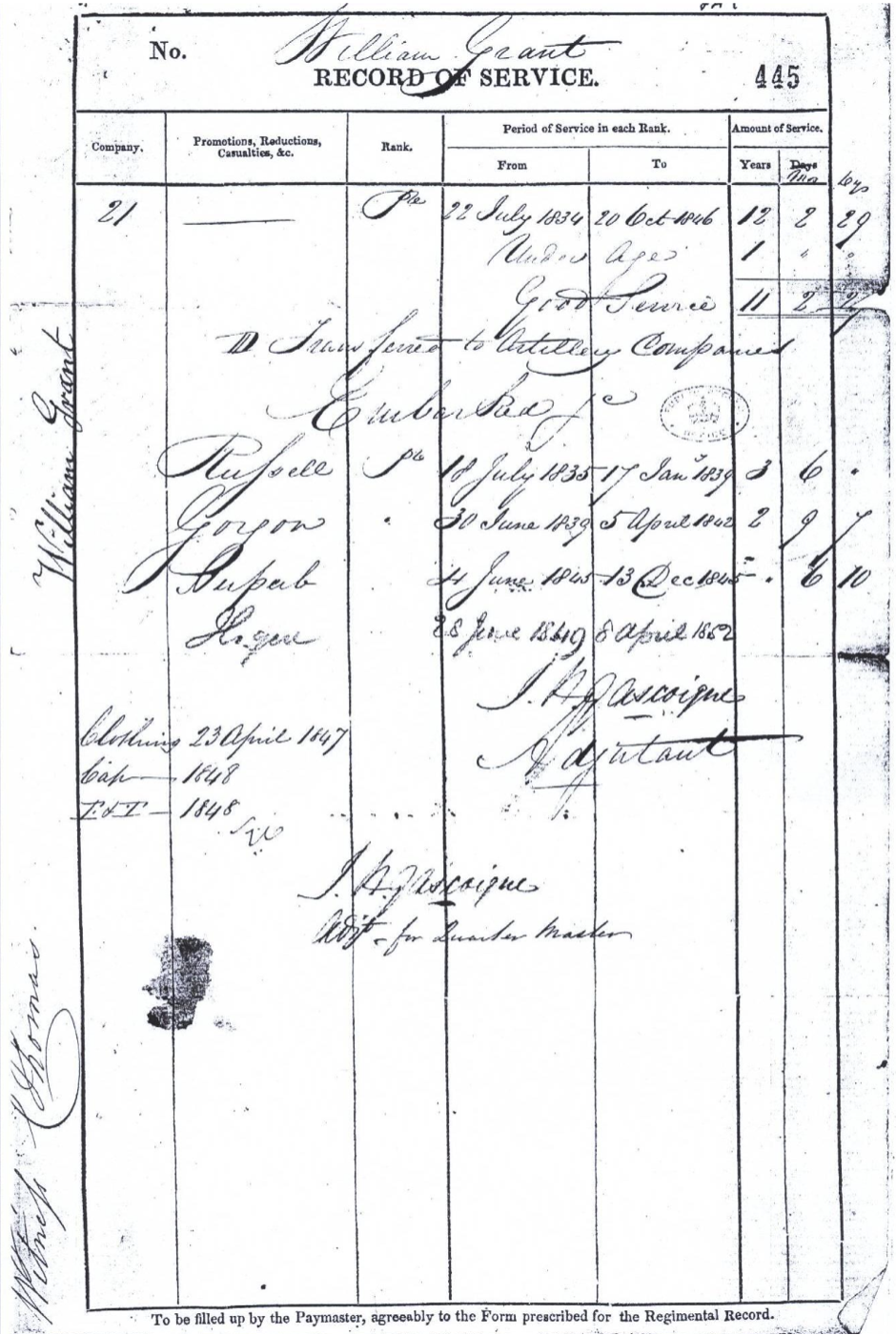
William Goodwin Grant’s Attestation and Military Record (Page 7) [1]
Behind him, when he left, he left very little. William had been born on 12th September 1815, the first child of Francis Grant, a mason and bricklayer, and his wife Susanna, née Browne — baptised at the Parish Church of Eye, the register recording him as William Goodwin, son of Francis and Susan Grant, Eye, Mason [4].
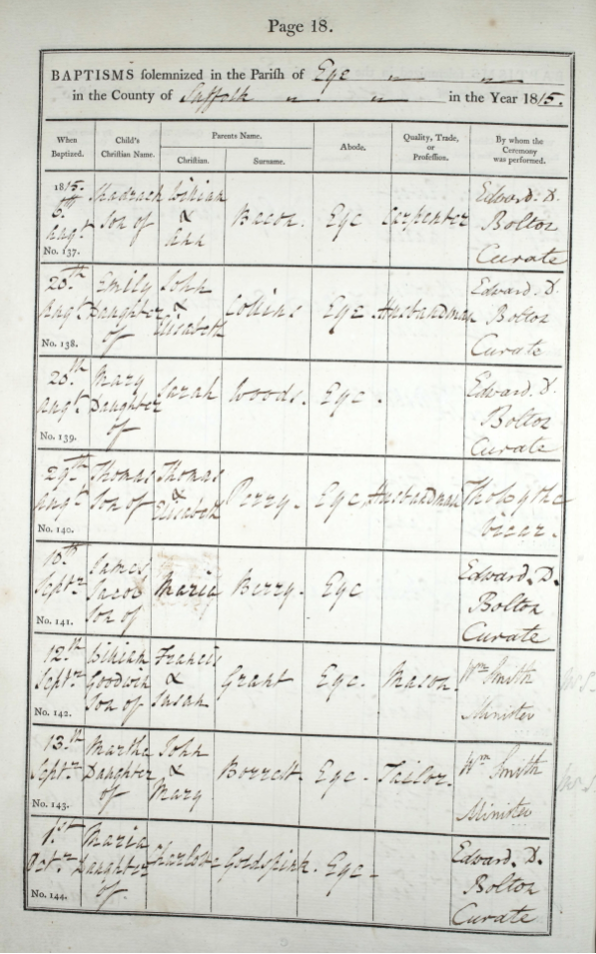
William Goodwin Grant’s Baptism Record [4]
Eye was a small market town in the north of Suffolk, just a few miles south of the River Waveney, which formed the county boundary with Norfolk, and of the Norfolk market town of Diss beyond it. The town took its name from the Old English word for island: it sat on low ground almost encircled by the River Dove and its tributaries, the surrounding clay plateau given over to dairy farming and the cultivation of turnips, its fields irregularly shaped in the medieval way, scattered farms and small woods stretching away to the horizon [5]. The church of St Peter and St Paul rose above it all a 101-foot tower of elaborate flushwork flint and limestone, described by Pevsner as “one of the wonders of Suffolk”, its bells cast in frames made by a local firm that specialised in nothing else [6].
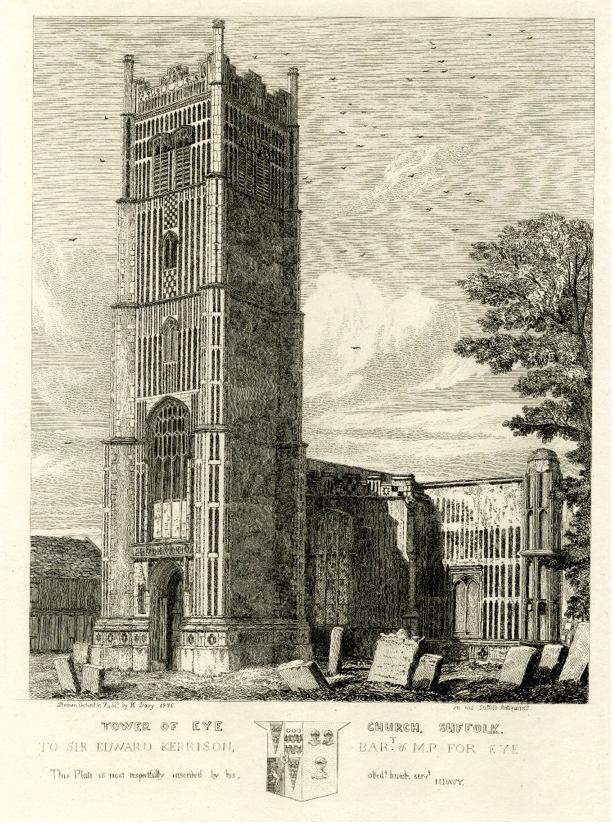
“Tower of Eye Church, Suffolk," etching by Henry Davy, dated 1827 [7]
The ruins of Eye Castle, a Norman motte-and-bailey built by William Malet shortly after 1066 and one of only two castles recorded in the Domesday Book as a source of income, rose above the river meadows to the south of the church, its motte topped by a windmill in William's day [5]. Two breweries served the town. Linen was retted from flax in the nearby waters. A Fisher's theatre served the town, built in the year of William's birth as one stop on the company's circuit of permanent playhouses across Norfolk and Suffolk [8]. It was a typical small East Anglian market town — ancient, self-contained, modestly prosperous — and, by the time William was growing up in it, beginning to feel the tremors of a changing world.
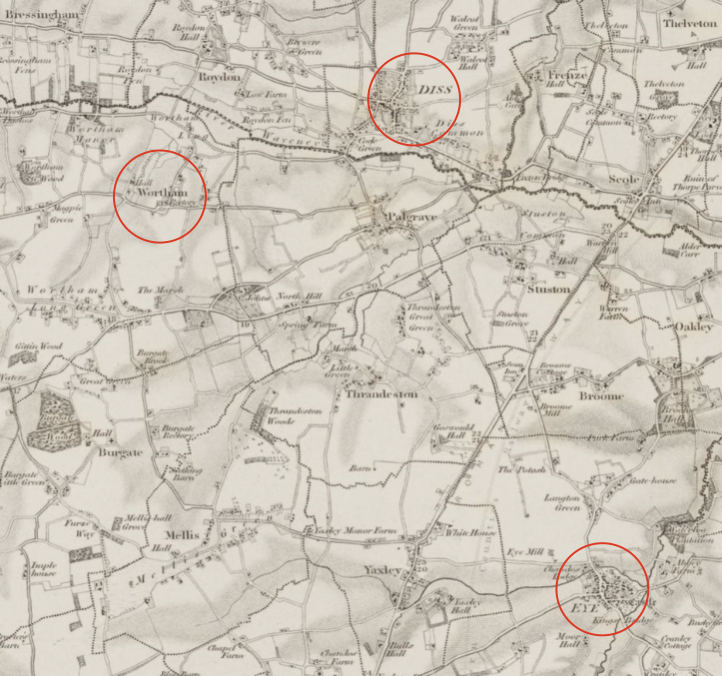
Eye, Wortham, and Diss: the landscape of William Grant's childhood [9]
Those tremors had already produced violence. In February 1822, when William was six, the agricultural troubles that had been spreading through Suffolk broke openly in Eye itself. A body of labourers marched to a local farm and dragged a threshing machine into the street, the new machinery that was costing men their livelihoods made suddenly, furiously concrete. A deliberate fire was started on a neighbouring farm shortly after [10]. The disturbances of 1822 were a foretaste of worse to come. In the autumn and winter of 1830, when William was fifteen, the wave of agrarian unrest that swept southern and eastern England under the name of Captain Swing reached Suffolk, where it recorded incidents across the county before burning out. The labourers there chose strike action over machine-breaking, but settled nothing. The threshing machines stayed. The wages did not rise [11].
It was the world in which William grew up: a world of uncertain rural labour, of men working trades that machinery was beginning to undercut. Francis Grant was one such man, his trade described variously as mason, marble mason, and bricklayer across the records [12], shifting between whatever work the local economy offered. Eye, Wortham where he had married Susanna in 1814 [13], and Diss just across the Waveney in Norfolk formed his working landscape. Diss was around five miles from Eye on foot, a morning's walk; the two towns had been administratively intertwined for centuries. Francis could baptise one son at Eye and another at Diss a couple of years later without crossing any boundary that mattered.
Francis and Susanna had married on 31st October 1814 at Wortham church, neither of them able to write, both signing the register with a mark13. William had broken that pattern. His parents could not write; he could — most likely the product of a parish or Sunday school education in Eye, institutions spreading rapidly through Suffolk's market towns in the 1820s. When he stood in the church at St. Dogmaels in 1843, William signed his own name in the register while Hannah placed her mark beside it [14]— a quiet generational distance, written in ink.
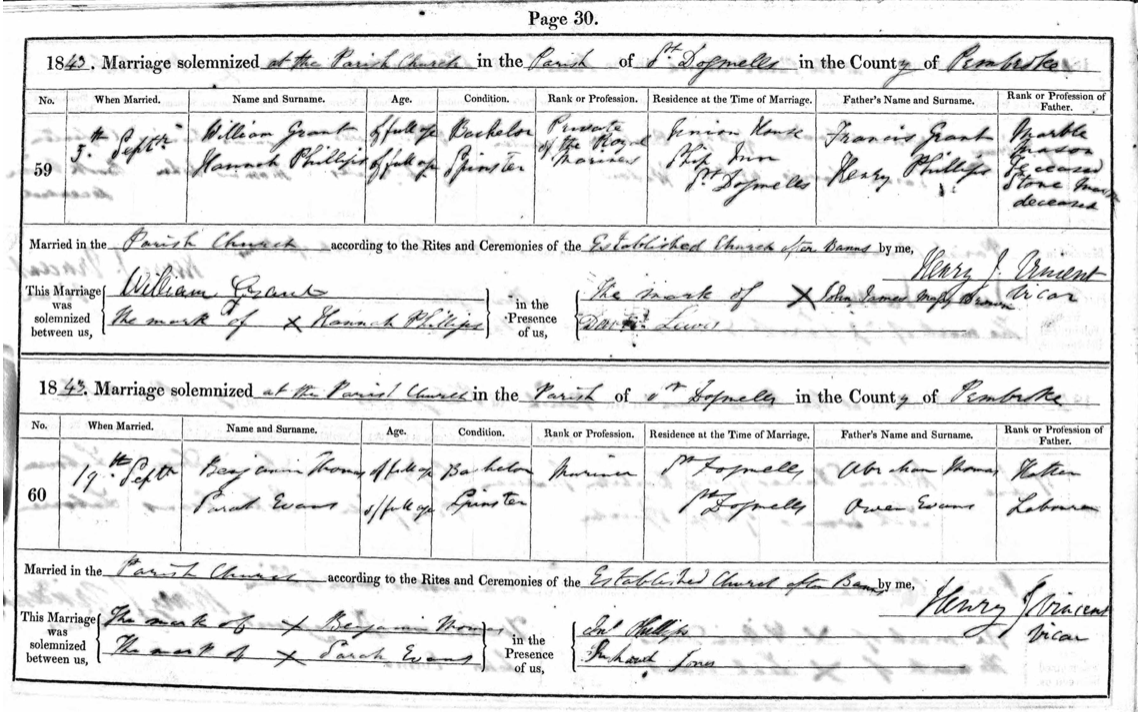
William Goodwin Grant and Hannah Phillips’ Marriage Record [14]
Francis was a man of turbulent history even before William was born. In November 1811, three years before his marriage to Susanna, the Ipswich Journal carried a notice reporting that Francis Grant — aged about twenty, an apprentice in the building trades, stout and ruddy-complexioned, missing a toe — had escaped from Eye Borough Gaol on a Tuesday night [12]. What he had been imprisoned for is not recorded. By October 1814 he was at liberty and marrying Susanna at Wortham. But the arc of his life ran steadily downward. In October 1824, when William was nine years old, Susanna died. The burial register of Wortham recording her plainly: Susanna, Wife of Francis Grant, late Browne, Eye, buried 6th October 1824, aged thirty-four [15]. She had been married barely ten years. Francis was left a widower with at least two young boys, and whatever hold he had on stability loosened steadily thereafter. By October 1840, he was living — and dying — in the Eye Union Workhouse. His death certificate gives his cause of death as Decline; the informant is John Thornton, Master, Eye Union House [12]. The workhouse master, not a family member, registered his death. William was twenty-five by then, and may well have been at sea when it happened.
It was, then, a young man with every reason to leave who signed his name that July. His brother Charles would eventually take himself to London and find work as a bricklayer in Kentish Town, their father's trade, carried into the metropolis [16]. William went the other way entirely. His attestation record makes clear he was no apprentice but a fully qualified blacksmith, trained in Eye, competent at the forge by nineteen — and that is how his children would remember him decades after his death, writing William Grant, Blacksmith on their marriage certificates [17]. The recruiting party that came to Eye that summer was one of many sent out, seeking volunteers across the counties of southern and eastern England, and led, in William's case, by Sergeant O'Neil, the man who enlisted him on 22nd July [1]. Three days later, William appeared before Arthur Pearson, a Justice of the Peace of Eye, who read the Articles of War aloud, administered the oath of allegiance, and certified that the answers William had given were his own. A surgeon examined him the same day and found him sound in every particular: no rupture, no varicose veins, lungs clear, general appearance healthy, strength sufficient to undergo the fatigue to which soldiers are liable [1]. The Royal Marines used no press gangs; every man in the Corps was a volunteer [18]. Sergeant O'Neil had found his man. The blacksmith's trade was his origin, but the Royal Marines would be his life.
In July 1835, William joined H.M.S. Russell at Sheerness as a private [19].
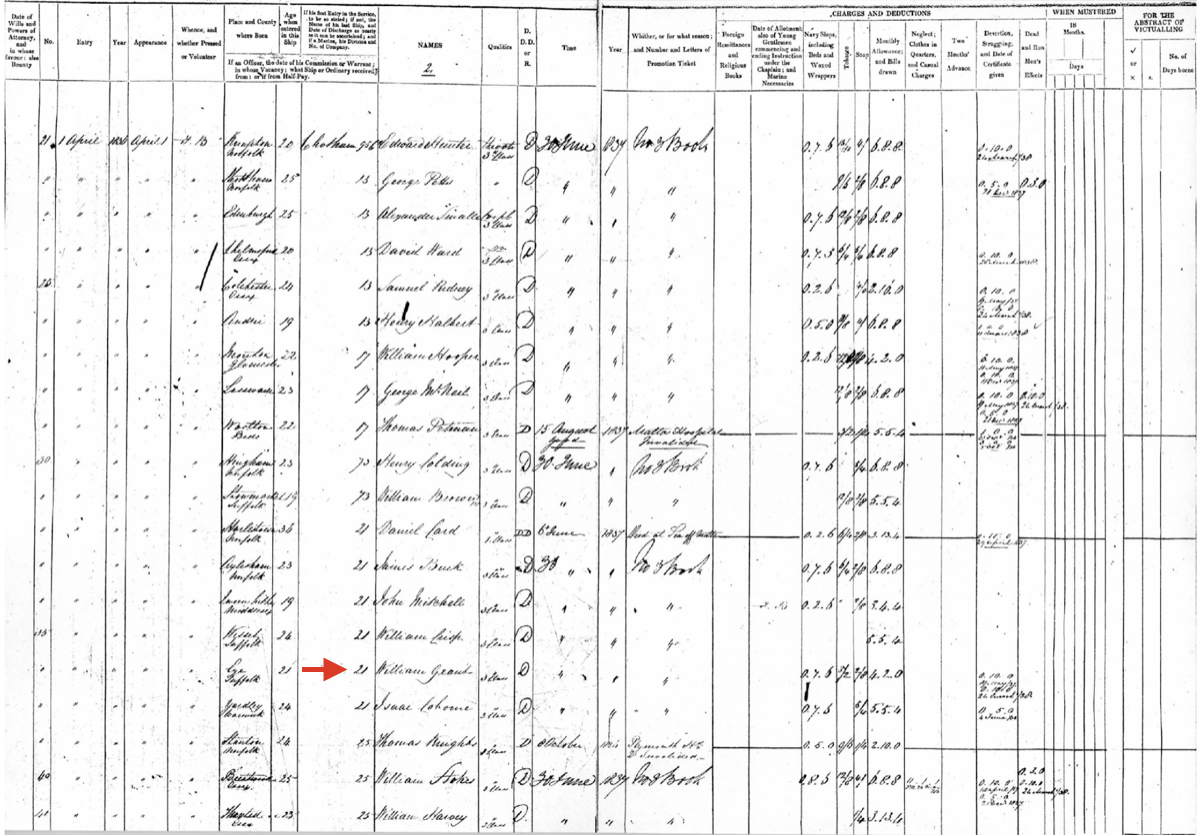
Muster Book of H.M.S. Russell, 14 July to 30 September 1835. William Goodwin Grant appears as the fifth entry from the bottom (indicated by a red arrow) [19]
The Russell was a third rate 74-gun ship of the line, built at Deptford between 1812 and 1820 and launched on 22 May 1822, a Vengeur-class two-decker of around 1,750 tons with a complement of 520 men. She had been commissioned at Portsmouth on 21 March 1835 under the command of Captain W. H. Dillon, and William joined her at Sheerness on 18 July 1835 as a private in the Royal Marines [20].
To understand what William's days aboard her looked like, it helps to understand what a private Marine's role actually meant on a 74. The Russell's main armament was arranged across two gun decks: 28 massive 32-pounder long guns on the lower gundeck and 28 18-pounders on the upper deck, with carronades and lighter guns above. Each of those lower-deck 32-pounders weighed nearly three tonnes and required a crew of up to fourteen men to run out, load, prime, aim, and fire [20]. As a Marine private, William's battle station would have been one of these great guns, his days punctuated by relentless drills: running the gun in and out on the side tackle-falls, swabbing the barrel between charges, ramming the cartridge home, the sequence repeated until it could be performed in the dark, in smoke, in chaos. Between drills he had his Marines' duties: standing sentry at the captain's cabin, the ward-room, and the galley during the hours of cooking; stationed at the large guns through the night; mustering for inspection in the distinctive red coat that set his corps apart from the navy blue around him [21].
The Russell's 520 men lived and ate and slept within 176 feet of hull, a world of hammocks slung eighteen inches apart, of darkness below the waterline, of watch-keeping in four-hour rotations that made the days blur into weeks. The muster book records William's small deductions from pay: soap and tobacco taken from ship's stores, the latter a daily comfort that most men aboard shared. He drew slops too, the standard-issue clothing that supplemented what a man had brought aboard, worn until it fell apart and replaced from the purser's account [19].
The Russell sailed from Spithead on 16 August 1835, passing Cape Ortegal on 27 August and anchoring in the River Tagus, Portugal, on 13 September, the first of many Portuguese and Spanish anchorages that would define the next three and a half years of his service. The log for 21 September, with the ship still in the Tagus, records five men punished that day for drunkenness, insolence, and disobedience of orders, the lash administered on deck before the assembled crew. William was not among them, but he watched. She moved to Vigo on 23 September, returning to Lisbon from Corunna on 11 October. A letter written from the ship at Lisbon on 15 October 1835, published in the Hampshire Advertiser, gives a rare first-person glimpse of conditions aboard: the crew had already been twice to Corunna and twice to Vigo; the political situation on shore was so opaque that they knew nothing of what was going on except through the English papers; the work ran from four in the morning to eight at night. The mizen mast had been found decayed above the poop deck, and a survey held as to whether it should come out. Those who did not care about getting home yet, the letter noted drily, voted against it. In early December the Russell was dispatched from Lisbon to reinforce Commodore Sir W. Montagu's detached squadron at Cádiz, for the protection of British mercantile property, arriving there on 7 December. She was still at Cádiz on 18 December, all well, when she received orders to proceed to Corunna. She passed Cape St. Vincent on 18 December, and Christmas Day 1835 found the ship off Cape Finisterre, running north. From Corunna she moved between El Ferrol and Vigo through January, February, and into March 1836, the Russell recorded at Vigo in early March and at El Ferrol around 12 March, before returning once more to Corunna [22].
To understand what the Russell was doing on this prolonged patrol of the Iberian Peninsula, one must understand the political situation unfolding on shore. The 1830s had plunged both Spain and Portugal into dynastic civil war. In Portugal, Dom Miguel had contested the right of his niece, the young Queen Maria II, to the throne. In Spain, Isabella's succession to her father King Ferdinand VII was disputed by her uncle Don Carlos, a pretender who drew his support from conservative, absolutist, and deeply Catholic regions of the north [23]. In both countries, the pretenders stood for reaction: rigid monarchy, religious traditionalism, and the suppression of constitutional government.
Britain's interest was clear. In April 1834 she had joined the Quadruple Alliance with France, Spain, and Portugal, seeking to compel both pretenders to renounce their claims and thereby establish liberal constitutional regimes in the Peninsula. The political situation was also entangled in the terms of Britain's own commitments: the Quadruple Alliance of 1834 restricted British assistance to a 'naval force', a limitation Palmerston defended in the Commons as permitting the landing of Marines since their operations remained principally sustained by ships. Regular Army troops could not be deployed without breaching the treaty outright, which is precisely why Marines and naval forces rather than infantry were the instrument of British policy in Spain. Tory opposition pressed the point relentlessly, arguing that Marines serving ashore under General Evans already constituted an undeclared land war [24]. In Portugal the strategy worked quickly. Dom Miguel yielded. In Spain, however, the conflict deepened into what became known as the First Carlist War, a brutal and drawn-out struggle fought primarily in the Basque Country, Navarre, and Catalonia.
British forces were fully engaged from 1836. A Royal Marine Battalion formed at Santander in May 1836, assembled from detachments across the divisions, and was immediately deployed along the northern coast. One hundred men under Lieutenant Halliday, joined by a further detachment under Lieutenant Langley, were sent to garrison Portugalete at the mouth of the Bilbao river, where they fortified a captured Spanish monastery and armed it with two long 32-pounder and two 9-pounder guns, the same calibres William drilled on daily. On 5 May 1836, the Legion, aided by the guns of H.M.S. Phoenix and other ships of the squadron, drove the Carlists from their positions outside San Sebastian, though the Marines were subsequently withdrawn from Bilbao and returned to San Sebastian without holding permanent ground [25].
It was around this time, while on patrol off the north coast of Spain, that the Russell suffered a mishap of her own. Her foremast was struck by lightning, damaged badly enough to require replacement rather than repair. She was relieved on station by H.M.S. Talavera and sailed for home; the Hampshire Advertiser reported from Portsmouth on 16th July that she was "on her way home to receive a new foremast... and will refit at Plymouth” [26]. William was aboard her throughout, the long passage home, and the weeks of refit that followed, as much a part of his service as any spell at anchor off Corunna. The repair kept her in the West Country into the autumn, but she did not stay long once seaworthy. By mid-October 1836, with the political situation in Lisbon deteriorating sharply, the Admiralty ordered six line-of-battle ships to reinforce Rear-Admiral Sir William Gage's squadron in the Tagus "in aid of the cause of the young Queen, whom recent events have placed in critical circumstances" [27]. The Russell was among them. She sailed in company with the Minden and the Partridge and arrived in the Tagus on 26th October, William once again aboard her, the new foremast not yet three months fitted [28]. She remained on the station into December, anchored alongside the Hastings, Cornwallis, Minden, Malabar, and Pembroke, with two French line-of-battle ships, a French frigate, corvette, and brigs, and a Brazilian corvette also lying in the river [29].
In early spring of 1837 came the battle that earned the Marines lasting credit: at Oriamendi, four Carlist battalions fell on the British and Spanish positions on 16 March. The Marines held. When the Spanish and Legion troops around them collapsed in disorder, it was the Royal Marine Battalion under Lieutenant Colonel Owen that deployed five companies behind a natural breastwork, held the San Sebastian road, and presented such a front that the Carlists halted their pursuit, allowing the broken Christino forces to reach the safety of San Sebastian's fortifications. On 21 March, General Evans published an order praising the unshaken firmness of the British Royal Marines under Lieutenant Colonel Owen, in repulsing, as they did, four times their number [25].
The Russell does not appear in the records of the shore operations at Portugalete or Oriamendi [30]. Her role was in all likelihood the sustained patrol work of the broader squadron, anchoring along the north Spanish and Portuguese coasts, showing the flag, escorting supply lines, and maintaining the naval presence that kept the sea lanes open and the Carlist cause contained. It was unglamorous but essential: without the squadron controlling the northern coast, the Marines and the British Auxiliary Legion ashore would have had no supply line and no line of retreat. William, at his station on the Russell's lower deck, was part of that fabric, the weeks at anchor in Corunna and El Ferrol, the lightning-struck foremast and the months of refit at Plymouth, and the renewed watch in the Tagus through that winter were each as much a part of the campaign as any shore engagement.
On 19 May 1837, somewhere between the Tagus and Malta [31], William straggled on at least one occasion [19]. The muster book records the offence in the column headed 'Desertion, Straggling, and Date of Certificate given': straggling, the lesser charge of being absent without leave rather than deserting outright. He returned, and the matter was not held permanently against him: his discharge record would later note that his name was not in the Defaulters Book.
The Russell's final year in commission brought William closer to disaster than any single shore engagement had, and very nearly took him somewhere else entirely. She had returned to Malta by the turn of the year, and on 11th January 1838 sailed again, the Jupiter and Bellerophon following her out of harbour within days [32]. A fortnight or so later, while she lay somewhere in the Mediterranean, almost certainly working toward Gibraltar, the Russell received orders to carry troops to Canada, very likely in connection with the rebellion then underway in the Canadas; a planned exchange of her captain, Sir William Dillon, for a Captain Price, was cancelled as a direct result [33]. For William, by then nearing three years aboard her, the order would have meant an entirely different war: not the familiar coasts of Spain and Portugal but the Atlantic crossing and a Canadian winter, garrisoning a rebellion rather than patrolling one. The order came to nothing, and Dillon remained in command; William's war stayed a Mediterranean one, though for a few weeks it had not been certain that it would.
On the morning of 13th February, a severe gale, the worst remembered by the oldest inhabitants of Gibraltar, struck the harbour while the Russell lay at anchor there alongside the Bellerophon, Talavera, Jupiter, and Minden. Nineteen merchant vessels were driven ashore and two more dismasted; the Russell, riding out the gale with the others, lost her small bower anchor, as did the Talavera [34]. One report has it that axes were laid on the Russell's own deck, ready to cut away her masts, and that she was saved only by a cable veered across from the Talavera, though this detail does not appear in the fuller, dated eyewitness account, which reserves the most severe peril for the Bellerophon, nearly lost before her crew ran her guns forward and her captain's firmness saved her [35]. As a Marine private rather than a topman, William's part in such an emergency cannot be confirmed from the surviving records; in all likelihood, he would have been turned to with the rest of the ship's complement for the general labour an emergency of this kind demanded, working a pump, standing by a line, or simply waiting below while the cable groaned and the axes, if the report is accurate, lay ready on the deck above him. Whatever his exact station that morning, he was among the few hundred men whose lives depended, for some hours, on a single cable holding. The Russell remained at Gibraltar in the gale's immediate aftermath, then made her way back to Malta, arriving from Gibraltar on 10th March [36].
She did not stay long. By the end of April she was homeward bound, reaching Plymouth by the 30th [37], and was refitted there at Plymouth Sound before proceeding once again to Lisbon [38]. She was still on that station in high summer: at the end of July, she served as the venue for a court-martial trying the boatswain and acting-master of H.M.S. Scylla, the former reprimanded for drunkenness, the latter honourably acquitted of disrespect and overstaying his leave after the court adjourned to await a letter from the Admiralty [39]. A court-martial of this kind was a board of captains, not a muster of the ship's company, and there is no reason to think William's own duties changed because his ship had become, for a day or two, the seat of someone else's trial; but the Russell's great cabin, ordinarily Dillon's own, would have been given over to the proceedings, and word of another ship's drunken boatswain and his disrespectful acting-master would have travelled through the lower deck regardless of who sat in judgment. She remained at Lisbon into the fourth week of December, leaving the station for the last time on 11th December 1838, anchoring at Spithead before proceeding to Sheerness in the last days of the year to be paid off, having been three and a half years in commission [40].
The war continued until 1839, ending with victory for the forces of Isabella [23]. William left H.M.S. Russell on 16 January 1839, having served three years and six months aboard her: three and a half years of Atlantic swell and Iberian harbours, of gun drill and watch-keeping, of Christmas Days off Cape Finisterre and New Years in El Ferrol, of a lightning strike and a cancelled posting to Canada and a gale that nearly lost three ships of the line at once. The certificate signed by Captain Dillon recorded him as of sallow complexion, aged twenty-one years, and standing five feet nine and a half inches [41]: an inch and a quarter taller than the nineteen-year-old blacksmith who had presented himself at Springfield five years earlier. He had walked into that recruiting office still physically maturing, and the Russell had continued the job. By the time of his final discharge in 1856 he would stand five feet ten and a half inches. He was now twenty-three years old. The Russell had made him into something else. What that was, the next ship would continue to define.
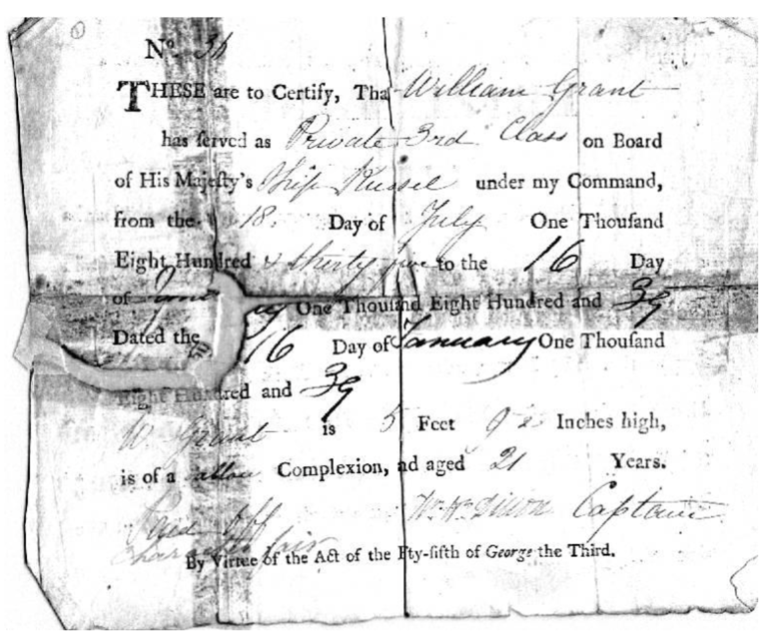
Discharge Certificate for William Goodwin Grant [41]
He did not remain on shore for long. On 30 June 1839, six days after Ibrahim Pasha's army had destroyed the Ottoman forces at Nezib, William joined H.M.S. Gorgon at Sheerness1, commissioned ten days before under Captain William Honeyman Henderson. The Russell had been a vessel of the old world: oak, sail, and smoothbore iron. The Gorgon was a different kind of vessel entirely, a wooden steam paddle sloop designed by Sir William Symonds and the first vessel in the Royal Navy fitted with direct-acting engines, which placed the cylinders directly beneath the crankshaft and saved some sixty tons of weight over older side-lever designs. Built at Pembroke Royal Dockyard and launched on 31 August 1837, her paddle wheels were twenty-seven feet in diameter and her two engines of 160 horsepower each drove her at a reported eight and a half to nine and a half knots. She was teak-built with oak main beams, displaced 1,610 tons, and could carry coal for twenty days' steaming [42]. She had already, before Henderson's appointment, made a name for herself on the coast of Spain, outpacing every rival under steam and beating the brig Pantaloon, supposedly the fastest man-of-war brig afloat, over a three-hundred-mile trial under sail alone; and hers was, by contemporary report, the first command of its kind given to a post captain rather than a commander, an honour shortly repeated by her near-sister Cyclops, launched from the same Pembroke slip [43].
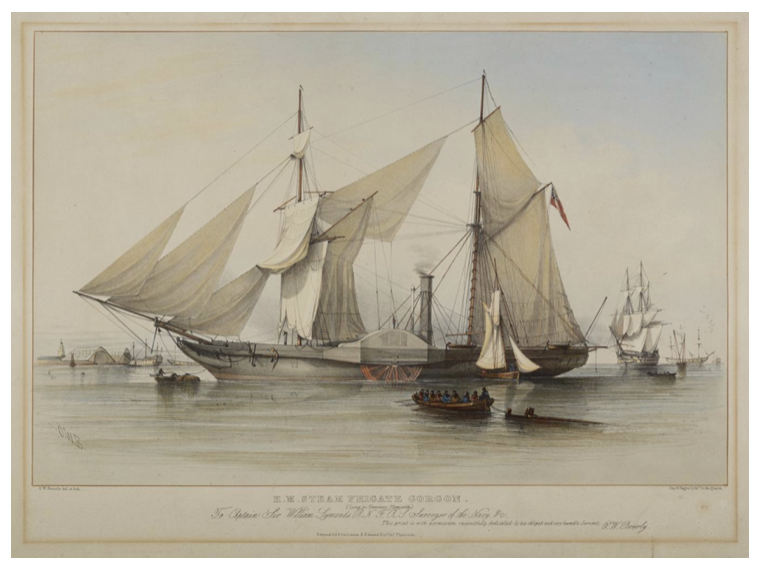
Colour print of H.M.S. Gorgon (1837) [44]
For a Marine not yet three months aboard, the Gorgon would, in all likelihood, have been a disorienting introduction even without the crisis that drove her eastward. The Russell had been a world of rope and canvas, of wind and timber working against each other in sounds a man could learn to read. The Gorgon was noise of a different order: the thud and vibration of the engines below decks, the smell of coal smoke and heated iron, the paddle wheels churning alongside rather than the clean passage of a hull under sail. William had spent three and a half years learning the rhythms of a sailing ship of the line. He was now on something that the men who designed it were still arguing about in Parliament, a vessel whose engines weighed more than intended and whose sea-keeping remained a subject of debate [45]. He was also, for the first time in his service, heading east. The Russell's world had been Iberian: the familiar western waters, Portuguese anchorages, Gibraltar, the Atlantic coast he had known for years. Smyrna, Constantinople, Alexandria, Beirut: these were names from scripture and from newspaper headlines, not from any life he had led.
William had no time to grow used to her before the wider world intruded. The defeat at Nezib had been catastrophic for the Ottomans, and worse followed within days: Sultan Mahmud II died, and the Ottoman fleet, its commander judging the dynasty's cause lost, sailed for Alexandria and defected to Mehemet Ali [46]. With Constantinople apparently open to Ibrahim Pasha's army and Russia's intentions an open question, Britain and France moved their Mediterranean squadrons together into Besika Bay, off the Dardanelles, ready to go forward at a moment's notice [47] It was into this gathering crisis that the Gorgon was thrown. Through the first weeks of August she was driven hard down the Channel and into the Atlantic, sighted off Sandgate making a reported eleven knots, then thought the fastest pace yet seen from a steamship in the navy, before calling at Portsmouth and Plymouth carrying despatches for Admiral Sir Robert Stopford that the press, with evident excitement, described as "said to be important" [48]. She reached Gibraltar on 28 August, five days out of Plymouth, and Malta on 3 September, twelve days out of England, carrying in mail and carrying out. Two days later, fresh despatches for Stopford, who had by then gone on to Constantinople itself to meet with the new Sultan [49]. Malta meant quarantine. Any vessel arriving from the eastern Mediterranean was required to serve a period of enforced isolation at the Lazzaretto on Manoel Island in Marsamxett Harbour before she or her crew could enter pratique, the formal clearance that allowed free movement ashore. The length of the quarantine depended on the ship's last port and whether sickness had been reported; vessels from the Levant typically served between fourteen and forty days, the latter figure giving the institution its name. The Lazzaretto itself had just been enlarged in 1837 and 1838, a permanent limestone complex of fumigation chambers and confined yards, surrounded on the landside by triple walls to prevent those inside from leaving before their time was served [50]. It was not a prison, exactly, but it was not freedom either. Whether William had encountered any form of quarantine during his Russell years is not known; his Mediterranean ports on that commission had been western ones, Gibraltar and Lisbon, not the plague-risk stations of the eastern sea. This was new.
By 18 September she had joined the main fleet at Besika Bay; by the 27th the squadron had been reinforced to fifteen ships by three line-of-battle ships and the Gorgon herself, officers were being recalled from leave, and the press read the signs correctly: "some more important employment," it noted, was shortly to be found for the fleet than idly cruising from port to port [51].
Through the autumn and winter of 1839 the Gorgon settled into the work that the crisis demanded of a steamer: not battle, but the endless, essential business of carrying intelligence. The fleet anchored at Vourla Bay for the winter in late October, and she made coal and fuel runs to Smyrna, departing on 26 October and returning on 2 November [52]. On 13 November the whole body of Marines belonging to the different ships of the fleet was put ashore for exercise and inspection by the commander-in-chief; the day being exceedingly fine, the Marines were reported "perfectly efficient," the parade "a very grand sight" [53]. William would have been among them. The Gorgon had already made a despatch run to Constantinople in mid-October, proceeding there on the 14th and returning on the 23rd, at which point the Phoenix was immediately sent off with further despatches to Lord Ponsonby and the whole British squadron got under way for Vourla [54]. In January 1840 she made a further run to Malta, arriving around 6 January in company with the Castor, then returning to Vourla by 18 January [55].
In February came a more significant assignment. Admiral Sir Robert Stopford, whose health had suffered in the severe Vourla winter, had been permitted by the Admiralty to leave the Levant for Malta, with Rear-Admiral Sir John Louis taking the station command. Stopford and his personal staff embarked on the Gorgon, which left Vourla on 9 February. She arrived at Malta on the night of the 12th, and on the afternoon of the 13th the Admiral disembarked at the Lazzaretto to begin his mandatory quarantine period [56]. The Governor, his staff, and the captains of every British ship already in clean pratique attended to receive Stopford at the Lazzaretto's gates, the peculiar formality of a greeting conducted across a quarantine boundary. His flag was transferred from the Gorgon to the Bellerophon, which was already cleared, so that naval command could continue without interruption. The Gorgon herself was not released from quarantine until around 29 February [57]. The threat was not abstract: that same spring, plague broke out aboard H.M.S. Acheron at Malta, having come in from Alexandria, a boy dying of it on board within days of arrival [58]. The Gorgon had made the same passage from the same port not long before.
She then turned east again, this time on a mission of a different order. Mehemet Ali had refused to return the Ottoman fleet, and by March 1840 British patience was running short. The Gorgon departed for Alexandria carrying, according to contemporaneous reports in the European press, a formal demand for the immediate restitution of the fleet, with notice that in the event of refusal the English Consul-General and other British subjects were to quit Alexandria at once [59]. She arrived before the end of March and remained stationed there; an Alexandria letter of 27 March confirmed her presence in harbour alongside the Daphne corvette, with consuls of several nations applying to their governments for protective warships in anticipation of what might follow[60]. The Pasha remained firm; the Gorgon remained at her anchorage; and the weeks passed in the peculiar tension of a harbour where everyone present knew that the next development was likely to come not from diplomacy but from a fleet.
By late April she was off the Italian coast. On 26 April, while lying off Capri, she collided with H.M.S. Bellerophon, carrying away that vessel's bowsprit and inflicting considerable damage on her hull; she arrived at Malta from Naples two days later and remained there through at least late May while her defects were made good [61]. In June she was at Smyrna, where she landed three Turkish officers who had made their escape from Alexandria aboard the Volcano steamer; these were, in all likelihood, officers of the detained Ottoman fleet making their way back to Turkish authority. She departed Basika Bay on 24 June, arrived at Malta on the 28th with despatches from Lord Ponsonby at Constantinople, and remained in port for machinery repairs [62].
She was heading back to the fleet when steam’s particular hazards made themselves known. On the night of 10 July 1840, as the Gorgon approached Basika Bay at 2.30 in the morning, four men were lost, killed by by the paddle wheel as it turned, their hand leads and lines lost with them. By evening the ship had reached anchor in Vourla Bay, H.M.S. Princess Charlotte and the wider squadron in company [63]. The log records it without comment beyond the bare facts. This was not enemy action, but an accident peculiar to the new kind of ship William now served on, where rope and lead-line, carried over from the age of sail, could turn lethal in the proximity of a churning paddle wheel in the dark.
Four men gone in the dark, in minutes, from a machinery hazard that would have had no equivalent on the Russell. In all likelihood William had never served alongside an engine before; few men in the Royal Navy had. The paddle wheel was not a thing a Marine learned to treat carefully during his first months on a sailing ship of the line. Whether the deaths on 10 July left the ship's watches thinner for the weeks that followed cannot be confirmed from the surviving record, but four men fewer on a crew already shorthanded, in the worst heat of a Syrian summer, would have meant longer hours awake for those who remained. It would be wrong to state outright that this is what brought William to the grating nineteen days later. What can be said is that by 29 July, after the best part of a year of active operations in the eastern Mediterranean, a man who had kept watch through that long run of months and miles was punished for falling asleep at his post.
Through the last weeks of July the fleet concentrated at Basika Bay; the Gorgon lay there in company with the Hastings and Zebra [64]. By 29 July she was well on her way south, off the island of Nicaria. It was there that William Grant was punished. The Captain’s log records it without sentiment: W. Grant, [20 or 30] lashes for sleeping on his post, the figure not entirely clear in the surviving copy of the entry.
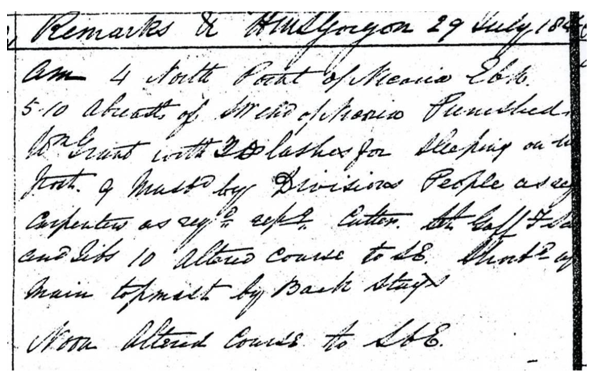
Extract from Captain’s Log on 29th July 1840 recording William’s punishment [65]
The punishment was administered before the assembled ship's company, the standard form for such an offence. Sleeping on watch was among the more serious offences under the Articles of War. No captain could, on his own authority, punish a man with more than twelve lashes, though this limit was commonly and openly exceeded; it was, however, uncommon for a captain to go beyond twenty-four [66]. If the figure was thirty, William's punishment exceeded even that informal ceiling; if twenty, it sat within the range most captains were prepared to inflict without troubling a court martial. Either way, it left marks that did not fade quickly. For a man who had served three and a half years on the Russell without appearing in the Defaulters Book [1], it was a severe and public punishment. The record does not say what had driven a competent Marine to fall asleep at his post in the middle of a long passage south: the accumulated exhaustion of weeks at sea, the heat of late July in the Aegean, or something else entirely.
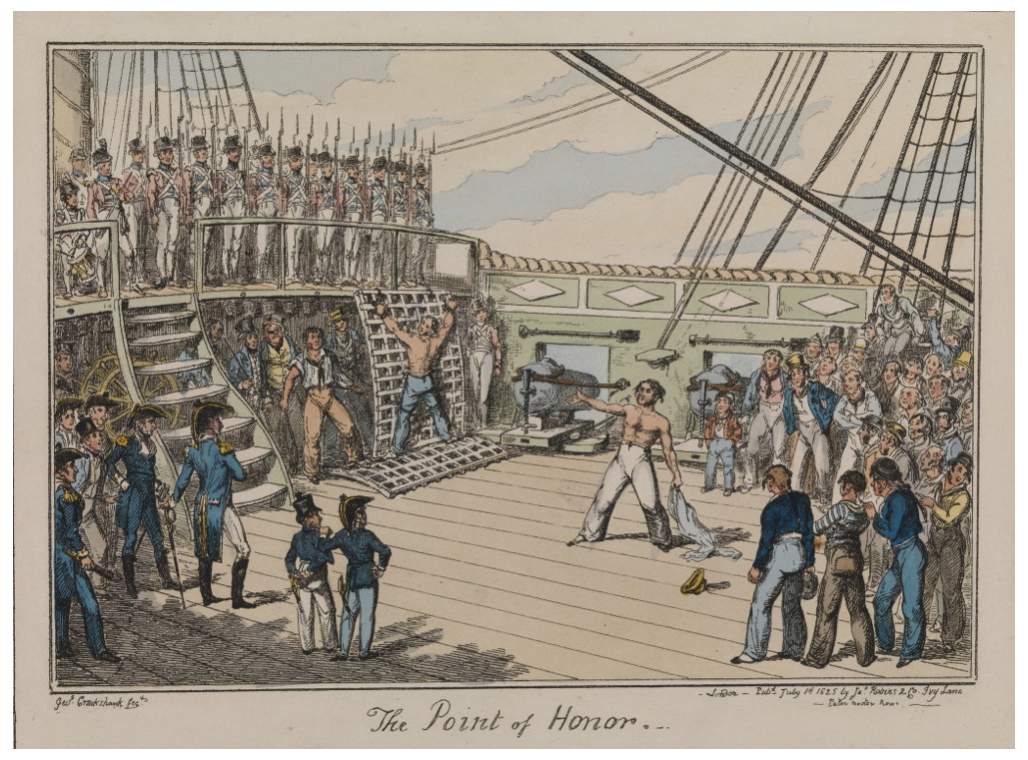
Depiction of flogging at sea, c. 1825 [67]
The thirty lashes were recorded and then the log moved on, as logs did. There is no further entry about William until the Malta dockyard incident the following year, and nothing in the record to say how a man carried such a punishment, administered publicly before his shipmates, or what it altered in him. What the two entries together suggest, set against a service record otherwise unmarked by the Defaulters Book, is less a pattern of disorder than a man finding the limits of what he could sustain: the heat, the operational tempo, the months away from any familiar shore, and then a Maltese dockyard offering the temporary relief of going somewhere he was not supposed to go.
The Gorgon left Alexandria around 12 August, rejoining Napier's squadron at Beirut on the 14th [68]. Commodore Napier himself had arrived three days earlier with four ships of the line, taking up, in one correspondent's words, "a very threatening position in front of the town"; he was joined the next day by both the Castor, from Tripoli, and the Gorgon, from Alexandria [69]. For William, this was the kind of work a steamer like the Gorgon was suited to: not the set-piece bombardment that would come in November, but the patient, day-to-day business of stopping and searching merchant shipping along a contested coast. By 23 August, a Beirut letter found the Gorgon there under Napier's direct command, the squadron having taken "about a dozen vessels under the Pacha's flag, all with stores, troops" [70]. Among them were a cutter of war, a large unarmed frigate, and a brig found to be carrying cases of muskets; about five hundred stand of arms were recovered, along with a handful of Turkish troops, most of them invalids, sent ashore to hospital [71]. The writer's assessment was blunt: "The Egyptians have about 8,000 men here. We expect hostilities to commence immediately” [70].
By late August the Gorgon was one of several ships blockading the port, "all boats and vessels coming in" being "continually captured by them” [72]. An officer writing home from off Beirut in August caught the same rhythm from the deck: the Castor and Gorgon were out, keeping a bright eye to windward, watching for the moment the Egyptian fleet might venture out [73]. The British force gathering for the landing reached some five thousand men, organised into three divisions aboard the Cyclops, the Phoenix, and the Hydra; the marines and artillery of the whole fleet, by contrast, were to go aboard a single ship: the Gorgon [74]. After dark on 9 September, William's own ship became, for one night, the assembly point for the entire fleet's landing force, some sixteen hundred marines crowding aboard a vessel that normally carried a few dozen [75]. Whether William himself was among those put ashore the following afternoon cannot be confirmed from the surviving record, but there is no doubt he experienced the night before: his own deck packed with strangers from a dozen other ships, the boats passing and repassing until close to midnight, and "the utmost order and regularity" with which, by one officer's account, the whole transfer was carried out "without a single accident” [74].
At daylight on the 10th, the steamers and the Turkish squadron weighed anchor and stood north toward D'Jounieh Bay. A diversion had already been staged off the town itself, the Benbow opening on Egyptian troops forming on the heights from about three miles, five shells in six falling, by one account, with the precision of a musket ball, before the squadron broke off and the main body landed unopposed at D'Jounieh between two and four that afternoon, while a smaller force, covered by the Castor, secured the mouth of the Dog River to the south [76]. Within an hour and a half, nearly five thousand men were ashore without a single mishap. The Gorgon fired at intervals through the day on the troops moving through the town below, the Benbow and Edinburgh, from a better position, doing greater execution still with their shells [77]. Once ashore, the heights were occupied at once: two companies of Marines, under Captain Childs, were sent to reinforce the Turkish battalion holding the high ground above the Dog River, while a Turkish battalion of their own took the village of Zug, about a league inland [76].
Three days later, on 12 September, a separate force of 220 marines and 150 armed mountaineers, drawn from the Benbow, Hastings, Castor, Zebra, and Cyclops, was sent to take the Albanian-held castle at D’Jebail (modern day Byblos and an ancient city in the Keserwan-Jbeil Governorate of Lebanon) [78]. The Gorgon was not among the ships engaged, but every marine on the coast would have heard what happened. After an hour's bombardment, the marines went ashore under Captain Robinson, advancing through gardens beneath the castle walls to within thirty yards of the tower before a concealed outwork opened a destructive fire on them; finding the wall unbreakable and his men falling fast, Robinson drew them off in good order. The ships renewed their fire on the tower itself but could make no impression on it, and by half past five the marines were re-embarked. Five men were killed and eighteen wounded [78].
On 25 September, the Gorgon and Cyclops left Beirut at midnight, carrying a battalion of marines 500 strong under Captain Morrison and a Turkish battalion of like strength under the Ottoman officer Kourschid Aga, Commodore Napier's broad pennant flying from the Gorgon herself [79]. At daylight the castles of Sidon rose above the horizon, the old Phoenician town that Napier called the twin sister of Tyre, an emporium of commerce in days gone by, with Captain Berkeley's squadron already standing off the coast, watching for their approach [80]. Seeing no armed mountaineers gathered at Damour, they pushed on directly to Sidon, joined at daylight by the Thunderer, the Austrian frigate Guerriera under the Archduke Frederick, a Turkish corvette, and the Wasp, with the Stromboli arriving from England with a further 284 marines under Captain Wylock [81]. The town was summoned, and the governor refused to answer; by eleven o'clock, with no reply forthcoming, the squadron opened fire on the castle and barracks [82]. In half an hour the firing ceased, and the Turkish battalion was landed under Captain Austin to take the castle by its causeway, while the first battalion of marines was put ashore by Captain Henderson of the Gorgon on the beach to the north of the town [83]. Napier himself led the marines into the barracks and on to the upper gate, and by evening the town was taken, its garrison of nearly 3,000 men entirely accounted for against a landing force of under 1,000; five hundred Egyptian prisoners were carried back to the fleet aboard the Hydra [84]. Napier's own report to the Admiral described the loss as trifling: one marine officer, Lieutenant Hockin, recently arrived in the Stromboli, and three seamen killed, with two mates, a boatswain, and thirty men wounded [85]. A wire report reaching London a month later by way of Marseilles gave a markedly different account of the action [86]. Whether William was among Morrison's shore party that day cannot be confirmed from the surviving records; as a private of several years' standing he was the kind of man such a landing party would have drawn on, but the Gorgon's own gunners during the bombardment were drawn from the same ship's company, and nothing in the record tells us which duty fell to him that day.
The squadron anchored off Acre on the afternoon of 2 November; the original plan had called for the Gorgon and the other steamers to tow the heaviest ships into position, but the plan was abandoned overnight after Captain Henderson judged it could not be done in time, and the fleet sailed in under canvas the following morning instead [87].
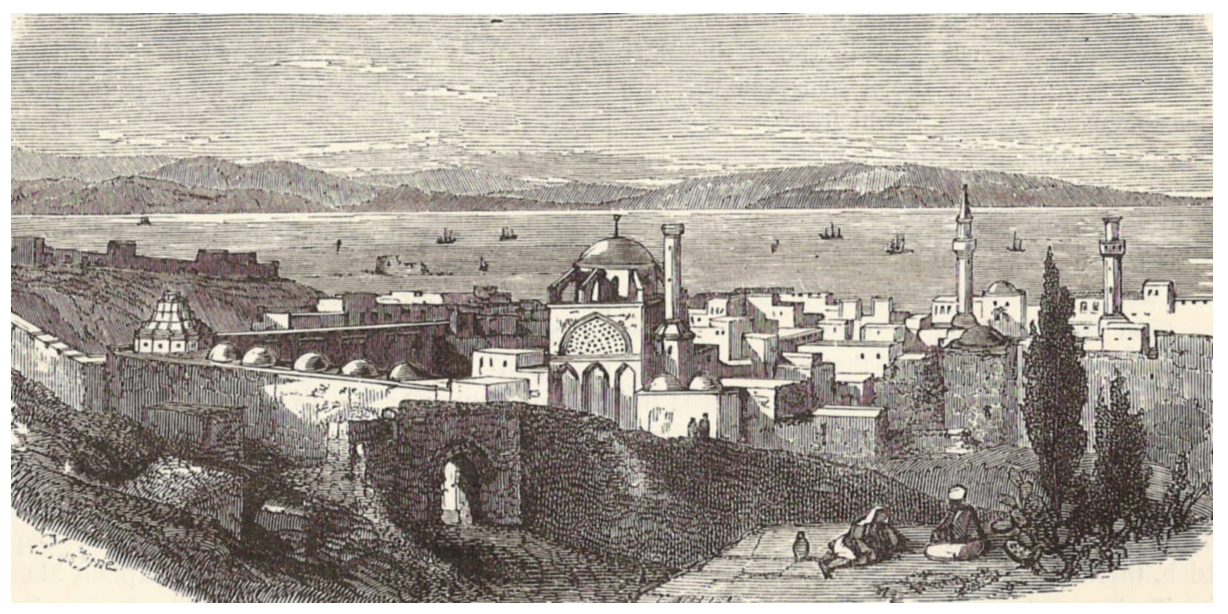
The port and bay of Acre in 1840 [88]
The campaign's climax came on 3 November 1840. The Gorgon's log places William at the heart of the action: under way before eight that morning, she stood off Acre firing into the town as the forts fired back, and by early afternoon had, with the rest of the fleet, taken up her station for the main attack [89]. As a Marine aboard a steamer her size, William would most likely have been at one of her guns rather than held apart from the gun crews, which meant ten rounds of shot and nine of shell fired and answered, hour after hour, in a din that swallowed every other sound. Admiral Stopford's despatch, written the following morning, said it was generally believed the Gorgon's shells had set off the powder magazine. Napier disagreed: in his own account he wrote that the true cause would never be known, and that several ships' crews believed the credit belonged to their own guns [90]. At twenty-five minutes past four, the main magazine of the fortress blew up. Even amid the thunder of hundreds of guns, the crash was heard clearly above the tumult of the bombardment, and a mass of fire and smoke rose like a volcano into the sky. About 1,700 souls were hurled into eternity in that single instant; two entire regiments formed on the ramparts were annihilated where they stood, and every living creature within sixty thousand square yards ceased to exist. Among the dead recovered afterwards were donkeys and cattle that had been tethered nearby, kept ready to carry shot to the guns [91]. The ships had lain wrapped in their own smoke all through the action, so dense at times that no aim could be trusted; William would have worked his gun half-blind, by the same routine drilled into him since Sidon and D'Jounieh, with no clearer view of what his own shot was doing than anyone else aboard. When the firing paused after the magazine exploded, the silence was, by one account, more unsettling than the cannonade itself, broken only by the mountains echoing the blast back like distant thunder and the occasional crash of a building giving way [92]. The defence continued sporadically into the night. Acre fell, the last Egyptian stronghold on the Syrian coast; Ibrahim Pasha evacuated Syria, and Mehemet Ali agreed, under the terms of the Convention of London, to return the Ottoman fleet [93].
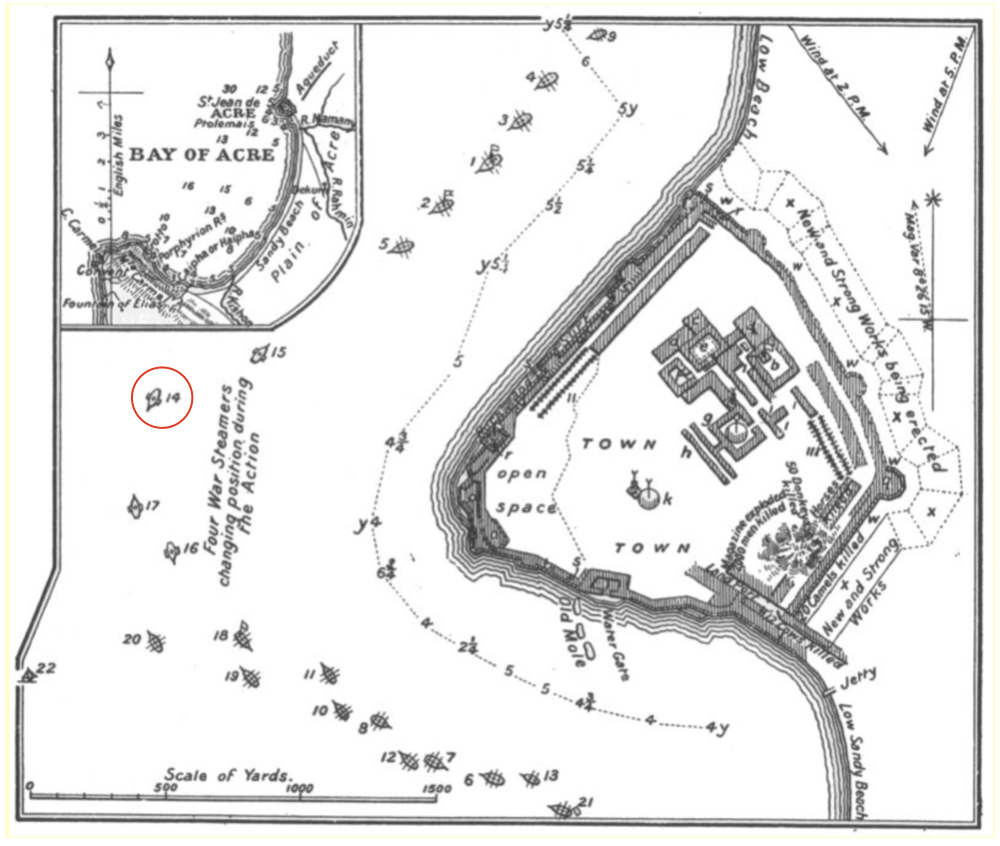
Bombardment of St. Jean d'Acre, November 3rd, 1840," chart by J.C. Brettell. The Gorgon’s position depicted with a red circle [94]
At sunset the log records the Allied fleet running for anchorage: Powerful, Bellerophon, Thunderer, Edinburgh, Benbow, Revenge, Castor, Hayes, Wasp, Talbot, and Pique, the Turkish Admiral's ship, a frigate, and two corvettes, the largest naval force assembled in the eastern Mediterranean in a generation. The Powerful, her main topmast badly damaged and her main topgallant mast shot away, was towed clear of the action by the Gorgon herself, an episode confirmed independently by more than one account of the battle [95]. British losses were reported with real inconsistency in the days that followed: Napier's own despatch gave eighteen killed and forty-one wounded across the fleet; an official return printed three weeks later gave seventeen killed and thirty-six wounded; two further independent reports, reaching London within days of each other, gave fourteen killed and forty-two wounded. No single figure can be called definitive [96].
The log for 4 November records the aftermath. At 3.30 in the morning, intelligence arrived that the town was being evacuated by the enemy, and the crew drew the fires forward. From five o'clock the ship's boats began landing the Turkish troops, joined from six by the Phoenix, Stromboli, and Vesuvius; the mosque in the town bore north, Mount Carmel south-west by west. The crew spent the day getting out baggage and boats' crews, picking up shot, and supplying the Phoenix with coal. And then, recorded without ceremony among the afternoon entries: an explosion took place in the town. Whether this was the same blast Napier later described, a second explosion, a day or two after the surrender, which broke Captain Collier's leg and gave Sir Charles Smith a contusion on the foot, or a separate incident altogether, the log does not say [97].
It was a decisive demonstration of what steam could do in battle, not only in firepower but in manoeuvre: the steamers positioning the sailing ships of the line with a precision that sail alone could never achieve. The Gorgon was at the heart of it, and William aboard her.
What Acre meant to a private Marine standing on the Gorgon’s deck that afternoon cannot be recovered from the record. What can be said is that he was present at the largest combined naval action in the eastern Mediterranean in living memory, that the explosion of the fortress magazine at four o’clock sent a column of smoke and debris visible from far out to sea, and that the ship he stood on had played a specific, documentable part in bringing the day to that moment. He had joined the Gorgon at Sheerness as one private among a ship’s complement, carrying despatches for an admiral and coal for a fleet at anchor. By November 1840 the same ship had carried the ultimatum into Alexandria harbour, run intelligence across the eastern Mediterranean for eighteen months, and anchored in sixteen fathoms while Acre burned. Whether any of this registered on him in the way it registers on us, looking back, cannot be confirmed.
Two medals eventually marked the Syrian campaign: a British one, the Naval General Service Medal with a 'Syria' clasp, and a Turkish one, struck by the Sultan himself and known to the British as the St. Jean d'Acre medal, in gold for commanding officers, silver for junior officers, copper for everyone else [98]. William claimed the first. His name is there in the application register kept at Chatham, and again on the published roll: William Grant, Marine, of the Gorgon [99]. Whether the Sultan's medal ever reached him, no record says, though a private's share of it, if it came, would have been struck in copper [100], the same metal issued to every rank-and-file Marine and seaman who stood on a British deck that day.
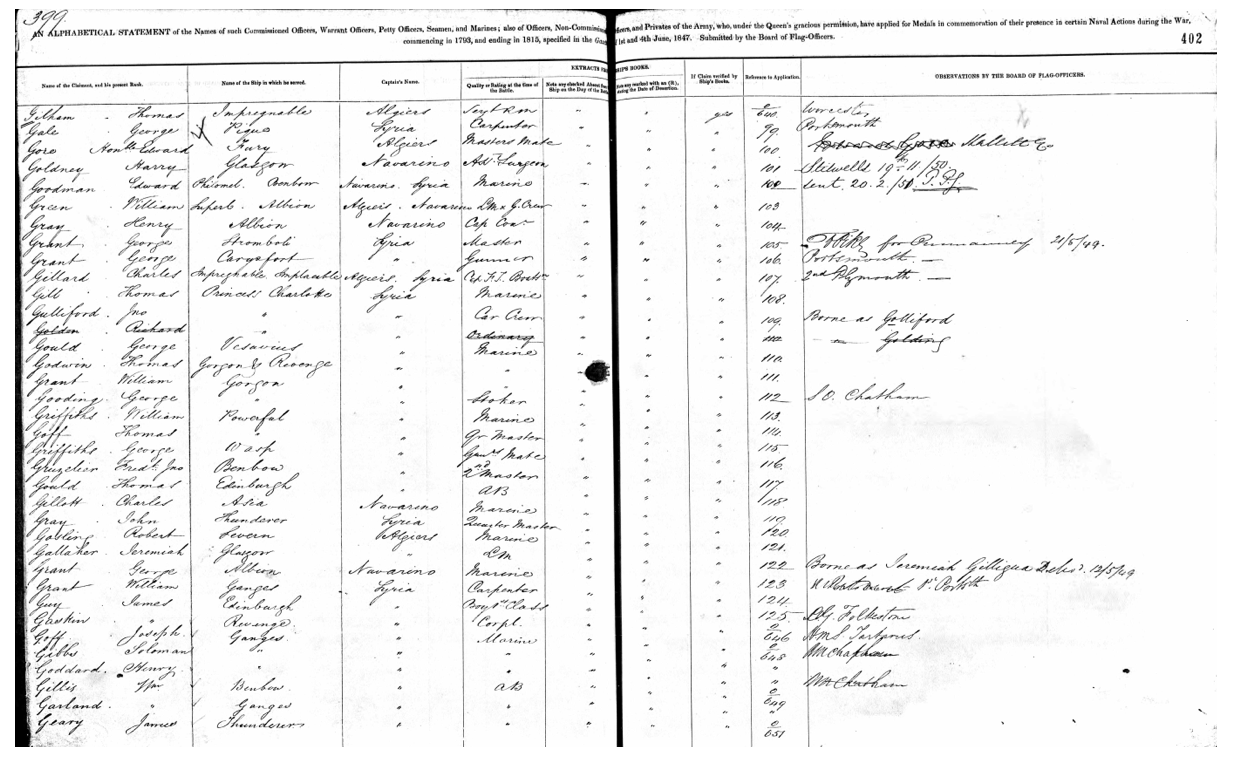
William Grant’s Naval General Service Medal Record [99]
Months later, the Gorgon returned to Acre’s fortress to collect marines who had garrisoned there through the winter and fallen sick doing so [101]. From there she made her way toward Malta, by way of Alexandria and Jaffa, carrying intelligence on the state of affairs in Syria as she went [102]. She was in Malta's Grand Harbour by 25 February [103], and the pace of life had shifted from active operations to the routines of a ship in harbour: fitting paddle boards, bending sails, drawing boatswains' and carpenters' stores, artificers variously employed.
And it was at Malta that William found himself in trouble again. The Captain's log for 1 April 1841 records: “Wm Grant R.M Grog to be stopped 7 days, for not returning to the ship after being turned out of the Dockyard, late brought off by escort of Marines” [104]. He had failed to make his own way back to the ship after being expelled from the dockyard, and had to be collected by his fellow Marines and marched aboard under escort. Seven days without grog was a meaningful but not severe punishment. It was not a flogging, and his name remained off the Defaulters Book. Discipline aboard could be harsher for far less: a fellow Marine, Thomas Groombridge, had spent three days in irons on bread and water that February for insolence and refusing to walk with his hammock when ordered [105]. Against that standard, William's own punishments, the lashes and the stopped grog, sit closer to routine than exceptional; together his punishments paint a consistent portrait, a capable and experienced Marine, but not one inclined to make life easy for his commanding officers.
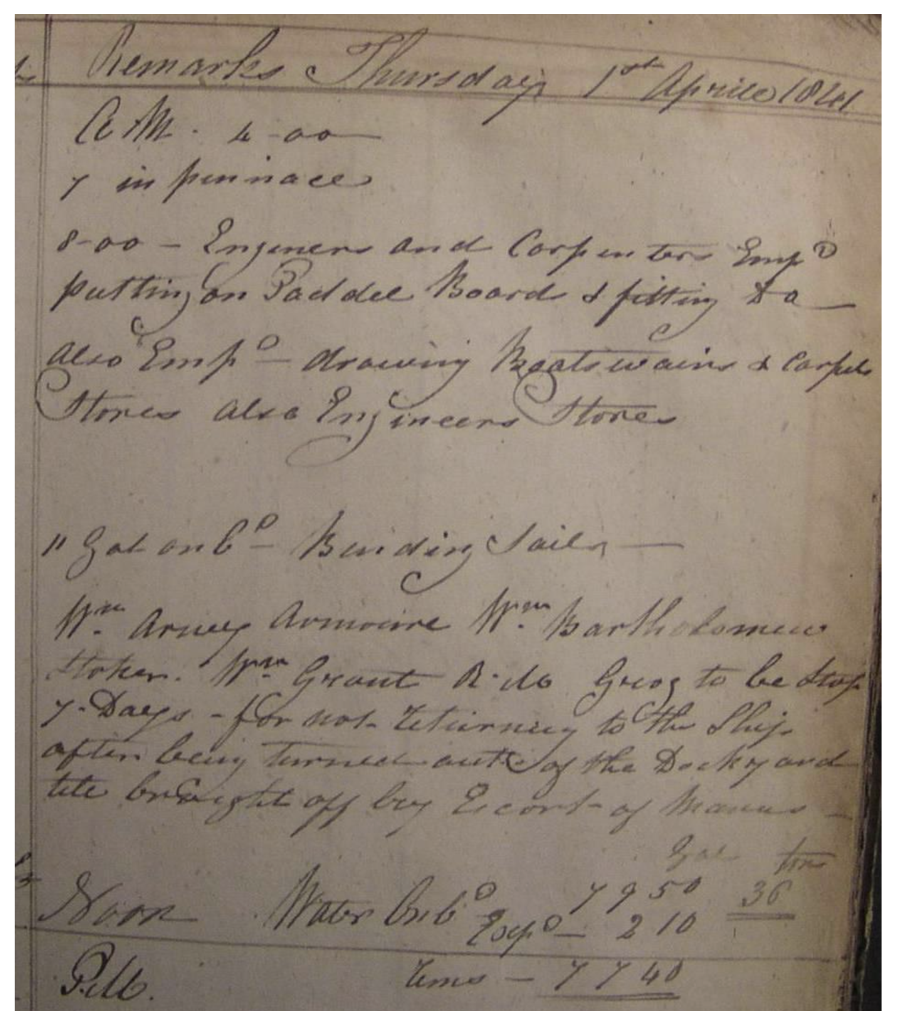
Captain's Log, H.M.S. Gorgon, 1 April 1841 recording William Grant's punishment [104]
The Gorgon left Malta for Alexandria on the evening of 3 April [106], and spent the next month ranging across the Mediterranean before returning to Alexandria, where she remained for some three months, protecting British interests.
It was there, a full month after William's punishment, that Mehemet Ali paid the ship a visit. He came on 1 May, a Saturday, washing day aboard ship, at ten minutes' notice, as though deliberately choosing the moment the English would be least prepared to receive him. He brought a crowd of Turkish and French officers to watch. The crew had no time to dress for the visit, but they were put through their gun drill regardless: the 32-pounders fired three times a minute, faster than Mehemet Ali believed possible until he stood and counted it himself, and the ten-inch Paixhans guns were fired too, with hollow shot and shell, the whole crew worked through every evolution under his eye. He gave little away in praise, careful, the correspondent thought, to seem unimpressed, though in the captain's cabin he could not help remarking on the books on the shelf, observing that his own captains kept only pipes [107]. Whether William stood at one of those guns that day cannot be confirmed, but if he did, he would have spent the morning performing the same drill he had once fired in earnest at Acre, watched this time not by the enemy but by the man whose defiance had brought them there in the first place.
After the visit from Mehemet Ali, the Gorgon remained at Alexandria for the rest of the spring and into the summer, before returning to Malta by 10 July [108]. She departed again in early October, bound once more for Alexandria.
On 9 October, the log recorded the death of one of the crew: "Mr. George Frigles, the Chief Engineer departed this life." The next morning, at half past seven, moored in Alexandria, the Captain recorded committing his body to the deep [109]. It was the tone of the logs throughout: terse, factual, unmoved. A newspaper report reaching England that winter, by way of the West Indies, carried the same news in barer form still, "the first engineer of the Gorgon had died," travelling almost as far in the telling as the man himself had travelled in the living [110]. Frigles was a warrant officer, in charge of the engines, a different world from a Marine private's aboard a ship as small as the Gorgon, and William may not have known him well. But on a vessel that size, with a crew that small, every death would have been felt by the whole ship's company in some way, even a death among men whose work and quarters lay apart from his own.
On 26 December the Gorgon sailed from Alexandria on a cruise along the coast of Syria [111]. She left Alexandria again on 16 February and arrived at Malta on 20 February, carrying the Calcutta mail; in the harbour that day lay a considerable fleet, the Howe, Impregnable, Vanguard, Rodney, Thunderer, Victory, Cyclops, Devastation, and Vesuvius [112]. After taking on stores, she made for home by way of Tunis and Algiers, setting course for England before the end of the month [113].
William left the ship on 5 April 1842, having served two years, nine months, and seven days aboard her, and returned to barracks [114]. For a man who had grown up in a small Suffolk village and never expected to see the Mediterranean, let alone Acre's ramparts or an Egyptian Pasha inspecting his own ship's guns, those years may well have held more colour and consequence than anything likely to come after them. But they had also held a shipmate's death, a flogging, the smell of a fortress town burning, and three years of the same close, hard, repetitive work that filled most of a Marine's days at sea, however far from home the sea happened to be. Whether he stepped ashore glad to be going home, sorry to be leaving behind the only adventure he was ever likely to have, or simply too tired and too institutionalised to feel either very strongly, the record cannot say.
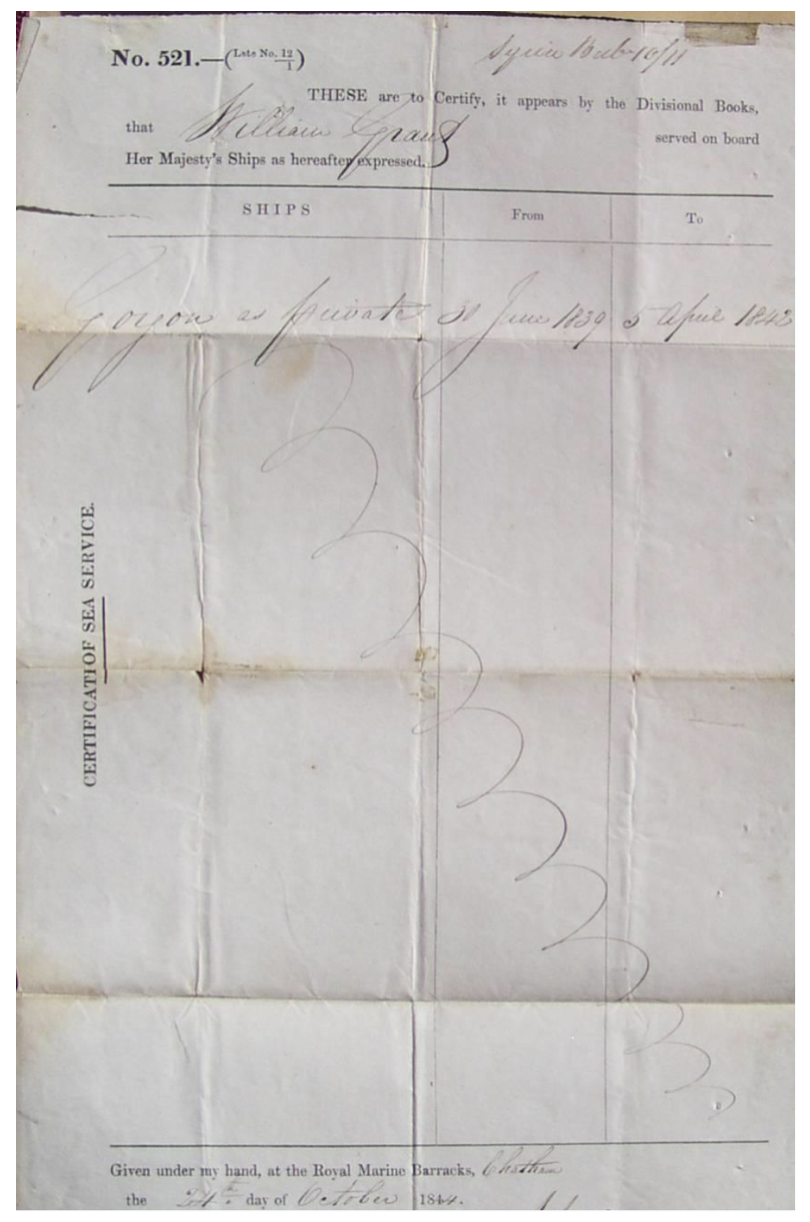
William Grant’s Certificate of Sea Service on board the Gorgon [114]
He had joined the Gorgon as a private who had spent three and a half years on Iberian patrol. He left her having carried Commodore Napier across the winter Mediterranean, having been the ship that brought the British ultimatum into Alexandria harbour, having taken many lashes for an offence the log records only as sleeping at his post, having been escorted back to his ship by Marines in a Maltese dockyard, and having watched the smoke of Acre's magazine rise over the Syrian coast. On her final voyage home, she had even carried the eleven thousand medals struck for the Syrian campaign, gold, silver, and copper according to rank, meant for distribution among everyone who had served there, William included, if he ever claimed his [115]. His own Certificate of Sea Service, issued two years later, carries an annotation beginning "Syria," the rest no longer legible [116]. Whatever word followed, it was, by any measure, a considerable understatement of what he had actually done.
William's next posting carried him into an entirely different kind of conflict, not a foreign war but a domestic insurrection, and one with a peculiarly Welsh character. There was no enemy fleet here, no fortress to be silenced from the deck of a steamer. There were toll-gates, dark lanes, farmers in disguise, and the slow, grinding business of standing picket outside a workhouse while a rumour ran ahead of you faster than any courier could carry it.
The Rebecca Riots had begun in the summer of 1839 as scattered, localised protests against the tolls charged on the turnpike roads of west Wales, the first tollgate destroyed at Efailwen on the Pembrokeshire–Carmarthenshire border [117]. The trouble subsided for nearly three years, then returned in the winter of 1842 with far greater force and a far wider reach, spreading from Carmarthenshire and Pembrokeshire into the Teifi Valley and the semi-industrialised districts to the south [118]. Newspapers as far off as Dublin and Edinburgh were soon reprinting the same dispatches, in almost the same words, as the story of "Rebecca" travelled the length of the kingdom [119]. The causes ran deeper than the gates themselves. The early nineteenth century had brought a slow breakdown in the social fabric of rural Wales: a rising population pressing on a backward agricultural economy, rents that climbed and never fell, tithes paid by a largely Nonconformist population to a church not its own, and an outdated system of local government that offered no relief and very little sympathy [120].
The movement took its name from the manner of its protest. Bands of men, led by a figure dressed in women's clothes and calling himself "Rebecca," would descend on a toll-house at night, tear down the gate, sometimes pull down the keeper's cottage as well, and vanish into the dark before any pursuit could be organised. Whether the name came from a borrowed dress, a woman called Rebecca who lent her clothes to the first rioter, or the verse in Genesis promising that the seed of Rebecca would "possess the gate of those which hate them," cannot be settled from the surviving record; in all likelihood all three explanations fed one another [121]. Mounted on heavy farm horses and moving with an intimate knowledge of the lanes and fields, the Rebeccaites evaded yeomanry and dragoons with a consistency that exasperated the authorities. Their threatening letters, written in English and Welsh and signed "Becca and Children," threatened arson, destruction, and retribution against anyone who stood against them. One, dated 16 December 1842 and addressed to those who had "sworn to be constable," warned that the property of informers would "be in conflagration" within a single night unless its targets gave up their connections to the toll contractor Bowlin; it closed, "Faithfull to Death with the county" [122].
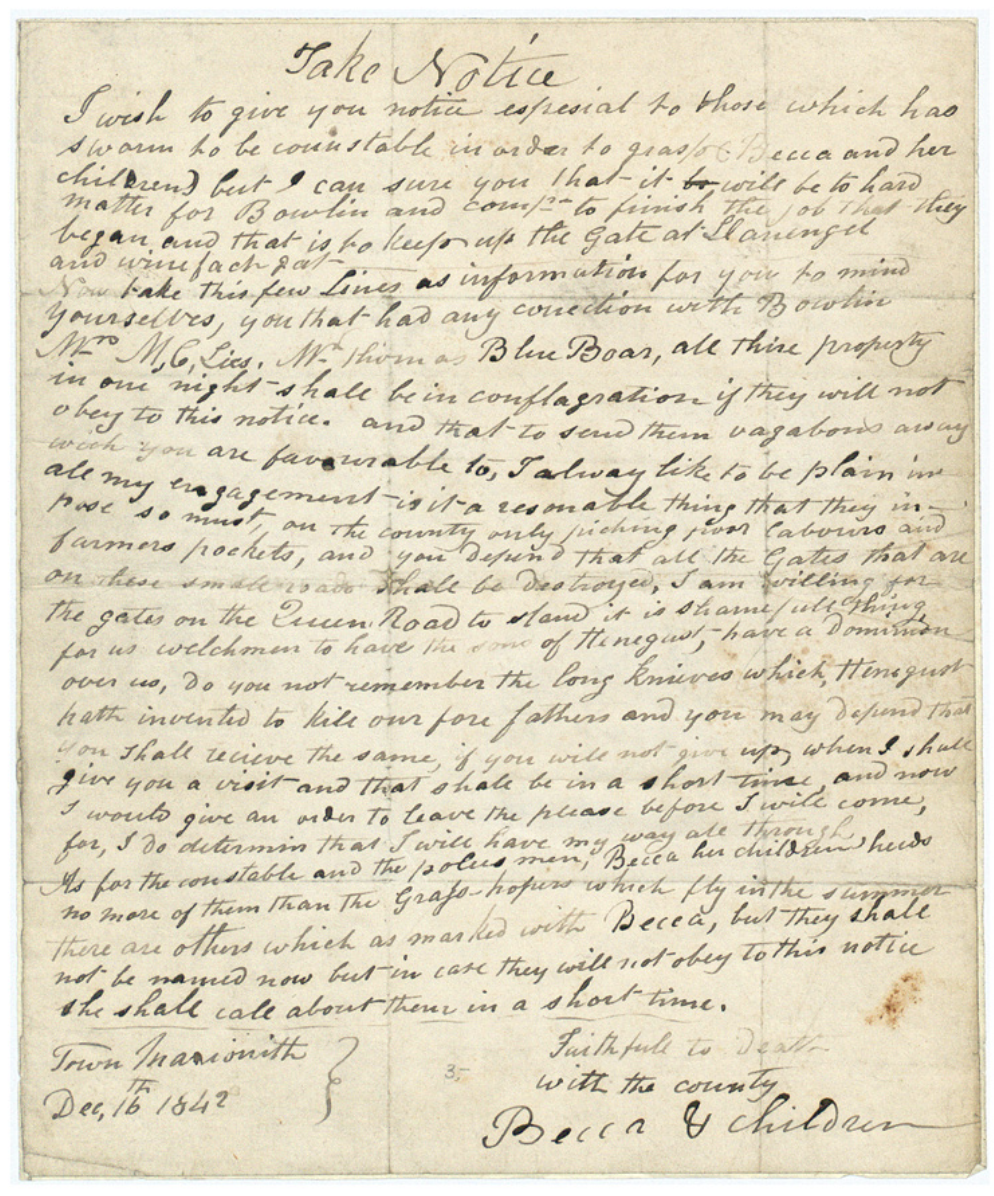
Rebecca letter, 16 December 1842 [122]
It is into this restless, rumour-thick country, that William was posted. The military presence in west Wales shifted almost month by month through 1842 and 1843, companies arriving, recalled, and replaced as the disturbances ebbed and flared. As early as January 1843 a company of Marines stationed at St Clears was withdrawn to Milford in response to "special orders received from the metropolis," the Castlemartin Yeomanry sent in their place; the same report records a fresh detachment of twenty-seven rank and file, a sergeant, and a corporal under orders to march from Chatham to reinforce the Marines at Milford [123]. By late June the Marines at Pembroke Dock had been substantially strengthened and placed under the command of Colonel Love, entrusted with suppressing the movement across the three counties [124]. On 26 June a detachment under Major Whylock embarked at Pembroke on the steamer Confiance, bound for Cardigan [125]; a separate, fuller movement followed a week later, when a party of 120 Marines, besides officers, came across from Pater and marched through St Dogmaels into Cardigan itself on the evening of 3 July, sixty of them continuing on to Newcastle Emlyn the following morning, the remainder staying behind in billets at Cardigan [126]. By the close of that summer the authorities counted, when the whole Pembroke force was concentrated, three captains, six lieutenants, fifteen sergeants, fourteen corporals, four drummers, and two hundred and nine privates under arms in the district, a force assembled, the press reported, by combining the existing Pembroke garrison with a fresh relief detachment arriving from Plymouth, rather than allowing the Pembroke men to rotate home as had originally been intended [127]. By 1843 detachments were distributed across the region in something like settled proportions: seven officers and a hundred and fifty-five men at Pembroke itself, two officers and fifty men at Haverfordwest, two officers and forty-two men at Cardigan, two officers and forty at Narberth, with smaller parties elsewhere [128]. Even after that, the picture refused to stay still: an express from the Mayor of Haverfordwest in late August sent Captain Dawes and Lieutenant Hamley hurrying out from the Pembroke depot on what proved, in the end, to be a false alarm, the town's drums beating the natives into a fright over a Rebecca who never came.
What this run of newspaper reports establishes, more clearly than anything else available, is that the Marines who passed through this campaign were not a single body permanently quartered at Pembroke Dock under one flag. They were a current: companies and detachments moving in and out of the dockyard, drawn at different moments from different home divisions, consolidated, redistributed, and consolidated again as the unrest demanded. One report, datelined the very week William's documented presence in Wales begins to matter, is explicit on the point: the garrison then at Pembroke had been due to return to "its divisional head-quarters at Chatham," and was retained in the district instead, to be joined with the incoming Plymouth detachment under Colonel Love's command [129]. No muster roll naming William has been traced, so which detachment he travelled with cannot be shown directly. But his own Certificate of Sea Service was issued, eighteen months later, at the Royal Marine Barracks, Chatham [114].
William was, in all likelihood, among the men quartered in just such a building: the Cardigan Union Workhouse at St Dogmaels [130]. The Poor Law guardians were not pleased to have soldiers under their roof. A letter from Thomas Williams, Guardian of Verwick, to the Poor Law Commission on 22 August 1843 makes their irritation vivid:
"As our Union Work House is now partly inhabited by the marines, their presence I do not consider necessary at all, as I do not apprehend any danger whatever of the work house being demolished… What I most particularly beg to call your attention is how far are we…to supply the marines from the funds of the Poor Rate, are we liable to supply them with candles, a fresh supply of bed clothes, including supporting their wives and other characters which now inhabit a certain part of the Work House with them?"
The postscript was blunter still: "I doubt very much whether our master or the master of any other Union Work House is or will be able to keep sufficient separation between the soldiers and those women who inhabit the workhouse" [131]. The Commission was unmoved. Its reply, dated a week later, stated plainly that "where Union Work Houses may be threatened it appears to them to be proper that troops shall be stationed in them for their defence," directed that "all communication between the soldiers and the inmates should be strictly prohibited," and confirmed that the cost would fall on the Government rather than the Poor Rate [132]. The Guardians did not give up easily: a further motion on 27 September called for the military's removal, by which point the riots themselves were already losing their force [133].
There is a quietly bitter symmetry in the detail, whether or not William ever reflected on it himself: the son of a man who had died in the Eye Union Workhouse three years before was now billeted inside a Welsh one, both institutions creatures of the same New Poor Law of 1834, passed, as it happens, the same year William enlisted [134]. The law was deeply unpopular on both sides of the border; in rural Wales, where poverty was acute and the Welsh-speaking poor regarded an English-administered Poor Law with particular suspicion, it had become one of the very grievances feeding the Rebecca movement he had been sent to put down [135]. The building itself was barely older than the disturbance that filled it with soldiers. The Cardigan Union had only been formed in May 1837, its twenty-six constituent parishes spanning both sides of the county boundary, from Aberporth and Llangoedmore in Cardiganshire to St Dogmaels, Nevern, and Newport in Pembrokeshire; the workhouse itself, built to house a hundred and twenty inmates on land taken from Tŷ'n Coed Farm just north of the village, had been tendered for in 1837, raised through 1839, and completed only in 1840 to designs by William Owen of Haverfordwest, new enough, in 1843, that the mortar could hardly have weathered [136]. Owen's cruciform plan, three ranges run off a central spine to form four open courtyards, gave the building an oddly handsome, almost monastic symmetry from the air; on the ground it would have meant long stone corridors, a porter's lodge dividing the men's entrance from the women's, and a central observation room with canted windows from which the master could watch most of the building's life pass beneath him at once [137]. Whatever picketing the Marines did during their stay, they did it inside walls still raw enough to remember the masons who had built them.
St Dogmaels itself, the village whose lanes William marched through on whatever day his detachment arrived, was at this date still a small, loosely gathered place: the 1838 tithe map shows perhaps a hundred buildings clustered around the ruined abbey, with wide gaps between them, the long ranks of terraced houses that define the village today not yet built [138]. The abbey ruins themselves, roofless since the Dissolution three centuries before, still dominated the skyline above the river, the old parish church standing in their shadow; the Teifi ran past below [139]. The village's life still ran, as it had for generations, off the water below it: herring taken in season from the estuary, salmon worked by Seine net from the Netpool, small ships built and launched from the strand at the Pinog, a maritime trade old enough that it would have struck William, with his own years at sea, as entirely familiar even in a place he had never before set foot [140]. Nonconformity ran just as deep: Bethsaida, the village's newest Baptist chapel, had opened only five years before he arrived, and the Calvinistic Methodists at Capel Seion the same year; whatever the established church recorded in its register, most of the parish almost certainly worshipped elsewhere [141]. It was, in other words, exactly the kind of quiet, half-built, in-between place that makes a sudden garrison feel enormous: a hundred-odd Marines, billeted in a workhouse three years old, in a village of perhaps a few hundred souls, waiting on rumours of a woman who was never quite where she was said to be.
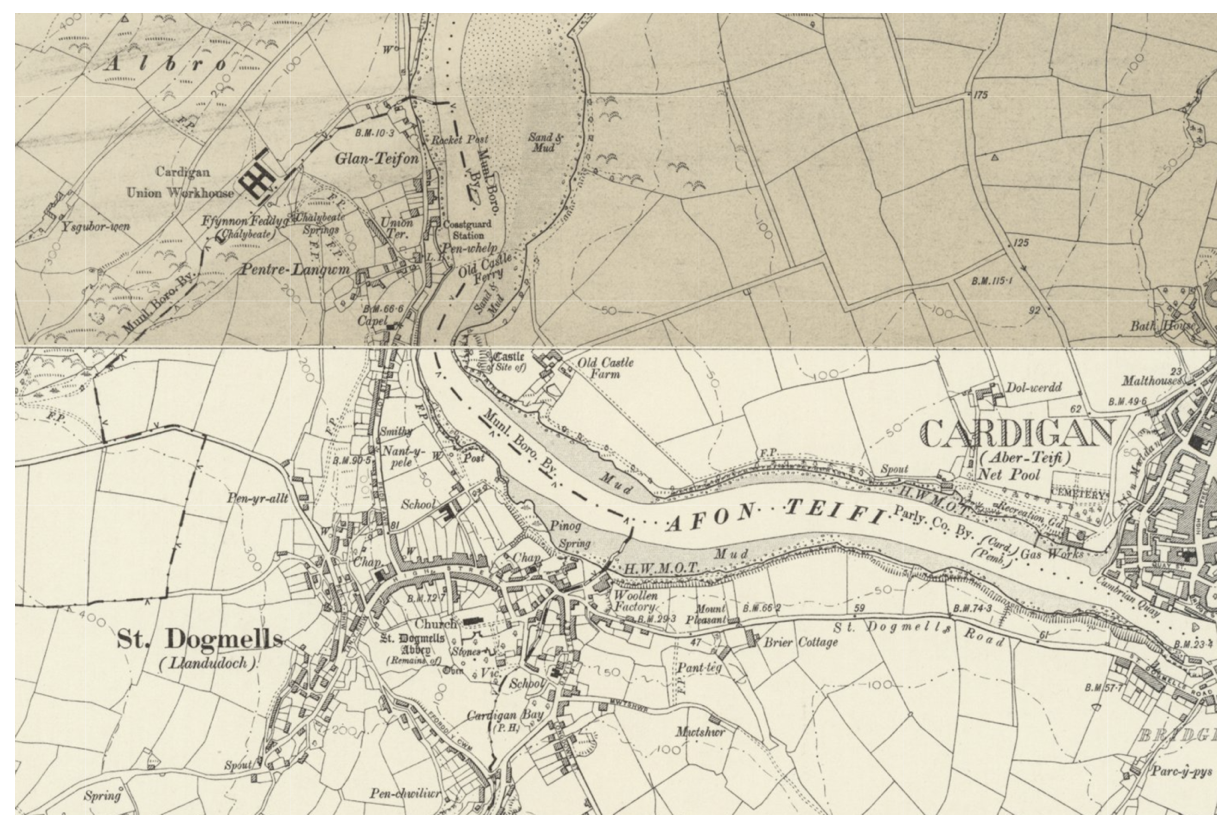
St Dogmaels and Cardigan, Ordnance Survey map, c. 1880s–1888 [142]
It was inside, or at least from, that workhouse that William found his wife.
On 5 September 1843, he married Hannah Phillips at the Parish Church of St Dogmaels [14]. The marriage register, entry no. 59, tells us more about the two of them than any other surviving document. William is recorded as a Private of the Royal Marines, of full age, a bachelor, resident at the Union House: the firmest evidence that survives for his presence in Wales at all, and, it should be said plainly, the only document that places him there by name. Hannah, also of full age, a spinster, was living at the Ship Inn in St Dogmaels; her father, Henry Phillips, a stonemason, was already deceased. William's own father is named in turn: Francis Grant, marble mason, a man who had shaped stone for his living, just as Hannah's father had. Two masons' children were married that day in a Welsh border church. William signed his name in the register; Hannah, who could not write, made her mark beside it, a small, plain asymmetry that says something about the different worlds each of them had come from. The register plainly designates William as a “Private of the Royal Marines”.
St Dogmaels' ten taverns and public houses, the Ship Inn among them, were kept that year by a scatter of named landladies and landlords: Ann Richards at the Ship, Elizabeth James at the Fountain, Eliz Evans at the Sailor's Return, in a parish of around 2,478 souls at the 1841 census [143]. For a few months in 1843, soldiers, paupers, farmers, and disguised rioters all moved along the same handful of lanes between them.
By September the riots were already losing their momentum. At the County Gaol in Carmarthen that November, forty-five rioters awaited trial; they were convicted early in the new year, and through the winter of 1843–44 the troops scattered to the theatre were gradually disbanded and sent back to their home stations [144]. On 24 October 1844, more than a year after his marriage, William was recorded back at the Royal Marine Barracks in Chatham [114]. He had left Wales, at last, with a wife.
In June 1845 William joined H.M.S. Superb at Sheerness, a 2nd Rate ship of 80 guns and 2,589 tons, with an allowed complement of 645 men [145]. His time aboard her was brief: just six months, from 4 June to 13 December 1845, but it was an unusually eventful six months for a peacetime posting. The Superb had been chosen as one of eight ships in an Experimental Squadron, assembled to pit Sir William Symonds' new hull designs against older, more conventionally built ships of the line in a series of competitive cruises.
On Monday 23 June, Queen Victoria and Prince Albert came out from Osborne to inspect the squadron at Spithead, going aboard the Royal Yacht Victoria and Albert and weighing anchor at half past eleven [146]. This was a personal tour rather than a display of seamanship: the Queen went aboard the St Vincent, the Trafalgar, and the Albion in turn, walked their decks, tasted the chocolate in the Trafalgar's bread-room, and chatted with the captains, one of whom, asked if he had a good crew, replied that he had until the Admiralty had taken away a hundred of his best men [146]. The fleet manned its yards and fired a Royal salute as she arrived, and did the same as she left, but there was no sailing that day at all.
It was the next morning, Tuesday 24 June, that the squadron put itself through the kind of trial the Queen had come to see.
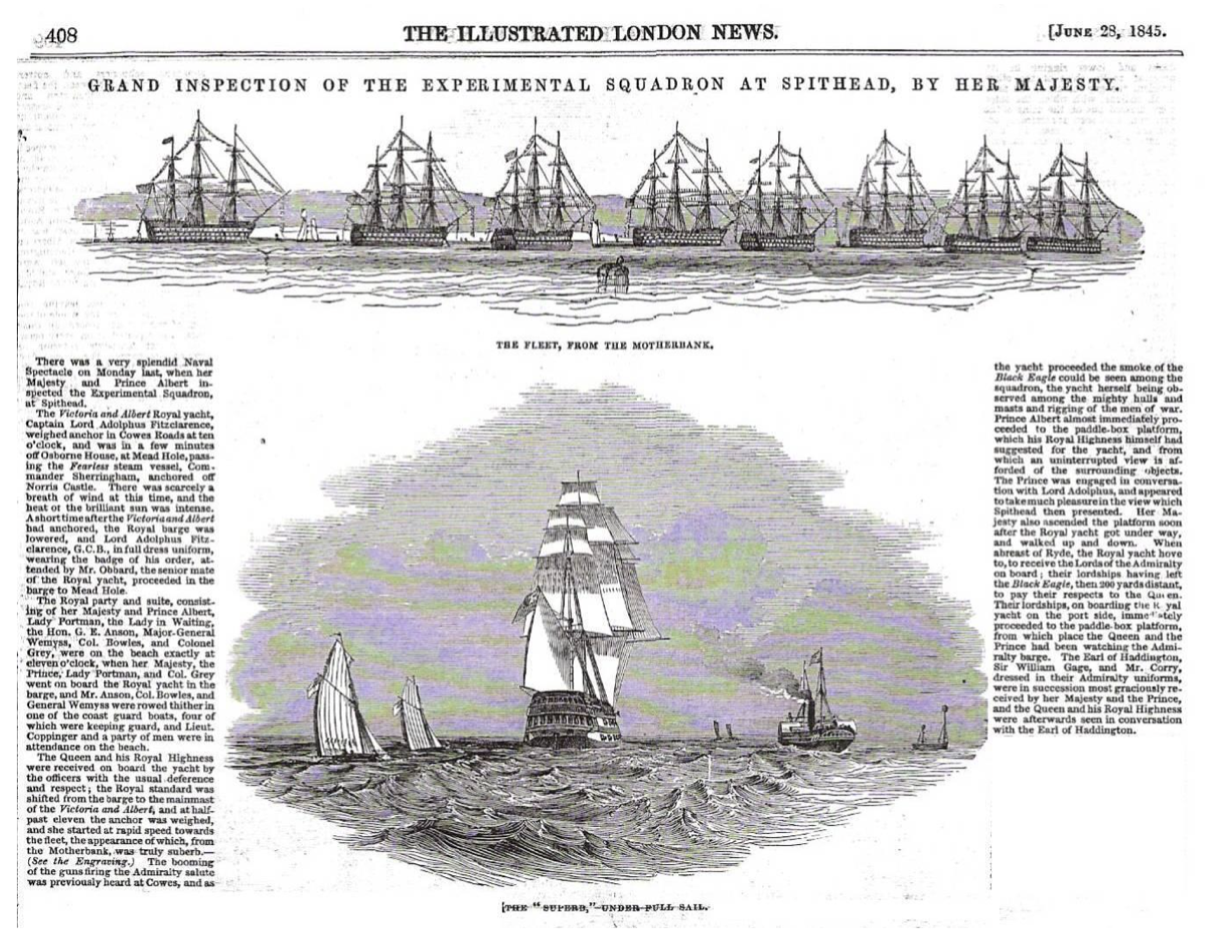
The Superb, under full sail. Illustrated London News, depicting the Royal inspection of the Experimental Squadron at Spithead, 23 June 1845 [147]
A sequence of timed sail drills was signalled one after another, each ship spreading more sail or taking it back in, racing to finish first. The Superb sat this part of the exercise out [148]. It was only afterward, about one o'clock, that she got under way on her own under Captain Corry, crowding on sail to follow the Royal Yacht out toward St Helen's. She went out "in grand style," but by the time she reached the Nab, a sandbank at the eastern edge of Spithead where the sheltered anchorage opens out into the more exposed waters of the eastern Solent and the Channel beyond, and where wind and sea conditions could change noticeably as a ship passed it, a freshening wind forced the crew to take much of that sail back in again [148]. For William and the rest of her complement this meant the opposite of the smart, practised show the other ships had just put on: working the ropes and canvas at speed to get her moving, then doing the same work in reverse only a short time later. By half past four, when the rest of the squadron had furled their sails and lay still, the Superb was one of only two ships, with the Vernon, still under sail at all [148].
Three weeks later, on Tuesday 15 July, the squadron weighed anchor in earnest and put to sea to begin the first of its three competitive cruises. The Queen and Prince Albert came down again, this time with the King and Queen of the Belgians, the Queen Dowager, and Prince George of Cambridge among the party, travelling by special train to Gosport for the occasion [149]. This time the Superb sailed with the rest of the squadron rather than apart from it. Queen Victoria recorded the moment in her own journal: the fleet "passed us slowly & majestically, a really glorious sight to behold," every ship's yards manned and her crew cheering as they passed the Royal Yacht and made for sea [150]. William was one of those men: a Marine private among the hundreds the Queen watched pass from the water that day, not an officer she might have spoken with, but exactly the kind of figure such a display depended on, doing the same work he had done many times before, if rarely with royalty looking on.
The trials took the ship from Portsmouth to Cork and back to Plymouth by September, out again briefly at the end of that month, and on a third and final cruise from late October, returning to Plymouth on 3 December, ten days before William's own posting ended [151]. In between, she was twice put through Portsmouth's own hands: once in early July, when she was found to have settled two inches below her proper waterline from overloading and had to be hastily re-coppered above the new draught, and again in early October, when her entire bottom was stripped, recaulked, and recoppered in a single span of eighteen hours, a job remarked on at the time for the speed and skill of the dockyard men who did it, though no one seemed quite sure why it had been ordered at all, since the old copper had been perfectly sound [152]. In that final cruise, racing the other ships of the squadron in trials sailing off the wind, the Superb won every contest, a result confirmed not only by report at the time but by Captain Corry's own despatch to the Admiralty afterward, which stated plainly that his ship had beaten the whole squadron on each occasion she was tried that way [153].
After the cruise's end, the Superb was assigned to take up the Ocean's regular moorings at Sheerness, the ship's home port throughout William's time aboard her [154].
William's posting to Portsmouth, where he would spend most of the next decade, was not an accident. The Royal Marine Barracks at Portsmouth, known from 1827 as Clarence Barracks, had housed the Portsmouth Division since 1768, and it was there that William, as an ordinary Marine, would most likely have returned between sea deployments in the earlier years of his service [155].
In October 1846, William left that world behind and was transferred to an Artillery Company [156]. The Royal Marine Artillery had its own dedicated barracks at Gunwharf, Portsmouth, since 1824, and it was presumably there, rather than at Clarence Barracks with the ordinary Marines, that William would have trained and been quartered from this point [157]. The Artillery had functioned as a distinct body within the Corps since 1804, nicknamed the "Blue Marines" for the blue rather than red of their uniform, and trained alongside the Royal Artillery at Woolwich rather than within the ordinary Marine establishment; it would not become a fully separate corps in its own right until 1859, three years after William's discharge, but it was already, in every practical sense, its own world within the wider Marines [158]. Two years after his transfer, the Division's remaining Marines moved out of Clarence Barracks entirely, into newly built accommodation at Forton Barracks, Gosport; whether William, by then with the Artillery Company, was caught up in this move or remained at Gunwharf throughout cannot be established from the records seen so far [159]. Shore service for a Royal Marine Artilleryman meant gun drill, weapons instruction, and guard duties at the dockyard and barracks, work that, whatever William's actual living arrangements, was a markedly steadier and more repetitive routine than the years of foreign postings before it. His service record notes new clothing issued in April 1847 and a new cap the following year, the practical paperwork of a man being kept equipped for the role [160]. By the time of his discharge a decade later he was recorded as belonging to the 5th Artillery Company specifically, though whether he held that number from the moment of his 1846 transfer or was moved into it at some later point is not clear [161].
It was in this settled stretch that the family took proper shape. By the time their first child Susanna was born, on 6th July 1847, William and Hannah were, according to the family's later account, established at 23 Silver Street, Portsea, with William stationed ashore throughout the likely months of her conception [162]. Whether that settled posting is what actually brought her about is not something any document can say, but it fits. The pattern repeats with their second child, Charles, born on 2nd July 1849 at 9 Copper Street, Portsea: another shore posting lining up with the likely window [163]. William was not there for Charles's birth itself. He had joined H.M.S. Hogue three days earlier, on 28th June, and would not see his son until he came home [164].
La Hogue, as the press of the day generally called her, was an old ship recently made new: a 74-gun two-decker built at Deptford in 1811, now converted to run under a screw, one of a number of older sailing ships being fitted with steam power in this period [165]. Her movements over the following months took William back through waters he had first sailed a decade earlier. In early August 1849 she formed part of the squadron escorting Queen Victoria on her first visit to Ireland, present at the royal arrival at Cork and later, described in one newspaper as "the majestic Hogue," the last ship in the line as the squadron saw the Queen out of Kingstown harbour [166].
By October she was under orders for the Mediterranean, and her relief at Queenstown arrived in a strangely personal form: the Superb, William's own ship four years before, sent out from Portsmouth to take her place, carrying seventy of the Hogue's men home as passengers before sailing on herself [167]. Whether William was among the men who watched her come alongside is not recorded, but if he was, it would have been the second time in his career that the Superb crossed his path: the ship he had served on at Spithead in 1845 now arriving to carry his old shipmates home while his current one sailed onward without him. Hogue herself left for Lisbon on 6th November, joining a squadron under Commodore William Fanshawe Martin [168, 169]. That December she was tried for speed against two of the other steamers down the Tagus and across the bar to Gibraltar, and came off well: a newspaper covering the trial judged she had "the advantage" of one of her rivals under sail, her engines making 49 revolutions a minute under steam alone, burning 28 tons of coal a day to hold 7.2 knots [170].
The posting was not an easy one. In March 1850, with the squadron lying at Lisbon, the ship's second lieutenant, a Mr Hardman, exchanged a few words with the captain on deck, then went below alone, loaded a pistol, and shot himself in the mouth. The ball took an upward path and came out through his eye, destroying it. He survived, invalided home aboard another ship, though one of his fellow officers, writing of it within days, feared he might try again if the watch on him ever slipped. The letter describing it circulated in the London papers within a fortnight, one printing it under the bare headline "Attempted Suicide of Lieutenant Hardman” [171, 172]. A ship that size kept her men in close company for months at a stretch, and a story like this, an officer rather than a hand before the mast, a quarrel reduced to "a few words" before a man went below alone with a pistol, was exactly the kind of thing that would have run the length of the lower decks for weeks afterward, reshaped a little with every retelling. What William made of it cannot be known, but he would certainly have heard of it, and almost certainly talked about it. That same year, on 25th July, the man holding the post of Captain of the Main Top fell from the mainmast to his death, a second violent loss for a crew that had not yet had four months to put the first behind it [173].
By early September the ship had moved on to Malta, and it was there, working her way into harbour alongside the flagship Queen on the 4th, that she sailed into one of the largest waterspouts seen in the Mediterranean in years. The danger did not pass until gunfire broke it apart: two shots from the Queen, one from the Hogue herself [174]. For a crew that spent its days at gun drill and its nights confined to a wooden hull a few hundred feet long, a waterspout bearing down on the ship while she still had no room to manoeuvre in a crowded harbour, with no certainty that firing on it would even work, would have been among the more frightening things many of them lived through at sea. A storm or a man lost overboard were dangers a Marine of William's years had already weathered; a waterspout closing on the ship and only narrowly broken apart by her own guns was something else again, rare enough to be talked about for a long time after.
She left the Mediterranean for good not long afterward, reaching Spithead by way of Gibraltar in late October, leaking badly at the stern from a fault in the gear that raised and lowered her screw [175]. By early November she was in dock at Portsmouth for repair, her crew, William among them, put up aboard the receiving ship Blake while the work was done; she was not pronounced fit for sea again until early December [176]. Before Christmas she sailed for Ireland, reaching Queenstown on Boxing Day, where she stayed for four months and took on a standing Admiralty duty: cruising the western approaches to the Channel to bring water and provisions to merchant ships held windbound by easterly winds, a job that kept her at sea more than in harbour that winter [177]. In early February a storm caught her jolly boat, the small general-purpose boat kept aboard for routine errands ashore, while it was away collecting supplies at Queenstown; it was trapped and swamped, and the ship lost 285 pounds of fresh beef and 400 pounds of vegetables with it [178].
While William was at sea aboard the Hogue, the census-taker called at Copper Street in the spring of 1851 and found a young family managing without him: Hannah recorded as a ‘Soldier's Wife’, lodging alongside another young women, Amelia Turner, whose connection to her is unknown and who may simply have been a fellow boarder, the rent perhaps helping to cover the household costs in his absence; Susan four years old and Charles not yet two [179].
Much of 1851 was spent in the Tagus at Lisbon, where the Hogue remained attached to Commodore Martin's squadron alongside the Prince Regent, Leander, and Arethusa [180, 181]. As the year drew to an end, the squadron was briefly drawn toward Morocco, after a French naval bombardment of Sallée and Rabat raised fears for British interests at Tangier; Hogue and the Dauntless were detached from the Lisbon station and sent there to stand by, though no action is recorded as having followed [182]. By February 1852 the ships at Lisbon, Hogue among them, were ordered to refit, and by March she had reached Queenstown, where a contemporary report noted she was "full of defects" and would need a dockyard before she could go on [183, 184]. She was ordered home, paid off her wages, and given her crew a fortnight's holiday, before working back to Portsmouth: Hogue and the Prince Regent reached Spithead from Queenstown on the morning of 31st March 1852, just over a week before William left her [185].
William left the Hogue on 8th April 1852 and came home. It was the first time in nearly three years that he had returned for anything more than leave between postings, and George Grant, William and Hannah's third child, was born nine months later, on 20th January 1853 in Portsea [186]. The arithmetic speaks for itself.
In total across his entire career, the Divisional Board calculated nine years, six months and twenty-nine days of service afloat and on foreign stations, against twelve years, five months and five days on shore in the United Kingdom [187].
What William did between leaving the Hogue and his discharge four years later is not recorded. His Record of Service lists only four ships across his entire career, Russell, Gorgon, Superb, and Hogue, with no fifth vessel entered for any part of this period, and the Divisional Board's tally of time afloat and ashore is given only as a career-long total, not broken down by date or location. The gap falls squarely across the Crimean War, fought between October 1853 and February 1856, and it is tempting to wonder whether William, by then approaching forty and a veteran of two foreign campaigns already, was among the Royal Marine Artillery gunners sent to the Baltic or Black Sea fleets. Nothing found supports this. No Crimean or Baltic campaign medal has been traced for him, in contrast to the clear documentary trail his Syria medal claim left in the Admiralty's own rolls, and his discharge certificate's remarks, which took care to note "Has served in Syria," make no mention of any later campaign1. The likeliest explanation is that William spent these years on shore service in the United Kingdom, probably still with the Artillery Company in Portsmouth, but this remains an inference from absence rather than a documented fact.
On 28th July 1856, at the Royal Marine Barracks, Gosport, William was discharged from the Royal Marines. His Certificate of Discharge, No. 111, issued in lieu of his original, which he had stated to have lost, records twenty-two years and four days of honest and faithful service, discharged for length of service. He was forty-one years old; his height is given as five feet ten and a half inches, his hair brown, his eyes hazel, his complexion fresh. Against distinguishing marks: four. Against character: Very Good. The certificate's own reference notation identifies him at discharge as belonging to the 5th Artillery Company, corroborating the Divisional Board's record [188].
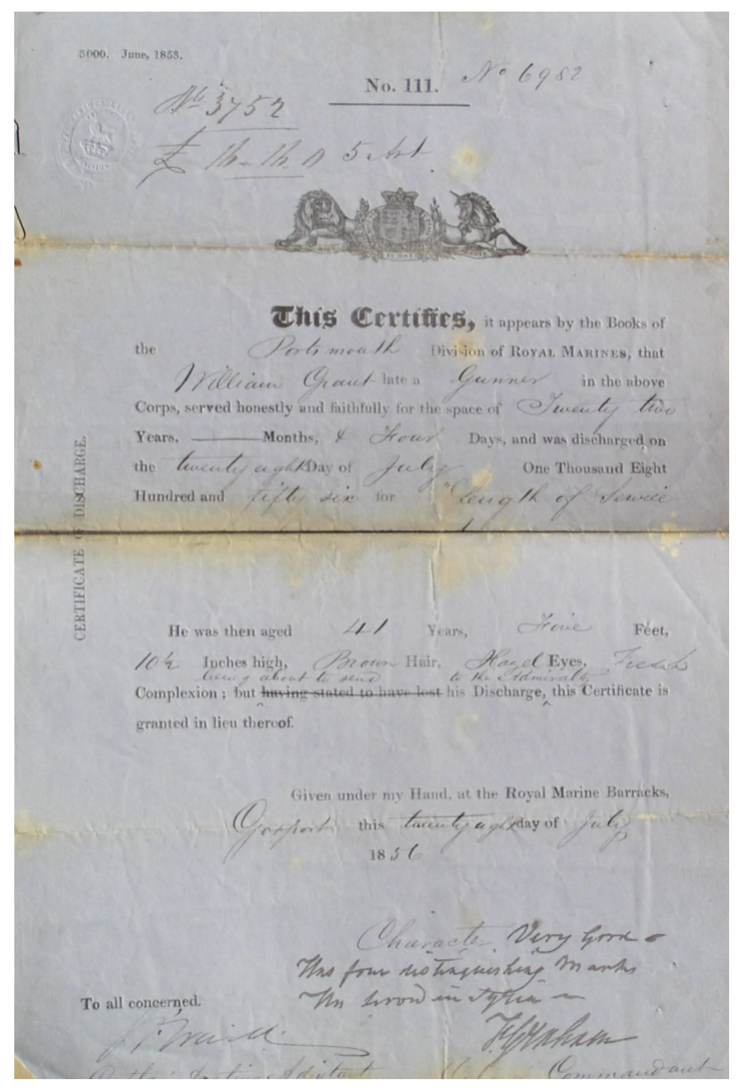
Certificate of Discharge for William Goodwin Grant [188]
That contrast with his enlistment record is worth pausing on. In July 1834, the surgeon at Springfield had written WONES against his name: no wounds, no scars, no marks whatsoever [1]. By July 1856, William carried four distinguishing marks. It is tempting to connect this to the lashes recorded in July 1840, and entirely plausible that some or all of the marks were scarring from that flogging, but neither the discharge certificate nor the Divisional Board's remarks, which note only "has four distinguishing marks" without describing them, say what they actually were.
That final character assessment deserves a moment's pause of its own. The man who had left the Russell in 1839 with a fair character, who had been punished for sleeping at his post off the Syrian coast, who had been marched back to the Gorgon under Marine escort after failing to return from shore leave in Malta, left the Corps twenty-two years later with his character assessed as Very Good. The Divisional Board's remarks page adds: "Name not in Defaulters Book"[1]. Despite the flogging and the Malta escapade, William had never been entered as a persistent offender in the Corps' formal register. The certificate also notes: "Wm served in Syria."
Ten days later, on 7th August 1856, the Admiralty issued William his Greenwich Hospital Out-Pensioner's certificate, No. 3752, certifying a pension of sixteen pounds sixteen shillings a year, granted for length of service and commencing from 29th July 1856 [189]. His height was recorded one final time: five feet ten and a half inches, brown hair, hazel eyes, aged forty-one. The certificate records twenty-two years and four days of honest and faithful service, but not all of it counted equally. His Record of Service shows that just over a year of his earliest service was discounted as "Under Age" — the period before he reached the minimum qualifying age for pension purposes — leaving a net "Good Service" total of approximately eleven years in his first rank alone. The pension he received was calculated on this reduced figure [190]. An independent entry in the Royal Hospital Chelsea's own pension returns for the same year confirms the same pension number, the same rate, and the same commencement date, naming William as a Gunner [191].
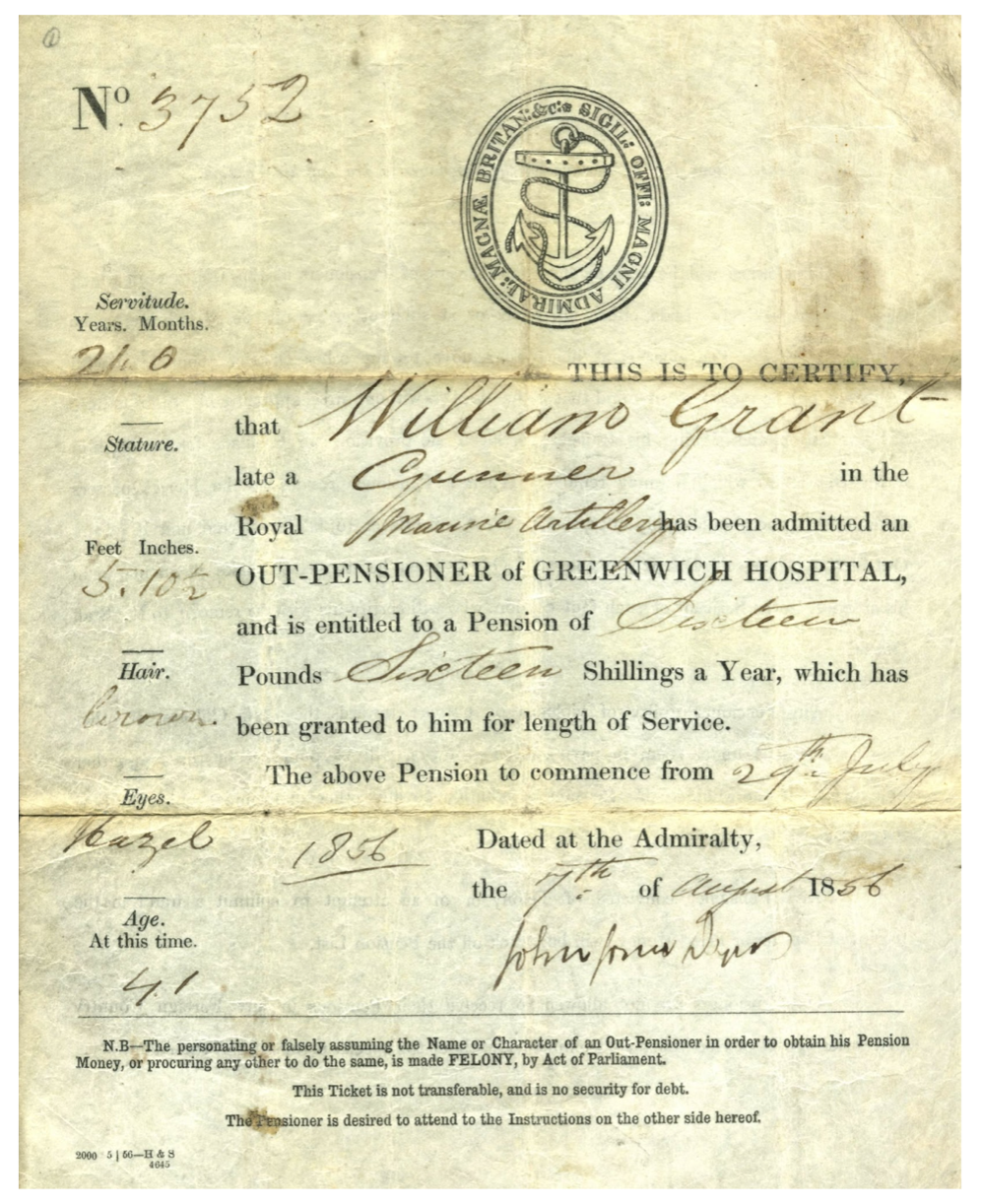
Greenwich Hospital Out-Pensioner's certificate for William Grant [191]
For the first time in twenty-two years, William had no ship, no barracks, and no orders. Whatever came next in Portsmouth would be his own to arrange, in a way none of his working life since nineteen had been.
The greatest change was at home. William and Hannah had been married for thirteen years, and for most of them their marriage had been second to his service: Hannah in lodgings in Portsea raising the children while he was aboard the Hogue, a "Soldier's Wife" whose husband was away at sea [179]. Susan was nine in 1856, Charles seven, George three; a father who came home every evening was something the two eldest had scarcely known. From the summer of 1856, William was a permanent fixture in his own household for the first time, a husband and father in daily fact rather than in the intervals between postings.
Portsmouth was the natural place to build that life. In the mid-nineteenth century it was one of the largest industrial cities in the south of England, a rapidly expanding naval and dockyard town whose economy revolved almost entirely around the Royal Navy. The dockyard was among the biggest employers in the country, and the surrounding streets of Portsea, Landport, and Southsea were thick with the families of serving and former servicemen, dockyard tradesmen, and naval workers of every description. For a pensioned Marine gunner with a blacksmith's trade, it was the obvious world to settle in.
He did not rest on his pension for long, and nothing required him to. The pension was granted for past service, not as a wage for idleness: the printed instructions issued with it governed only how and where it was drawn, and out-pensioners were free to take whatever work they could find [192]. At £16 16s a year, a little under six shillings and sixpence a week, it was a foundation rather than a living for a family of five, and William's trade was worth money in Portsmouth. From January 1857 he worked as a smith at the Ordnance Factories, the trade he had set aside at the recruiting office in 1834 now put back to work in the service of the same military establishment he had left the year before. After fifteen months he moved to the Military Store Department at the Gun Wharf, where he worked for six years [193]. It was familiar ground in the most literal sense. The Gun Wharf was the deep-water wharf beside the dockyard where the ordnance of both services was stored and issued, guns, carriages, small arms, and warlike stores of every description, collected by ships fitting out for sea and returned by ships paying off [194]. It was also where the Royal Marine Artillery had its barracks, and where William himself had been quartered as a gunner. The Marine who had soldiered at the Gun Wharf now returned to it as a civilian smith.
What William actually did at his forge is not recorded; the Superintendent says only that "he was a smith." In an establishment that existed to store, issue, and maintain guns, carriages, small arms, and warlike stores of every description, a smith's work would have run to the ironwork of all of it, the repair and refitting that kept stored ordnance fit for issue, but that is inference from the nature of the place, not anything the documents say. What is certain is that smithing in Portsmouth's government yards was no longer the trade of the village forge. In the Dockyard, a great purpose-built Smithery had gone up in 1852, five chimneys and a massive steam hammer at the head of the building slips, and iron work on that industrial scale was the direction of the whole town's trade [195]. Whether William's own shop at the Ordnance establishment ran to a steam hammer or stayed closer to the anvil work he had learned in Eye is not recorded, but the man who kept his trade through twenty-two years of soldiering had come back to it in the town where it was being transformed.
What the records do show is the kind of employer he had joined. The government's manufacturing departments in the years after the Crimean War were, by the standards of the day, good masters. Piece-working was spreading through the War Office factories from the mid-1850s, wages ran better than the going rate in the private metal trades, there was room for a steady man to rise, and sick pay for artificers and labourers had been authorised by the War Office as early as 1855, decades before any law required it, funded by a penny a week into the sick fund [196].
But there was a line running through every government workshop, and William stood on the wrong side of it. Industrial workers like him were hired men, not civil servants: no superannuation waited for them, and no security of tenure protected them [197]. Permanence belonged to the established men, those carried on the fixed strength of the department, and the difference was everything when the estimates tightened. Government work in Portsmouth had always run to this rhythm. When the Crimean War ended, the Dockyard across the wall had discharged two hundred and twenty artificers and dismissed every labourer taken on for the war; the pattern of sudden, sweeping reductions was a fixture of the town's working life, familiar to every man who drew a government wage [198]. William, hired in January 1857 while that contraction was still fresh, had seven years inside the line before it reached him.
The 1861 census catches the household in the middle of those Gun Wharf years, and it shows a settled family. William, now in his mid-forties and recorded as an R.M. Greenwich Pensioner, is head of household. Hannah, born in South Wales, is beside him. Their three children, Susan around thirteen, Charles eleven, and George eight, are listed as scholars [199]. By then William and Hannah had also taken in a boarder: Charles Gardner, an R.M. Greenwich Pensioner in his mid-sixties, a widower. It was not a new arrangement for the family so much as a reversal of one. Ten years earlier Hannah had been the lodger in someone else's house; by 1861 the household could take one in, and a fellow pensioner's rent may well have mattered as a supplement to William's pension and his wages from the Gun Wharf.
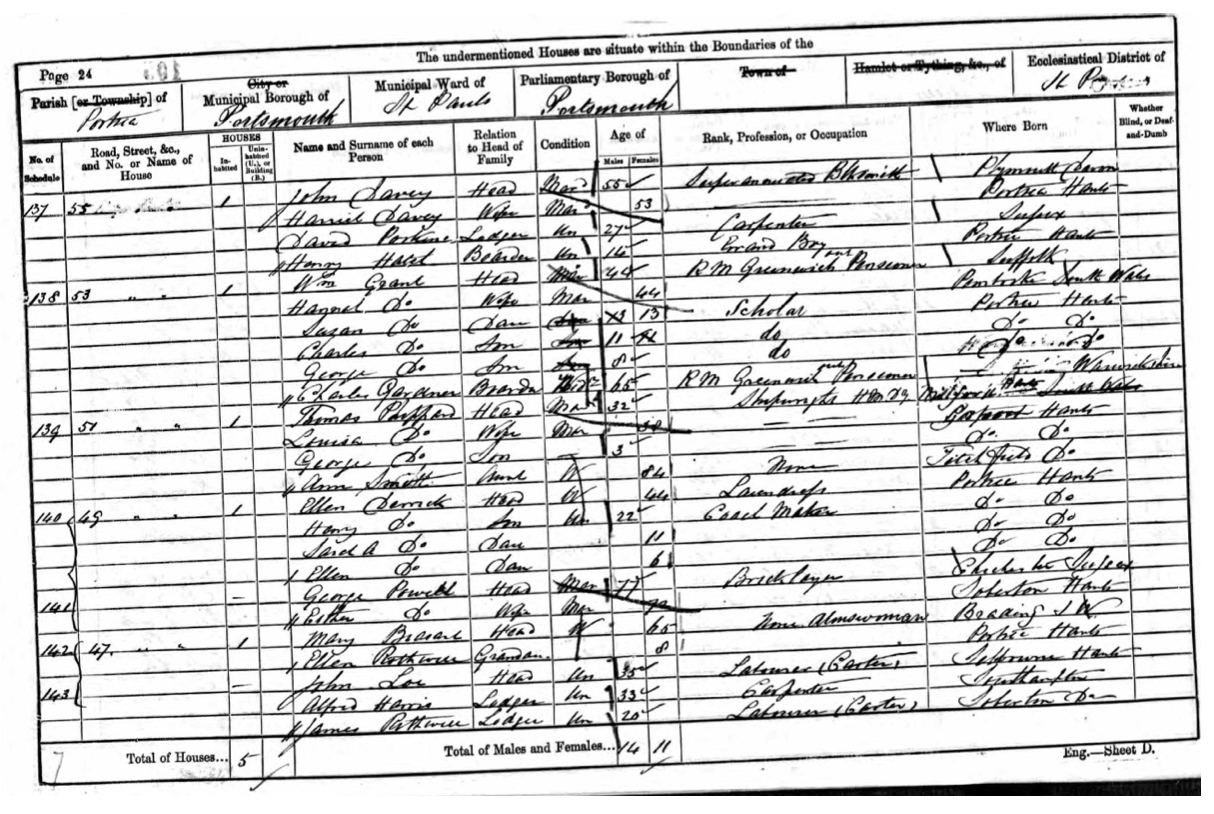
1861 Census [199]
The settled years ended abruptly. On 13th April 1864 William was discharged from the Military Store Department as part of a staff reduction [193]. He moved fast. The very next day he obtained a reference from the Superintendent, certifying his fifteen months at the Ordnance Factories, his six years at the Military Store Department, and that his conduct throughout had been “very satisfactory”.
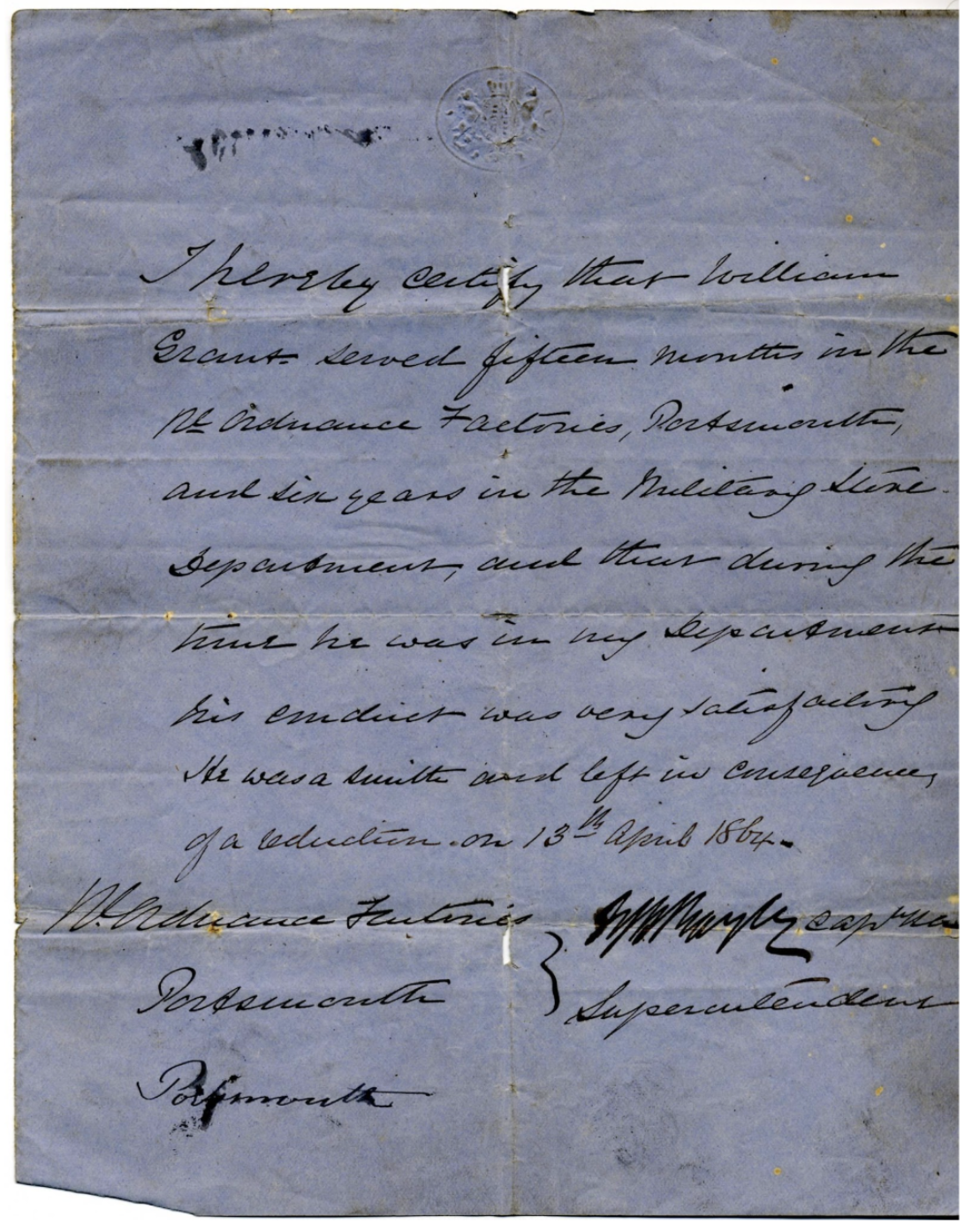
Letter from Portsmouth Ordnance Factory Superintendent [193]
That same day he wrote to the War Office asking to be reinstated as an established smith in the Royal Ordnance Factories, an established post being a permanent one on the civil strength rather than casual hired labour. The reply came a week later, on 21st April, directed by Earl de Grey and Ripon, the Secretary of State for War: enquiries had been made into the circumstances of his discharge, and his Lordship saw no reason to interfere [200].
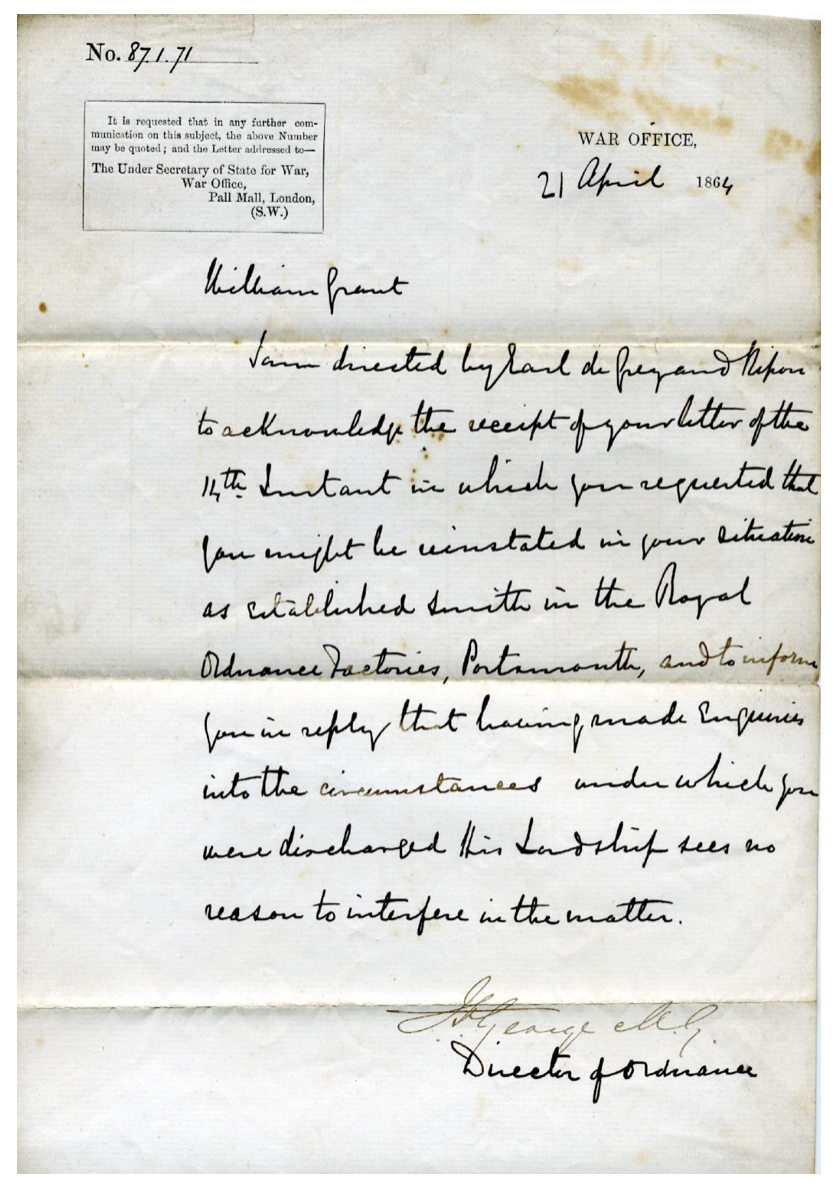
War Office Letter to William Grant (1864) [200]
The refusal was terse, but the decision was probably never really about William. The Ordnance Factories and the Military Store Department were both War Office establishments, inherited in the 1850s when the centuries-old Board of Ordnance was wound up and its manufacturing and storekeeping functions absorbed into the War Office [201]. By the 1860s the War Office's manufacturing establishment at Portsmouth was in retreat, and within a few years of William's dismissal it would be gone altogether [202]. The reduction that cost him his place in April 1864 fell within that longer contraction. There was a sharp edge to the timing, too: in the very years William was let go and refused reinstatement, the Admiralty was beginning its Great Extension of Portsmouth Dockyard, a 180 acre programme that would leave the yard three times the size it had been at the start of Victoria's reign [203]. Portsmouth's naval economy was not shrinking. The corner of it William worked in was.
On 15th June 1864, two months after his dismissal, William joined H.M.S. Asia. She was an 84 gun 2nd Rate sailing ship that was, by 1864, already a relic. Built in Bombay in 1824 by the celebrated Wadia family of Indian shipbuilders, she was constructed from Malabar teak rather than the oak or elm of English built ships, which gave her a longer life, and in appearance she was a smaller cousin of Nelson's Victory. She had fought at the Battle of Navarino in 1827, been taken out of commission at Portsmouth in 1852, and served thereafter as a Guard Ship of the Reserve Fleet at Portsmouth [204]. By the time William came aboard she was a stationary harbour vessel: a floating barracks in all but name, moored at Portsmouth, carrying on her books an average complement of more than sixteen hundred men, a depot's population rather than a fighting crew [205].
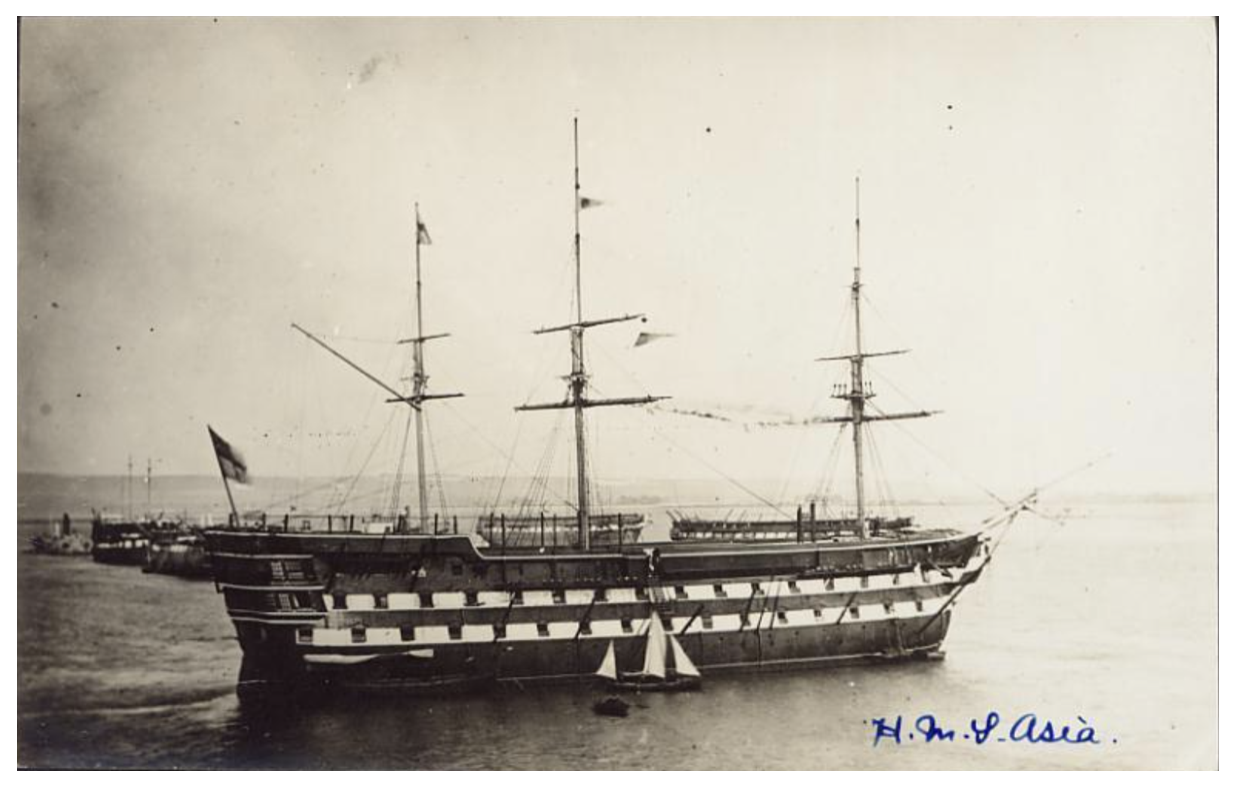
HMS Asia [206]
It was employment, but it was not his trade. Why William kept pressing his claim against the War Office, the record does not say, and his reasons can only be guessed at: the wages, perhaps, or the wish to end his working life at a forge rather than aboard a hulk, or simply the conviction of a man with a very satisfactory reference in his pocket that six years' service was owed something more than a week's notice. What his letters do show is the shape of what he wanted. The place he had asked to be reinstated to was his own trade, exercised on shore, with the permanence of the establishment attached to it: everything a berth on a harbour ship was not.
On 3rd December 1866, thirty months into his time aboard the Asia, he wrote to the War Office again, this time claiming compensation or remuneration for his six years' service at the Gun Wharf, and enclosing the Superintendent’s reference in support. The reply of the 6th was as final as the first: the Secretary of State regretted that the request could not be entertained, and the certificate was returned to him in the envelope [207]. Twice he had put his case to the department, and twice been refused. He was, by then, a dying man, whether he knew it or not.
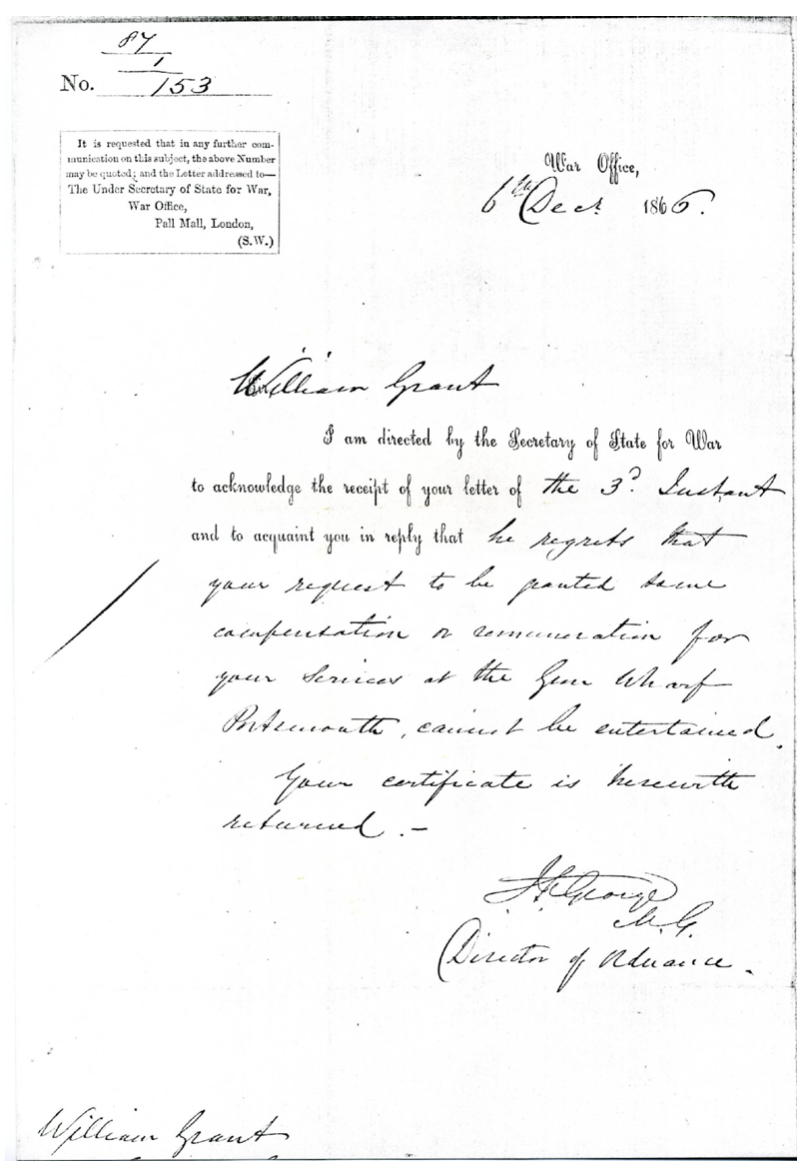
War Office Letter to William Grant (1866) [207]
The Asia was where his working life ran out. The consumption that killed him was, by his death certificate's account, of long duration, and it is reasonable to think it was already at work through these years. The stationary ships kept a steady traffic with the naval hospitals as a matter of routine: in 1864 alone, William's first year aboard, one hundred and eighty-six of the Asia's men were discharged to hospital [205]. His own wages were paid to 31st December 1866 and no further. The final ten weeks of his life went unpaid, and at some point in them, too ill to serve, he was taken across the harbour, following the route so many of the Asia's men had gone before him.
He died on 15th March 1867 at the Royal Hospital Haslar, the great naval hospital on the Gosport side of Portsmouth Harbour [208]. His death certificate records the cause as Phthisis, pulmonary tuberculosis, a progressive wasting of the lungs endemic in the Victorian navy and army, spread through the close quarters of gun decks and barracks and accelerated by damp, cold, and years of physical hardship. In Portsmouth, where overcrowded naval housing and damp sea air combined with the poverty of the dockyard districts, it was a common cause of death among working men of William's generation, an occupational disease as much as a personal misfortune. He was little older than his father had been when he died in the Eye Union Workhouse twenty-seven years before [12].
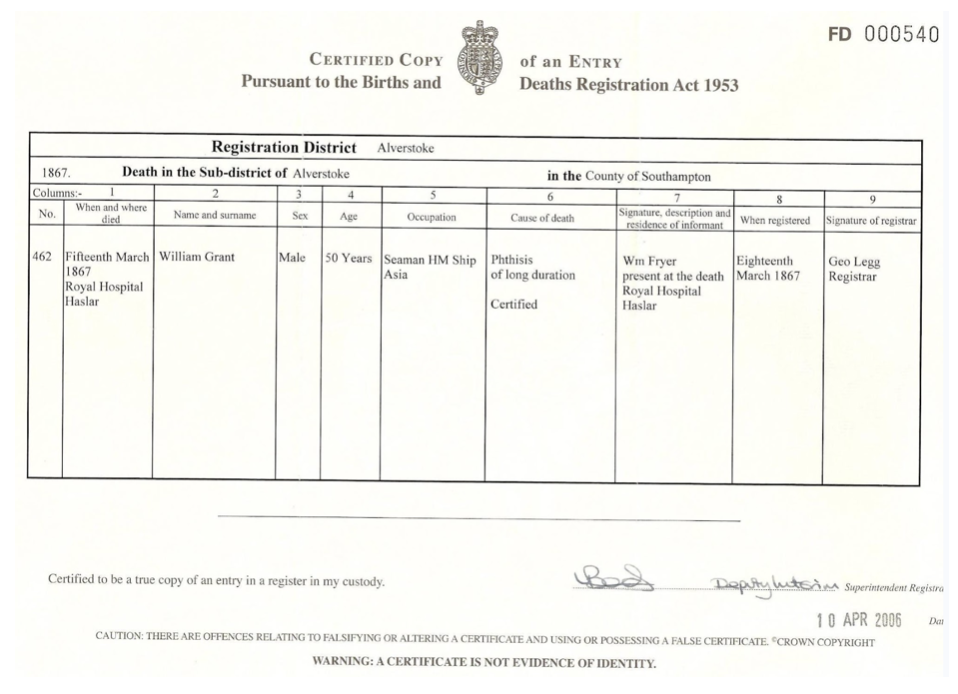
William Grant’s Death Certificate [208]
He died intestate. On 11th July 1867, the Admiralty issued a Certificate of the Inspector of Seamen's Wills, Register No. 157, 1867, certifying Hannah Grant, residing at 11 Fratton Grove, Fratton, as his widow and sole claimant to his effects [209]. His personal effects from the Asia were delivered up on 18th July 1867, handled by surgeon Charles Cooke at Haslar. His back wages from the Asia amounted to £3 0s 8d. Three pounds and eightpence. The same sum, almost exactly, as the three pound bounty he had received when he walked into the recruiting office at Springfield in July 1834.
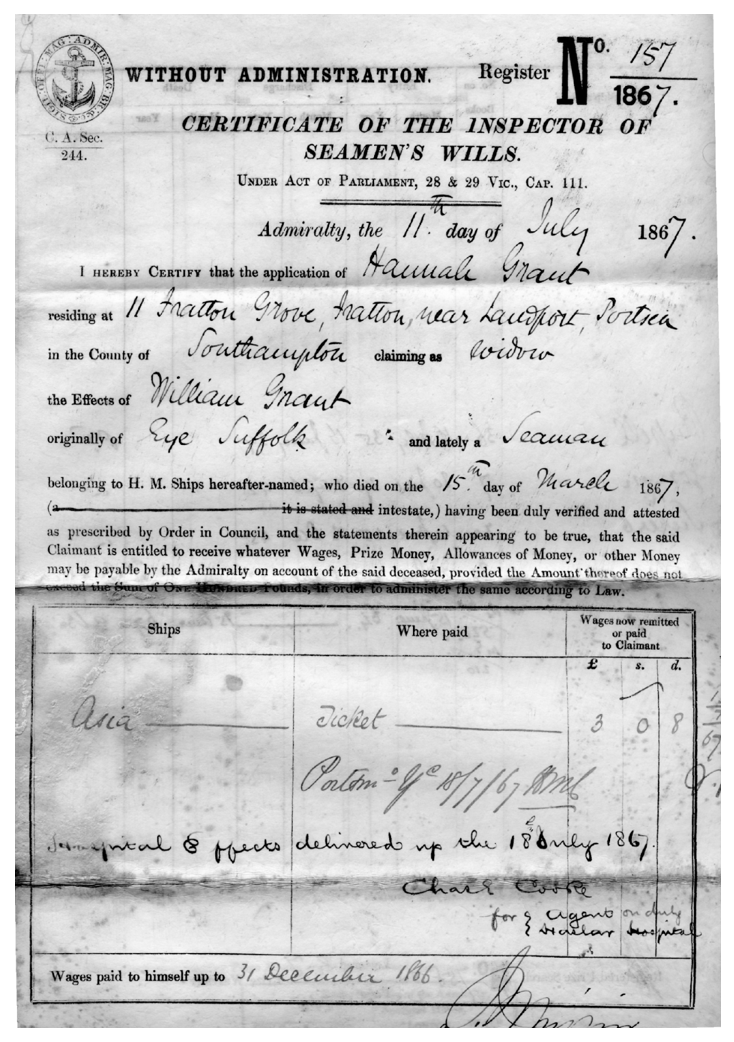
Certificate of the Inspector of Seamen's Wills (Register No. 157, 1867) issued by the Admiralty on 11th July 1867 [209]
He had been at the landings in D'Jounieh Bay, at the storming of Sidon, and at Acre when the magazine blew and the fortress fell. He had stood at a grating on the Gorgon's deck and received the punishment the log recorded without sentiment. He had stood picket in west Wales while men in women's clothes pulled down toll-gates in the dark. He had married a mason's daughter by the banks of the Teifi and carried her south to Portsmouth. He had watched navies transform from sail to steam and from wood to iron, from the cat-of-nine-tails to the campaign medal that named Syria on its clasp. He had died in a naval hospital, his service on record and his pension in payment.
He had given the service twenty-two years of his life, and at the end it was the service, not the family hearth, that gathered him in: a naval hospital to die in, a naval surgeon to hand over his effects, an Admiralty certificate to tell his widow what he was owed. Three pounds and eightpence, almost to the penny what the Corps had paid for him at nineteen. The books balanced. And without those books, the musters and the logs and one archivist at the Ceredigion Archives, the life inside the entries would have been entirely lost.
Explore further…
William Goodwin Grant appears in the Maternal Grandmother family tree, which traces the Grant line from Suffolk through three generations of descendants to the present day.
His story joins a small but growing group of documented military and naval ancestors on this site — among them Frederick Tinsley Birchall, who earned a Conspicuous Gallantry Medal at Jutland, and Robert Edward Butt, who spent four years as a prisoner of war. William's 1834 Chatham attestation is one of the earliest service records documented here so far, spanning the Royal Marines, the Army, and the Royal Navy across more than a century of the family's history.
William's journey from village blacksmith to Royal Marine Gunner is charted in the Maternal Ancestral Occupational Trees, and his given name is itself a piece of family pattern: William is one of the most frequently recurring names across the direct ancestral lines, as the Names page shows.
References:
[1] Royal Marines Attestation and Service Papers, William Grant, born Suffolk, aged 19 at attestation: ADM 157/403/240, folios 240–244, The National Archives, Kew; TNA catalogue description confirms attestation at Chatham 1834, transfer to Royal Marine Artillery 1846, discharge 1856 for length of service. Attestation form records enlistment by Sergeant O'Neil, 22 July 1834; sworn before Arthur Pearson, Justice of the Peace, Eye, Suffolk, 25 July 1834. Surgeon's certificate same date confirms no rupture, no varicose veins, lungs sound, general appearance healthy. Commanding Officer's certificate dated 1 August 1834. Record of Service (p. 445) confirms Private from 22 July 1834 to 20 October 1846, transferred to Artillery Company and promoted Gunner from that date. The record has not been digitised; images reproduced in Michael George Jones, William Goodwin Grant (unpublished family history, n.d.), family papers of Louise Butt, and consulted directly by Louise Butt, June 2026.
[2] Bounty at enlistment confirmed as three pounds: ADM 157/403/240, as above [^1]. Marine Corps levy money history: set at three pounds on the Corps' establishment in 1755; raised to five guineas by the end of the Seven Years War; remained at five guineas until at least 1804, when the Army levy for foot recruits stood at sixteen guineas by comparison. Britt Zerbe, The Birth of the Royal Marines, 1664–1802 (Woodbridge: Boydell Press, 2013), pp. 96–97, citing NA ADM 2/1155, 26 March 1759, p. 379, and NA ADM 1/3246, 'Recruiting Instructions', 1804, p. 10.
[3] Certificate of Discharge No. 111, William Grant, Portsmouth Division, Royal Marine Barracks Gosport, 28 July 1856. Confirms: rank at discharge Gunner; twenty-two years and four days' service; discharged for length of service; aged 41; height 5 feet 10¼ inches; brown hair; hazel eyes; fresh complexion; four distinguishing marks. Issued in lieu of original, William Grant having stated he had lost his discharge. Greenwich Hospital Out-Pensioner No. 3752; pension £16 16s. Signed by the Commandant, Royal Marine Barracks Gosport. Reproduced in Michael George Jones, William Goodwin Grant (unpublished family history, n.d.), family papers of Louise Butt. Whether the original discharge certificate is among the service papers at ADM 157/403/240, folios 240–244, The National Archives, Kew, has not been confirmed.
[4] Baptism register, St Peter and St Paul, Eye, Suffolk, 12 September 1815: William Goodwin, son of Francis and Susan Grant, Eye, Mason. Parish Church of Eye, Suffolk, 12 September 1815, entry No. 142, Suffolk Archives, ref. FB135/D1/10, I (Ancestry.com Operations, Inc., 2025), Ancestry [accessed 14 June 2026]
[5] Eye, Suffolk: etymology, geographical description, and castle. 'Eye, Suffolk', Wikipedia, en.wikipedia.org/wiki/Eye,_Suffolk [accessed 14 June 2026]; 'Eye', Poppyland, poppyland.co.uk/eye.html [accessed 14 June 2026]; 'Eye', Vision of Britain, visionofbritain.org.uk/place/18 [accessed 14 June 2026]. The River Dove and the island character of the original settlement are documented in local histories drawing on White's History, Gazetteer and Directory of Suffolk (Sheffield: William White, 1844). Eye Castle: Norman motte-and-bailey built by William Malet c.1066-1071; one of two castles recorded as a source of income in the Domesday Book of 1086; largely ruined by the fourteenth century. 'Eye Castle', Wikipedia, en.wikipedia.org/wiki/Eye_Castle [accessed 14 June 2026]; Historic England listing 1019669, historicengland.org.uk [accessed 14 June 2026].
[6] St Peter and St Paul, Eye: tower description. Nikolaus Pevsner, The Buildings of England: Suffolk (Harmondsworth: Penguin, 1961), p. 206: "The w tower of Eye church is one of the wonders of Suffolk, 101 ft tall and panelled in flushwork from foot to parapet." Internet Archive, archive.org/details/buildingsofengla0000niko_j9r0/page/206/mode/2up [accessed 14 June 2026]. Bell-frame makers: George Day and Son, bell hangers of Eye, established from 1802 and operational into the 1930s; 'The Bells of Westhorpe', westhorpebells.co.uk/bell-ringing/ [accessed 14 June 2026]; Framlingham parish church bells, stmichaelsframlingham.org.uk/history/church-bells/ [accessed 14 June 2026]; TNA bill from Messrs. George Day and Sons, Church Bell Hangers, Eye, Suffolk, discovery.nationalarchives.gov.uk/details/r/f002dfc5-e14a-40bf-a4a6-960d18be6691 [accessed 14 June 2026].
[7] Henry Davy (1793–1865), Tower of Eye Church, Suffolk, etching, 1827, 350 x 262 mm. British Museum, London; digital reproduction via Picryl, picryl.com/media/tower-of-eye-church-suffolk-by-henry-davy-ea670b [accessed 14 June 2026]. Public Domain Mark 1.0.
[8] Trades and amenities of Eye c.1815-1840: two breweries, two retteries for the processing of flax, and a David Fisher Theatre all confirmed in 'A Short History of Eye', eye-love.info/history/ [accessed 14 June 2026], drawing on Clive Paine, The History of Eye (Eye, n.d.), and the contribution of Jan Perry. Pigot's Commercial Directory of Suffolk (London: Pigot and Co., 1830); White's History, Gazetteer and Directory of Suffolk (Sheffield: William White, 1844). Fisher's theatre: Eye was on the circuit of David Fisher's Norfolk and Suffolk Company of Comedians; the Eye theatre was built in 1815, the year of William's birth. Jane and Geoff Ward, 'Fisher Theatre Family' (North Norfolk U3A Local History Group, March 2025), northnorfolku3a.org.uk/images/stories/groupfolders/localhistory/Fisher-Theatre-Family.pdf [accessed 14 June 2026].
[9] Ordnance Survey, six-inch map, Suffolk Sheet L NW (Eye), surveyed 1816 to 1821, revised 1835 to 1836, source mapping to 1852, printed 1853; sheet size 44 x 59 cm. National Library of Scotland, maps.nls.uk/view/257504866 [accessed 14 June 2026]. Out of copyright. Red circles marking Eye, Wortham, and Diss added by Louise Butt.
[10] Agricultural disturbances in Eye and surrounding hundreds, February to March 1822. Bury and Norwich Post, 13 March 1822, 'Disturbances' column, confirms machine-breaking by parties of labourers across Suffolk and Norfolk, including at Eye, where the Magistrates called in the City Police; the article describes labourers seizing threshing machines, demolishing them in the street, and committing arson. Norfolk Chronicle, 2 March 1822 and 9 March 1822. All three newspapers sourced via British Newspaper Archive, findmypast.co.uk [accessed 14 June 2026]. The disturbances in Eye and Hoxne hundreds are further confirmed by Paul Muskett, 'The East Anglian Agrarian Riots of 1822', Agricultural History Review, 32:1 (1984), pp. 1-13, bahs.org.uk/AGHR/ARTICLES/32n1a1.pdf [accessed 14 June 2026]. The fire on a neighbouring farm is consistent with the pattern of incendiarism described across the region in the same reports.
[11] Captain Swing in Suffolk, autumn and winter 1830. E.J. Hobsbawm and George Rudé, Captain Swing (London: Lawrence and Wishart, 1969), appendix tables; specific page references not confirmed against the text, held at Internet Archive, archive.org/details/captainswing00hobs [accessed 14 June 2026].
[12] Francis Grant's trade is recorded variously across the family documents: as apprentice to Thomas Skinner, bricklayer and stone mason, in a gaol escape notice naming Francis himself, Ipswich Journal, 20 November 1811; as mason, in the baptism register of his son William, Parish Church of Eye, Suffolk, 12 September 1815, entry No. 142, Suffolk Archives, ref. FB135/D1/10, Suffolk, England, Church of England Births and Baptisms, 1813–1924 (Ancestry.com Operations, Inc., 2025), Ancestry [accessed 14 June 2026]; as bricklayer, in the baptism register of his son Charles, Diss, Norfolk, 14 October 1817, Norfolk, England, Church of England Births and Baptisms, 1813–1922, Ancestry [accessed 14 June 2026]; as marble mason, in the marriage register of his son William, St Dogmaels, Pembrokeshire, 5 September 1843, where Francis is recorded as deceased, Pembrokeshire, Wales, Anglican Baptisms, Marriages and Burials, 1599–1995, Archives Wales via Ancestry [accessed 14 June 2026]; and as bricklayer again in his own death register entry, Eye Union House, 23 October 1840.
[13] Marriage register, Wortham, Suffolk, 31 October 1814: Francis Grant and Susanna Browne. Suffolk Archives, ref. FB131/D1/9, Suffolk, England, Church of England Marriages and Banns, 1754–1949 (Ancestry.com Operations, Inc., 2025), Ancestry [accessed 14 June 2026].
[14] Marriage register, St Dogmaels, Pembrokeshire, 5 September 1843, entry no. 59: William Grant, bachelor, private, Royal Marines, and Hannah Phillips, spinster. Father of groom: Francis Grant, marble mason, deceased. Father of bride: Henry Phillips, stone mason, deceased. Witnesses: John James, David Lewis, and possibly Mary Brown. Officiated by Henry J. Vincent, Vicar of St Dogmaels (1799–1865). Archives Wales, Pembrokeshire, Wales, Anglican Baptisms, Marriages and Burials, 1599–1994 (Ancestry.com Operations, Inc., 2020), Ancestry [accessed 14 June 2026].
[15] Burial register, Wortham, Suffolk, 6 October 1824, entry no. 180: Susanna, wife of Francis Grant, late Browne, abode Eye, aged 34. Officiated by James Merest, Curate. Suffolk Archives, ref. FB131/D1/15, Suffolk, England, Church of England Deaths and Burials, 1813–1999 (Ancestry.com Operations, Inc., 2025), Ancestry [accessed 14 June 2026].
[16] Charles Grant's presence in Kentish Town as a bricklayer is attested by two records from 1854: his marriage register entry, St Pancras Church, Middlesex, 31 July 1854, entry no. 327, where he is described as bricklayer, residing at Grapes Place, Kentish Town, father Francis Grant deceased, London Metropolitan Archives, ref. P90/PAN1/109, London, England, Church of England Marriages and Banns, 1754–1932 (Ancestry.com Operations, Inc., 2010), Ancestry [accessed 14 June 2026]; and the baptism register entry for his son William, Kentish Town, 6 July 1854, born 3 May 1854, father Charles Grant described as labourer, London Metropolitan Archives, ref. P90/JNB/008, London, England, Church of England Births and Baptisms, 1813–1917 (Ancestry.com Operations, Inc., 2010), Ancestry [accessed 14 June 2026].
[17] William is described as blacksmith on the marriage certificates of four of his children: Susan Grant, married Thomas William Faith, 22 March 1862, Portsea, St Mary, archive ref. CHU 3/1D/60; George Grant, married Martha Cantell, 29 June 1874, Portsea, St Mary, archive ref. CHU 3/1D/73; Charles Grant, married Eliza Gubbs, 24 January 1875, St James Milton, archive ref. CHU 47/1B/3; and Susannah Grant, married Ralph Bailey, 26 April 1892, Portsea, St Mary, archive ref. CHU 3/1D/89. All Portsmouth History Centre; all via Hampshire, Portsmouth Marriages, Findmypast [accessed 14 June 2026]. William had died in 1867, twenty-five years before Susannah's marriage, yet the description remained consistent across three decades.
[18] The Royal Marines recruited almost exclusively by voluntary enlistment, in marked contrast to the Royal Navy, which had previously relied on both enticement and impressment to man the fleet. Impressed men entered the Marine Corps only in exceptional circumstances and constituted no more than one per cent of Marine manpower across the period 1755–1802, the overwhelming majority of that one per cent concentrated in a single year of wartime emergency. Britt Zerbe, '"That most useful body of men": the Operational Doctrine and Identity of the British Marine Corps, 1755–1802' (PhD thesis, University of Exeter, 2010), pp. 73–84, fns. 277–278, published open access at ore.exeter.ac.uk/articles/thesis/29696102 [accessed 14 June 2026]. For the contrast between Marine fixed-term voluntary enlistment and naval impressment in the period following the Napoleonic Wars, see John D. Bolt, '"The Sons of Neptune and of Mars": Organisational Identity and Mission in the Royal Marines, 1827–1927' (PhD thesis, University of Portsmouth, 2020), pp. 35, 37. Press gang activity ceased with the end of the Napoleonic Wars in 1815 and impressment powers were not exercised in peacetime; Virginia Preston, 'Manning the Royal Navy in the 1830s and 1840s' (PhD thesis, University of Portsmouth, 2008), p. 10.
[19] Muster Book, H.M.S. Russell, 14 July to 30 September 1835; wages and sea victualling began 14 July 1835; complement 520, rated Third. TNA, ADM 37/9733; transcription in Michael Jones, William Goodwin Grant research document [internal cross-reference]. The Russell (74 guns, third rate, launched 1822) commissioned at Portsmouth 21 March 1835 and departed Spithead for Lisbon and Malta on 16 August 1835; ship's service history at sites.rootsweb.com/~pbtyc/18-1900/R/04042.html [accessed 14 June 2026].
[20] H.M.S. Russell (1822): Vengeur-class third rate, 74 guns, 1,750 tons burthen, gundeck length 176 ft 6 in; ordered 6 January 1812, built at Deptford Dockyard, laid down August 1814, launched 22 May 1822; Wikipedia, 'HMS Russell (1822)', en.wikipedia.org/wiki/HMS_Russell_(1822) [accessed 14 June 2026], citing Brian Lavery, The Ship of the Line, vol. 1 (Naval Institute Press, 1984), p. 189, and Rif Winfield, British Warships in the Age of Sail 1817–1863 (Seaforth Publishing, 2014). Commissioned July 1835; ship's service history at sites.rootsweb.com/~pbtyc/18-1900/R/04042.html [accessed 14 June 2026]. Complement 520 at time of William's service: Muster Book, H.M.S. Russell, 14 July to 30 September 1835, TNA, ADM 37/9733 (designed complement 590). William Grant joined 18 July 1835 as private, Royal Marines; Certificate of Service, H.M.S. Russell, signed W. H. Dillon, Captain, 16 January 1839, TNA via Michael Jones, William Goodwin Grant research document [internal cross-reference]. Captain W. H. Dillon confirmed in muster table, TNA, ADM 37/9733.
[21] The daily routine of Marines and seamen at the guns is described from direct experience by Samuel Leech, Thirty Years from Home, or A Voice from the Main Deck (Boston: Tappan and Dennet, 1843), a Royal Navy seaman who served aboard British ships of the line in the early nineteenth century; available at Project Gutenberg, gutenberg.org/files/63273/63273-h/63273-h.htm [accessed 14 June 2026]. John Bechervaise, Thirty-Six Years of a Seafaring Life, by an Old Quarter Master (Portsea: W. Woodward, 1839), a Royal Navy quartermaster writing in the same period, is held at Internet Archive, archive.org/details/thirtysixyearsa00mastgoog [accessed 14 June 2026].
[22] The Russell's movements from August 1835 to March 1836 are drawn from the following sources. Departure from Spithead 16 August 1835: Lloyd's List, 18 August 1835, recording H.M.S. Russell as having sailed for the West Coast of Spain on 16 August 1835. Movements August to October 1835, including Cape Ortegal 27 August, Tagus 13 September, Vigo 23 September, and return to Lisbon from Corunna 11 October: captain's log, H.M.S. Russell, transcription in Michael Jones, William Goodwin Grant research document [internal cross-reference]; original log held at TNA, series ADM 51 or ADM 53; corroborated by Hampshire Advertiser, 7 November 1835, Ships at Foreign Stations column, confirming H.M.S. Russell and Viper arrived at Lisbon from Corunna 11 October 1835; and Bell's Weekly Messenger, 8 November 1835, Naval Intelligence, confirming the same. Squadron on coast of Spain, October 1835: Bell's New Weekly Messenger, 25 October 1835, listing Russell, 74, among ships employed on the coast of Spain. Russian fleet threat and Russell as part of Lisbon naval force, early November 1835: Brighton Gazette, 5 November 1835. Letter from H.M.S. Russell, dated Lisbon 15 October 1835, describing conditions aboard: Hampshire Advertiser, 31 October 1835, Ships at Foreign Stations column. Dispatched from Lisbon to Cádiz for protection of British mercantile property: Hampshire Advertiser, 5 December 1835. Arrival at Cádiz 7 December 1835: Lloyd's List, 29 December 1835; Public Ledger and Daily Advertiser, 31 December 1835. At Cádiz 18 December 1835, all well, ordered to proceed to Corunna: Naval and Military Gazette, 23 January 1836; Hampshire Advertiser, 6 February 1836. At Vigo early March 1836: Naval and Military Gazette, 5 March 1836. At El Ferrol around 12 March 1836, Captain Sir W. H. Dillon commanding: Globe, 15 March 1836. All newspaper sources via Findmypast [accessed 14 June 2026]. General deployment corroborated by Rootsweb naval database, 'HMS Russell (1822)', sites.rootsweb.com/~pbtyc/18-1900/R/04042.html [accessed 14 June 2026]. The log entry of 21 September 1835 recording punishments: captain's log, H.M.S. Russell, transcription in Michael Jones, William Goodwin Grant research document [internal cross-reference].
[23] The dynastic crises of the 1830s in Spain and Portugal are summarised here from standard reference sources. For the First Carlist War (1833–39), including Don Carlos's claim, the Carlist support base in the Basque Country, Navarre, and Catalonia, and the ideological character of the conflict as a struggle between absolutism and constitutional government: 'Carlist Wars', Encyclopaedia Britannica, britannica.com/event/Carlist-wars [accessed 14 June 2026]; 'First Carlist War', Wikipedia, en.wikipedia.org/wiki/First_Carlist_War [accessed 14 June 2026]. For the Portuguese succession dispute between Dom Miguel and Queen Maria II: 'Carlist Wars', Encyclopaedia Britannica, as above, which notes that the Quadruple Alliance successfully supported Maria da Glória against Dom Miguel. For the Quadruple Alliance of April 1834 joining Britain, France, Spain, and Portugal: 'Quadruple Alliance (1834)', Wikipedia, en.wikipedia.org/wiki/Quadruple_Alliance_(1834) [accessed 14 June 2026].
[24] The Quadruple Alliance of April 1834 restricted British assistance to Spain to a "naval force," a limitation Palmerston defended in the Commons as permitting the landing of Marines since the principal part of their operations remained sustained by ships; the deployment of regular Army troops would have breached the treaty outright. HC Deb 5 August 1836 vol 35 cc946–967 (Mr Maclean and Lord Palmerston); HC Deb 10 March 1837 (Spain debate); HC Deb 18 April 1837 cc1419–1420 (Affairs of Spain, adjourned debate); all at api.parliament.uk/historic-hansard [accessed 14 June 2026].
[25] H.E. Blumberg, History of the Royal Marines 1837–1914, minor editing by Alastair Donald (Royal Marines Historical Society, n.d.), pp. 3–4; available at rmhistorical-assets [accessed 14 June 2026]. Evans's order of 21 March 1837 is quoted here in part; the full order continues: "afforded you a noble example of the irresistible force of military organisation and discipline, which the Lieutenant General feels confident on future occasions you will be proud to emulate." Owen is named as Major at the battalion's formation in May 1836 and as Lieutenant Colonel by Oriamendi in March 1837; the biography uses his Oriamendi rank throughout.
[26] Hampshire Advertiser, 16 July 1836, p. 3, via Findmypast [accessed 17 June 2026]. Verbatim: "H.M.S. Russell, 74, Captain Sir Wm. Dillon, knt., K.C.H., having been relieved on the North Coast of Spain by the Talavera, 74, Capt. T. Sullivan, is on her way home to receive a new foremast, &c., damaged by lightning, and will refit at Plymouth."
[27] Order to reinforce the Tagus squadron, October 1836: Brighton Gazette, 13 October 1836, p. 3, via Findmypast [accessed 17 June 2026], the apparent originating report; reprinted in substantially identical terms in the Globe, 14 October 1836, p. 4 (crediting the Brighton Gazette); Berkshire Chronicle, 15 October 1836, p. 3; Statesman and Dublin Christian, 17 October 1836, p. 1; and Royal Cornwall Gazette, 11 November 1836, p. 2. All via Findmypast [accessed 17 June 2026].
[28] Public Ledger and Daily Advertiser, 14 November 1836, p. 3, via Findmypast [accessed 17 June 2026]: "Russell, Minden, and Partridge, from Plymouth, 26th [October]."
[29] The Age (London), 11 December 1836, p. 14, via Findmypast [accessed 17 June 2026]; corroborated by Globe, 11 November 1836, p. 4 ("Plymouth, Nov. 10") and Globe, 15 November 1836, p. 4 ("Devonport, Nov. 12"), and Hampshire Advertiser, 19 November 1836, p. 3. All via Findmypast [accessed 17 June 2026].
[30] The Russell is not recorded in the Michael Jones research document as having landed Marines at Portugalete or contributed to the Oriamendi operations; Jones's transcriptions of the captain's log note the ship's punishments, anchorages, and crew movements in detail, and the absence of any such entry makes her participation unlikely. Newspaper corroboration of the Russell's movements (see footnote 22) places her at Vigo on 1st May 1836, a significant distance from Portugalete at the mouth of the Bilbao river, only days before the 5th May action at San Sebastian, and shows her still on the north Spanish coast until she was relieved by H.M.S. Talavera, her foremast damaged by lightning, sometime before mid-July 1836. For March 1837, the record shows her in the Tagus on 27th February and at Malta by 26th May, a three-month gap spanning the date of Oriamendi (16th March) with no intervening sighting found. Given how consistently the regional and naval press reported the Russell's routine movements and minor mishaps throughout this period, demonstrated across dozens of newspaper references recovered for 1836 alone and for the whole of 1838, the absence of any report connecting her to either shore operation is a meaningful silence rather than simply a gap in available sources. The original log at TNA (ADM 51 or ADM 53, piece number unconfirmed) would confirm her precise whereabouts on both occasions.
[31] Rootsweb naval database, 'HMS Russell (1822)', sites.rootsweb.com/~pbtyc/18-1900/R/04042.html [accessed 14 June 2026]: Russell in the Tagus 25 January 1837, influenza endemic amongst the British squadron; Tagus again 27 February 1837; Valletta harbour, Malta, 26 May 1837. These entries establish the ship on passage from the Tagus to Malta across the spring of 1837, placing the straggling offence of 19 May somewhere on that transit.
[32] Naval and Military Gazette and Weekly Chronicle, 24 February 1838, p. 5, via Findmypast [accessed 17 June 2026], reporting from Malta, 24 January. Verbatim: "the Russell, 74, Capt. Sir W. Dillon, sailed on the 11th; the Jupiter troop-ship (with troops) on the 14th, and the Bellerophon, 74, Capt. Jackson, on the 15th."
[33] Globe, 29 January 1838, p. 3, via Findmypast [accessed 17 June 2026], reporting from Plymouth, 27 January. Verbatim: "The Russell, in the Mediterranean, has received orders to proceed to Canada with troops. In consequence of this order the contemplated change of Capt. Dillon with Capt. Price will not take place."
[34] Letter from Gibraltar, dated 22 February 1838, originally published in the Hampshire Telegraph, reprinted in the Naval and Military Gazette and Weekly Chronicle, 17 March 1838, p. 3, via Findmypast [accessed 17 June 2026].
[35] Naval and Military Gazette and Weekly Chronicle, 10 March 1838, p. 4, via Findmypast [accessed 17 June 2026]. This detail does not appear in the fuller, dated eyewitness letter cited above (n3), which attributes the most severe peril to the Bellerophon and has not been independently corroborated.
[36] Malta Gazette intelligence reprinted in the Falmouth Express and Colonial Journal, 14 April 1838, p. 3, via Findmypast [accessed 17 June 2026].
[37] Falmouth Express and Colonial Journal, 5 May 1838, p. 8, via Findmypast [accessed 17 June 2026]. Verbatim: "H.M.S. Russel, from Malta, for Plymouth."
[38] Brighton Gazette, 17 May 1838, p. 3, via Findmypast [accessed 17 June 2026]; corroborated by Naval and Military Gazette and Weekly Chronicle, 12 May 1838, p. 4, via Findmypast [accessed 17 June 2026], reporting from Plymouth, 11 May, confirming the Russell and Jupiter together in the Sound and the Russell under orders for Lisbon.
[39] Shipping and Mercantile Gazette, 15 August 1838, p. 2, via Findmypast [accessed 17 June 2026], reporting from Lisbon, 7 August; corroborated by Shipping and Mercantile Gazette, 14 August 1838, p. 3, via Findmypast [accessed 17 June 2026], confirming the Russell at Lisbon on the 7th alongside the Donegal, Magicienne, Espoir, and Scylla, and noting the court-martial's conclusion.
[40] Hampshire Advertiser, 29 December 1838, p. 3, via Findmypast [accessed 17 June 2026]; corroborated by Lloyd's List, 28 December 1838, p. 1, via Findmypast [accessed 17 June 2026].
[41] Certificate of Service, H.M.S. Russell, William Grant, private, Royal Marines, signed W. H. Dillon, Captain, 16 January 1839, reproduced in Michael George Jones, William Goodwin Grant (unpublished family history, n.d.), family papers of Louise Butt. Physical description: sallow complexion, aged 21 years, height five feet nine and a half inches. The stated age conflicts with William's baptism of September 1815, which makes him twenty-three in January 1839; ages in service documents were frequently approximate, and the certificate is quoted as it stands. The Record of Service, p. 445, gives his Russell service as ending 17 January 1839, one day later than the certificate's date.
[42] Wikipedia contributors, "HMS Gorgon (1837)," Wikipedia, citing J. J. Colledge and Ben Warlow, Ships of the Royal Navy: The Complete Record of all Fighting Ships of the Royal Navy (rev. ed., Chatham Publishing, 2006), and Rif Winfield and David Lyon, The Sail and Steam Navy List: All the Ships of the Royal Navy 1815–1889 (Chatham Publishing, 2004), accessed 17 June 2026.
[43] "The Cyclops Steam-Frigate," Morning Post, 1 August 1839, via Findmypast, accessed 17 June 2026; "Sheerness," Kentish Mercury, 6 July 1839, via Findmypast, accessed 17 June 2026; "Saturday, July 13, 1839" (editorial), Naval and Military Gazette and Weekly Chronicle of the United Service, 13 July 1839, via Findmypast, accessed 17 June 2026.
[44] Print by T.H. Parker, Science Museum Group, Object No. 1925-554. © The Board of Trustees of the Science Museum. Released under a CC BY-NC-SA 4.0 Licence.
[45] Lord Ingestre and Sir Charles Adam, Commons supply debate, reported in Morning Herald (London), 3 March 1840, via Findmypast, accessed 17 June 2026; London Courier and Evening Gazette, 3 March 1840, via Findmypast, accessed 17 June 2026.
[46] Charles Napier, The War in Syria, vol. 1 (London: John W. Parker, 1842), Introduction, pp. xxxviii–xliv, recounting the defeat at Nezib (24 June 1839), the death of Sultan Mahmud II (30 June 1839), and the Capudan Pacha's defection of the Ottoman fleet to Alexandria, where it joined Mehemet Ali's squadron on 14 July 1840. Project Gutenberg, gutenberg.org/ebooks/53498 [accessed 20 June 2026].
[47] Charles Napier, The War in Syria, vol. 1 (London: John W. Parker, 1842), Chapter I, p. 1. Project Gutenberg, gutenberg.org/ebooks/53498 [accessed 20 June 2026].
[48] "Sandgate," Kent Herald, 15 August 1839, via Findmypast, accessed 17 June 2026; Naval Intelligence, Saunders's News-Letter, 12 August 1839, via Findmypast, accessed 17 June 2026; Naval Intelligence, Globe, 15 August 1839, via Findmypast, accessed 17 June 2026. The eleven-knot figure is a shore observer's impression rather than a measured trial speed.
[49] "Movements of Her Majesty's Ships and Vessels in Commission," Naval and Military Gazette and Weekly Chronicle of the United Service, 14 September 1839, via Findmypast, accessed 17 June 2026; "By private letters from Constantinople and Malta," London Evening Standard, 18 September 1839, via Findmypast, accessed 17 June 2026.
[50] Wikipedia contributors, "Lazzaretto of Manoel Island," Wikipedia, accessed 17 June 2026; Wikipedia contributors, "Lazaretto," Wikipedia, accessed 17 June 2026, noting the enlargement under Governor Bouverie, 1837 and 1838; Wikipedia contributors, "Plague epidemics in Malta," Wikipedia [accessed 17 June 2026].
[51] “Friday Evening, September 27,” London Evening Standard, 27 September 1839, via Findmypast [accessed 17 June 2026]; “Affairs of the East” (from the Morning Post), Bristol Mirror, 28 September 1839, via Findmypast [accessed 17 June 2026]; “London, Saturday, Sept. 28,” St. James’s Chronicle, 28 September 1839, via Findmypast [accessed 17 June 2026]; naval database entry, HMS Gorgon, rootsweb pbtyc database, https://sites.rootsweb.com/~pbtyc/18-1900/G/02026.html [accessed 17 June 2026].
[52] Naval database entry, HMS Gorgon, rootsweb pbtyc database, https://sites.rootsweb.com/~pbtyc/18-1900/G/02026.html [accessed 17 June 2026]; “Naval and Levant Intelligence,” Morning Chronicle, 18 November 1839, via Findmypast [accessed 17 June 2026].
[53] "Vourla Bay, December 22, 1839," Hampshire Advertiser, 25 January 1840, via Findmypast, accessed 17 June 2026.
[54] Ibid.
[55] "Malta papers and letters to the 8th inst.,” London Evening Standard, 27 January 1840, via Findmypast [accessed 17 June 2026]; “Naval Intelligence,” Morning Herald (London), 13 February 1840, via Findmypast [accessed 17 June 2026]. The rootsweb database gives the arrival as “Sunday evening,” which does not correspond to 6 January 1840, a Monday; the discrepancy is minor and has not been resolved.
[56] "Malta," Morning Herald (London), 9 March 1840, via Findmypast [accessed 17 June 2026]; "Army and Navy," Cork Constitution, 26 March 1840, via Findmypast [accessed 17 June 2026]; "Malta, Naval Intelligence," Cork Constitution, 26 March 1840, via Findmypast [accessed 17 June 2026]; naval database entry, HMS Gorgon, rootsweb pbtyc database [accessed 17 June 2026].
[57] Naval database entry, HMS Gorgon, rootsweb pbtyc database [accessed 17 June 2026], giving the release date as "28 Feb 1840, released from quarantine on Saturday." The two details in this entry are not fully consistent: 1840 was a leap year, and Saturday that week fell on 29 February, not the 28th. The main text gives "around 29 February" to reflect this minor discrepancy rather than asserting either date as confirmed.
[58] London Evening Standard, 18 May 1840 (from Malta Times, 31 April), via Findmypast [accessed 17 June 2026]; Morning Herald (London), 19 May 1840 (Malta papers, 31 April), via Findmypast [accessed 17 June 2026]. The Malta Times reported that a boy aboard the Acheron died of plague on the Tuesday following her arrival from Alexandria, and that the steward was taken ill with similar symptoms and was not expected to survive.
[59] Globe, 13 April 1840, via Findmypast [accessed 17 June 2026], confirming the Gorgon's arrival at Alexandria from Malta with despatches from Vourla Bay; "Second Edition: News from Spain and Turkey," London Courier and Evening Gazette, 17 April 1840, via Findmypast [accessed 17 June 2026]; "The Eastern Question," Sun (London), 18 April 1840, via Findmypast [accessed 17 June 2026]; "Constantinople: A Threat to Pulverize Mehemet Ali," Old England, 2 May 1840, via Findmypast [accessed 17 June 2026]. These sources describe the Gorgon's mission in terms of reported intelligence and press speculation rather than confirmed official records; the despatch content is attributed to contemporary newspaper sources, not to a surviving document.
[60] "Hamburg Papers: Alexandria, March 27," Morning Herald (London), 25 April 1840, via Findmypast, accessed 17 June 2026; naval database entry, HMS Gorgon, rootsweb pbtyc database, accessed 17 June 2026.
[61] "Naval and Military Intelligence," London Evening Standard, 18 May 1840, via Findmypast [accessed 18 June 2026]; "Naval Intelligence," Morning Herald (London), 19 May 1840, via Findmypast [accessed 18 June 2026], both confirming the collision with H.M.S. Bellerophon off Capri on 26 April 1840, in which the Bellerophon's bowsprit was carried away and her hull considerably damaged; "Naval Intelligence," Naval and Military Gazette, 6 June 1840, via Findmypast [accessed 18 June 2026], placing the Gorgon at Malta on 25 May, alongside the Hydra and Rhadamanthus.
[62] "Naval and Foreign Intelligence," London Evening Standard, 6 July 1840, via Findmypast [accessed 18 June 2026], quoting a Malta Times report of 25 June: the Gorgon "arrived at Smyrna on the 17th from Malta, last from Mytilene," where she "landed three Turkish officers who made their escape from Alexandria, and arrived in the Volcano steamer." "Naval Intelligence," Sun (London), 6 July 1840, via Findmypast [accessed 18 June 2026].
[63] Captain's Log, H.M.S. Gorgon, 10 July 1840, as transcribed in Michael George Jones, William Goodwin Grant (unpublished family history, n.d.), family papers of Louise Butt. The log records the ship abreast of the Rabbit Islands at 2.30 a.m., standing up for Basika Bay; four men lost by getting foul of the paddle wheel, with one hand-line and one hand-lead lost with them; and the ship coming to anchor at 6 p.m. in Voula Bay, 5¼ fathoms, the Voula obelisk bearing west-north-west, the Princess Charlotte and squadron in company. Original held at the National Archives, Kew, series ADM 51 (piece number unconfirmed).
[64] Naval database entry, HMS Gorgon, rootsweb pbtyc database, https://sites.rootsweb.com/~pbtyc/18-1900/G/02026.html [accessed 17 June 2026], recording the fleet at Basika Bay in late July 1840 with the Hastings and Zebra.
[65] Captain's Log, H.M.S. Gorgon, 29 July 1840, as transcribed in Michael George Jones, William Goodwin Grant (unpublished family history, n.d.), family papers of Louise Butt
[66] N.A.M. Rodger, The Wooden World: An Anatomy of the Georgian Navy (London: Collins, 1986), pp. 218–220. Rodger establishes that no captain could, on his own authority, punish a man with more than twelve lashes, but that this limit was commonly and openly exceeded; he finds it was "uncommon for a captain to exceed twenty-four lashes" when doing so (p. 220). Sentences of several hundred lashes recorded elsewhere in his account derive from formal courts martial for serious offences, a different category from a captain's own summary punishment, and are not comparable to William's case.
[67] George Cruikshank, The Point of Honour, hand-coloured etching, published 1 July 1825 by James Robins & Co., Ivy Lane, London. The print originally illustrated the story of the same title in Greenwich Hospital, A Series of Naval Sketches by 'The Old Sailor' [Matthew Henry Barker] (London, 1826). National Maritime Museum, Greenwich; Royal Museums Greenwich, rmg.co.uk/collections/objects/rmgc-object-104328 [accessed 20 June 2026]; image, images.rmg.co.uk/asset/18957/ [accessed 20 June 2026].
[68] A letter from an Alexandria correspondent, dated 6 August 1840, was reproduced with differing excerpts in at least two papers: "Egypt," Morning Chronicle, 27 August 1840, via Findmypast [accessed 21 June 2026], recording the arrival that day of "her Majesty's steamers Cyclops from the fleet, and Gorgon from Malta and Beyrout"; and a fuller printing specifying her arrival "from Beyrout on the 4th inst." with a postscript dated 7 August noting she was then coaling, via Findmypast [accessed 21 June 2026]. A second letter from the same correspondent, dated 16 August and printed in the Morning Post, 8 September 1840, via Findmypast [accessed 21 June 2026], confirms she "returned to Beyrout on the 12th inst.”
[69] "Important News from the East," Dublin Evening Mail, 11 September 1840, via Findmypast [accessed 21 June 2026]; "Summary of News," Dublin Morning Register, 11 September 1840, via Findmypast [accessed 21 June 2026]; Bell's Weekly Messenger, 13 September 1840, via Findmypast [accessed 21 June 2026]. All three reproduce the same report, headed "Beyrout, Aug. 22," stating that Commodore Napier arrived on the 13th and was joined the following day by the Castor from Tripoli and the Gorgon from Alexandria.
[70] "Naval and Military Intelligence," The Sun (London), 8 September 1840, via Findmypast [accessed 18 June 2026], reproducing a private letter from Beirut dated 23 August 1840 (corrected from a previously used date of 22 August; see note below). Verbatim: "We are in a queer state here; we have Commodore Napier with four ships of the line, a frigate and a corvette, besides the Gorgon. They have taken about a dozen vessels under the Pacha's flag, all with stores, troops, etc.; one of them a large frigate, but she had only six guns aboard, and made no resistance. The Egyptians have about 8,000 men here... We expect hostilities to commence immediately." The date correction follows independent confirmation from two further reproductions of a related but distinct 22 August report in the Dublin Monitor, 10 September 1840, and Dublin Evening Mail, 11 September 1840, both via Findmypast [accessed 21 June 2026].
[71] "Important News from the East," Dublin Monitor, 10 September 1840, via Findmypast [accessed 21 June 2026]; "Important News from the East," Dublin Evening Mail, 11 September 1840, via Findmypast [accessed 21 June 2026]. Both reproduce a report headed "Beyrout, Aug. 22," describing the vessels detained as "a cutter of war, a large unarmed frigate, and a brig" carrying muskets, with "about five hundred stand of arms and a few troops, most of whom are invalids" sent ashore to hospital.
[72] "Affairs of the East" (from The Times), London Courier and Evening Gazette, 28 September 1840, via Findmypast [accessed 21 June 2026], reproducing a report dated "Beyrout, Aug. 29": "This port is blockaded by the Powerful, Edinburgh, Thunderer, Ganges, Benbow, Castor, Carysfort, and Gorgon (steamer), within a pistol shot of the town, and all boats and vessels coming in are continually captured by them."
[73] "Manning the British Navy," Weekly Chronicle (London), 27 September 1840, via Findmypast [accessed 21 June 2026], reproducing a letter dated "off Beyrout, in Syria, August 1840"
[74] "Operations Against Beyrout" (Private Correspondence of the Morning Chronicle), dateline Beyrout, 10 September 1840, reprinted in Globe, 6 October 1840; St James's Chronicle, 6 October 1840; and London Evening Standard, 6 October 1840, all via Findmypast [accessed 21 June 2026]. Verbatim: "The Turkish force, consisting of about 5400 men, were ordered to be sent in three divisions on board the Cyclops, the Phoenix, and the Hydra steamers, and the marines and artillery to be sent on board the Gorgon... about twelve o'clock the whole was accomplished with the utmost order and regularity, and without a single accident."
[75] "Capture of Beyrout," letter from H.M. Ship Ganges, Jouna Bay, dated 20 September 1840, printed in The Sun (London), 6 October 1840, and Globe, 6 October 1840, both via Findmypast [accessed 21 June 2026]. Verbatim: "After dark all the marines embarked on board the Gorgon (about 1,600), and the Turkish troops on board the Cyclops, Hydra, and Phoenix." This figure is for marines specifically, and is distinct from the "about 4,600 Turkish troops" carried by the Bellerophon, Phoenix, and Cyclops convoy described earlier in the same letter.
[76] Charles Napier, The War in Syria, vol. 1 (London: John W. Parker, 1842), pp. 51–53; Project Gutenberg, gutenberg.org/ebooks/53498 [accessed 21 June 2026]. Napier's first-hand account: the Turkish troops and marines were moved into the steamboats after dark on the 9th; at ten the Powerful weighed for D'Jounie with the Pique, Castor, Carysfort, Daphne, and Wasp; "the Castor and one steamer were directed to anchor off Nahr-el-Kelb [Dog River], enfilade the pass, and land a Turkish battalion to the north of the river"; the rest of the squadron anchored off D'Jounie at two in the afternoon, with all troops landed by four o'clock; "the heights were immediately occupied, a couple of companies of marines, commanded by Captain Childs, were detached to reinforce the Turks at Nahr-el-Kelb, and a battalion was posted in the village of Zug, about a league distant." This is consistent with, and gives the fuller operational picture behind, the Ganges letter's narrower observation (footnote 75) of troops "landing without opposition off the Dog River," which describes the flanking action visible from on board ship rather than the main D'Jounieh landing.
[77] "Capture of Beyrout," H.M. Ship Ganges, Jouna Bay, 20 September 1840, as above (footnote 75). Verbatim: "The Benbow and Edinburgh, from having a better position, did great execution with their shells," and the Gorgon "fired at intervals during the day upon the troops passing through the town."
[78] Captain Henry Martin to Commodore Napier, H.M.S. Carysfort, D'Jebail, 13 September 1840, reproduced in full in Napier, The War in Syria, vol. 1, pp. 62–66; Project Gutenberg, gutenberg.org/ebooks/53498 [accessed 21 June 2026]. The force is given as 220 marines and 150 armed mountaineers, drawn from the Benbow, Hastings, Castor, Zebra, and Cyclops; the Gorgon is absent from both the force list and the ship-by-ship casualty return (Benbow 2 killed, 4 wounded; Hastings 2 killed, 1 officer and 10 men wounded; Castor 1 wounded; Zebra 1 killed; Cyclops 1 officer and 1 seaman wounded; "Total killed, 5. Total wounded, 18"), confirming she was not among the ships engaged at D'Jebail.
[79] Charles Napier, The War in Syria, vol. 1 (London: John W. Parker, 1842), p. 84; Project Gutenberg, gutenberg.org/ebooks/53498 [accessed 21 June 2026]. Napier's own narrative: "At midnight we left Beyrout with the Gorgon and Cyclops, having a battalion of marines, 500 strong, under Captain Morrison, and a Turkish battalion of like force, commanded by Kourschid Aga." Aga (also agha) was an Ottoman title for a military commander or officer, here used as part of this individual's name and rank rather than as a place name; Napier gives no further detail on Kourschid Aga beyond this mention.
[80] Napier, War in Syria, vol. 1, p. 84. Verbatim: "At daylight next morning, the castles of Sidon, the twin sister of Tyre, the emporium of commerce in days gone by, appeared above the horizon, and the squadron under Captain Berkeley close at hand, anxiously expecting our arrival. Seeing no mountaineers at Damour, we pushed on at once to Sidon."
[81] Napier, War in Syria, vol. 1, p. 88, reproducing Napier's own despatch to Admiral Stopford, dated D'Jounie, 29 September 1840. Verbatim: "At daylight the Thunderer, and the Austrian frigate Guerriera, commanded by the Archduke Frederick, a Turkish corvette, and Wasp, joined; as also Stromboli from England, with 284 marines, under Captain Wylock." Combined with the 500-strong battalion at [footnote 79], this gives a total British marine landing force of approximately 784, plus the Turkish battalion of "like force" (~500) and the Archduke's own ship's company.
[82] Napier, War in Syria, vol. 1, p. 84. Verbatim: "which was summoned, and, on receiving no answer by eleven o'clock, the attack began."
[83] Napier, War in Syria, vol. 1, pp. 88–89, Napier's despatch as above. Verbatim: "a few shot and shell were fired from the Gorgon at the castle and barracks, and shortly after, the whole of the squadron opened their broadsides... In half an hour the firing ceased, and Captain Austin landed the Turkish battalion in the castle, which is joined to the town by a narrow causeway... The first battalion of marines were now landed by Captain Henderson, of the Gorgon, on the beach to the northward of the town."
[84] Napier, War in Syria, vol. 1, pp. 89–90, Napier's despatch as above. Verbatim: "I put myself at the head of the British marines, and broke into the barracks... I marched the battalion along the line wall to the upper gate, broke it open, and seized the castle... The garrison consisted of nearly 3000 men, and not one escaped; our force was under 1000." Napier credits himself, not Captain Morrison, with personally leading the breakthrough; Morrison commanded the marine battalion overall ([footnote 79]) but is not named in Napier's account as leading the assault on the citadel. The figure of 500 prisoners carried back aboard the Hydra is from "Affairs of the East," Globe (London), 26 October 1840, via uploaded clipping [accessed 21 June 2026] (see also [^85]); Napier's despatch does not itself give a prisoner count separate from the garrison total.
[85] Napier, War in Syria, vol. 1, p. 90, Napier's despatch as above. Verbatim: "Our loss, which I inclose, has been trifling; one marine officer and three seamen, killed; two mates, a boatswain, and thirty men wounded." Stopford's covering despatch to the Admiralty (p. 85) corroborates: "the only officer killed was Lieutenant Hockin, of the Royal Marines... who had only arrived in the Stromboli, with a detachment of Royal Marines, in time to take part in the enterprise."
[86] "Important News from the Seat of War," reproducing an express from Marseilles via the Levant mail of 21 October 1840, originally printed in the Morning Chronicle (Second Edition), 26 October 1840, and reprinted the same day in the London Evening Standard, the Sun (London), the Evening Chronicle, and the London Courier and Evening Gazette, all via uploaded clippings [accessed 21 June 2026]. Verbatim (Morning Chronicle text): "It was composed of an English ship of the line, a brig, the Gorgon, Cyclops, and Hydra steamers, joined by the steamer Stromboli... having three hundred and fifty marines on board... There was some opposition, and Lieut. Hocking, only just out in the Stromboli, and about a dozen marines were killed. The loss altogether, between English, Turks, and Austrians, was about fifty killed and wounded. The Archduke behaved most gallantly, and personally headed the party that took the citadel." This conflicts directly with Napier's own first-hand despatch (above, [footnotes 82-83]), which gives a much lighter loss and credits the citadel assault to Napier himself, and names the garrison at 2,000 rather than Napier's nearly 3,000. The wire report reached London secondhand, by way of Marseilles, roughly three weeks after the action; Napier's despatch was written within days by the commanding officer present. Both are preserved here; the discrepancy is unresolved. Note also that this report's marine figure for the Stromboli (350) differs from Napier's own figure of 284 ([footnote 80]); the two have not been reconciled.
[87] Charles Napier, The War in Syria, vol. 1 (London: John W. Parker, 1842), pp. 198–202; Project Gutenberg, gutenberg.org/ebooks/53498 [accessed 21 June 2026]. Captain Boxer's original plan called for the Gorgon and the squadron's three other steamers to tow the heaviest ships into position one at a time. Napier doubted it could be done quickly enough and put the question to Captain Henderson of the Gorgon directly, asking whether, having placed one ship, he could return and place a second within two hours; Henderson "replied, 'he could not.'" Stopford abandoned the plan on Napier's advice, and the fleet sailed in under sail the following morning instead.
[88] Image taken from https://www.dcmmedals.co.uk/st-jean-dacre-1840-the-royal-navys-first-campaign-medal/ [accessed 27 June 2026].
[89] Captain's Log, H.M.S. Gorgon, 3 November 1840 (National Archives, ADM 51); photographed page, family papers of Louise Butt). The log records the Turkish Admiral observed in the offing at 7am; the Gorgon weighing and standing off Acre at 7.40, "throwing shot and shell into the town which was returned by Forts"; closing with the Vesuvius, the Turkish Admiral, and two Austrian frigates at 9; closing with H.M.S. Pique at 11.55; and coming to anchor at 12.40 in sixteen fathoms, with bearings given for Cape Bianco, the outer point of Mount Carmel, and the south end of Acre. The log gives "Cape Bianco," not Bianca, and records fire "returned by Forts"; it does not state that the town was set on fire. Ordnance expended through the action: shot 10 (2 in number), shell 9, cartridges 9.
[90] Robert Burford, Description of a View of the Bombardment of St. Jean d'Acre (London: Geo. Nichols, 1841), pp. 4–5; Internet Archive, archive.org/details/descriptionofvie00burf_26 [accessed 21 June 2026]. Stopford's despatch, dated Princess Charlotte, off St. Jean d'Acre, 4 November 1840, is reproduced here and, in near-identical wording, in Napier, War in Syria, vol. 1, p. 222: "it is generally supposed that the shells from the Gorgon occasioned the destruction of the powder magazine." Burford's own explanatory note to the panorama (plate 30) gives a slightly softer version of the same claim: "It was supposed to have been a shell fired from the Gorgon that caused the explosion of the powder magazine." Napier's own narrative states plainly that the cause could never be established, and that several ships' crews believed their own guns responsible: Napier, p. 208.
[91] Burford, Description of a View of the Bombardment of St. Jean d'Acre, p. 8. Verbatim: "At twenty-five minutes past four, this most awful explosion of the principal powder magazine in the arsenal took place... even amidst the thundering of hundreds of cannon, the crash was clearly heard; a mass of fire and smoke suddenly ascended like a volcano into the sky... about 1,700 souls were in a second of time hurled into eternity. Two entire regiments formed in position on the ramparts were annihilated, and every living creature within the area of 60,000 square yards ceased to exist. Fifty donkeys, three camels, twelve cows, and some horses were found dead." Independent contemporary accounts give somewhat different figures and timing: "Syria: The Capture of St. Jean d'Acre," Weekly Chronicle (London), 29 November 1840, via uploaded clipping [accessed 21 June 2026], gives the explosion at twenty minutes past four and "the number killed by the explosion above 1,200," independently describing "30 donkeys dead... tethered in a square ready to carry shot." "Bombardment and Capture of St. Jean d'Acre," The Era and The Examiner, both 29 November 1840, via uploaded clippings [accessed 21 June 2026], give the same earlier time and "Egyptian loss—1,500 to 1,700 killed by explosion; 500 killed on the ramparts." Burford's account, written with Stopford's direct co-operation and acknowledged assistance, is followed in the main text for time and detail; the lower estimates are preserved here rather than adopted.
[92] Burford, Description of a View of the Bombardment of St. Jean d'Acre, pp. 3–4. Verbatim: "the ships were so constantly enveloped in a dense smoke that no correct aim could be taken... for a few minutes nothing broke the fearful silence but the echos of the mountains repeating the sound like the rumbling of distant thunder, and the occasional fall of some tottering building."
[93] "Convention between Commodore Napier... and His Excellency Boghos Yusef Bey... done and signed at Alexandria on the 27th November, 1840," reproduced in full in Papers Relating to the Foreign Relations of the United States, 1879, document 518, U.S. Office of the Historian, history.state.gov [accessed 21 June 2026].
[94] "Bombardment of St. Jean d'Acre, November 3rd, 1840," chart by J.C. Brettell, sometime Engineer-in-Chief to Mehemet Ali. The Gorgon, no. 14 on the ship key, is grouped with the Phoenix, Stromboli, and Vesuvius as one of the "Four War Steamers changing position during the Action,” reproduced via pdavis.nl/Syria_Map.htm [accessed 21 June 2026]
[95] Napier, War in Syria, vol. 1, p. 209. Verbatim: "The Powerful, having her main-top mast badly wounded, and the main-top-gallant mast down, was towed out by the Gorgon." "The Capture of St. Jean d'Acre," Morning Chronicle, 28 November 1840, via uploaded clipping [accessed 21 June 2026], independently corroborates the same detail.
[96] Napier, War in Syria, vol. 1, p. 230, official casualty return: "Total killed, 18—Total wounded, 41." "The Capture of St. Jean d'Acre," Morning Chronicle, 28 November 1840, via uploaded clipping [accessed 21 June 2026], reproducing an official return received via Malta correspondent, 13 November: "Total killed, 17; wounded, 36." "Bombardment and Capture of St. Jean d'Acre," The Era and The Examiner, both 29 November 1840, and "Syria: The Capture of St. Jean d'Acre," Weekly Chronicle (London), 29 November 1840, all via uploaded clippings [accessed 21 June 2026]: "British loss—14 killed and 42 wounded." "The Fall of St. Jean d'Acre" (from the Devonport Independent), Globe, 30 November 1840, via uploaded clipping [accessed 21 June 2026]: loss "amounting in all to 16 killed, and about a like number wounded." None of these figures has been reconciled with any other. Napier's own figure is followed in the main text as the account of the commanding officer present, recorded nearest to the action.
[97] Captain's Log, H.M.S. Gorgon, 4 November 1840 (photographed page, family papers of Louise Butt). Verbatim: "AM 3.30 [Rec'd] intelligence of town being evacuated by enemy, drew the fires forward. 5 Proceeded to land the troops... Phoenix, Stromboli and Vesuvius landed troops. Mosque in town bearing north, Mt Carmel SW by W... PM... An explosion took place in the town." Napier, War in Syria, vol. 1, p. 231: "A day or two after the surrender of the ill-fated town of Acre, another severe explosion took place, but fortunately few suffered. Captain Collier had his leg broke, and Sir Charles Smith received a contusion on the foot." Napier's "a day or two after the surrender" points to 5–6 November, not the 4th; the log's 4 November explosion entry therefore cannot be assumed to be the same event, and the two have not been independently reconciled.
[98] Peter Duckers, "St. Jean d'Acre, 1840: the Royal Navy's First Campaign Medal," DCM Medals, dcmmedals.co.uk/st-jean-dacre-1840-the-royal-navys-first-campaign-medal [accessed 27 June 2026]; "Naval General Service Medal (1847)," Wikipedia [accessed 27 June 2026].
[99] The National Archives, ADM 171/1, p. 402, via UK, Naval Medal and Award Rolls, 1793–1972, Ancestry.com Operations, Inc., Provo, UT, 2010 [accessed 27 June 2026]: "Grant, William — Gorgon — Syria — Reference to Application 112." Ancestry's index entry for the same record confirms: "William Grant, Naval General Service Medal, Service Year 1840–1841, Service Location Syria, Ship Name Gorgon." Only 50 Syria clasps were issued in total, out of 20,933 medals issued for all actions combined; claimants had to survive to 1847 and apply by 1 May 1851 (Spink, "The Naval General Service 1793–1840 Medal Rolls," spink.com [accessed 27 June 2026])
[100] Duckers, as footnote 98: the medal was announced by Sultan Abdul Mejid in March 1841, first distributed from January 1842, and required a formal claim from March 1842; approximately 850 silver and just over 9,700 copper medals were issued to personnel of the 32 ships involved in the operations.
[101] "Intelligence from the East," Downpatrick Recorder, 20 February 1841, via uploaded clipping from Find My Past [accessed 27 June 2026], reproducing a letter dated "Her Majesty's ship Britannia, Jan. 8," from Marmorice Bay: "the Gorgon and Stromboli, which have since proceeded: the former to Acre, for the purpose of assisting to bring away the marines who were left there to garrison the fortress, but have suffered most severely from sickness."
[102] "Foreign News," Penzance Gazette, 24 February 1841, via uploaded clipping from Find My Past [accessed 27 June 2026], reproducing the Frankfort Gazette's report from Alexandria, dated 12 January: "By the Gorgon steamer which quitted Jaffa on the 10th January, we have received the following details of the state of affairs in Syria.”
[103] "In Port" listing dated 25 February, Naval and Military Gazette and Weekly Chronicle of the Army, Navy, &c., 13 March 1841, via uploaded clipping from Find My Past [accessed 27 June 2026]: "In Port—Princess Charlotte, Ceylon 6, Bellerophon 78, Edinburgh 72, Thunderer 84, Carysfort 26, Dido 18, Wasp 16; surveying-vessel Magpie; steam-frigates Medea, Gorgon, Cyclops, Hydra, and Phoenix…"
[104] Captain's Log, H.M.S. Gorgon, 1 April 1841 (photographed page collected by Michael George Jones, William Goodwin Grant (unpublished family history, n.d., family papers of Louise Butt). Verbatim: "Wm Grant R.M. Grog to be stop 7 Days for not returning to the Ship after being turned out of the Dockyard and late brought off by Escort of Marines."
[105] Captain's Log, H.M.S. Gorgon, 1 February 1841, photographed page from the family history research of Michael Jones, held among the family papers of Louise Butt. Verbatim: "Thos. Groombridge to be kept in irons for three days on bread & water for insolence and refusing to walk with his hammock when ordered by the First Lieut."
[106] "Naval Movements," Morning Chronicle, 17 April 1841, via uploaded clipping from Find My Past [accessed 27 June 2026], reproducing the Malta Times of 5 April: "The Gorgon (steam frigate) left on the evening of the 3d for Alexandria."
[107] "Mehemet Ali was still busy in perfecting his military arrangements," Bristol Mercury, 5 June 1841, via uploaded clipping from Find My Past [accessed 27 June 2026], reproducing an account by "the correspondent of the Times": "He visited the Gorgon steamer on the 1st instant, at ten minutes' notice (on washing Saturday, too), as if he wished to take the English at the greatest disadvantage... He would not believe that they could fire their 32-pounders thrice a minute, until he stood by and noted it. The ten-inch paixhans were also fired with hollow shot and shell, and the crew put through every evolution in his presence; and a crowd of Turkish and French officers whom he brought to 'see what the English could do.'... but on entering the captain's cabin he could not forbear exclaiming, 'Ha, these English captains have always books on their shelves; mine have only pipes instead.'" A shorter, independent account of the same visit appears in "Foreign Intelligence: Turkey and Egypt," Dublin Evening Post, 29 May 1841, via uploaded clipping from Find My Past [accessed 27 June 2026].
[108] Research of Michael Jones, family papers of Louise Butt, drawing on the Captain's Log, H.M.S. Gorgon: the ship was "within 50 miles of Valetta on 10th July," staying at Malta until departing again in early October.
[109] Captain's Log, H.M.S. Gorgon, 9–10 October 1841, as transcribed in the research of Michael Jones, family papers of Louise Butt: "On the 9th October the log recorded the death of one of the crew, 'Mr. George Frigles, the Chief Engineer departed this life' and on the 10th at 7.30am moored in Alexandria the Captain recorded in the log 'Committed the body of George Frigles, Chief Engineer to the deep.’"
[110] "Mediterranean and West Indies News," Weekly True Sun, 27 February 1842, via uploaded clipping from Find My Past [accessed 28 June 2026], reproducing a letter from H.M. steamer Hydra dated Port Royal, Jamaica, 16 January 1842: "The first engineer of the Gorgon had died." This report reached England by way of the West Indies station rather than directly from the Mediterranean, evidently some months after the event itself.
[111] "Egypt," The Examiner, 26 February 1842, via uploaded clipping from Find My Past [accessed 28 June 2026], dateline Alexandria, 26 December 1841: "Her Majesty's steam-frigate Gorgon sailed this morning from Alexandria on a cruise along the coast of Syria."
[112] "India," Naval and Military Gazette and Weekly Chronicle of the Army, Navy, &c., via uploaded clipping from Find My Past [accessed 27 June 2026], dateline "Valetta, Malta, Feb. 20": "Her Majesty's steam frigate Gorgon has just arrived from Alexandria, with dates from thence to the 14th instant, and an Indian mail from Calcutta... mails reached Alexandria on the 15th, and Malta, per Gorgon steamer, on the 20th."
[113] "Malta" (Naval Movements), Naval and Military Gazette and Weekly Chronicle of the Army, Navy, &c., 19 March 1842, via uploaded clipping [accessed 28 June 2026]: "The Gorgon steam-frigate, for Tunis, Algiers, and England, took her departure yesterday." Corroborated in "Malta, March 2," Naval and Military Gazette and Weekly Chronicle, 12 March 1842, via uploaded clipping [accessed 28 June 2026], full passenger list of artillery and engineers "lately belonging to the British army in Syria."
[114] Certificate of Sea Service No. 521, William Grant, issued Royal Marine Barracks, Chatham, 24 October 1844 (photographed document, family papers of Louise Butt). Service recorded: Gorgon, as Private, 30 June 1839 to 5 April 1842. This span calculates to two years, nine months, and seven days.
[115] "The Royal Navy," Sun (London), 9 March 1842, via uploaded clipping from Find My Past [accessed 28 June 2026]: "The Gorgon has brought home 11,000 medals from the Turkish government, to be distributed among the officers, seamen, and marines engaged in the Syrian warfare... Those for Sir R. Stopford, Sir Charles Napier, &c., are gold, and set round with diamonds; the others are gold, silver, and bronze." Corroborated in "The Syrian Medals," Naval and Military Gazette and Weekly Chronicle, 12 March 1842, via uploaded clipping from Find My Past [accessed 28 June 2026]: "Three are of gold, for the Admiral, Commodore, and Sir Charles Smith. Those for the other officers are silver, and the men's copper."
[116] As established in the medal paragraph: the certificate's top-right annotation begins "Syria" but the remaining word cannot be confidently read.
[117] Rebecca Riots origins, summer 1839, Efailwen tollgate: The National Archives education resource pack, 'Rebecca Riots: What happened during them?' (Crown Copyright, 2008), and the Ammanford, Carmarthenshire website (reproducing 'Rebecca in Pontardulais' by Ivor Griffiths), both date this to May 1839; Michael George Jones's family research, William Goodwin Grant (unpublished family history, n.d.), gives 6 June 1839, citing a retrospective Welshman article of 31 December 1954 (see note 45 below for further detail on this 1954 source); David Williams, The Rebecca Riots: A Study in Agrarian Discontent (Cardiff: University of Wales Press, 1955), and Henry Tobit Evans, Rebecca and Her Daughters (ed. G.T. Evans, 1910), are the underlying near-contemporary and scholarly sources for most later accounts. The exact month is not given consistently across sources and is not resolved here.
[118] Spread of the disturbances from the winter of 1842, Carmarthenshire/Pembrokeshire borders into the Teifi Valley and south Carmarthenshire: Lowri Ann Rees, 'Paternalism and rural protest: the Rebecca Riots and the landed interest of south-west Wales', Agricultural History Review, 59:1 (2011), pp. 36–60; corroborated in Henry Tobit Evans, Rebecca and Her Daughters, as above.
[119] The same wire reports of the Carmarthen disturbances were reprinted with only minor variation in The Examiner (1 July 1843), the Caledonian Mercury (3 July 1843), and, retrospectively, the Dublin Weekly Nation (21 March 1846), all via uploaded clippings from Find My Past [accessed 28 June 2026]. The 1846 piece is a compilation of earlier Examiner dispatches and should be treated as a secondary digest rather than a primary report in its own right.
[120] Underlying socio-economic causes: tithe, rent, and Poor Law grievances. Lowri Ann Rees, 'Paternalism and rural protest', as above; The National Archives education resource pack, as above.
[121] The naming of the movement cannot be settled from the surviving record, and three distinct explanations circulate. Henry Tobit Evans, Rebecca and Her Daughters (ed. G.T. Evans, 1910), pp. 9–10, gives the most detailed account: that Thomas Rees, alias "Twm Carnabwth" of Mynachlogddu, the first leader at Efailwen, could not be fitted with a borrowed dress until one belonging to "a tall and stout old maid named Rebecca" was found and altered for him, "and not, as some say, from having taken Genesis xxiv. 60 as a motto" — Evans's own stated view favours the borrowed-dress explanation over the biblical one. Evans separately notes "a curious coincidence" that the toll-keeper's wife at Efailwen Gate itself was also named Rebecca (Rebecca Davies), and that some attributed the movement's name to mockery of her defence of the gate. The Genesis explanation Evans argues against is nonetheless the one given in The National Archives education pack, glossed there as chapter 24, verse 60; Michael George Jones's family research and the Ammanford, Carmarthenshire website (reproducing 'Rebecca in Pontardulais' by Ivor Griffiths) both also name Twm Carnabwth as the leader who wore the dress, consistent with Evans. None of the three explanations can be confirmed as the sole origin, and they are not necessarily mutually exclusive.
[122] Rebecca letter, 16 December 1842 (HO 45/265 f.1), The National Archives, reproduced in full transcript and simplified transcript in the National Archives education resource pack (Crown Copyright, 2008).
[123] 'Anti-Toll Agitation! — Rebecca and Her Daughters Again!', The Welshman, 27 January 1843, via uploaded clipping from Find My Past [accessed 28 June 2026]: Marines at St Clears recalled to Milford "in consequence of special orders received from the metropolis," replaced by Castlemartin Yeomanry; "a detachment of Marines consisting of 27 rank and file, 1 sergeant and 1 corporal, have been ordered to proceed from Chatham to reinforce the Marines stationed at Milford."
[124] The general strengthening of the Pembroke Dock garrison from late June 1842, and his command of the operation across the three counties: Henry Tobit Evans, Rebecca and Her Daughters (ed. G.T. Evans, 1910).
[125] 'The Rebecca Riots', Globe, 29 June 1843, via uploaded clipping from Find My Past [accessed 28 June 2026], dateline Pembroke, 26 June: "The detachment of Marines from Pembroke Dock, under the command of Major Whylock, embarked this morning on board the Confiance steamer, for Cardigan." This contemporary report gives no figure for the detachment's size. A later published history, Henry Tobit Evans, Rebecca and Her Daughters (ed. G.T. Evans, 1910), p. 76, and the editorial notes to George Eyre Evans's transcription of the Trevor correspondence ('Rebecca Riots: Unpublished letters, 1843–44', Transactions of the Carmarthenshire Antiquarian Society and Field Club, vol. XXIII, reproduced via Ammanford, Carmarthenshire website [accessed 28 June 2026]), both state that the Whylock/Confiance detachment numbered 120 men, but neither is a contemporary source for that figure: in the newspaper clippings examined for this biography (Waterford Mail, 8 July 1843; Saint James's Chronicle, 4 July 1843), "120 in number, besides officers" describes a separate, later arrival at Cardigan on 3 July (see note 45b below), not explicitly the same detachment as Whylock's 26 June departure. The two later secondary sources may be conflating these as a single movement. Both the 26 June departure and the 3 July arrival are independently well attested; their relationship to each other, and the size of the earlier movement specifically, are not.
[126] 'Riots in Wales — More Gates Destroyed', Waterford Mail, 8 July 1843, and 'More Gates Destroyed', Saint James's Chronicle, 4 July 1843, both via uploaded clippings from Find My Past [accessed 28 June 2026], reprinting the Carmarthen Journal: "About 10 o'clock on Monday evening last a party of the Royal Corps, 120 in number, besides officers, arrived here from Pater, by a steamer which landed them under Penrhyn Castle, on the Pembrokeshire side of Cardigan Harbour. They marched through the village of St. Dogmaells, and arrived here at the hour above mentioned… at eight o'clock on Tuesday, sixty, besides officers, marched on their route to Newcastle Emlyn, where they will remain; the rest are stationed here." "Monday evening last" places this arrival on 3 July 1843, with the Newcastle Emlyn detachment marching out on 4 July.
[127] 'The Rebecca Riots', Silurian, 1 July 1843, via uploaded clipping from Find My Past [accessed 28 June 2026], crediting the United Service Gazette: "Instead of the garrison of Royal Marines now at Pembroke being conveyed to its divisional head-quarters at Chatham, as was originally intended, we have good reason for believing that it will be consolidated with the relief detachment on its arrival from Plymouth, and be placed under the orders of Colonel Love, of the 73d Regiment… The whole force, when concentrated at Pembroke, will consist of 3 Captains, 6 Lieutenants, 15 sergeants, 14 corporals, 4 drummers, and 209 privates."
[128] Distribution of forces across Pembroke, Haverfordwest, Cardigan, and Narberth by 1843: Michael George Jones, William Goodwin Grant, as above; broadly corroborated as to Cardigan and Haverfordwest deployments in the Waterford Mail, 8 July 1843, via uploaded clipping from Find My Past [accessed 28 June 2026].
[129] 'Milford Haven, August 30', Naval and Military Gazette and Weekly Chronicle of the Army, Navy, India and Colonial Chronicle, 2 September 1843, via uploaded clipping from Find My Past [accessed 28 June 2026]: express to the Royal Marine Depot at Pembroke from the Mayor of Haverfordwest; "Capt. Dawes and Lt. Hamley, with a small force, immediately proceeded to Haverford, where, indeed, two suspicious characters had been apprehended"; false alarm; Colonel Love inspecting the Castlemartin Yeomanry at Narberth the same week. Neither officer's home division is stated in this report, and neither has been traced in any other source consulted.
[130] It cannot be confirmed from the surviving record that William was billeted at the Cardigan Union Workhouse itself, as distinct from elsewhere in Cardigan. Michael George Jones states in his own family research, William Goodwin Grant (unpublished family history, n.d.), "William Grant was I believe one of the Marines at Cardigan and they were billeted at the Cardigan Union Workhouse," explicitly flagging this as his own belief rather than a documented fact. A letter from a Ceredigion Archives archivist, quoted by Jones, states that the Cardigan Union Workhouse minutes for 1843 "confirm that he, as a member of the military, was quartered in the Work House," but this appears to restate the general billeting of Marines there at that date (the subject of the archivist's preceding sentence) rather than independently confirming William by name; no transcribed minute entry naming William has been seen. His stated residence at marriage, "the Union House," remains the only document that places him there directly.
[131] Thomas Williams, Guardian of Verwick, to the Poor Law Commission, 22 August 1843. Cardigan Union Workhouse minutes, Ceredigion Archives, as transcribed in Michael George Jones, William Goodwin Grant (unpublished family history, n.d.), family papers of Louise Butt.
[132] Assistant Secretary, Poor Law Commission, to the Cardigan Union Guardians, 29 August 1843. Cardigan Union Workhouse minutes, Ceredigion Archives, as transcribed in Michael George Jones, William Goodwin Grant (unpublished family history, n.d.), family papers of Louise Butt. The same archivist's letter describes the troops billeted at the workhouse as "Royal Marine Artillery." William's own marriage register entry, dated the same week as this correspondence, records him plainly as "private, Royal Marines," not Royal Marine Artillery, which he did not join until 20 October 1846. The "Royal Marine Artillery" wording in the workhouse minutes is most likely a loose or anachronistic use of the term, somewhere between the original minutes, the archivist's paraphrase, or Jones's transcription, rather than an accurate record of the detachment's actual designation.
[133] Cardigan Union Workhouse minutes, 27 September 1843, motion of Mr Asa J. Evans for the removal of the military, as transcribed in Michael George Jones, William Goodwin Grant, as above.
[134] Francis Grant's death in the Eye Union Workhouse, October 1840, is established earlier in this biography (see note 4 above). The Poor Law Amendment Act 1834 (4 & 5 Will. IV c.76) is the common origin of both the Eye and Cardigan Unions.
[135] The National Archives education resource pack, as above.
[136] Cardigan Poor Law Union formed 9 May 1837, its twenty-six constituent parishes spanning Cardiganshire and Pembrokeshire; Peter Higginbotham, 'The Workhouse in Cardigan, Cardiganshire', workhouses.org.uk [accessed 28 June 2026]. Tender process 1837–38, site on Tŷ'n Coed Farm, St Dogmaels; building completed 1840, designed to house 120 inmates, at a cost of around £3,250–£3,286 (sources differ slightly on the exact figure): 'Former Cardigan workhouse, St Dogmaels', History Points [accessed 28 June 2026]; 'Albro Castle', Wikipedia [accessed 28 June 2026].
[137] Architectural description: three ranges connected by a central spine, four open courtyards, Tudor-style chimneys and casement windows, central observation room with canted windows; designed by William Owen of Haverfordwest, built by Benjamin Evans. 'Albro Castle', Wikipedia [accessed 28 June 2026]; Peter Higginbotham, 'The Workhouse in Cardigan, Cardiganshire', workhouses.org.uk [accessed 28 June 2026].
[138] St Dogmaels village extent at the 1838 tithe map, c.100 buildings loosely clustered around the abbey with significant gaps: Heneb (The Trust for Welsh Archaeology), 'St Dogmaels — Historic Landscape Character Area', heneb.org.uk [accessed 28 June 2026]. The dense terraced housing characteristic of the village today is recorded as a largely late nineteenth-century development, after William's time there.
[139] St Dogmaels abbey, dissolved 1536; the parish church standing near the ruins at this date was the early eighteenth-century building, later rebuilt in 1847, after William's stay, and so not the building described here. Historic UK, 'St Dogmaels', historic-uk.com [accessed 28 June 2026]; Heneb, as above; 'St Dogmaels', PLANED (St Dogmaels Heritage & Culture Group, in conjunction with Cambria Archaeology, 2004) [accessed 28 June 2026].
[140] Herring fishery from the medieval period to 1914, Seine-net salmon fishing from the Netpool, shipbuilding at the Pinog and Glanteifion strand: 'St Dogmaels', PLANED, as above.
[141] Bethsaida Baptist Chapel opened 1838; Capel Seion Calvinistic Methodist Chapel completed 1838: 'St Dogmaels', PLANED, as above. Both were standing and active in the village throughout William's time there.
[142] Ordnance Survey County Series map, Pembrokeshire, c. 1880s–1888 (one inch to the mile or larger scale, exact sheet and survey date not given on the image consulted), via the National Library of Wales's Places of Wales search tool, places.library.wales [accessed 28 June 2026], linking to the digitised sheet hosted at maps.nls.uk. The map shows the Cardigan Union Workhouse, labelled, on the Pembrokeshire side of the Teifi above Glan-Teifon, and the village of "St. Dogmells" (period spelling) with its church, abbey ruins, and High Street to the south. As a late nineteenth-century survey, the map shows St Dogmaels considerably built up beyond its 1838 state described elsewhere in this section; it is used here only to confirm the location and relative position of the workhouse, river crossing, and village, which had not changed since William's time.
[143] Pigot's Directory, 1844 (Cardigan with the village of St Dogmaels and neighbourhoods): ten taverns and public houses listed in the parish, including the Ship, kept at that date by Ann Richards; the Fountain, kept by Elizabeth James; and the Sailor's Return, kept by Eliz Evans. This directory entry confirms the Ship Inn's existence and trading name in the parish at a date immediately following Hannah's residence there as recorded in the marriage register; it does not itself say anything about Hannah, her position at the inn, or whether Ann Richards was already its keeper in September 1843 specifically. Population of the parish, 1841 census (2,478).
[144] Convictions at Carmarthen, late 1843 / early 1844, and the gradual stand-down of troops: Henry Tobit Evans, Rebecca and Her Daughters (ed. G.T. Evans, 1910); Silurian, 1 July 1843, via uploaded clipping from Find My Past [accessed 28 June 2026].
[145] “Portsmouth," Times, 14 July 1845, reproducing the official return ordered by the Lords of the Admiralty, via search snippet of pdavis.nl/Times.php?id=504 [accessed 28 June 2026]. The return gives the Superb as 80 guns, 2,589 tons burden, with an allowed complement of 645 men (607 actually victualled at the time of the return). This figure differs from a separate, later table in the Morning Herald, 21 July 1845 (via uploaded clipping from Find My Past), which gives 2,389 tons and 766 men; the two contemporary sources have not been reconciled, and the Admiralty return is followed here as the more authoritative of the two.
[146] “Inspection of the Fleet at Spithead by Her Majesty," Times, 23 June 1845, via search snippet of pdavis.nl/Times.php?id=504 [accessed 28 June 2026]. Confirms the Royal party embarked from Mede-under-Osborne at twenty past eleven, arrived at Spithead at noon under a general salute with yards manned, and that the Queen toured the St Vincent, Trafalgar, and Albion in person, including the exchange with Captain Lockyer of the Albion ("I had a good ship's company... until it pleased their Lordships of the Admiralty to take away from me 100 of my best men"). The same report states explicitly that the fleet would exercise under sail "tomorrow," confirming the inspection itself involved no sailing. Corroborated as to date by "Grand Inspection of the Experimental Squadron at Spithead, by Her Majesty," Illustrated London News, 28 June 1845, via uploaded clipping from Find My Past [accessed 28 June 2026].
[147] "Grand Inspection of the Experimental Squadron at Spithead, by Her Majesty," Illustrated London News, 28 June 1845, from the research of Michael Jones [accessed 28 June 2026]. The accompanying engraving, captioned "The 'Superb,' under full sail”.
[148] Shipping and Mercantile Gazette, 24 June 1845, via uploaded clipping from Find My Past [accessed 28 June 2026], reporting the exercise of "yesterday," i.e. Tuesday 24 June. Verbatim: "About one o'clock the Superb, 80, Capt. Corry, got under way, and made sail out towards St. Helen's, followed by the royal yacht... The Superb went out in grand style, but the breeze freshening when on the other side of the Nab, she was compelled to shorten sail and take in her royals, topgallant-studdingsails and foretopmast-studdingsails." The same source states explicitly: "(The Superb did not join in the exercise.)" The detail that the Superb and Vernon alone remained under sail at half past four is also from this source. Independently corroborated by "Grand Naval Evolutions of the Fleet at Spithead in Presence of Her Majesty and Prince Albert," London Evening Standard, 24 June 1845, via uploaded clipping from Find My Past [accessed 28 June 2026].
[149] "Departure of the Experimental Squadron," Norfolk Chronicle, 19 July 1845, via uploaded clipping from Find My Past [accessed 28 June 2026], and "Grand Naval Review," Bell's New Weekly Messenger, 20 July 1845, via uploaded clipping from Find My Past [accessed 28 June 2026]. Both confirm the departure took place on Tuesday 15 July 1845, with the Queen and Prince Albert, the King and Queen of the Belgians, the Queen Dowager, and Prince George of Cambridge among the party. Corroborated by Times, 11 and 12 July 1845, via search snippet of pdavis.nl/Times.php?id=504 [accessed 28 June 2026], confirming the departure planned for "Tuesday next" at about one o'clock, timed to the tide.
[150] "Queen Victoria's visit to watch the Experimental Squadron, Portsmouth, 15 July 1845," Royal Collection Trust, rct.uk [accessed 21 June 2026], quoting Queen Victoria's own journal directly: the fleet "passed us slowly & majestically, a really glorious sight to behold," with "the yards being manned, the sailors cheering" as the squadron passed the Royal Yacht and made for sea.
[151] Times reports of 16 July, 11 September, 23 September, 13 October, and 5 December 1845, via search snippet of pdavis.nl/Times.php?id=504 [accessed 28 June 2026]. The first cruise sailed from Portsmouth 15 July, reached Cork by 11 September, and returned to Plymouth by 23 September; the second sailed from Plymouth 28 September and returned 10 October; the third sailed from Plymouth 21 October and returned to Plymouth 5 December (a later table in the same source gives 3 December for the squadron's specific return to anchor in Plymouth Sound). The first cruise was commanded by an ailing Rear-Admiral Hyde Parker; the second and third by Rear-Admiral Sir Samuel Pym, with day-to-day command during part of the third cruise held in turn by the ships' own captains as Commodore (initially Moresby of the Canopus, then Willes of the Vanguard, who joined later and took the broad pendant as senior officer).
[152] Times, 7 July 1845 ("the Superb, 80, Captain Corry, has immersed her copper line two inches, and consequently has been obliged to have a batch of shipwrights put upon her to copper her above her draft"), and Times, 4 October 1845 ("the entire process of stripping the copper off the bottom, re-caulking, and recoppering the vessel with new metal, only occupied a space of time not exceeding 18 hours"), both via search snippet of pdavis.nl/Times.php?id=504 [accessed 28 June 2026]. The October report notes the ship's copper and bottom had in fact been sound, and that the reason for the full recoppering, at a cost of over £1,000, was not clear even to her own captain.
[153] "It is said that in this trial the Superb, 80, Captain Corry, has proved the fastest sailing ship," Times, 1 November 1845, via search snippet of pdavis.nl/Times.php?id=504 [accessed 28 June 2026], reporting on the third cruise. Independently confirmed by Captain Corry's own report, reproduced in the Times, 28 May 1846, as part of a published Parliamentary return of the captains' assessments following the squadron's three cruises: "In the trials which have taken place 'off the wind,' the Superb, on each occasion, beat all the squadron."
[154] "Trial of Anchors," Morning Herald (London), 25 August 1845, via uploaded clipping from Find My Past [accessed 28 June 2026]. Verbatim: "It is reported that after the termination of the experimental cruise, the Trafalgar, 120, and the Superb, 80, will take up moorings at Sheerness... the Superb will occupy the regular moorings of the Ocean." Reported as planned rather than confirmed as carried out.
[155] "The Royal Marine Barracks, Portsmouth were established in 1768 but the premises did not prove altogether satisfactory, and in 1848 the Portsmouth Division was relocated to Forton Barracks in nearby Gosport," "History of the Royal Marines," Wikipedia, https://en.wikipedia.org/wiki/History_of_the_Royal_Marines [accessed 28 June 2026]. The 1827 renaming to Clarence Barracks, following a visit by the Duke of Clarence to present colours to the Royal Marines Light Infantry, and the 1848 exchange with the Army's Forton Barracks, are confirmed in "Clarence Barracks," Wikipedia, https://en.wikipedia.org/wiki/Clarence_Barracks [accessed 28 June 2026]. No document specifically places William at Clarence Barracks; this is inferred from his having been an ordinary Marine of the Portsmouth Division prior to his 1846 Artillery transfer.
[156] Royal Marines Record of Service, William Grant, p.445 (National Archives), via uploaded image [accessed 28 June 2026]: records the transfer to Artillery Company but does not give a specific date; the entry sits between his Hogue service line (ending 1852) and his earlier Superb entry in the ship-service table, with no day or month legible. The date of 30th October 1846 given in some secondary accounts derives from Michael Jones's family-research document, not from the primary Record of Service itself, and is not independently confirmed here.
[157] "The Royal Marine Artillery was initially based at Chatham, but in 1824 was moved to its own dedicated barracks, Gunwharf Barracks, in Portsmouth. In 1858 the Royal Marine Artillery moved from there to Fort Cumberland," "History of the Royal Marines," Wikipedia, https://en.wikipedia.org/wiki/History_of_the_Royal_Marines [accessed 28 June 2026]. This establishes the Royal Marine Artillery's general barracks arrangement in this period; no document has been found placing William at Gunwharf specifically, and his actual quarters between his 1846 transfer and his 1849 posting to the Hogue are not established.
[158] John D. Bolt, "'The Sons of Neptune and of Mars': Organisational Identity and Mission in the Royal Marines, 1827–1927" (PhD thesis, University of Portsmouth, 2020), p.60, on the 1816 adoption of the blue uniform and the "Blue Marines" nickname; pp.60–64 on the Corps' distinct organisational structure and training alongside the Royal Artillery at Woolwich, well before formal separation. On formal separation: The National Archives, "Royal Marines other ranks" research guide [accessed 28 June 2026]: "In 1855 the Royal Marine Light Infantry (RMLI) was formed, followed by the Royal Marine Artillery (RMA) in 1859."
[159] "Clarence Barracks," Wikipedia, https://en.wikipedia.org/wiki/Clarence_Barracks [accessed 28 June 2026]: "By the 1840s the Marines were outgrowing this accommodation, and an arrangement was made whereby the Admiralty exchanged Clarence Barracks for the Army's Forton Barracks, near Gosport. In 1848 the Portsmouth Division of the Royal Marines Light Infantry moved into their new accommodation in Forton." No source establishes William's own accommodation arrangements during or after this move; as an Artillery Company man by this date, he may or may not have been affected by a transfer that primarily concerned the Light Infantry element of the Division.
[160] Royal Marines Record of Service, William Grant, p.445: "Clothing 23 April 1847; Cap 1848; I & I 1848."
[161] Proceedings of a Divisional Board, William Grant, Gunner, Portsmouth Division (No. 155), 1856: "the purpose of verifying and recording the Service, Conduct, Character, and cause of Discharge of 5th Artillery Company William Grant, Gunner of the Portsmouth Division of the Royal Marines." Reproduced in Michael George Jones, William Goodwin Grant (unpublished family history, n.d.), family papers of Louise Butt; see main text footnote 1 for full provenance. No source establishes whether William belonged to the 5th Artillery Company continuously from his 1846 transfer or was assigned to it at some later point before 1856.
[162] Birth registration, Susanna Grant (mother's maiden name Phillips), GRO Reference: 1847, September Quarter, Portsea Island Union, Volume 07, Page 132.
[163] Birth certificate, Charles Grant, registered 10 August 1849, GRO Reference 1849, September Quarter, Portsea Island Union, Volume 07, Page 142, Registration No. 343. Born 2nd July 1849 at 9 Copper Street, Southsea. Father William Grant, Gunner, Royal Marine Artillery. Mother Hannah Grant, formerly Phillips.
[164] Royal Marines Divisional Board Proceedings, p.441: "Hogue. 28 June 1849 – 8 April 1852." Reproduced in Michael George Jones, William Goodwin Grant (unpublished family history, n.d.), family papers of Louise Butt; see main text footnote 1 for full provenance.
[165] "The Royal Visit to Ireland," Express (London), 9 July 1849, via uploaded clipping from Find My Past [accessed 28 June 2026]: lists "La Hogue (screw)" among the steam vessels expected to compose the royal squadron, giving her armament as 60 guns and complement as 500 men under Captain Macdougall, and noting "La Hogue at Sheerness" at time of writing.
[166] "The Queen in Ireland," Nottingham Review, 10 August 1849, via uploaded clipping from Find My Past [accessed 28 June 2026], datelined "Cork, Friday Night": describes the Queen's arrival at Cove, with marines on each ship firing a feu de joie, and names La Hogue among the escorting squadron. "Departure of Her Majesty from Kingstown," Weekly Freeman's Journal, 11 August 1849, via uploaded clipping from Find My Past [accessed 28 June 2026]: describes the royal departure from Kingstown harbour, with "the majestic Hogue" forming the rear ship of the escorting squadron of war steamers.
[167] "Devonport, Thursday, October 18, 1849," Hampshire Advertiser, 20 October 1849, via uploaded clipping from Find My Past [accessed 28 June 2026]: "The Superb, 80, Captain E. Purcell, arrived from Portsmouth on Wednesday morning, on her way to Ireland, to relieve the Hogue, 56, ordered to the Mediterranean. Seventy men, belonging to the Hogue, took passage in the Superb. She sailed for Queens Town to-day." William's own service aboard the Superb, June to December 1845, is established earlier in this chapter; whether he was present for this exchange of men at Queenstown is not recorded.
[168] "Portsmouth Herald, Portsmouth, Nov. 10, 1849," Hampshire Advertiser, 10 November 1849, via uploaded clipping from Find My Past [accessed 28 June 2026]: "The Hogue, 56, Captain Macdougall, left there [Cork] on Tuesday for Lisbon," dating her departure to Tuesday 6 November 1849.
[169] "Naval Intelligence," Sun (London), 19 November 1849, via uploaded clipping from Find My Past [accessed 28 June 2026]: gives the composition of "the Lisbon, or Channel squadron" under Commodore William Fanshawe Martin, flying his broad pendant in the Prince Regent, 92, with the Hogue, 60 guns, 500 men, Captain Macdougall, among the steam vessels, described as "a converted two-decker," already at Lisbon alongside the Arrogant and Encounter.
[170] "The Screw Trials," Hampshire Independent, 5 January 1850, via uploaded clipping from Find My Past [accessed 28 June 2026]: detailed account of a sailing and steaming trial between the Hogue, Arrogant, and Encounter, Lisbon to Gibraltar, departing Tuesday 4 December 1849. Verbatim: "In sailing, the Hogue had, if anything, the advantage of the Arrogant... The Hogue, average rate 7.2 knots per hour; engines making 49 revolutions per minute, consuming 28 tons of coal in 24 hours."
[171] "General," Weekly Chronicle (London), 14 April 1850, via uploaded clipping from Find My Past [accessed 28 June 2026], quoting a letter from H.M. ship Hogue, dated Lisbon, 31 March 1850. Verbatim: "We had rather an unexpected accident the other day at sea. Our second lieutenant, Mr. Hardman, had a few words with the captain, then quickly went below, loaded a pistol, and shot himself, firing the weapon off in his mouth; the ball struck his teeth, took an upward direction, and came out of his eye, completely destroying it; he is now getting over it, and is invalided home in the Bulldog. Unless a very strict watch is kept over him, I am afraid he will attempt it again."
[172] "Attempted Suicide of Lieutenant Hardman," Bell's New Weekly Messenger, 14 April 1850, via uploaded clipping from Find My Past [accessed 28 June 2026], reprinting the same letter under this headline. No source beyond these two newspaper reprints of a single letter has been located for this incident; nothing further is known of Lieutenant Hardman's fate.
[173] Captain's Log, H.M.S. Hogue, 25 July 1850: death of Captain of the Main Top. Reproduced in Michael George Jones, William Goodwin Grant (unpublished family history, n.d.), family papers of Louise Butt. This footnote currently rests on the Jones compilation rather than a confirmed independent primary log sighting; flagged here pending further verification.
[174] "Malta, Sept. 8," Shipping and Mercantile Gazette, 18 September 1850, via uploaded clipping from Find My Past [accessed 28 June 2026], corroborated by Hampshire Independent, 21 September 1850, via uploaded clipping from Find My Past [accessed 28 June 2026]. Verbatim: "On entering port the flag-ship and the Hogue were endangered by one of the largest waterspouts ever seen in the Mediterranean, and the danger was not past until two guns fired from the Queen, and one from the Hogue, had succeeded in breaking it." Dated to 4 September 1850.
[175] "The Hogue, screw steamer, Captain McDougal, arrived at Spithead on Thursday, from Gibraltar, which she left on the 1st inst.," Hampshire Independent, 26 October 1850, via uploaded clipping from Find My Past [accessed 28 June 2026], dating her arrival to 24 October 1850. The leak is reported in Portsmouth Times and Naval Gazette, 26 October 1850, via uploaded clipping from Find My Past [accessed 28 June 2026]: "The Hogue leaks considerably at the stern."
[176] "Hogue, 60, screw guard-ship, Captain Macdougal, was taken into the angle dock at Portsmouth, on Saturday, when the Blonde, fitting for a receiving hulk, was taken out. The crew of the Hogue are hulked on board the Blake," Morning Herald (London), 5 November 1850, via uploaded clipping from Find My Past [accessed 28 June 2026], dating the dock entry to Saturday 2 November 1850. The specific cause of the leak, "the apparatus for lifting her screw," is confirmed in Douglas Jerrold's Weekly Newspaper, 9 November 1850, via uploaded clipping from Find My Past [accessed 28 June 2026]. Her readiness for sea again is confirmed in Shipping and Mercantile Gazette, 9 December 1850, via uploaded clipping from Find My Past [accessed 28 June 2026]. The departure for Ireland is reported as planned for "Monday next" in Weekly Chronicle (London), 22 December 1850, via uploaded clipping from Find My Past [accessed 28 June 2026], dating it to approximately 23 December 1850.
[177] "The Admiralty have ordered the 60-gun screw line-of-battle ship Hogue, Captain Macdougall, to proceed from Cork to the Chops of the Channel for the relief, with water and provisions, of the homeward bound trading vessels; and the Admiralty have further ordered that in future the Hogue is to cruise in the Chops of the Channel at all times when the wind has been blowing from the eastward for 24 hours," Globe, 22 February 1851, via uploaded clipping from Find My Past [accessed 28 June 2026], quoting the United Service Gazette.
[178] Captain's Log, H.M.S. Hogue, February 1851: jolly boat swamped at Queenstown, loss of 285 lb beef and 400 lb vegetables recorded. Reproduced in Michael George Jones, William Goodwin Grant (unpublished family history, n.d.), family papers of Louise Butt. As with footnote 174, this currently rests on the Jones compilation rather than a confirmed independent primary log sighting; flagged here pending further verification.
[179] 1851 England Census, HO107/1659, folio 32, page 23, Copper Street, Landport, Portsea Island registration district, St Paul ecclesiastical parish, Hampshire. Household schedule no. 97: Hannah Grant (36, Soldier's Wife, lodger, born Pembrokeshire, Wales, Susan Grant (4), Charles Grant (2), alongside fellow lodgers Eliza McKay (20) and Amelia Turner (24). The relationship, if any, between Hannah and the other two women, and the identity of the household's head, are not established from this record.
[180] "Naval and Military," Hampshire Advertiser, 16 August 1851, via uploaded clipping from Find My Past [accessed 28 June 2026]: lists "the Prince Regent Commodore Martin, Phaeton, Leander, Arethusa, Hogue, Arrogant, and Hecate" at Lisbon, 9 August 1851.
[181] "Naval," Daily News (London), 25 August 1851, via uploaded clipping from Find My Past [accessed 28 June 2026], reporting movements as of 14 August: confirms Hogue among the ships at Lisbon under Commodore Martin. Corroborated by Western Courier, 12 November 1851, via uploaded clipping from Find My Past [accessed 28 June 2026], listing Hogue among "Vessels of War in the Tagus," 20 October 1851.
[182] "Morocco. Bombardment of Sallee and Rabat by the French. Tangier Threatened," Dundee, Perth and Cupar Advertiser, 9 December 1851, via uploaded clipping from Find My Past [accessed 28 June 2026]. Verbatim: "Her Majesty's ship La Hogue and Dauntless were hourly expected at Tangier, having been detached from the Lisbon squadron by Commodore Martin, for the protection of British interests on the coast of Morocco."
[183] "Naval," Western Courier, West of England Conservative, and Plymouth and Devonport Advertiser, 18 February 1852, via uploaded clipping from Find My Past [accessed 28 June 2026]: reports the squadron, Prince Regent, Leander, Hogue, and Dauntless, at sea on passage to Cork to refit. Corroborated by Sun (London), 20 March 1852, via uploaded clipping from Find My Past [accessed 28 June 2026]: "the Channel squadron is now being concentrated. The Hogue, 60, screw-ship, is ordered from Queenstown to Portsmouth... The Arethusa, Dauntless, Hogue, and Arrogant are ordered to be paid wages, and the crews are to have a fortnight's holiday."
[184] "Naval Intelligence," Cork Constitution, 13 March 1852, via uploaded clipping from Find My Past [accessed 28 June 2026]. Verbatim: "The Hogue, 60, screw-ship, Captain M'Dougall... and Leander... are full of defects, and they must go to a dockyard port to refit.”
[185] "The Royal Navy," Globe, 31 March 1852, via uploaded clipping from Find My Past [accessed 28 June 2026]: "The Prince Regent, 90, and Hogue, 60, arrived at Spithead this morning from Queenstown."
[186] Birth registration, George William Grant (mother's maiden name Phillips), GRO Reference: 1853, March Quarter, Portsea Island, Hampshire, Volume 2B, Page 406. William's departure from the Hogue on 8th April 1852 is established by the Divisional Board Proceedings, p.441, reproduced in Michael George Jones, William Goodwin Grant (unpublished family history, n.d.), family papers of Louise Butt; see main text footnote 1 for full provenance.
[187] Royal Marines Record of Service, William Grant, p.445 (National Archives); see main text footnote 1 for full provenance: lists service aboard Russell (18 July 1835 – 17 January 1839), Gorgon (30 June 1839 – 5 April 1842), Superb (4 June 1845 – 13 December 1845), and Hogue (28 June 1849 – 8 April 1852) only. No fifth ship is entered. Corroborated by the Divisional Board Proceedings, p.441, which gives only the career-long totals without a date-by-date breakdown.
[188] Certificate of Discharge No. 111, William Grant, Royal Marine Barracks Gosport, 28 July 1856 (National Archives), reproduced in Michael George Jones, William Goodwin Grant (unpublished family history, n.d.), family papers of Louise Butt.
[189] Greenwich Hospital Out-Pensioner Certificate No. 3752, William Grant, dated at the Admiralty 7 August 1856, reproduced in Michael George Jones, William Goodwin Grant (unpublished family history, n.d.), family papers of Louise Butt.
[190] Royal Marines Record of Service, William Grant, p.445 (National Archives), reproduced in Michael George Jones, William Goodwin Grant (unpublished family history, n.d.), family papers of Louise Butt; see main text footnote 1 for full provenance. The "Amount of Service" column records total Private service of 12 years, 2 months, 29 days, with a deduction of approximately 1 year for "Under Age" service, leaving a "Good Service" total of approximately 11 years, 2 months, 29 days. William enlisted at 19 in July 1834; the minimum qualifying age for pension purposes was 20, meaning roughly the first year of his service did not count toward his pensionable total. The discharge certificate figure of "twenty-two years and four days" is the gross career total across all ranks and postings, not the net pensionable figure.
[191] UK, Royal Hospital Chelsea Returns of Payment of Army and Other Pensions, 1842-1883, The National Archives, WO 22/88, accessed via Ancestry.com [accessed 29 June 2026]: William Grant, Gunner, pension number 3752, admitted to out-pension 7 August 1856, pension commencing 29 July 1856. This record was obtained independently via Ancestry and is not derived from the Jones compilation. It corroborates the Greenwich Hospital Out-Pensioner Certificate No. 3752 reproduced in Michael George Jones, William Goodwin Grant (unpublished family history, n.d.), family papers of Louise Butt.
[192] Printed "Instructions for the guidance of the Pensioner in drawing his Pension," reproduced with the Greenwich Hospital Out-Pensioner documents in Michael George Jones, William Goodwin Grant (unpublished family history, n.d.), family papers of Louise Butt. The instructions concern payment arrangements (quarterly payment by district Staff Officers of Pensioners, transfer between districts on notice) and grounds of forfeiture (violence toward pension staff, felony, fraud, residence abroad without Admiralty permission); they contain no restriction on civilian employment.
[193] Superintendent's reference letter, Gun Wharf, Portsmouth, April 1864, reproduced in Michael George Jones, William Goodwin Grant (unpublished family history, n.d.), family papers of Louise Butt. Verbatim: "I hereby Certify that William Grant served fifteen months in the [R.?] Ordnance Factories, Portsmouth, and six years in the Military Store Department and that during the time he was in my Department his conduct was very satisfactory. He was a smith and left in consequence of a reduction on the 13th April 1864."
[194] Jeremy Lake, Thematic Survey of the Ordnance Yards and Magazine Depots (English Heritage, 2003), section 2.1, on the ordnance wharfs adjoining the dockyards, including New Gun Wharf, Portsmouth; Paul L. Knox, Strong Island: Portsmouth's History in Brick and Stone (2020), p. 36, on the Gun Wharf's role in issuing munitions to ships going to sea and receiving them back from ships paying off or refitting.
[195] Naval Dockyards Society, Twentieth Century Naval Dockyards Devonport and Portsmouth: Characterisation Report (2015), Part 3 (Portsmouth), on the former Portsmouth Smithery (1852, building 1/209) at the head of Slips 1 and 2, which retained its steam hammer and other heavy engineering until the 1980s; available at navaldockyards.org. The Smithery was an Admiralty Dockyard building; the equipment of the War Office Ordnance establishment where William worked is not recorded.
[196] John Black, "The development of professional management in the public sector of the United Kingdom from 1855 to 1925: the case of the ordnance factories," PhD thesis, Open University, 2000. Piece-working introduced at the Royal Carriage Department, 1855 (chronology, ch. 1); wages in the government manufacturing departments better than average compared with the private engineering and metal trades, with scope for promotion from the shop floor (Black's characterisation of the sector across the period, ch. 1); sick pay for artificers and labourers authorised by the War Office 9 March 1855 (WO 47/2752, p. 853, cited in Black, ch. 6), with employees contributing one penny to the sick fund (evidence to the Morley Inquiry, 1887, cited in Black, ch. 6). The detailed sick pay rates Black quotes were recorded in 1887 and are not assumed here to describe the 1857–64 scheme exactly.
[197] Black, thesis as above, ch. 6: industrial workers in the government manufacturing departments did not hold civil service status; managers, foremen and writers were admitted to the government superannuation scheme only from 1906, and industrial workers had no entitlement before the National Insurance Act 1911. The distinction between hired and established workmen is the subject of William's own letter of 14 April 1864, which sought reinstatement "as an Established Smith"
[198] Paul L. Knox, Strong Island: Portsmouth's History in Brick and Stone (2020), pp. 60 to 61: post-Crimean discharge of 220 artificers and all wartime labourers from Portsmouth Dockyard, and the recurring pattern of large-scale dismissals from the government yards across the century. The Dockyard was an Admiralty establishment, distinct from the War Office departments that employed William; it is cited here for the pattern of government employment in the town, not as his employer.
[199] England Census, 1861, Portsea, The National Archives, RG 9/642, folio 105, page 24 (GSU roll 542676), accessed via Ancestry.com.
[200] War Office letter, 21 April 1864, reproduced in Jones. Verbatim: "I am directed by Earl de Grey and Ripon to acknowledge the receipt of your letter of the 14th. Instant, in which you requested that you might be reinstated as Established Smith in the Royal Ordnance Factories, Portsmouth, and to inform you in reply that having made enquiries into the circumstances under which you were discharged His Lordship sees no reason to interfere in the matter." De Grey (George Robinson, Earl de Grey and Ripon, later Marquess of Ripon) served as Secretary of State for War 1863 to 1866 and was later Viceroy of India, 1880 to 1884.
[201] The Board of Ordnance's functions were absorbed into the War Office in 1855, with the Board formally abolished in 1856: Jeremy Lake, Thematic Survey of the Ordnance Yards and Magazine Depots (English Heritage, 2003), sections 2.1 and 2.18; John Black, "The development of professional management in the public sector of the United Kingdom from 1855 to 1925: the case of the ordnance factories," PhD thesis, Open University, 2000 (chronology: office of Master-General of Ordnance abolished 1855).
[202] Black, thesis as above, p. 117: the government manufacturing department at Portsmouth survived "until the late 1860s." Black gives no detail of the Portsmouth establishment's run-down.
[203] Paul L. Knox, Strong Island: Portsmouth's History in Brick and Stone (2020), p. 63, dates the start of the 180 acre Great Extension programme to 1864. The Naval Dockyards Society characterisation report (see note 196), Part 3, introduction, citing Colson (1881), has the yard gaining 180 acres by 1865 for what it calls the 1867 extension. The sources are compatible if authorisation and land acquisition are dated 1864 to 1865 and main construction from 1867, but the start date is given variously, and the main text is worded accordingly. The enlarged yard was three times its size at the beginning of Victoria's reign (Knox, p. 63).
[204] H.M.S. Asia: built Bombay 1824 by the Wadia family shipbuilders, of Malabar teak; flagship at the Battle of Navarino, 1827; taken out of commission at Portsmouth 1852; Guard Ship of the Reserve Fleet at Portsmouth thereafter. Ship history per Michael George Jones, William Goodwin Grant (unpublished family history, n.d.), family papers of Louise Butt. Jones also states she saw service off Syria in 1840; she does not appear among the ships named in Napier's accounts of the principal actions (The War in Syria, 1842), and this claim has not been corroborated.
[205] Statistical Report of the Health of the Navy for the year 1864, Home Station, Table No. 5, transcription at sites.rootsweb.com/~pbtyc [accessed 4 July 2026]: Asia listed among Stationary Ships, Portsmouth, commissioned 1 April 1862; average complement 1,650; 627 cases of disease and injury in the year; 5,296 days' sickness; 186 men discharged to hospital. Her average of 14.5 men sick daily, 8.7 per 1,000 of her force, was among the lowest ratios on the Home Station; the discharge figure reflects the ordinary hospital traffic of a very large floating population, not an unhealthy ship.
[206] Image of H.M.S. Asia reproduced in Michael George Jones, William Goodwin Grant (unpublished family history, n.d.), family papers of Louise Butt. The original source, artist, and date of the image are not recorded in the Jones documents.
[207] War Office letter, docket No. 87/1/153, 6 December 1866, reproduced in Michael George Jones, William Goodwin Grant (unpublished family history, n.d.), family papers of Louise Butt. Verbatim: "I am directed by the Secretary of State for War to acknowledge the receipt of your letter of the 3d. Instant and to acquaint you in reply that he regrets that your request to be granted some compensation or remuneration for your Services at the Gun Wharf Portsmouth, cannot be entertained. Your certificate is herewith returned." Signed by the Director of Ordnance.
[208] Death certificate, William Goodwin Grant, 15 March 1867, Royal Hospital Haslar; registered Alverstoke district, 18 March 1867. Cause: Phthisis (pulmonary tuberculosis), of long duration; informant a hospital official. The certificate itself gives his age as 50; computed from his baptism of September 1815 he was 51. Ages on Victorian death certificates were supplied by the informant and are frequently approximate. William, baptised September 1815, was fifty-one at his death. Francis Grant's dates (c.1791–1840) make him about forty-nine at his own death in the Eye Union Workhouse, 23 October 1840.
[209] Certificate of the Inspector of Seamen's Wills, Register No. 157, 1867, Admiralty, 11 July 1867, reproduced in Michael George Jones, William Goodwin Grant (unpublished family history, n.d.), family papers of Louise Butt. Hannah Grant, 11 Fratton Grove, Fratton, near Landport, Portsea, claiming as widow of William Grant, originally of Eye, Suffolk, lately a Seaman. Wages from H.M.S. Asia: £3 0s 8d, paid to himself up to 31 December 1866. Personal effects delivered up 18 July 1867; handled by Charles Cooke, surgeon, Haslar Hospital. William Grant died intestate. The certificate's description of William as Seaman of H.M.S. Asia sits beside the R.M. Greenwich Pensioner of the 1861 census without contradiction: the pension derived from his completed Marine service, the Asia rating from the separate civilian engagement he took on in 1864. Enlistment bounty of three pounds: ADM 157/403/240 (see note 1). His back wages of £3 0s 8d thus almost exactly equalled the sum he was paid on entering the service thirty-three years earlier.
