
Ancient Origins

Map showing the two potential dispersal routes for early modern humans out of Africa. The Northern Route that proposes dispersal via the Sinai Land Bridge and the Southern Route, which suggests an eastward dispersal through the Bab al Mandab (southern Red Sea).
From around 70,000 years ago, and for tens of thousands of years before the final dispersal, humans within Africa itself were exploiting an increasingly wide range of habitats, from dense forest to arid desert. Archaeological sites across the continent spanning the preceding 120,000 years reveal this widening ecological range, and it is this flexibility, rather than any single technological breakthrough, that is thought to have equipped the population that eventually left Africa to succeed where earlier dispersals, evidenced only by fossils with no living descendants, had failed [6]. The routes north into the Levant themselves opened and closed repeatedly rather than remaining a single lasting corridor, tracking the same climatic rhythm in a series of distinct windows [7].
Genetic evidence suggests that once these migrants reached the wider Arabian region they did not move on swiftly. They appear to have remained there for as long as 30,000 years, adapting to their new environment: strong genetic evidence of natural selection acting on at least 57 separate genes dates to this period, including genes related to fat metabolism, neural development, skin, and the function of cilia, the microscopic hairlike structures found throughout the body [8]. This long pause was followed by a major episode of interbreeding with Neanderthals, and then, after 50,000 years ago, by the much more rapid expansion that carried their descendants across the rest of Eurasia and as far as Australia. A handful of rare mitochondrial lineages survive today among populations still living along the southern Arabian coastline, thought to be direct descendants of those who stayed behind rather than joining the wider expansion [9].
It is one particular thread within this vast dispersal, the one that led north and west out of the Levant into Europe and, in time, to Britain, that connects to my own ancestors, and through them, to my family today.
Long before there were names, dates or parish registers to record them, our ancestors were already on the move. The fossil record indicates that Homo sapiens evolved from earlier hominin populations in Africa. Human remains from Jebel Irhoud, 100 kilometres west of Marrakech in Morocco, associated with Middle Stone Age artefacts dated to approximately 315,000 years ago, are among the oldest currently known fossils attributed to our species, and along with other fossil discoveries, indicate early humans populated vast areas across Africa. Their combination of modern facial features and more archaic cranial morphology supports the view that modern human evolution was a pan-African process rather than the result of a single, sudden origin in one region [1].
The fossil record previously showed that anatomically modern humans dispersed out of Africa into the near east between 100,000-130,000 years ago but these assumptions are now being challenged. Analysis of a 180,000-year-old jawbone from the Misliya Cave, in Israel, shows much earlier periods of human migration out of Africa [2], and a skull from Apidima Cave, in southern Greece, has also been interpreted as evidence of an early Homo sapiens presence in Eurasia, possibly more than 210,000 years ago [3], though the fossil survives only in fragments, and specialists remain divided over both what species it represents and how old it truly is. These early movements were not random: recent studies conclude that dramatic climate fluctuations reduced aridity and created favourable environmental conditions enabling multiple waves of human migration from northeastern Africa across the Arabian Peninsula and the Levant region (the eastern Mediterranean) into Asia, Europe, Australia, and eventually to the Americas [4,5].

Y-DNA is passed down the direct paternal line from father to son, while mtDNA is inherited through the direct maternal line from a mother to all her children.
The documentary genealogy connecting these haplogroup carriers to the present day is explored throughout the site — beginning with Ancestor Stories, the Ancestral Locations map, and the Death and Mortality data. The family trees for the paternal grandfather, paternal grandmother, maternal grandfather, and maternal grandmother lines show how these haplogroup carriers connect to the present generation. Ancestral occupations across the paternal and maternal lines are recorded separately.
Genetic clues
Both mitochondrial DNA (mtDNA) and the Y chromosome (Y-DNA) have been used extensively by molecular paleoanthropologists in attempts to reconstruct our human lineage and understand these migratory routes. Genetic markers within the mitochondrial genome and on the Y-chromosome are used to trace female and male lines of heredity, respectively. As human populations spread out geographically they diversified genetically and accumulated mutations that can be measured, these act as a molecular clock and provide insights relating to our evolutionary past. These mutations can be clustered creating ‘haplogroups’, a term relating to distinct genetic population groups of people who share a single common ancestor on either their paternal or maternal line. Geneticists are using these haplogroup distributions to trace significant events in human prehistory and, in many cases, offer accounts of where and when a haplogroup originated.

Maternal haplogroup lineage for my family.
U5a1a1:
PAST generations > Ann Williams (1818-1892) > Eliza Gubbs (1853-1936) > Nora Dorothy Grant (1895-1975) > Kathleen Nora Grimshaw (1921-2017) > PRESENT generations
X2c:
PAST generations > Ann Wilde (1775-) > Hannah Gibson (1815-1891) > Jane Steel (1854-1903) > Edith Henderson (1882-1970) > Lilian Dorothy Birchell (1907-1996) > Brenda Dorothy Pluck (1936-2020) > PRESENT generations
Haplogroup lineage data taken from PhyloTree in 2022 using www.phylod3.herokuapp.com. PhyloTree [10] is a comprehensive phylogenetic tree of worldwide human mitochondrial DNA variation.
Out of Africa
All living humans can trace their ancestry to a single woman, ‘Mitochondrial Eve’ who lived approximately 180,000 years ago [11]. Although not the first female of our species, nor the only living female of her time, Eve is the most recent female from which mitochondrial DNA has been passed through resulting generations in an unbroken line of genetic inheritance.
A parallel line of descent runs through the male line alone, carried from father to son on the Y chromosome. The most recent common ancestor along this patrilineal thread, known as Y-chromosomal Adam, lived at a broadly similar time to Eve, around 183,000 years ago [12]. As with Eve, he was neither the first man of our species nor the only living male of his generation, but simply the most recent point at which every surviving male line of descent converges, a title that can itself shift forward through history as other male lines die out.
A recent controversial study [13] suggests Eve and her family lived in the Makgadikgadi–Okavango palaeo-wetland of southern Africa, south of the Zambezi River and sprawled across what is now the Kalahari region in Botswana. Eve had at least two daughters, one (haplogroup – L0) the ancestor of modern-day indigenous click-speaking Khoe-San populations in southern Africa [14], the other (haplogroup – L1) giving rise to descendants across Africa, as well as ‘Lara’ [15], the ancestral mother of the L3 haplogroup and all non-Africans.
Adam's own descendants split in a similar pattern. One branch, Amadlozi [16], the ancestral father of haplogroup A, remained within Africa, his descendants found today mainly among southern and eastern African populations [17]. Adam himself is thought to have lived far to the west of Eve's wetland homeland, most likely somewhere between what is now Cameroon and Nigeria, in the north-western quadrant of the continent [18].

Naro bushman (San) mother with child, Central Kalahari, Botswana
The genetic evidence is particularly revealing and indicates a single major population expansion out of eastern Africa approximately 60,000-70,000 years ago, coinciding with the emergence of the L3 haplogroup, which was responsible for successfully populating the rest of the world [19]. The same migration carried a single corresponding male lineage, CT, out of Africa with it. This lineage split first into two, and one of those branches split again: one line became ancestral to Thang-la's haplogroup D and Eshu's haplogroup E [16], while the other gave rise to haplogroup C and to F, the ancestor of the great majority of Y-chromosome lineages found outside Africa today [17].
As populations dispersed around the Persian Gulf our ancestors rapidly diverged. Naomi [16] was born ~62,000 years ago [20] and founded the western Eurasian haplogroup N. Arid conditions, along with the Rub’al Khali desert and Asir mountains as major barriers, closed off corridors from the Arabian Peninsula to the Levant and likely encouraged migration toward Southern Asia [21]. Within a few thousand years Naomi’s descendants, including Rohani [Oppenheimer], the mother of the maternal haplogroup R, had made their way across Iran and Pakistan to the Indus Valley and into Southwest Asia [22].
Into Europe
Modern humans appeared in Europe between 50,000 and 45,000 years ago. While some of Naomi's and Rohani's descendants continued east into the Indus Valley, others turned north and west instead, following the same long dispersal that was carrying people across the whole of Eurasia during this period. Those who reached Europe embraced specialised stone tools, figurative artwork like cave paintings and rock sculptures. Europa (haplogroup U), a descendant of Rohani, is estimated to have appeared during this time [23], giving rise to the lineage resulting in Ann Williams and her female descendants.
Recently, Homo sapiens fossils from the site of Bacho Kiro Cave in Bulgaria provided some of the earliest directly dated evidence for the dispersal of H. sapiens across the mid-latitudes of Eurasia. Pioneer groups rapidly dispersed, bringing new behaviours into Europe, where they encountered Neanderthal populations and, over many thousands of years and through a mix of demographic, climatic, and ecological factors, gradually came to replace them. Within 20,000 years of leaving Africa, H. sapiens had become the dominant hominid species in Europe.
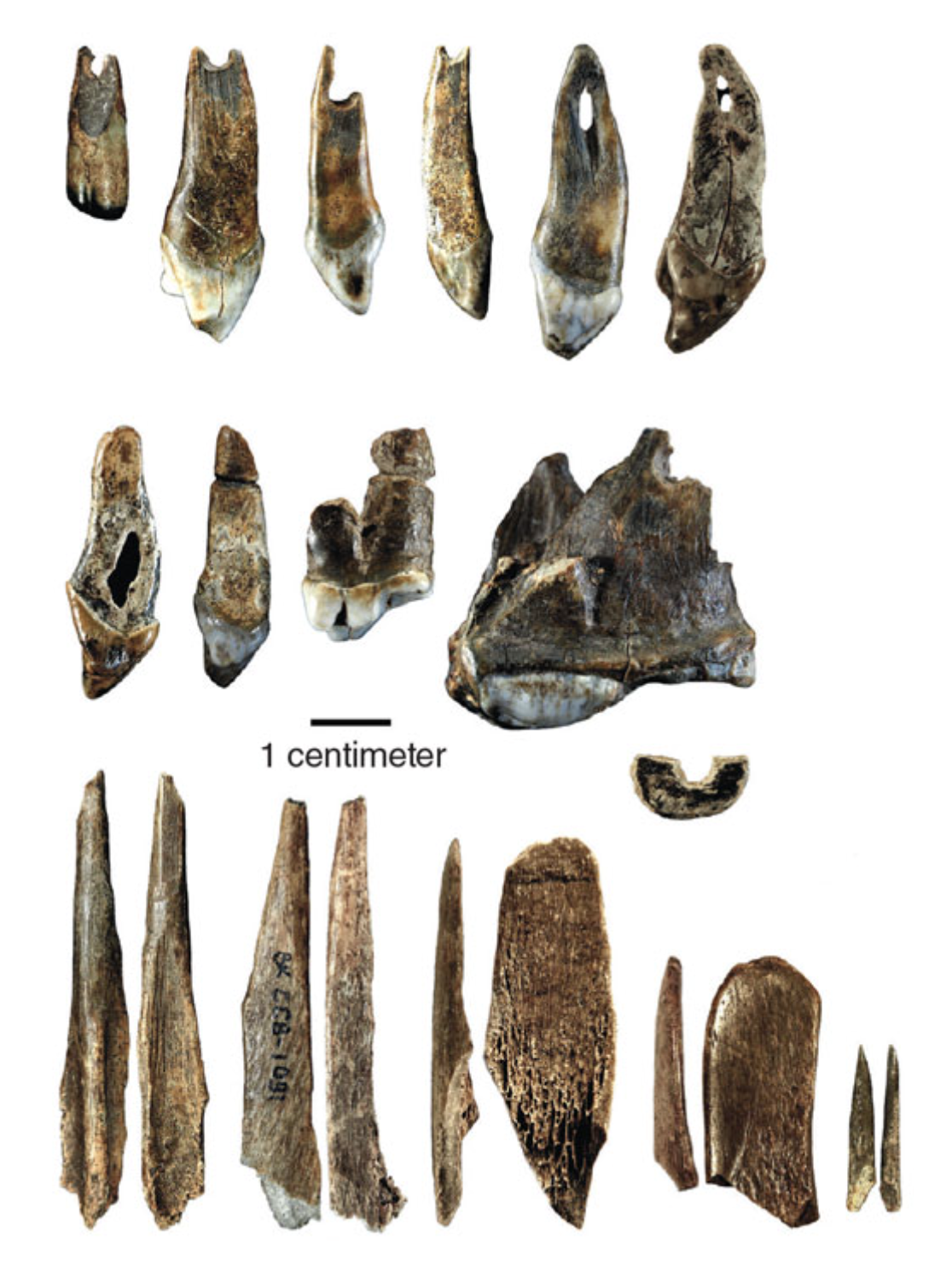
The bone tools and animal-tooth pendants of Bacho Kiro (Rosen Spasov and Geoff Smith, MPI-EVA Leipzig, License: CC-BY-SA 2.0)
Excavations at the cave site in 2015 revealed the most spectacular finds including thousands of animal bones, stone and bone tools, beads and pendants and the remains of five human fossils [24]. Genetic analysis of these remains found that the men among them carried two distinct Y-chromosome lineages, one a basal branch of haplogroup F, the other haplogroup C1, direct descendants of Adam's own line and among the very first patrilineal evidence of the population that would go on to father most of Europe [25]. Genomic analysis of this same population has since dated their single shared episode of interbreeding with Neanderthals to approximately 45,000-49,000 years ago, an encounter carried by every non-African lineage alive today [26]. Members of this same pioneering population pushed even further, reaching as far as modern-day Germany within a few thousand years and possibly further still toward the British Isles [27]. These artefacts provide a clear chronological picture of when Homo sapiens first occupied this cave, some 45,000 years ago and highlight the lifestyles of these hunter-gatherers and their ability to exploit their environment.
Important technological advances were made by the Upper Palaeolithic cultures, such as the invention of flint tools and fine-edged blades. It was also a time of artistic innovation, as seen in the cave paintings that can be found across Asia as well as in Western Europe, testifying not only to the development of technologies and tools but also to a high level of cultural and intellectual achievement. Descendants of Europa benefitted from this cultural awakening, which coincided with a period of rapid population growth and expansion resulting in nine major surviving daughter groups, U1 through U9, which are now found among people who have ancestral origins throughout Europe, Asia, and Africa.
Around 25,000 to 30,000 years ago, Ursula (haplogroup U5) [16,28], ancestor of the modern Grant line, daughter of the Europa lineage, is born. This ancient lineage is thought to have evolved among the glacial refugia of southern and eastern Europe, in the Franco-Cantabrian region, the Balkans, and Ukraine [28], before expanding further into Europe. The Dolní Věstonice burial site in the Czech Republic reveal how far the U5 population had dispersed with the presence of ancient remains of two U5 individuals dated at approximately 31,155 years old [29]. This archaeological site is an abundant source of prehistoric artifacts from the Gravettian period suggesting that carriers of haplogroup U5 were part of the pan-European Gravettian culture. At the neighbouring site of Pavlov, part of the same Gravettian settlement complex, a male individual has been found to carry haplogroup I, the lineage that defines Wodan himself [16], and that would, through him, give rise to the modern Durrant line [30].
Gravettian Culture
Members of the Gravettian culture wore shells as ornaments, sewed clothing with bone needles, created stylised ‘venus’ female figurines with elaborate headdresses and exaggerated breasts and buttocks, and left their distinctive art and artifacts from Spain to western Russia. The Gravettian were characterised by a stone tool industry with small pointed blades being used for big-game hunting, such as bison, horse, reindeer, and mammoth. These hunter-gatherers also practised specialised hunting, selective butchery and food storage. Despite these shared cultural practises, new genetic evidence shows the Gravettian were from two distinct groups, the first living in and around France and Spain, the second from across the Czech Republic and Italy [30].

Panel of the Rhinos, Chauvet-Pont-d'Arc Cave, France
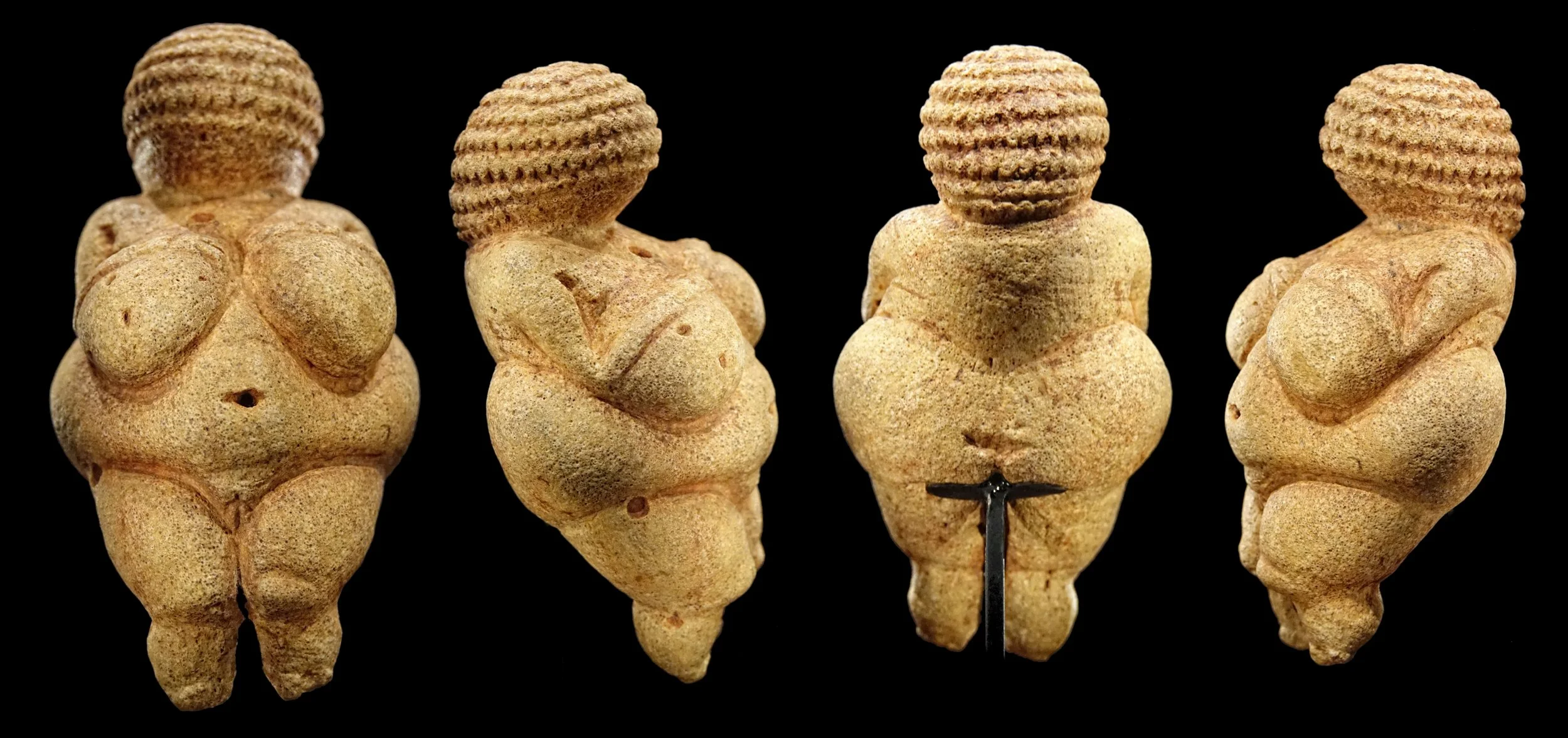
Venus of Willendorf, Austria
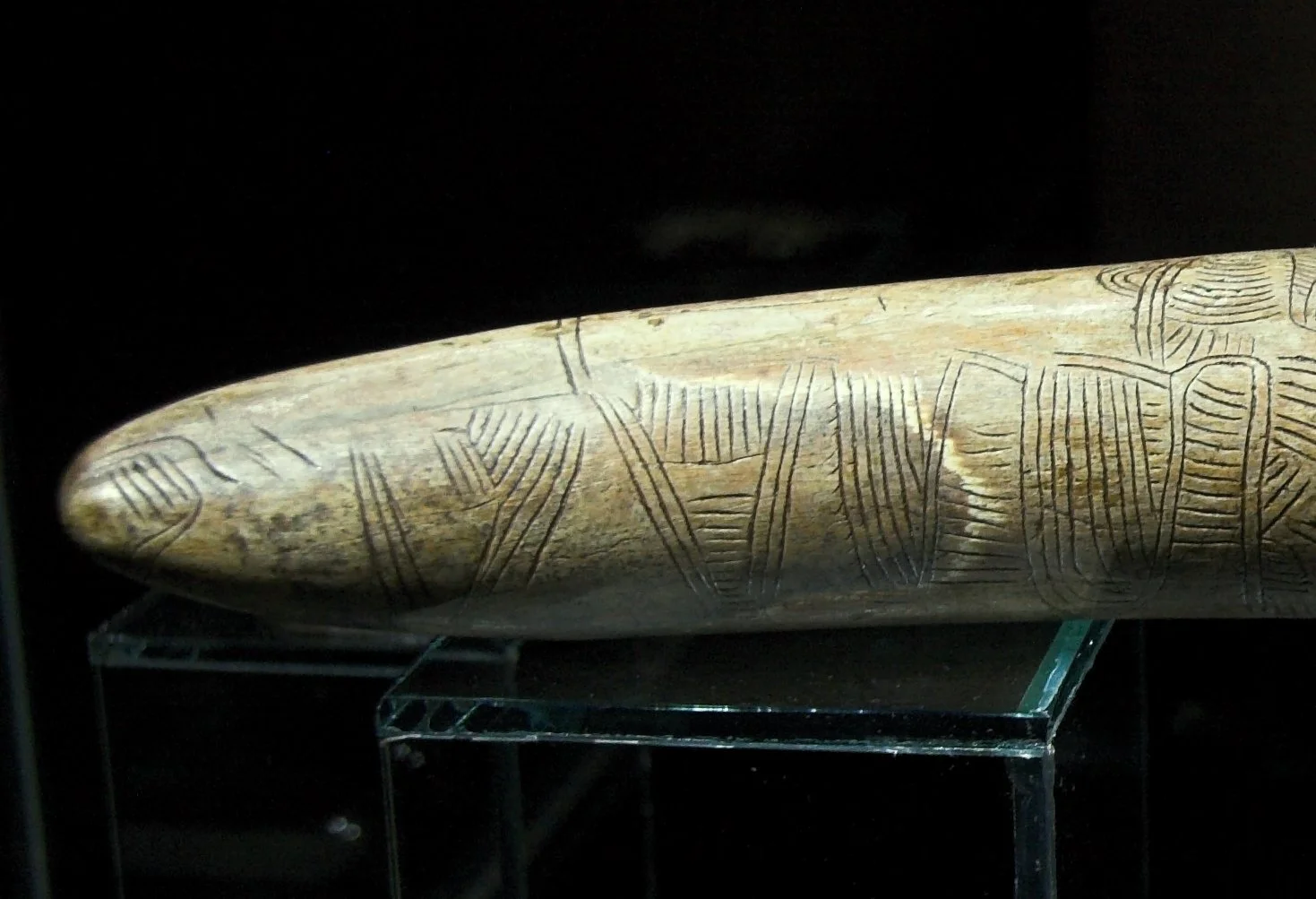
Engraved mammoth tusk from Pavlov, Czech Republic
The eastern Gravettians were specialised mammoth hunters that built sturdy structures out of the animals' bones, such as those at Předmostí, an exceptional prehistoric site located near Brno in the Czech Republic. Around 30,000 years ago it was inhabited by people who used the bones of more than 1000 mammoths to build their settlement and to carve ivory sculptures. Genetic analysis shows that the people of Předmostí belonged to a single, closely related population that also included the neighbouring settlements of Dolní Věstonice and Pavlov, a few miles distant, where Wodan's own line has already been found among the dead [30]. Analysis of carbon and nitrogen stable isotopes in human and animal fossil bones from the site found that humans consumed mammoth in large quantities, a reliance that would have helped sustain them through the increasingly harsh winters building toward the Last Glacial Maximum still to come [31].
Xenia Emerges
Around 31,800 years ago in West Asia, during the late Palaeolithic period, Xenia was born bearing the mutation that defines haplogroup X [16], the root of a family of lineages that would, many thousands of years later, narrow down to the specific branch, X2c, carried by Ann Wilde and her female descendants. She and Ursula were, in a sense, distant cousins, both descended from Naomi's line within a few thousand years of one another, yet their paths could hardly have diverged more sharply. While Ursula's own descendants were already living through the Gravettian at sites like Dolní Věstonice and Pavlov, and would go on to weather the Last Glacial Maximum in the refugia of southern Europe, Xenia's line stayed behind in West Asia for tens of thousands of years more, never once appearing among the Mesolithic hunter-gatherers of Europe or North Africa [32]. Even today, it remains one of the rarest matrilineal haplogroups in Europe, found in only 1-2% of native Europeans [33]. The region's deepest reservoir of X diversity survives today among the Druze of the Levant, an isolated community whose thousand-year tradition of marrying only within itself has preserved genetic patterns dating back far further still, further evidence that this corner of West Asia, rather than Europe, was Xenia's true home [34].
It would take the Neolithic farmers moving out of the Near East to finally bring Xenia's descendants into Europe at all, part of a small group of lineages carried through the Caucasus and the Carpathian Basin into Central Europe for the very first time [35].
Oisin’s Journey
While Wodan's line was settling into the heart of Europe, the ancestors who would become Oisin were following a very different path. The paternal haplogroup R itself does not emerge until around 25,000 years ago, at the height of the Last Glacial Maximum, and the evidence points not to Europe but to the vast plains of Central Asia and Siberia [36].
A young man buried at Mal'ta, in south-central Siberia, around 24,000 years ago, is among the earliest confirmed ancient individuals to carry the root lineage that defines Oisin himself, a Y-chromosome marker sitting at the base of nearly all western Eurasian men alive today [36]. His people, part of a population now known as the Ancient North Eurasians, ranged across a cold, open landscape thousands of miles from the ice sheets pressing down on Europe, in a world entirely separate from the one Wodan's line was weathering in its Balkan refuge.
Oisin's own particular branch, the one that would become R1b, appears to have differentiated somewhere further west, in West Asia, long before it reached Europe at all [37]. It would be another ten thousand years before any trace of R1b arrived on the continent. As the ice began its final retreat, a man we might call Orso, carrying a further mutation on Oisin's own line, R1b1, was buried at Villabruna, in what is now northern Italy, the earliest confirmed carrier of this branch anywhere in Europe, arriving around 14,000 years ago, a lifetime after Wodan's own descendants had already been established there for millennia [30].
Genetic analysis of Orso's own remains points to an appearance that would look striking to modern eyes: dark skin, paired with blue or light-coloured eyes, a combination almost the reverse of the modern Northern European stereotype, shared by hunter-gatherers found right across Ice Age Europe, from Spain to Sweden [30]. This kind of prediction is now possible because scientists have identified the specific genes responsible for human pigmentation and developed methods to read their state directly from ancient DNA, even in genomes many thousands of years old [38,39]. The pattern itself has a clear cause: darker skin protects against damaging UV radiation nearer the equator, but becomes a liability further from it, where the same UV is instead needed to make vitamin D in the skin. As descendant populations across Europe, including Oisin's and Wodan's own lines, spread into these different environments over the millennia that followed, each came under its own pressure to lighten, not as one single event but repeatedly, in different times and places [40].
The Last Glacial Maximum

19,000 BC
Roughly 20,000 years ago, during the Last Glacial Maximum of the Pleistocene Ice Age, ice spread over much of North America and Eurasia. Image by NOAA Climate.gov, based on data from the University of Zurich Applied Sciences, provided by Science on a Sphere.
Across much of northern and central Europe, the land became genuinely uninhabitable, buried under ice or reduced to a barren, wind-scoured tundra that could no longer support the plants and game that hunter-gatherers depended on. Human populations survived only by contracting into a handful of glacial refugia, warmer, more sheltered pockets further south where enough life persisted to sustain them, most importantly the Franco-Cantabrian coast of northern Spain and southwestern France, the Balkans, and the Mediterranean shoreline of Iberia. These refugia were not culturally uniform: the western, Franco-Cantabrian pocket developed its own distinctive toolkit, the finely worked stone blades known as the Solutrean culture, quite different from the Gravettian traditions that continued further east in the Balkans and Italy [44].
Ursula's own descendants sheltered in the Balkan refuge specifically, waiting out the worst of the Ice Age before the climate finally began to ease and people could spread back out to recolonise the rest of the continent [28]. A woman we might call Uvira, the first individual to carry the mutation that would come to define Ursula's own precise branch, U5a1, is found at exactly this moment of re-expansion, buried at Padina in the Iron Gates region of what is now Serbia, around 8,800 BCE [45]. In time, this same population's reach extended much further north still. Genetic evidence recovered from early Scandinavian hunter-gatherers points to two distinct waves of resettlement reaching that region once the ice retreated: one arriving from the south, broadly the same route Uvira's own people had taken; the other along the ice-free Norwegian coast from the northeast; the two eventually meeting and mingling there. One of the earliest Scandinavian individuals confirmed by this research carried Uvira's own U5a1 branch [46]. Whether Uvira's own particular descendants were among those who made this journey north isn't something the evidence can say for certain, but the branch she represents was clearly well established among Scandinavia's earliest settlers. Ancient DNA recovered from hunter-gatherers spanning this entire period, from tens of thousands of years before the Ice Age to thousands of years after it, shows a real, continuous maternal thread running through it, direct genetic continuity between the population Ursula belonged to and the hunter-gatherers who re-emerged once the ice retreated [47].
Wodan's own line weathered the same crisis nearby, and very likely in much the same way, sheltering in this same Balkan refuge alongside Ursula's own descendants. Haplogroup I is found nowhere in significant numbers outside Europe, and its deepest surviving diversity dates to almost exactly the time of the Last Glacial Maximum itself. Its I2a branch in particular is closely associated with a refuge in the Balkans, not far at all from where Wodan's own descendants had already settled at Pavlov before the ice took hold, suggesting his line may have survived the Ice Age sheltering in the very same region [48].
Roughly 20,000 years ago, during the Last Glacial Maximum of the Pleistocene Ice Age, ice spread over much of North America and Eurasia, a major climatic episode lasting from around 26,000 to 19,000 years ago, during which extensive ice sheets covered almost a quarter of the Earth's land surface. In North America, the ice sheet's southern margin reached deep into the Midwest, as far as present-day Iowa;in Europe, it extended into Germany and Poland; in Asia, mountain glaciation covered much of the Tibetan plateau. Sea levels fell by around 130 metres, and average global temperatures dropped some 6°C below those of today [41, 42].
While Oisin's own ancestors ranged a bitterly cold but largely ice-free landscape across Siberia and Central Asia, and Xenia's own line remained undisturbed further south in West Asia, the descendants of Ursula and Wodan faced the harshest test yet. Siberia's escape from major glaciation seems counterintuitive given how cold it became, but the region was simply too dry: so far from any ocean moisture source that even extreme cold couldn't generate enough snowfall to build large ice sheets, and glaciation there was largely confined to a handful of isolated mountain ranges rather than the continent-spanning ice that buried Scandinavia [43]. Instead, it became a vast, treeless grassland known as the mammoth steppe, cold, dry, and open, but rich enough in game to sustain the hunter-gatherers who lived there.
Britain’s Earliest People
As the ice retreated, Britain remained joined to the rest of Europe by dry land [49], and people began moving into it for the first time in many thousands of years. None of these earliest arrivals, however, were Ursula's or Wodan's own particular descendants, their own families' arrival in Britain still lay many thousands of years in the future. What follows is the story of the island itself, repeatedly settled and resettled by different peoples long before either line finally made the crossing. Evidence of this has now been found right across the country, from the south coast to the far north of England.
The clearest sign of just how far this reach extended comes from Heaning Wood Bone Cave in Cumbria, where the earliest known human remains from northern Britain, a young girl who died around 11,000 years ago and has been nicknamed the "Ossick Lass", were buried alongside a small string of pierced sea-shell beads. Her remains were too poorly preserved for her genetic ancestry to be determined, but her presence alone confirms that people had already pushed deep into the north of the country by this time, several thousand years before farming ever arrived [50].
It is from two even older individuals, both discovered further south and both well enough preserved for a fuller genetic picture, that the clearest story of this earliest period has emerged. Two of the very oldest human genomes ever recovered from British soil reveal that this was not a single, uniform movement of people, but the arrival of at least two genuinely distinct populations within the space of little more than a thousand years [51].
The earlier of the two, a woman who died at Gough's Cave in Somerset roughly 15,000 years ago, belonged to an older population already established across Magdalenian Europe, closely related to people living at sites in Spain and Belgium at the same time. Her people ate the land mammals of the tundra, and the remains found alongside her, including human bones bearing cut-marks and modification, have been read by archaeologists as evidence of ritual practices involving the dead.
A second individual, a man who died at Kendrick's Cave in North Wales little more than a thousand years later, around 13,500 years ago, tells an entirely different story [51]. His ancestry connects instead to the wider population expanding out of the Villabruna cluster, the same broad ancestral group already met at Villabruna itself, in Italy. His people's diet, rich in marine and freshwater foods, and his burial alongside decorated ivory ornaments rather than butchered animal remains, point to a genuinely different way of life from the one practised at Gough's Cave. His mitochondrial DNA belongs to haplogroup U5a2, a cousin branch of the same wider family Ursula herself belonged to [51]. None of this tells us that her own particular line was here this early, only that people carrying her wider genetic family had already reached the furthest edge of northwestern Europe within a couple of thousand years of the Ice Age's end. Whether this specific population left any descendants at all is impossible to say, Britain, as the evidence from these sites already shows, was settled and resettled by different peoples many times over, and not every arrival left a lasting mark.
Generations after Kendrick's Cave, one of the best-known ancient Britons of all lived and died at Gough's Cave itself, the same site as the Magdalenian woman described above, though many thousands of years later and from an entirely different population. This man, now known as Cheddar Man, lived around 10,000 years ago, well into the Mesolithic, and belongs to the same broad Y-DNA family as Wodan, though not, as far as the evidence currently shows, his own specific branch [52]. His presence confirms that people carrying some part of this wider paternal lineage were now well established across Britain, even as the land bridge connecting it to the rest of Europe was still, for the moment, intact.
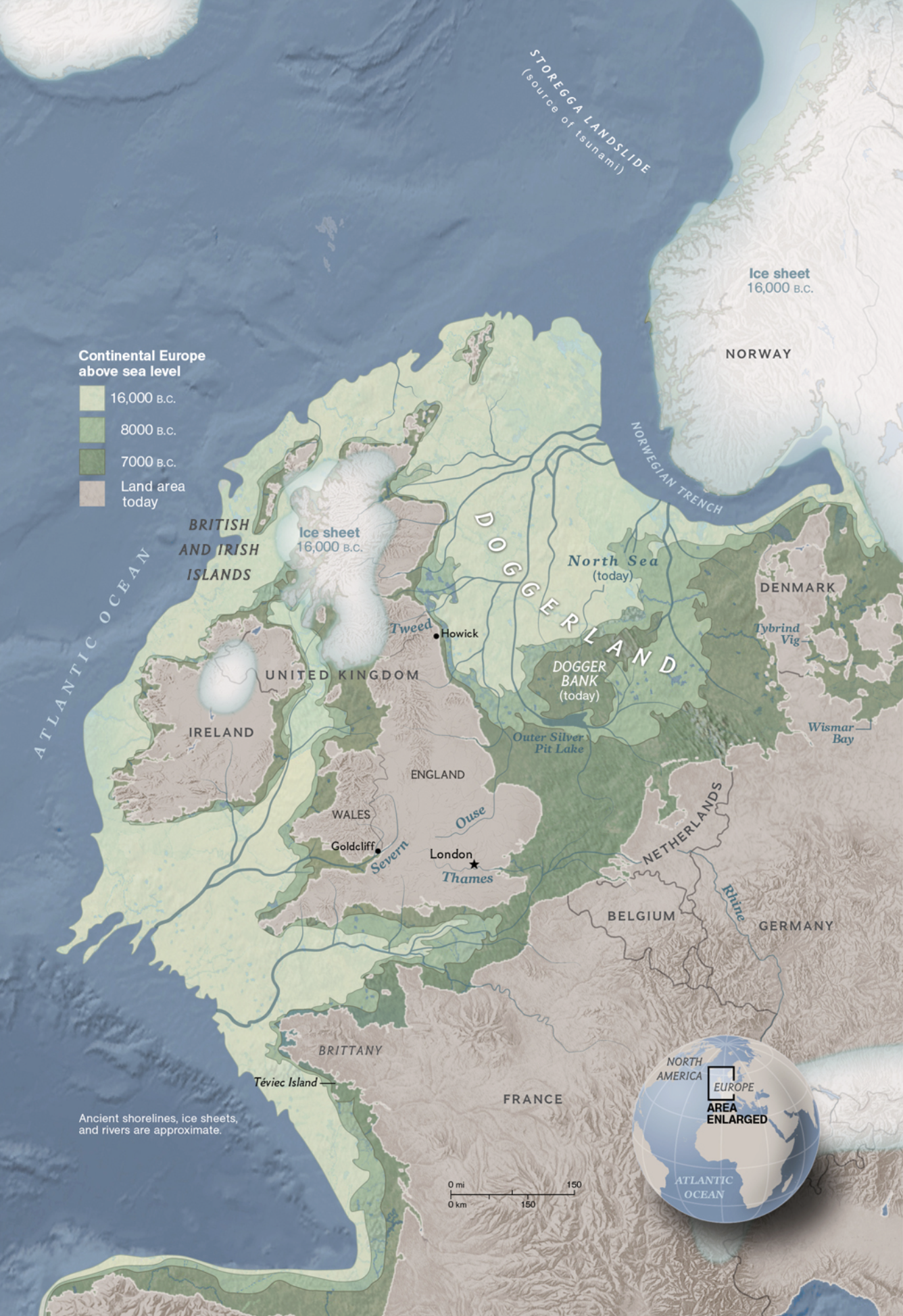
Doggerland, the now-submerged landscape that once connected Britain to mainland Europe, shown here before rising seas gradually reclaimed it. What survives today as Dogger Bank, a shallow sandbank in the North Sea, was once solid, inhabited ground. Map by William E. McNulty and Jerome N. Cookson, National Geographic Magazine (2012), based on research by the University of Birmingham's North Sea Palaeolandscape Research Team.
For thousands of years yet, this land connection would survive. As global temperatures rose and the ice continued its retreat, sea levels crept upward too, but not swiftly enough to submerge a landmass the size of Doggerland all at once, the process took millennia rather than centuries, rising by as much as a couple of metres a century during major bursts of meltwater, then stalling for generations at a time. By around 8,000 years ago, what remained of this once-vast country had shrunk to a scattering of low islands, and a catastrophic tsunami swept across what was left of it. The wave was triggered by one of the largest submarine landslides of the entire Holocene epoch, a collapse of some 2,400-3,200 cubic kilometres of sediment off the coast of Norway, sending waves as high as 20 metres crashing onto the Shetland Isles, and still several metres high by the time they reached the coast of northern England, around 6,150 BCE [53,54]. Recent research on the Northumberland coast, close to where Wodan's own broader family was already living, suggests the tsunami coincided with a real and significant decline in the region's Mesolithic population, though whether any specific community there was struck directly remains genuinely uncertain, the timing of the tide when the wave arrived may have made all the difference between a direct hit and a near miss [55]. Even this was not quite the end; a handful of islands are thought to have endured for a few centuries more before the land connection finally disappeared entirely, somewhere around 6,500 to 5,800 BCE. Losing this land bridge did not mean losing all contact with the continent, though. Boats were already part of life for the people of this period, and it was by boat, not on foot, that the next great change would eventually reach Britain.
The Age of Farming
Around 10,000 years ago, in the hills and river valleys of the Fertile Crescent, people began doing something genuinely new: rather than following the herds and the seasons, they started staying in one place, planting crops, and keeping animals close. This was not a single invention spreading outward from one point, but several related experiments taking hold independently in different communities across the region at roughly the same time, later merging into a single, unstoppable way of life [56].
From there, farming moved into Europe along two broad fronts, each leaving its own distinctive mark on the archaeological record. One traced the Mediterranean coastline westward, reaching Iberia and southern France, its communities identified today by pottery decorated using the edge of a cockle shell pressed into wet clay, a style archaeologists call the Cardial or Impressed Ware tradition. The other moved up through Anatolia and the Balkans, following the Danube deep into Central Europe, its communities marked instead by pottery incised with fine linear bands, the tradition known as Linear Pottery, or LBK. These distinctive pottery styles are not incidental to the story, they are themselves evidence of the transition itself. Farming produces a genuine surplus that hunting and gathering does not, and that surplus, grain above all, needs to be stored between harvests, protected from damp and pests through the lean months. Pottery, heavy and easily broken, only makes sense for people settling in one place long enough to make it, use it, and keep it, so its sudden appearance across Europe is itself a marker of the deeper shift underway: a settled, surplus-producing way of life replacing a mobile one [57].
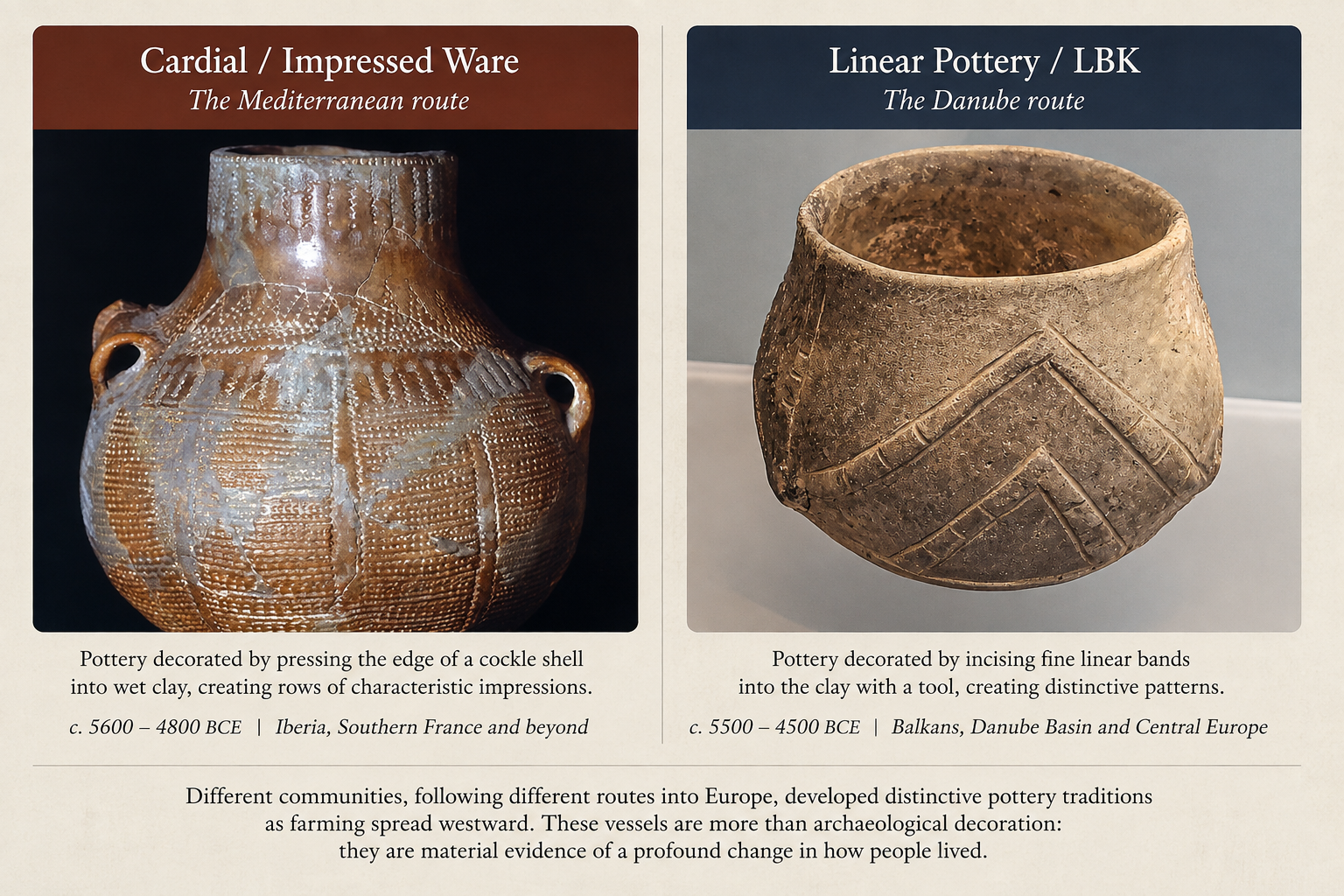
It was not, primarily, a story of people simply teaching their neighbours a new technique. Genetic evidence shows real, substantial movements of farming populations themselves, carrying their ancestry with them as they went, not merely their tools and seeds, a set of maternal lineages known as the mitochondrial "Neolithic package" makes up the overwhelming majority of these early farmers' genetic diversity, while the older hunter-gatherer lineages they encountered account for only a small fraction [35].
What this meant for Europe's existing hunter-gatherer populations varied enormously by region. Across much of western Europe, incoming farmers came to dominate the genetic record almost entirely within a few centuries, leaving only faint traces of the older hunter-gatherer lines. But this was not a uniform replacement everywhere. A real divide persists across the continent, roughly running from the Black Sea to the Baltic, on one side of which farming brought near-total population change, and on the other, considerably more continuity with what came before [58].
It was into the western branch of this migration, the Anatolian farmers moving through the Caucasus and the Carpathian Basin, that Xenia's own line finally entered Europe, after tens of thousands of years confined to West Asia [35]. Whether this reflects farmers themselves migrating in numbers, or the slower spread of farming as an idea between neighbouring communities, has long been debated; Y-chromosome evidence generally favours the former, showing that a real, substantial movement of people, not just their methods, accompanied agriculture's spread across the continent [59]. Wodan's own family took a different, quieter path into this same new world: a man we might call Waska, carrying a further mutation (I-L161.1) on Wodan's own line, was absorbed into one of Iberia's earliest farming communities around 5,300 BCE, his indigenous ancestry folded into the new way of life rather than displaced by it, part of a wider pattern in which entire hunter-gatherer lineages, not just individuals, were drawn into the farming world as it expanded around them [60]. None of this, though, brought either line's own particular descendants to Britain, that still lay many centuries ahead, and would happen only once farming itself finally made the crossing. Ursula's and Oisin's lines, meanwhile, when first confirmed in the ancient record at all, are found on the eastern side of the great divide throughout this whole period, still rooted among the steppe and forest populations of what is now Russia and Ukraine, though what came before that first confirmed appearance remains genuinely unknown.
Agriculture Reaches Britain
Farming reached Britain during the early fourth millennium BCE, roughly 4,000 BCE, more than two millennia after rising sea levels had finally severed the land connection across Doggerland. The first farming communities therefore crossed the Channel by boat, bringing domestic animals, cereals, and new practices of cultivation, herding, pottery production, and monument building.
Their genetic impact was substantial. Early Neolithic people in Britain were largely descended from farming populations ultimately related to the Aegean and western Mediterranean, with particularly close affinities to Neolithic populations associated with Iberia, northern France, and the Atlantic seaboard [52]. This does not necessarily mean a single migration travelled directly from Iberia; the shared ancestry may instead reflect several stages of movement and mixing across western Europe before any group made the crossing [61], and isotope analysis of individual teeth gives this a very human dimension: at one Early Neolithic burial site in central England, several people were found to have grown up not in Britain at all, but somewhere in temperate continental Europe, most likely northern France, before ending their lives buried far from where their childhoods began [62]. Xenia's own broader line was among the farming populations of continental Europe at this time, but if any of her family made this particular crossing to Britain, no trace of them has yet turned up among the British burials tested so far, an absence that may say more about how much still lies unexcavated than about where they actually were. Nor was the change in Britain itself instant or uniform: British Neolithic genomes retained a geographically variable trace of the older hunter-gatherer ancestry, and the archaeological record suggests forager and farmer communities coexisted for generations rather than one simply replacing the other overnight [63]. Ursula's own line belonged to that older hunter-gatherer world, and her wider U5 family does turn up again and again among the traces that persisted, though her own precise U5a1a1 branch has still never been identified this early, whether that means she genuinely hadn't arrived yet, or simply hasn't been found, the evidence can't yet say.
"Farming" did not mean permanent village life everywhere, either. Early communities combined cultivation with cattle and sheep herding, and many moved seasonally between grazing territories, much as their hunter-gatherer predecessors once followed game; more substantial, long-lived settlements did exist too, and the balance between permanence and mobility varied considerably from region to region. From the later thirty-eighth and early thirty-seventh centuries BCE, something over two centuries after farming itself first arrived, communities in southern Britain began constructing causewayed enclosures, large earthworks formed by rings of interrupted ditches and banks, at sites like Windmill Hill in Wiltshire [64]. These do not appear to have been defended settlements, but places where scattered communities gathered for feasting, exchange, animal management, ceremony, and the working-out of social relationships between groups.
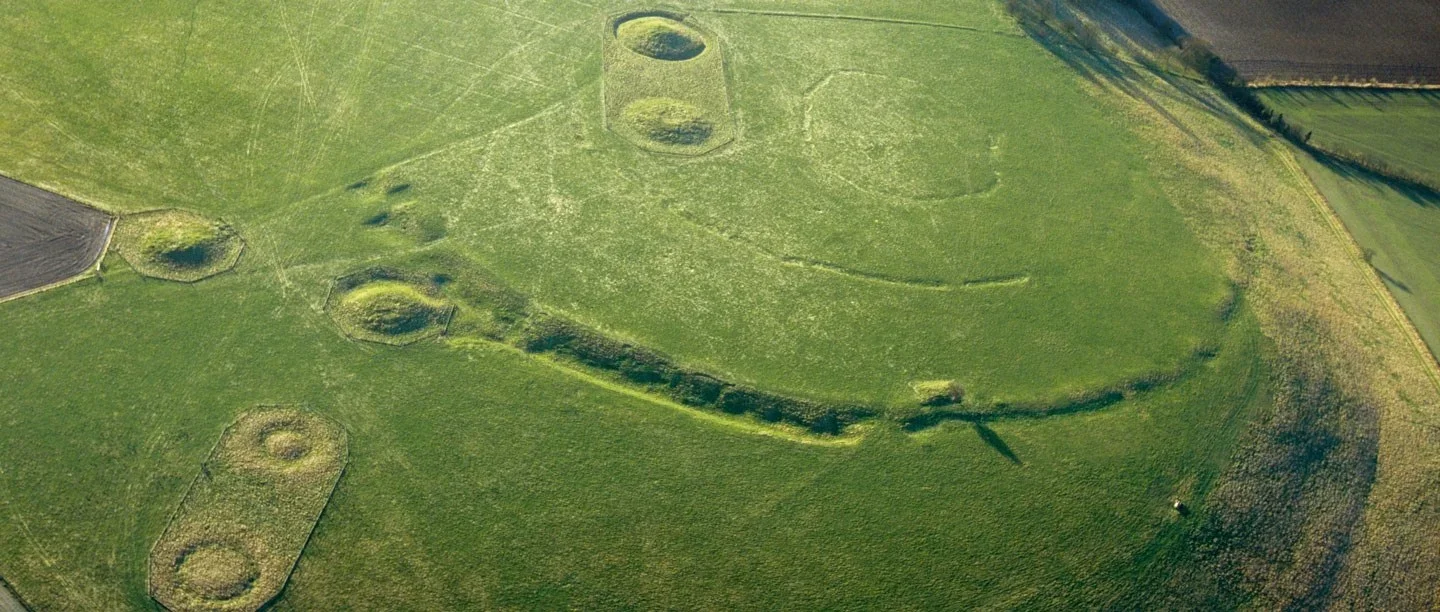
Windmill Hill, Avebury is a classic example of a Neolithic 'causewayed enclosure', with three concentric but intermittent ditches and is the largest known causewayed enclosure in Britain.
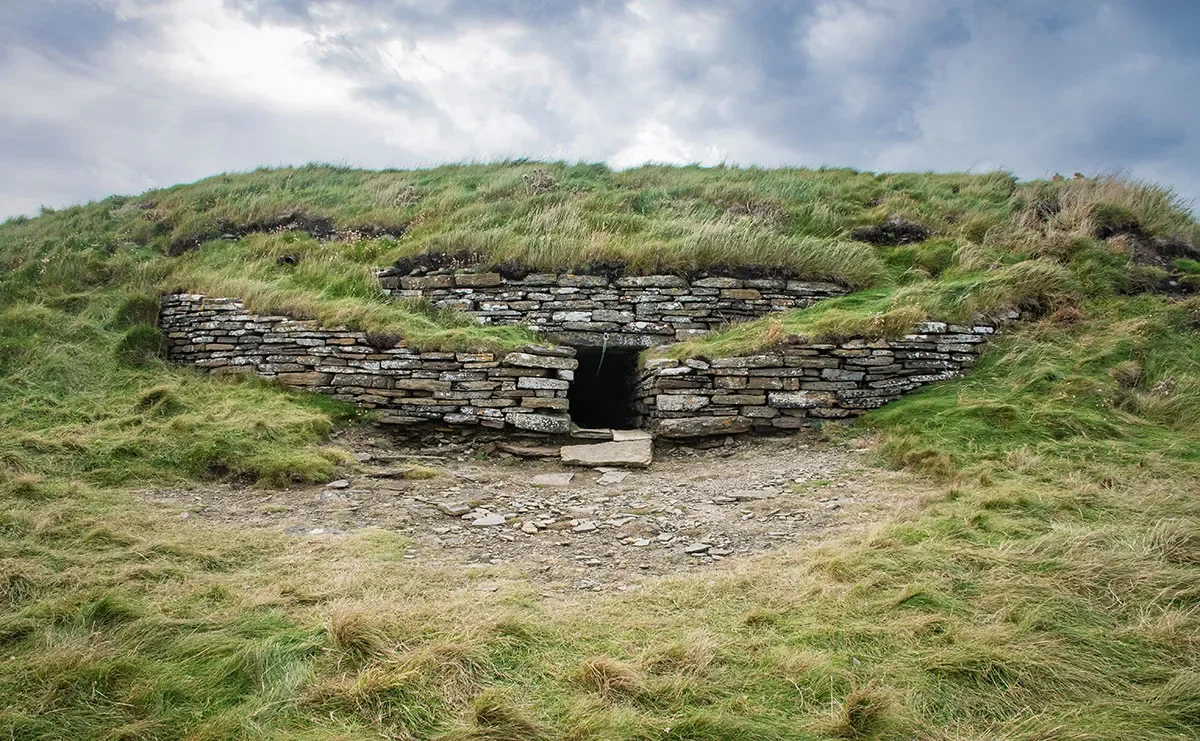
Tomb of the Eagles, or Isbister Chambered Cairn, is a Neolithic chambered tomb located on a cliff edge at Isbister on South Ronaldsay in Orkney, Scotland
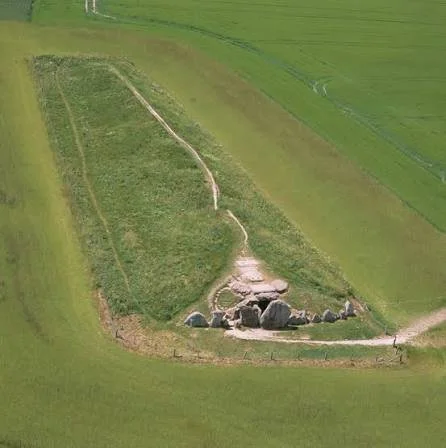
West Kennet Long Barrow is one of Britain's largest Neolithic tombs. It holds cremations and the partial remains of at least forty-six people.
Alongside them, long barrows and other collective tombs became places where human remains were repeatedly rearranged, added to, and sometimes removed altogether, a pattern archaeologists often read as evidence that the dead remained materially bound up with the lives of the living, though the beliefs underlying it can't be recovered with certainty. Recent ancient-DNA analysis of several Orkney and Caithness tombs has given this idea real substance: many of the men buried together turn out to be close biological relatives through the paternal line, suggesting these communities were deliberately using their tombs to trace and display descent itself, quite possibly a social practice every bit as significant to them as the pots, cattle, and crops that came with farming [65]. Among the men whose bones have been tested in these same tombs, the Y-chromosome haplogroup I2a turns up again and again, Wodan's own broader paternal family, well and truly at home in this landscape of monuments and ancestors, even if it isn't yet possible to say whether his own particular, documented line was among the men buried there, or whether these were more distant cousins sharing the same deep root.
Oisin's story, for now, plays no part in any of this. His own people are still a world away on the Pontic-Caspian steppe; it will be many centuries yet before their path crosses this island's.
The Steppe and the Yamnaya
On that same open grassland running north of the Black and Caspian Seas, an entirely different world had been taking shape for far longer, one built around cattle, sheep, and constant movement rather than fields and permanent villages. Between approximately 4,500 and 4,300 BCE, one of the largest and richest known Eneolithic communities of the middle Volga buried its dead at Khvalynsk, on the Volga River, a cemetery that would grow to hold over two hundred graves, an exceptional assemblage of 373 worked-copper objects, among the largest known from the Eneolithic steppe, and remarkable evidence of ritual sacrifice, more than 150 sheep, cattle, and horses buried alongside their owners [66].
Chemical evidence indicates that dairy products were already being consumed here, part of a wider pattern of dairying taking hold across parts of the Eneolithic steppe, though its scale and importance likely varied from community to community [67]. This turn toward herding and dairying was not simply a matter of taste. The steppe climate was drying through this same period, and cattle and sheep, able to survive on marginal, increasingly arid grazing land, offered a far more dependable source of food than the region's older, more varied economy of hunting, fishing, and small-scale foraging ever could [66,67]. It was less a lifestyle choice than a response to real, sustained environmental hardship. Shared pressures like this often draw people together as much as they drive them apart, and Khvalynsk appears to have been exactly this kind of meeting point, where populations connected with the northern Volga, the forest-steppe further north, and networks reaching south to the Caucasus interacted, and at times mixed [68]. This particular adaptation wasn't unique to the steppe. Around this same broad era, a completely different mutation for digesting milk into adulthood arose independently among pastoralist populations in Africa, the same problem, solved twice, by two unrelated populations facing the same challenge in different parts of the world [69].
It is here, generations before the Yamnaya culture itself existed, that the same broad R1b lineage carried by Orso at Villabruna, fourteen thousand years earlier, turns up again in the record for the first time. A man we might call Otar, on this same paternal line, carried a further mutation, R-L754, and was buried at Ekaterinovskiy-Mys on the Samara River around 5,300 BCE [70]. The connection between them is a broad phylogenetic one rather than a directly traced family line: Y-DNA passes unbroken from father to son, but Orso, the one confirmed individual we have from those thousands of years, may simply belong to a related branch rather than being Otar's own direct forebear.
The world these people were building was not without its own dangers. Ancient DNA recovered from several Bronze Age burials on this same stretch of steppe, not far from Ekaterinovskiy-Mys itself, has identified early strains of Yersinia pestis, the bacterium behind plague, circulating among these communities thousands of years before it appears in any written record [71].
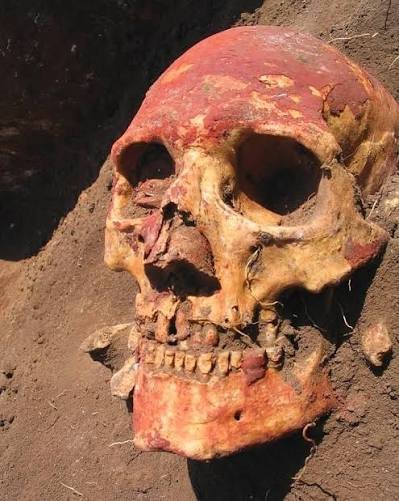
A skull stained with red ochre, a burial practice distinctive to the Yamnaya world. Samara region, Russia, c. 3300–2600 BCE.
Credit: Photo: Natalia Shishlina
The genetic ancestry that would come to define the Yamnaya world was already forming in communities like this one by around 4,000 BCE, but it would be many more centuries before Yamnaya emerged as its own distinct archaeological culture, around 3,300 BCE [68]. Still fundamentally pastoral, still following their herds across the open grassland, Yamnaya communities developed something genuinely new: they began building great earthen burial mounds, kurgans, over their dead, most of them constructed within a few centuries either side of 2,800 BCE, laid to rest on their backs with knees drawn up, covered in red ochre [73]. Wheeled vehicles, solid wooden wagons drawn by oxen, sturdy enough that entire carts were sometimes buried alongside the dead, were among the technologies that made this new way of life practical, allowing people, goods, and livestock to move far greater distances than before. Wheeled transport wasn't unique to the Yamnaya alone, and it was only one factor among several, alongside their pastoral economy, their social networks, and simple population growth, that together made possible the remarkable expansion still to come.
It is also here, in this same world, that Ursula's own specific branch came into being. A woman we might call Urte must have lived before the earliest currently known carriers of U5a1a1, though she has not herself been identified. The earliest currently published individual assigned to this branch is a man buried at Khvalynsk around this same period, who inherited his mitochondrial DNA through his mother, as everyone does, regardless of sex [66]. Remarkably, another man from this same community carried Otar's own R-L754 lineage too, a coincidence of geography and time rather than any known family connection between the two, but a striking one nonetheless: the earliest currently published representatives of Ursula's and Otar's specific branches have therefore been found within the same Khvalynsk community, on this same stretch of steppe.
Within this same wider R-L754 family, later men across the steppe carried a further, more downstream mutation, R-M269. Odal was one of them. Oisin's own documented line likely descends from this same branch, though not necessarily from Odal himself specifically, the connection is a broad phylogenetic one, not a traced family line. R-M269 itself would not become the dominant Western European lineage it is today for many centuries yet, that transformation belonged to specific later branches descending from it, spreading above all with the Bell Beaker culture much further down the line [72].
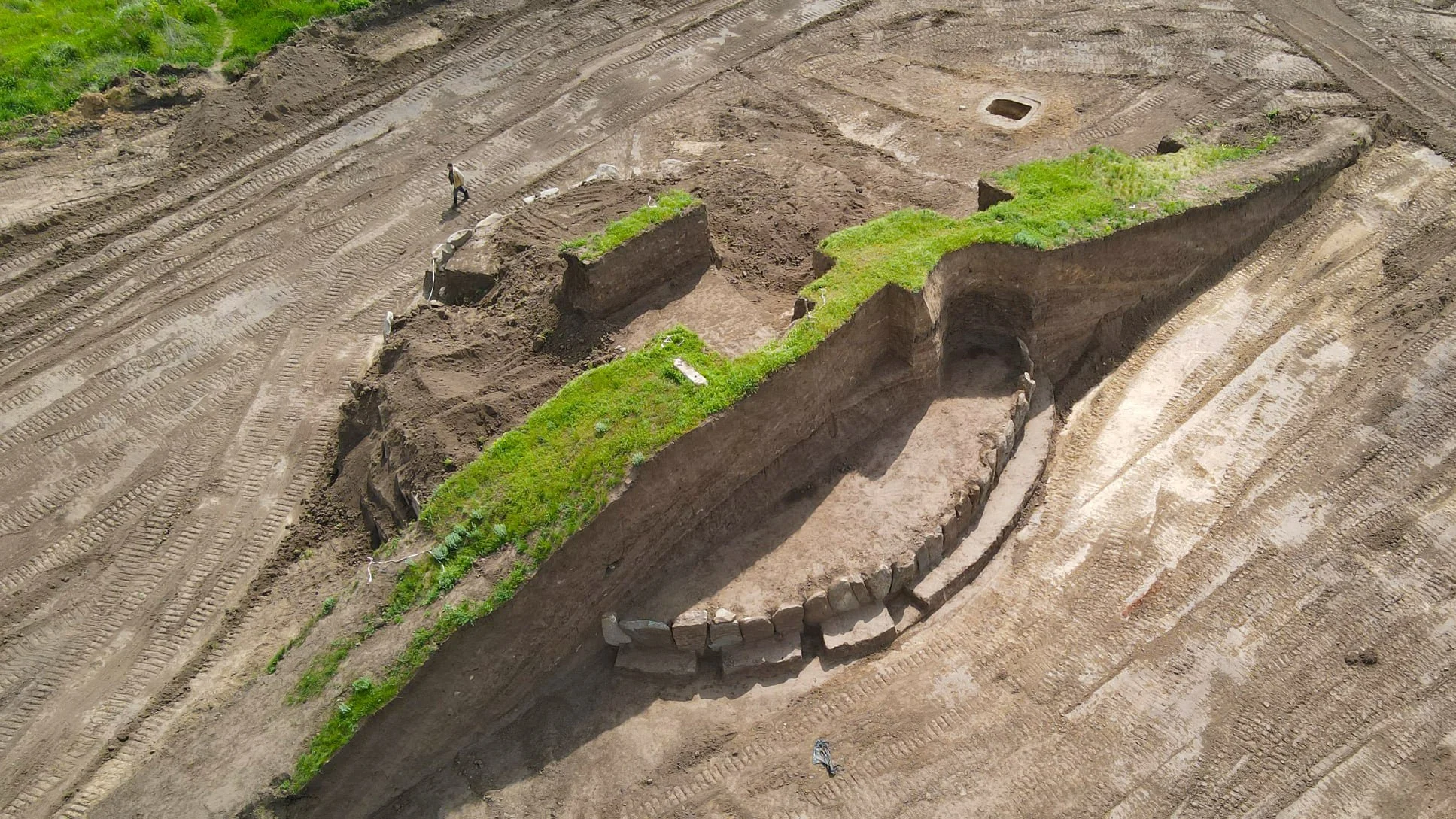
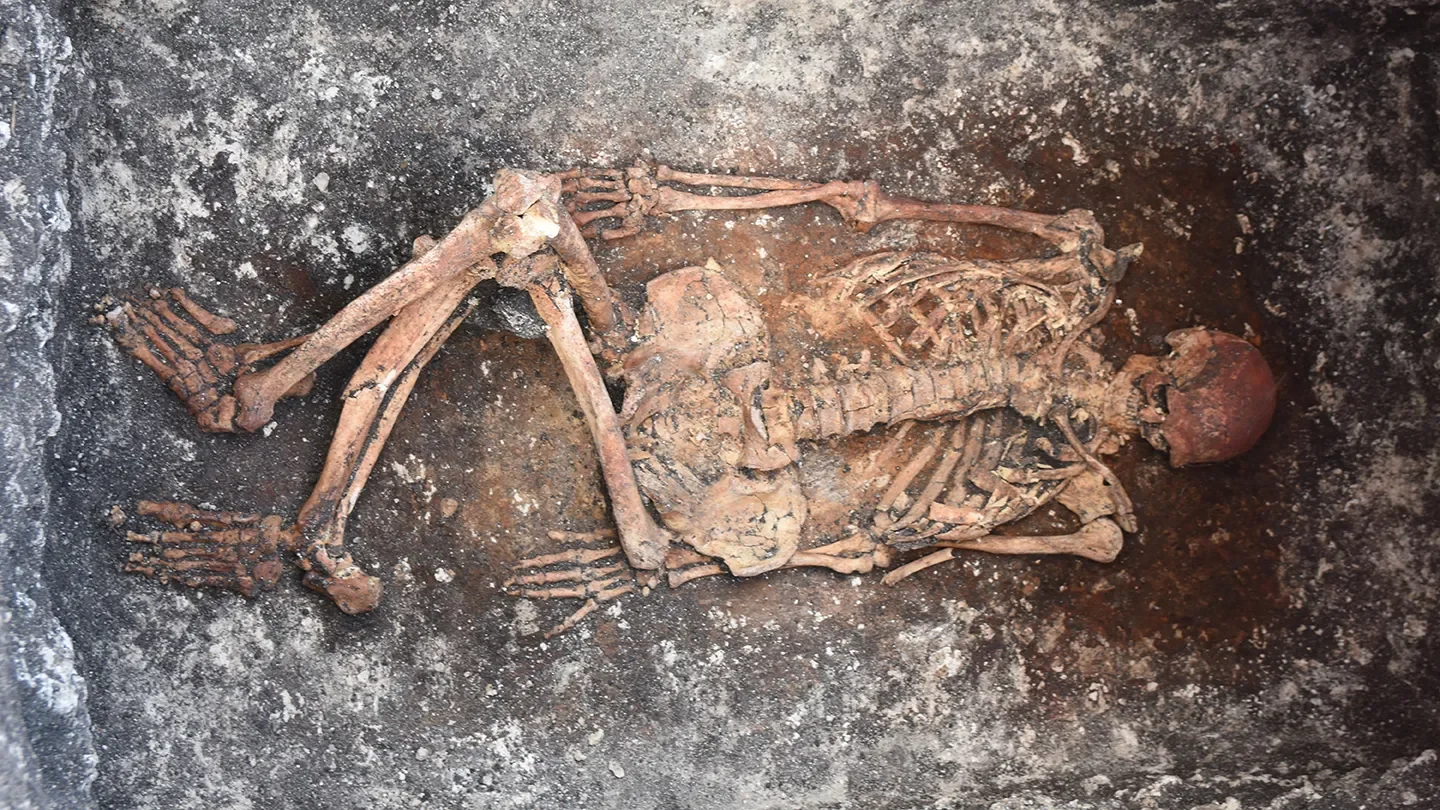
Upper Image: An open kurgan with stone circle (cromlech), the great earthen burial mounds raised by the Yamnaya over their dead. Novooleksandrivka, near Dnipro, Ukraine, c. 3500 BCE
https://www.indo-european-connection.com/science/yamna-culture
Lower Image: A Yamnaya skeleton showing skeletal wear consistent with habitual horseback riding — among the earliest such evidence anywhere. Pontic-Caspian steppe, c. 3000 BCE.
Credit: Photo: Photo: Michał Podsiadło
While this steppe world was taking shape, Xenia's own line, having finally reached Europe with the first farmers, was continuing to quietly diversify. Xanthe herself represents an early branch of this same X2c family, the branch that will, many centuries later, lead to Ann Wilde. She was buried in a communal gallery grave at Niedertiefenbach in western Germany around 3,200 BCE, the earliest confirmed ancient individual known to carry this branch, though the specific sample there resolves one step further still, to a subclade called X2c1, a level of precision beyond anything currently known about the documented family line itself [74]. Whether she and the X2c1 sample are one and the same, or simply close relatives on the same family tree, isn't something the evidence can yet say for certain, our own family's own test results only resolve as far as X2c itself. Genome-wide genetic analysis of the wider Niedertiefenbach community, together with archaeological and isotopic evidence, found a surprisingly large proportion of older hunter-gatherer ancestry mixed in alongside their farming heritage, a reminder that even by this point, centuries after the transition began, the two worlds were still very much blending into one another.
The scale of what followed on the steppe was extraordinary. Beginning around 3,000 BCE, Yamnaya-descended populations expanded outward in multiple directions, into Central Europe, into Central and South Asia, carrying with them not just their genes but, many linguists believe, the deep ancestor of the Indo-European family of languages spoken by billions of people today [60]. Horses were already being kept and exploited for meat, milk, and transport within this world, though regular mounted riding would become widespread only later, that particular transformation, and the further changes it brought, belonged to a still later chapter of this same story [75].
The Beaker People
Among the many communities touched by the Yamnaya's own expansion was one named, by archaeologists, for the distinctive bell-shaped pots buried alongside its dead: the Bell Beaker culture. Beginning around 2,800 BCE in the lower Rhine region, and drawing on ancestry ultimately rooted in the Yamnaya steppe, Beaker-associated people and their goods spread with remarkable speed across much of western Europe over the following centuries [72]. The culture takes its name from the graves themselves: unlike the collective tombs and shared enclosures of the preceding farming centuries, Beaker burial typically meant a single body laid on its side in a crouched position, accompanied by a small, personal set of grave goods, a distinctive pot, sometimes a copper dagger or an archer's wrist guard, occasionally gold ornament, marking a genuinely new relationship between the dead and the living.
Their spread also coincided with one of the most severe climate shocks of the entire Holocene. Beginning around 2,200 BCE, a prolonged, widespread drought later named the 4.2-kiloyear event brought sustained aridification across a huge stretch of the world, from Mesopotamia to Iberia. In Iberia, where Bell Beaker communities were becoming established at exactly this time, people responded by digging some of the earliest known groundwater collection systems in the region [76]. In Britain and along the North Sea, the same period saw real strain too: population decline recorded on Orkney, changes in how communities stored food, and some archaeologists see the close-knit, seafaring network the Beaker culture became as partly a response to this same pressure [77].
Britain, already reshaped once by the arrival of farming and touched by several earlier waves of settlement, now faced a transformation of a different order again. Beaker-associated migrants arrived from the continent from around 2,450 BCE, and within just a few centuries came to replace some 90% of Britain's existing gene pool [72]. One particular family within this vast movement of people is especially well documented, and it is here that Oisin's own paternal line, already traced as far as Odal on the open steppe, finally reaches this island.
In Iberia, a man we might call Oretus, one of Odal's own descendants, carried the next mutation on this same paternal line, R-P312, the marker that would go on to define the very branch of the Beaker phenomenon that eventually reached Britain. He is the earliest confirmed individual anywhere found to carry it, buried at El Hundido, near Burgos in northern Spain, sometime between 2562 and 2306 BCE [78]. The site itself had a long and dramatic history by the time of his burial: centuries earlier, it had held a large collective tomb, the remains of nearly a hundred people, before that older monument was deliberately destroyed by fire. Isotope analysis of teeth from Beaker-period individuals buried there afterwards shows a community that was not entirely local, at least one person's origins traced back to the west of the Iberian Peninsula, evidence that the mobility already carrying the Beaker phenomenon across the continent extended even to who ended up buried at any one site [79].
It was Oretus's own wider family, not Oretus himself, who made the actual crossing to Britain a few generations later. Owen, carrying a further mutation on this same paternal line, R-L21, was buried at Amesbury Down within sight of Stonehenge around 2,200 BCE, not alone, but as one of a group of at least seven men and children laid to rest together, whose remains suggest they may have been closely related. Buried alongside them were eight Beaker pots, an unusually high number, five flint arrowheads that later gave the group its name, the Boscombe Bowmen, a boar's tusk, and a rare carved bone toggle. Isotope evidence from their teeth suggests these were not new arrivals from the continent at all, but young men who had grown up further north in Britain itself, in Wales or the Lake District, before moving south to the Stonehenge area not long before they died. Owen himself is the earliest confirmed individual anywhere carrying R-L21, on the direct path toward the documented line carried by the Milburn and Butt families today [72].
Ursula's own U5a1a1 line, descended from Urte, reaches Britain at almost exactly the same moment, buried at Windmill Fields in County Durham at the very start of this same Beaker period [80]. But she did not arrive, it seems, aboard the same boats as Owen's people. The man buried alongside her, presumably her son, carries an entirely different, much older Y-chromosome lineage, I-Y3709, part of the same broad paternal family Wodan himself belongs to, though not, as far as the evidence shows, his own specific documented branch, and already established in Britain long before the Beaker migration ever arrived. As already noted, a man inherits his mitochondrial DNA from his mother regardless of his own paternal line, so there's nothing contradictory in this indigenous man carrying such a recently arrived maternal marker. It simply tells us that Ursula's own line reached Britain woven into a family that was, on its paternal side, already established there. It would be another eight hundred years before Owen's line and Ursula's own line are found together in the same individual, a man carrying both an R-L21 father's line and a U5a1a1 mother's line, buried at Biddenham Loop in Bedfordshire [80].

Durrant y-DNA lineage

Butt yDNA lineage
Paternal haplogroup lineage for my family.
R-L1335 (R-FGC10125):
PAST generations > Matthias Milburn > Matthew Milburn (1704-1783) > Robert Milburn (1731-1781) > Thomas Milbourn (1763- 1797) > Robert Milbourn (1793-1842) > Thomas Milbourn (1816-1893) > George William Butt (1856-1916) > Robert Edward Butt (1886-1969) > Robert Edward Butt (1932-2011) > PRESENT generations
I-L161.1 (I-FGC7206):
PAST generations > John Durrant (1752-1825) > Thomas Durrant (1791-1877) > Daniel Durrant (1819-1895) > George Durrant (1850-1933) > Victor William Durrant (1875-1947) > Maurice Gordon Durrant (1914-1984) > PRESENT generations
Maps created using SNP tracker from Scaled Innovation (http://scaledinnovation.com/gg/snpTracker.html)
References:
Hublin, JJ., et al. New fossils from Jebel Irhoud, Morocco and the pan-African origin of Homosapiens. Nature 546, 289-292 (2017). https://doi.org/10.1038/nature22336
Hershkovitz, I., et al. The earliest modern humans outside Africa. Science 359, 456-459 (2018). https://doi/10.1126/science.aap8369
Harvati, K., et al. Apidima Cave fossils provide earliest evidence of Homo sapiens in Eurasia. Nature 571, 500–504 (2019). https://doi.org/10.1038/s41586-019-1376-z
Timmermann A. & Friedrich T. Late Pleistocene climate drivers of early human migration. Nature 538 (7623):92-95 (2016). https://doi.org/10.1038/nature19365
Groucutt, H.S., et al. Multiple hominin dispersals into Southwest Asia over the past 400,000 years. Nature 597, 376–380 (2021). https://doi.org/10.1038/s41586-021-03863-y
Hallett, E.Y., et al. Major expansion in the human niche preceded out of Africa dispersal. Nature 644, 115–121 (2025). https://doi.org/10.1038/s41586-025-09154-0
Beyer, R.M., et al. Climatic windows for human migration out of Africa in the past 300,000 years. Nature Communications. 12, 4889 (2021). https://doi.org/10.1038/s41467-021-24779-1
Tobler, R., et al. The role of genetic selection and climatic factors in the dispersal of anatomically modern humans out of Africa. PNAS 120, e2213061120 (2023). https://doi.org/10.1073/pnas.2213061120
Fernandes, V., et al. The Arabian Cradle: Mitochondrial Relicts of the First Steps along the Southern Route out of Africa. American Journal of Human Genetics 90(2), 347-355 (2012).
van Oven M & Kayser M. Updated comprehensive phylogenetic tree of global human mitochondrial DNA variation. Hum Mutat. 30(2):E386-94 (2009). https://doi.org/10.1002/humu.20921.
Rito T., et al. The First Modern Human Dispersals across Africa. PLOS ONE 8(11): e80031 (2013). https://doi.org/10.1371/journal.pone.0080031
Hallast, P., et al. Assembly of 43 human Y chromosomes reveals extensive complexity and variation. Nature 621, 355-364 (2023). https://doi.org/10.1038/s41586-023-06425-6
Chan, E.K.F., et al. Human origins ina southern African palaeo-wetland and first migrations. Nature 575, 185–189 (2019). https://doi.org/10.1038/s41586-019-1714-1
Schlebusch CM., et al. Genomic variation in seven Khoe-San groups reveals adaptation and complex African history. Science 338(6105):374-9 (2012). https://doi.org/10.1126/science.1227721
Sykes B. (2001). The Seven Daughters of Eve. London, Bantam Press
Y-DNA and mitochondrial clan names defined by Oxford Ancestors and listed on https://isogg.org/wiki/Oxford_Ancestors_haplogroup_nicknames
Haber, M., et al. A Rare Deep-Rooting D0 African Y-Chromosomal Haplogroup and Its Implications for the Expansion of Modern Humans Out of Africa. Genetics 212, 1421-1428 (2019). https://doi.org/10.1534/genetics.119.302368
Scozzari, R., et al. Molecular Dissection of the Basal Clades in the Human Y Chromosome Phylogenetic Tree. PLoS ONE 7(11), e49170 (2012). https://doi.org/10.1371/journal.pone.0049170
Soares P., et al. The Expansion of mtDNA Haplogroup L3 within and out of Africa. Mol Biol Evol. 29(3):915-27 (2012). https://doi.org/10.1093/molbev/msr245
Soares P., et al. Correcting for purifying selection: an improved human mitochondrial molecular clock. Am J Hum Genet. 84(6):740-759 (2009). https://doi.org/10.1016/j.ajhg.2009.05.001
Rose J,I. New light on human prehistory in the Arab-Persian Gulf Oasis. Curr. Anthropol. 2010; 51:849-883
Metspalu M., et al. Most of the extant mtDNA boundaries in south and southwest Asia were likely shaped during the initial settlement of Eurasia by anatomically modern humans. BMC Genet. 5:26 (2004). https://doi:10.1186/1471-2156-5-26
Fu Q., et al. A Revised Timescale for Human Evolution Based on Ancient Mitochondrial Genomes. Current Biology. 2013; 23(7) 553-559
Hublin, JJ., et al. Initial Upper Palaeolithic Homo sapiens from Bacho Kiro Cave, Bulgaria. Nature. 581, 299-302 (2020). https://doi.org/10.1038/s41586-020-2259-z
Hajdinjak, M., et al. Initial Upper Palaeolithic humans in Europe had recent Neanderthal ancestry. Nature 592, 253-257 (2021). https://doi.org/10.1038/s41586-021-03335-3
Sümer, A.P., et al. Earliest modern human genomes constrain timing of Neanderthal admixture. Nature 638, 711-717 (2025). https://doi.org/10.1038/s41586-024-08420-x
Mylopotamitaki, D., et al. Homo sapiens reached the higher latitudes of Europe by 45,000 years ago. Nature 626, 341-346 (2024). https://doi.org/10.1038/s41586-023-06923-7
Malyarchuk, B., et al. The Peopling of Europe from the Mitochondrial Haplogroup U5 Perspective. PLoS ONE 5(4), e10285 (2010). https://doi.org/10.1371/journal.pone.0010285
Posth C., et al. Paleogenomics of Upper Palaeolithic to Neolithic European hunter-gatherers. Nature. 2023; 615, 117-126
Fu, Q., et al. The genetic history of Ice Age Europe. Nature 534, 200-205 (2016). https://doi.org/10.1038/nature17993
Bocherens H., et al. Reconstruction of the Gravettian food-web at Předmostí I using multi-isotopic tracking (13C, 15N, 34S) of bone collagen. Quaternary International (2014), http://dx.doi.org/10.1016/j.quaint.2014.09.044
Isern, N., Fort, J., & de Rioja, V.L. The ancient cline of haplogroup K implies that the Neolithic transition in Europe was mainly demic. Scientific Reports 7, 11229 (2017). https://doi.org/10.1038/s41598-017-11629-8
Simoni, L., Calafell, F., Pettener, D., Bertranpetit, J., Barbujani, G. Geographic patterns of mtDNA diversity in Europe. American Journal of Human Genetics 66(1), 262-278 (2000). https://doi.org/10.1086/302706
Reidla, M., et al. Origin and diffusion of mtDNA haplogroup X. American Journal of Human Genetics 73, 1178–1190 (2003).
Szécsényi-Nagy, A., et al. Tracing the genetic origin of Europe's first farmers reveals insights into their social organization. Proceedings of the Royal Society B 282(1805), 20150339 (2015). https://doi.org/10.1098/rspb.2015.0339
Raghavan, M., et al. Upper Palaeolithic Siberian genome reveals dual ancestry of Native Americans. Nature 505, 87–91 (2014).
Myres, N.M., et al. A major Y-chromosome haplogroup R1b Holocene era founder effect in Central and Western Europe. European Journal of Human Genetics 19(1), 95–101 (2011).
Ferrando-Bernal, M., Brand, C.M. & Capra, J.A. Inferring human phenotypes using ancient DNA: From molecules to populations. Current Opinion in Genetics & Development 90, 102283 (2025).
Grossman, S.R., et al. A composite of multiple signals distinguishes causal variants in regions of positive selection. Science 327(5967), 883-886 (2010).
Jablonski, N.G. & Chaplin, G. Human skin pigmentation as an adaptation to UV radiation. PNAS 107(Suppl. 2), 8962-8968 (2010).
Clark, P., et al. The Last Glacial Maximum. Science. 2009; 325 (5941) 710-714
Tierney J., et al. Glacial cooling and climate sensitivity revisited. Nature. 2020; 584, 569-573
Nørgaard, J., et al. Absence of Large-Scale Ice Masses in Central Northeast Siberia During the Late Pleistocene. Geophysical Research Letters 50(10), e2023GL103594 (2023).
Straus, L.G. The Human Occupation of Southwestern Europe during the Last Glacial Maximum: Solutrean Cultural Adaptations in France and Iberia. Journal of Anthropological Research71(4) (2015).
Mathieson, I., et al. The genomic history of southeastern Europe. Nature555, 197-203 (2018).
Günther, T., et al. Population genomics of Mesolithic Scandinavia: Investigating early postglacial migration routes and high-latitude adaptation. PLoS Biology 16(1), e2003703 (2018).
Posth, C., et al. Pleistocene mitochondrial genomes suggest a single major dispersal of non-Africans and late glacial population turnover in Europe. Current Biology26(6), 827–833 (2016).
Rootsi, S., et al. Phylogeography of Y-chromosome haplogroup I reveals distinct domains of prehistoric gene flow in Europe. American Journal of Human Genetics75(1), 128–137 (2004).
Gaffney, V., Thomson, K. & Fitch, S. (eds). Mapping Doggerland: The Mesolithic Landscapes of the Southern North Sea. Archaeopress (2007).
Warburton, K., Peterson, R., et al. Farthest North: Human Remains from Heaning Wood Bone Cave, Cumbria, UK and their European context. Proceedings of the Prehistoric Society 91, 47–66 (2026).
Charlton, S., Brace, S., Hajdinjak, M., et al. Dual ancestries and ecologies of the Late Glacial Palaeolithic in Britain. Nature Ecology & Evolution 6, 1658–1668 (2022).
Brace, S., Diekmann, Y., Booth, T.J., et al. Ancient genomes indicate population replacement in Early Neolithic Britain. Nature Ecology & Evolution 3, 765–771 (2019).
Weninger, B., Schulting, R., Bradtmöller, M., et al. The catastrophic final flooding of Doggerland by the Storegga Slide tsunami. Documenta Praehistorica 35, 1–24 (2008).
Gaffney, V., et al. A great wave: the Storegga tsunami and the end of Doggerland? Antiquity 94(378), 1409–1425 (2020).
Sharrocks, P.D. & Hill, J. Evaluating the impact of the Storegga tsunami on Mesolithic communities in Northumberland. Journal of Quaternary Science 39, 473–487 (2024).
Riehl, S., Zeidi, M., Conard, N.J. Emergence of Agriculture in the Foothills of the Zagros Mountains of Iran. Science 341(6141), 65-67 (2013).
Kılınç, G.M., et al. The Demographic Development of the First Farmers in Anatolia. Current Biology 26, 2659-2666 (2016).
Allentoft, M.E., et al. Population genomics of post-glacial western Eurasia. Nature 625, 301-311 (2024).
Balaresque, K., et al. Cultural or genetic spread of the Neolithic? Evidence from Y-chromosome lineages in Europe. Proceedings of the Royal Society B 277(1689), 1961-1968 (2010).
Haak, W., et al. Massive migration from the steppe was a source for Indo-European languages in Europe. Nature 522, 207-211 (2015).
Rivollat, M., et al. Ancient genome-wide DNA from France highlights the complexity of the Neolithic transition in Europe. Science Advances 6, 5344 (2020).
Neil, S., Montgomery, J., Evans, J., Cook, G.T., Scarre, C. Isotopic Evidence for Human Movement into Central England during the Early Neolithic. European Journal of Archaeology 23(1), 1–25 (2020).
Thomas, J. Neolithization and population replacement in Britain: an alternative view. Cambridge Archaeological Journal 32(3), 507–525 (2022).
Whittle, A., Healy, F., Bayliss, A. (eds). Gathering Time: Dating the Early Neolithic Enclosures of Southern Britain and Ireland. Oxbow Books (2011).
Cummings, V., Fowler, C., Olalde, I., Cuthbert, S., Reich, D. Building tombs and entombing the dead as technologies of descent and affinity in Neolithic northern Scotland. Antiquity 100(410), 324–339 (2026).
Anthony, D.W., et al. The Eneolithic cemetery at Khvalynsk on the Volga River. Praehistorische Zeitschrift 97, 22-67 (2022).
Wilkin, S., et al. Dairying enabled Early Bronze Age Yamnaya steppe expansions. Nature 598, 629-634 (2021).
Lazaridis, I., et al. The genetic history of the Southern Arc: A bridge between West Asia and Europe. Science 377, 4247 (2022).
Tishkoff, A., et al. Lactase persistence and the evolution of dairy culture in Africa and Europe. Nature Genetics 39(1), 31-40 (2007).
Mallick S, Micco A, Mah M, Ringbauer H, Lazaridis I, Olalde I, Patterson N, Reich D (2024) The Allen Ancient DNA Resource (AADR) a curated compendium of ancient human genomes. Sci Data 11, 182.
Rasmussen, S., et al. Early divergent strains of Yersinia pestis in Eurasia 5,000 years ago. Cell 163(3), 571-582 (2015).
Olalde, I., et al. The Beaker phenomenon and the genomic transformation of northwest Europe. Nature 555, 190-196 (2018).
Frînculeasa, A., Preda, B. & Heyd, V. Pit-Graves, Yamnaya and Kurgans along the Lower Danube. Praehistorische Zeitschrift 90(1-2), 45-113 (2015).
Immel, A., et al. Genome-wide study of a Neolithic Wartberg grave community reveals distinct HLA variation and hunter-gatherer ancestry. Communications Biology 4, 113 (2021).
Librado, P., et al. The origins and spread of domestic horses from the Western Eurasian steppes. Nature 598, 634-640 (2021).
Benítez de Lugo Enrich, L. & Mejías Moreno, M. The hydrogeological and paleoclimatic factors in the Bronze Age Motillas Culture of La Mancha (Spain): the first hydraulic culture in Europe. Hydrogeology Journal (2017).
Kleijne, J., Weinelt, M. & Müller, J. Late Neolithic and Chalcolithic maritime resilience? The 4.2 ka BP event and its implications for environments and societies in Northwest Europe. Environmental Research Letters 15(12), 125003 (2020).
Olalde, I., et al. The genomic history of the Iberian Peninsula over the past 8000 years. Science 363(6432), 1230–1234 (2019).
Ortega, L.A., Alonso-Fernández, C., Zuluaga, M.C., Alonso-Olazabal, A. & Jiménez-Echevarría, J. Strontium and oxygen isotopes to trace mobility routes during the Bell Beaker period in the north of Spain. Scientific Reports 11, 19553 (2021).
Patterson, N., et al. Large-scale migration into Britain during the Middle to Late Bronze Age. Nature 601, 588-594 (2022).
Behar D., et al. A “Copernican” Reassessment of the Human Mitochondrial DNA Tree from its Root. Am J Hum Genet. 2012; 90(4): 675-684
Juras A., et al. Mitochondrial genomes reveal an east to west cline of steppe ancestry in Corded Ware populations. Sci Rep. 2018; 8(1)