
Quietly Rooted: George William Butt (1856-1916)
On a June day in 1856, in the small Northamptonshire village of Polebrook, a young unmarried woman named Rebecca Butt went to register the birth of her son. She could not write, and so where her signature should have stood she made a mark, a single cross, and the registrar wrote her name beside it for her. He set down the child's names, George William, and left blank the columns kept for the father's name and occupation, because there was no name to put there [1].

George William Butt’s Birth Record [1]
Seven months later the baby was carried up to All Saints, the old church that stands on its low rise of ground in the middle of the village among the stone cottages, its slender broach spire not long since restored, and there, at the plain octagonal font that had served the parish since the twelfth century [2], he was christened. The curate entered him in the register under a different surname altogether, and added, in the plain shorthand the age reserved for children like him, a single word: illegitimate [3].
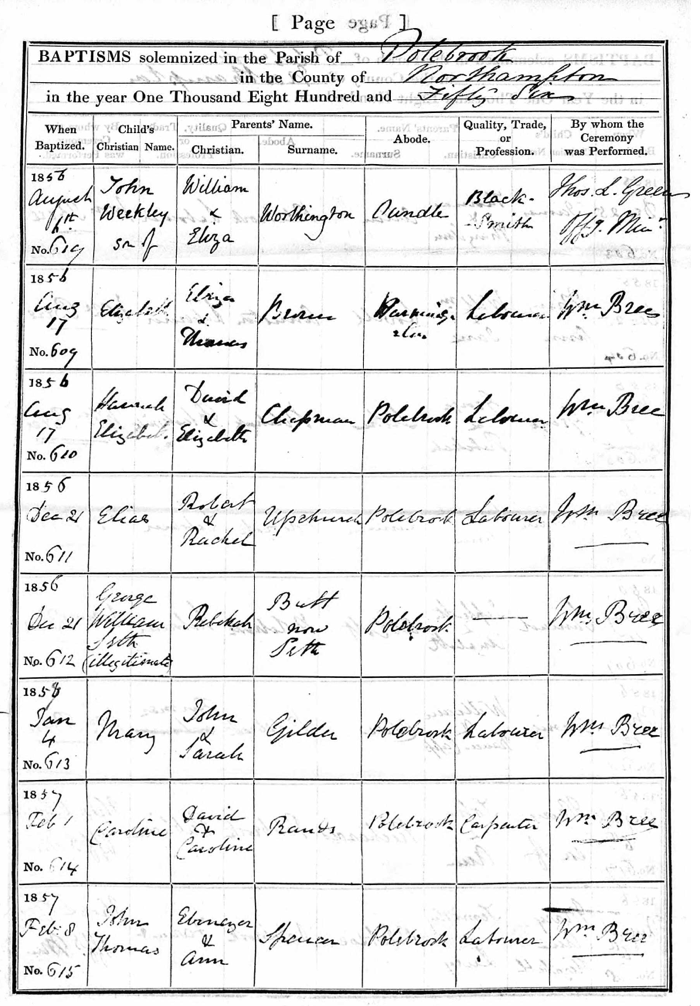
George William Butt’s Baptism Record [3]
It is about as bare a beginning as the century's paperwork allowed. Within the first year of his birth George William Butt appears under two surnames and, on both records, no father at all, a boy of a few months already carrying a mark of shame set down in the church's own hand. What makes his long life worth the telling is that he spent every year of it, quietly and without any fuss the record retains, building the very things that beginning had denied him: a settled name, a place, and above all a family of his own. He never travelled far. He died sixty years later in the same small stretch of the Nene valley where he was born, a few miles from the font. He left almost no record of what his illegitimacy cost him, and there is one moment, at his own wedding, where we may guess that it weighed on him more than he ever said; but his answer to it, so far as sixty years of paperwork can show, was not to brood or lament but to fill his life with purpose.
The change of surname between the birth and the baptism has a simple cause. In the months between the two, Rebecca married a Polebrook labourer named William Seth [4], and the boy was christened, and afterwards raised, as a Seth. Yet the baptism did less than it might have. Married though she now was, Rebecca is entered at the font not plainly as a Seth wife but as "Rebekah, Butt now Seth," the older name kept beside the new; William Seth is nowhere named as the child's father, the profession column left blank as it had been at the birth; and the word the curate had set against George still stood, unaltered by the wedding. The marriage gave the household a surname and a roof, but it did not make George legitimate, nor even trouble to make him look it. He was a Seth by upbringing and a Butt by blood, and the register let both stand.
By the census of 1861 the household at Polebrook is a Seth household through and through: William and Rebecca at its head, and among the children a four year old set down as George Seth, with his elder half sister Elizabeth Butt, then eight, and two small half brothers, Robert and Edward Seth [5]. But there is one telling asymmetry in how the enumerator wrote the family down. George, born a Butt, has been quietly folded in under the household name and entered as a Seth; his elder half sister, then eight, has not. She keeps her mother's maiden name as Elizabeth Butt and is set down not as a daughter of the house at all but as a boarder, a lodger under the roof rather than a child of it. The two eldest, both illegitimate, both Rebecca's by an earlier chapter of her life, were absorbed into the new family on unequal terms: the boy took the stepfather's name, the girl remained, on paper, a Butt. It is possible the difference lay in their ages. Elizabeth was three when her mother married, a child already known about the parish for three years as Rebecca's own, too old to be quietly reintroduced as anyone else's daughter; George, by contrast, was an infant of a few months, young enough to pass into the household as William Seth's own child and be entered so without a word of explanation to anyone. It is fair to imagine, too, that a boy was reckoned the more useful addition, another pair of hands promised to the fields and, in time, to wages, where a girl's labouring years were shorter and more lightly paid. Whatever the reasons, the census caught the household in the act of making one child its own and leaving the other, for the moment, at the door. So George grew up inside a family, with brothers and sisters who shared his mother if not his father, in a labourer's cottage of the kind that stood in every Northamptonshire village, likely two dark rooms under the thatch, a clay floor underfoot, the parents in one room and the children packed into the other. It was poor, but it was a home, of which George was a part.
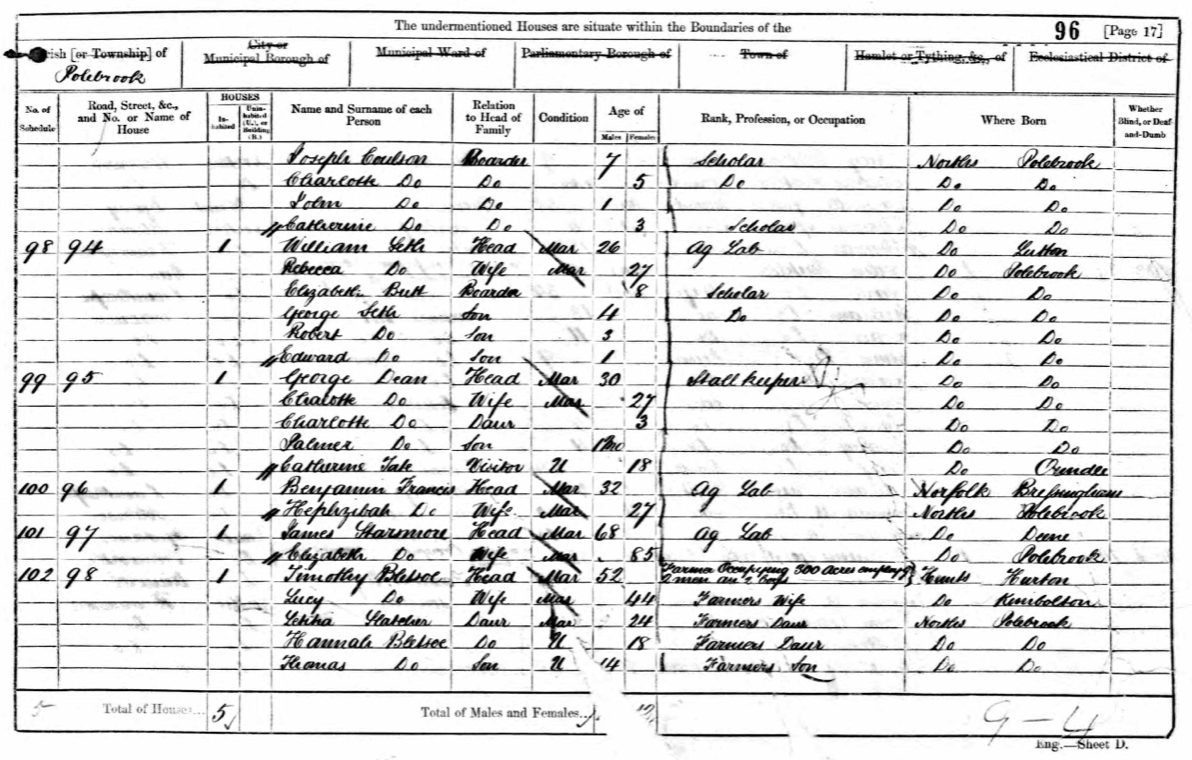
1861 Census [5]
The blank column of his birth was no mere custom or delicacy. The New Poor Law of 1834 had swept away the old parish machinery that once pressed the fathers of base-born children to pay for them; as first passed, its bastardy clauses ended the parish's power to charge the putative father at all and laid the whole cost and the whole shame of such a child upon the mother, on the improving theory, set down in the Commissioners' own report, that throwing the burden on the woman would work as a restraint on immorality and a spur to chastity [6]. It was the most violently opposed part of the whole measure, and within ten years the harshest of it had been softened: by the time of George's birth the law once more allowed a mother to seek maintenance from the father, but only by her own hand, in a summary hearing before the magistrates, and only on evidence that corroborated her word [6]. That was a public ordeal few village women faced willingly, and no record of any such proceeding by Rebecca has come to light. It may well be why she married when she did, three months after the birth, the wedding giving the child a surname and a roof where the law would otherwise have left her to provide both alone; but her reasons are her own story. The empty column in George's paperwork was not only a silence; it was a policy. And yet the plainest fact of his early life runs against it: he was kept. In an age that gave an unmarried mother every reason to give up such a child, and few means to hold on to one, George was not given up but carried to the font, entered in the register, and raised under a roof with his mother and her other children. That keeping, so easily passed over, was the first of the settled things his life was built from.
And yet he was, in one respect, not quite like the others, and a child notices such things. His half brothers were Seths and belonged to the man of the house; George was a Seth only by adoption of the surname, a boy whose true name and whose father were a question no one answered. We cannot know how heavily that sat on him, and it would be wrong to make him brood where the record is silent. But it is not hard to imagine a boy learning early that his own name was a borrowed one, and filing the knowledge away. Whatever he made of it, the choice he took as a grown man speaks for itself. He kept neither the Seth name he was raised under nor, later, the name of any father he might have claimed. The surname he carried into his manhood, and stamped on every one of his own children, was the one thing that had been truly his from the first day: his mother's, Butt.
As to who his father actually was, that is a question that can only be answered now and by means George could never have dreamed of. It has no bearing on the boy in the Polebrook cottage, for it is likely he was never told, and to him the man in question, a villager who had married one of Rebecca's own sisters, would have been at most an uncle by marriage, a face at a family table [7].
Whatever shelter that household gave, it did not last, and its ending set the shape of George's life. Some time in the mid 1860s the family moved the few miles from Polebrook to Lutton, the village William Seth had been born in [5], and it was there, on a January day in 1870, that Rebecca died. She was thirty six. The cause was set down as a diseased heart, and a neighbour, not one of her own family, stood at the bedside to give the particulars, making her mark against them just as Rebecca had once made hers [8]. George was thirteen.
The household broke along its natural line. When the census-taker came the following year, William Seth was still at Lutton, a widower keeping his own children about him, the young Seths, Robert and Edward and little Martha and Emma [9]. George was not among them. He had gone. A few miles off, at Barnwell, the census finds him at fourteen already out in the world and earning his keep, a live-in farm servant in the household of a farmer named James Smith [10].
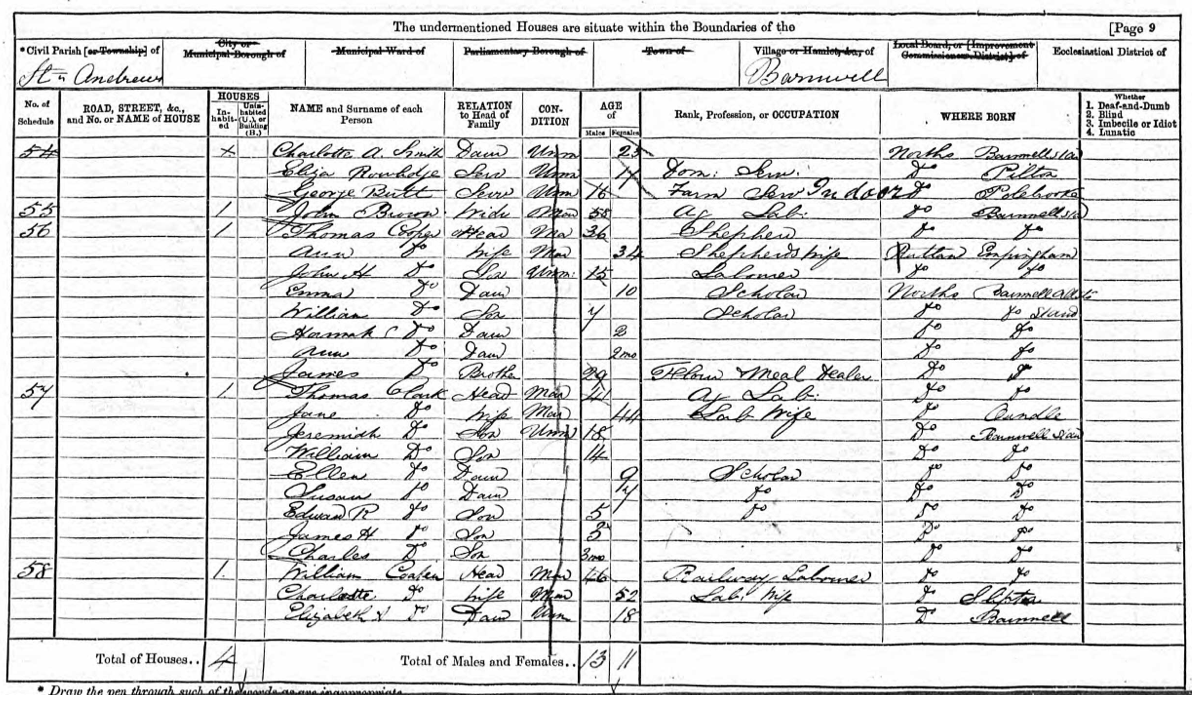
1871 Census [10]
There was nothing unusual in a boy of his class going into service so young; it was the ordinary fate, and half the labouring lads of the county did the same. Living-in farm service, the boarding of boys and single men under the farmer's own roof, was in slow retreat all through the later century, and George's generation was among the last to be reared inside it [11]. The very term the census set against his name, farm servant (indoor), turned less on where he worked than on how he was hired: not by the day or the week, as an ordinary labourer was, but on a long engagement of six or twelve months that took him into the house for his board and lodging and was binding in law [12]. It was a young man's condition. More than half the country's farm servants were under twenty, and it was uncommon for a lad to stay at one farm beyond two or three years, many moving on at the end of each contract; so we should picture George's place under James Smith's roof not as a settlement but as a stage, a hired year or two in a boy's working life, the kind of place a youth passed through on his way to somewhere of his own. George left no account of what that place was like, but a contemporary from the same county and class did. A boy hired at a farm in his early teens might be shoeblack and knife-cleaner in the morning and stick-chopper at night, drawing a shilling a week and feeling, as one such lad remembered, quite rich [13]. It is the texture the census strips away: not just a farm servant but a boy about the house and yard, at the foot of the working world, earning his shilling and his keep.
There was a real difference, too, between the two working lives that service opened onto, and it shaped everything that followed. A farm servant who lived in was fed and housed by his master and could put by part of his wage; he might save for some years and then, when he chose, marry and set up on his own account. The day labourer, hired by the week and keeping himself, more often married young and raised his family on a bare six or seven shillings [14]. George would live both lives in turn, the servant's first and the labourer's after, and the hinge between them was his marriage.
The timing is stark. The one person who tied him to that Lutton household was his mother, and within a year of losing her he was gone from it, and gone too from the half brothers and sisters who had been the company of his childhood, likely sleeping over another man's stable, roused before first light to feed and tend the animals, out in the raw dark of a winter morning while the farmer's own family slept warm indoors [15]. Whether he was pushed or simply saw no place for himself there once his mother was under the ground, the record cannot say. What it can say is that from this point George made his own way, alone, and the direction he made it in was north and east, down the valley to the little market town that would be home for the rest of his life.
Oundle sits in a loop of the river Nene, the water curling almost all the way around it, so that the town stands on its low rise of ground like an island above the wet meadows, the tall spire of St Peter's lifting over the roofs and visible for miles across the flat [16].
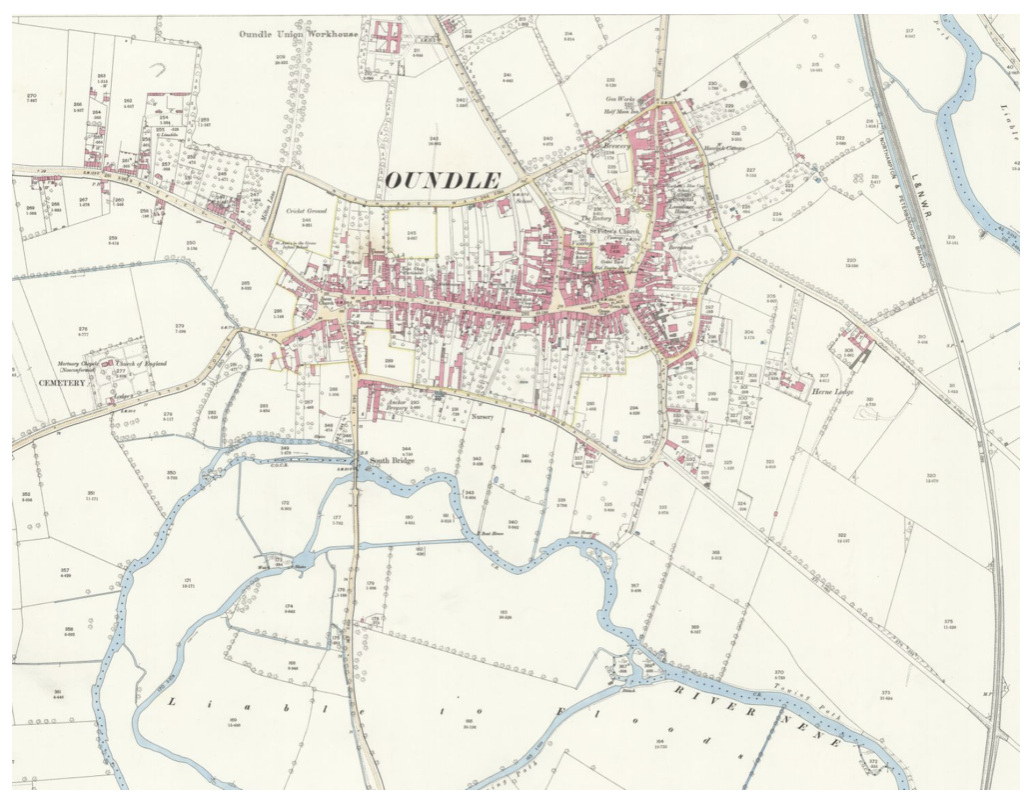
Map of Oundle, published 1886 [17]
In George's day it was a stone-built town of some three thousand souls, its streets lined with houses of the seventeenth and eighteenth centuries, its week turning on the Thursday market that the church bell still rang in at midday. It had its old curiosities, the iron spring they called the Drumming Well for the strange noise it was said to make, and the bobbin lace that the women of the town had once made at their cushions. And it had its poorer quarters, the crowded yards and courts that ran off West Street and North Street, tight little runs of cottages behind the main frontages [16], and it was into these that George came, and among them that he stayed for forty years.
That he stayed was itself a choice against the current of the age. All through George's working life the countryside was emptying around him; the long flight from the land carried the labourers' sons by the hundred thousand into the cities, the coalfields, the colonies and the emigrant ships, until the villages of the shires stood visibly thinner than their fathers had known them [15]. The tide that carried other men's sons to Leicester or London or the Canadian prairie carried George barely two miles down the valley, and there set him down for good. The current was real enough at home, if hard to measure exactly: Polebrook, which had held some 470 people in the year of his birth, counted about 400 by the mid nineties, a decline the changing parish boundaries blur but do not hide [18,19].
The work he came to do was the work he had been bred for, and it was hard. The Northamptonshire countryside an agricultural labourer walked out into each morning was the planned countryside that a century and more of enclosure had made, the old open fields long since carved into rectangular closes bounded by straight hawthorn hedges, much of the low ground down to permanent pasture [20]. The dates of that remaking, parish by parish, bracket George's own geography: Barnwell's fields had been closed since 1683, Polebrook's since 1790 and Oundle's since 1807, but Lutton, the village of his boyhood, was enclosed only from 1861, so that the last open field land his family lived beside was being hedged and squared into the modern pattern during his own childhood [21]. There was more art in the labour than a townsman would guess. The age had a name for the farm labourer as a type, Hodge, and made of him a figure of settled contempt, a slow and animal creature fit only for mindless toil; yet that caricature was the townsman's, not the truth. The great government enquiries into farm labour, from the very start of the Victorian era, told a different tale, one their own commissioners set down: that field work was skilled work, various and exacting, calling as one of them wrote for no inconsiderable skill to manage the common tools with effect, and that the year-round man was, in another's phrase, versatile and accomplished [22]. A good man could spread a field of manure until it lay as neat as a chessboard of black squares, hoe a drill of turnips clean, lay a hedge, dig a ditch, and, at the summer's height, build a hayrick that stood square and shed the rain like a piece of architecture [15]. Laying a hedge, indeed, was reckoned one of the higher branches of the craft, and a man who could do it, the reports noted, could always find work [22]. No boy walked into any of this ready-made; he grew into it, and his wages grew with him. In the informal apprenticeship of the fields a lad was reckoned first a quarter-man, then a half-man, then at last a full-man on a grown man's rate, and what moved a lad up the scale was less his birthdays than his strength, his willingness, and the skill his hands were picking up, so that a boy of fourteen taken into service, as George was, might reach a man's wage somewhere about eighteen or twenty [21]. It is worth holding that in mind against the bare census line, farm servant, aged fourteen. Behind it stands a boy at the very foot of that ladder, learning the tools and the beasts and the weather in another man's yard, with the whole slow ascent to a full-grown labourer's wage still in front of him. But the wages were a pittance and the year was a treadmill. A farm labourer in the Midland counties in George's young manhood might earn something on the order of ten shillings a week, and out of that keep a wife and a houseful of children, pay his rent, and dread the one institution that waited for those who could not: the union workhouse, the shadow that fell across every labouring family when the work ran short or the body gave out [23].
George came of age just as that class found its voice. In February 1872, when he was fifteen, two thousand labourers gathered under a chestnut tree at Wellesbourne in Warwickshire to hear a hedge-cutter and Methodist preacher named Joseph Arch, and out of that meeting grew the first great union of farm labourers, the "revolt of the field" that ran through the Midlands, Northamptonshire among them, the labourers meeting by lamplight and rushlight to ask, for the first time in living memory, for a living wage: fourteen or fifteen shillings a week against the twelve that most were paid [24]. The movement reached its height in 1874, when the National Agricultural Labourers' Union counted tens of thousands of members; but that same year the farmers answered with a great lock-out, turning union men out of work across the eastern counties, and as the long agricultural depression settled over the land the union slowly withered24. Whether George ever joined Arch's union we do not know and never will; most likely he was too young, too newly arrived, and too intent on making his own start to be in the thick of it. But he lived inside those years, breathed that air, and shared that hope. And in 1884, when the Reform Act at last gave the farm labourer the vote, George, the base-born boy of Polebrook who could not write his name, became at twenty eight a citizen with a say in the country that had once entered a word of shame against him in a parish book. He would have had little enough time for politics, a working man with a growing family. But the vote was his, and there is a quiet justice in that which he can hardly have failed to feel. The registers of his last years bear it out: from 1910 to 1915 his name stands on the Oundle roll, following him from yard to yard [25].
He was twenty when he married. On the eleventh of September 1876, at St Peter's in Oundle, George married Charlotte Odam, a Nassington-born woman a few years his elder, and the register of that day tells us a great deal about them both [26]. Neither could write. Where the bride and groom should have signed, each made a mark, a cross scored on the line, so that this couple set out on forty years of marriage without either of them able to form their own name on the page.
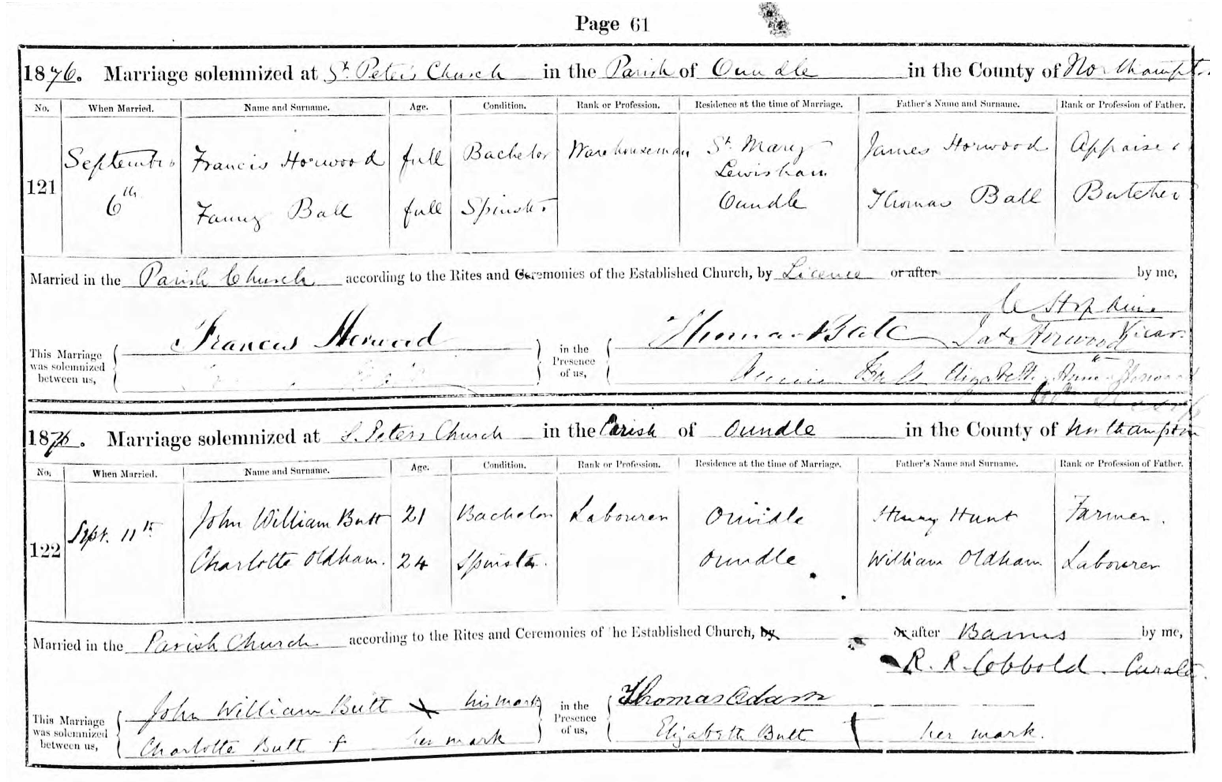
George Butt and Charlotte Odam’s Marriage Record [26]
The failing was not theirs; this was a country that schooled its poor by charity and let the harvest have them. What that meant on the ground can be read in the county's own surveys. Polebrook had gained a small National day school by 1840, a master and mistress on twenty pounds a year and a house, teaching a few dozen children [27]; but schooling was voluntary, it commonly ended by ten or twelve, and a labourer's child was worth sixpence a day in the fields [28]. Lutton, where George's family moved when he was about eight, had at the county survey of 1840 no day school at all, only a Sunday school of twenty children, and the handful of its children not in education were recorded, without comment, as being in agriculture at sixpence a day [27]; whether matters there had improved by the sixties, no record in hand can say. Nothing in law required it to be otherwise. The Act that first built the board schools came only in 1870, when George was already fourteen and in service; attendance was not made compulsory until 1880, by which time he was a husband and father; the gang system of child field labour had been brought under regulation only in 1867, and the first Act restraining the farm employment of young children followed in 1873, when George was seventeen and long past its protection [29]. The reforms that would have caught a child born twenty years later all came a little too late for him, the schooling most of all. The two crosses on the marriage lines are not the marks of slow minds but of that lateness. The curate, an educated man taking down what he heard, misheard the bride's surname and wrote it Oldham; but the family were Odams, and Odams they remained, and the slip is only the sort of small violence the written record was forever doing to people who could not correct it.
There is a stranger thing still on that page. Where George's own forename should stand, the register gives him not as George but as "John William Butt." It is not possible to know from the record alone whether this was the curate’s mistake, a hearing error, a clerical slip, or the name George himself gave when the entry was made. What matters is that the couple could not read the page back to correct it, and so the error, like the miswritten surname Odam, remained.
And then there is the father's name. In the column on that marriage certificate reserved for the groom's father, George at last supplied one, the blank of his own birth filled in his own voice for the first time in his life: Henry Hunt, farmer, of Polebrook [26]. It was not an empty flourish. There were real men of that name in Polebrook, two of them, first cousins, and one, a farmer's son who was himself by then a farmer of some standing in the parish, matches to the letter the man George named [30]. Whether that Henry Hunt was anything to George we cannot show, and the harder question of his true fathering is one for another place [7]; but the name he reached for was a real man's, near to hand, and that in itself tells us something. We cannot know why he chose it, and it would be wrong to pretend otherwise; but the choosing is itself worth dwelling on, for it is the one moment in sixty years of records where George reached past the blankness of his birth and put something in its place, and a man does not invent a father idly. It is fair to imagine several things moving in him at once. Perhaps the name was simply the truth as he had been given it, a thing his mother told him once, in the way such things are told to a child, a name he had carried privately for years and now at last had cause to speak aloud. Perhaps it was a name he reached for on the day itself, the appearance of decency a public occasion seemed to demand, a wedding being a thing done before witnesses and a register and the eyes of a whole parish, and the empty column a shame he would not carry up the aisle. Or the name was not plucked from the air at all but drawn from his own working life, the Polebrook farmer of that name he had perhaps laboured for, or known, or admired, a real man near enough to hand to borrow, near enough perhaps to have half stood, in the boy's own mind, for the father he never had. We cannot choose between these, and need not. What the choice shows past all doubt is the state of mind behind it. Here was a man of twenty, standing up in the parish church to make a family of his own, and being asked, before the register and the witnesses, to name his father, the very question his whole life had refused to answer. He did not leave the column blank, as it had been left at his own birth and would be left, we may be sure, had he simply told the curate the truth that he did not know. He gave a name, plain and respectable, a farmer, a man of some small standing. Whatever prompted it, he would not let the blankness he was born into be entered against him a second time. He filled the empty column with his own voice and walked out of the church a married man with a father's name behind him at last. His half sister Elizabeth was one of the two witnesses, and she too signed by a mark. Less than two years later, at her own marriage, she faced the same empty column and answered it as boldly as George had, giving her father not as a blank but as the resounding and wholly invented "St Swithin Wadsworth Butt, farmer, [31]" a flourish of respectability grander even than George's plain Polebrook farmer. Both had learned, somewhere in the same childhood, to answer that question not with a blank but with a name.
And from here the story is, quite simply, a family, which is exactly as George appears to have wanted it. For forty years he and Charlotte lived in the yards and streets of Oundle, moving as the rent and the work required, from Drumming Well Yard off West Street, the yard named for the town's strange old well, where the census of 1881 finds them still a young couple, on to North Street through the eighties and nineties, then, by 1910, to Inkerman Yard, one of the countless courts and streets of England named for the Crimean battlefields of the decade of George's birth, and finally across West Street to Setchell's Yard, where the registers find him to the end of his recorded life [25]. They never left the town. Every one of those addresses lies within a few hundred yards of the others, a whole life lived inside the boundaries of a single market town.
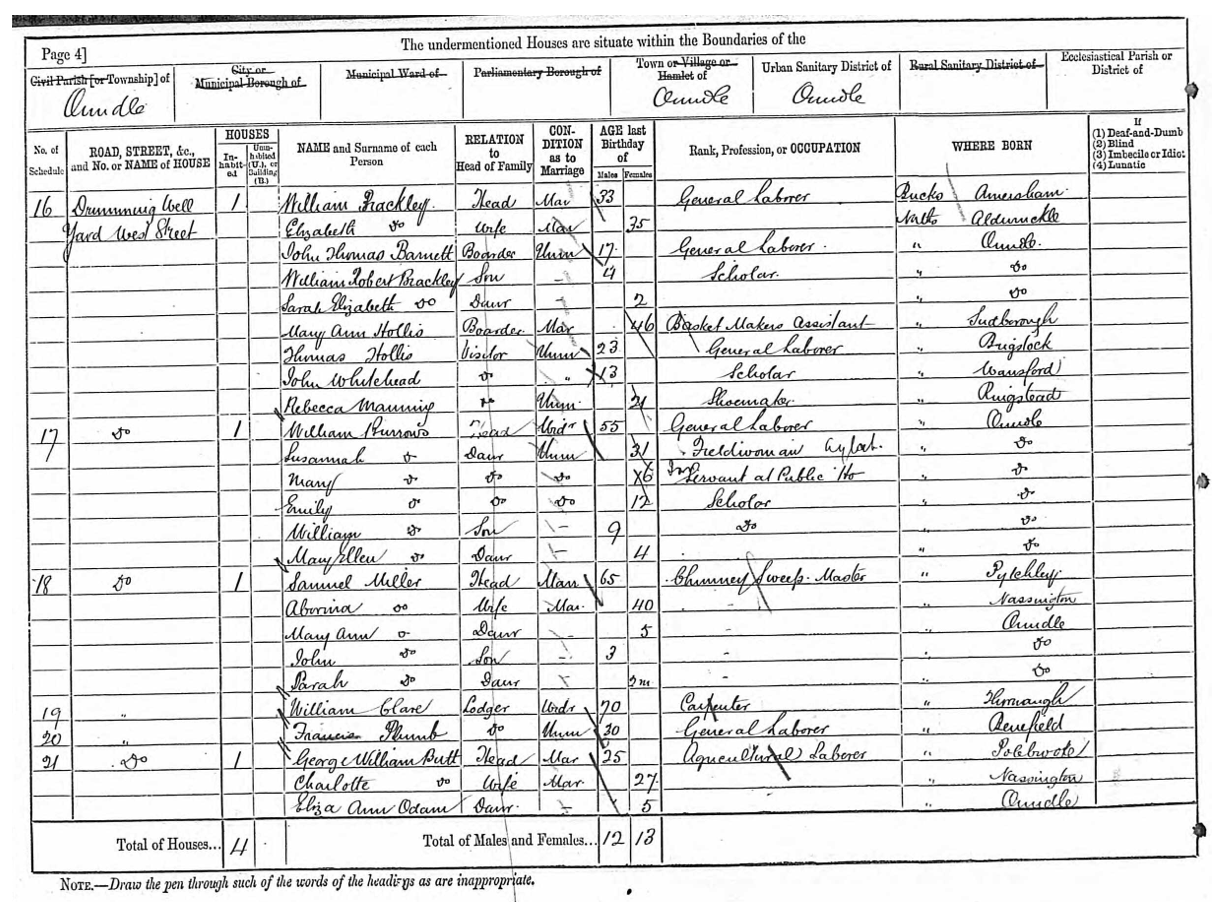
1881 Census [32]
The children came steadily and, by the hard measure of the age, all survived. One after another they were carried up the hill to St Peter's to be christened: Emily Rebecca in 1876, her second name quietly keeping her dead grandmother's alive; then William James in 1879, John Thomas in 1881, Mary Ann Elizabeth in 1884, and last of all Robert Edward in 1886, born in Clark's Yard [33]. Every rite the family's record preserves, baptism and marriage alike, was performed at the parish church. Whatever George privately believed, and on that the record is silent, the Church of England that had written him down illegitimate at its font was the church he was married in and the church he carried every one of his children back to.
There is also a soft echo worth noticing in the youngest boy's names. Robert and Edward had been the names of George's own half brothers, the little Seths of the Polebrook cottage of his boyhood. Whether he chose them on purpose, reaching back across thirty years to the household he had left, we cannot say; but a man who had lost so much of his own beginning might well have wanted to carry a piece of it forward, and the coincidence is one to sit with.
By the census of 1891 the whole young family stood assembled under the one roof: George, thirty six and still a farm labourer, Charlotte beside him, and the children gathered together.
Sharing the house that year was a twelve year old boy, Ralph Wood, a young relative from George's own side, a great-grandson of the same Samuel and Sarah Butt of Polebrook from whom George himself descended. Whatever brought him there, the boy who had once been taken into other people's households was now giving a Butt child a place in his.
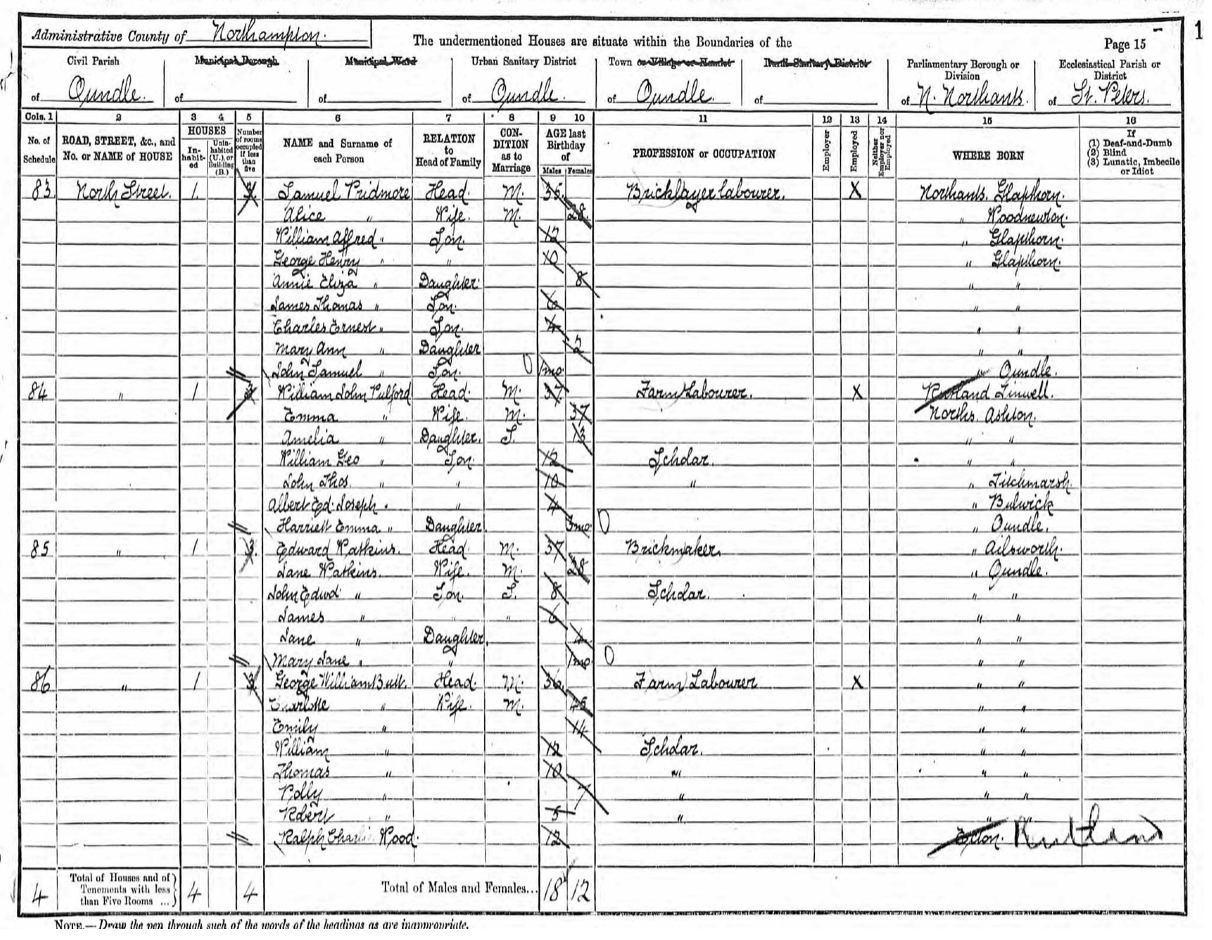
1891 Census [34]
Growing up alongside them was Charlotte's elder daughter Eliza Ann, born in 1875 before the marriage and raised in the household as one of the family, so that the children under his roof numbered six, one more than he had fathered. All six lived to grow up: in an age when the small graves outnumbered the christenings in many a labouring family, to raise six children and lose none was a quiet triumph. Charlotte herself would set it down years later, asked on the census how many children she had borne and how many still lived, and giving the same number twice: six, and six [35].
The single clearest picture we have of the man comes from the census of 1901, and it is a picture of father and son together. By then George had come off the land and taken to the milk round, and the enumerator found him and fourteen year old Robert side by side in North Street, the two of them driving a milk cart for a local farmer.
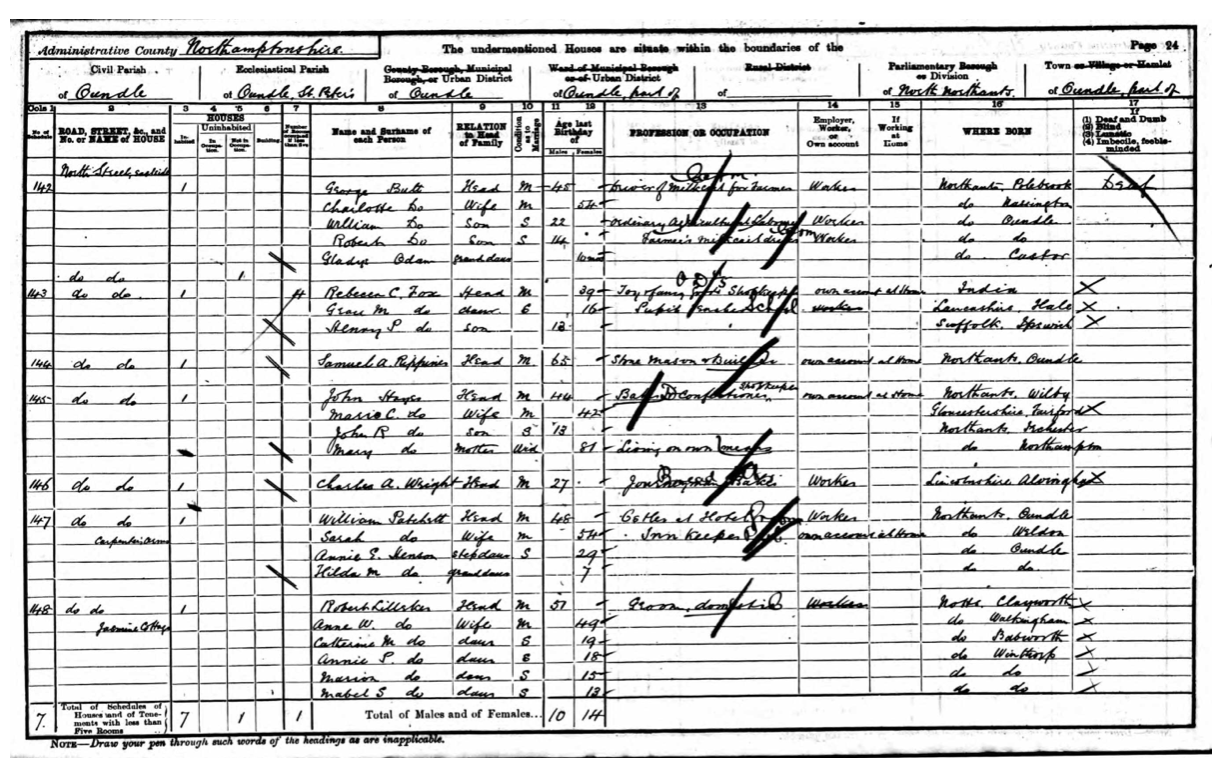
1901 Census [36]
The change was a small one on the page and a shrewd one in its times. The long depression that had lain over English farming since the seventies, brought on above all by cheap corn flooding in from the New World, fell hardest on the plough; what endured, and even prospered, was grass and stock and above all milk, the one produce of the land that no ship could yet carry fresh across an ocean [37]. Across the Midlands the arable was going down to pasture and farmers were turning dairymen, and George's own Nene valley was among the districts making that turn, milk becoming one of the few corners of country work the age was actually rewarding. When George gave up the spade for the churns he was not drifting between jobs; he was moving, whether by luck or by judgement we cannot know, onto the one piece of firm ground his trade still offered.
And here, wonderfully, the record is joined by a photograph, the one likeness of George that has come down to us. He stands in cap and waistcoat and heavy boots at the head of a pale horse, one hand at the bridle, the tall churns on the cart behind, and he looks steadily out at whoever held the camera with the unhurried, slightly wary composure of a man not much used to being photographed.
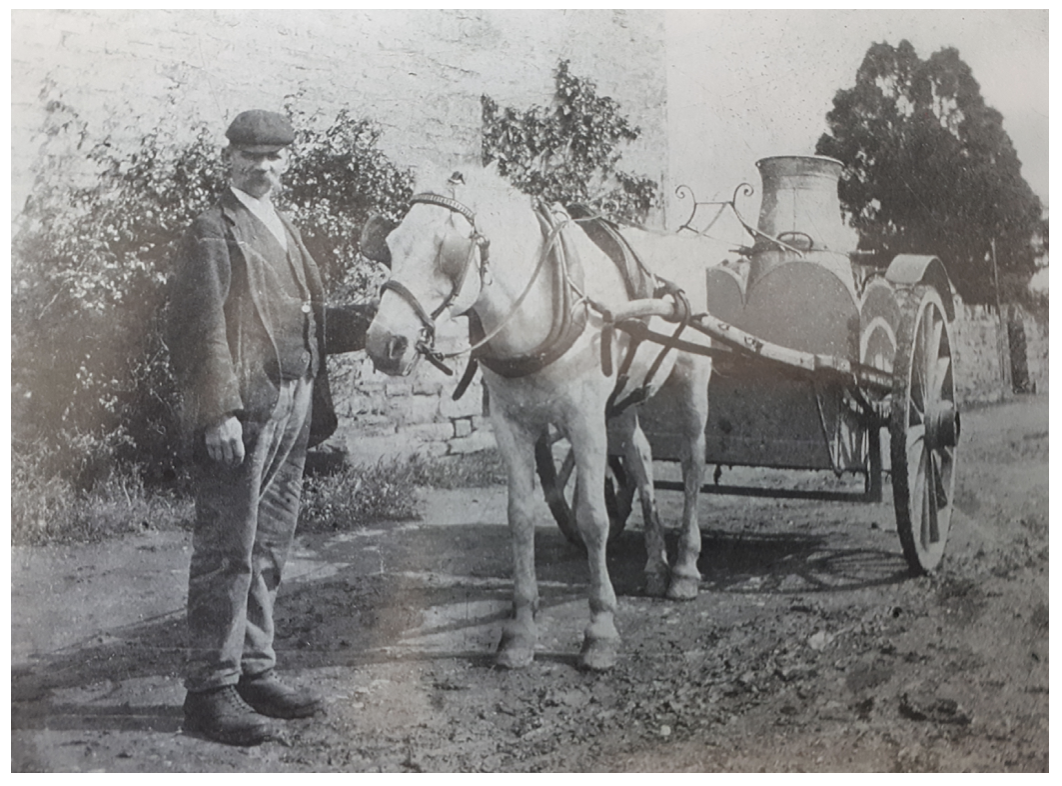
George William Butt c. 1901 [38]
It is worth dwelling on, because it is the nearest we will ever come to seeing him: an ordinary working man beside his horse on an Oundle morning, the milk waiting to go round. That the boy beside him on those rounds was Robert makes it more precious still. Whatever else George's working life was, it was rarely solitary; again and again the record shows him working alongside his own, and one imagines the two of them out together in the grey light, the cart rocking over the cobbles, the town waking around them.
His trade shifted over the years, as a poor man's must, following whatever wage was going. Agricultural labourer in his youth, and so recorded at Robert's birth [33] and through the earlier censuses [32,34]; milkman by the time his son William married at the end of 1905 [39]; a labourer again at his daughter Emily's wedding in 1908 [40] and at his son Robert's in 1909 [41]; and a gardener by the census of 1911 [35], the calling that would see him out.
Through all of it the family was spreading and marrying around him. He gave three of his children away in the space of four years, and in the signatures on those marriage registers you can watch the world turning over between one generation and the next. George signed by his mark, and so did Charlotte, and so still did their son William at his wedding in 1905 [39]; but Emily and Robert, the younger two, signed their own names in a clear round hand [40,41]. Whether William ever caught up we cannot say for certain: by 1911 he was a milkman himself out at Yaxley near Peterborough, following the trade his father had taught him from the cart, and his household's census schedule is signed "Wm Butt," though on a household return there is no telling whether the hand was his own or his wife's [42]. The parents could not write their names, but at least two of the children plainly could. It is the small domestic mark of the Education Acts that had made schooling compulsory for the generation coming up, and there is something moving in it: the illiterate labourer who lived to see his own children lettered, and who would end his days tending the grounds of one of the great schools of England.
The trades themselves travelled down the family, half inheritance and half escape. By the census of 1911 the three sons had spread across the working world their father had passed through and beyond it: John Thomas on the land as a farm labourer [43], William on the milk round at Yaxley [42], and Robert, further than George ever went, an engineer with charge of a great school's power station [44]. And the record carries one small tribute. John Thomas named a son for his father: George William Butt, the grandfather's names passed whole to a grandson he lived to see grow into boyhood.
For that is where the last chapter finds him. By the census of 1911 George, then in his mid fifties, is listed as a school gardener, living with Charlotte in one of the cramped courts of Inkerman Yard off West Street, whose corner building still bore a datestone of 1650 [45].
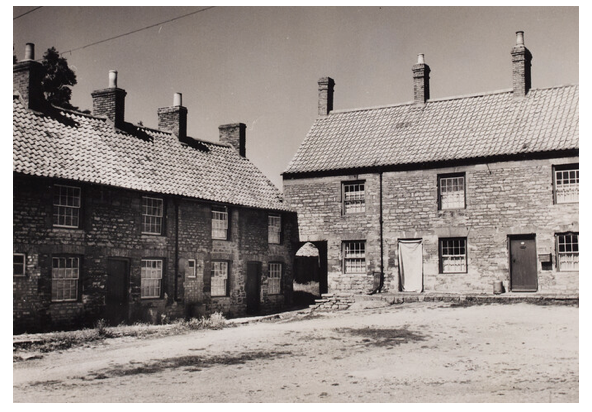
Cottages at the corner of Inkerman Yard and West Street, Oundle [45]
The household ran to six people and three generations: the old couple; their grown daughter Mary Ann, still at home; two small granddaughters, Gladys and Ida; and Harry Lee, who had filled in the schedule and who was family by marriage rather than blood, the stepson of Charlotte's brother Stephen Odam. Six people, and the dwelling only four rooms [35].
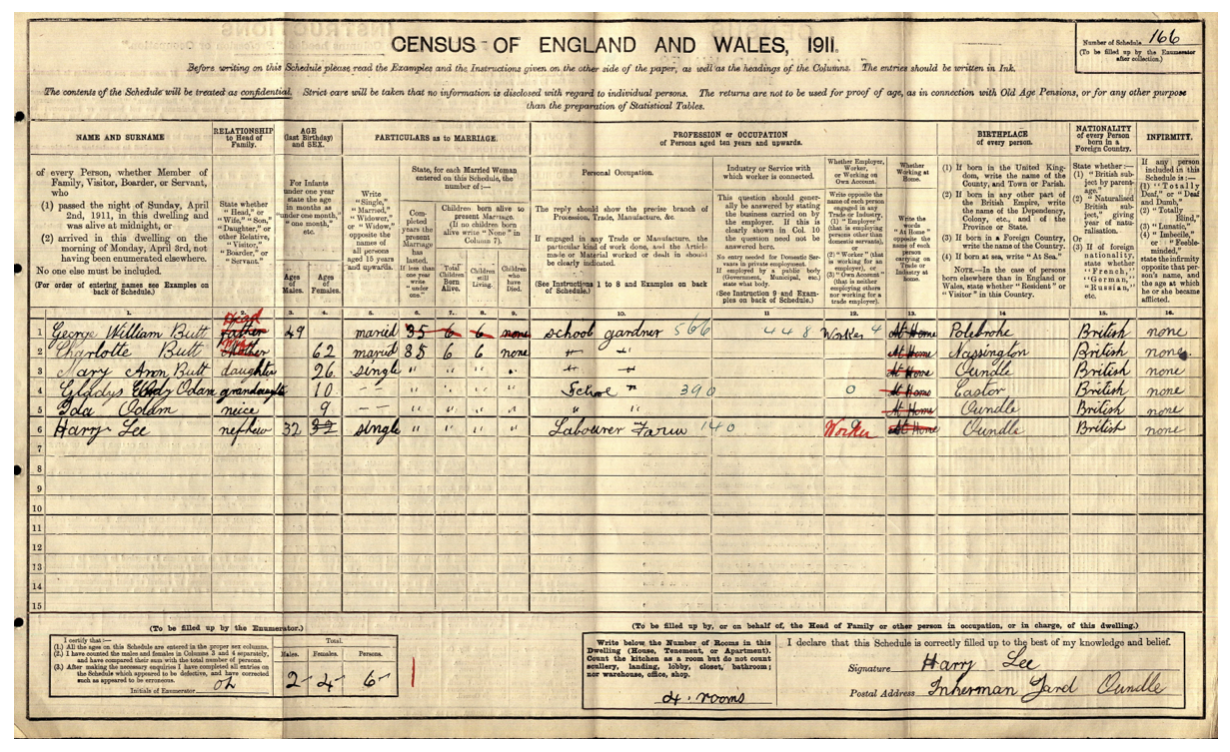
1911 Census [35]
The school he tended was Oundle School, and these were its golden years. Under its famous headmaster Frederick William Sanderson the old grammar school was being remade into one of the foremost places in the country for science and engineering, its buildings and its grounds growing year on year, and the whole town lifted a little on the tide of it. The county directory of 1910 counts three hundred and forty boys, new boarding houses lately built about the town, workshops and laboratories, and a games field of thirty six acres, and every acre of it was ground that somebody had to keep [46]. Sanderson himself made much of the gardens, preaching the ordered garden as a model of a life and a school, a place of beauty in which boys might learn [47]. And there were real gardens to match the sermon: rock plants and fernery about the biology laboratory, a rose garden, a long herbaceous border, all laid out and stocked, the work going on even through the war years, for boys, he held, "were not to be deprived of their heritage because men quarrelled and fought [48].” George appears by name in none of it; gardeners never do. But those were the years when the old man with the barrow was still on the grounds, and it is fair to imagine his spade in that soil.
Oundle in George's day held two educations side by side and did not confuse them: the school's boys, at their books to seventeen or eighteen and pointed toward the universities and the professions, and the town's labouring children, schooled to ten or twelve and pointed toward the fields and the workshops [28]. George had stood on the labouring side of that line all his life. And yet the family had got inside the walls, by the tradesmen's gate. George was part of that great enterprise in the humblest possible way, one of the men who kept its lawns and borders, and there is a real and quiet dignity in the image: the boy who never sat a day in any classroom, ending his working life keeping the grass green at a school whose masters were teaching the sons of gentlemen.
He was not, as it happens, the only Butt on the school's books. His son Robert worked there too, keeping the school's power station, so that for several years before the war the father tended the gardens and the son kept the machinery, the two of them drawing their wages from the same great institution [35,44]. One likes to think of them crossing the quad of a morning, the old gardener and his grown son, nodding to one another between their tasks. And they lived as close as they worked. In 1911 George was at Inkerman Yard and Robert a few doors along the same West Street at Morris's Yard, the two households falling in the very same corner of the census, father and son within a few hundred yards of one another.
And for one moment, thanks to a paragraph in a local newspaper, we see George plainly. In November 1911 a gang of men was out lifting the potato crop on the school grounds, George among them, and a quarrel flared. He was knocked to the ground, and the affair went as far as the Oundle petty sessions, where a fellow workman, Arthur Briggs, stood charged with having assaulted him. The two were near neighbours as well as workmates: Briggs was living that spring in Setchell's Yard off West Street [49], one of the same crowded courts George moved within. The little report is unexpectedly revealing. The court heard that George was by then very deaf, so deaf that they had difficulty even administering the oath to him; but sworn he was, and he gave his evidence, and the reporter kept one word of it. George told the bench that "taters" had been thrown at him. It is a single word, and it is everything. In sixty years of registers, schedules and certificates, every syllable concerning George William Butt was set down by somebody else, curates, enumerators, registrars; here, once, and never again, the man himself speaks, and when he speaks it is pure Northamptonshire. Not potatoes: taters. The defendant answered that he had thrown nothing, but had only pushed the old man, who fell, and that he had been dismissed from the work for his pains. The magistrates dismissed the case.
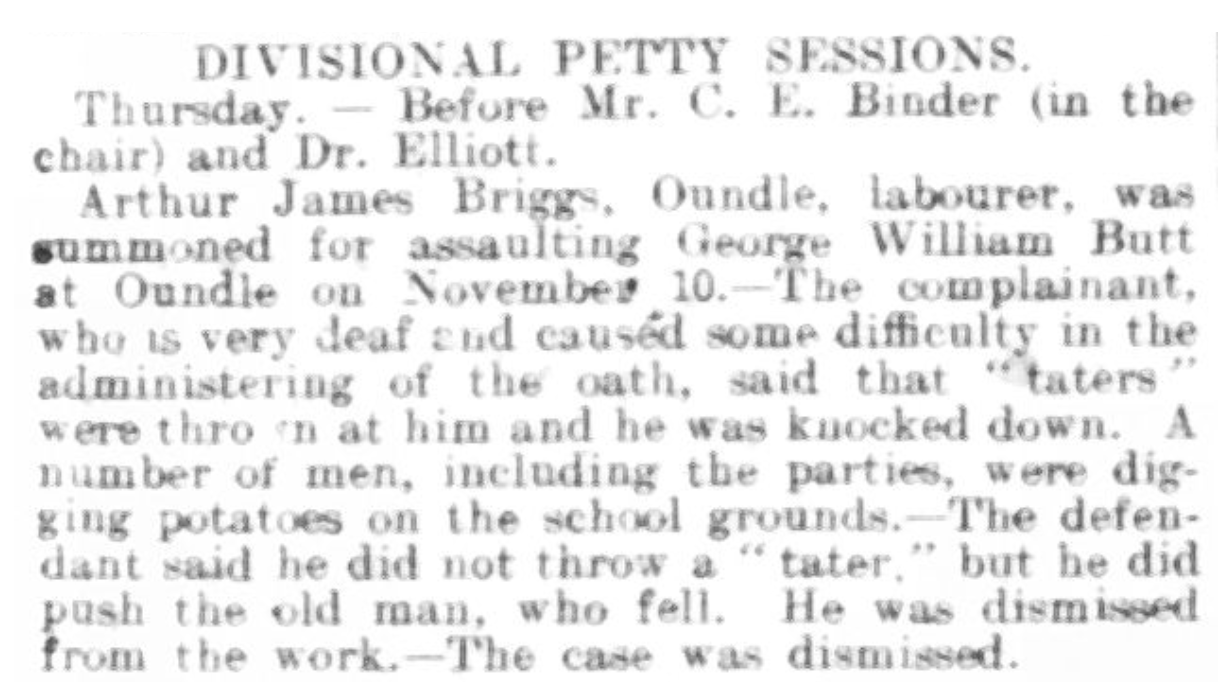
Report of the assault on George [50]
It is a small, almost comic scrap of a scene, and yet it holds the only sound of George's own voice anywhere in the record, and it tells us three true and touching things besides. That at fifty five he was still out in the field with a spade and a fork, doing a young man's labour; and it could hardly have been otherwise, for the state's first old age pension had arrived only in 1909, five shillings a week, means tested, and payable at seventy [51], so that a labourer of George's generation worked until the body gave out or the workhouse took him, and George, who would die at sixty, was never to come within ten years of pensionable age. That he had grown deaf, the same affliction that would overtake his son Robert in later years. And that in the town he was now, simply and a little tenderly, "the old man."
When the war came in the summer of 1914 it reached even into the Oundle yards and took George's youngest son. Robert, a reservist, was called up at once and was in France within weeks; he had been in the line barely a day when the fighting overwhelmed his position, and he was taken prisoner and carried off into Germany, into a captivity that would last more than four years and carry him across Germany and the occupied Baltic [52].
The thing that gives George's last years their particular weight is that he knew. This was no father kept in the dark. By December 1914 the news had come through to Oundle, and the Northampton Mercury reported that the parents of Private Robert Butt had heard from their son, that he was a prisoner, and that he was well [52].
And then a postcard came home. A photograph of Robert among his fellow captives, addressed in a careful cursive hand to George Butt himself52, and George could not read a word of it. Whatever Robert had written, and whatever the Mercury printed, reached him only second hand, for neither George nor Charlotte could read, and the news had to be read aloud to them both by someone else in the house. So we can be sure of the hardest fact of all: that George spent the last two years of his life knowing his boy, the very boy who had ridden the milk cart at his side, was a prisoner in a foreign country, and knowing, as the war ground pitilessly on and the casualty lists lengthened and the food grew short and dear, how utterly little a milkman and gardener in a Northamptonshire town could do about it.
This was no distant son. The boy now behind German wire was the one George had worked beside for years, the one he had crossed the quad to nod at of a morning. A father that close does not need a diary to tell us he carried it daily, a low and constant dread that no work could fill.
For the better part of a year George had been dying, a cancer of the stomach running its cruelly predictable course: the appetite failing, food that would no longer go down, the nausea, the steady wasting of a once labouring frame, and toward the end the pain and the great weariness [53]. On the twelfth of December, at West Street, Oundle, it took him [54]. Charlotte was with him at the end, and it was she who went to the registrar the same day and gave the particulars. She made her mark against them, a bold cross now where forty years before, as a bride, she had scored a wavering one. Illiterate to the last, and together to the last. The certificate gives his age as sixty two [52]; in truth he was sixty, one final inexactness in a life whose papers never once managed to fix his age. It is worth pausing on that, for it was true from the very start and true to the end. Set the records side by side and George ages at a rate all his own: for most of his life the papers ran him a year or two ahead of himself, and then, in 1911, the household schedule swung the other way and entered him a good five years short [35], younger on paper than he had been in a decade. The errors do not accumulate or drift in one direction, as a single mistake copied forward would; they scatter, sometimes high, sometimes low, because there was nothing to copy from. No document behind him could be consulted, no birth certificate produced, no literate parent appealed to; each census-taker and clerk simply looked at the man in front of him and guessed. It is the quiet signature of a life begun without papers: a man so lightly recorded at his beginning that not one of the officials who wrote him down across sixty years, himself included when he could not read what they wrote, ever quite knew how old he was.
One small provision the times may at last have made for him. Under the National Insurance Act of 1911, in force from the summer of 1912, a manual worker in George's position was for the first time compulsorily insured against sickness, with a benefit for an insured man too ill to work [55]. As an employed gardener George may well have come within the scheme, though he came to it old, at fifty six, and with only a few years to pay into it, so that the Act's own provisions would have given him not the full ten shillings a younger man drew but a reduced rate, the benefit of a life that had contributed almost nothing because it had almost run out. Whether he was insured at all, and whether he ever drew on it through that last year, no surviving paper tells us. If he did, there is a small mercy in it, and a late one: the state that had first known him as a fatherless line in a register book may have owed him a few shillings a week at the end, the first it ever owed him.
George lived two years knowing his son was a prisoner, and died more than two years before Robert came home. So he went to his grave with the war unfinished and his son still a captive somewhere in Germany, the outcome unknown. He had lived to learn that the worst had begun, and he did not live to learn that it ended well. Of all the things the record withholds from George Butt, that is the cruellest: the boy came home, but not in time for his father to see it. George had come into the world fatherless and went out of it with a son lost behind enemy lines, the beginning and the end of his life each marked by an absence. What it cost a dying man to carry that, through the long fevered nights of that last winter, we can only guess at, but no one who has been a parent will need it spelled out. Beside him through it all was Charlotte, who would outlive him by more than a decade.
For a life so thin in surviving paper, George William Butt's turns out to be a remarkably whole one, and that wholeness is the point of it. He began with the very least a man could begin with: a base-born child of two surnames and no father, marked with a word of shame in a parish book before he could walk, left motherless at thirteen and out to service by fourteen. He never owned an acre or a house, never learned to write his own name, never went far from the reach of the river he was born beside. There is nothing in his record to suggest he was anything other than steadfastly ordinary, an obscure man who followed the plough, drove the milk cart, and kept the gardens, one of the unrecorded many who, as one chronicler of the farm labourer wrote, “give us our daily bread [15].”
And that, given where he started from, is exactly the measure of the man. Out of a beginning designed to leave him rootless he made himself one of the most rooted men imaginable: forty years in a single town, his children raised whole to adulthood, and a hearth that was never only his own children's, a wife's daughter reared as his own, a young cousin taken in, a daughter's daughters, all given room under his roof as the years went on; the same few streets walked from the fields to the milk round to the school gardens, and his work, again and again, done at the side of his own family. The boy the parish had marked as belonging to nobody made belonging the entire business of his life, and made room, besides, for others who had little enough of their own. He filled every blank he had been handed, and the one name he refused all his days to give up, the name he was carrying when he died as surely as when he was born, was the one that had always, quietly, been his own.
Explore further…
George William Butt appears in the Paternal Grandfather family tree, which traces the Butt line from Polebrook through Oundle and down the generations.
He began life as a base-born child under the New Poor Law and could never write his own name, one of the labouring poor whose working lives are traced through the Paternal Ancestral Occupational Trees.
He and Charlotte Odam are listed together in the Second Great Grandparents snapshot, which places them in the wider context of that generation across all family lines.
His youngest son, Robert Edward Butt, is profiled in Prisoner of War, which follows the boy who rode the milk cart at George's side into four years of captivity in Germany and the occupied Baltic, the imprisonment George learned of but did not live to see ended.
George died at sixty of stomach cancer, a decade short of the state's first old age pension; his death contributes to the figures on the Death and Mortality page.
References:
[1] Birth of George William Butt, entry no. 434, born 26 May 1856 at Polebrook; mother Rebecca Butt, who signed by mark; no father recorded; registered 23 June 1856 by Samuel Selby, registrar. GRO index, Oundle registration district, June quarter 1856, vol. 3b, p. 191.
[2] Baptism of George William Butt, entered as "George William Seth (illegitimate)," 21 December 1856, no. 612, Polebrook, Northamptonshire; mother "Rebekah, Butt now Seth," of Polebrook; officiant William Bree; profession column blank. The record is the Bishop's Transcript of the Polebrook baptism register, Northamptonshire Record Office, Northampton; digital image in Northamptonshire, England, Church of England Baptisms, 1813 to 1912 (Ancestry.com Operations, 2014), where the mother is indexed under her maiden surname as Rebekah Butt.
[3] Baptism of George William Butt, entered as "George William Seth (illegitimate)," Polebrook parish register, 21 December 1856, no. 612; mother "Rebekah, Butt now Seth," of Polebrook; officiant William Bree; profession column blank.
[4] Marriage of William Seth and Rebecca Butt, Polebrook parish church, 15 September 1856, entry no. 68, after banns, William Bree, curate, officiating; the groom a bachelor and labourer of Polebrook, son of Thomas Seth, baker; the bride a spinster of Polebrook, daughter of Samuel Butt, labourer; the groom signed, the bride made her mark. The record is the Bishop's Transcript of the Polebrook marriage register, Northamptonshire Record Office, Northampton; digital image in Northamptonshire, England, Church of England Marriages, 1754 to 1912 (Ancestry.com Operations, 2014), which indexes the bride as Rebekah Butt, of full age, daughter of Samuel Butt, and the groom as William Seth. Register image viewed. The officiant is the William Bree who baptised George three months later.
[5] 1861 census of England, Polebrook, Northamptonshire, registration and sub-registration district Oundle, enumeration district 8, household schedule 98; household of William Seth (26, agricultural labourer, born Lutton) and Rebecca Seth (27, born Polebrook), with Elizabeth Butt (boarder, 8), George Seth (4), Robert Seth (3) and Edward Seth (1). TNA, RG 9, piece 961, folio 96, page 17 (GSU roll 542728); digital image in 1861 England Census (Ancestry.com Operations, 2005).
[6] Bastardy clauses of the Poor Law Amendment Act 1834 (4 and 5 William IV, c. 76), royal assent 14 August 1834, and their later modification by the Bastardy Act 1844 (with further provision in 1845), the 1844 regime being the law in force at George's birth. For the political and moral framing of the clause see Bianca M. Serbin, 'Bastardy and the New Poor Law: Redefining the Undeserving', Swarthmore Undergraduate History Journal 3, no. 1 (2022), pp. 98 to 112 (open access); and, on the pressures the clause placed on unmarried mothers, Dorothy L. Haller, 'Bastardy and Baby Farming in Victorian England' (Loyola University, 1989 to 1990). The sequence from 1834 to 1844 and the Commissioners' stated rationale are in the parliamentary record: introduction of the Bastardy Act, House of Commons, 10 February 1844, Hansard, third series, vol. 72, cols 476 to 479; and the Lords' committee debate on the original clause, 8 August 1834. Statute details confirmed at workhouses.org.uk (Higginbotham). Digital editions viewed.
[7] Incest, Illegitimacy, and Inference: Untangling the Paternity of George William Butt of Polebrook, a private DNA and documentary parentage study by Louise Butt (March 2026), argued to the Genealogical Proof Standard and concluding that Thomas Milbourne of Polebrook, an uncle of George's by marriage, was his highly probable biological father, a finding assessed as highly probable rather than proved.
[8] Death of Rebecca Seth, Lutton, 24 January 1870, aged 36, wife of William Seth, labourer; cause diseased heart; informant Rachel Birdett, present at death (by mark); registered 26 January 1870. GRO index, Oundle registration district, March quarter 1870, vol. 3b, p. 151. A notice also appeared in the Northampton Mercury, 5 February 1870.
[9] 1871 census of England, Lutton, Northamptonshire, registration and sub-registration district Oundle, enumeration district 9, household schedule 5; household of Wm Seth (38, head, born Sutton, Northamptonshire), with Robert Seth (13), Edward Seth (11), Martha Seth (7), and Emma Seth (4). TNA, RG 10, piece 1511, folio 5, page 1 (GSU roll 829773); digital image in 1871 England Census (Ancestry.com Operations Inc., 2004).
[10] 1871 census of England, St Andrews, Barnwell, Northamptonshire, registration and sub-registration district Oundle, enumeration district 4, household schedule 54; household of James Smith (63), Charlotte Smith (60), Charlotte A Smith (23), Eliza Rowlidge (17), and George Butt (16, servant, born Polebrook, Northamptonshire). TNA, RG 10, piece 1510, folio 72, page 9 (GSU roll 829773); digital image in 1871 England Census (Ancestry.com Operations Inc., 2004). George Butt was born 26 May 1856 [footnote 1], so was actually 14 years of age on census day (April 2nd, 1871).
[11] On the decline of living-in farm service over the second half of the nineteenth century, see Alun Howkins, Reshaping Rural England: A Social History, 1850 to 1925 (London, 1991).
[12] On the indoor/outdoor distinction as a matter of the mode of hiring rather than the site of labour, the farm servant's long engagement of six or twelve months with board and lodging upheld in law, and the youth and mobility of farm servants (over half aged under twenty, and seldom remaining at one farm beyond two or three years), see Nicola Verdon, 'Skill, status and the agricultural workforce in Victorian England', History 104 (2019), pp. 829 to 850. Accepted manuscript at Sheffield Hallam University Research Archive (SHURA), https://shura.shu.ac.uk/24898/. Digital edition viewed.
[13] The contemporary account is Autobiography of a Yokal, by Ernest Wadsworth, edited by Francis Howcutt (2024, openly licensed CC BY-NC-SA 4.0), pp. 26 to 30; the manuscript reproduced in facsimile. Wadsworth, a Northamptonshire labourer of a slightly later generation than George, recalls his first place in farm service. Cited for the lived texture of a boy's entry into farm service in the same county and class, not as evidence of George's own experience. Internet Archive, https://archive.org/details/autobiography-of-a-yokal (accessed 12 July 2026).
[14] On the distinction between the live-in farm servant and the day labourer, see G. E. Mingay, Rural Life in Victorian England (London, 1977), p. 78. Mingay's texture chapters lean heavily on Rider Haggard, Cobbett and Flora Thompson.
[15] On the life, labour, wages, housing and politics of the agricultural labourer in George's lifetime, including the skilled character of field work, weekly wages of the order of ten to fourteen shillings in the Midland counties, the shadow of the union workhouse, Joseph Arch's union and the revolt of the field of 1872, the lock-out of 1874, the long agricultural depression, and the extension of the vote to agricultural labourers under the Reform Act of 1884, see F. E. Green, A History of the English Agricultural Labourer, 1870 to 1920 (London, P. S. King & Son).
[16] Topography and character of Oundle detailed in: 'Parishes: Oundle', in A History of the County of Northampton, Volume 3, ed. William Page (London, 1930), pp. 85–101. British History Online, https://www.british-history.ac.uk/vch/northants/vol3/pp85-101 (accessed 12 July 2026); W. Smalley Law, Oundle's Story: A History of Town and School, with a foreword by F. W. Sanderson (London: Sidgwick and Jackson, 1922). Internet Archive, https://archive.org/details/oundlesstoryhist00laww (accessed 12 July 2026). The town's size and character in George's lifetime are corroborated by the Oundle entry in The Comprehensive Gazetteer of England and Wales (1894 to 1895), which describes it as well built, well paved and remarkably clean, standing in the liberty and hundred of Polebrooke, with the parish church spire rising to 208 feet and a weekly market held on Thursday; viewed at Findmypast, https://www.findmypast.co.uk/discover/census-land-and-surveys/land-and-estates/comprehensive-gazetteer-of-england-and-wales-1895 (accessed 12 July 2026).
[17] Ordnance Survey, Northamptonshire XIX.5 (Oundle), 25 inch to the mile, surveyed 1884, published 1886. First Edition. National Library of Scotland. https://maps.nls.uk/view/114477290 (accessed 12 July 2026).
[18] The 1851 Religious Census of Northamptonshire, ed. Graham S. Ward, Victor Hatley Memorial Series vol. 2 (Northamptonshire Record Society, 2007); returns of Sunday 30 March 1851, nos 513 (Barnwell St Andrew), 518 to 523 (Oundle), 525 and 526 (Polebrook) and 527 and 528 (Lutton). Digital edition viewed at https://www.northamptonshirerecordsociety.org.uk/vhm/1851-religious-census (accessed 12 July 2026). The Lutton return was signed by J. F. Stansbury, curate, identified in the edition as headmaster of Oundle Grammar School, 1848 to 1876: the school whose grounds George would one day keep was already ministering in the villages of his childhood. Several returns for the district were compiled and signed by Samuel Selby, registrar, the same officer who registered George's birth in 1856 (footnote 1).
[19] Polebrook entries in John Marius Wilson, Imperial Gazetteer of England and Wales (1870 to 1872), population 488, with a free school, the village two miles east south east of Oundle, viewed at FamilySearch, https://www.familysearch.org/library/books/records/item/578571-the-imperial-gazetteer-of-england-and-wales, vol. 5, p. 630; and The Comprehensive Gazetteer of England and Wales (1894 to 1895), population 382 (civil parish) and 401 (ecclesiastical), viewed at Findmypast, https://www.findmypast.co.uk/discover/census-land-and-surveys/land-and-estates/comprehensive-gazetteer-of-england-and-wales-1895 (both accessed 12 July 2026). Parish boundaries shifted between the two counts, so the comparison is indicative rather than exact.
[20] B. McDonagh and S. Daniels, 'Enclosure stories: narratives from Northamptonshire', Cultural Geographies 19.1 (2012), pp. 107 to 121.
[21] David Hall, The Open Fields of Northamptonshire, Northamptonshire Record Society vol. 38 (1995), gazetteer of parishes; enclosure dates of Barnwell (1683), Polebrook (1790), Armston (1683), Oundle (1807) and Lutton (from 1861). Digital edition viewed at https://www.northamptonshirerecordsociety.org.uk/general/open-fields (accessed 11 July 2026).
[22] On the recognition by the Victorian government enquiries, from the 1843 reports onward, that agricultural labour was skilled, various and exacting work rather than the mindless toil of the 'Hodge' caricature, see Verdon, 'Skill, status and the agricultural workforce' (footnote 12), especially sections II and III: the phrase 'no inconsiderable skill' from the 1843 report of Commissioner Vaughan; the description of the year-round worker as 'versatile and accomplished'; the informal apprenticeship by which a boy rose from quarter-man to half-man to full-man as his strength and skill increased, reaching a man's wage at about eighteen to twenty; and hedge-laying as one of the 'higher branches' of the craft, at which a superior labourer 'can always get work'. Digital edition viewed.
[23] The Midland range is corroborated by Mingay, Rural Life in Victorian England, p. 79, which places the Midlands between the low-wage south and the high-wage north and gives, after James Caird's 1851 survey for The Times, a national average weekly wage rising from 9s 7d in 1850 to 11s 7d in 1860, 12s in 1870, and 13s 9d in 1880; nearby Nottinghamshire family incomes of 12s to a pound are cited on the same page.
[24] On the life, labour, wages, housing and politics of the agricultural labourer in George's lifetime, see F. E. Green, A History of the English Agricultural Labourer, 1870 to 1920 (London, P. S. King and Son): the skilled character of field work, weekly wages of the order of ten to fourteen shillings in the Midland counties, the shadow of the union workhouse, Joseph Arch's union and the revolt of the field of 1872, the lock-out of 1874, the long agricultural depression, and the extension of the vote to agricultural labourers under the Reform Act of 1884. The movement began at a mass meeting at Wellesbourne, Warwickshire, in February 1872, where some two thousand labourers gathered to hear Joseph Arch (1826 to 1919); the local Warwickshire Labourers' Union was inaugurated at Leamington on 29 March 1872 and grew that year into the National Agricultural Labourers' Union, which reached a peak of about 85,000 members in 1874. Contemporary wages of about twelve shillings a week were raised to fourteen or fifteen in the wake of the strike. That same year the farmers answered with a lock-out, mainly in the eastern counties, turning union men out of work; and as the agricultural depression deepened the union declined, to its dissolution in 1896. See '1872: The Warwickshire farm labourers' strike', British Newspaper Archive blog, 16 April 2024, https://blog.britishnewspaperarchive.co.uk/2024/04/16/1872-warwickshire-farm-labourers-strike/ (accessed 12 July 2026), drawing on the Illustrated London News, Daily News, Sheffield Daily Telegraph and other titles of 1872; and Pamela Horn, 'The farm workers' champion: Joseph Arch (1826 to 1919)', Journal of Liberal Democrat History 37 (Winter 2002 to 2003), pp. 10 to 13.
[25] Oundle electoral registers, 1910 to 1915, Parliamentary County of Northamptonshire, Northern Division, recording George William Butt in West Street, Oundle, throughout: at Inkerman's Yard in 1910 and 1911; at both Inkerman's Yard and Setchell's Yard in 1912, the transitional year marking the move; and at Setchell's Yard in 1913, 1914 and 1915. England and Wales, Electoral Registers 1910 to 1932; original records The British Library, archive reference SPR.Mic.P.441/BL.N.31/3; digital images and transcripts viewed at Findmypast. The two yards lay on opposite sides of West Street, Inkerman's Yard on the north and Setchell's Yard on the south. The registers were compiled from a qualifying period of residence in the preceding year, so their addresses lag the household's actual removes by some months; the census of 2 April 1911 independently places the family at 2 Inkerman Yard (see Footnote 35), consistent with the registers of 1910 and 1911.
[26] Marriage of George William Butt (entered as "John William Butt") and Charlotte Odam (entered as "Oldham"), St Peter's, Oundle, 11 September 1876, entry no. 122, after banns, R. R. Cobbold officiating; both parties signed by mark; father of the groom given as Henry Hunt, farmer, of Polebrook; father of the bride given as William Odam, labourer; witnesses Thomas Odam and Elizabeth Butt (by mark). Original register, Northamptonshire Record Office, Northampton; digital image in Northamptonshire, England, Church of England Marriages, 1754 to 1912 (Ancestry.com Operations, 2014). The "Oldham" spelling is treated as a phonetic error by the officiant, the bride being illiterate.
[27] Rosemary Dunhill, Northamptonshire National Schools 1812 to 1854, Northamptonshire Record Society vol. 50 (2017); Appendix 2, the report on educational provision of 1840, entries for Polebrook (day school "just commenced," 35 children, master and mistress at £20 a year with a house), Lutton with Washingley (Sunday school of 20 children only; children not in education "in agriculture, 6d a day") and Barnwell St Andrew (endowed school, all children receiving daily education). Digital edition viewed at the Northamptonshire Record Society, https://www.northamptonshirerecordsociety.org.uk/general/national-schools (accessed 12 July 2026). The same volume records three Polebrook children among the 200 attending the Oundle National School as early as 1824.
[28] For a documented Oundle instance of the labourer's child at work, see Chris Hamson, 'Evangelical, Liberal, Labourer: Joseph Rowell of Oundle and Brigstock', Northamptonshire Past and Present 63 (2010), p. 75 and following: Rowell, born in Oundle in 1851 to a labouring family, five years before George, was already two years at work when he left the town at twelve. Digital edition viewed at the Northamptonshire Record Society, https://northamptonshirerecordsociety.org.uk/npp/npp-n63 (accessed 12 July 2026). The same article describes Oundle as a town of two educations, the Public School's boys kept at their studies to seventeen or eighteen for the universities and the professions, the labouring class schooled to about ten for manual work (pp. 75 to 76).
[29] The Elementary Education Act 1870 (the Forster Act) established the board schools that filled the gaps left by the voluntary system; the Elementary Education Act 1880 (the Mundella Act) made attendance compulsory to the age of ten; the Agricultural Gangs Act 1867 first brought the public gang system of field labour under regulation, barring children under eight from gang work; and the Agricultural Children Act 1873 was the first Act to restrain the farm employment of young children by tying it to a minimum of schooling, though it proved largely ineffective in practice. Their bearing on the labourer's child is discussed in Green, A History of the English Agricultural Labourer (Footnote 15).
[30] There were two Henry Hunts of Polebrook, first cousins. Henry, son of Adam and Ann Hunt, was baptised at Polebrook on 11 August 1833; Henry, son of William and Susanna Hunt, was baptised there on 27 March 1840, his father entered in the register as a farmer. It is the second, himself a Polebrook farmer and unmarried through George's working years, whose description matches the "farmer, of Polebrook" that George gave. Baptisms and censuses viewed via Ancestry (register images, Northamptonshire, England, Church of England Baptisms 1813 to 1912; and the 1861 and 1871 censuses). No record connects either man to Rebecca Butt, and the question of George's actual paternity is treated elsewhere; the name is cited here only as evidence that George named a real and specific Polebrook man.
[31] Marriage of Sarah Elizabeth Wadsworth Butts (Elizabeth Butt) and Thomas Kingshott, West Tarring parish church, Sussex, 28 January 1878; the bride a spinster of 21, signing by mark; father of the bride given as "St Swithin Wadsworth Butt, farmer." Original register, West Sussex Record Office, Chichester (Sussex Parish Registers, ref. Par 193/1/3/2); digital image in West Sussex, England, Church of England Marriages and Banns, 1754 to 1936 (Ancestry.com Operations, 2022).
[32] 1881 census of England, Drumming Well Yard, West Street, Oundle, Northamptonshire, registration district Oundle, enumeration district 12; George William Butt (25, agricultural labourer, born Polebrook), Charlotte Butt (27), Eliza Ann Odam (5), Emma Butt (4), William Butt (2) and John Thomas Butt (infant). TNA, RG 11, piece 1585, folio 41, page 4 (GSU roll 1341380); digital image in 1881 England Census (Ancestry.com Operations, 2004).
[33] Children of George William Butt and Charlotte Odam, from their Oundle baptisms and the civil registration indexes: Emily Rebecca (baptised 24 December 1876, entered "Batt"); William James (born April to June 1879, GRO Oundle registration district, vol. 3b, p. 220; baptised 8 August 1883, no. 92, the forenames entered in transposed form as "James William"); John Thomas (baptised 28 April 1881); Mary Anne Lizzie (baptised 26 October 1884); and Robert Edward (born 7 April 1886, baptised 2 August 1889). Baptisms in Northamptonshire, England, Church of England Baptisms, 1813 to 1912 (Ancestry.com Operations, 2014), original registers Northamptonshire Record Office, Northampton (refs. 249P/6 and 249P/369); birth of William James from FreeBMD, England and Wales Civil Registration Birth Index, 1837 to 1915 (Ancestry.com Operations, 2006), citing the General Register Office indexes. Register and index entries viewed.
[34] 1891 census of England, North Street, Oundle, Northamptonshire, registration district Oundle, enumeration district 11; George William Butt (36, farm labourer, born Oundle in error for Polebrook), Charlotte Butt (45, born Nassington), and children Emily (14), William (12), Thomas (10), Polly (7) and Robert (5); with Ralph Charlie Wood (12) in the household. TNA, RG 12, piece 1222, folio 108, page 15 (GSU roll 6096332); digital image in 1891 England Census (Ancestry.com Operations, 2005). Ralph Charles Wood was George's first cousin once removed on the Butt side: a great-grandson of Samuel and Sarah Butt of Polebrook (George's maternal grandparents) through their daughter Mary Ann Butt, Rebecca's sister, and Mary Ann's daughter Sarah Jolley, Ralph's mother. He was thus no blood relation of Charlotte's; the connection ran entirely through George.
[35] 1911 census of England, 2 Inkerman Yard, Oundle, Northamptonshire, registration district Oundle (169), enumeration district 21; George William Butt (49, school gardener, born Polebrook), Charlotte Butt (62, born Nassington), the schedule recording the marriage as of thirty five years' standing with six children born and six living; daughter Mary Ann Butt (26); granddaughters Gladys Eliza and Ida Odam (10 and 9); and Harry Lee (32), who signed the schedule; the dwelling recorded as of four rooms. TNA, RG 14, piece 8646; digital image in 1911 England Census (Ancestry.com Operations, 2011). Harry Lee was the stepson of Charlotte's brother Stephen Odam, and so connected to the household through Charlotte's side.
[36] 1901 census of England, 142 North Street, Oundle, Northamptonshire, registration district Oundle, enumeration district 11; George Butt (45, born Polebrook) and his son Robert (14) both recorded as milk cart drivers for a local farmer, with Charlotte Butt (54), William Butt (22) and the infant granddaughter Gladys Odam (10 months). TNA, RG 13, piece 1457, folio 16, page 24, schedule 142; digital image in 1901 England Census (Ancestry.com Operations, 2005).
[37] On the agricultural depression falling hardest on arable farming, and the comparative resilience of pasture, livestock and above all liquid milk, protected from overseas competition by its perishability and sustained by the quick turnover of the weekly milk cheque, see David Taylor, 'Growth and Structural Change in the English Dairy Industry, c.1860 to 1930', Agricultural History Review 35, no. 1 (1987), pp. 47 to 64, https://www.bahs.org.uk/AGHR/ARTICLES/35n1a5.pdf; and P. J. Perry, British Farming in the Great Depression, 1870 to 1914 (Newton Abbot, 1974), Internet Archive, https://archive.org/details/britishfarmingin0000perr. Taylor notes the extension of milk production in Northamptonshire, and specifically in the Nene and Welland valleys, in these years. See also Green (footnote 15). For the depression's particular force in Northamptonshire, where it broke farming families of many generations' standing and counts among the sharpest breaks in the county's rural history, see the special agricultural history number of Northamptonshire Past and Present 7.6 (1988 to 1989), p. 377, Northamptonshire Record Society, https://www.northamptonshirerecordsociety.org.uk/pdf/npp/volume-7/npp-v7-n6.pdf. All accessed 12 July 2026.
[38] Photograph of George William Butt with his horse and milk cart (c. 1901); digital copy shared by Stephanie Smith via Ancestry, 14 May 2021 (image file dated 6 May 2021). The identification of the subject as George William Butt rests on Stephanie Smith's attribution.
[39] Marriage of William James Butt and Eleanor Maud Stilwell, Oundle parish church, 26 December 1905, entry no. 470; groom aged 27; father of the groom George William Butt, milkman; groom signed by mark; residence Inkerman Yard, Oundle. Northamptonshire Record Office, Northampton, ref. 249P/371; digital image in Northamptonshire, England, Church of England Marriages, 1754 to 1912 (Ancestry.com Operations, 2014).
[40] Marriage of Arthur George Bugby and Emily Rebecca Butt, Irthlingborough parish church, 7 March 1908, entry no. 74; bride aged 31; father of the bride George Butt, labourer; the bride signed her own name; witnesses Frederick Bugby and Mary Butt. Northamptonshire Record Office, Northampton, ref. 178P/65; digital image in Northamptonshire, England, Church of England Marriages, 1754 to 1912 (Ancestry.com Operations, 2014).
[41] Marriage of Robert Edward Butt and Elizabeth Jacobs, Oundle parish church, 2 August 1909, entry no. 20; groom aged 23; father of the groom George William Butt, labourer; both parties signed their own names; residence Jericho Yard, Oundle; witnesses Agnes Jacobs and Arthur George Bugby. Northamptonshire Record Office, Northampton, ref. 249P/372; digital image in Northamptonshire, England, Church of England Marriages, 1754 to 1912 (Ancestry.com Operations, 2014).
[42] 1911 census of England, Yaxley, Northamptonshire (Middlestone Lane, Yaxley, Peterborough), registration district Stilton (170), sub-registration district Stilton, enumeration district 11; William James Butt (head, 33, milkman, born Oundle), Elizabeth Maud Butt (34), Ivy May Butt (four months), and Phoebe Stilwell (60), a relation of William's wife; the schedule bears the name "Wm Butt" at the foot as head of household, though a household return does not show whether the hand was William's own or another’s. TNA, RG 14, piece 8664; digital image in 1911 England Census (Ancestry.com Operations, 2011).
[43] 1911 census of England, 5 Garibaldi Terrace, Newcomen Road, Wellingborough, Northamptonshire, registration district Wellingborough (166), enumeration district 24; John Thomas Butt (head, 29, farm labourer, born Oundle), Annie Butt (26), and their son George William Butt (2), named for his grandfather. TNA, RG 14, piece 8532; digital image in 1911 England Census (Ancestry.com Operations, 2011).
[44] Robert Edward Butt's employment on the technical staff of Oundle School. 1911 census of England, Morris's Yard, West Street, Oundle, registration district Oundle (169), enumeration district 21; Edward Robert Butt (the forenames reversed from his usual order; head, 24, born Oundle, occupation "Labourer Engineers," that is a labourer in engineering work) with Elizabeth Butt (21); TNA, RG 14, piece 8646. 1921 census of England, Victoria, Oundle, enumeration district 20, schedule 189; Robert Edward Butt (head, 35, electrician, employed by "Mr F. W. Sanderson [entered 'Landerson'], Headmaster, Oundle Schools," place of work Oundle Schools) with Elizabeth Butt and their three daughters; TNA, RG 15. Both digital images in the 1911 and 1921 England Censuses (Ancestry.com Operations, 2011 and 2025). And "The Heart of Oundle," p. 149, recording "Mr 'Bobby' Butt... in charge of the School Power Station from 1908 to 1949," a man Sanderson often called on in an emergency; article provided by Elspeth Langsdale, Oundle School Archivist. The "Bobby" Butt of that account is identified as Robert Edward Butt by the 1908 power-station date, the census record of his engineering trade, and his lifelong Oundle residence.
[45] The corner building of Inkerman Yard and West Street, Oundle: Northamptonshire Historic Environment Record, building record 2416/0/225 (MNN138922), recording a datestone reading "W H 1650" set above a central oriel window, and pre-demolition photographs of the corner building and the cottages of the yard (the building demolished between 1959 and 1968). The photograph reproduced here is the record's image 7, "Building on the corner of Inkerman Yard and West Street," copyright unknown, reproduced with acknowledgement to the Northamptonshire Historic Environment Record. https://her.northamptonshire.gov.uk/Monument/MNN138922 (accessed 14 July 2026).
[46] Kelly's Directory of Northamptonshire (London: Kelly's Directories, 1910, 15th edition), Oundle. For Oundle School under the head master Frederick William Sanderson (340 boys in 1910, four newly built boarding houses each holding forty boys, workshops and laboratories, and a cricket and football field of thirty six acres), p. 244; for the Rev. William Smalley Law, B.D., vicar of Oundle since 1906, the general description p. 242 and Places of Worship p. 244, so that the author of Oundle's Story (note 14) was incumbent of St Peter's through George's last decade. Digitised at University of Leicester Special Collections Online, https://leicester.contentdm.oclc.org/digital/collection/p16445coll4 (accessed 14 July 2026).
[47] H. G. Wells, The Story of a Great Schoolmaster: Being a Plain Account of the Life and Ideas of Sanderson of Oundle (London: Chatto and Windus, 1924), reproducing Sanderson's sermon "The Garden of Life," in which he preaches on the Genesis text that man was set in the garden of Eden "to dress it and to keep it" (Genesis 2:15) and builds from it his philosophy of the ordered garden as the model of a life and a school. Project Gutenberg ebook 64410, https://www.gutenberg.org/ebooks/64410 (accessed 14 July 2026).
[48] Sanderson of Oundle (New York and London: The Macmillan Company, 1928), an anonymous memorial volume compiled by a small editorial committee from the contributions of more than fifty of Sanderson's colleagues and old boys; for the gardens laid out about the biology laboratory (rock plants, fernery, rose garden and a large herbaceous border) and continued through the war because boys "were not to be deprived of their heritage because men quarrelled and fought," pp. 135 to 136. Viewed via the Internet Archive, https://archive.org/details/sandersonofoundl009661mbp (accessed 14 July 2026).
[49] 1911 Census of England and Wales, Setchell's Yard, West Street, Oundle, Northamptonshire, RG14/8646, schedule 30, enumeration district 21, household of Arthur James Briggs; viewed at Ancestry.
[50] Divisional Petty Sessions," Northampton Mercury, 24 November 1911, p. 10.
[51] Old Age Pensions Act 1908 (8 Edw. 7 c. 40), in force from 1 January 1909: a non-contributory, means-tested pension of up to five shillings a week, paid in full to a person whose yearly means did not exceed £21 and tapering on a sliding scale to nothing above £31 10s, payable from the age of seventy. House of Commons Library Standard Note SN 4817 (D. Thurley, 12 August 2008); statute text at legislation.gov.uk.
[52] Robert Edward Butt served with the 1st Battalion, West Yorkshire Regiment (Private 7545) and was captured at Troyon, on the Chemin des Dames above the River Aisne, on or about 20 September 1914, after little more than a day in the line; he remained a prisoner in Germany and on the Baltic until 1919. His battalion's war diary is TNA WO 95/1618/2; his Red Cross prisoner records are International Committee of the Red Cross, Prisoners of the First World War, Robert Butt, PA 274 and PA 19865. The report that his parents had heard he was a prisoner and was well appeared in "Oundle, Military News," Northampton Mercury, 18 December 1914, p. 7. The photographic postcard of Robert, sent from Friedrichsfeld camp and addressed to his father George Butt, was provided by Christine Nix, daughter of Ronald Lloyd. That Robert cherished and later showed the letters sent to him in captivity by F. W. Sanderson is recorded in the "Valete" notice, The Laxtonian (1949), and the article "The Heart of Oundle," both provided by Elspeth Langsdale, Oundle School Archivist. For the full account see the companion biography, "Prisoner of War," at rootsandrabbitholes.com/ancestor-stories/prisonerofwar.
[53] The certificate records the cause of death but nothing of how George bore it. The symptoms described here are those characteristic of stomach cancer, drawn from present-day clinical description, and are given to indicate the likely course of his last year rather than as any record of his own case. See NHS, "Stomach cancer: Symptoms," nhs.uk/conditions/stomach-cancer/symptoms (accessed 15 July 2026).
[54] Death certificate of George William Butt, 12 December 1916, West Street, Oundle; cause of death carcinoma of the stomach; informant Charlotte Butt, present at the death, who signed by her mark; age given as 62. Registered Oundle registration district, December quarter 1916; General Register Office index, vol. 3B, p. 247.
[55] National Insurance Act 1911 (1 & 2 Geo. 5 c. 55), royal assent 16 December 1911; Part I established compulsory national health insurance for employed persons aged sixteen and upwards, contributions running from July 1912 and benefits from 1913. The full sickness benefit for an insured man was ten shillings a week for up to twenty-six weeks, followed, where incapacity continued, by a disablement benefit of five shillings a week (secs. 8, 14 and Fourth Schedule). But the Act reduced the sickness rate for a person who entered insurance within its first year, aged fifty or above, with fewer than five hundred contributions paid (sec. 14(3)); George, fifty-six when the scheme began and with at most some three years' contributions by 1916, fell within that class and would have drawn a reduced rate rather than the full ten shillings. Whether he was insured at all turns on whether his later gardening was employment under a contract of service rather than casual labour, which no record in hand establishes; whether any benefit was drawn in his final illness is likewise unrecorded.
