
A Silent Signature: Maria Efford Gorey (1861-1890)
The historical record of a working-class Victorian woman is mostly made by other people. Births, marriages, and deaths were registered by the state; children were baptised by the church; husbands were documented by the army. Women like Maria Efford Gorey appear in these records as names attached to men, the daughter of a shepherd, the wife of a sergeant, or as the occasion for an entry that belongs to someone else. When they acted as informants, when they signed their own names, when they appeared in the record as agents rather than subjects, it was usually by chance and almost always briefly. What they thought, how they managed, what they said to each other across a kitchen table: none of this was collected. The institutions that generated the archive were not interested in it.
Maria Efford Gorey is no exception. Her life spans twenty-nine years, five children, four addresses, and at least two counties, and the documentary record she left behind amounts to a handful of registrations made in other people's handwriting, a two-line newspaper notice, and one signature. That signature matters.
On 22 August 1878, Maria Efford Gorey signed her own marriage register [1]. She was seventeen years old. Her mother, Elizabeth, signed beside her as witness: two women writing their own names on the same document, in the same church, on the same summer morning.
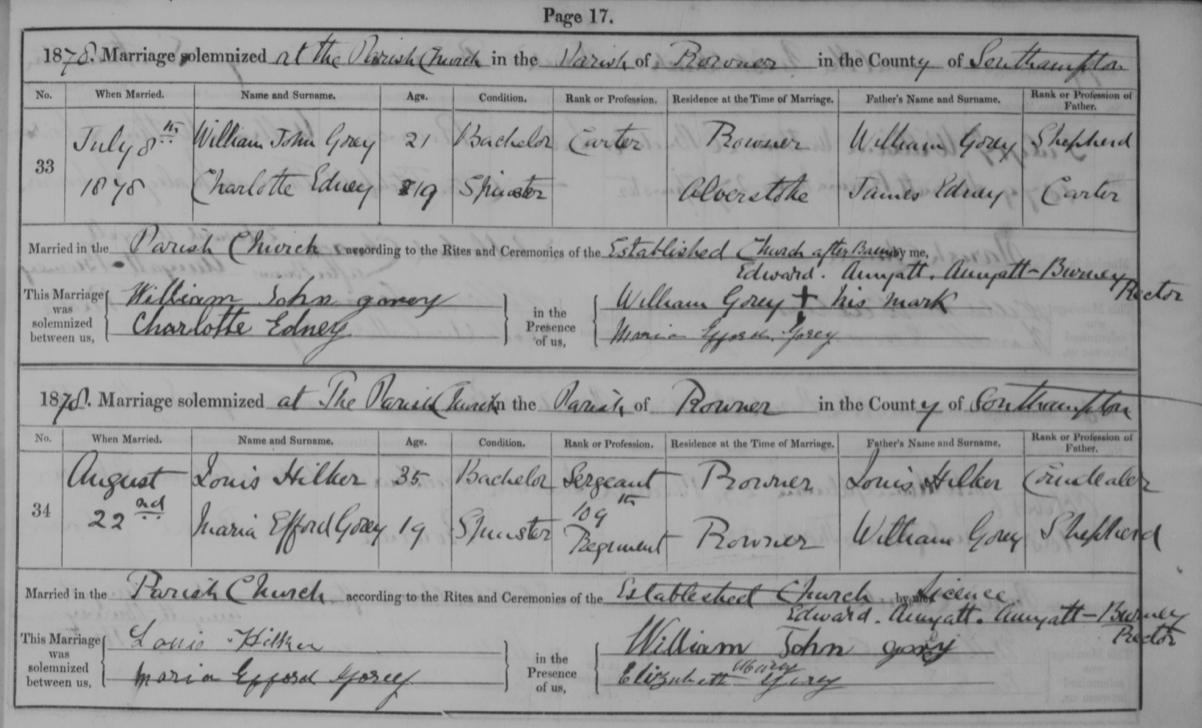
Marriage record for Maria Efford Gorey and Louis Hilker [1]
Elizabeth Mary Gorey (née Smith) could write, in a household where her husband could not. She had signed her own marriage register in 1852 [2], and in the decade of Maria's birth, that was not a given. Nationally, female literacy in 1851 ran at approximately 55%, well below the male rate of nearly 70%; in Hampshire, women signed at a slightly higher rate than the national female average — 65 in every 100 brides against 55 nationally — but the gap between men and women within the county remained, and for working-class girls it was wider still [3]. Before the 1870 Education Act formalised elementary schooling for all children [4], a girl born into a shepherd's household was likely to encounter literacy, if at all, through Sunday school alone. The Registrar General had been using marriage register signatures as his primary national measure of literacy since 1839, which makes the Rowner register itself legible in those terms: Elizabeth's signature in 1852 and Maria's in 1878 sit at two distinct points on that curve.
It is the only time Maria Efford Gorey's handwriting exists in the historical record. After this, other people did the writing. After this, she became the subject rather than the author, and she stayed the subject until the end.
Maria Efford Gorey was not born in Curdridge, but Curdridge made her family. The baptism registers of St Peter’s, a village near Bishops Waltham in the inland Hampshire chalk country, record William Gorey and Elizabeth Smith producing children through the 1850s: Jane Emily in January 1853, John William in November 1856, William listed both times as a labourer [5]. In October 1857, Jane Emily Gorey was buried at Curdridge, aged four [6]. She had lived long enough to walk and talk and be known. Then she was gone, three years before Maria was born. Elizabeth Gorey had already buried a daughter when Maria arrived. She already knew what it was to do that.
The parish the Goreys left was not a village in any concentrated sense: a church, a common, and a scattering of farms and cottages connected by lanes rather than by any identifiable centre. The name itself is Anglo-Saxon, Cuthred’s ridge, and the settlement had been strung along that ridge since at least the thirteenth century [7]. The Common, which had provided fuel and grazing to the poor households of the parish for generations, was enclosed by Act of Parliament in 1856 [8], the year John William was baptised, and the year the landscape the Goreys depended on began to contract around them. Whether the enclosure contributed directly to their departure cannot be confirmed from the documentary record alone; but the timing is suggestive, and the loss of common rights bore hardest on precisely the kind of labouring household William and Elizabeth represented.
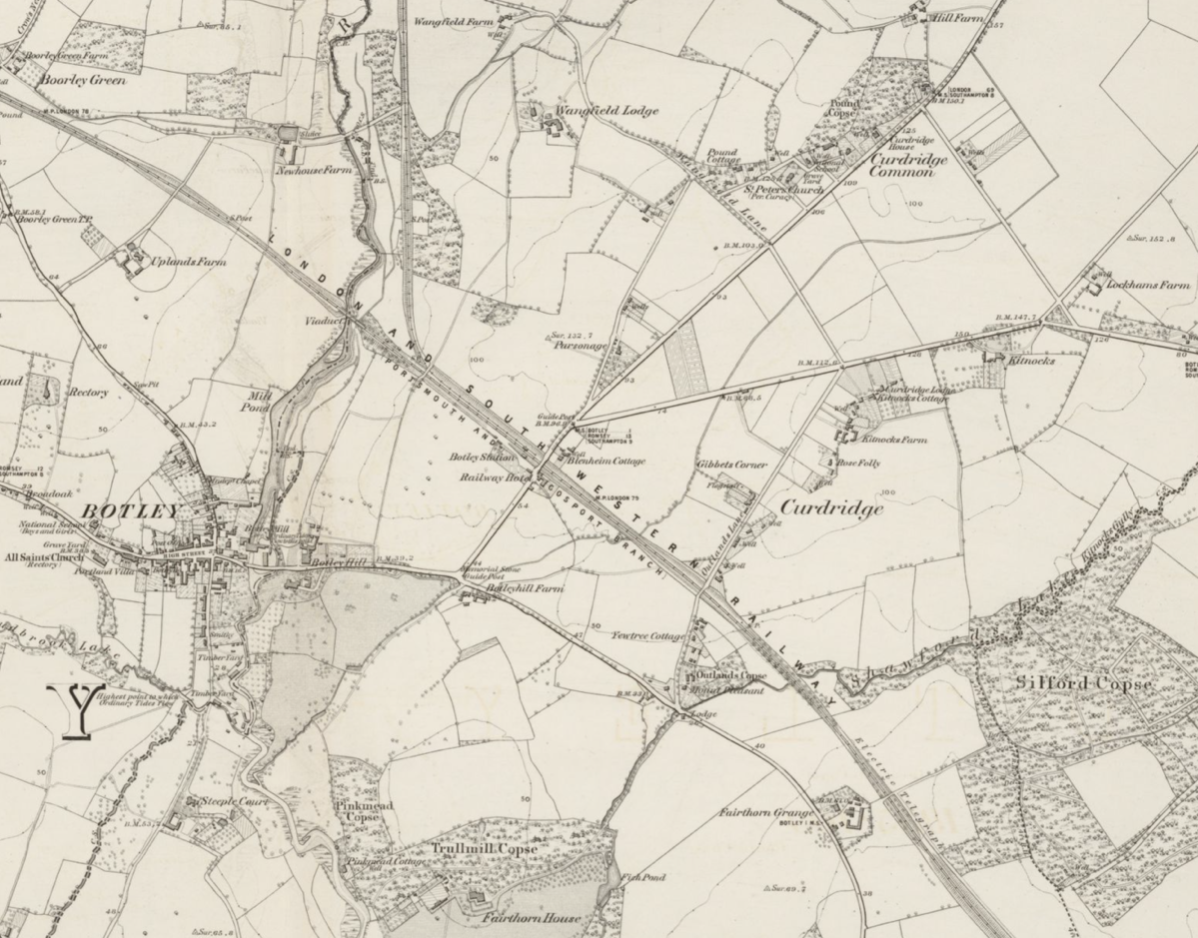
Map of Curdridge, Hampshire, surveyed in the 1860s [9]
Sometime between 1857 and 1861 the family moved, from the inland chalk country south to the Gosport peninsula, where the War Office was purchasing the flat land around the harbour for its great artillery works. Fort Rowner, Fort Brockhurst, Fort Grange, and Fort Elson were among the five earthwork forts of the ‘Gosport Advanced Line’, built between 1858 and 1862 as part of the landward defence of Portsmouth harbour from perceived French invasion [10]. Maria was born at Elson on 8 January 1861, her father's occupation recorded as shepherd on her birth certificate [11].

Maria’s Birth Record [11]
She was named for her aunt, Maria Efford Smith, her mother's sister, a living woman of seventeen when the baby arrived. The aunt would outlive her niece by thirty-five years [12]. Maria was baptised on 10 February 1861 at St Thomas's, Elson [13] — a small church constituted only in 1845 to serve the growing harbour-edge community, its living in the patronage of Thomas Walpole, Rector of Alverstoke, with James Ogilvy Millar, Incumbent, officiating [14].
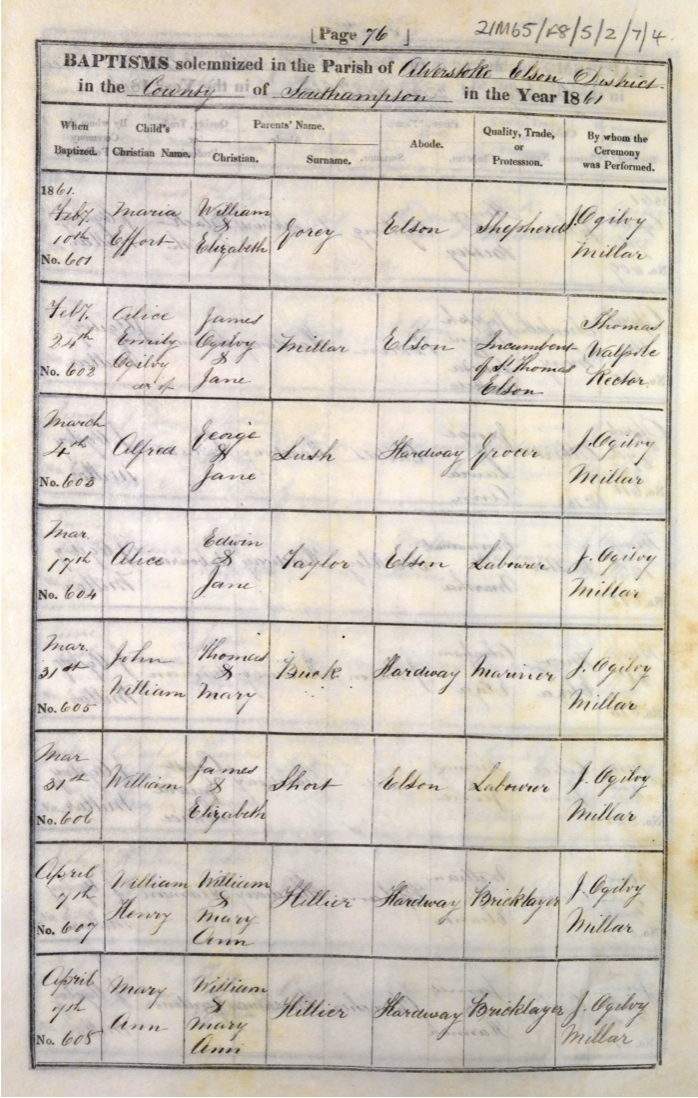
Maria’s Baptism Record [13]
Elizabeth could write her own name, she had signed her marriage register in 1852 [2], and she would sign again as witness at Maria's wedding in 1878 [1]. But when she appeared before the registrar in February 1861 to record her daughter's birth, she made her mark [11]. The X beside her name on Maria's birth certificate sits in direct tension with the signatures that bracket it. Whether that mark reflects the difference between a prepared ceremonial signature and an unannounced administrative encounter, the exhaustion of a woman recently delivered, or the outer limit of what Elizabeth's literacy actually was, the record cannot resolve. What it does complicate is any simple claim that Elizabeth could write. She could, sometimes, under some conditions. What those conditions were, and what she understood herself to be capable of, she did not leave behind. And yet what she had modelled was enough: the act of putting one's own name to things, of being present on the document, of not being represented by a mark, even if she herself had sometimes been.
The Rowner the family moved into was not yet the suburban parish it would become. In the early 1860s it was still largely agricultural, scattered farms, copses, and common land, the lanes connecting isolated dwellings rather than any concentrated settlement. Chark Common lay to the west; the church of St Mary the Virgin sat beside a lane at the parish's heart, surrounded by fields. To the east, beyond the railway line, the land flattened toward the harbour, and on clear days Portsmouth lay visible across the water. To the north and west, the earthworks of the Gosport Advanced Line were still being thrown up; Fort Rowner barely half a mile from where the family settled, Fort Brockhurst to the north-east. Maria grew up in the narrow space between an ancient agricultural parish and a modern military construction site, with the harbour at her back and the forts at her door.
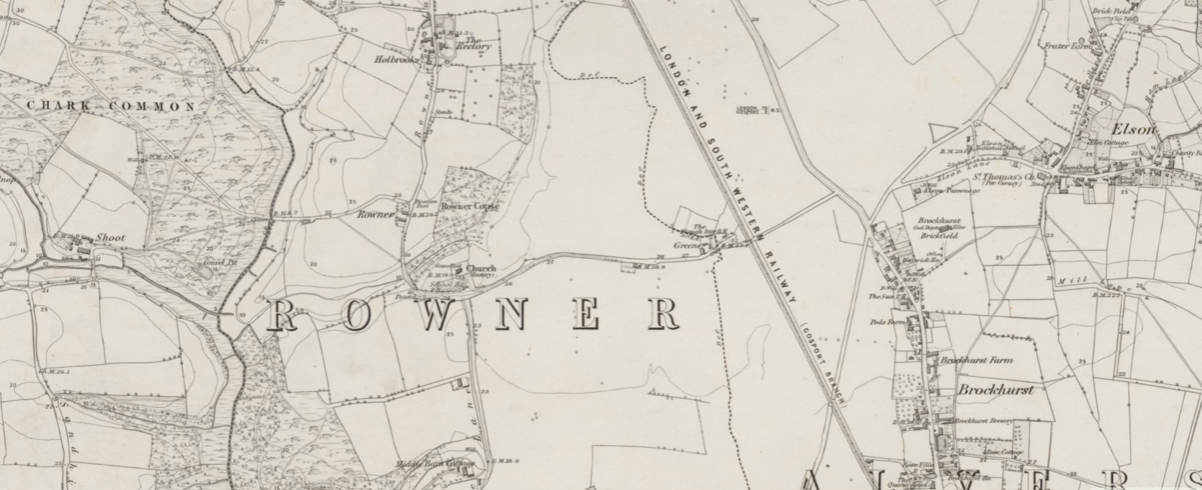
The Rowner parish, where the Gorey family lived through the 1860s and 1870s, surveyed in 1856 [15]
By the census that spring the family was recorded at a dwelling, ‘An Oldhouse’ in Rowner, sitting in the schedule between Green's Farm and Church House, close to Rowner Church on Grange Lane, the household already taking in lodgers: bricklayers from Wales, farm labourers from Hampshire, men from the construction economy that surrounded the forts [16]. The 1871 census finds them on the Southampton and Gosport Road, between Green's Cottage and Church House, in all likelihood the same spot, or very close to it, Maria now ten, the lodgers still coming and going [17].
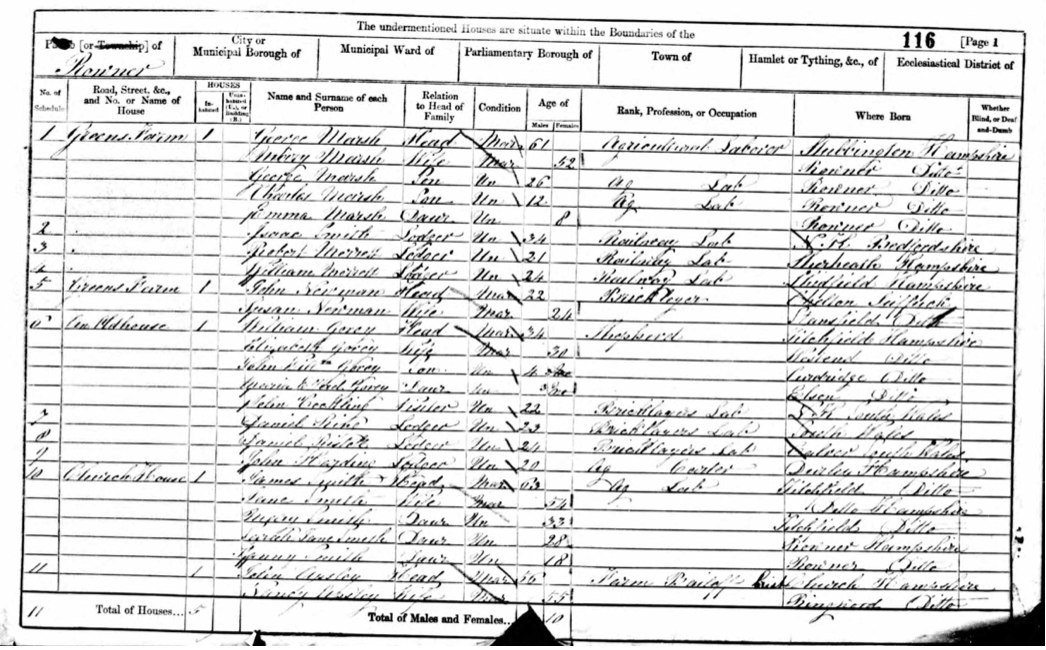
1861 Census [16]
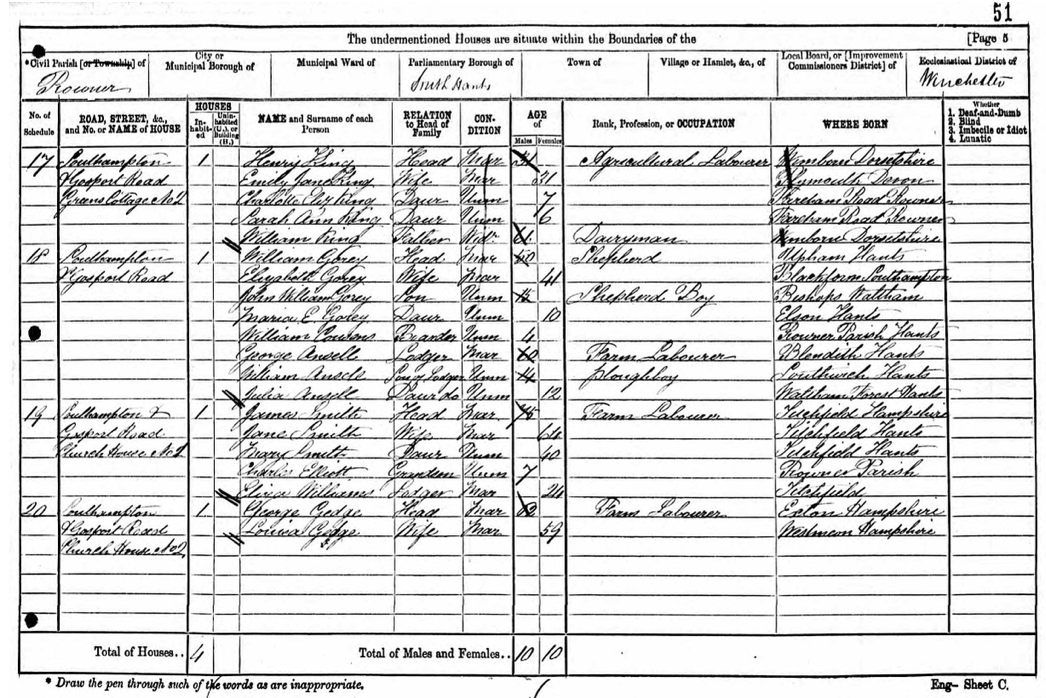
1871 Census [17]
The household William and Elizabeth kept was one where working men came and went for income. What that daily negotiation looked like, who managed it, what it required, the record does not say. What it does show is a family that had learned to make room for strangers, and a mother who could sign her own name at a time when many women in her position could not.
Somewhere in Bishops Waltham, her aunt was getting on with her life. Two Maria Effords in the world. One got to be old. The other did not make it to thirty.
She was seventeen when she met Louis Hilker, in all likelihood shortly after his regiment returned from India in December 1877. The record does not document the meeting, no letter survives, no diary, nothing that gives us the conversation or the weather. What the record gives us is the gap between their worlds, which is itself a kind of story.
Louis Hilker was a sergeant stationed at Fort Grange, one of the five earthwork forts of the Gosport Advanced Line, sitting in the flat land between Gosport and the Solent, practically next door to the world Maria had grown up in. He was thirty-five years old. He had been in British service since 1856, when he had walked into a recruiting depot in the Hanseatic port of Stade, Hanover, at nineteen [18]. In the twenty-two years since, he had shipped to the Eastern Cape of South Africa [19], transferred to India, served through postings at Karachi, Aden, Bombay, Multan, Roorkee, and Dinapore [20], been court-martialled once at Chatham, risen to Mess Sergeant of the 109th Regiment of Foot, and arrived back in England with four good-conduct badges and twenty-two years of service behind him. He was still a serving soldier when he met Maria, a pension would come later, when the Childers Reforms dissolved the 109th in 1881 [21]. He had already outlasted three continents before he came to Hampshire.
A German-born soldier in the British Army was not unusual. Germans had been present in Britain in significant numbers throughout the Victorian period, in trade, in industry, in military service, broadly integrated and largely unremarkable in the garrison towns of southern England. What was unusual, relative to Maria's world specifically, was the accumulated distance of his experience. The Eastern Cape. The Arabian desert. Seventeen years in Indian cantonments. None of it had any equivalent in Elson or Curdridge or the Gosport Road. What drew a nineteen-year-old shepherd's daughter to a thirty-five-year-old German sergeant, the record does not say. But that distance was visible, written into his service record, his accent, his rank. Whether it was part of the attraction, or simply what she married into, cannot be confirmed. What the record tells us is that she said yes.
What followed, the evidence of the life they actually built together, suggests that something real was made between them. The gravestone would eventually say so, in four words, more plainly than any document in the archive.
The marriage register at St Mary the Virgin, Rowner, shows two weddings on the same page [1]. Entry 33: William John Gorey, twenty-one, carter, and Charlotte Edney, eighteen, spinster, married 8 July 1878, Maria's brother, already settled at Foxbury in Titchfield with a wife and two children by the time of the 1881 census [22]. Among the witnesses to John's wedding: Maria Efford Gorey, signing her own name. Entry 34: Louis Hilker, thirty-five, Sergeant, 109th Regiment, and Maria Efford Gorey, listed as nineteen, spinster, married 22 August 1878. Among the witnesses to Maria's wedding: William John Gorey. The Gorey siblings witnessed each other's marriages, six weeks apart, from the same church, conducted by the same rector, Edward Amyatt-Amyatt-Burney.
John went to a carter's daughter from Alverstoke. Maria went to a German sergeant from three continents away, sixteen years her senior. Same page. Different worlds entirely.
Below John's signature in entry 34 is Elizabeth Gorey's, the mother, present as witness, signing her name as she had signed it beside her own husband's twenty-six years before. The rector closed the register. The Hampshire chapter was done.
The 109th Regiment had returned from India in December 1877; Louis had followed it home. On 3 May 1881 the army discharged him, two months before the Childers Reforms formally amalgamated the 109th into the Leinster Regiment on 1 July, but as part of the same process of dissolution [23]. He did not choose to stop moving. The regiment stopped moving, and took the decision out of his hands.
What that closure meant in practical terms became clear in the years immediately following. The family network Maria had grown up inside, her parents on the Gosport Road, John and Charlotte nearby, existed now at a distance that, for a young wife following a serving soldier, might as well have been the Eastern Cape. The women she would come to know and rely on in the years ahead were women she had not yet met, in towns she had not yet seen.
What following the regiment actually meant is visible in the 1881 census, taken three years into the marriage with their daughter Maria Efford Kate just over a year old. Louis appears in two military records that year: at South Camp, Aldershot, Lance Sergeant, forty-four years old, birthplace Stade, Hanover, British Subject with the 2nd Battalion of the newly formed Leinster Regiment; and at Dorchester attached to the 39th Regimental District Depot, remarked as 3rd Battalion Dorsetshire Regiment [24]. Maria is not beside him at either location. She is at Rose Cottage, Rowner, a small thatched dwelling, with baby Maria Kate, in her parents' house [25]. The Dorchester posting is significant: it places Louis at the depot that would become the family's next address.
The men around him on the census page tell a different story. Sergeant Hartmann, born Brunswick, has his wife and six children beside him, the children's birthplaces, Delhi, Dinapore, Aldershot, mapping the regiment's journey across three decades [24]. Louis gets one line. Married, forty-four, alone. Whether the difference was rank, timing, or luck with the commanding officer's permission cannot be confirmed. What the page shows is the gap between what military marriage could look like and what it looked like for the Hilkers in the spring of 1881.
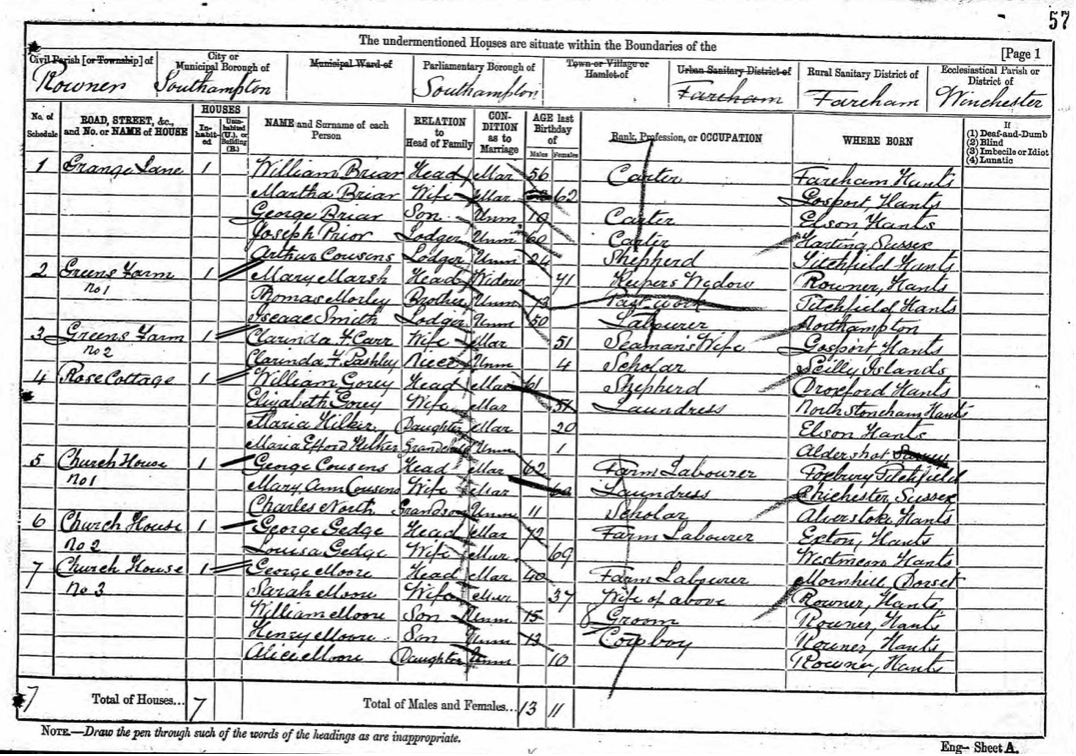
1881 Census [25]
The Victorian army actively discouraged its rank and file from marrying. A soldier needed his commanding officer's formal permission, and a wife married with that permission was carried 'on the strength' of the regiment: entered on its married establishment roll, recognised as part of the military household, and entitled in principle to quarters, rations, free passage when the regiment moved, and a place in the institutional life of the garrison. A wife married without permission was 'off the strength', and the distinction was everything. She received nothing from the War Office: no roof, no rations, no transport, no acknowledgement that she existed. Permission was rationed by rank. Under the regulations of 1867, only seven per cent of privates could marry on the strength, but sixty per cent of sergeants, and regimental staff-sergeants without restriction, provided a man had seven years' service and a good conduct badge behind him [26]. Many married anyway and took the consequences. Louis, a sergeant of twenty-two years' service when he stood in Rowner church in 1878, was on the favourable side of that arithmetic, and the regulations were on Maria's side in a way they were never on the side of a private's wife. Whether she was in fact carried on the establishment cannot be confirmed from the surviving record, and the documents pull in both directions.
When Maria Kate was born at South Camp on the twenty-second of February 1880 [27], the camp her parents had made their home was already a quarter-century old and well past the life its builders had intended for it. The wooden huts of the original camp, run up between 1854 and 1859, had been designed to last thirteen years; by the time Maria arrived, they had stood for more than twenty, and would stand for another decade before funds were eventually found to replace them with brick [27]. The married quarters, where families on the strength were housed, were part of the same fabric: wooden, ageing, and subject to inspection rather than improvement. Maria had carried her pregnancy through the autumn and winter in these conditions. There was no military hospital for soldiers' wives at Aldershot in 1880 — the Louise Margaret Hospital, which would eventually provide that service, would not open until 1898 [28] — and for a working-class woman in a garrison town, birth meant confinement at home, attended in all likelihood by a local midwife rather than a doctor [29]. The room in which she laboured was almost certainly one of those wooden huts: cold in a February that offered nothing of the spring, partitioned rather than private, with whatever warmth a stove and the presence of neighbours through thin walls could provide. A sergeant's family was better placed than most. Louis’s rank entitled him to consideration that a private's wife could not expect, but better placed is not the same as comfortable. The huts that surrounded Maria Kate's first weeks of life would be described, within a decade, as being in terrible condition. That they were home, and that Louis registered his daughter's birth from South Camp six weeks after her arrival, is the extent of what the record confirms.
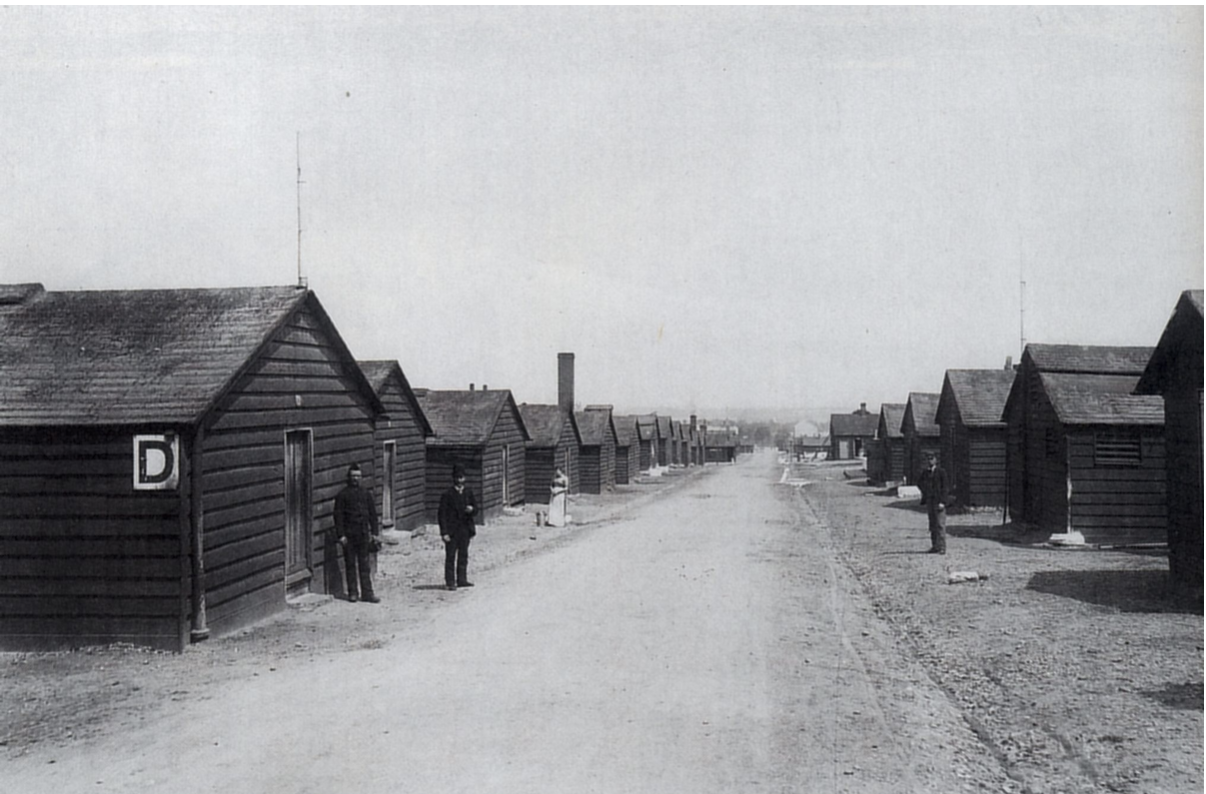
The wooden huts of D lines, c. 1890 shortly before they were demolished to make way for the brick barracks. These huts were part of the original Camp, built between 1854 and 1859 © Paul H. Vickers; reproduced by permission [pending][30].
Yet by census night in April 1881 she and the infant were back in her parents' cottage at Rowner25 while Louis remained at Aldershot [24]. Whether the separation reflects a young mother gone home to her own mother with the baby, as countless army wives did regardless of their standing on the establishment, a wife never carried on the strength at all, or a household quietly dismantled as the 109th approached its amalgamation and Louis his discharge, the record does not say. What it does say is that when the army's arrangements failed or lapsed, the Gorey household at Rowner was where Maria went.
The army categorised its women as it categorised everything else, by rank. Officers had ladies, sergeants had wives, soldiers had women. As a sergeant's wife, Maria occupied a recognised middle tier in the garrison social world, formally part of the regiment, expected to conduct herself as a reflection of her husband's position. Whether she felt it to be so is another matter. The law was less interested in how she felt than in what she owned, which, under coverture, was nothing.
The legal framework surrounding her position as a married woman deserves a moment. Under the common law doctrine of coverture, a married woman had no separate legal identity: her property and earnings belonged to her husband at marriage. The Married Women's Property Act of 1870 had taken the first legislative step, giving wives a limited right to retain their own earnings and to inherit property up to the value of £200 in their own name; it did not apply retrospectively, and it left the broader structure of coverture intact. The Act of 1882 went further, giving married women the full formal right to own and dispose of property in their own name, and it was this Act that finally dismantled the doctrine as a practical legal reality [31]. These were significant reforms in principle. In practice, for an army wife with no independent income whose housing was controlled by the regiment and whose only economic security was Louis's continued service, the protections they offered were limited.
Louis was discharged from the 109th in May 1881 [23] and took a position with the permanent staff of the newly formed Dorsetshire Regiment's militia battalion. He stayed in England, and the family came together in Dorset.
The Dorset Militia was a part-time reserve force, not a regular regiment. Its permanent staff, experienced men like Louis, with long regular service behind them, trained the part-time soldiers who assembled for their annual embodiment of around twenty-eight days, and administered the depot between camps. It was a more locally rooted existence than a line regiment's perpetual postings, but it was not settled in the way that civilian life is settled. The annual training camp moved location, Louis appeared at Blandford Forum in July 1882, the family's son baptised there while his father was on temporary deployment [32]. Depot duties continued through the year. Maria managed the household in his absences, and there were absences.
The baptism registers trace the years in fragments. Dorothea was baptised at Holy Trinity Dorchester on 5 April 1885, Louis now Sergeant of Militia, the family's abode given as Dorchester [33]. By this point Maria had three children under five in a garrison town where she had no family network beyond the regiment, and no domestic help beyond what she organised herself. She ran the household on a militia sergeant's pay, got the older children to the elementary schools that had been compulsory since the Education Act of 1880 [34], and managed the illnesses and ordinary days and ordinary needs of a young family in Fordington terrace housing largely without her husband present.
The gaps in the baptism record may reflect nothing more than the ordinary spacing of a working-class Victorian family: four years between Louis William John and Dorothea, four years again between Dorothea and Frederick. They may also reflect losses the record was never required to document. Stillbirths were not registrable until 1926; miscarriages left no official trace at all. If Maria lost pregnancies in those years, she did so without the archive noticing, and without any of it appearing in the account that survives of her.
By 1889 the family was settled at Maie Terrace, West Fordington [36], now Prospect Road [37], the address they would keep until the end. Ordnance Survey maps of the period place Maie Terrace immediately west of the railway line, between the Royal Horse Artillery Barracks to the north and the Infantry Barracks to the south-east, with the Dorchester Water Works beyond. It was a street shaped by the garrison that surrounded it, and Louis's service had brought them to it.
Fordington in the 1880s was a parish in the process of being overtaken by the town. For most of the nineteenth century the eastern quarter of the parish had existed as Dorchester's poorest and most overcrowded district, its character shaped by centuries of open-field farming on some of the largest common land in Dorset. By 1878, the year of Maria's marriage, the great field had finally been enclosed, the open wheat replaced by iron fences and, in time, by terrace after terrace of workmen's cottages.
West Fordington, where Maria lived, was a different kind of neighbourhood. It lay on the other side of the town, pressed between the railway line and the garrison, newer and more regularly built than the ancient lanes to the east. The streets around Maie Terrace were largely a product of the same decades that had produced the barracks: the terraced housing of a garrison suburb, functional and close-built, shaped by the presence of the military rather than by centuries of agricultural settlement.
The church at the heart of that community was Christ Church, built in 1846 as a chapel of ease to the ancient parish church of St George's Fordington [38]. Henry Moule, vicar of St George's since 1829 and War Office chaplain to the Dorchester garrison, had used the proceeds of his Barrack Sermons to provide a place of worship for the troops and their families on their own side of the town [39]. Under the Queen's Regulations, chaplains were required to regard soldiers' families as their parishioners whether on the married roll or not, and commanding officers were required to afford every facility for wives and families to attend public worship and to induce them by every means in their power to attend regularly [40]. Christ Church was where that obligation attached. It was where Maria brought her children to be baptised: Frederick in April 1889, Eva in August 1890. Christ Church had no burial ground of its own. That function remained with St George's, the parish church, which received the dead of the whole parish including West Fordington [41]. Maria's daily religious life centred on the chapel Moule had built for her community. When she died, it was St George's that received her.
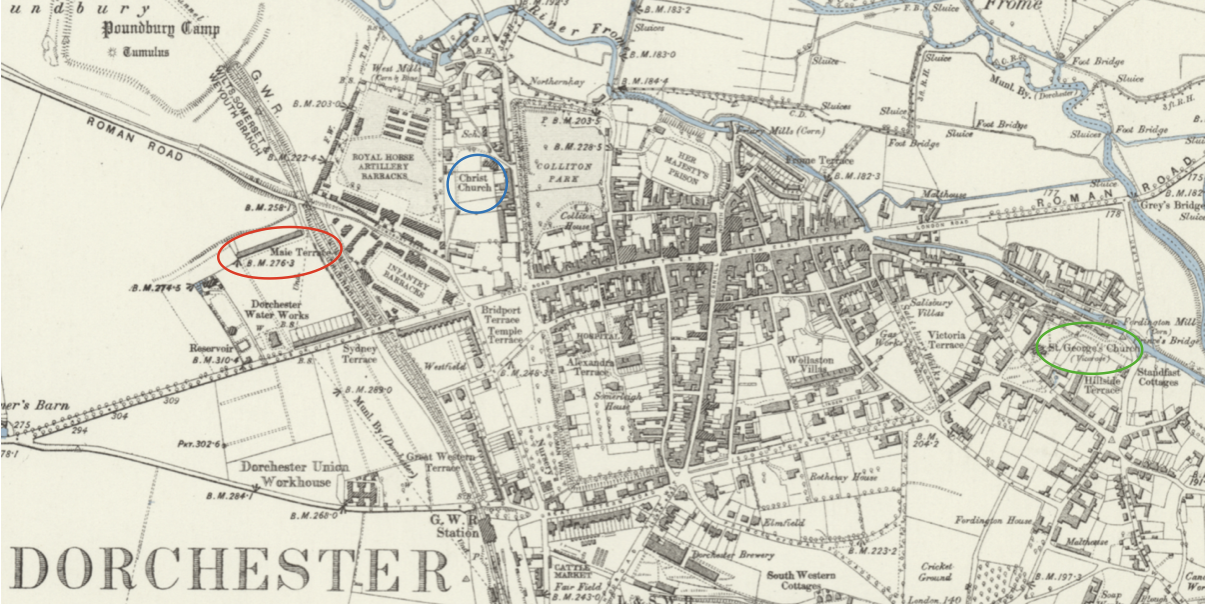
Late 19th century map of Dorchester. Location of Maie Terrace, Christ Church and St George’s Church outlined with a red, Blue and Green circles, respectively [42]
Moule had described the conditions in the eastern quarter of the parish in 1854 in terms that retained their force decades later, in letters addressed directly to Prince Albert as president of the Duchy of Cornwall, which owned the land:
"At the East end of Dorchester, then, and within a space that can scarce exceed five acres, about 1,100 persons are congregated in a set of dwellings, many of which are of the most wretched description, and utterly destitute of the normal conveniences of life... scarcely a cottage in this division has a single inch of ground beyond that on which it stands. Their filth is consequently cast either into the open and wretched drain in the street, or into the Mill Pond, from which moreover, the people draw most of their water for washing, and sometimes, even for culinary purposes, ‘the conveniences’ of more than half of these 1,100 people empty themselves together with the filth from the County Gaol, and of some proportion of the other three Parishes of Dorchester. The population, with few exceptions, consists of mechanics, labourers, and paupers from this and many other parishes. Vice, in its worst forms, abounds amongst them."
Rev. Henry Moule, Four Letters to Prince Albert (1854) [43]
In August of that year a severe cholera outbreak, introduced through prison laundry brought from Millbank Gaol in London, killed at least thirty people in the parish. Out of the experience Moule invented the dry earth closet, patented in 1860, and widely adopted across the empire [44]. By the time Maria was living in Maie Terrace, the worst conditions Moule had described had been substantially improved through sewerage and piped water. But the improvement was partial, and the epidemic likely remained within living memory of the streets it had killed.
Those streets lay half a mile east of where Maria lived. Thomas Hardy, the Dorset novelist, moved into Max Gate in 1885, less than a mile from Fordington [45]. His connection to the parish was older and deeper than proximity: through his lifelong friendship with Horace Moule, the vicar's son, he had known Fordington's streets since boyhood [46]. In The Mayor of Casterbridge, published in 1886 while Maria was raising her children in West Fordington, he gave the fictional Mixen Lane, drawn from Mill Street in the eastern quarter, its plainest description:
"The lane and its surrounding thicket of thatched cottages stretched out like a spit into the moist and misty lowland. Much that was sad, much that was low, some things that were baneful, could be seen in Mixen Lane. Vice ran freely in and out certain of the doors in the neighbourhood; recklessness dwelt under the roof with the crooked chimney; shame in some bow-windows; theft (in times of privation) in the thatched and mud-walled houses by the sallows. Even slaughter had not been altogether unknown here. In a block of cottages up an alley there might have been erected an altar to disease in years gone by… Yet this mildewed leaf in the sturdy and flourishing Casterbridge plant lay close to the open country; not a hundred yards from a row of noble elms, and commanding a view across the moor of airy uplands and corn-fields, and mansions of the great."
Thomas Hardy, The Mayor of Casterbridge, Chapter 36 (1886) [47]
Elsewhere he called it simply "the hiding-place of those who were in distress and debt [46]." Maria's Maie Terrace was not those streets: it was newer, more regularly built, its hardships those of the garrison rather than of the ancient rural poor. But Fordington was one parish and one name, and the world Moule had documented and Hardy was fictionalising shaped the broader landscape Maria moved through when she left her own street.
In Far from the Madding Crowd (1874), Hardy's first major literary success, Fanny Robin is a young working-class woman who follows a soldier, is deserted by the man who promised to marry her, and dies in childbirth at the Casterbridge workhouse [48]. Fanny Robin is not Maria. But Hardy gave Fanny Robin a chapter of extraordinary tenderness. He gave her a grave. Maria Efford Hilker got two lines in the Bridport News. Hardy did not know her name. She did not know she was living in the world he had already written. What she knew was the work of keeping a household on a fixed income, in an unfamiliar town, without family nearby. That daily labour is what the official record mostly omits: not the dramatic moments of birth and death, but the sustained daily work of a woman managing a household in an unfamiliar town, on a fixed income, without her husband often present. She dealt with landlords and tradespeople, navigated the parish, kept her children in school under the compulsory attendance legislation. The literacy she had inherited, the capacity to sign for things, to be present on documents, was not incidental to any of this.
In England and Wales in the decade 1881–90, around 149 infants in every thousand born alive died before their first birthday. Meningitis was among the more lethal causes, swift, poorly understood, and entirely beyond the reach of Victorian medicine to treat [49]. In the spring of 1889, Maria gave birth to a son at Maie Terrace. Frederick August Hilker was baptised at West Fordington on 21 April [35], the name August carrying the quiet mark of Louis's origins, the inscription of Hanover into English children that ran through their naming. Within weeks he was dying. The cause was meningitis, and the certificate records an illness of fourteen days [50], a fortnight in which nothing Victorian medicine possessed could alter the outcome.
The death certificate confirms that neither Maria nor Louis is named as informant. The person who registered Frederick's death was a neighbour, Eva Samson, present at the death. She lived at number 5 Maie Terrace, doors away from the Hilkers at number 2 [51]. Louis was in all likelihood occupied with the militia at the time, though this cannot be confirmed from the certificate alone. Maria's absence from the registrar's office is harder to account for. Grief, perhaps, or illness, or some practical constraint the document does not explain. What it shows is that in the worst days of that spring, the person who stepped forward was Eva Samson. When Maria's last child was baptised at West Fordington sixteen months later, she was named Eva Elizabeth [52]. Whether the name honoured the neighbour who had sat with the dying Frederick cannot be proven, but the coincidence is suggestive, and naming a child for the woman who stood with the family at its worst moment would have been entirely in keeping with the customs of the street.
The three surviving children would have understood enough to know something terrible had happened. Maria Kate was nine, old enough to help, old enough to see her mother's face. Louis William John was seven. Dorothea was four. They were there in August 1890, ten, eight, and five, when Eva Elizabeth was baptised, Maria's fifth child, in a house where a son had died the year before.
Eight weeks later, Maria was dead.
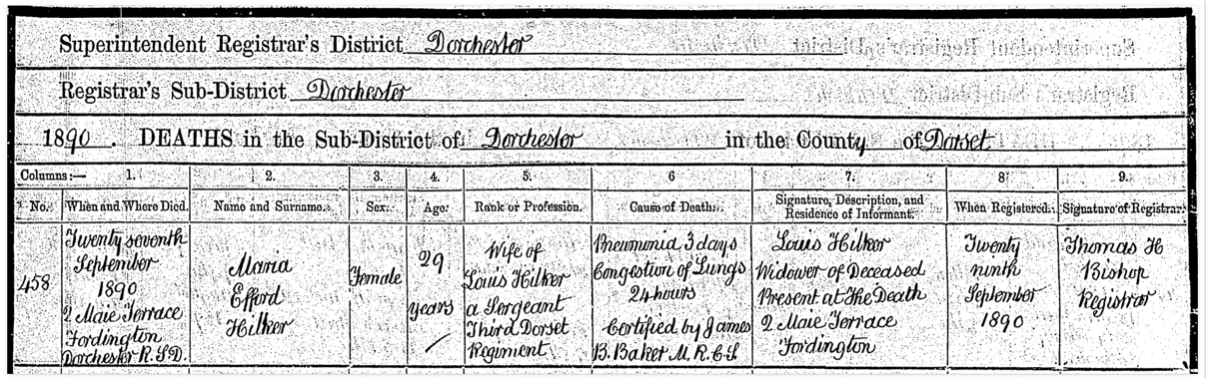
Maria Efford Gorey’s Death Certificate [53]
The death of women in the weeks and months following childbirth was, in 1890, a fact of life so common it had its own cultural grammar. The maternal mortality rate in England and Wales held stubbornly at around four to five deaths per thousand births throughout the second half of the nineteenth century, a figure that had barely shifted despite the advances of the age. The majority resulted from puerperal fever, haemorrhage, and respiratory infection [54]. Pneumonia in the postpartum period was a recognised and common killer: the immune system, depleted by childbirth, was less able to mount an effective defence against the infections that thrived in the close quarters of a Fordington terrace in a Dorset autumn.
Whether this precise mechanism explains Maria's illness cannot be proven from the death certificate alone, but the timing placed her in the period of heightened vulnerability that Victorian doctors recognised even if they could do nothing to address it. Victorian death certificates were imprecise instruments in this regard, and respiratory and chest conditions were among the headings under which postpartum causes were routinely recorded when practitioners either misidentified the cause or declined to name it directly. Pneumonia on the certificate does not foreclose a postpartum reading of her death; it simply cannot confirm one. Sulphonamide antibacterial drugs, which would dramatically reduce maternal mortality when introduced in the 1930s, were forty years away [53]. The illness that killed Maria was the same illness that would become routinely treatable within her daughter's lifetime.
The death certificate names Louis as informant, he was there, in the room, at the end. She was buried at Fordington Cemetery on 30 September 1890, aged twenty-nine. The Bridport News of 3 October recorded her death in two lines:

Maria Efford Gorey’s Death Notice [55]
In Bishops Waltham, her aunt, the other Maria Efford, the one the name had come from, was forty-six, and had thirty-five more years ahead of her [56].
Maria Efford Gorey had signed her name once in the historical record, in the summer of 1878, her mother standing beside her. After that she became someone other people wrote about: registers, certificates, a newspaper notice, a burial entry. Other people's hands, other people's ink. She raised three children through the hardest years of West Fordington, in a house where a son had died and a husband was often absent, and she did it without leaving a single document that records how.
When she died, those children were dispersed. Maria Kate, Louis William John, and the baby Eva went to William and Elizabeth Gorey at 14 Nightingale Terrace, Cambridge Road, Alverstoke [57], the grandparents who had sheltered Maria and her firstborn a decade earlier. Dorothea, then five, was taken to the Biles family in Allington, Bridport [58], for reasons the record does not explain. For the baby, the journey was the most dangerous. Eva Elizabeth was two months old when her mother died, abruptly weaned into a household with no woman of nursing age, which in 1890 meant hand-feeding: cow's milk, condensed milk, pap. She survived into the new year. Unpasteurised milk was a recognised route by which tuberculosis entered infants, and tubercular meningitis was the form the disease characteristically took in babies infected that way [59]. Whether Eva's infection came through her feeding or from contact with the disease that was everywhere in Victorian England cannot be determined, but on 22 February 1891 she died at her grandparents' house [56] aged eight months. It was Maria Kate's eleventh birthday.
Louis was the informant on Eva's death certificate. He was stationed seventy miles away at the Dorchester depot, which means he travelled to Alverstoke to register his daughter's death. Eva's name was inscribed on the family headstone at Fordington alongside her mother and her brother Frederick [60]. For a man whom the record shows almost entirely through institutional entries, the decision to place her name on the stone so that the three of them would be remembered together is one of the few acts of unmistakable feeling the archive preserves.
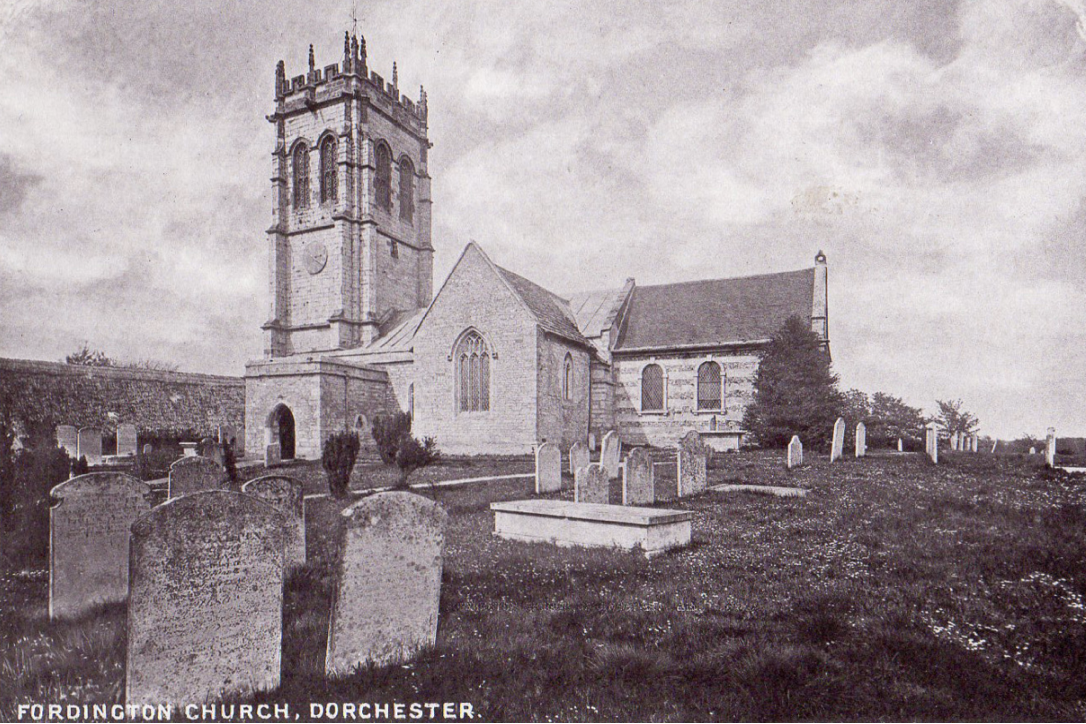
St George’s Church, Fordington c. 1890 [61]
By 1901 the three surviving children had converged again at 20 Broad Street [62], Southsea, in the household of Victor Durrant, Maria Kate's husband, where their father Louis, now an army pensioner, was also living. They had found their way back to each other.
The name Efford, which Elizabeth had carried from her own sister and given to her daughter, which Maria had given to hers, ended with Maria Kate: carried through a life, but not passed on.
And when Louis died in 1904 in Southsea, his children added his name to the stone at Fordington, seventy miles away, in a cemetery none of them were living near. He is not recorded as buried there [63]. Someone made that journey, or wrote that letter to a monumental mason in Dorchester, deliberately and at some cost.The stone does not say soldier. It does not say sergeant or veteran or pensioner. It does not record his rank, his regiment, or his years of service on three continents. Instead, the inscription reads: Husband of Maria Efford Hilker [64]. His children chose to mark their father by his relationship to the mother they had lost. The oldest had been eleven when Maria died; the youngest had been four. They wrote her name where it would outlast everything else, and this is what they chose.
Explore further…
Maria Efford Gorey appears in the Maternal Grandfather family tree, which traces the Durrant and Hilker lines from Gosport and Dorchester through to Maurice Durrant and beyond. Her marriage to Louis Hilker, a German-born sergeant of the 109th Regiment of Foot, connects a Hampshire shepherd's family to three continents of British military service.
She and Louis are listed together in the Second Great Grandparents snapshot, which places them in the wider context of that generation across all family lines.
Her daughter Maria Efford Kate Hilker is profiled in Haunted by Death, the biography that follows what became of the children Maria left behind: dispersed at her death, reunited a decade later in Southsea, and carrying her name forward into the twentieth century.
Maria died at twenty-nine, the youngest death in her generation of direct line ancestors, and the one that pulls the generational average down furthest on the Death and Mortality page. She died of pneumonia eight weeks after her fifth child was born, in an era when sulphonamide drugs were forty years away. That cause of death contributes to the maternal mortality count in the cause of death breakdown charted there.
References:
[1] Marriage register: St Mary the Virgin, Rowner, 22 August 1878, marriage of Louis Hilker and Maria Efford Gorey (Portsmouth History Centre, CHU 46/1C/3). The marriage register gives Maria's age as nineteen. Her birth certificate establishes her date of birth as 8 January 1861, making her seventeen years and seven months at the date of marriage. The stated age on the register is incorrect by approximately two years. Misstatement of age in marriage registers was not unusual in this period, as ages were self-reported and not verified against documentation.
[2] Marriage register: Curdridge Parish, 1 June 1852, Elizabeth Smith and William Gory (Hampshire Archives and Local Studies, Winchester, Hampshire, England, Anglican Parish Registers, ref. 82098/1/3).
[3] Annual Report of the Registrar-General of Births, Deaths, and Marriages in England: Fourteenth Report, 1851, Table V (England: Marriages — Proportional Number of Marriages; of Persons who signed their Names), p. 7. The national figures for England show 69.2 in 100 men and 54.7 in 100 women signing the marriage register in 1851; Hampshire figures appear in the same table (row 5: 69.9 men, 65.1 women — above the national female average). Digitised copy: Wellcome Library via archive.org. For scholarly analysis of this methodology see W.B. Stephens, Education, Literacy and Society, 1830–70 (Manchester: Manchester University Press, 1987).
[4] The Elementary Education Act 1870 was the first piece of legislation to deal specifically with the provision of education in England and Wales, establishing a system of locally elected school boards empowered to build and manage schools where voluntary provision was insufficient. Compulsory attendance was not introduced until a further Education Act in 1880, which mandated schooling between the ages of five and ten. UK Parliament, 'The 1870 Education Act', Living Heritage, https://www.parliament.uk/about/living-heritage/transformingsociety/livinglearning/school/overview/1870educationact/ [accessed 6 June 2026].
[5] Baptism register, St Peter's, Curdridge: Jane Emily Gorey, 3 January 1853; John William Gorey, 2 November 1856. Hampshire Archives and Local Studies, Winchester, Anglican Parish Registers, ref. 98M82/PR1; transcription via Ancestry.com, Hampshire, England, Church of England Baptisms, 1813–1921 (Ancestry.com Operations, Inc., 2023) [accessed 6 June 2026].
[6] Burial register, St Peter's, Curdridge: Jane Gorey, buried 4 October 1857, aged 4. Hampshire Archives and Local Studies, Winchester, Anglican Parish Registers; transcription via Ancestry.com, Hampshire, England, Church of England Burials, 1813–1921 (Ancestry.com Operations, Inc., 2023) [accessed 6 June 2026].
[7] Kevan Bundell, 'Curdridge and Curbridge — the same or different?', Kevan's Miscellany (11 May 2020), https://bundellbros.co.uk/kevansmiscellany/2020/05/11/curdridge-and-curbridge-the-same-or-different/ [accessed 6 June 2026], citing Richard Coates, The Place-Names of Hampshire (Batsford, 1989); and Bundell, 'Kitnocks — the origin of the name', Kevan's Miscellany (4 March 2014), https://bundellbros.co.uk/kevansmiscellany/2014/03/04/kitnocks-the-origin-of-the-name-3/ [accessed 6 June 2026], citing Hampshire Records Office COPY/761/1 and Harold G. Barstow (trans.), 1332 and 1464 Rentals of the Bishops Waltham Manors (1992).
[8] Kevan Bundell, 'The Inclosure of Curdridge Common, 1856', Kevan's Miscellany (2 June 2025), https://bundellbros.co.uk/kevansmiscellany/2025/06/02/2121/ [accessed 6 June 2026]. Bundell notes that the original Inclosure Map is held at the Hampshire Records Office, Winchester.
[9] Curdridge, Hampshire. Ordnance Survey six-inch to the mile map, Hampshire & Isle of Wight Sheet LXVI, surveyed 1866–68, published 1871. St Peter's Chapel of Ease, where the Gorey children were baptised in the 1850s and 1860s, is visible at upper left, beside Curdridge Common. National Library of Scotland, maps.nls.uk.
[10] The Gosport Advanced Line comprised five polygonal earthwork forts — Fort Elson, Fort Brockhurst, Fort Rowner, Fort Grange, and Fort Gomer — built on the western side of Gosport to protect Portsmouth harbour from landward attack. Construction spanned 1853 to 1863, with the three central forts (Brockhurst, Rowner, and Grange) begun in 1858. Historic England, 'Fort Brockhurst, Gosport, Hampshire', https://historicengland.org.uk/education/schools-resources/educational-images/fort-brockhurst-gosport-hampshire-plb-k930371 [accessed 6 June 2026]; see also Wikipedia articles on Fort Elson, Fort Brockhurst, Fort Rowner, Fort Grange, and Fort Gomer, citing David Moore, Fort Brockhurst and the Gomer-Elson Forts (Gosport: Solent Papers, 1990).
[11] Civil birth registration: Maria Efford Gorey, born 8 January 1861, Elson, Alverstoke, Hampshire. GRO, England & Wales Births 1837–2006, Alverstoke district, vol. 2B, p. 454, Q1 1861; transcription via Ancestry.com [accessed 6 June 2026]. Baptism register, Alverstoke Elson District: Maria Efford Gorey, baptised 10 February 1861. Hampshire Archives and Local Studies, Winchester, Anglican Bishops' Transcripts, ref. 21M65/F8/5/2; transcription via Ancestry.com, Hampshire, England, Church of England Baptisms, 1813–1921 (Ancestry.com Operations, Inc., 2023) [accessed 6 June 2026].
[12] Baptism register, St Peter's, Curdridge: Maria Efford Smith, 14 April 1844, daughter of John Smith, paper-maker, and Mary Ann Smith. Hampshire Archives and Local Studies, Winchester, Anglican Parish Registers, ref. 98M82/PR1; transcription via Ancestry.com, Hampshire, England, Church of England Baptisms, 1813–1921 (Ancestry.com Operations, Inc., 2023) [accessed 6 June 2026]. The aunt's marriage to Jesse Bannell is reflected in her death registration as Maria E. Bannell: GRO, England & Wales Civil Registration Death Index, Droxford district, July–September 1925, vol. 2c, p. 148, age 81; index via Ancestry.com, England & Wales, Civil Registration Death Index, 1916–2007 (Ancestry.com Operations Inc., 2007) [accessed 6 June 2026].
[13] Baptism register, St Thomas's, Elson: Maria Efford Gorey, 10 February 1861, daughter of William Gorey, shepherd, and Elizabeth Gorey, abode Elson; officiant James Ogilvy Millar, Incumbent. Hampshire Archives and Local Studies, Winchester, Anglican Bishops' Transcripts, ref. 21M65/F8/5/2; transcription via Ancestry.com, Hampshire, England, Church of England Baptisms, 1813–1921 (Ancestry.com Operations, Inc., 2023) [accessed 7 June 2026].
[14] St Thomas's, Elson was constituted as a separate chapelry in 1845, carved out of the ancient parish of Alverstoke. Its living was a vicarage in the diocese of Winchester, in the patronage of the Rector of Alverstoke — Thomas Walpole (1805–1881), who held that rectory from at least the 1840s until his death. 'Elson', Parishmouse Hampshire Family History Guide, https://parishmouse.co.uk/hampshire/elson-hampshire-family-history-guide/ [accessed 7 June 2026]; 'Alverstoke'; Thomas Walpole (1805–1881), Wikidata, https://www.wikidata.org/wiki/Q42566358 [accessed 7 June 2026].
[15] Ordnance Survey, Hampshire & Isle of Wight Sheet LXXXIII, six-inch to the mile, surveyed 1856, published c.1871 (61 × 92 cm). National Library of Scotland digital collection, https://maps.nls.uk/view/266663065 [accessed 7 June 2026].
[16] 1861 England Census, Rowner, Hampshire: William Gorey household, An Oldhouse. The National Archives, RG9, piece 651, folio 116, page 1; transcription via Ancestry.com, 1861 England Census (Ancestry.com Operations Inc., 2005) [accessed 7 June 2026].
[17] 1871 England Census, Rowner, Hampshire: William Gorey household, Southampton and Gosport Road. The National Archives, RG10, piece 1158, folio 51, page 5; transcription via Ancestry.com, 1871 England Census (Ancestry.com Operations Inc., 2004) [accessed 7 June 2026].
[18] WO 97/1991, Proceedings on Discharge, The National Archives, Kew, ref. GBM_WO97_1991_160_003–005, accessed via Findmypast. Enlistment at Stade confirmed by attestation paper within same piece. Age at enlistment approximately nineteen, derived from age at discharge (43 years 10 months, 3 May 1881); no birth record has been located.
[19] 'Soldiers of the British German Legion 1857', safrika.org, https://safrika.org [accessed 7 June 2026], transcribed by Nolene Lossau from original records. Transcription accuracy cannot be guaranteed; the entry should be treated with caution pending verification against primary sources.
[20] Hart's Army List, annual volumes 1860–1877, confirming 109th Regiment of Foot stations year by year. Louis's presence at each station is inferred from continuous service confirmed in WO 97/1991 rather than from individual posting orders.
[21] WO 97/1991 as above: 4 good-conduct badges; convicted by court martial once. Court martial detail: WO 86/19, General Court Martial Register: Louis Hilker, 109th Regiment, Chatham, 14 January, Desertion, 56 days; Chatham consistent with Hart's Army List 1870 confirming the regiment's UK depot was at Chatham during the Multan years. Chelsea pension: WO 121/235, Findmypast ref. GBM/WO121/0235/001_118; WO 117/34, entry 87717.
[22] 1881 England Census, Foxbury, Titchfield, Hampshire: William Gorey household. The National Archives, RG11, piece 1171, folio 51, page 6; transcription via Ancestry.com, 1881 England Census (Ancestry.com Operations Inc., 2004) [accessed 7 June 2026].
[23] Discharge date 3 May 1881: WO 97/1991, Proceedings on Discharge, The National Archives, Kew, ref. GBM_WO97_1991_160_003–005, accessed via Findmypast. Amalgamation date 1 July 1881: National Army Museum, '109th Regiment of Foot (Bombay Infantry)', nam.ac.uk, https://www.nam.ac.uk/explore/109th-regiment-foot-bombay-infantry [accessed 7 June 2026]; Leinster Regiment Association, 'A Short History', leinster-regiment-association.org.uk, http://leinster-regiment-association.org.uk/wp/the-regiment/a-short-history/ [accessed 7 June 2026].
[24] 1881 England Census, South Camp, Aldershot, 109th Regiment of Foot (enumeration book subsequently overwritten 'Leinster Reg.'): Louis Hilker, Lance Sergeant, age 44, birthplace Stade, Hanover, British Subject. The National Archives, RG11, piece 786, folio 86, page 1; transcription via Ancestry.com, 1881 England Census (Ancestry.com Operations Inc., 2004) [accessed 7 June 2026]. British Army Worldwide Index 1881: Louis Hilker, Sergeant, 39th Regimental District Depot, Dorchester, April–September 1881, service number 6935, remarked '3rd Bn. Dorsetshire Regt.', WO 16/2398; and L. Hilker, Corporal, 2nd Bn. Leinster Regiment, Aldershot, April–September 1881, service number 367, WO 16/2065; both via FindMyPast, British Army, Worldwide Index 1881 [accessed 7 June 2026]. The two muster entries carry different service numbers and ranks; the discrepancy has not been resolved from the surviving record.
[25] 1881 England Census, Rose Cottage, Rowner, Hampshire: Maria Hilker, age 20, married, born Elson, Hampshire, listed as daughter in William and Elizabeth Gorey household, with Maria Efford Hilker, age 1. The National Archives, RG11, piece 1171, folio 57, page 1; transcription via Ancestry.com, 1881 England Census (Ancestry.com Operations Inc., 2004) [accessed 7 June 2026].
[26] The army's active discouragement of marriage and the conditions of eligibility for the Married Roll are set out in Queen's Regulations and Orders for the Army, Vol. II (London: Her Majesty's Stationery Office, 1881), Section VII, paras. 161–163: all soldiers below the rank of sergeant were required to have completed seven years' service and to hold at least one good-conduct badge before their names could be placed on the Married Roll; the detailed quota figures by rank and the advantages allowed to married soldiers on the establishment were governed by Army Circulars rather than the Regulations themselves. For the rank-differentiated percentage quotas under the 1867 regulations, see Lynn MacKay (ed.), Women, Families and the British Army 1700–1880, vol. VI (London: Routledge, 2020), introduction. For a readable secondary account of the on-strength/off-strength distinction and its practical consequences, see Barbara Starmans, 'Women and the Victorian Regiment', The Social Historian (https://www.thesocialhistorian.com/women-and-the-victorian-regiment/, accessed [13 June 2026]).
[27] Birth certificate of Maria Hilker, 22 February 1880, South Camp, Aldershot, Hants: father Louis Hilker, Sergeant, 109th Foot; mother Maria Hilker, formerly Gorey; informant L. Hilker, Father, South Camp, Aldershot; registered 17 March 1880. GRO, Farnham district, vol. 2A, p. 113, Q1 1880; transcription via FindMyPast, England & Wales Births 1837–2006, accessed [13 June 2026].
[28] The Louise Margaret Hospital, Aldershot, was founded to serve soldiers' wives and children at Aldershot Garrison; the foundation stone was laid 1 March 1897 and the hospital opened 25 July 1898. 'Louise Margaret Hospital', Wikipedia, en.wikipedia.org/wiki/Louise_Margaret_Hospital [accessed 13 June 2026]. Prior to its opening no dedicated military maternity provision existed for soldiers' wives at Aldershot.
[29] For working-class women in this period, home delivery attended by a local midwife remained the norm; the Midwives' Institute was not founded until 1881, and professional registration did not follow until the Midwives Act of 1902. 'Victorian Childbirth', victorianweb.org/science/maternity/uvic/8.html [accessed 13 June 2026], drawing on Irvine Loudon, Death in Childbirth: An International Study of Maternal Care and Maternal Mortality 1800–1950 (Oxford: Clarendon Press, 1992).
[30] Photograph of the wooden huts of D Lines, Aldershot, c. 1890, shortly before demolition to make way for brick barracks; the huts were part of the original Camp built between 1854 and 1859 and had been designed to last thirteen years, yet remained occupied for more than thirty. Paul H. Vickers, 'The End of Montgomery Lines', Garrison Herald, issue 003 (August/September 2015), reproduced at friendsofthealdershotmilitarymuseum.org.uk/garrison.003.html [accessed 13 June 2026]. © Paul H. Vickers; reproduced by permission [pending].
[31] Under the common law doctrine of coverture, a married woman had no separate legal existence: her property, earnings, and legal capacity merged into her husband's upon marriage. For the legislative history and its social context, see Marissa Bolin, Married Women, Law, and the Novel, 1836–1885 (PhD thesis, University of York, 2018), pp. 7–9, available at etheses.whiterose.ac.uk/id/eprint/22738 [accessed 13 June 2026], which draws on H. Arthur Smith, The Married Women's Property Act 1882; with Introduction and Critical and Explanatory Notes (London: Stevens & Sons, 1882), p. 8. The primary statutes are: Married Women's Property Act 1870, 33 & 34 Vict. c. 93; Married Women's Property Act 1882, 45 & 46 Vict. c. 75; both available at legislation.gov.uk [accessed 13 June 2026]. The 1870 Act — giving wives a limited right to retain their own earnings — was repealed and superseded by the more comprehensive 1882 Act with effect from 1 January 1883.
[32] Baptism register, Blandford Forum, 19 July 1882: Louis William John Hilker; father Louis Hilker, soldier; mother Maria Efford Hilker. Dorset History Centre, ref. PE/BF: RE; transcription via Ancestry.com, Dorset, England, Church of England Births and Baptisms, 1813–1906 (Ancestry.com Operations, Inc., 2011) [accessed 13 June 2026]. Blandford Forum is approximately fifteen miles from Dorchester; the most likely explanation for the distance is that Louis was at Blandford for the Dorset Militia's annual training embodiment in July 1882, making the baptism a product of a temporary deployment rather than a change of address.
[33] Baptism register, Holy Trinity Church, Dorchester, 5 April 1885: Dorothea Hilker; father Louis Hilker, Sergeant of Militia; mother Maria Efford Hilker. Dorset History Centre, ref. PE/DO(HT); transcription via Ancestry.com, Dorset, England, Church of England Births and Baptisms, 1813–1906 (Ancestry.com Operations, Inc., 2011) [accessed 13 June 2026].
[34] Elementary Education Act 1880, 43 & 44 Vict. c. 23, which made school attendance compulsory for children aged five to ten and required all school districts to draw up attendance bye-laws by 31 December 1880; legislation.gov.uk/ukpga/Vict/43-44/23 [accessed 13 June 2026].
[35] No birth or infant death registrations for the Hilker family have been identified in the Dorchester district GRO index between 1882 and 1885, or between 1885 and 1889. Stillbirths were not subject to civil registration until the Births and Deaths Registration Act 1926, 16 & 17 Geo. 5, c. 48; legislation.gov.uk [accessed 13 June 2026].
[36] Address established from the baptism register entry for Frederick August Hilker, West Fordington. Baptism register, St Mary the Virgin, West Fordington, 21 April 1889: Frederick August Hilker; father Louis Hilker, Sergeant; mother Maria Efford Hilker; address Maie Terrace. Dorset History Centre, ref. PE/FOR(SM); transcription via Ancestry.com, Dorset, England, Church of England Births and Baptisms, 1813–1906 (Ancestry.com Operations, Inc., 2011) [accessed 13 June 2026].
[37] The identification of Maie Terrace as the present-day Prospect Road is established by comparison of the historic and current Ordnance Survey mapping at that location: National Library of Scotland, OS map viewer, maps.nls.uk/geo/explore/#zoom=18.0&lat=50.71538&lon=-2.44836&layers=193&b=ESRIWorld&o=100 [accessed 13 June 2026]. Prospect Road lies within the area historically designated West Fordington in ecclesiastical records but falls within the modern boundary of Dorchester; contemporary documents for the Hilker family use both "West Fordington" and "Fordington" interchangeably, reflecting the administrative ambiguity of the district in this period.
[38] Christ Church, West Fordington, constituted as a chapel of ease to St George's Fordington by the Ecclesiastical Commissioners on 29 May 1847. Michael Russell, 'West Fordington 1845–1963: History of Christ Church and St Mary's', OPC Dorset, opcdorset.org [accessed 13 June 2026].
[39] Henry Moule (1801–1880), vicar of St George's Fordington from 1829, served for some years as chaplain to the troops in Dorchester Barracks. Christ Church was built in 1845–46 partly from the proceeds of his Barrack Sermons (1st edn, London, 1845; 2nd edn, 1847), with additional grants from the Incorporated and Diocesan Church Building Societies and a site given by the Duchy of Cornwall. 'Moule, Henry', Dictionary of National Biography, 1885–1900, vol. 39, Wikisource, https://en.wikisource.org/wiki/Dictionary_of_National_Biography,_1885-1900/Moule,_Henry [accessed 13 June 2026]; 'Christ Church, Dorchester', Wikipedia, https://en.wikipedia.org/wiki/Christ_Church,_Dorchester [accessed 13 June 2026], citing OPC Dorset.
[40] Queen's Regulations and Orders for the Army, Vol. II (London: HMSO, 1881), Section VII, para. 179 (chaplains to regard soldiers' families as parishioners whether on the married roll or not) and para. 180 (commanding officers to afford every facility for wives and families to attend public worship and to induce them by every means in their power to attend regularly).
[41] Russell, 'West Fordington 1845–1963 History of Christ Church and St Mary's', OPC Dorset, opcdorset.org [accessed 13 June 2026].: Christ Church had no burial ground; burials from the West Fordington congregation were conducted at St George's, Fordington.
[42] Ordnance Survey. (1889). Dorset XL [Map]. 1:2,500. County Series. Available at https://maps.nls.uk
[43] Henry Moule, Four Letters to His Royal Highness Prince Albert, on the Dwellings and Condition of Eleven Hundred of the Working Classes and Poor of Fordington (London: Bradbury and Evans, 1854) [BL 002568104]; quotation as reproduced in Ian Gosling, 'Fordington Slums, Filth and Cholera', Dorchester Civic Society blog, 10 February 2023, dorchestercivicsociety.org.uk [accessed 13 June 2026].
[44] The 1854 cholera outbreak followed the transfer of 700 prisoners from the overcrowded Millbank penitentiary to Dorchester Barracks on 15 August, despite protests from the Mayor and Aldermen who knew cholera was present in the London prison. The disease entered Fordington through washing done at home by two women in Holloway Row employed to launder the convicts' clothes and bedding. The outbreak began on 1 September 1854; by the end of that month thirty people had died, Moule performing as many as five burials in a single day. Ian Gosling, 'Fordington Slums, Filth and Cholera', Dorchester Civic Society blog, 10 February 2023, dorchestercivicsociety.org.uk [accessed 13 June 2026]; Dorset History Centre blog, 'Icen Cottage — Fordington and the Rev Henry Moule', 25 August 2023, news.dorsetcouncil.gov.uk [accessed 13 June 2026], drawing on the Fordington burial registers. For the patent: patent No. 1316, dated 28 May 1860, taken out jointly with James Bannehr; 'Henry Moule', Wikipedia, en.wikipedia.org/wiki/Henry_Moule [accessed 13 June 2026].
[45] Max Gate, Alington Avenue, Dorchester, was designed by Hardy himself and built in 1885; he lived there until his death in 1928. 'Max Gate', National Trust, nationaltrust.org.uk [accessed 13 June 2026].
[46] Horace Moule (1832–1873), fourth son of Henry Moule, vicar of St George's Fordington, met Thomas Hardy around 1856–57 and became his closest intellectual friend; Hardy's connection to Fordington through the Moule family therefore predated his residence at Max Gate by nearly three decades. Michael Russell, 'Life of Horatio Mosley Moule 1832–1873', OPC Dorset, opcdorset.org/fordingtondorset/Files/FordingtonHoratioMosleyMoule1832-1873.html [accessed 13 June 2026]; 'Horace Moule', Thomas Hardy Life Page, Wilfrid Laurier University, lifepage.wlu.ca/horace-moule/ [accessed 13 June 2026].
[47] Thomas Hardy, The Mayor of Casterbridge (London: Smith, Elder & Co., 1886), Chapter 36. Text verified against online-literature.com/hardy/casterbridge/36/ [accessed 13 June 2026].
[48] Thomas Hardy, Far from the Madding Crowd (London: Smith, Elder & Co., 1874), first published serially in the Cornhill Magazine, January to December 1874. Full text available at online-literature.com/hardy/Madding/ [accessed 13 June 2026].
[49] Supplement to the Fifty-Fifth Annual Report of the Registrar-General of Births, Deaths and Marriages in England and Wales (Decennial Supplement) (London: HMSO, 1895), Table A, p. vii; archive.org/details/sid14149880. The Registrar-General's own reclassification of infant deaths from 'hydrocephalus' to 'tubercular meningitis' in 1881, noted in F.B. Smith, The People's Health 1830–1910 (New York: Holmes & Meier, 1979), p. 288, reflects the diagnostic uncertainty that persisted throughout the period; no effective treatment existed before the antibiotic era.
[50] ‘Frederick August Hilker’ (1889). Certified copy of death certificate for Frederick August Hilker, 4 June 1889. Dorchester Register Office.
[51] The 1891 census places John and Eva Sansom at 5 Maie Terrace, Fordington St George — three doors from the Hilkers at number 2: 1891 England Census, Fordington St George: John Sansom household, 5 Maie Terrace. The National Archives, RG12, piece 1653, folio 67, page 46; transcription via Ancestry.com, 1891 England Census (Ancestry.com Operations Inc., 2004) [accessed 13 June 2026]. John Sansom's occupation is given as bricklayer; the 1883 Holy Trinity Dorchester baptism register records the baptism of their son Harry on 20 July 1883, confirming the family were established in Dorchester before the Hilkers' arrival: Dorset History Centre, PE/DO(HT); transcription via Ancestry.com, Dorset, England, Church of England Births and Baptisms, 1813–1906 (Ancestry.com Operations, Inc., 2011) [accessed 13 June 2026].
[52] Baptism register, St Mary the Virgin, West Fordington, 6 August 1890: Eva Elizabeth Hilker; father Louis Hilker, Sergeant; mother Maria. DHC reference PE/FOR(SM):RE1/2.
[53] Death certificate of Maria Efford Hilker, September quarter 1890, Dorchester district: GRO index, vol. 5A, p. 174.
[54] Irvine Loudon, Death in Childbirth: An International Study of Maternal Care and Maternal Mortality 1800–1950 (Oxford: Clarendon Press, 1992), pp. 14–15 for the maternal mortality rate in England and Wales holding at approximately four to five deaths per thousand births through the second half of the nineteenth century; pp. 193–203 for the systematic misclassification of puerperal and postpartum causes on Victorian death certificates, including their recording under respiratory and chest headings; pp. 249–251 for the introduction of sulphonamide drugs in the 1930s and their effect in dramatically reducing maternal mortality.
[55] 'Deaths', Bridport News, 3 October 1890, p. 8. Findmypast, 'British Newspaper Archive', findmypast.co.uk [accessed 13 June 2026].
[56] Baptism of Maria Efford Smith, 14 April 1844, Curdridge, Hampshire: Hampshire Archives and Local Studies, Anglican Parish Registers, ref. 98M82/PR1; accessed via Ancestry.com, 'Hampshire, England, Church of England Baptisms, 1813–1921' [accessed 13 June 2026]. Banns of marriage, Jesse Bannell and Maria Efford Smith, 1864, Curdridge, Hampshire: Hampshire Archives and Local Studies, Anglican Parish Registers, ref. 98M82/PR1; accessed via Ancestry.com, 'Hampshire, England, Church of England Marriages and Banns, 1754–1921' [accessed 13 June 2026]. Death of Maria E Bannell, July–September quarter 1925, Droxford district, aged 81: GRO index, vol. 2c, p. 148; accessed via Ancestry.com, 'England & Wales, Civil Registration Death Index, 1916–2007' [accessed 13 June 2026].
[57] Death certificate of Eva Elizabeth Hilker, 22 February 1891, 14 Nightingale Terrace, Alverstoke; cause of death tubercular meningitis, one month; certified by S.T. Crouch M.R.C.S.; informant L. Hilker, father, The Barracks, Dorchester; registered 24 February 1891. GRO index, vol. 2b, p. 430; accessed via Findmypast, 'England & Wales, Civil Registration Death Index, 1837–1915' [accessed 13 June 2026]. The 1891 census confirms that Maria Kate and Louis William John Hilker were also resident at the Gorey household, Cambridge Road, Alverstoke at the time of Eva's death: TNA, RG12/879, fol. 131, p. 21; accessed via Ancestry.com, '1891 England Census' [accessed 13 June 2026].
[58] 1891 census, Allington, Dorset: Francis Biles household; TNA, RG12/1664, fol. 4, p. 2. Accessed via Ancestry.com, '1891 England Census' [accessed 13 June 2026].
[59] P.J. Atkins, 'White Poison? The Social Consequences of Milk Consumption, 1850–1930', Social History of Medicine, 5:2 (1992), pp. 207–227, at pp. 207, 214, 220–221, for milk as a vector of tuberculosis and the elevated mortality risk for artificially fed infants.
[60] Dorset Monumental Inscriptions, memorial ref. 374: headstone of Maria Efford Hilker, Fordington Cemetery; inscription reads 'In loving memory of Maria Efford beloved wife of Louis Hilker who departed this life Sep 27 1890 aged 29 years. Also of Frederick August died May 31st 1889 aged 5 months, Eva Elizabeth died Feb 22nd 1891 aged 8 months (children of the above).' Dorset Family History Society transcription, accessed via Findmypast, 'Dorset Monumental Inscriptions' [accessed 13 June 2026]; Find A Grave, memorial no. 262347770, findagrave.com [accessed 13 June 2026].
[61] Photograph of St George's Church, Fordington, from the private postcard and photograph collection of Michael Russell, OPC for Fordington; reproduced at freepages.rootsweb.com/~fordingtondorset/genealogy/Files/FordingtonPostcards2.html [accessed 13 June 2026]. © Michael Russell FIPD, all rights reserved, April 2014 (last updated May 2016). Reproduced for non-commercial genealogical purposes.
[62] 1901 census, Portsmouth, Hampshire: Louis Hilker household; TNA, RG13/1003, fol. 105, p. 2. Accessed via Ancestry.com, '1901 England Census' [accessed 13 June 2026].
[63] Dorchester Town Council burial records search, cemeterysearcher.co.uk/search/dorchester [accessed 13 June 2026]: search for Hilker returns Maria Efford Hilker, plot OG397, and Frederick August Hilker, plot OG329; no burial record for Louis Hilker or Eva Elizabeth Hilker appears in the Fordington Cemetery register. Louis Hilker died 9 June 1904 at 36 Wiltshire Street, Southsea; his place of burial has not been identified.
[64] Somerset and Dorset Family History Society, Dorset Monumental Inscriptions, grave ref. 374: Louis Hilker, husband of Maria Efford Hilker, headstone, St George, Fordington. Accessed via Findmypast, 'Dorset Monumental Inscriptions' [accessed 13 June 2026].
