Spliced to Service: Arthur James Grimshaw (1891-1983)
On a summer afternoon in early July 1891, the Reverend John Appleyard poured water over the head of a small boy at St James’ church in Gorton, on the eastern edge of Manchester. The child's name was entered in the parish baptism register as Arthur James Grimshaw, born, the record noted, on the third of June, the son of James Grimshaw, machine worker, and his wife Alice. The family lived at 2 Froxmer Street, a modest terraced house standing immediately beside the vast Gorton Foundry, as close to the heart of Manchester's engineering industry as it was possible to be born.
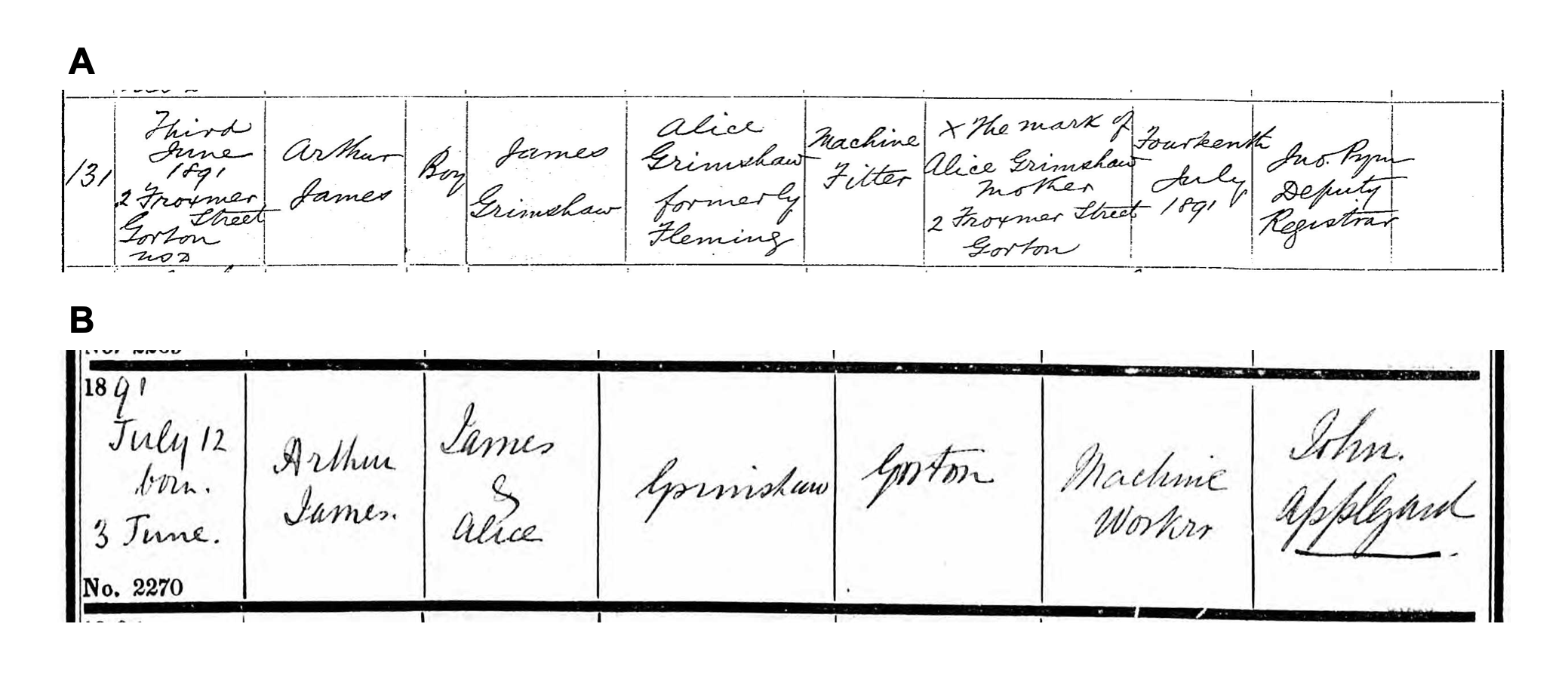
Civil birth registration (A) and parish baptism entry (B) for Arthur James Grimshaw, born 3 June 1891 in Manchester and baptised in Gorton later that summer [1].
It was an unremarkable beginning to what would prove an extraordinarily long life, one that would carry Arthur from the smoky streets of Gorton to the Rock of Gibraltar, from the cramped engine rooms of warships to a quiet retirement in Southsea, and from the reign of Queen Victoria to the age of the Falklands War. He was born into an empire at its zenith and died in a country still reckoning with what it had lost. Between those two points lay two world wars, a revolution in naval technology, the contraction of Britain from unchallenged sea power to middle-rank nation, and one November morning on the Firth of Forth that Arthur Grimshaw would carry with him for the rest of his ninety-one years.
Gorton in the 1890s was not a place of beauty. It was a place of work, dense, purposeful, and relentless. The district sat on the eastern fringe of Manchester, its skyline broken by the chimneys of locomotive works, iron foundries, and engineering shops.
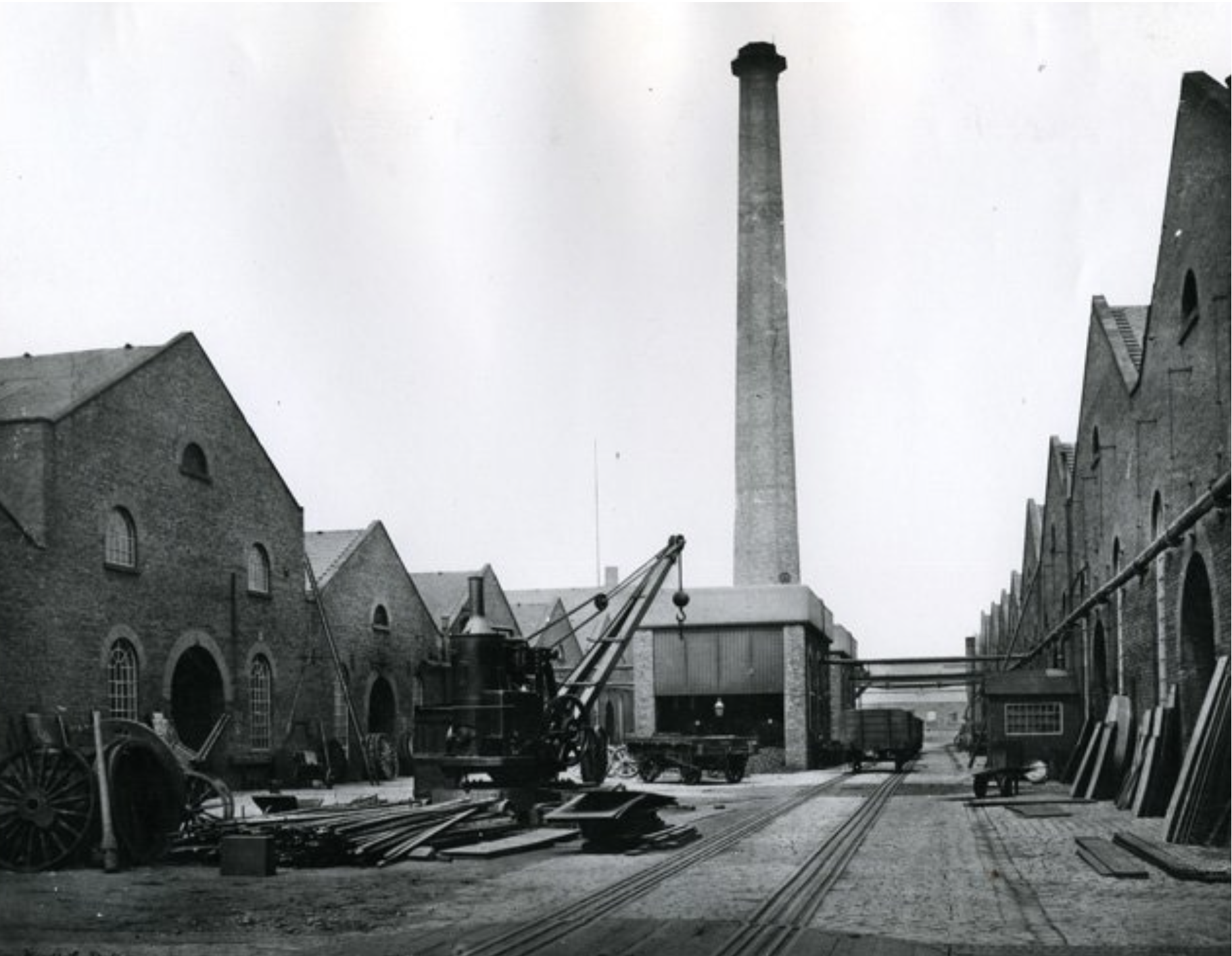
Beyer, Peacock & Company works in 1870 [2]
Yet it had not always been this way. When the Beyer, Peacock & Company works were first established at Gorton in 1854, the area was home to a community of just 2,000 people, and the land to the east of Manchester was still largely rural [3].
The transformation that followed was startling. By the time Arthur Grimshaw was born in 1891, Gorton's population had grown from roughly 3,000 in 1845 to around 13,500 [4], an almost fivefold increase driven almost entirely by the arrival of heavy industry and the workers who served it.
The most famous of those industrial landmarks was the Gorton Foundry itself, Beyer, Peacock & Company, whose 12-acre site had been turning out steam locomotives since 1855 and whose engines ran on railways across the British Empire. Their works encompassed boiler shops, smithies, forges, iron foundries, fitting, erecting and machine shops, pattern shops, grinding shops, and stables; by 1914 the site employed 2,300 people [5]. Directly opposite, on the northern side of the railway line, sat Gorton Tank, the locomotive works of the Manchester, Sheffield and Lincolnshire Railway, established in 1848, which had grown to cover more than 30 acres [6]. Together, the two great works dominated the neighbourhood physically, economically, and atmospherically. The chimneys were part of the skyline Arthur saw every day; the hooter was part of the daily rhythm he grew up with.
The neighbourhood that had grown up around these works was, as one local historian put it, far from picturesque, ”heavy industry and rows of terraced houses on muddy roads" was the typical local landscape [7]. Yet the picture was not entirely one of soot and iron. Gorton's rapid growth had created a dense working-class community with its own institutions, rhythms, and solidarities. Richard Peacock, the co-founder of Beyer, Peacock & Company, had been active in the life of the district: he established a free school, a library, and a Mechanics' Institute in Gorton, and served as the area's first Member of Parliament when the Gorton constituency was created in 1885 [8]. His influence lingered long after his death in 1889, in the buildings he had commissioned and the institutions he had endowed. The nearby Church of St Mark, West Gorton, itself funded substantially by Peacock's co-founder Carl Friedrich Beyer and built in 18657, had, by the 1880s, become a hub of community life. Its congregation and clergy fostered cricket and then football teams which, through a succession of name changes and ground moves from St Mark’s (West Gorton) to Gorton AFC and Ardwick AFC, eventually became Manchester City Football Club [9].
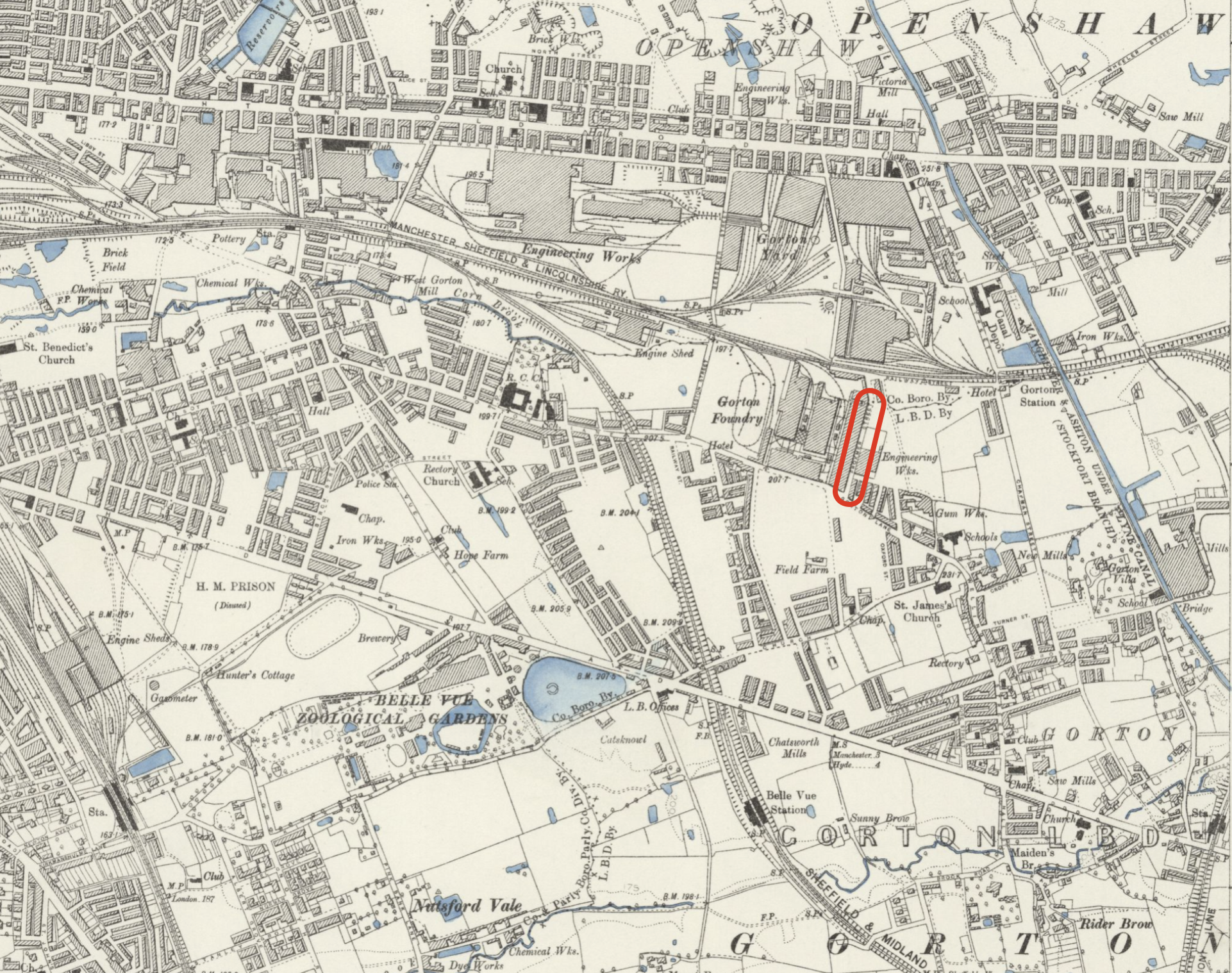
Gorton neighbourhood in the late nineteenth century [10] showing the Gorton Foundry with Froxmer Street running immediately alongside it; the red line marks Froxmer Street, the location of Arthur James Grimshaw’s birth, amid a landscape with heavy industry and rows of terraced streets set amid farm land, the Manchester, Sheffield and Lincolnshire Railway line, and the nearby Belle Vue Zoological Gardens.
It was precisely this kind of community, networks of church, chapel, workplace, and street that shaped the Gorton Arthur Grimshaw grew up in. James Grimshaw, Arthur's father, had made his living as an iron slatter, a man who worked with iron sheets and metal cladding, one of the countless skilled trades that kept Manchester's industrial machine running. His wife Alice had come to Manchester from Sheffield, another city shaped by metal and fire, and together they built a family on Peacock Street, off Gorton Lane. When the census enumerator called in April 1901, the household at number 33 told its own story: James, forty, iron slatter; Alice, thirty-six, and alongside the domestic duties that would have filled most of her hours, she was also running a coffee house from the premises and selling chip potatoes [11], that quintessentially northern working-class staple that could be had hot and cheap on any Manchester street corner. It was a household that combined skilled manual trade with small commercial enterprise, and it spoke to a family doing whatever it took to stay respectable and solvent in a neighbourhood where the margin between the two was always thin.
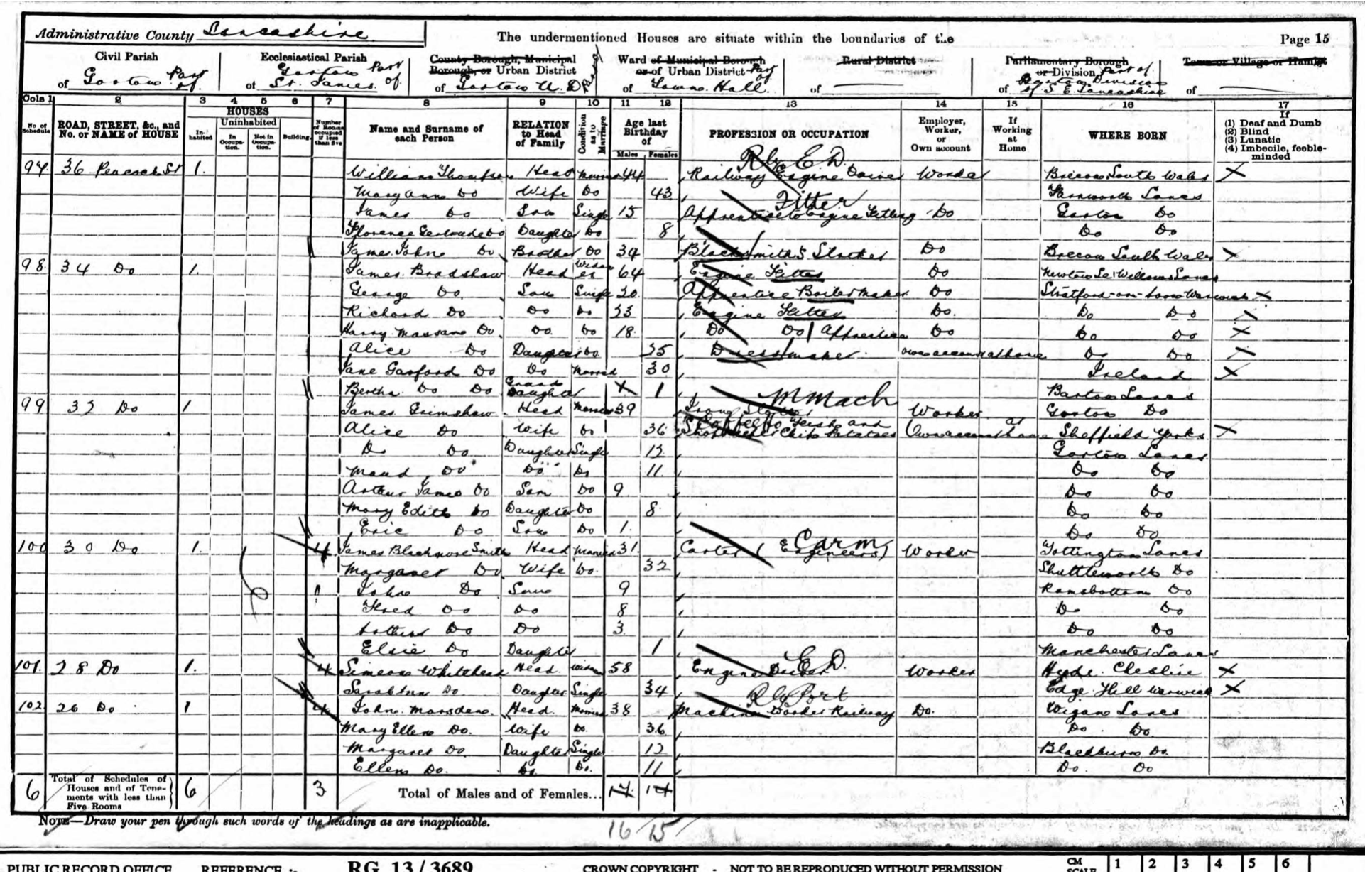
1901 Census [11]
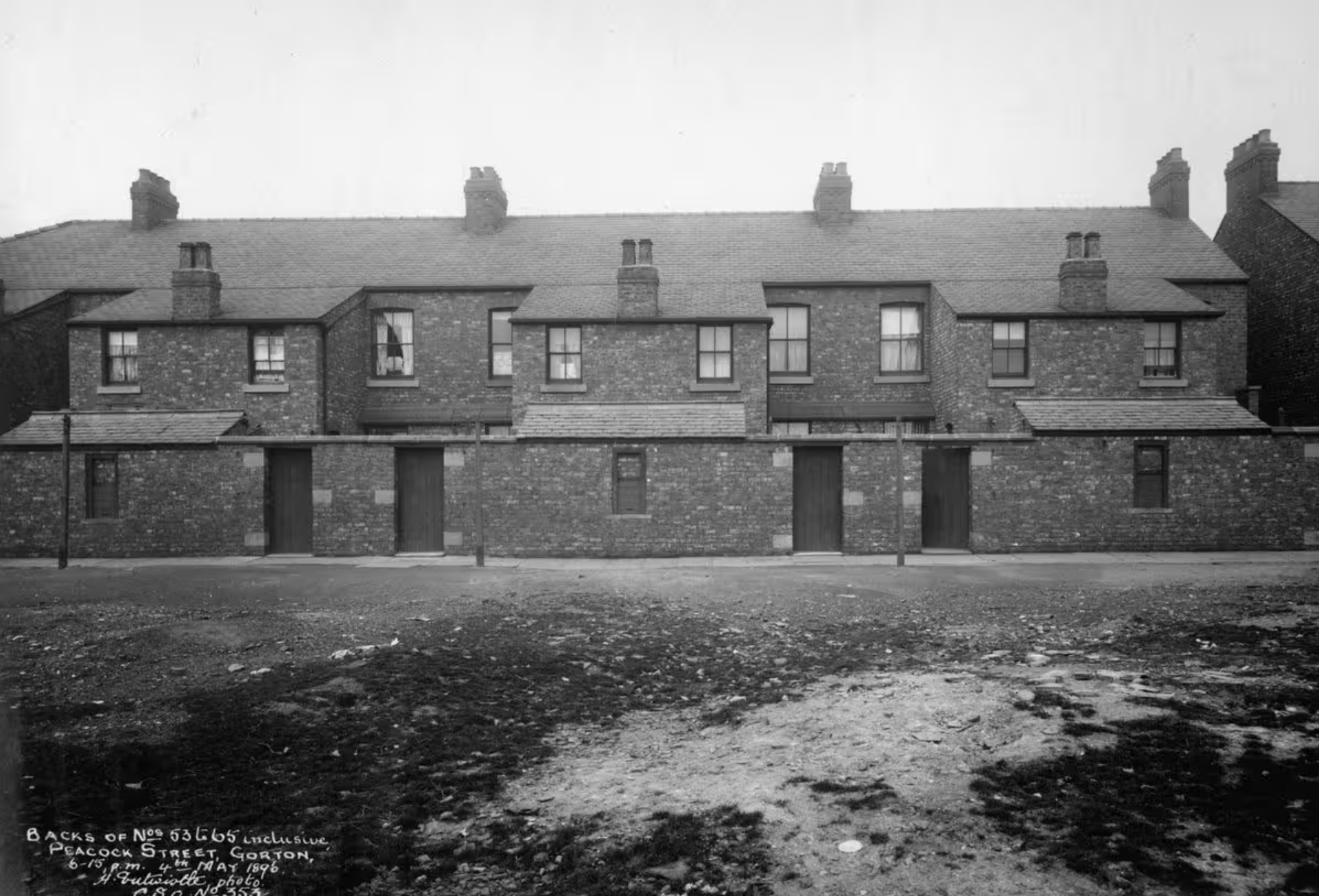
Backs of the terraced houses on Peacock Street, Gorton, c.1896, showing the narrow yards and brick outbuildings behind the Grimshaw family’s street of residence (Manchester Evening News / Manchester Archives) [12].
Arthur was nine, the middle child in a family that also included older sisters, young Mary, and baby Eric, barely a year old. Since 1897 he had attended St James' Church of England Primary School for Boys in Gorton [13], one of the church schools that anchored working-class community life in Victorian Manchester, educating the children of the foundry men and iron workers and giving form and structure to a neighbourhood otherwise defined by labour. He was a slight boy, he would grow no taller than five feet four in adulthood, but he grew up in a world of machinery and metalwork, and he appears to have absorbed its lessons well.
Despite the industrial grimness, Gorton in the 1890s retained unexpected textures. Harry Chadwick, a local man born in Gorton in 1916, recalled that even in the 1920s, despite the area containing one of the greatest concentrations of heavy and light engineering in Britain, it still had a slightly rural feel [14]. He described farm tracks surrounded by fields with buttercups and daisies, skylarks singing overhead, and fishing in what he remembered as the clear waters of local canals. Birch Farm, Yew Tree Farm, Debdale Farm and others, persisted amid the factory yards and railway sidings, supplying perishable fresh produce to a neighbourhood that had grown faster than its infrastructure could fully absorb. For a boy with an inquiring mind, Gorton offered something more interesting than a single industrial texture: it was a place in the act of becoming, its old rural edges still visible beneath the new industrial surface.
And then there was Belle Vue.
Just to the west of the Grimshaw household, clearly marked on every map of the district, lay Belle Vue Zoological Gardens, one of the most celebrated entertainment venues in Victorian and Edwardian England. The site had been developed by John Jennison from the 1830s onwards, and had found its footing after the adjacent Longsight railway station opened in 1843, making it accessible to the vast working-class populations of east Manchester [15]. By the time Arthur was a boy, Belle Vue had grown into a remarkable institution: its attractions included exotic animals in bear pits, a monkey house, an elephant house, and open-air sea lion pools; a great ballroom capable of holding ten thousand dancers; a boating lake and Italian gardens; a hall of mirrors, toboggan ride, and roller-skating arena; and, most spectacularly of all, a fireworks island with a huge painted scenic backdrop against which elaborate pyrotechnic displays were staged [16]. The reputation of Belle Vue had spread across the north of England as 'the playground of the north', drawing visitors from across the region to dance, watch wrestling, attend the circus, and listen to orchestral and brass band concerts.

Advertisement for Belle Vue zoo & gardens c. 1900 [17]
For a boy growing up amid the foundry chimneys and iron works of Gorton, Belle Vue was the wonder within walking distance. The lions and elephants; the fireworks reflected in the ornamental lake; the noise and colour of it all — none of it cost more than a working family could manage, and all of it was close enough to reach on foot. Arthur would have known it from childhood, and it set against the industrial grimness of the neighbourhood a note of something altogether more vivid.
By 1911, when the great census of England and Wales counted every soul under one roof, the Grimshaws had moved northward to 84 Waverley Road in Moston [18]. James, now forty-nine, had left the iron trade and become a tramway car driver for Manchester Corporation Tramways, one of the most ambitious municipal transport networks in Britain, which had been electrifying its horse-drawn lines since the late 1890s [19]. Alice, forty-six, had borne five children and seen all five survive into adulthood. The eldest daughter Alice, twenty-two, had become a shorthand typist; Maud, twenty-one, was a milliner. Mary Edith, eighteen, was still at home. Eric, eleven, was at school [18]. And Arthur, nineteen, was recorded as an apprentice to the engineering trade, following his father's original path, not his later one. The machine shops, not the tramcar, called to him. It was precisely the right environment in which to raise an engineer.
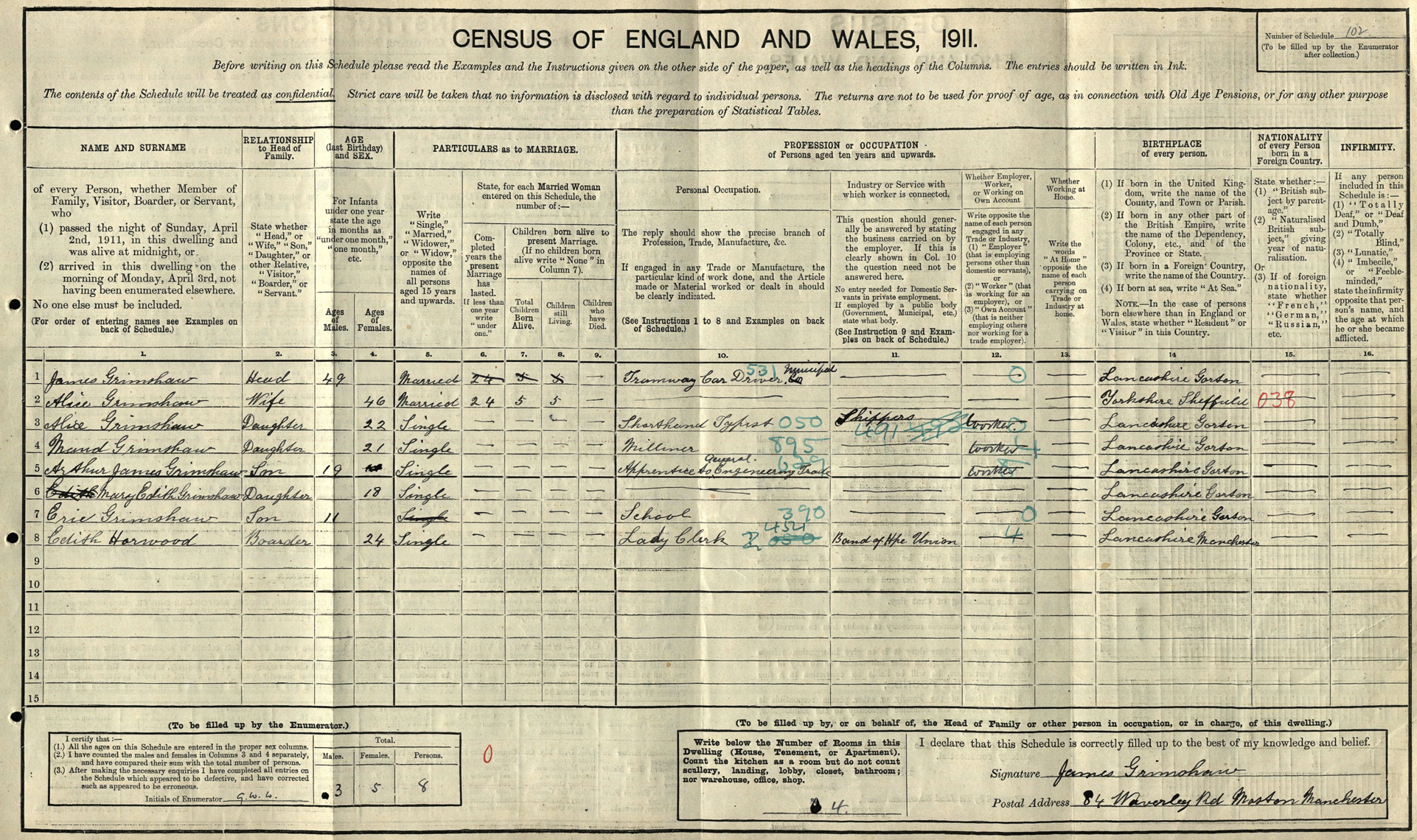
1911 Census [18]
Arthur came of age during one of the most dramatic military build-ups in modern history. From 1906 onward, Britain and Germany were locked in a naval arms race that gripped the public imagination and filled the newspapers with statistics about displacement tonnage, gun calibres, and armour plating. The launch of HMS Dreadnought in 1906 had made every other battleship in the world obsolete overnight, and both nations threw themselves into building the new generation of capital ships that she had pioneered.
For a young engineer in Manchester, the Royal Navy must have seemed like precisely the kind of institution that needed men of his skills. The Fleet was expanding rapidly, and it needed Engine Room Artificers, the skilled tradesmen who kept the new turbines and boilers of the modern warship functioning. It was steady, respected, skilled work, with the additional appeal of travel, adventure, and a uniform.
Arthur James Grimshaw presented himself for enlistment on 17 March 1913 [20]. He was twenty-one years old.
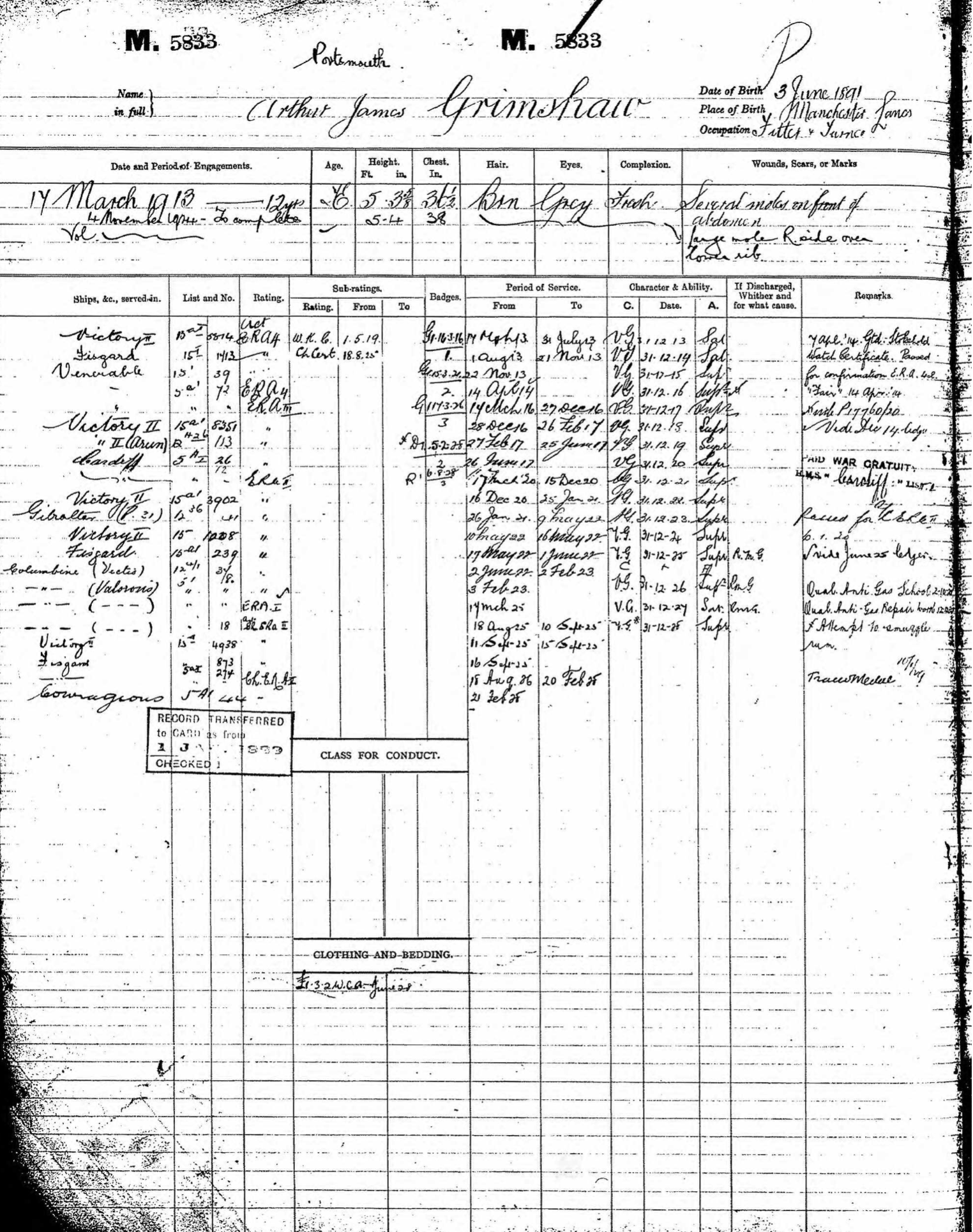
Arthur James Grimshaw’s entry in the UK, Royal Navy Registers of Seamen’s Services [20]
The naval surgeon who examined him recorded his particulars with bureaucratic thoroughness in the service record that would follow him for the next three decades: five feet three and a half inches tall, brown hair, grey eyes, fresh complexion, several moles on the front of his abdomen, a larger mole on his lower rib. His occupation was fitter and turner. What the surgeon's record did not note, and what his granddaughter Belinda would later recall with some amusement, was that Arthur could not swim, a fact that sits oddly against a career spent entirely at sea, though he was far from alone among the lower deck ratings of his generation in never having learned. He was assigned the service number M.5833, allocated to the Portsmouth Port Division, and signed on for an initial term of twelve years, the standard engagement for an Engine Room Artificer [21], long enough to learn the trade thoroughly and earn a pension if he served to its end.
He could not have known it, but he had enlisted with barely sixteen months to spare before the world changed.
Before following Arthur to sea, it is worth pausing to understand the world he was entering, because it was a world that those above decks rarely saw, and that history has tended to overlook in favour of admirals, battles, and the drama of the quarterdeck.
The Engine Room Artificer (ERA) was, quite simply, the man who made the ship go. The designation had been introduced by the Admiralty in 1868, when it became clear that the new age of steam required a different kind of sailor, one trained in the full complexity of marine engineering: boilers, reciprocating engines, turbines, pumps, generators, condensers, and the thousand auxiliary systems that kept a modern warship alive [22]. ERAs were generally recruited from men who had already completed a long engineering apprenticeship as fitters or turners, in civilian workshops or Royal Dockyards [23], Arthur’s training as a fitter and turner was exactly the foundation the service required. He was not recruited to learn engineering; he was recruited because he already knew it.
One photograph survives from this period of his early service: a formal studio portrait taken by a photographer, almost certainly during a shore visit in late 1914 or 1915. Arthur is wearing the fore-and-aft rig of an Engine Room Artificer — the double-breasted dark jacket, peaked cap, and bow tie that marked the ERA out from the square-rigged seamen above him on deck — and he is perhaps twenty-three or twenty-four years old. He looks directly at the camera with the serious composure that the occasion required. The photograph was the kind a man sent home to his family.
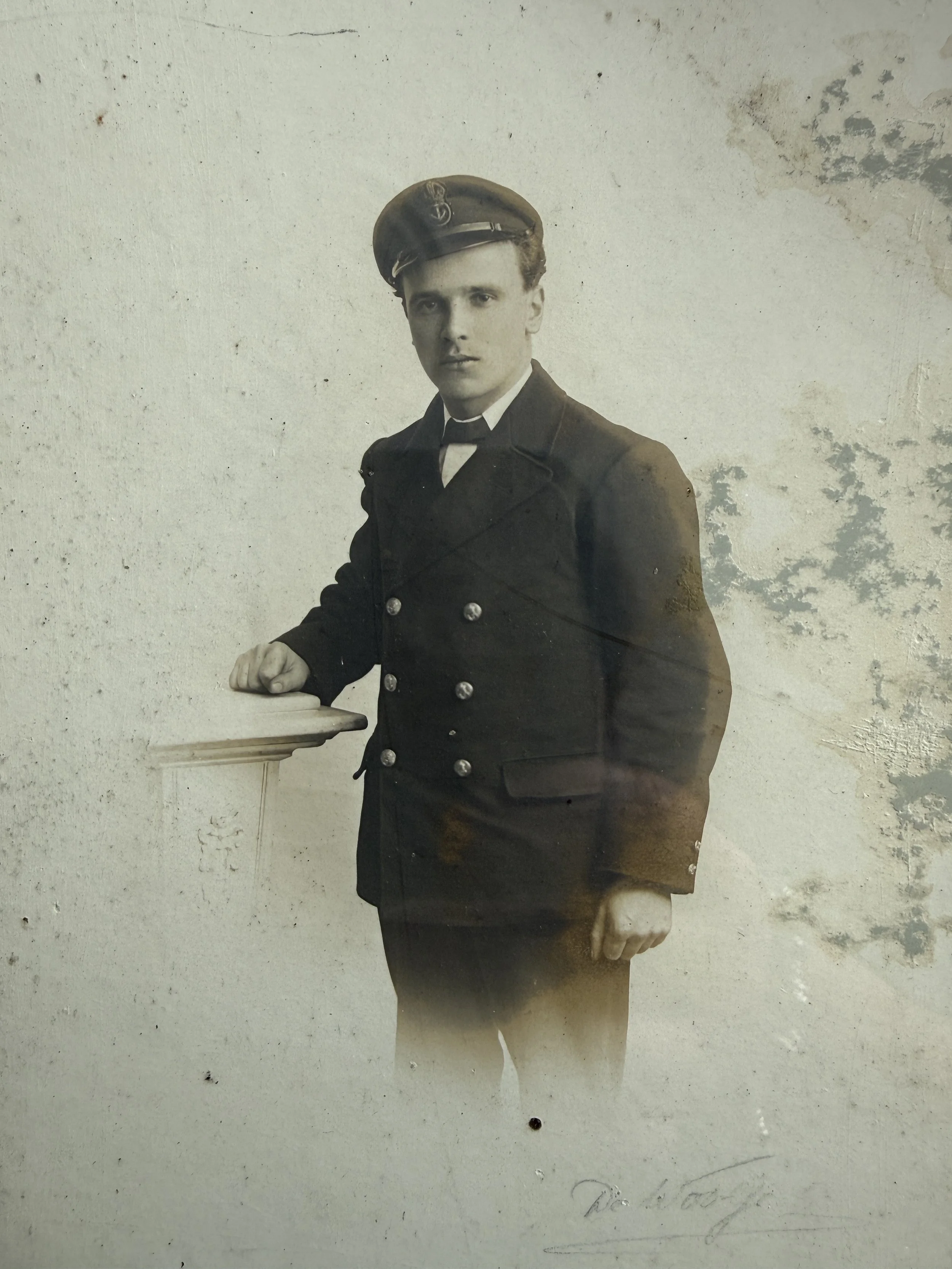
Arthur James Grimshaw, Engine Room Artificer, Royal Navy, photographed at the De Vos studio, Belgium, c. 1914–1915.[Photograph: Butt family collection.]
The training establishment Arthur passed through in 1913 was itself a remarkable place. HMS Fisgard, the Royal Navy's artificer training centre at Portsmouth, was not a shore building but a collection of Victorian warship hulks moored in Portsmouth Harbour, their gun decks converted into workshops and classrooms. The old warships Audacious, Invincible, Hindostan, and Sultan were all pressed into service as floating schools, designated Fisgard I through IV [24]. By the early 1920s all artificer training for the Navy was concentrated in these hulks at Portsmouth [25]. It was a fitting environment in which to train engineers: surrounded by the physical evidence of naval history, working within the very fabric of ships their trade was designed to keep running.
Arthur had entered as an ERA 4th Class and earned his Watch Certificate on 7 April 1914 [20] the formal qualification confirming he was competent to keep an unsupervised engineering watch at sea. The engine room itself was a world below the waterline, windowless, deafeningly loud, lit by artificial light regardless of whether it was noon or midnight on the surface above. Temperatures routinely exceeded a hundred degrees in temperate waters; in the Mediterranean or the tropics, the heat was something close to unbearable, the air thick with oil vapour, steam, and the smell of hot metal. As one description of HMS Belfast's engine room captured it:
“never was so much gear put into so little space as in an engine room — pumps, steam pipes, valves, dials, turbines and still more pumps [26]”.
The noise of turbines running at speed made normal speech impossible; communication was by signal, by gesture, and by the engine telegraphs, those brass dials mounted on the bulkhead that relayed orders down from the bridge: Full Ahead, Half Speed, Slow, Stop, Full Astern. When the bridge rang for more speed, it was the ERA's job to provide it, whatever state the machinery was in and whatever was happening on deck above.
In action, the ERA's world was particularly peculiar. When HMS Venerable was shelling the Belgian coast in 1914 and 1915, when HMS Cardiff was taking hits at Heligoland in November 1917, Arthur knew about it only through the vibration of the hull, the pitch and roll of the ship, the urgent changes on the engine telegraph, and the sounds that filtered down through steel decks. He could not see the enemy. He could not see the horizon. He could only keep the engines running and trust that those above him were doing their part.
Watch-keeping structured every day at sea. The twenty‑four‑hour naval day was divided into a sequence of named watches, most four hours long, with two shorter “dog watches” in the evening so that the same men were not always on the same night watch [27]. It was a rhythm that erased the ordinary distinctions of morning and night, replacing them with a cycle of duty and rest belonging to no clock a landsman would recognise. In harbour there was more regularity: Sunday divisions, maintenance work through the week, and the daily rum ration served at noon [28], the tot that was both tradition and right, as much a part of naval life as the uniform itself. Shore leave in foreign ports brought the sudden, startling abundance of the world outside, heat and noise and strange languages, before the gangway came up and the grey routine resumed.
The ERA's mess, the small compartment where he ate, slept, and spent his off-watch hours was home for months at a time. Messmates became a kind of adopted family, men who knew each other's habits and stories and irritabilities with the intimacy that only confinement produces. It was a very particular kind of life, and it produced a very particular kind of man: patient, methodical, at home in confined spaces with imperfect tools under pressure, skilled at improvisation when the right part was unavailable and the ship needed to move regardless.
His progress through the ERA grades told its own story. He had entered as an ERA 4th Class and advanced steadily as his experience accumulated and his examinations were passed. To reach Chief ERA required a minimum of six years' service [29], examinations in theory and practice, and a record of competence that left no room for doubt. Chief ERA was ranked equivalent to a Chief Petty Officer, the pinnacle of the non-commissioned engineering world. His service record assessed his character at successive intervals as Satisfactory, Superior, and finally, again and again, Superlative, the highest grade available, a word that appears in column after column of his record [20].
The summer of 1914 unravelled with terrible speed. The assassination of Archduke Franz Ferdinand in Sarajevo on 28 June set off a chain of diplomatic failures and military mobilisations that pulled the great powers of Europe into war. Britain declared war on Germany on 4 August. The country that Arthur had enlisted into, confident, imperial, supreme at sea, suddenly found itself committed to a continental land war on a scale nobody had imagined.
Arthur had spent his first months in the Navy passing through shore establishments and training ships, Victory II, the great Portsmouth shore base, and Fisgard, before joining HMS Venerable, a pre-dreadnought battleship of the London class assigned to the 5th Battle Squadron of the Channel Fleet and based at Portland [30].
It was from HMS Venerable, in the early autumn of 1914, that Arthur Grimshaw made a decision that thousands of young men were making across Britain that season: he got married.
On 3 October 1914, just eight weeks after the declaration of war, Arthur James Grimshaw and Nora Dorothy Grant were married at the Church of the Holy Trinity in Weymouth, in the county of Dorset [31]. It had not been the plan. Belinda, Arthur's granddaughter, would later recall that Arthur and Nora had been due to marry on 4 August 1914, the very day Britain declared war on Germany. The date had not been chosen carelessly; the government had extended the August Bank Holiday to create an unprecedented four-day closure running from Monday 3rd through Thursday 6th August, making it the longest bank holiday in British history [32], an emergency measure to prevent the financial markets from collapsing under the weight of the gathering crisis. For Arthur and Nora, it would simply have seemed like a rare stretch of free days: time enough to marry. Instead it became the day everything changed, and the wedding had to wait. The marriage register records the essentials with spare elegance: Arthur, aged twenty-three, bachelor, Engine Room Artificer, Royal Navy; his father James recorded as motorman. Nora, twenty years old, spinster, of Portsmouth, her father Charles Grant a shipwright, a man who had given his working life to the sea in his own way, building the ships that men like Arthur then sailed. There was something fitting about this: the daughter of a man who built warships marrying a man who kept their engines running. The witnesses were Beatrice Maud Grant and Thomas William Hibbs. The vicar was the Reverend R. Cabbott.
The Portsmouth Evening News carried notices of the wedding in its editions of both 8th and 9th October 1914 [33], brief announcements in the marriage columns, set against pages full of war dispatches and the particular anxious energy of a country still adjusting to a conflict already proving far larger and more costly than anyone had predicted. The Battle of the Marne had only just been fought [34], halting the German advance, and triggering the digging of trench lines that would soon dominate the Western Front.
For Arthur and Nora, as for so many couples of that autumn, the ceremony was an act of faith against an uncertain future. Weymouth was no coincidence: the town's harbour had long served as a naval anchorage, and HMS Venerable's presence there in October 1914 was part of the Fleet's early wartime dispositions along the south coast. Arthur married where his ship was, with whatever brief leave he could secure.
Leave, however, was brief. Within weeks of the wedding, HMS Venerable was in action.
In October 1914, the German Army was pressing hard against Belgian and Allied positions along the Flemish coast in what became known as the Battle of the Yser, a desperate struggle to prevent the Germans from breaking through to the Channel ports. HMS Venerable was attached to the Dover Patrol for naval bombardment duties. From 26 to 30 October 1914, she shelled German positions along the Belgian coast between Westende and Lombardsijde, her twelve-inch guns joining a naval effort to hold back an advance that, if successful, would have put German forces within striking distance of the English Channel itself. For three days she also served as flagship of Rear Admiral Sir Horace Hood, Commander-in-Chief of the Dover Patrol [35].
Rear-Admiral Hood's official despatch, published the following spring, gave the strategic picture plainly. The flotilla had been organised, Hood wrote, "to prevent the movement of large bodies of German troops along the coast roads from Ostend to Nieuport, to support the left flank of the Belgian army, and to prevent any movement by sea of the enemy's troops." The lighter vessels had proved insufficient when the German guns grew heavier, so "the scouts therefore returned to England, while HMS Venerable and several older cruisers, sloops and gunboats arrived to carry on the operations." Hood also recorded that he transferred his flag to the French destroyer Intrepide on 30 October, leading a combined Franco-British flotilla into action off Lombartzyde, the first significant Anglo-French naval cooperation of the war [36].
The experience, as one Venerable crew member wrote home to his parents in Scarborough, was more visceral than any official despatch could convey. Midshipman Foster's letter, published in the Grimsby Daily Telegraph in November 1914, described what it was actually like to be aboard:
"We went out to Nieuport last Monday to help the troops firing on land, and we were firing at the Germans and made them retreat ever so far. We had Admiral Hood on board. It was not all one-sided, for the Germans brought big siege-guns and howitzers down to the beach and fired at us. Shells were dropping thickly all the time, and submarines were about too. We were fired at several times by torpedoes, but they always missed us. Last Wednesday we began bombarding as usual, when we were attacked by submarines and then aeroplanes. Nobody was hurt. We were attacked again in the afternoon, and they fired torpedoes at us, but missed. At about four p.m. the ship touched ground, but we soon got off. It has been like that nearly all the time — submarines and aeroplanes mainly attacking us. We used a lot of ammunition [37]."
The grounding at four p.m. is confirmed by other sources: Venerable ran lightly aground on an uncharted sandbank but was freed with assistance from HMS Brilliant on the rising tide, having sustained no significant damage [35]. For Arthur in the engine room, the moment would have been unmistakeable, the sudden drag on the hull, the ship catching, the urgent demand for manoeuvring power to free her, and then the relief as she came clear.
On the 27th, German field guns were moved close to shore to return fire; most of the lighter vessels were forced to retreat, but the heavily armoured Venerable held her station. Hood's despatch noted that other vessels in the flotilla suffered heavily protecting Venerable: HMS Falcon "came under a heavy fire when guarding the Venerable against submarine attack," losing her commanding officer and eight men killed and sixteen others disabled [35]. Men were dying specifically to keep Venerable safe while she bombarded the coast. Arthur, in Venerable's engine room, was being shielded by other ships while other men died.
Through 1914 and into 1915, Hood's final assessment in his despatch was borne out: naval operations along the coast continued "for more than three weeks without intermission," and by the spring "it gradually became apparent that the rush of the enemy along the coast had been checked, that the operations were developing into a trench warfare, and that the work of the flotilla had, for the moment, ceased" [35]. The bombardments worked. The German advance along the Belgian coast was halted. Arthur was part of an operation that succeeded in its strategic purpose.
HMS Venerable returned to the Belgian coast twice more: on 11 March 1915, bombarding near Westende as a deliberate diversion to draw German attention during the British attack at the Battle of Neuve Chapelle; and on 10 May 1915, attempting to suppress German artillery that had been shelling Dunkirk harbour, though on this occasion German counter-battery fire prevented her from dropping anchor or achieving success [34]. Arthur was in the engine room for all of these.
The Dardanelles campaign, Winston Churchill's ambitious scheme to force a passage through the Turkish straits, knock the Ottoman Empire out of the war, and open a southern route to Russia, had been unfolding since February 1915. The land campaign on the Gallipoli peninsula had opened with the landings of 25 April, and was already proving as costly and inconclusive as anything on the Western Front.
The scale of what that suffering meant was no secret to any man aboard. The great naval assault of 18 March, in which the Allied fleet had attempted to force the Dardanelles in a single day, had ended in catastrophe reported in every British newspaper.
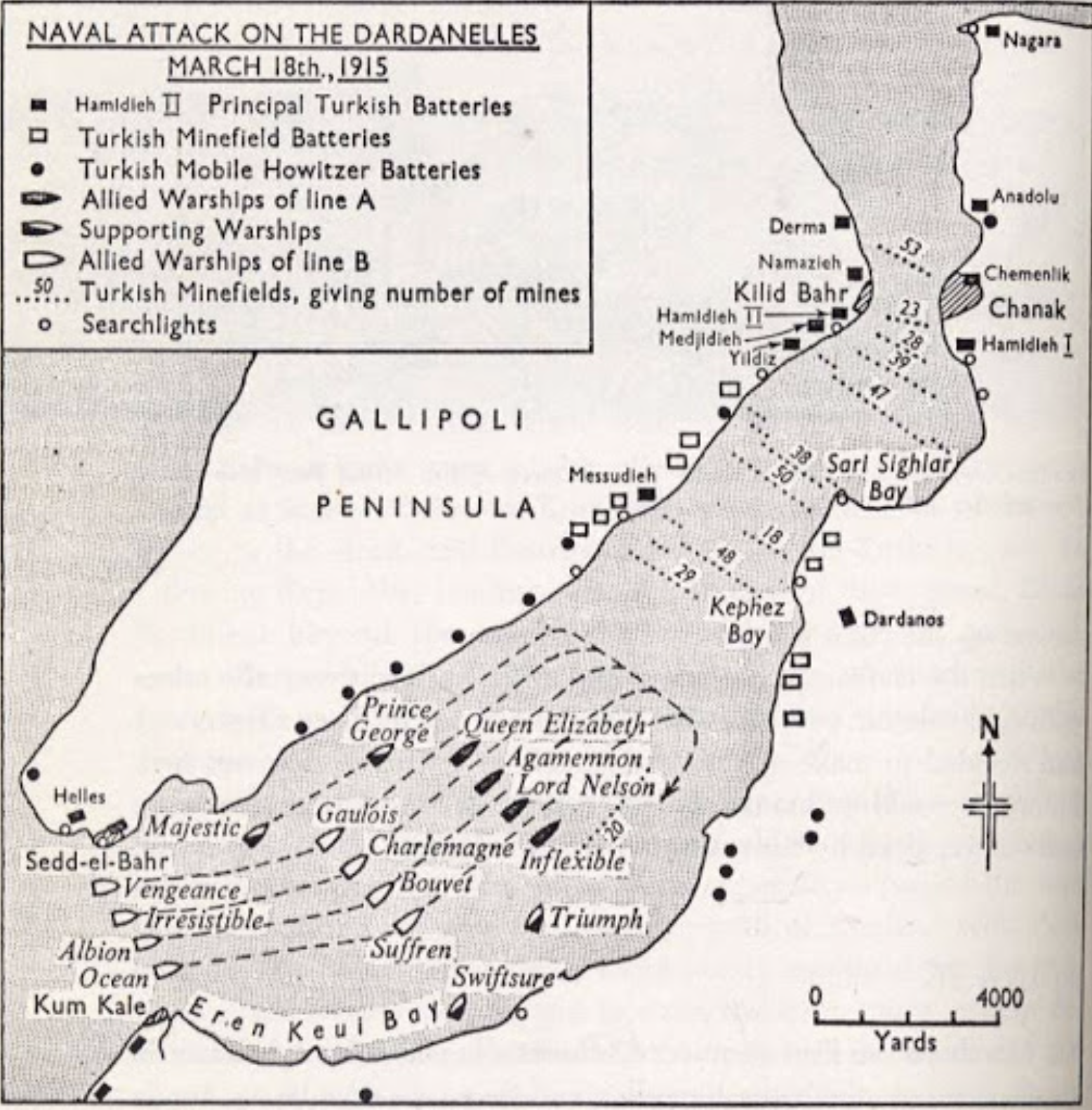
Map of the naval attack on the Dardanelles, 18 March 1915, showing the Allied battleship dispositions that HMS Venerable was to join when she was sent to reinforce the pre‑dreadnought squadron off the Gallipoli peninsula [38].
Three battleships had been sunk by mines drifting with the current in waters the charts had not fully mapped. "Both vessels sank in deep water, practically the whole of the crews having been removed safely under a hot fire," reported the Sunderland Daily Echo with careful understatement, adding that HMS Inflexible had her forward control position hit by a heavy shell and required repair, and that the Gaulois was damaged by gunfire [39]. The Daily Mail's correspondent, watching from the shore, had described a powder magazine explosion at Chanak sending "a great balloon of white smoke... leaping out from a fierce red flame" to a height hundreds of feet above the cliffs, and then, at a quarter past two, a still more violent explosion at Fort Kildil Bahr, "a huge mass of heavy jet black smoke" that "towered high above the cliffs on the European and Asiatic sides" and hung visible across the whole panorama of land and sea for a quarter of an hour [40]. The forts had been damaged. The mines had not been cleared. The campaign had shifted to a land war. It was into these waters that HMS Venerable was now ordered.
In mid-May 1915, HMS Venerable was ordered to the Dardanelles to replace the battleship HMS Queen Elizabeth, which was being withdrawn. She steamed to the eastern Mediterranean with the battleship Exmouth, the crew knowing they were sailing towards a campaign already synonymous with suffering and failure [41].
From 14 to 21 August 1915, HMS Venerable was in action at Suvla Bay [42] supporting the Allied attacks on Ottoman positions that formed part of the great August Offensive, the desperate final attempt to break the deadlock at Gallipoli. The Navy's role was to provide gunfire support for troops fighting in the hills above the bay, her twelve-inch guns turned on Ottoman trenches and artillery positions while soldiers who had been dying of heat, disease, and enemy fire since April tried one more time to push forward.
HMS Agamemnon, operating in the same waters that August, was one of the ships Venerable was working alongside. Midshipman Henry Denham, seventeen years old and keeping a secret diary aboard Agamemnon in defiance of standing orders, described the experience of bombarding from a warship at Gallipoli: the destroyers and drifters deployed to screen the ship from submarines, the careful zig-zagging at speed between anchorages, the wire nets hauled out each time the ship stopped, the scorched hills above the bay, the dust of shell impacts, the tiny figures on the beach that represented an entire army in extremis [43]. None of this reached Arthur. Below the waterline, his Gallipoli was the heat — which in August at Suvla Bay was something close to insupportable even by the standards of a man who had spent his working life beside boilers, the engine room of a warship in those waters registering temperatures well above 130 degrees Fahrenheit [44] — the engine telegraph with its requests for speed and manoeuvre, and the deep shudder through the hull each time the main battery fired. The panorama above was extraordinary. Below, there was only the machinery, and the noise, and the heat. Arthur was there in the engine room through August heat that made the Mediterranean deck planks too hot to touch and the spaces below almost unbearable.
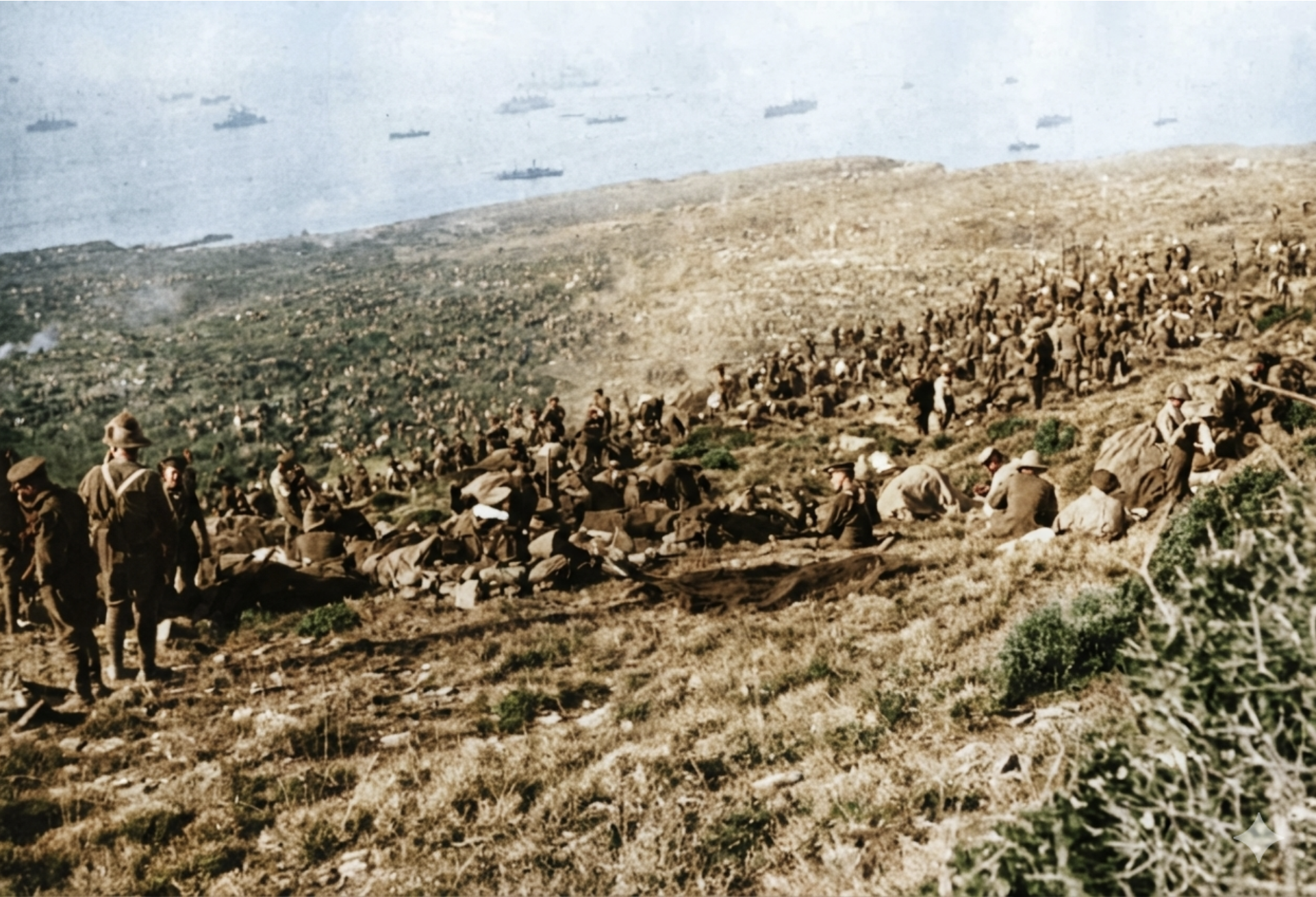
From the Illustrated London News (image colourised using Google Gemini AI). The original caption reads "The first photograph to be published illustrating the scene which involved the historic landing at Suvla Bay. Never before has a landing of such a nature been carried out...Here amid the wild country of the Gallipoli peninsula the men are seen making preparations for their stay, officers and men lending a willing hand to raise a bivouac as comfortable as possible.” [45]
The August Offensive failed, as every previous offensive had failed. The hills stayed in Ottoman hands.
In October 1915, HMS Venerable put in at Gibraltar for a refit. By December she had transferred to the Adriatic Sea to reinforce the Italian Navy against the Austro-Hungarian fleet [46]. Arthur remained aboard until December 1916, when his posting ended and he returned to Portsmouth. HMS Venerable herself continued in service for the rest of the war before being sold for scrapping in June 1920 [47], one more pre-dreadnought consumed by a war that had made her class obsolete before it was over.
Arthur missed the Battle of Jutland. The great fleet engagement of the war was fought on 31 May 1916, while he was aboard Venerable in the Adriatic, part of a force reinforcing the Italian Navy and a long way from the North Sea. He would later serve on ships that had been there.
It was not until June 1917 that Arthur's next significant posting came. His new ship was HMS Cardiff, a brand-new C-class light cruiser, completed that very month at Fairfield's yard in Govan on the Clyde [48], fresh from the builders and smelling of paint and new metal. She was faster and more modern than anything Arthur had served on, assigned as flagship of the 6th Light Cruiser Squadron, part of the Grand Fleet based at Scapa Flow and Rosyth [49].
On 17 November 1917, HMS Cardiff fought at the Second Battle of Heligoland Bight. The British operation had been planned as an ambush: intelligence from the codebreakers of Room 40 had revealed a large German minesweeping operation in the Bight, and a substantial British force was sent to intercept it [50]. The action began at 7:30 in the morning, roughly sixty-five miles west of Sylt, in conditions of poor visibility that would define and frustrate everything that followed [51].
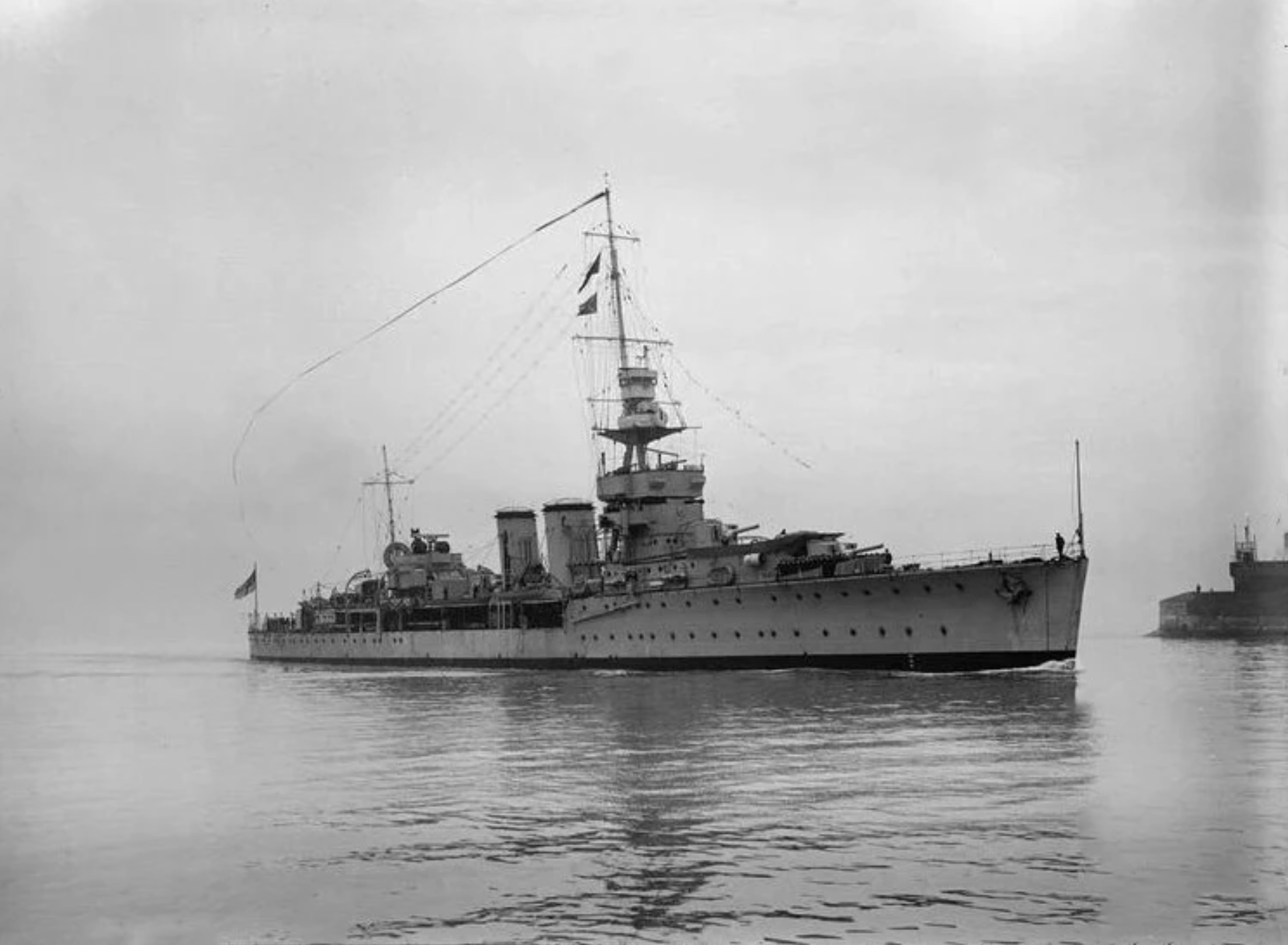
HMS Cardiff (D58) Royal Navy C-Class Light Cruiser [52]
The German force was commanded by Rear-Admiral Ludwig von Reuter, a name that would appear again in Arthur's story, in very different circumstances, exactly a year later. For now, von Reuter's cruisers and torpedo boats covered the minesweepers as they retreated, laying smoke screens that turned the engagement into a confused, near-blind pursuit. Ships on both sides could barely see what they were firing at. On HMS Calypso, a single 5.9-inch shell hit the conning tower, killed the captain and all bridge personnel simultaneously, cut every electrical communication, and, in a measure of how much was going wrong at once, forced in an electro-pneumatic firing push that caused the ship to discharge one of her own torpedoes [51]. Cardiff fired more rounds than any other ship in her squadron throughout the engagement, yet in the thick smoke she hit nothing [51]. The frustration was complete: a carefully planned ambush, and the enemy disappeared into the grey.
Cardiff paid for her persistence. She was hit by four 5.9-inch shells, killing seven of her crew and wounding thirteen [51]. Among the dead was the youngest man aboard: Bugler Charles Ernest Timmins of the Royal Marine Light Infantry, fourteen years old. He had joined Cardiff as the ship's bugler after nine months' training, and he was standing on the bridge, having just sounded 'Action Stations,' when a piece of shrapnel from a German shell blew a hole in Cardiff's funnel, pierced his bugle, and struck him. He died of his wounds. Rear-Admiral Sinclair wrote to his mother Amy at their home in Gillingham that his last act was to sound 'Action Stations’ [53]. His father, John Llewellyn Timmins of the Royal Marine Light Infantry, had been killed in action aboard HMS Hogue in 1914. The boy had grown up as a serviceman's son and died as one himself [52].
Arthur was in Cardiff's engine room when the shells struck: the concussive shudder through the hull, the sudden violent impacts transmitted through steel, the urgent demands on the engine telegraph, the question of whether steam pressure and propulsion remained intact. He could not see what was happening. He could only keep the turbines running and wait.
What came after was different. When the action ended and the men below decks came up into the grey November light, they would have seen what Arthur could not see during the engagement: the damage to the ship, the places where the shells had struck, and the spaces where men were no longer standing who had been there mere hours before. On a ship of Cardiff's size, a light cruiser with a complement of around four hundred men, the dead were not strangers. They were messmates, watch-keepers, men whose names Arthur knew and whose faces he saw every day. The ERA's world below decks was intimate in the way that only confinement produces; the ship's company above decks was not much larger. A fourteen-year-old bugler would have been known to everyone aboard. His voice, his call, the sound of his bugle at the start of every day, these were woven into the routine of the ship in the way that only a small community's particular details are.
What Arthur made of it privately is not recorded. The Navy of 1917 had no language for what we would now call survivor's guilt: the specific, disorienting awareness of having come through unchanged while others around you did not, the knowledge that the difference between the living and the dead was a matter of where you happened to be standing when the shells arrived. He was below the waterline; Timmins was on the bridge. That was the reality. There was no logic to survive, no principle to extract. There was only the work still needing to be done, the turbines still turning, and the long sail back to Scapa Flow with seven empty places in the ship's company.
The cost across the squadron was heavier still. On HMS Caledon, Ordinary Seaman John Carless was mortally wounded in the abdomen and kept serving his gun, lifting projectiles, helping clear the other casualties, collapsing once, getting up, cheering on the new crew, before he fell and died. He was awarded a posthumous Victoria Cross [54]. Twenty-two British sailors were killed in the battle in total.
Over the next twelve months the shape of the war changed irrevocably. By April the Grand Fleet had moved its main base south from Scapa Flow to Rosyth on the Firth of Forth, Cardiff among its squadrons. Marder, the standard historian of the Grand Fleet, described Scapa as "remote, isolated, grim, and depressing" by contrast, and the move to Rosyth, with its proximity to Edinburgh, its better facilities and its comparative civilisation, gave the fleet a morale boost at a critical moment in the war [55]. On the Western Front, the German Spring Offensive of March 1918 had driven deep into Allied lines, for a few terrible weeks it had seemed as though Germany might actually win the war on land, but the Allies had held, counterattacked, and from August onwards the Hundred Days Offensive drove the German armies steadily back. At sea, the German High Seas Fleet had barely ventured out since Jutland in 1916, its ships bottled in Wilhelmshaven while the Grand Fleet waited. In late October 1918, the German naval command issued orders for a final desperate fleet sortie, in effect a death ride intended to preserve the navy's honour regardless of the human cost. The sailors refused; insubordination spread through the larger ships, and mutinies from Wilhelmshaven to Kiel triggered a revolution that ended the Kaiser's reign and accelerated the armistice. [56] The war on land was already lost. The war at sea had, in its quiet and frustrating way, been lost for two years.
The armistice came on 11 November, but Cardiff’s role in what followed had already begun six days earlier when the German delegation led by Rear-Admiral Meurer had sailed from Germany in the cruiser Königsberg to negotiate the terms of the fleet's surrender with Admiral Beatty aboard HMS Queen Elizabeth. Cardiff was part of the escort that brought them in [57]. The morning of 21 November, ten days after the armistice, was therefore not the first time she had directed German warships into the Firth of Forth.
A journalist present described what happened as the Königsberg was guided to her anchorage off Inchkeith at six that evening:
"The Cardiff's searchlight fluttered as she raked her orders across. The Konisberg raked her searchlight round in acknowledgment, and came round to fall into station astern of the British flagship. It suggested something like the resignation and mute evidence of a prisoner of war" [56].
From the bridge of the Königsberg, the reporter could see the German officers looking back at the ship giving them orders, while around them, invisible in the darkness, the full weight of the British Grand Fleet lay at anchor, mile upon mile of warships "humming with life." The German delegation was deliberately kept below decks as they were conveyed up the river to meet Beatty: "The greatest factor for the world's peace, the most patent argument against Germany's claims to world domination was all about them and hidden from them" [56].
The Bristol Times and Mirror printed its account on 19 November, two days before the main fleet surrender, and noted that the German ships for the full handover were expected in British waters on Thursday the 21st, and "they will be taken over” [56].
On the morning of 21 November 1918, Arthur James Grimshaw stood at his station aboard HMS Cardiff and witnessed one of the most extraordinary sights in the history of naval warfare.
The armistice had been signed ten days earlier, and among its terms was the requirement that the German High Seas Fleet surrender. The fleet that had been built at such colossal expense over the preceding two decades, the fleet that had been the whole point of the naval arms race that had done so much to bring Britain and Germany to war, was to sail into Allied custody. Admiral Beatty, commanding the Grand Fleet from his flagship HMS Queen Elizabeth, had assembled over 370 ships for the occasion. HMS Cardiff had been given the singular honour of leading the German fleet in [58].
She sailed out to meet them in the grey North Sea dawn, Arthur in the engine room keeping her turbines at the required speed, and then turned back towards the Firth of Forth with the German fleet following astern. Behind Cardiff came nine dreadnought battleships, five battle cruisers (Seydlitz, Moltke, Hindenburg, Derfflinger, Von der Tann), seven light cruisers, and forty-nine destroyers: seventy ships in all, their guns trained fore and aft in the attitude of surrender, sailing between the two great lines of Allied warships that flanked them on either side [59]. Admiral von Hipper, the German commander, had refused to participate in the humiliation. The fleet was led instead by Rear Admiral Ludwig von Reuter, sailing to a captivity he had not chosen.
G. A. Clews, an electric wireman aboard Cardiff who wrote home to his family in Blackhale Mill within weeks of the event, described it in the plainest possible terms: "Never have I seen such a sight in my life” [60].
They sailed into the Firth of Forth and the formal surrender was concluded off Rosyth. Admiral Beatty signalled: The German flag will be hauled down at sunset to-day, Thursday, and will not be hoisted again without permission [57]. At sunset, the flags came down across the fleet, one after another. The ships that had threatened Britain's command of the seas for a decade were done.
For the men of HMS Cardiff, who had been given the honour of leading them in, it was a moment that none of them would ever forget or fully explain. Arthur Grimshaw was twenty-seven years old. He had been in the Navy for five years, had bombarded the Belgian coast three times, supported the landings at Gallipoli, been under fire at Heligoland, directed the German delegation's ship into the Forth six days earlier, and had now watched the greatest naval surrender in history from the ship that led it. He would live for another sixty-five years, through another world war and the long twilight of British sea power. Nothing would quite match that November morning.
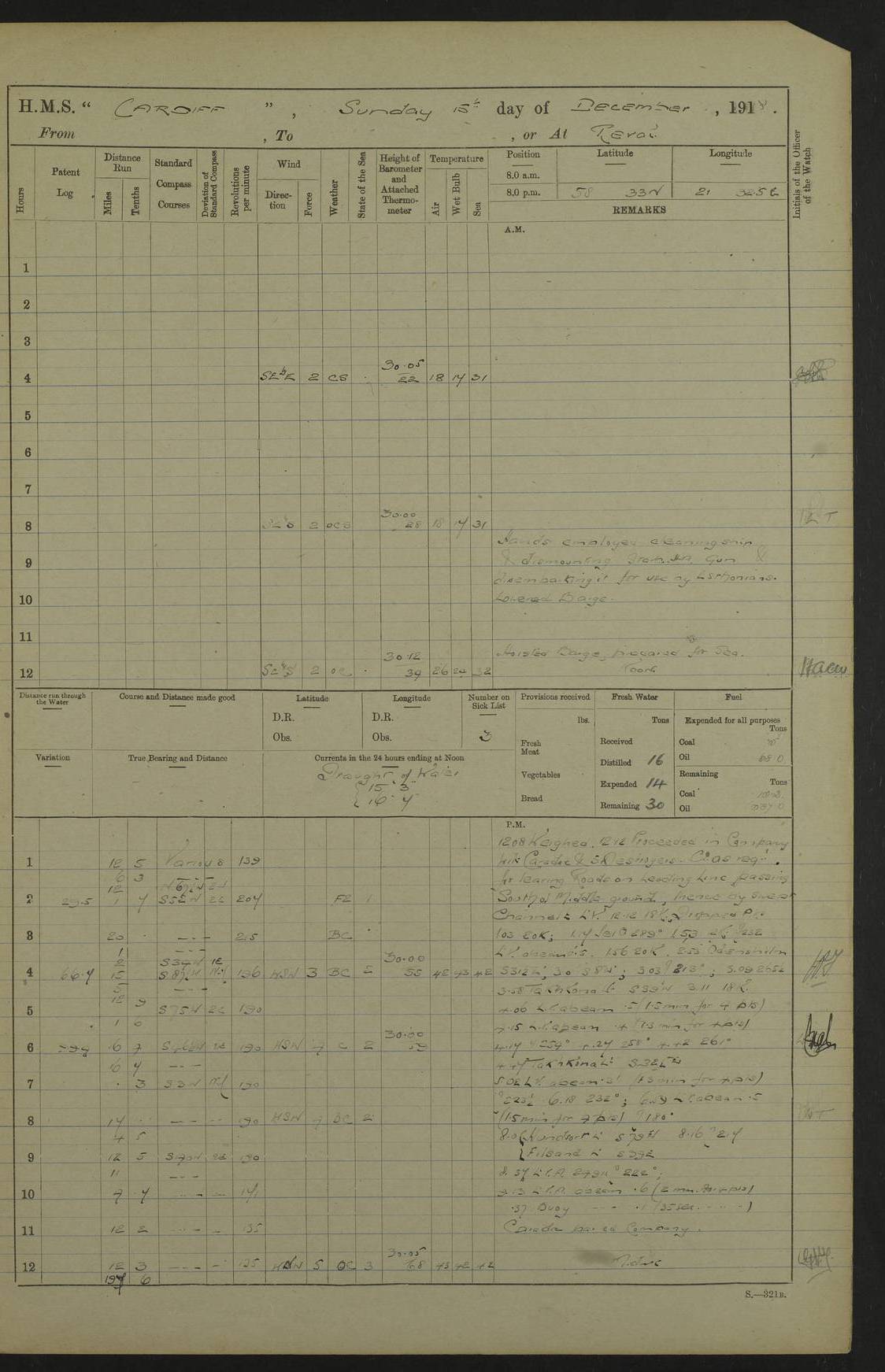
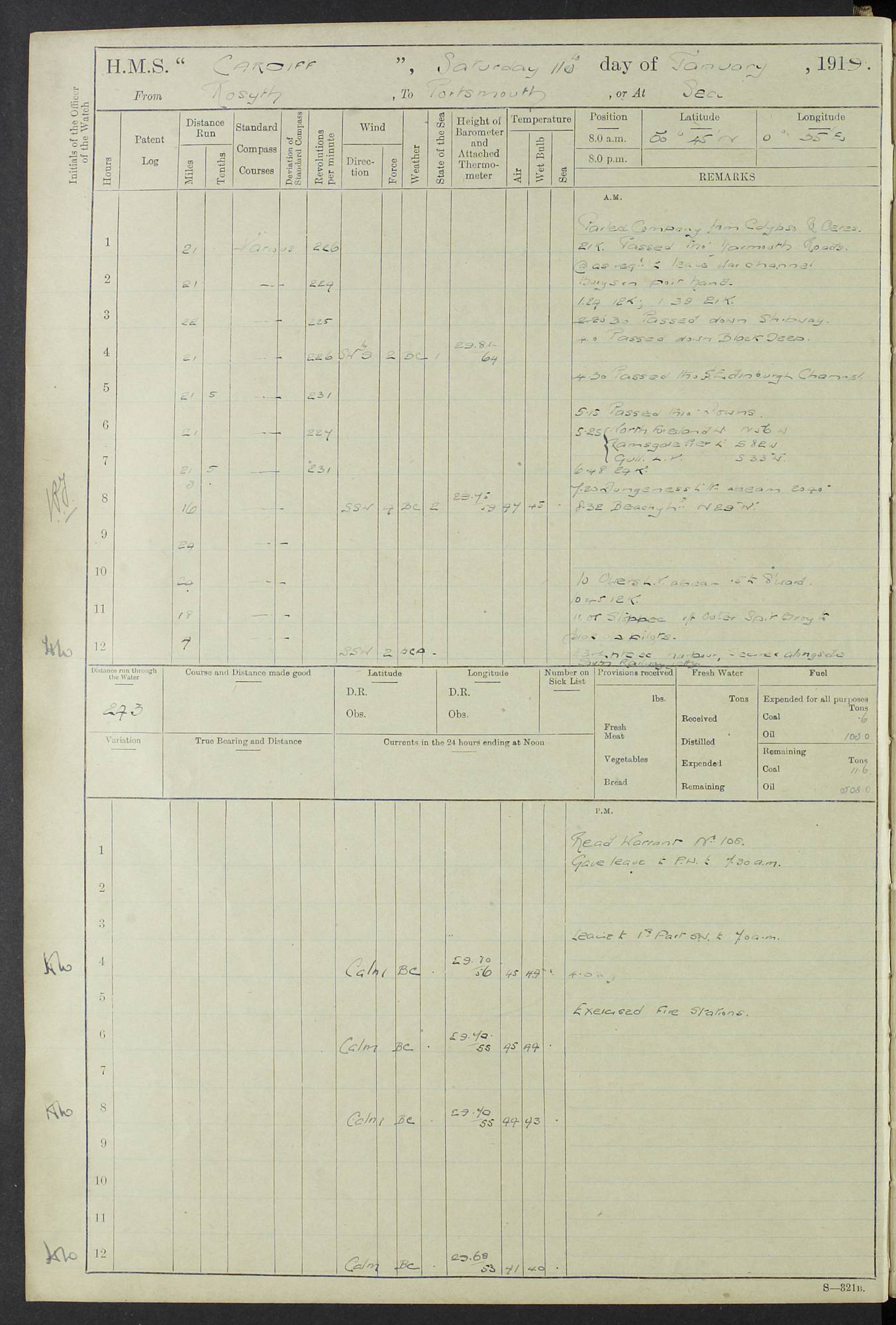
The peace barely paused HMS Cardiff's operational tempo. Within days of the German surrender, she was ordered to the Baltic Sea, where the newly independent Baltic States were fighting for their lives against Bolshevik forces advancing from Russia. The Russian Revolution of 1917 had convulsed the old order, and in the chaos that followed, Britain found itself intervening, half-heartedly, expensively, and ultimately unsuccessfully, against the Bolsheviks on behalf of the White Russian forces. On 14 December 1918, HMS Cardiff and her half-sister Caradoc, with five destroyers, bombarded Bolshevik positions along the Estonian coast [61], cutting the Russian supply lines by destroying a bridge connecting the advancing Bolshevik forces with Petrograd and forcing their retirement [62]. The following day, Cardiff's starboard anti-aircraft gun was dismounted and handed over to the Estonians [63] to help defend their new capital. A week later the squadron was recalled, and Cardiff arrived back at Portsmouth on 11 January 1919 [64].
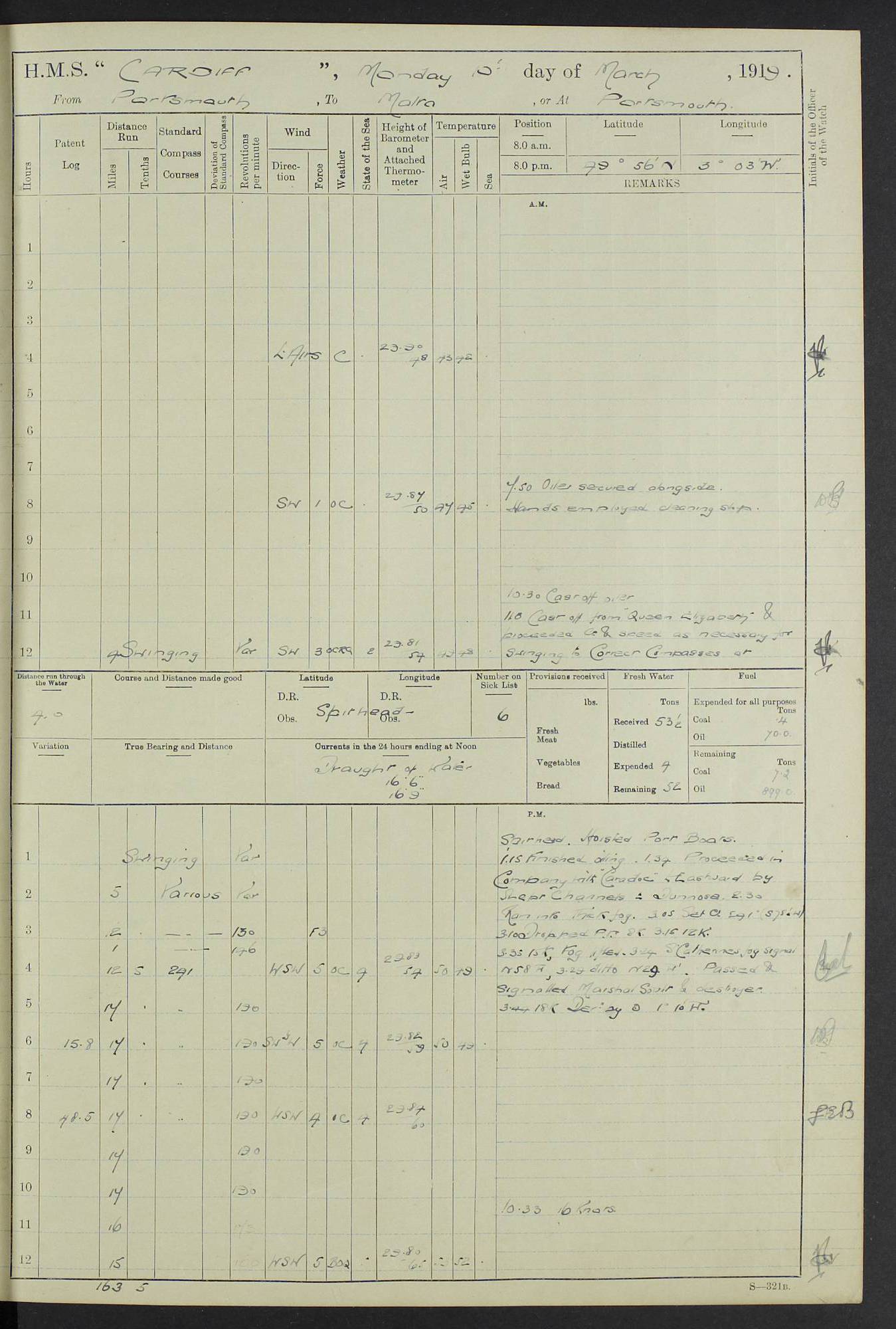
By 10 March 1919, she was on her way to Malta, now redesignated as flagship of the 3rd Light Cruiser Squadron and assigned to the Mediterranean Fleet [65]. The Adriatic was the focus of her work through 1919, the post-war settlement was convulsing the former Habsburg lands, and the Navy's job was peacekeeping among the competing national claims of a region being remade from scratch.
It was somewhere in those Mediterranean waters, in the summer of 1919, that news reached HMS Cardiff of what had happened to the ships she had led into Scapa Flow seven months earlier. On 21 June 1919, with the principal British guard ships absent on exercises, Rear Admiral von Reuter, the same man who had followed Cardiff into the Forth that grey November dawn, gave a secret order. Throughout the morning, Kingston valves were opened, bulkhead doors unlocked, and watertight integrity destroyed across the interned German fleet. Fifty-two of the seventy-four ships sank to the bottom of Scapa Flow in the largest single loss of warships in history [66]. It was a final, defiant act: the ships Arthur had helped escort to their anchorage now lay on the seabed of an Orkney bay. The fleet that had haunted Britain for two decades was gone for good.
In 1920, HMS Cardiff was in the Black Sea, at Constantinople by 30 January 1920, in the final death throes of the Ottoman Empire, and then at Odessa, where the White Russian forces Britain and France had been supporting were collapsing before the Bolshevik advance. After the failed White advance on Moscow in summer 1919, the Red Army had launched a counteroffensive that had by winter 1919–1920 turned into a rout of the White forces. Cardiff arrived at Odessa on 4 February, and Admiral Hope concurred in the decision to evacuate the city in the face of the advancing Bolsheviks. The ship departed the next day, but returned on 11 February, and Hope assumed command of all British forces in the city [67]. There was a humanitarian motive behind the British presence, a natural reluctance to abandon those whom they had hitherto supported to Bolshevik vengeance. Arthur was in the engine room, keeping Cardiff ready to move at whatever speed was required.
He had spent four Christmases aboard Cardiff. The first, in 1917, was at Scapa Flow, barely six weeks after seven men had been killed at Heligoland Bight and the ship had come home with holes in her [68]. There were customs to keep, even there: the mess deck strung with bunting and paper chains, the officers making their tour of each table to taste the food, the compulsory church service in the morning [69]. And the rum: always the rum. 'Apart from the rum issue,' one Royal Navy rating of the period wrote of Christmas at sea, 'the lower deck was dry' [70]. Parcels had been posted from home weeks earlier, in the faith that the GPO's postal operation, which tracked the positions of Royal Navy ships worldwide and routed mail accordingly, would find Cardiff wherever she happened to be [71].
The second was unlike anything he could have anticipated: the eastern Baltic in late December 1918, the war formally over but Cardiff still firing her guns against Bolshevik positions on the Estonian coast [72]. Christmas Day itself was spent somewhere in those frozen waters, temperatures well below freezing, ice forming on the shallower inlets, a world away from any English notion of the season. Whether the parcel had caught up with them at Libau or Riga is not recorded. He rang in 1919 arriving at Helsingfors in the grey Finnish winter [73].
A month before that Christmas, Cardiff had put into Gibraltar. It was late November 1919, the Rock appearing out of the haze as it had appeared to every British sailor for two centuries, the great limestone mass rising abruptly from the flat water to fourteen hundred feet, its fortifications and signal stations layered up the face of the cliff, Spain spreading away to the north and the coast of Africa visible on a clear day across the Strait [74]. For a man who had spent three years in the grey North Sea and the frozen Baltic, the Mediterranean light was still something to adjust to: the warmth, the colour, the narrow bustle of Main Street where Genoese merchant families, a substantial Sephardic Jewish community, and the British garrison had been compressed together for two centuries into a community that was none of these things entirely, and all of them at once [73]. The locals moved between English and Spanish mid-sentence in their own vernacular, (Llanito, they called it), and the Barbary macaques picked their way along the upper fortifications with the unhurried confidence of creatures who knew they had been there longer than anyone [73].
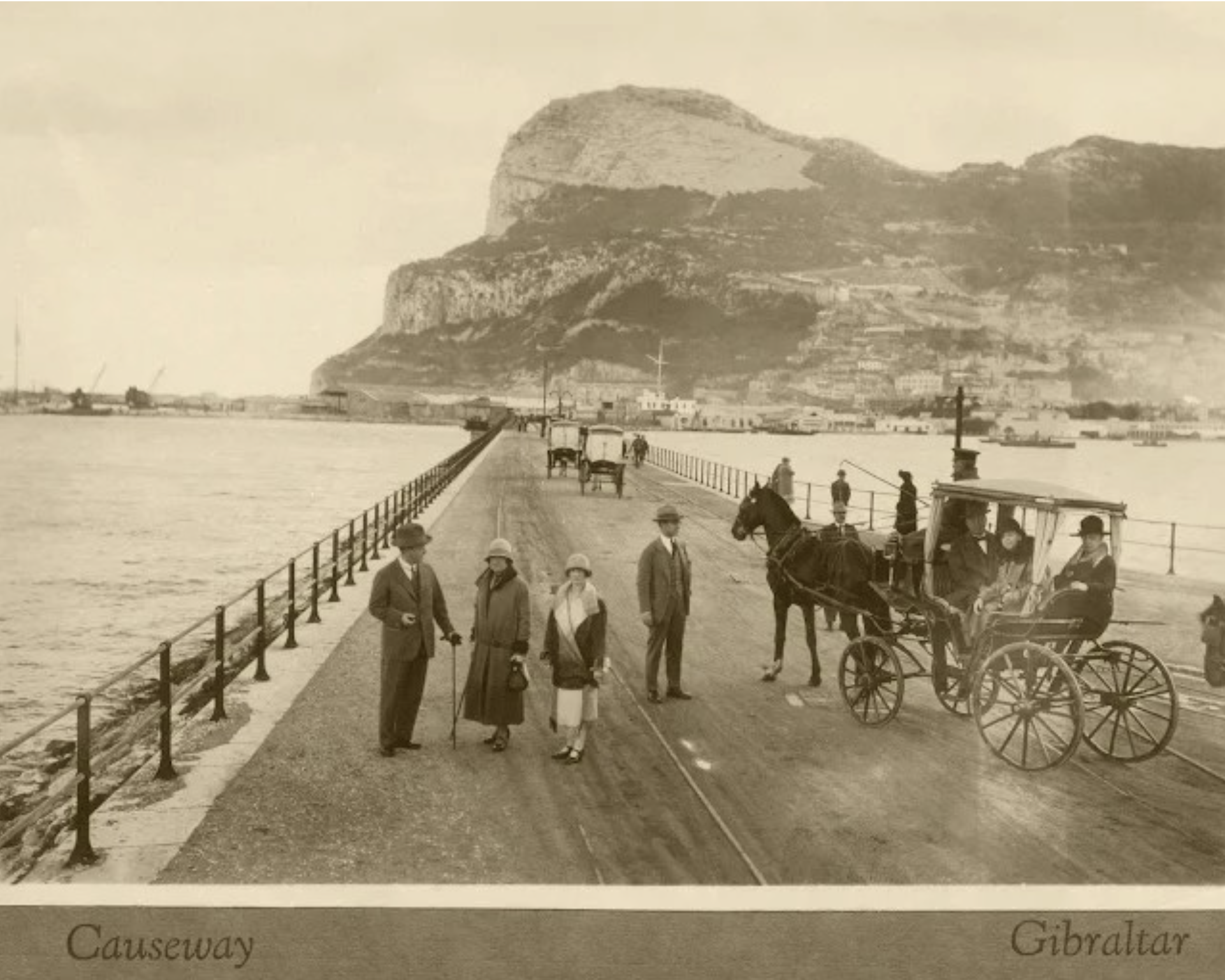
Rock of Gibraltar c. 1920s. The Causeway connected Gibraltar to Spain. Photograph taken by Harry Pollard [75]
It was during this port call that Arthur was initiated into the United Services Lodge No. 3813, a Freemasons' lodge established specifically to serve the military and naval personnel rotating through the garrison. The lodge register records him as the first name on its page: Arthur James Grimshaw, twenty-eight years old, Engine Room Artificer, HMS Cardiff [76]. The ceremony would have taken place in one of the garrison buildings, surrounded by fellow naval and army men from across the Mediterranean station, men who, like Arthur, moved constantly from ship to ship and port to port, and who had found in the lodge a framework of obligation and recognition that stayed constant when everything else changed. He was passed and raised in the months that followed.
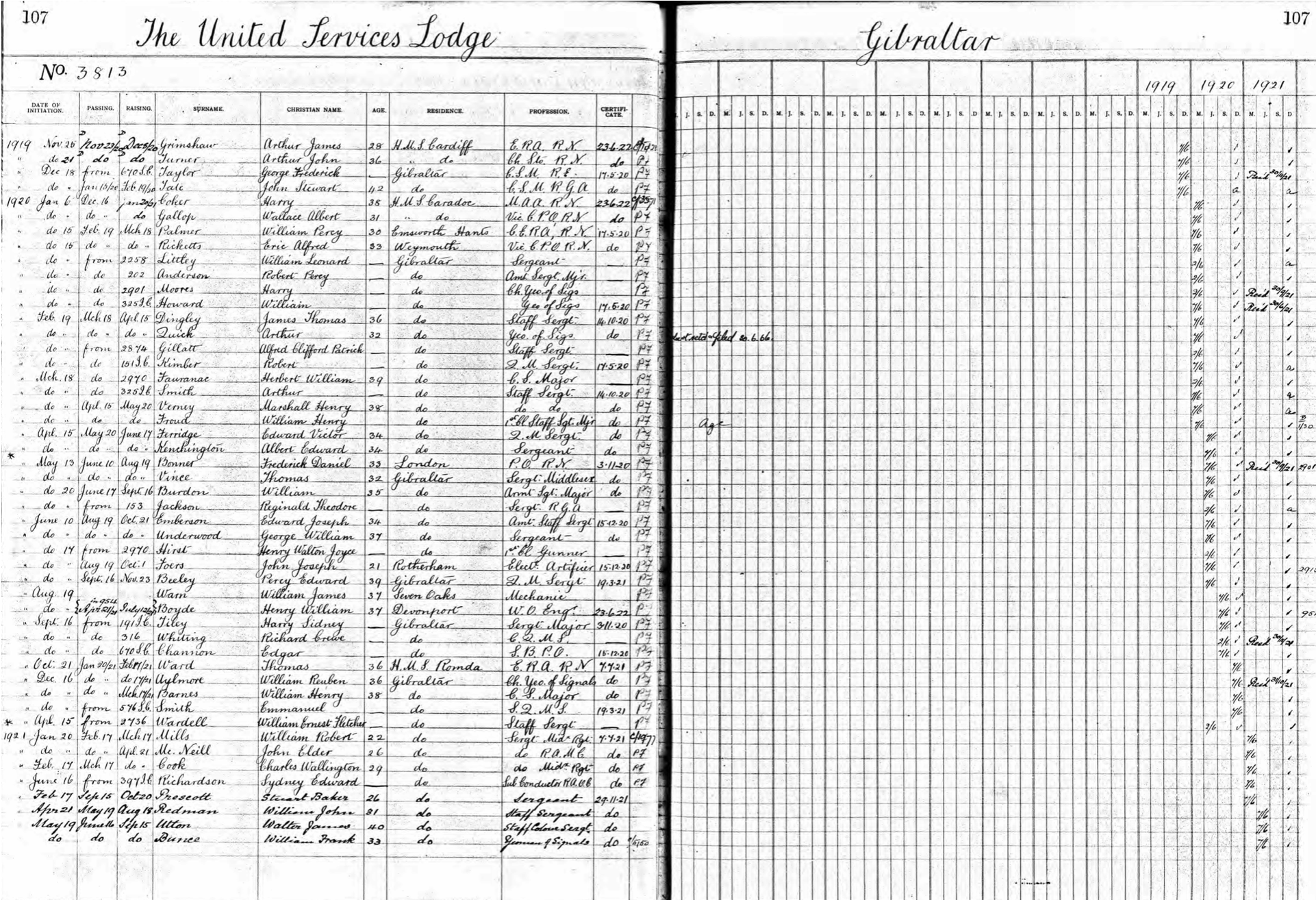
Arthur's entry in the register of the United Services Lodge No. 3813, Gibraltar, November 1919 — initiated while Cardiff was in port [76]
The appeal for a man in his position was straightforward. The lodge offered brotherhood and continuity in a life defined by motion, a network of mutual recognition that transcended any particular ship or station. A Mason could walk into a lodge in Portsmouth, Gibraltar, Malta, or Hong Kong and find men who spoke a common language of ritual and duty. That continuity mattered. It was the one thing that moved with him.
By Christmas 1919 the world had shifted entirely: Malta, warm stone, the smell of the Mediterranean, shore leave in a city that bore no resemblance to anything he had known in Manchester or the Orkneys [77]. Nora's letters found him there, at least. He spent Christmas 1920 there too [78]. By December of that year, his posting on Cardiff ended. He had served aboard her for three and a half years, through more history than most men see in a lifetime.
Five weeks at Victory II, the Portsmouth shore establishment that served as an administrative clearing house between postings, and then, on 26 January 1921, Arthur's new assignment began [20]. His vessel was HMS P.31: a P-class patrol boat built by J. Readhead & Sons at South Shields, launched on 5 February 1916 [79]. She displaced around 613 tons, stretched roughly 230 feet from stem to stern, and made about 20 knots from twin steam turbines producing some 3,500 indicated horsepower, the same type of machinery as Cardiff's, but a fraction of the power, on a vessel with a fraction of the crew [78]. After three and a half years aboard a fleet flagship that had led the German High Seas Fleet into surrender, the engine room of a patrol sloop was a significant step down in scale but no less important.
By June 1920, the experimental ASDIC unit at Portland Naval Base, working to develop the submarine detection apparatus that had originated from wartime hydrophone research, was sufficiently advanced to fit its equipment to a small group of trial vessels for sea exercises with submarines. P.31 was one of them, alongside patrol boats P.38, P.40 and P.59, and two Admiralty whalers [80]. These vessels were attached to the old depot ship HMS Gibraltar for administrative purposes, then to the sloop HMS Heather, conducting sea trials and continuing research from Portland [79]. When Arthur's service record records his posting as 'Gibraltar', it records not the Rock but the depot ship, the administrative parent to which P.31 and her companion trial vessels were tendered.
Arthur joined P.31 in January 1921, seven months after the ASDIC equipment was fitted. He was keeping the engines running on one of the Navy's most technically significant small vessels, part of a programme that would, within a few years, be formalised into the anti-submarine training establishment at Portland known as HMS Osprey, and whose technology would eventually be central to defeating the U-boat campaign in the Second World War [79]. P.31's own commanding officer, Lieutenant Newton William-Powlett, would move from the ship directly to the new anti-submarine school at Portland, where he was teaching specialist officers by March 1925 [81]. Arthur, in the engine room below, was on the operational edge of something the Navy was still working out.
She had been recommissioned at Portland in November 1920 and was conducting anti-submarine trial work in coastal waters (Portland, the Channel, the Devon coast) when Arthur joined her. P.31 moved between ports as her orders required, and by early 1921 she was operating from Sheerness, the Nore Command's dockyard at the mouth of the Medway [78].
Nora followed him there. That she left Portsmouth, her home, her family, the naval community she had known since childhood, and relocated to 289 High Street, Mile Town, Sheerness, tells its own story [82]. It was not the move of a woman whose husband was passing through on leave. It was the move of a woman settling in for the duration, making the best of a dockyard town she had no prior connection to because it was where Arthur was. The 1921 census, taken on the night of 24 April, records them together at that address: Arthur, thirty, Engine Room Artificer, HMS P.31; Nora, twenty-six, home duties [82]. For the first time in their married life (seven years in by now, five of those shaped by the sea) they had something approaching a regular domestic routine: a house to themselves, an address they both lived at, evenings that did not always end with Arthur returning to the gangway.
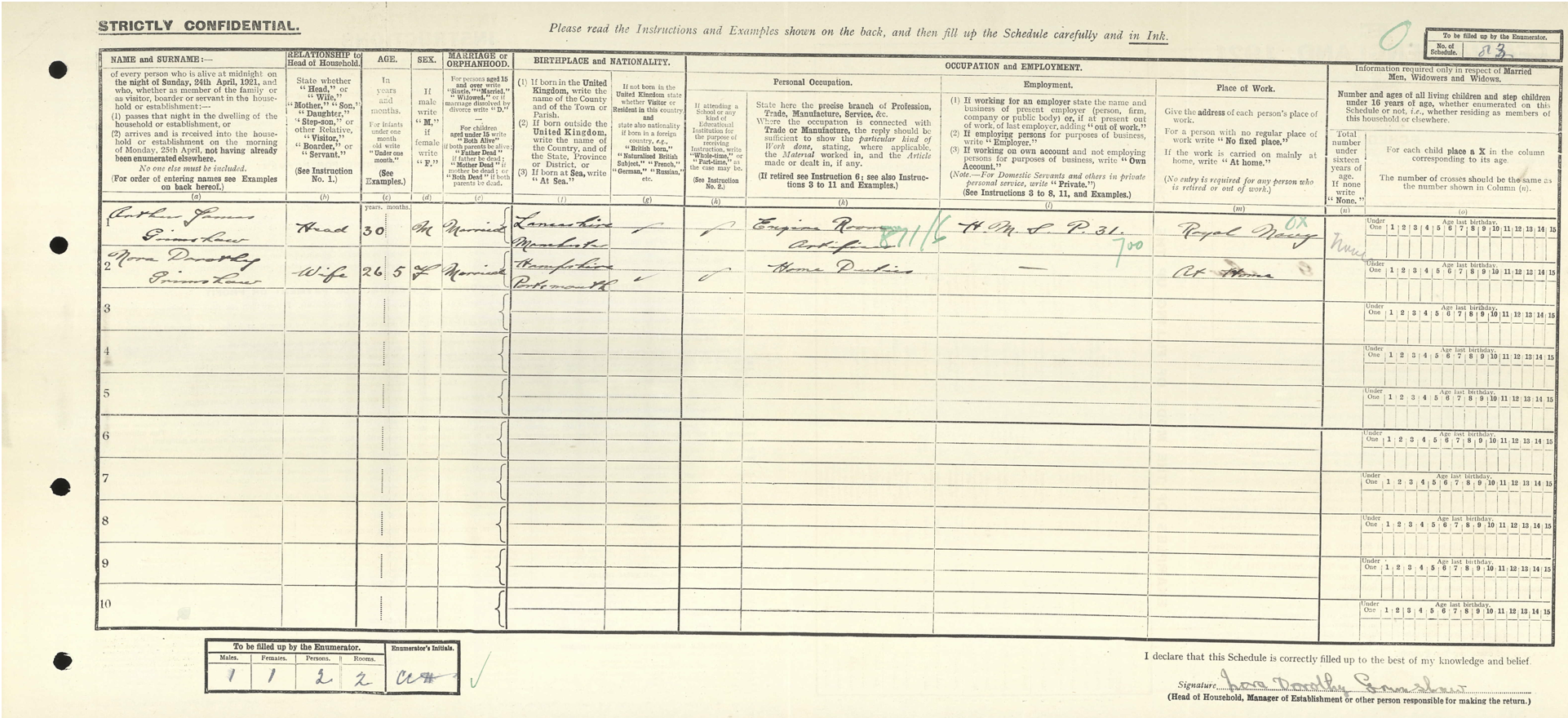
1921 Census [82]
P.31 went where her orders sent her. By September 1921 she was working the Devon coast; a Hydrographic Office file records that on 17 September she lost an anchor and cable at Torbay [83], one of those small operational mishaps that generate paperwork and no particular drama, logged and forgotten. Nora, by then five months pregnant with Kathleen, was back in Sheerness, on the Isle of Sheppey, at the mouth of the Medway, the kind of dockyard town that naval wives knew how to inhabit without complaint. By the time the birth was near she had returned to Portsmouth, to 117 Milton Road, Copnor, closer to family for the birth that mattered most. On 14 December 1921, Kathleen Nora Grimshaw was born there [84]. She was Arthur's one great hostage to a life spent largely at sea, an only child, and the one person whose growing up he would mostly miss. Nora registered the birth herself in January 1922. The certificate records the father as Arthur James Grimshaw, Engine Room Artificer, HMS P.31: present on the form, absent from the room.
Arthur left P.31 in May 1922 [20]. The posting had lasted sixteen months, the most settled period of his married life so far, measured not in sea miles but in mornings woken in the same house.
From May 1922 Arthur returned briefly to Portsmouth (a week at Victory II, then a short spell at Fisgard) before joining HMS Columbine, a shore establishment at Port Edgar near Rosyth, first under the tender Vectis and then under Valoris, where he remained until September 1925 [20].
In September 1925, Arthur returned to Fisgard, the artificers' training world he had first passed through in 1913, this time for a posting that would last until February 1928. It was long enough to suggest he was being used as an instructor as well as a student: a man with the Belgian coast, Gallipoli, Heligoland, and the surrender of the German Fleet on his record, teaching younger artificers what those years had taught him. By this point, all artificer training for the Navy had been concentrated in the Portsmouth hulks, and would remain so until the establishment moved to Chatham in 1930 [85]. Arthur's last years at Fisgard were the last years of that particular institution as Portsmouth knew it.
It was also during the autumn of 1925 that Arthur achieved two rather different distinctions in quick succession. On 2 October he qualified at the Anti-Gas School, the inter-war Navy's response to the catastrophic use of poison gas on the Western Front, ensuring that its personnel could recognise, respond to, and repair equipment damaged by chemical attack. He subsequently qualified in Anti-Gas Repair work as well [20]. These were not trivial qualifications: chemical warfare defence training had been a continuous programme within the Royal Navy throughout the interwar period, and the qualification reflected genuine anxiety that a future war might again deploy the weapons of 1915 [86]. Arthur's qualification in repair work was specifically about maintaining and fixing gas defence equipment, an engineering task perfectly matched to an ERA's skills.
At around the same time, however, his service record notes something rather more human: an attempt to smuggle rum [20]. The Navy's daily tot was a right and a tradition, but the regulations were clear: each day's spirit ration had to be consumed before evening rounds on the day of issue, and saving it up was strictly forbidden. Moving it off-ship, or trading it in the well-established informal economy of "sippers" and "gulpers," was an offence against naval discipline [87]. Whether Arthur was caught in a small personal scheme or a larger communal one, the record does not say. What it records is that it happened, a glimpse of the ordinary man behind the Superlative assessments, testing the limits of naval discipline in the time-honoured way of sailors the world over. The Superlative assessments continued. His career was unaffected.
From February 1928 Arthur was posted to HMS Courageous [20], one of the most significant ships of the inter-war Navy, a battlecruiser converted into one of Britain's first aircraft carriers [88], representative of the technological revolution slowly transferring naval supremacy from the gun to the aircraft. It was on Courageous that he received his promotion to Chief ERA 2nd Class in February 1928, and his further promotion to Chief ERA 1st Class in August 1931 [20], the pinnacle of the non-commissioned engineering world, the rank he would carry for the rest of his naval career. He remained with her until the spring of 1932.
From June 1934 back to Victory II, and then in September to HMS Excellent, the great gunnery school at Whale Island, Portsmouth, where he served under the tender Restless. He was pensioned off on 16 March 1935, with pension number 12795. He had given the Royal Navy twenty-two years [20].
No section of Arthur's career has been more enriched by newly discovered sources than his years aboard HMS Courageous, and the story they tell is a remarkable one.
Courageous was commissioned on 21 February 1928 [89], the very day Arthur joined her [20]. She was Britain's newest aircraft carrier, rebuilt at a cost of £2,025,000 from a wartime battlecruiser, and the newspapers of the day called her "Great Britain's floating aerodrome," noting that forty-eight aircraft would be housed in her hangars [90]. For Arthur in the engine rooms, the technical demands were familiar enough (the same turbines, the same boilers, the same watchkeeping rhythm) but the ship above him was something entirely new. The following day, a Blackburn Dart torpedo bomber of 463 Flight made the ship's first ever deck landing [91]. Arthur was aboard for it.
She sailed for the Mediterranean on 2 June 1928, joining the Mediterranean Fleet at Malta [90]. Arthur was now living beneath a flight deck for the first time, the turbines he tended were not propelling a gun platform, but an aerodrome at sea.
Less than five weeks after he joined, a bilge pump burst during testing at Devonport. The room filled with scalding steam. Warrant-Engineer H. E. Kent died of his injuries, and three others, including a fitter, Arthur's own trade classification, were hospitalised. The Admiralty issued its official statement of regret [92]. On Courageous, they buried a colleague and returned to work.
Three months later, at Malta, a Blackburn Dart torpedo bomber fouled its starboard wing-tip on something on the flight deck while taking off, and pitched overboard. A destroyer recovered the machine. The pilot, twenty-seven-year-old Lieutenant John Nicholson, who had been married only the previous September, was pulled from the cockpit showing no signs of life. Artificial respiration was unsuccessful. He was dead [93]. Arthur was on the ship.
Then, in August 1929, the Palestine crisis transformed Courageous from a training vessel into a transport. The 1929 Palestine riots, triggered by disputes over access to the Western Wall in Jerusalem, had broken out in late August, and the British government moved quickly. On 26 August the Evening Despatch reported that HMS Courageous "sailed for Malta to-day after hurriedly embarking the 2nd Battalion of the South Staffordshire Regiment," with the destroyers Wanderer and Veteran leaving for the Near East at 2 a.m. [94]. Arthur was in those engine rooms, keeping a ship at speed with a full infantry battalion packed above him.
By 1 September, the Sunday Mercury was reporting that "all the aircraft of the fleet air arm carried by H.M.S. Courageous have been landed at Gaza" [95]. The ship's entire air wing was now operating on land, over disputed territory, suppressing disorder from the air. By 11 September the situation was quietening: "H.M.S. Courageous has withdrawn its aircraft from Gaza, and is leaving shortly" [96]. The Palestine operation, a brief, strange colonial episode lived out in the engine rooms of an aircraft carrier, was over.
Courageous returned to home waters, reassigned to the Atlantic and Home Fleets from August 1930. And in October that year came the third fatal accident of Arthur's posting on her. At an inquest at Portland, a verdict of "Accidental death" was returned on Lieutenant David Alexander Christison Sillar, who died on the aircraft carrier attached to the Atlantic Fleet, after being struck by the propeller of the machine in which he had been a passenger. The engine was kept running while the landing party removed the machine to the lift; as Sillar bent in the cockpit, the propeller struck him on the back of the head [97].
Three deaths in Arthur's posting: a warrant engineer scalded by a burst pump, a pilot drowned when his aircraft went overboard, a passenger struck by a propeller on the flight deck. The ship was learning, at cost, what aircraft carriers required of their people, and Arthur was the senior engineering non-commissioned man aboard through all of it.
Then, in September 1931, came Invergordon, and Courageous was there. The mutiny of the Atlantic Fleet took place on Arthur's own ship, not in some distant squadron. Around a thousand ratings across the fleet refused to put to sea in protest at pay cuts that would strip some of their colleagues of a quarter of their wages, cuts that were themselves the Navy's share of the austerity the National Government was imposing on a country still reeling from the economic catastrophe that had begun with the Wall Street Crash two years before. The Depression had reached even here, into the engine rooms and mess decks of the Atlantic Fleet. Prime Minister, Ramsay MacDonald, had visited Courageous at Spithead just days before, and the men had already made their feelings plain. When the fleet arrived at the Cromarty Firth and the newspapers confirmed what had been rumoured, that pre-1925 ratings below petty officer would face cuts of around 25%: the lower deck refused to sign the adjusted allotment forms for their wives. On Courageous, at least, the discontent had a specific, domestic face: not abstract politics, but a man doing the arithmetic on what his family could no longer afford.
As a Chief ERA, Arthur occupied an ambiguous position in all of it. He was a senior rating, equivalent to a Chief Petty Officer, facing the lesser 10% cut rather than the 25% that had driven the men to act. He had not mutinied, and he would not have. But the stokers he worked alongside in those engine rooms every day, men whose labour was as essential to the ship as his own, were precisely the men the cuts would hurt most. He knew them. On a ship of Courageous's size, an ERA and a stoker shared the same machinery spaces, the same watches, the same heat. The mutiny was resolved quickly (the Cabinet moderated the cuts so that pre-1925 ratings faced only the same 10% as everyone else) but the fact that it had happened at all, on his own ship, in the engine rooms he ran, said something about the Navy Arthur had given his life to that no official communiqué would quite capture [98].
He left Courageous in the spring of 1932, having been promoted Chief ERA 1st Class [20]. He had served aboard her for four years, through her commissioning, three fatal accidents, the Palestine emergency, the Invergordon mutiny, and the endless cycle of deck landing exercises that the Navy was still refining at considerable cost. The training went on. The cost of it went on. Arthur went elsewhere.
April and May 1932 brought brief spells at Victory II and then Vernon [20], the Navy's torpedo and electrical school at Portsmouth. Then, on 8 December 1932, he joined HMS Coventry, a C-class light cruiser assigned to the Mediterranean Fleet [99]. It was in October 1933 that Nora and eleven-year-old Kathleen sailed out to join him in Malta [100]. and for the best part of eight months, until June 1934 [101], the family was reunited on the island that Britain had held since 1800 and that remained one of the Royal Navy's most important bases in the world.
For Kathleen it must have been a revelation: the great harbour at Valletta with its layered fortifications and the constant movement of naval traffic, the limestone streets, the Mediterranean light, a world entirely unlike anything Portsmouth could have offered a girl of twelve. Arthur, meanwhile, knew Malta already — he had been based there with Courageous from June 1928, and had visited regularly on Cardiff's Mediterranean deployments. For Nora, it was the rare gift of sustained time with a husband whose career had kept him away for so much of their married life.
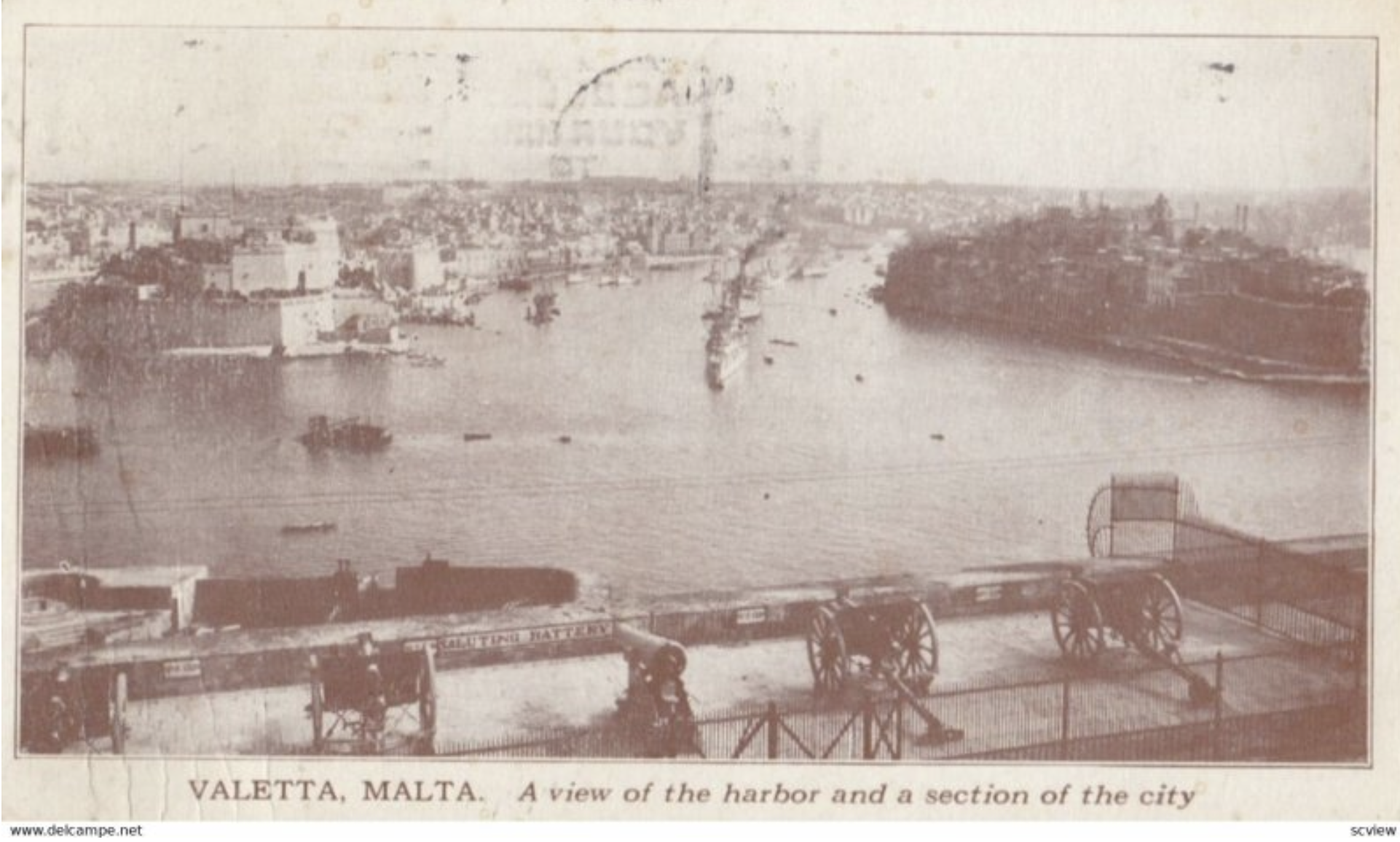
A postcard of Valetta, Malta c.1932 [102]
HMS Coventry returned home, and with her Arthur's last years of regular service wound towards their close. He was pensioned off on 16 March 1935, with pension number 12795 [20]. He had given the Royal Navy twenty-two years. Kathleen was thirteen.
Retirement from the Navy did not mean retirement from work. Arthur was forty-three years old, at the height of his abilities, and the dockyard and naval establishments of Portsmouth needed men of his skills. Arthur found employment in a technical capacity connected to his trade and his pension. For the first time in Kathleen's life, her father was reliably, consistently at home.
By September 1939, when the National Register was compiled in the anxious days immediately after Britain declared war on Germany for the second time in Arthur's life, he was found at 78 Milton Road, Southsea, working at the HM Engineer School as CERAT 12795 [103], a civilian instructor, passing on to the next generation the skills he had spent twenty-two years acquiring.
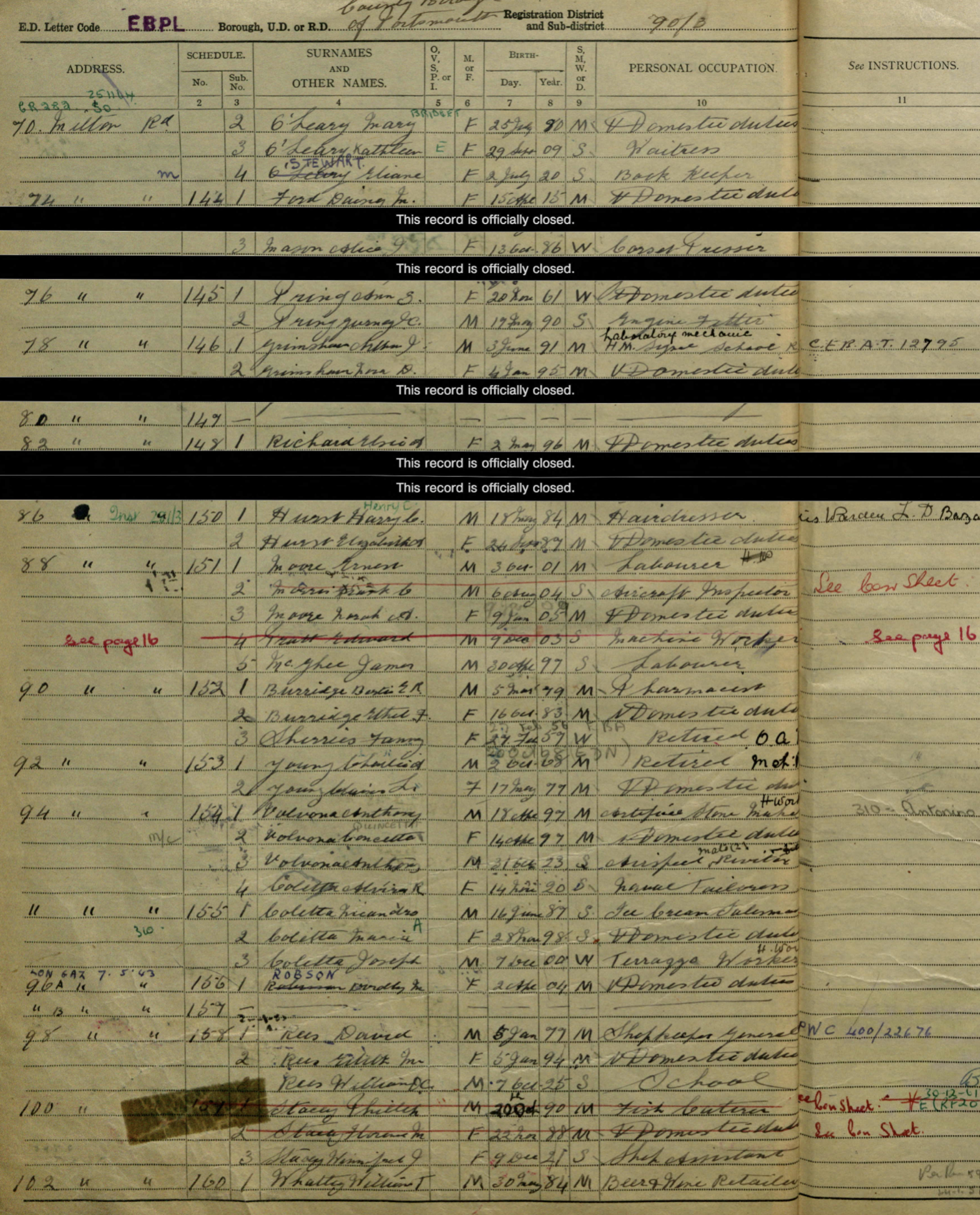
1939 Register [103]
However, the world outside was growing more dangerous by the year. Hitler had become Chancellor of Germany in 1933, and by the mid-1930s German rearmament was an open secret and a growing alarm. Britain began tentatively rearming; the Navy, which had spent more than a decade contracting, started to expand again. Arthur had stepped away at precisely the moment the service was preparing for what would come next.
A month later came the announcement that confirmed his new official status. On 17 October 1939, the London Gazette carried a long list of appointments to H.M. Dockyards and Naval Establishments. The heading above the relevant section read: Without Competition. These were not men who had sat examinations or competed for posts through the usual civil service machinery. They were men whose expertise was so demonstrably necessary, whose practical knowledge so thoroughly established, that the Crown appointed them directly on the strength of what they knew and what they could do. Among the Fitters listed in that cohort, fourteenth in the column, was Arthur James Grimshaw. [104]
Then the war he had hoped would not come arrived in earnest, and Arthur was recalled to active naval service [20].
He was forty-eight years old. He had already given the Navy two decades and fought one world war. But skilled Chief ERA artificers were not easily replaced, and the Navy needed him. On 2 February 1940 he reported to Victory II, listed in the service record as C ERA1 — Chief ERA First Class, pensioner, recalled for the duration. Within days he was posted to HMS Dolphin — the Royal Navy's submarine base at Fort Blockhouse, Gosport, at the very entrance to Portsmouth Harbour, which had been the home of the Submarine Service since 1904 [105]. Submarine warfare was central to both sides' strategy in this new conflict, and the men who maintained the machinery of the submarine service were doing work of genuine strategic importance.
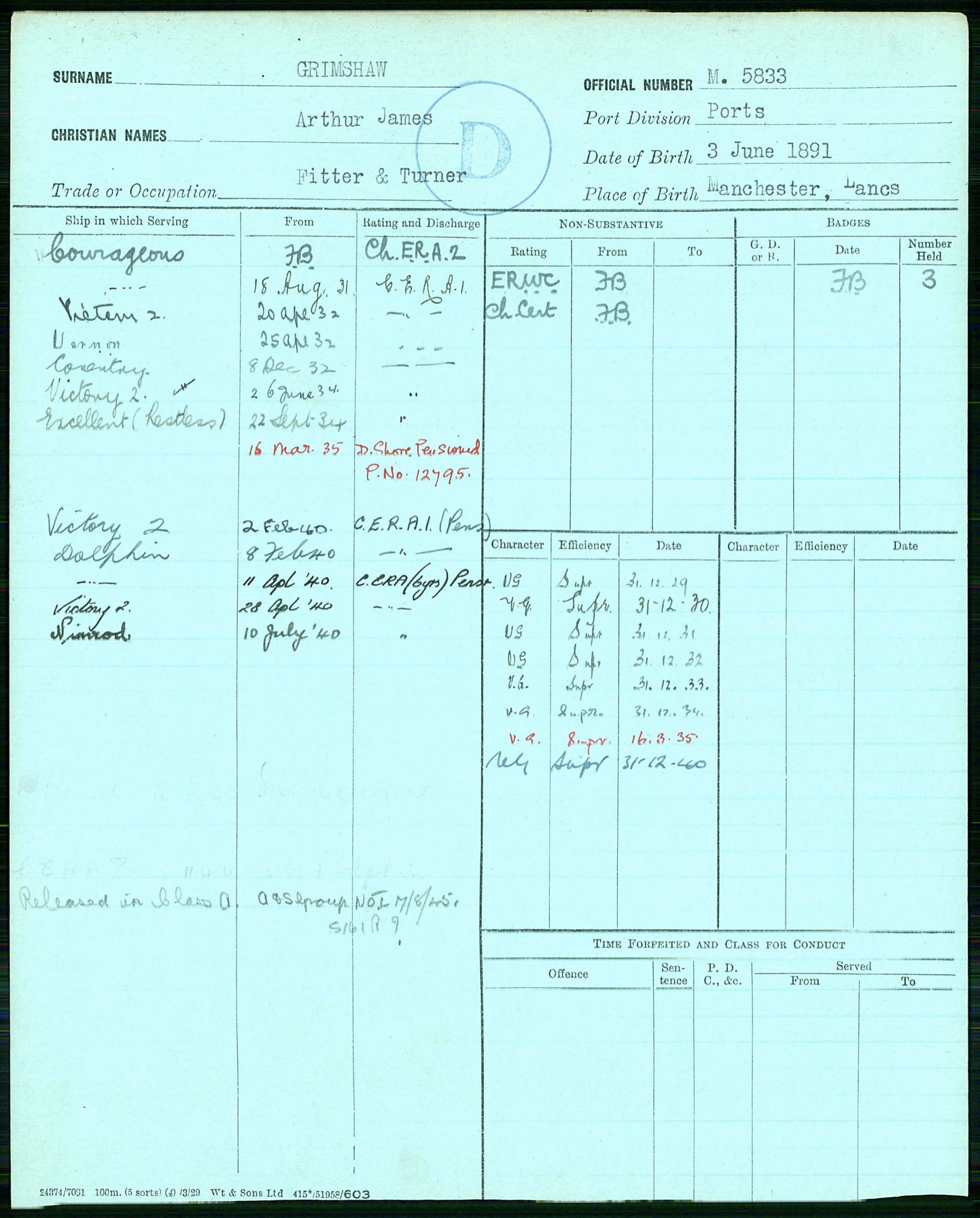
Second Naval Service Record Card [20]
Portsmouth itself had become a front line. The city and its dockyard were among the Luftwaffe's primary targets, and between August 1940 and July 1944 the city suffered sixty-seven air raids killing or injuring more than 3000 civilians [106]. The dockyard was hit repeatedly, the city centre gutted, thousands of homes destroyed or damaged. Arthur had returned to Dolphin to Victory II again by April 1940, and then in July 1940 was posted to HMS Nimrod [20], the Fleet Air Arm station at Machrihanish on the Kintyre peninsula in western Scotland, as far from Portsmouth as it was possible to get while remaining in Britain. The original Machrihanish airfield, HMS Nimrod, had been established during the First World War and was taken over by the Fleet Air Arm in 1940, becoming one of the three busiest stations in the United Kingdom during the war, used for training, for squadrons disembarked from carriers, and for anti-submarine patrols over the Firth of Clyde [107].
Kathleen, who had joined the WRNS in 1942, later recalled that her father was serving in Campbeltown at that time [108], father and daughter both in uniform simultaneously, both in Scotland, both in the service of the Navy that had shaped the family since 1913. Arthur's character assessment at Nimrod, recorded on 31 December 1940, was VG (Very Good) with Efficiency rated Superlative. Even in the second war, in his fiftieth year, the highest grade.
In September 1942, while Arthur was in Scotland, came news that would have struck close. HMS Coventry, the ship aboard which he had been stationed when Nora and Kathleen joined him on Malta in the autumn of 1933, had been overwhelmed by German aircraft in the Eastern Mediterranean. Sailing in support of Operation Agreement, a commando raid on Tobruk, she was attacked by a force of Ju-88 bombers and Stuka dive-bombers, hit by at least four bombs, and abandoned with at least sixty-four of her crew killed before being scuttled by HMS Zulu [109]. The ship that had anchored those sunlit months was gone.
Arthur was released in Class A on 17 August 1945 [20]. He was fifty-four years old, and he had served his country twice.
Arthur and Nora settled into the long, quiet years of retirement at 18 Wilberforce Road, Southsea, a solid, respectable address in a solid, respectable street, exactly the kind of place a Chief ERA with twenty-two years' service and a lifetime of careful habit would choose to end his days.
The post-war world remade itself around them. The National Health Service arrived in 1948. The ships Arthur had served on were disappearing or already gone: HMS Venerable had been towed to Germany for scrapping in 1922 [110], HMS Courageous sunk by a German U-boat in September 1939 [111], HMS Coventry lost off Tobruk in 1942, and his old flagship HMS Cardiff sold for scrap in January 1946 and broken up at Dalmuir in Scotland [112]. The ship that had led the German High Seas Fleet into surrender had been reduced to salvage metal. The fleet he had served was not just shrinking; it was being unmade.
The Suez crisis of 1956, the Anglo-French operation that ended in humiliation when the Americans refused to support it, was felt acutely in a naval town whose identity was bound up with Britain's capacity to project power at sea. The Defence Reviews of the 1960s, which cancelled the new carrier programme and announced withdrawal from east of Suez, were received in Southsea as something close to bereavement. The Navy Arthur had given his life to was being cut down to size by politicians who had decided that Britain could no longer afford its imperial past.
He turned eighty in 1971, the year Britain converted to decimal currency, a change that struck many of his generation as a symbolic abandonment of something old and reliable.
Wilberforce Road, at least, was full of life. Kathleen and Maurice were there with their children Belinda, Lucinda, and Nicholas. Belinda married David, himself a naval man, and four generations eventually came to share the house: Arthur, Kathleen and Maurice, Belinda and David, and finally Belinda and David's two young children, born in 1978 and 1981. The man who had stood in the engine room of HMS Cardiff while she led the German High Seas Fleet into surrender now sat in Southsea, babysitting for his great-grandchildren while their parents went out.
Nora died in 1975 [113]. Arthur was eighty-three, and they had been married for sixty-one years. The person who had been there longest, who had written the letters and waited through the postings and the wars, was gone.
But Wilberforce Road remained full. In April 1976, Arthur stood outside St Jude's church in Portsmouth for Belinda's wedding to David Butt. David came in Royal Navy square rig — the same uniform Arthur had seen on the lower deck for two decades, now worn by his granddaughter's husband on the steps of a Portsmouth church. Arthur is in the photograph: second from the right, straight-backed at eighty-four, wearing a dark double-breasted jacket that echoes, perhaps not entirely by accident, the fore-and-aft rig he had worn for twenty-two years. It is the only photograph in which he appears as an old man, and he looks entirely himself.
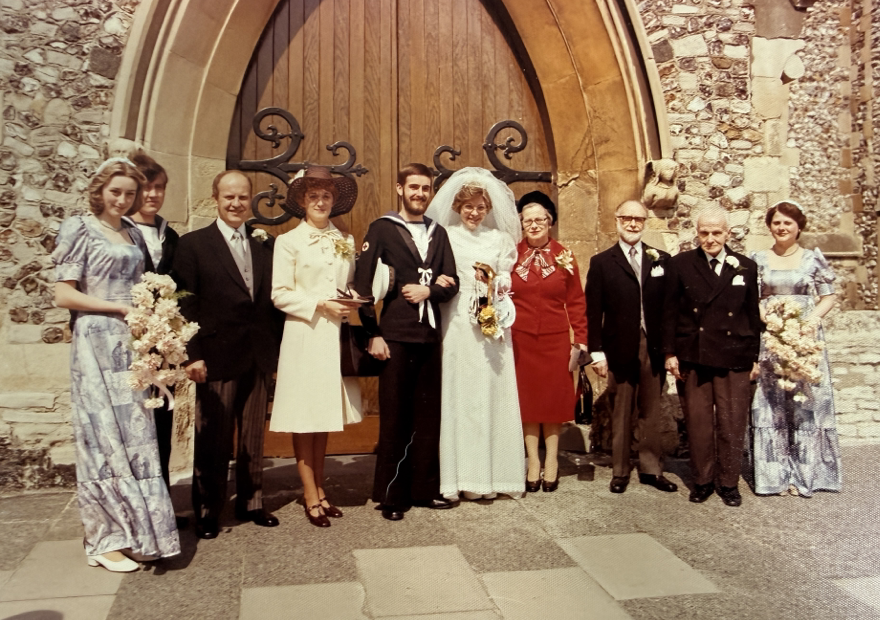
Wedding of Belinda Durrant and David Butt, St Jude's Church, Portsmouth, April 1976. Left to right: Stephanie Butt, the best man, John Leach, Brenda Dorothy Pluck, David Robert Butt, Belinda Elizabeth Grimshaw Butt (née Durrant), Kathleen Nora Durrant (née Grimshaw), Maurice Gordon Durrant, Arthur James Grimshaw, Lucinda Mary Durrant. Arthur, aged eighty-four, stands second from right. [Photograph: Butt family collection.]
The city Arthur Grimshaw died in was not quite the one he had first arrived in as a young naval rating seventy years before. Portsmouth in January 1983 was a city in transition, its great age as an industrial dockyard drawing to a close, its future as a place of naval heritage only beginning to take shape.
In October 1982, just three months before Arthur died, the wreck of the Mary Rose, Henry VIII's flagship, which had lain on the bed of the Solent for four hundred and thirty-seven years, had been raised in one of the most dramatic maritime salvage operations ever attempted and brought back into Portsmouth Harbour [114]. HMS Victory still stood in her dry dock in the historic dockyard, as she had since 1922 [115], the most famous warship in the world, still technically in commission as the First Sea Lord's flagship, her timbers a monument to a naval power that felt, in January 1983, both triumphant and fading.
The Falklands War was still very fresh. The task force had sailed from Portsmouth in April 1982, the ships passing Southsea seafront to crowds that understood too well what it meant to watch a fleet go to war [116]. Among the ships was another HMS Cardiff, a Type 42 destroyer bearing the name of the cruiser Arthur had once served on. This later Cardiff had shot down the last Argentine aircraft of the conflict, and had accepted the formal surrender of the Argentine garrison at Port Howard in the Falkland Islands [117]. A ship bearing the name of the cruiser Arthur had led into the Forth on that November morning in 1918 was there again in 1982, at the end of another conflict, accepting another capitulation.
Another ship, HMS Coventry, bearing the name of the cruiser lost off Tobruk in 1942, had been sunk by Argentine aircraft on 25 May 1982 with the loss of nineteen men [118]. Portsmouth had grieved, and Portsmouth had celebrated, as it always had.
Arthur James Grimshaw died on 14 January 1983, at 18 Wilberforce Road, Southsea [119]. He was ninety-one years old. Probate was granted at Winchester on 4 March 1983, his estate valued at £25,085 [120]. Outside, the winter Solent went about its business (the ferries crossing to the Island, the naval vessels moving in and out of the harbour mouth that he had watched for the better part of fifty years) and HMS Victory stood in her dock a mile away, the permanent reminder that the Navy's history was long, and that those who had served it were, in the end, part of something larger than themselves.
Explore further…
Arthur James Grimshaw appears in the Maternal Grandmother family tree, which traces the full Grimshaw and Grant lines from Manchester and Portsmouth. He and his wife Nora Dorothy Grant are profiled in the Great Grandparents snapshot.
Arthur died at ninety-one — a lifespan that places him among the Super Seniors in the family. The Death and Mortality page charts how life expectancy and cause of death shifted across generations, including those who reached their eighties and nineties.
His wife Nora Grant carries the maternal haplogroup U5a1a1, a lineage that can be traced back tens of thousands of years. That genetic line, which passes through Nora to their daughter Kathleen and beyond, is traced in Ancient Origins.
Arthur's career — as Engine Room Artificer, Chief ERA, and civilian instructor at the HM Engineer School — spans more than three decades of naval service across two world wars. It is recorded in the Maternal Ancestral Occupational Trees.
Arthur's life carried him from the industrial streets of Gorton to the Rock of Gibraltar, from Scapa Flow to the Grand Harbour at Valletta, before his long retirement in Southsea. The places he lived and served are mapped in Ancestral Locations.
References:
[1] England and Wales, Birth Registration Index, 1837–2008, index, Chorlton registration district, 1891 July–September quarter, volume 8c, page 763, entry for Grimshaw Arthur James; and Manchester, England, Church of England Births and Baptisms, 1813–1915, database, Ancestry.com (Provo, UT: Ancestry.com Operations, Inc., 2013), entry for Arthur James Grimshaw, born 3 June 1891 and baptised 12 July 1891 at St James, Gorton, son of James and Alice Grimshaw.
[2] Taken from the Science Museum Group Collection: https://www.scienceandindustrymuseum.org.uk/objects-and-stories/beyer-peacock#&gid=1&pid=5
[3] Science and Industry Museum. (2017). Beyer, Peacock & Co. Ltd: from Manchester to the world. Available at: https://www.scienceandindustrymuseum.org.uk/objects-and-stories/beyer-peacock
[4] Population figures taken from: https://www.manchester.gov.uk/parks-leisure-and-the-arts/parks-playgrounds-allotments-and-open-spaces/conservation-areas/introduction29/history
[5] Grace’s Guide to British Industrial History, “Beyer, Peacock and Co.”, available at: https://www.gracesguide.co.uk/Beyer,_Peacock_and_Co (accessed 16 May 2026). The employee number cited there is derived from Whitaker’s Red Book of Commerce (also issued as Who’s Who in Business), 1914 edition.
[6] Grace’s Guide to British Industrial History, “1894 Institution of Mechanical Engineers: Visits to Works”, section on the Manchester, Sheffield and Lincolnshire Railway’s Gorton Tank locomotive works, giving its establishment in 1848 and extent of over 30 acres, available at: https://www.gracesguide.co.uk/1894_Institution_of_Mechanical_Engineers:_Visits_to_Works (accessed 16 May 2026).
[7] St Marks (West Gorton). History. Available at: https://stmarkswestgorton.com/history/ (accessed 16 May 2026).
[8] Grace’s Guide to British Industrial History, “Richard Peacock”, biographical entry on the co‑founder of Beyer, Peacock and Co., available at: https://www.gracesguide.co.uk/Richard_Peacock (accessed 16 May 2026); and Anthony Dawson, “Hidden Stories of Engineering: The LGBTQIA+ German immigrant who became one of Britain’s leading engineers”, National Railway Museum Blog, 18 March 2026, describing Peacock’s expenditure on schools, swimming baths, a penny savings bank, public health measures and a mechanics’ institute in Gorton, available at: https://blog.railwaymuseum.org.uk/charles-beyer-the-lgbtqia-german-immigrant-who-became-an-engineering-expert/ (accessed 16 May 2026).
[9] For the origins of the cricket and football clubs at St Mark’s, West Gorton, and their evolution into Manchester City FC, see St Mark’s (West Gorton), “History”, https://stmarkswestgorton.com/history/ (accessed 16 May 2026); City Football Group, “Manchester City”, https://www.cityfootballgroup.com/clubs/manchester-city (accessed 16 May 2026); and “History of Manchester City F.C. (1880–1928)”, Wikipedia, https://en.wikipedia.org/wiki/History_of_Manchester_City_F.C._(1880%E2%80%931928) (accessed 16 May 2026).
[10] Ordnance Survey, “Lancashire CIV.SE”, 25‑inch to the mile series, map showing Gorton and the Beyer, Peacock & Co. works, c. 1890s, National Library of Scotland, online map library, available at: https://maps.nls.uk/view/101103827 (accessed 16 May 2026).
[11] Census of England and Wales, 1901 (RG 13/3689); Census of England and Wales, 1911 (schedule 102).
[12] Manchester Evening News, “Nostalgia: Discover Gorton’s chequered past”, feature article on Gorton’s industrial and social landscape, including an archival photograph of the backs of nos. 53–65 Peacock Street, Gorton, c.1896 (image reproduced in this work), available at: https://www.manchestereveningnews.co.uk/news/nostalgia/nostalgia-discover-gortons-chequered-past-10901079 (accessed 16 May 2026).
[13] National School Admission Registers & Log-Books 1870–1914, index, “St James Church of England School, Gorton (Admission Register Primary Boys, 1897)”, entry for Arthur Grimshaw, born 3 June 1891, son of James Grimshaw, film M 432, Gorton St James C of E School, Manchester, Lancashire; database accessed via Findmypast, “Gorton St James C of E School – Admission Register Primary Boys, 1897
[14] Chadwick, H. (1994). Childhood Memories of Gorton in the Nineteen-Twenties. Published by Neil Richardson. As cited in Gedye, S. (2022). Gorton, Abbey Hey & Openshaw, Manchester. A Walk in English Weather. Available at: https://awalkinenglishweather.com/gorton-abbey-hey-openshaw/
[15] Boardman, D. (undated). Belle Vue Revisited. manchesterhistory.net. As cited in Gedye, S. (2022). Gorton, Abbey Hey & Openshaw, Manchester. A Walk in English Weather. Available at: https://awalkinenglishweather.com/gorton-abbey-hey-openshaw/
[16] Belle Vue’s development into a large-scale leisure complex combining zoological exhibits, pleasure gardens, amusement rides, boating lakes, ballrooms, and firework displays is summarised in Chetham’s Library, “Belle Vue,” online collections; see also University of Sheffield, “Belle Vue (1836–1982),” Discover Our Archives; and “Fair – Belle Vue – Showground of the World,” Manchester Histories.
[17] Taken from: https://www.gr8rmcr.co.uk/post/belle-vue-zoo-the-rise-and-fall-of-manchester-s-legendary-wonderland
[18] 1911 England Census, Class RG14, Piece 24252, digital images, Ancestry.com (database), 1911 England Census, Ancestry.com Operations, Inc., Provo, Utah, 2011.
[19] On Manchester Corporation’s decision to electrify its horse tramways from the mid‑1890s and the completion of conversion by 1903, see Museum of Transport, Greater Manchester, “Timeline – Origins: 1824–1898” and “Municipals: 1899–1913.” For the scale and significance of the resulting system, see “Manchester Corporation Tramways,” which notes the opening of the electric system in 1901 and its development into one of the largest municipal tramway networks in Britain.
[20] Royal Navy service record: Arthur James Grimshaw, M.5833 (TNA, ADM 188/1029 and ADM 363/145); Royal Navy second service card (TNA, ADM 363).
[21] Arthur James Grimshaw, service record, UK, Royal Navy Registers of Seamen’s Services, 1848–1939, ADM 188/1029, The National Archives, Kew, Surrey (official number M.5833, Portsmouth Port Division, continuous engagement of twelve years), consulted via “UK, Royal Navy Registers of Seamen’s Services, 1848–1939,” database and digital images, Ancestry.com (Ancestry.com Operations, Inc., Provo, UT, 2014). Under naval enlistment law, continuous‑service engagements for ratings, including artificers, were limited to a fixed term that in practice was twelve years; see Naval Enlistment Act 1884, 47 & 48 Vict. c. 39, s. 2, as referred to in Armed Forces (Conditions of Service) Act 1939, 2 & 3 Geo. 6 c. 32, s. 1(1). For the long, structured career path envisaged for Engine Room Artificers, consistent with such a term, see “Engine Room Artificers Created in Royal Navy,” InEx Artificers, and “Timeline of Artificer Training,” The Fisgard Association, both accessed 16 May 2026.
[22] The rating of Engine Room Artificer was created by Admiralty decision in 1868 and was intended to provide skilled technical ratings responsible for the operation and maintenance of a ship’s machinery. See The Fisgard Association, “Timeline of Artificer Training,” The Fisgard Association, accessed 16 May 2026, https://www.thefisgardassociation.org/index.php?option=com_content&view=article&id=239&Itemid=499 (recording that on 28 March 1868 “Engine Room Artificers [were] created”). See also “Engine Room Artificers Created in Royal Navy,” InEx Artificers, accessed 16 May 2026, https://inexartificers.com/site/tiffies_history (noting that Engine Room Artificers were introduced in 1868 as a new CPO‑rated class to maintain and repair ship’s machinery). For contemporary and retrospective descriptions of ERAs’ responsibility for keeping the engines and auxiliary machinery running—“the men who made the ship go”—see “Naval Engineering Yesteryears,” Transactions of the Institution of Marine Engineers (reprinted in IMarEST online archive), accessed 16 May 2026, https://library.imarest.org/record/8042/files/v43b2p13a.pdf, and Marine Engineering Museum, “Timelines,” Marine Engineering Museum, accessed 16 May 2026, https://marine-engineering-museum.org.uk/timelines.html.
[23] On the requirement that Engine Room Artificers be fully trained tradesmen, see “The Training of Artificer Apprentices in HMS Fisgard,” Transactions of the Institution of Marine Engineers 15, no. 2 (reprinted in IMarEST online archive), which explains that early ERAs were “recruited from skilled fitters, turners and other engineering tradesmen” and that formal naval artificer apprenticeships were later introduced to provide an in‑house source of similarly trained men. For the development of the Boy Artificer scheme and the shift to training artificers within the service, see “Royal Navy Artificer Apprentices,” The Fisgard Association, accessed 16 May 2026, https://thefisgardassociation.org/index.php?option=com_content&view=article&id=3&Itemid=186, and “Timeline of Artificer Training,” Marine Engineering Museum, accessed 16 May 2026, https://marine-engineering-museum.org.uk/timelines.html (noting the introduction of Boy Artificer training in the early twentieth century). These accounts together show that, by the time Arthur James Grimshaw entered in 1913, direct‑entry ERAs were normally experienced engineering tradesmen, while a parallel in‑house apprenticeship route existed for Boy Artificers.
[24] Gosport Heritage Open Days, “HMS Fisgard (Gosport 1904–1932),” accessed 16 May 2026, https://www.gosportheritage.co.uk/hms-fisgard-gosport-1904-1932/.
[25] The Fisgard Association, “Royal Navy Artificer Apprentices,” accessed 16 May 2026, https://thefisgardassociation.org/index.php?option=com_content&view=article&id=3&Itemid=186.
[26] Imperial War Museums, “In the Engine and Boiler Rooms of HMS Belfast,” accessed 16 May 2026, https://www.iwm.org.uk/history/second-world-war/in-the-engine-and-boiler-rooms-of-hms-belfast.
[27] On the traditional naval watch system, see “What Are Watches on Board Ship?,” Royal Museums Greenwich, accessed 16 May 2026, https://www.rmg.co.uk/stories/maritime-history/what-are-watches-on-board-ship (describing a 24‑hour day divided into four‑hour watches with two evening dog watches to rotate duties), and “The Watch System,” Historic Naval Fiction, accessed 16 May 2026, https://www.historicnavalfiction.com/general-hnf-info/naval-facts/the-watch-system, which lists the five four‑hour watches and two two‑hour dog watches and explains their rotation function.
[28] On the timing of the daily rum ration, see Royal Museums Greenwich, “A Rum Deal: The Origins of Nelson’s Blood,” accessed 16 May 2026, https://www.rmg.co.uk/stories/maritime-history/curatorial/rum-deal-origins-nelsons-blood, which notes that from around 1655 the pint of rum ration was served daily, “half at 12 noon and the second half at about 5 or 6pm.” See also Western Front Association, “Alcohol in the Trenches: The Rum Ration,” accessed 16 May 2026, which records that the rum ration “was usually given out to the crew at midday,” and “Rum Ration: The Complete History Behind ‘the Daily Tot’,” Pusser’s Rum, accessed 16 May 2026, describing the “Up Spirits!” call between 11 am and noon for the daily tot.
[29] On ERA promotion, see “The Royal Navy,” recruiting booklet reprinted in For Posterity’s Sake (Royal Canadian Navy historical documents), p. 15, which describes the artificer career path as leading after 6 years to Chief Engine‑room Artificer, 1st Class.
[30] On HMS Venerable’s class and deployment, see “HMS Venerable,” History of War, accessed 17 May 2026, https://www.historyofwar.org/articles/weapons_HMS_Venerable.html, which describes her as a London‑class battleship serving in the 5th Battle Squadron of the Channel Fleet in August 1914. See also “5th Battle Squadron,” Wikipedia, accessed 17 May 2026, https://en.wikipedia.org/wiki/5th_Battle_Squadron, noting that in August 1914 the squadron, based at Portland, comprised several pre‑dreadnought battleships including HMS Venerable, and “London‑class Battleship,” Wikipedia, accessed 17 May 2026, which classifies the London‑class as pre‑dreadnought battleships.
[31] Marriage register: Holy Trinity Church, Weymouth, 3 October 1914 (Dorset Record Office, PE/WY:(HT) RE 2/5).
[32] On the extraordinary extension of the August Bank Holiday in 1914 and its financial context, see NatWest Group Remembers, 'August 1914: The Longest Bank Holiday', https://www.natwestgroupremembers.com/banking-in-wartime/banking-business/august-1914-the-longest-bank-holiday.html [accessed 31 May 2026].
[33] Portsmouth Evening News, 8 October 1914 and 9 October 1914.
[34] BBC History, “Battle of the Marne: 6–10 September 1914,” accessed 17 May 2026, https://www.bbc.co.uk/history/worldwars/wwone/battle_marne.shtml.
[35] On the Battle of the Yser as a desperate attempt to prevent a German breakthrough to the Channel ports, see “Battle of the Yser/IJzer, 1914,” GreatWar.co.uk, accessed 17 May 2026, http://www.greatwar.co.uk/battles/yser/yser-battle.htm; “Battle of the Yser,” Encyclopaedia Britannica, accessed 17 May 2026, https://www.britannica.com/topic/Battle-of-the-Yser; and “The Battle of the Yser, October 1914,” Belgian Army in World War 1, accessed 17 May 2026, http://www.belgianarmy.freeservers.com/yser.htm, which summarises the German attempt to break through towards the Channel coast and the Belgian defence along the Yser. For HMS Venerable’s role, including her attachment to the Dover Patrol, bombardment of German positions off the Belgian coast between Westende and Lombardsijde in late October 1914, and period as flagship of Rear Admiral Sir Horace Hood, see “HMS Venerable (1899),” Wikipedia, accessed 17 May 2026, https://en.wikipedia.org/wiki/HMS_Venerable_(1899) (drawing on R. A. Burt, British Battleships 1889–1904, Barnsley: Seaforth Publishing, 2013), and “HMS Venerable,” History of War, accessed 17 May 2026, https://www.historyofwar.org/articles/weapons_HMS_Venerable.html; see also “HMS Venerable – Ships,” Roll of Honour, accessed 17 May 2026, https://www.roll-of-honour.com/Ships/HMSVenerable.html, which notes her attachment to the Dover Patrol for bombardment duties.
[36] Rear‑Admiral Hood’s account of these operations is taken from his official despatch: see “Belgian Coast 1914–1918: Naval Despatches,” Naval‑History.net, accessed 17 May 2026, https://www.naval-history.net/WW1NavyBritishLGDispatchesNavy1914-16.htm, reproducing Rear‑Admiral Sir Horace Hood’s despatch on naval operations off the Belgian coast (London Gazette, 15 April 1915), in which he writes that his flotilla was “organised to prevent the movement of large bodies of German troops along the coast roads from Ostend to Nieuport, to support the left flank of the Belgian army, and to prevent any movement by sea of the enemy’s troops,” and notes that “the scouts therefore returned to England, while H.M.S. Venerable and several older cruisers, sloops and gunboats arrived to carry on the operations.” For contemporary newspaper publication of the despatch the following spring, see “Some Naval Heroes: Despatch from Rear‑Admiral Hood,” Midland Free Press, 17 April 1915, 8.
[37] ‘H.M.S. Venerable's Ordeal: Attacked by Submarines', Grimsby Daily Telegraph, 14 November 1914, p. 4. [Letter from Midshipman Foster to his parents at Scarborough.]
[38] Taken from: https://maviboncuk.blogspot.com/2020/03/march-18-1915-naval-victory-at-gallipoli.html (accessed 17 May 2026).
[39] ‘Three Warships Sunk in the Dardanelles', Sunderland Daily Echo, 20 March 1915, p. 5.
[40] Ibid. [The Daily Mail correspondent's account was reprinted in the same Sunderland Daily Echo article.]
[41] On the withdrawal of HMS Queen Elizabeth from the Dardanelles, see Sir Julian Corbett, Naval Operations, vol. 2 (London: Longmans, Green, 1921), chap. 5, available via Naval‑History.net, which records that on 12 May 1915 the Admiralty decided to recall Queen Elizabeth from the Eastern Mediterranean to reinforce the Grand Fleet. For HMS Venerable’s subsequent transfer to the Dardanelles, see “HMS Venerable (1899),” Wikipedia, accessed 17 May 2026, https://en.wikipedia.org/wiki/HMS_Venerable_(1899), drawing on R. A. Burt, British Battleships 1889–1904 (Barnsley: Seaforth Publishing, 2013), which states that “on 12 May 1915, Venerable was ordered to the Dardanelles to replace battleship HMS Queen Elizabeth in the Dardanelles Campaign”; see also “HMS Venerable,” History of War, accessed 17 May 2026, https://www.historyofwar.org/articles/weapons_HMS_Venerable.html, and “HMS Venerable – Ships,” Roll of Honour, accessed 17 May 2026, https://www.roll-of-honour.com/Ships/HMSVenerable.html, which summarise her service as including “May–October 1915 Dardanelles.”
[42] On HMS Venerable’s participation in the Suvla operations, see “HMS Venerable (1899),” Wikipedia, accessed 17 May 2026, https://en.wikipedia.org/wiki/HMS_Venerable_(1899), which records her service at the Dardanelles and involvement in the Suvla Bay fighting during August 1915. For the landings at Suvla Bay and their role in the August Offensive, see “Landing at Suvla Bay 6 to 15 August 1915,” Anzac Portal (Australian Department of Veterans’ Affairs), accessed 17 May 2026, https://anzacportal.dva.gov.au/wars-and-missions/ww1/where-australians-served/gallipoli/august-offensive/suvla-bay, and “The Landings at Suvla Bay, 1915,” FirstWorldWar.com, accessed 17 May 2026, which describe the Suvla landings and subsequent attacks, culminating in the 21 August assaults on Scimitar Hill and Hill 60 as part of the August Offensive.
[43] The photograph is reproduced and discussed in “Archie’s Letters from Suvla,” The Western Front Association, 24 February 2026, accessed 17 May 2026, https://www.westernfrontassociation.com/world-war-i-articles/2026/february/archies-letters-from-suvla/, which reproduces an image from The Illustrated London News
[44] Denham, H. M. (1981). Dardanelles: A Midshipman's Diary, 1915–16. London: John Murray. See also Imperial War Museum oral history: Denham, Henry Mangles (IWM catalogue 80010646).
[45] Contemporary accounts of Royal Navy engine rooms in tropical conditions recorded temperatures in the auxiliary engine room exceeding 130 degrees Fahrenheit, with stokers describing conditions in the stokehold as a particular ordeal during full-speed operations. [Source: account of HMS Terrible, 1902, reproduced at gwulo.com/node/25876 (accessed 17 May 2026).
[46] On HMS Venerable’s later First World War service, see “HMS Venerable – Ships,” Roll of Honour, accessed 17 May 2026, https://www.roll-of-honour.com/Ships/HMSVenerable.html, which gives “October–December 1915 refit at Gibraltar” and “December 1915–December 1916 Adriatic.” See also “HMS Venerable (1899),” Wikipedia, accessed 17 May 2026, https://en.wikipedia.org/wiki/HMS_Venerable_(1899), which notes that in October 1915 she arrived at Gibraltar for refit and in December 1915 transferred to the Adriatic Sea to reinforce the Italian Navy against the Austro‑Hungarian fleet, remaining there until early 1917. Arthur James Grimshaw’s continued service aboard Venerable until December 1916 is shown in his service record, UK, Royal Navy Registers of Seamen’s Services, 1848–1939, ADM 188/1029, The National Archives, Kew.
[47] HMS Venerable decommissioning detailed at https://www.worldnavalships.com/directory/shipinfo.php?ShipID=1427 (accessed 17 May 2026).
[48] On the construction of HMS Cardiff, see “HMS Cardiff,” ClydeMaritime, accessed 17 May 2026, https://www.clydemaritime.co.uk/troon_shipbreaking/hms-cardiff/, which records that she was a Ceres‑class light cruiser (pennant D‑58) built by Fairfield Shipbuilding and Engineering Company at Govan, Glasgow, laid down on 22 July 1916, launched on 12 April 1917 and completed on 25 June 1917.
[49] Wikipedia. 'HMS Cardiff (D58)'. Available at: https://en.wikipedia.org/wiki/HMS_Cardiff_(D58)
[50] Beesly, Patrick (1984). Room 40: British Naval Intelligence, 1914–18. Oxford: Oxford University Press, pp. 279–280.
[51] For the Second Battle of Heligoland Bight, see “Second Battle of Heligoland Bight,” Wikipedia, accessed 17 May 2026, which describes the British attempt to ambush German minesweepers in the Heligoland Bight on 17 November 1917 and notes that the action began at 7.30 a.m. about 65 nautical miles west of Sylt. See also Andrew Davies, “The Second Battle of Heligoland Bight—a centenary,” The Strategist, 24 November 2017, and “Second Battle of Heligoland (17 November 1917),” Naval‑Encyclopedia, both of which emphasise the poor visibility, smoke screens and resulting confusion of the engagement. The German minesweepers’ escort under Rear‑Admiral Ludwig von Reuter, and his successful withdrawal of his cruisers to the protection of the battleships Kaiser and Kaiserin, are summarised in “Ludwig von Reuter,” Wikipedia, accessed 17 May 2026. The hit on HMS Calypso’s conning tower and the deaths of her captain and bridge personnel are described in the Royal Museums Greenwich catalogue entry “HMS ‘Calypso’ at the Second Battle of the Heligoland Bight, 17 November 1917,” and the longer battle narrative confirms that a 5.9‑inch shell killed all personnel on her bridge. The detailed tactical account of the action, including the effects of the shell hit on Calypso’s electrical systems and the unintended discharge of a torpedo due to an electro‑pneumatic firing circuit, is taken from “Second Battle of Heligoland Bight,” The Dreadnought Project, accessed 17 May 2026.
[52] Image taken from: https://www.hampshireprints.co.uk/collections/royal-navy-c-class-cruisers-photo-prints/products/hms-cardiff-d58-photo-print-starboard-view-royal-navy-c-class-cruiser
[53] Commonwealth War Graves Commission, “Bugler Charles Ernest Timmins,” For Evermore: Stories of the Fallen, https://www.cwgc.org/stories/stories/bugler-charles-ernest-timmins/; and CWGC casualty record 3041746, https://www.cwgc.org/find-records/find-war-dead/casualty-details/3041746/.
[54] London Gazette, 17 May 1918, Supplement to Issue 30715 (Victoria Cross citation for Ordinary Seaman John Henry Carless, HMS Caledon); and Commonwealth War Graves Commission, “Ordinary Seaman John Henry Carless Continued Fighting to the End,” For Evermore: Stories of the Fallen, https://www.cwgc.org/stories/stories/ordinary-seaman-john-henry-carless-continued-fighting-to-the-end/.
[55] Marder, Arthur J. (1970). From the Dreadnought to Scapa Flow: The Royal Navy in the Fisher Era, 1904–1919. Vol. V: Victory and Aftermath, January 1918–June 1919. London: Oxford University Press, p. 130.
[56] Marder, Arthur J. (1970). From the Dreadnought to Scapa Flow, Vol. V. London: Oxford University Press, pp. 172–173.
[57] 'The Naval Surrender: Historic Meeting in the Firth of Forth', Bristol Times and Mirror, 19 November 1918, p. 5.
[58] Marder, Arthur J. (1970). From the Dreadnought to Scapa Flow, Vol. V. London: Oxford University Press, p. 190.
[59] Royal Museums Greenwich. 'HMS Cardiff leading the German High Seas Fleet to surrender in the Firth of Forth, 21 November 1918'. Object record. Available at: https://www.rmg.co.uk/collections/objects/rmgc-object-12162
[60] 'The Surrender of the German Fleet: Local Man Eye-Witness of an Historic Event', The Blaydon Courier, 4 January 1919, p. 7. [Letter from G. A. Clews to his parents at Blackhale Mill.]
[61] Imperial War Museum, photograph Q 19334: 'Royal Navy light cruiser HMS Cardiff. Rear Admiral Hugh Sinclair's flagship at Reval (Tallinn). December 1918.' Available at: https://www.iwm.org.uk/collections/item/object/205253782
[62] Stokes, Simon. 'Naval Actions of the Russian Civil War, Part 1.' PT Dockyard. Available at: https://ptdockyard.com/wp-content/uploads/2010/08/navalactionsofthercw.pdf, p. 4.
[63] HMS Cardiff, Ship's Log, 15 December 1918. The National Archives, Kew, ADM 53/37064. Digitised image available via the Old Weather project at: https://s3.amazonaws.com/oldweather/ADM53-37064/C1-ADM53-37064-0010_1.jpg
[64] HMS Cardiff, Ship's Log, 11 January 1919. The National Archives, Kew, ADM 53/37065. Digitised image available via the Old Weather project at: https://s3.amazonaws.com/oldweather/ADM53-37065/0011_0.jpg
[65] HMS Cardiff, Ship's Log, March 1919. The National Archives, Kew, ADM 53/37065. Digitised image available via the Old Weather project at: https://s3.amazonaws.com/oldweather/ADM53-37065/0040_1.jpg
[66] The Interned German Fleet at Scapa Flow: Sunk by their Hun Crews on Saturday', Banffshire Advertiser, 26 June 1919, p. 8.
[67] The timeline of HMS Cardiff’s movements and Rear‑Admiral Sir George P. W. Hope’s decisions in the Black Sea in early 1920 (Cardiff at Constantinople by 30 January, arrival at Odessa on 4 February, evacuation on 5 February, and return on 11 February when Hope assumed command of British forces in the city) is taken from “HMS Cardiff (D58),” Wikipedia, accessed 17 May 2026, https://en.wikipedia.org/wiki/HMS_Cardiff_(D58). For Cardiff’s broader post‑war service with the Mediterranean Fleet and in the Black Sea, and later 1920 movements between Malta and Constantinople, see also “HMS Cardiff,” Battleships‑Cruisers.co.uk, https://www.battleships-cruisers.co.uk/ship.php?ShipID=204. Background on the collapse of the White forces after the failed 1919 advance on Moscow, the Red Army counteroffensive, and Allied withdrawals from Black Sea ports including Odessa is drawn from standard accounts of the Russian Civil War and of Allied intervention in that conflict.
[68] 'HMS Cardiff', Battleships-Cruisers.co.uk, https://www.battleships-cruisers.co.uk/ship.php?ShipID=204 [accessed 17 May 2026]; ship's log, 1 January 1918, transcribed in 'HMS Cardiff – January 1918 to December 1919', Naval-History.net (Old Weather Project, transcription of ADM53-37053), https://www.naval-history.net/OWShips-WW1-06-HMS_Cardiff.htm [accessed 17 May 2026]
[69] 'Life on board HM Ships at Christmas: 1915 vs 2015', GOV.UK, 16 December 2015, https://www.gov.uk/government/news/life-on-board-hm-ships-at-christmas-1915-vs-2015 [accessed 17 May 2026]; National Museum of the Royal Navy, 'A History of Christmas Traditions in the Royal Navy', https://www.nmrn.org.uk/news/history-christmas-traditions-royal-navy [accessed 17 May 2026]
[70] J.A. Jolliffe, memoir of HMS Westcott, published in Hard Lying (V & W Destroyer Association), reproduced at 'Christmas at Sea in HMS Venomous', Holywell House Publishing, http://www.holywellhousepublishing.co.uk/Christmas.html [accessed 17 May 2026]. Jolliffe served in the Second World War; Royal Navy lower-deck Christmas customs were unchanged from the First World War period.
[71] The GPO maintained a dedicated operation for routing mail to Royal Navy ships worldwide, tracking vessel positions to ensure delivery; families addressed parcels by the sailor's name and ship, c/o GPO London. For the scale of the operation and the typical contents of home parcels — puddings, tobacco, clothing — see 'Letters Home', Explore Your Genealogy, https://www.exploreyourgenealogy.co.uk/letters-home-984 [accessed 17 May 2026], drawing on British Postal Museum and Archive records; 'A First World War Christmas', National Army Museum, https://www.nam.ac.uk/explore/christmas-ww1 [accessed 17 May 2026].
[72] 'HMS Cardiff', Battleships-Cruisers.co.uk, https://www.battleships-cruisers.co.uk/ship.php?ShipID=204 [accessed 17 May 2026]; 'HMS Cardiff (D58)', Wikipedia, https://en.wikipedia.org/wiki/HMS_Cardiff_(D58) [accessed 17 May 2026]; Steve R. Dunn, Battle in the Baltic: The Royal Navy and the Fight to Save Estonia and Latvia, 1918–1920 (Barnsley: Seaforth Publishing, 2020)
[73] 'HMS Cardiff', Battleships-Cruisers.co.uk, https://www.battleships-cruisers.co.uk/ship.php?ShipID=204 [accessed 17 May 2026]: timeline entry '1st January 1919 — Arrived Helsingfors'
[74] Neville Chipulina, 'The Boulevards of Gibraltar', The People of Gibraltar (blog), March 2017, https://gibraltar-intro.blogspot.com/2017/03/1915-el-buleva-hebreo-el-buleva-de-las.html [accessed 17 May 2026]
[75] Taken from: https://gibraltar-intro.blogspot.com/2017/01/1925-rms-empress-of-scotland-world.html (accessed 17 May 2026).
[76] England, United Grand Lodge of England Freemason Membership Registers, 1751–1921, Ancestry.com Operations, Inc., Provo, UT, 2015; Library and Museum of Freemasonry, London, Freemasonry Membership Registers, Country Q 3689–4385, Reel 68, Folio 107: entry for Arthur James Grimshaw, initiated 25 November 1919, age 28, profession E.R.A. R.N., residence HMS Cardiff, The United Services Lodge No. 3813, Gibraltar. Database and images available at Ancestry.com [accessed 17 May 2026].
[77] 'HMS Cardiff', Battleships-Cruisers.co.uk, https://www.battleships-cruisers.co.uk/ship.php?ShipID=204 [accessed 17 May 2026]: timeline entry '20th December 1919 — Arrived Malta'
[78] 'HMS Cardiff', Battleships-Cruisers.co.uk, https://www.battleships-cruisers.co.uk/ship.php?ShipID=204 [accessed 17 May 2026]: timeline entry '12th October 1920 — Arrived Malta'
[79] 'H.M.S. P31 (1916)', The Dreadnought Project, http://www.dreadnoughtproject.org/tfs/index.php/H.M.S._P31_(1916) [accessed 17 May 2026]; Wikipedia, 'P-class sloop', https://en.wikipedia.org/wiki/British_P_class_patrol_boat [accessed 17 May 2026]
[80] Roger Fry, 'Why Portland's Naval Base Was Called HMS Osprey', Dorset Echo, 17 August 2010, https://www.dorsetecho.co.uk/news/features/lookingback/8335706.why-portlands-naval-base-was-called-hms-osprey/ [accessed 17 May 2026], citing the attachment of P.31, P.38, P.40 and P.59 to the ASDIC sea trials programme from June 1920, and their administrative attachment to the depot ship HMS Gibraltar
[81] Dreadnought Project, 'H.M.S. Osprey (Anti-Submarine School)', http://www.dreadnoughtproject.org/tfs/index.php/H.M.S._Osprey_(Anti-Submarine_School) [accessed 17 May 2026], noting establishment at Portland 1 April 1924 and listing Lieutenant N.J.W. William-Powlett among specialist anti-submarine officers in March 1925
[82] Census Returns of England and Wales, 1921, The National Archives of the UK (TNA), Kew, Surrey, Series RG15, Reference RG 15/4414, RD 62 RS 1 ED 5, Book 04414: schedule for 289 High Street, Mile Town, Sheerness, Kent, entry for Arthur James Grimshaw and Nora Dorothy Grimshaw; database and images, 1921 England Census, Ancestry.com Operations, Inc., Lehi, UT, 2025, http://www.ancestry.com [accessed 17 May 2026].
[83] UK Hydrographic Office, HD registered file index, 1921: “HMS ‘P31’ loss of anchor and cable at Torbay on 17th September 1921”, UK Hydrographic Office Archive, https://archive.ukho.gov.uk/records/HD/1921 (accessed 17 May 2026).
[84] England and Wales, Birth Registration Index, 1837–2008, index, Portsmouth registration district, 1922 January–March quarter, volume 2b, page 674, entry for Grimshaw Kathleen Nora.
[85] The Fisgard Association, "Royal Navy Artificer Apprentices," accessed May 19, 2026, https://thefisgardassociation.org/index.php?option=com_content&view=article&id=3&Itemid=186.
[86] Chemical warfare defence training was maintained continuously throughout the interwar period across all three services, reflecting widespread anxiety that future conflict might replicate the gas attacks of 1915-1918. UK Parliament, Hansard, HC Deb (9 November 1926) vol 199, col 894W, "Defensive Gas Instruction," accessed 19 May 2026, https://api.parliament.uk/historic-hansard/written_answers/1926/nov/09/defensive-gas-instruction; Ulf Schmidt, "Preparing for Poison Warfare: The Ethics and Politics of Britain's Chemical Weapons Program, 1915–1945," in One Hundred Years of Chemical Warfare: Research, Deployment, Consequences, ed. Bretislav Friedrich et al. (Cham: Springer, 2017), 77-104; Joseph Alan Moretz, "The Capital Ship Controversy in the Interwar Royal Navy: An Operational and Tactical Reassessment" (PhD diss., King's College London, 1999), Appendix VI, 348.
[87] For the daily rum ration and its regulations, see "Rum Ration," Wikipedia, accessed 19 May 2026, https://en.wikipedia.org/wiki/Rum_ration; "The Abolition of the Rum Ration," U.S. Naval Institute Proceedings 96, no. 7 (July 1970), which states: "Each day's spirit ration has to be consumed before evening rounds on the day of issue. The saving up of the ration is forbidden"; "Jackspeak: Up Spirits!," Lookout: Pacific Navy News, 10 March 2025, https://lookoutnewspaper.com/jackspeak-up-spirits/, for the informal economy of "sippers" (a sip), "gulpers" (a gulp), and "sandy bottoms" (drink it all).
[88] HMS Courageous was one of three battlecruisers built during the First World War, then converted to an aircraft carrier between 1924 and 1928 at Devonport under the Washington Naval Treaty. Her large hull and high speed made the Courageous class ideal candidates for conversion. "HMS Courageous (50)," Wikipedia, accessed 19 May 2026, https://en.wikipedia.org/wiki/HMS_Courageous_(50); "The First Royal Navy Loss of WW2," Devonport Naval Heritage Centre, 2 September 2024, https://devonportnhc.wordpress.com/2024/09/03/the-first-royal-navy-loss-of-ww2/.
[89] H. M. S. Courageous (1916), The Dreadnought Project, “H.M.S. Courageous (1916),” accessed 31 May 2026, [http://www.dreadnoughtproject.org/tfs/index.php/H.M.S.Courageous(1916)]. The site notes that Courageous “commissioned at Devonport on 21 February 1928 for service in the Mediterranean.”
[90] 'Great Britain's Floating Aerodrome', North Mail / Newcastle Daily Chronicle, 29 February 1928, p. 12.
[91] Wikipedia. 'HMS Courageous (50)'. Available at: https://en.wikipedia.org/wiki/HMS_Courageous_(50)
[92] 'Explosion on a Cruiser: One Man Killed and Three Injured', Leicester Mercury (Extra Special), 24 March 1928, p. 1.
[93] 'Former Girls' Mistress Bereaved: Husband Killed in Air Crash', Surrey Advertiser, 30 June 1928, p. 13.
[94] 'All Palestine Now Under Martial Law', Evening Despatch (Birmingham), 26 August 1929, p. 1.
[95] 'Armoured Cars Hurried to the Palestine Border', Sunday Mercury (Birmingham), 1 September 1929, p. 9.
[96] 'Palestine Quieter: Naval and Military Preparations Cancelled', Grimsby Daily Telegraph, 11 September 1929, p. 8.
[97] 'Hit on Head by the Propellor of Aircraft: Lieutenant's Death', Torbay Herald & Express, 30 October 1930, p. 1.
[98] For the causes, organisation, and resolution of the mutiny, see Anthony Carew, 'The Invergordon Mutiny, 1931: Long-Term Causes, Organisation, and Leadership', International Review of Social History, 24, no. 2 (1979), pp. 157–188, https://doi.org/10.1017/S0020859000006027. For Rear-Admiral Tomkinson's contemporary report to the Admiralty — including his observation that "the trouble was confined to the ratings below leading rate, and that there was no feeling of any sort against the officers" — see Tomkinson to Admiralty, 19 September 1931, Admiralty record ADM 178/110 (The National Archives, Kew), reproduced at HMS Hood Association, 'The Invergordon Mutiny', http://www.hmshood.org.uk/history/inverg/index.htm [accessed 31 May 2026]. For a stoker's account of conditions aboard Courageous during the mutiny, including the lower deck's refusal to sign adjustments to wives' allotments and the visit of Prime Minister Ramsay MacDonald to the ship at Spithead on 12 September 1931, see Les Johnson (stoker, HMS Courageous), oral history recording, Imperial War Museums, catalogue reference 80005771, https://www.iwm.org.uk/collections/item/object/80005771 [accessed 31 May 2026].
[99] HMS Coventry, World War 1 C-type Light Cruiser,” Naval-History.net, accessed 31 May 2026. The service history records HMS Coventry as a C-class light cruiser and shows her subsequent service with the Mediterranean Fleet.
[100] Mrs Norah D Grimshaw” and “Miss Kathleen Grimshaw,” passenger list for Esperance Bay (Aberdeen and Commonwealth Line), dep. England – dest. Malta, master R. Mckenzie, 11 October 1933, UK and Ireland, Outward Passenger Lists, 1890–1960, database and digital images, Ancestry.com (Provo, UT: Ancestry.com Operations, Inc., 2012).
[101] Mrs Norah D Grimshaw” and “Miss Kathleen Grimshaw,” passenger list for Esperance Bay (Aberdeen and Commonwealth Line), dep. England – dest. Malta, master R. Mckenzie, 11 October 1933, UK and Ireland, Outward Passenger Lists, 1890–1960, database and digital images, Ancestry.com (Provo, UT: Ancestry.com Operations, Inc., 2012).
[102] Image taken from https://www.hippostcard.com/listing/valetta-malta-1932/37646290
[103] National Register, 1939 (78 Milton Road, Southsea).
[104] Grimshaw, Arthur James,” Civil Service Commission entry, The London Gazette (Supplement), no. 34711, 17 October 1939, p. 6963, accessed 31 May 2026, via The Gazette website.
[105] Wikipedia. 'HMS Dolphin (shore establishment)'. Available at: https://en.wikipedia.org/wiki/HMS_Dolphin_(shore_establishment)
[106] “80th anniversary of the Blitz” and “The Portsmouth Bomb Map,” Portsmouth Museum and Art Gallery, Portsmouth Museums, accessed 31 May 2026, https://portsmouthmuseum.co.uk/collections-stories/80th-anniversary-of-the-blitz/ and https://portsmouthmuseum.co.uk/collections-stories/80th-anniversary-of-the-blitz/the-portsmouth-bomb-map/; “RNB Portsmouth,” Sea Your History, stating that between July 1940 and May 1944 the Germans carried out 67 air raids on Portsmouth, accessed 31 May 2026, https://seayourhistory.org.uk/content/view/609/777/1/4/; “The Portsmouth Blitz,” Liberation Route Europe, noting that the Blitz in Portsmouth included 67 major bombing raids, accessed 31 May 2026, https://www.liberationroute.com/en/stories/437/the-portsmouth-blitz.
[107] Wikipedia. 'RNAS Machrihanish'. Available at: https://en.wikipedia.org/wiki/RNAS_Machrihanish; Wikipedia. 'RAF Machrihanish'. Available at: https://en.wikipedia.org/wiki/RAF_Machrihanish
[108] Kathleen Grimshaw, “My Wartime Memories,” WW2 People’s War, BBC, stating that she joined the WRNS in 1942 and that her father was then serving in Campbeltown, accessed 31 May 2026, https://www.bbc.co.uk/history/ww2peopleswar/stories/75/a4358775.shtml.
[109] For the loss of HMS Coventry off Tobruk during Operation Agreement, including her role as anti‑aircraft cover, damage by German dive‑bombers, abandonment and scuttling by HMS Zulu, and the death of around 63–64 men, see “HMS Coventry (D 43),” in Royal Navy losses, Naval‑History.net, accessed 31 May 2026; “Operation Agreement,” The Bay Museum, describing Coventry as badly damaged by German dive‑bombers and finally scuttled by Zulu with the loss of 63 crew, accessed 31 May 2026; and “The Sinking of HMS Coventry 14 September 1942,” photographs HU 89666 and HU 89667, Imperial War Museum collections, accessed 31 May 2026.
[110] “HMS Venerable (1899),” Wikipedia, summarising that the pre‑dreadnought battleship was sold for scrap after the First World War, resold to a German firm and towed to Germany, where she was broken up in 1922, accessed 31 May 2026, https://en.wikipedia.org/wiki/HMS_Venerable_(1899).
[111] “HMS Courageous – First British warship to be sunk in WW 2,” Royal Marines History, describing how HMS Courageous was torpedoed and sunk by the German submarine U‑29 on 17 September 1939 while on anti‑submarine patrol off the coast of Ireland, accessed 31 May 2026, https://www.royalmarineshistory.com/post/first-british-warship-to-be-sunk-in-ww-2-23-royal-marines-lost; “German U-Boat: HMS Courageous,” Uboataces.com, summarising the sinking of HMS Courageous by U‑29 in September 1939, accessed 31 May 2026, https://www.uboataces.com/battle-courageous.shtml.
[112] “HMS Cardiff,” World Naval Ships Directory, recording that the cruiser was sold for scrapping on 23 January 1946 and arrived at Arnott Young, Dalmuir, for breaking up on 18 March 1946, accessed 31 May 2026, https://www.worldnavalships.com/directory/shipinfo.php?ShipID=204; “The Service Life of HMS Cardiff – RN Ceres Class Cruiser,” World‑War.co.uk, stating that she was handed over for breaking up on 23 January 1946 and arrived at Arnott Young (Dalmuir) for scrapping on 18 March 1946, accessed 31 May 2026, https://www.world-war.co.uk/Ceres/cardiff.php.
[113] “Nora Dorothy Grimshaw,” death registration, age 80 (b. 4 January 1895), registered Jul–Sep quarter 1975, Portsmouth registration district, vol. 20, p. 0522, England & Wales, Civil Registration Death Index, 1916–2007
[114] “Raising the Mary Rose,” Mary Rose Trust, describing how Henry VIII’s flagship Mary Rose, which had sunk in the Solent in 1545 and lain on the seabed for more than four centuries, was lifted in October 1982 and brought into Portsmouth Harbour, accessed 31 May 2026, https://maryrose.org/discover/history/recovering-the-mary-rose/; “Mary Rose,” Encyclopaedia Britannica, noting that the warship, often serving as Henry VIII’s flagship, sank in 1545 and that the wreck was raised in 1982 and later put on display at Portsmouth, and “The Wreck of the Mary Rose,” BBC/Chronicle documentary summary, stating that the ship, lost in 1545, was salvaged on 11 October 1982 in one of the most complex and expensive projects in the history of maritime archaeology.
[115] “HMS Victory’s Conservation Announced as Victory Commemorates 100 Years in Dry Dock,” National Museum of the Royal Navy, news release, 10 January 2022, noting that HMS Victory was towed into dry dock no. 2 at Portsmouth Historic Dockyard on 12 January 1922 and has remained there ever since, accessed 31 May 2026, https://www.nmrn.org.uk/news/hms-victorys-conservation-announced-victory-commemorates-100-years-dry-dock.
[116] For the outbreak and dates of the Falklands War, and the sailing of the British task force in early April 1982, see “Falkland Islands War,” Encyclopaedia Britannica, noting that Argentina invaded on 2 April 1982 and that a British naval task force was dispatched three days later, and “Falklands 40: Key Naval Dates April 1982,” National Museum of the Royal Navy, which records that on 5 April 1982 ships of the Royal Navy, including carriers HMS Hermes and HMS Invincible, and HMS Fearless sailed from Portsmouth for the South Atlantic. Visual news reports from the time show the carriers leaving Portsmouth harbour in April 1982, with crowds lining the seafront to watch the task force depart.
[117] “D108 HMS Cardiff (1983),” Co‑Curate, noting that HMS Cardiff (D108) was a Type 42 destroyer which, during the Falklands War, shot down the last Argentine aircraft of the conflict and accepted the surrender of a 700‑strong Argentine garrison at Port Howard, West Falkland, accessed 31 May 2026, https://co-curate.ncl.ac.uk/resources/view/123449/; “D 108 HMS Cardiff – Royal Navy Type 42 Destroyer,” SeaForces.org, for technical description of Cardiff as a Type 42 guided‑missile destroyer and summary of her Falklands service, accessed 31 May 2026, https://www.seaforces.org/marint/Royal-Navy/Destroyer/D-108-HMS-Cardiff.htm.
[118] “HMS Coventry sinking remembered on 30th anniversary,” BBC News, 24 May 2012, reporting that on 25 May 1982 three bombs from Argentine aircraft struck the Type 42 destroyer HMS Coventry and that she sank with the loss of nineteen lives, accessed 31 May 2026, https://www.bbc.co.uk/news/uk-england-18181674.
[119] “Arthur James Grimshaw,” death registration, age 90 (b. 3 June 1892), registered Jan–Mar quarter 1983, Portsmouth registration district, vol. 20, p. 0852, England & Wales, Civil Registration Death Index, 1916–2007
[120] Probate calendar, 1983: Arthur James Grimshaw, 18 Wilberforce Road, Southsea (grant 4 March 1983).
[121] Death registration: Arthur James Grimshaw, 14 January 1983, Portsmouth registration district, sub-district Portsmouth, County of Hampshire, entry no. 162; certified copy obtained 2nd January 2025 (application no. 15965492/1, QBDAE 221048).