
Primroses and Purpose: Elizabeth Jacob (1889-1969)
On a Friday evening in February 1961, in the Haig Hall on Brook Street in Peterborough, a woman of seventy-one stood at the oche with a blindfold over her eyes and threw a dart at a board she could not see [1].
She was the captain of the Oundle British Legion team. Her opponents that night were members of the Peterborough Association for the Blind, and the arrangement was the one the two sides had settled on years before: the sighted women played blindfold, so that the game would be fair. Her team lost all three of their matches [2]. Four days later, when the BBC brought ‘Have a Go’ to Oundle and picked six townspeople out of a packed Victoria Hall to speak on the Light Programme, Elizabeth Butt was one of them. She used her half-minute of national airtime to send a greeting to her blind friends at Peterborough, and to tell Wilfred Pickles that she had captained the Oundle team against them the previous Friday.
"Who won?" asked Wilfred.
"They did," she replied [3].
It is a small scene and a slightly comic one, and it is the closest thing to a summary of her that sixty years of paperwork will yield. Elizabeth Jacobs belonged to almost everything a woman could belong to in a Northamptonshire market town of three thousand people, and she gave her time to a very particular kind of cause. Cancer patients. Refugees from Nazi Germany. Evacuated children and the women who took them in. Prisoners of war. Soldiers wanting a hot meal at ten at night. Households with no sugar. Old people with no funds. Blind darts players in a hall in another town, and their counterparts three thousand miles away in Montreal. Her name appears on the collection lists, the committee lists and the team sheets of the Women's Voluntary Services, the Women's Institute and the British Legion for more than thirty years, and she was still holding elected office at seventy-one.
What follows is not a story of achievement. She held no position of consequence outside Oundle, and left no letters. It is a record of turning up: of a woman who found, again and again, something that needed doing, and went and did it. She had some idea what that felt like.
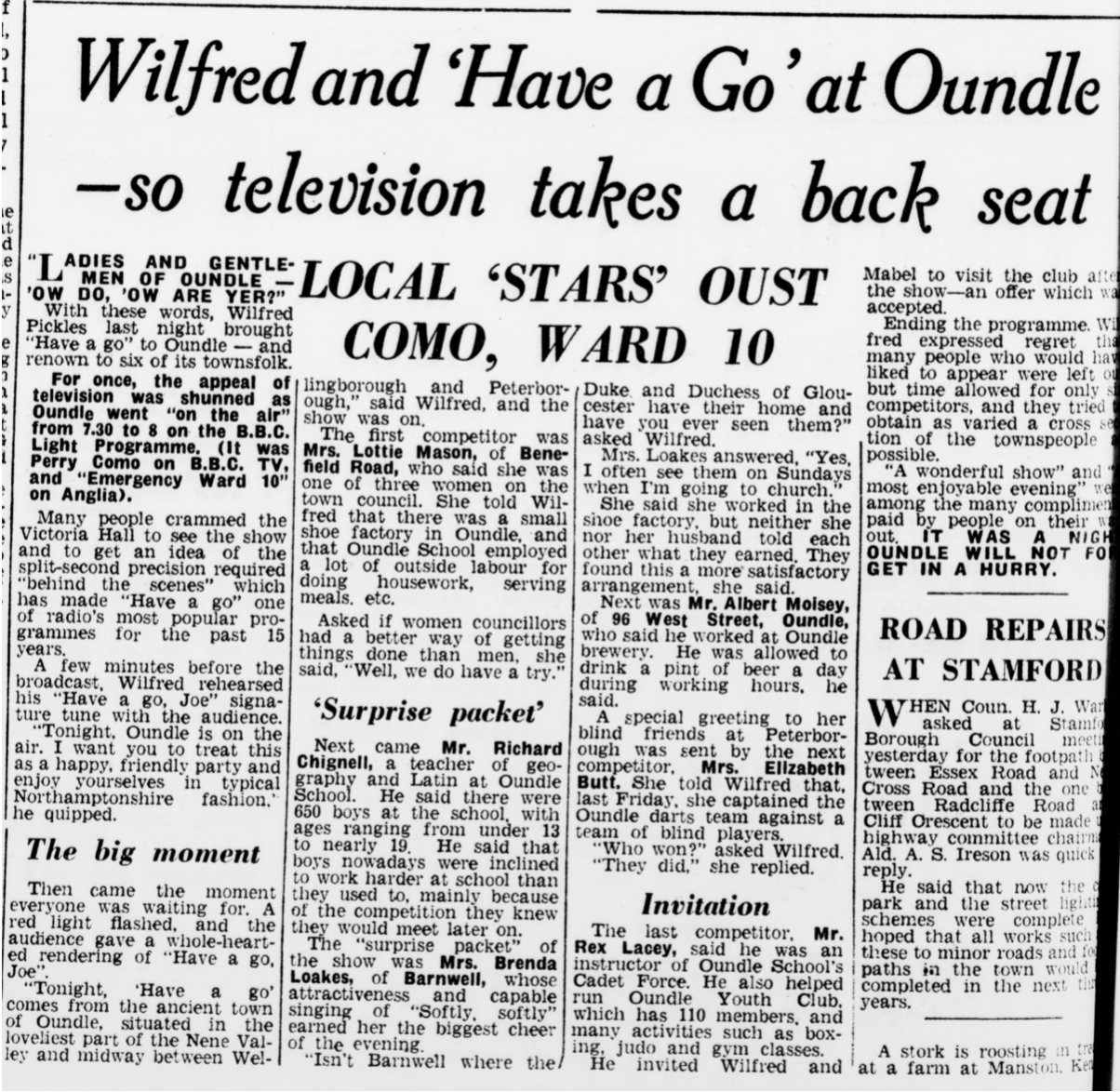
The report of the ‘Have a Go’ broadcast [3]
She arrived in the middle.
Ahead of her were five: Lucy, then Harriett and Gertrude, who had come together at Elton in February 1882, then William, then Eliza. Behind her would come five more, Agnes and Ann, twins arriving together in the summer of 1892, and then George, May and Rose [4]. Eleven in all, or twelve if the family's own reckoning is to be believed [5]. Elizabeth was the sixth, born on 27 November 1889 into a house at Victoria Yard where somebody was always small [6]. She was baptised at the parish church three weeks later, days before Christmas [7].
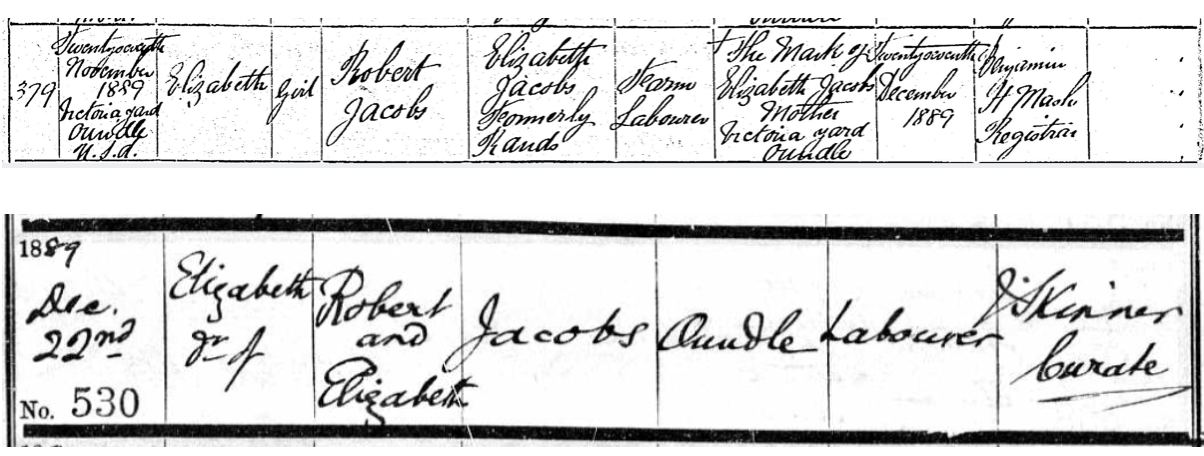
Elizabeth’s birth [6] and baptism [7] entries
The yard was one of the courts running back off West Street, a passage behind the chapel with the houses set along it. Seven households shared the ground that spring, and the last of them was the Victoria Beer House. Inkerman Yard was next door, Setchell's and Danford's opposite, each with its own cluster of families packed in behind the frontage. It was the part of Oundle where people lived several to a room and knew each other's business through the wall. At the top the street forked at the church, and the western road ran out past the cricket ground towards Benefield, where the Union Workhouse stood in its own grounds behind a wall [8].
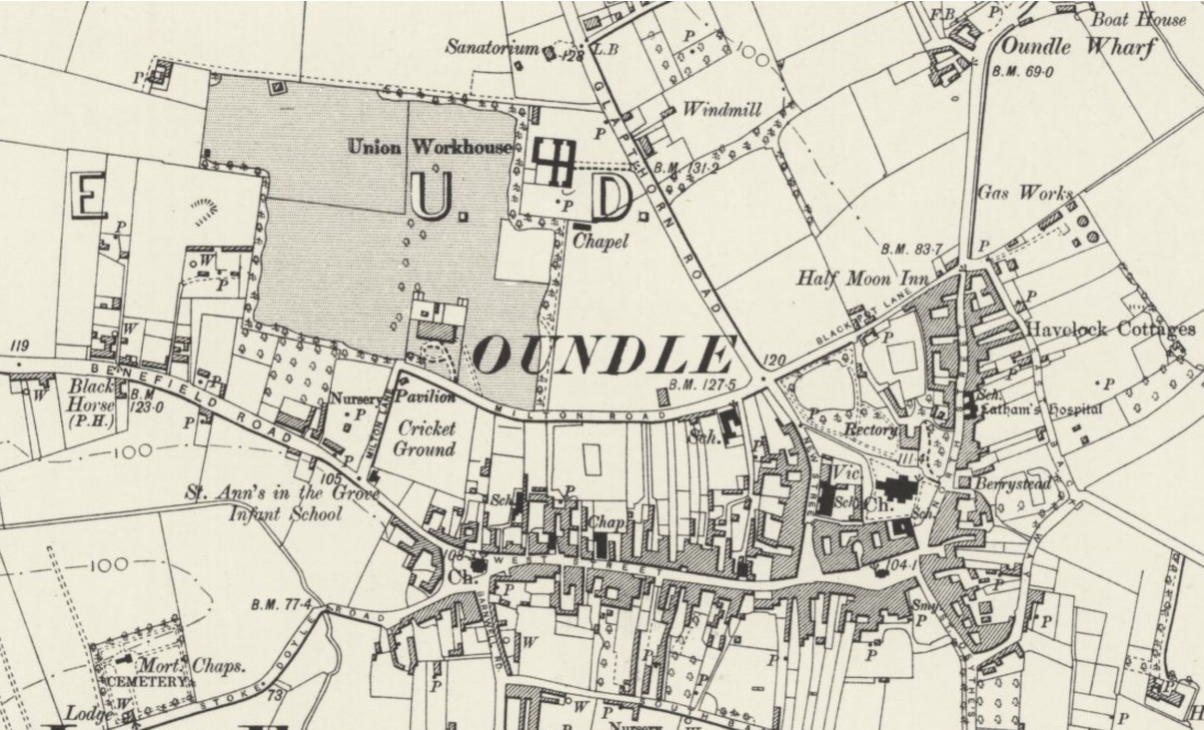
Oundle in 1899 [8]
Her parents had married at All Saints, Elton, in October 1877, both of them twenty years old [9]. The children came steadily after that and did not stop until her mother was forty-two, and every one of them had to be fed on whatever Robert could earn.
His trade shifted with whatever the district would pay for. The censuses catch him on the land at Elton in 1881, laying bricks at Oundle in 1891, and from the turn of the century on the railway, a platelayer for the London and North Western, walking out to Barnwell to keep the track sound. Farm work stopped in winter and bricklaying stopped in frost. The railway paid every week of the year, and he was still on the track at sixty-four [10].
What it did not buy was room. Three rooms in 1891, with five children under twelve inside [11]. Two more babies arrived, and by the turn of the century four of the older girls had left the house: Lucy married in 1900, Harriett and Gertrude gone into service [12], and Eliza to Elton, where her grandmother lived, and where she died of pneumonia in January 1901, at fourteen [13]. For a while that left Elizabeth the only daughter old enough to be any use with the small ones.
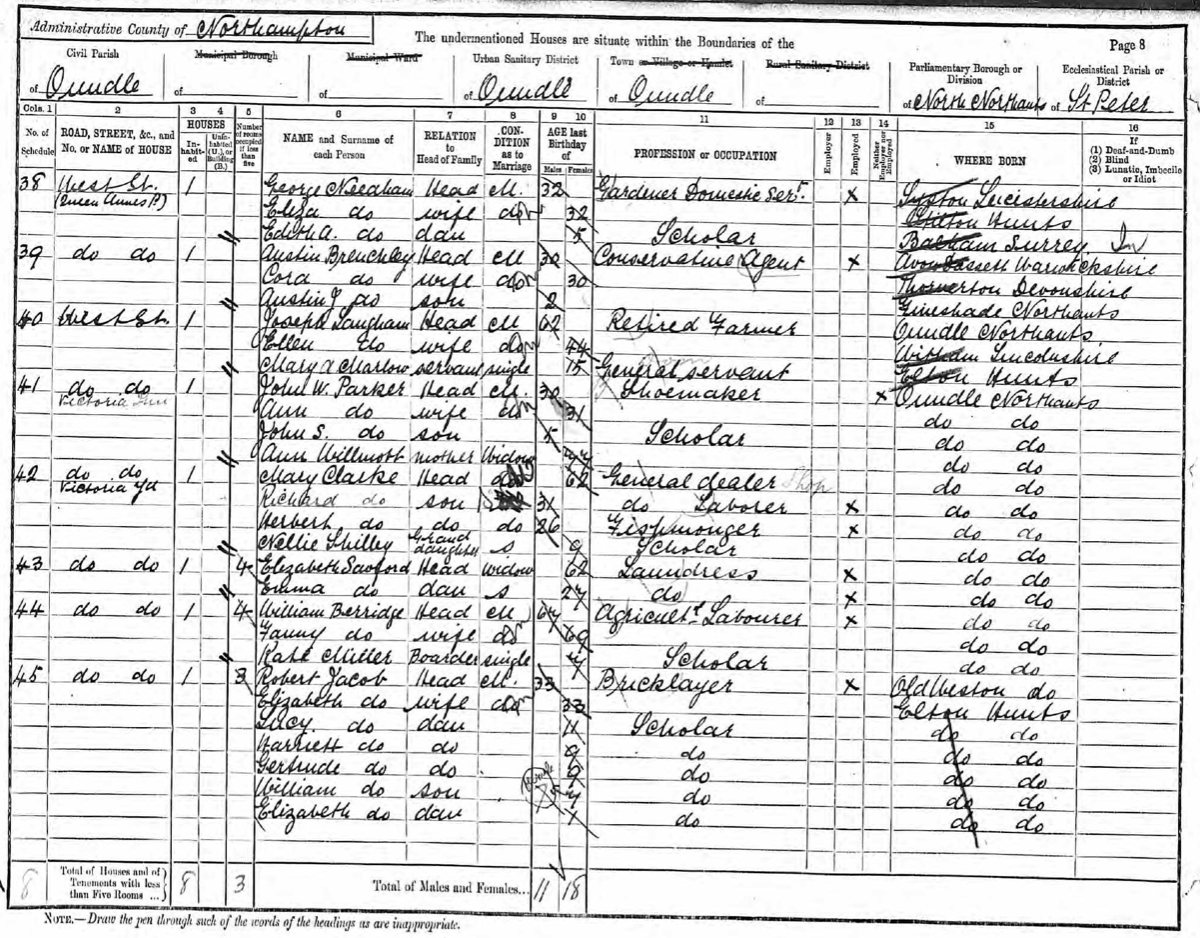
1891 Census [11]
By the spring of 1901 there were four rooms and eight people in them. With space at a premium, Elizabeth was not one of the eight [14]. She was on Benefield Road, in a house the enumerator recorded as a household of two. Emma Page, a 36 year-old charwoman from Flitwick, and Elizabeth Jacobs, Boarder, aged 11 [15].
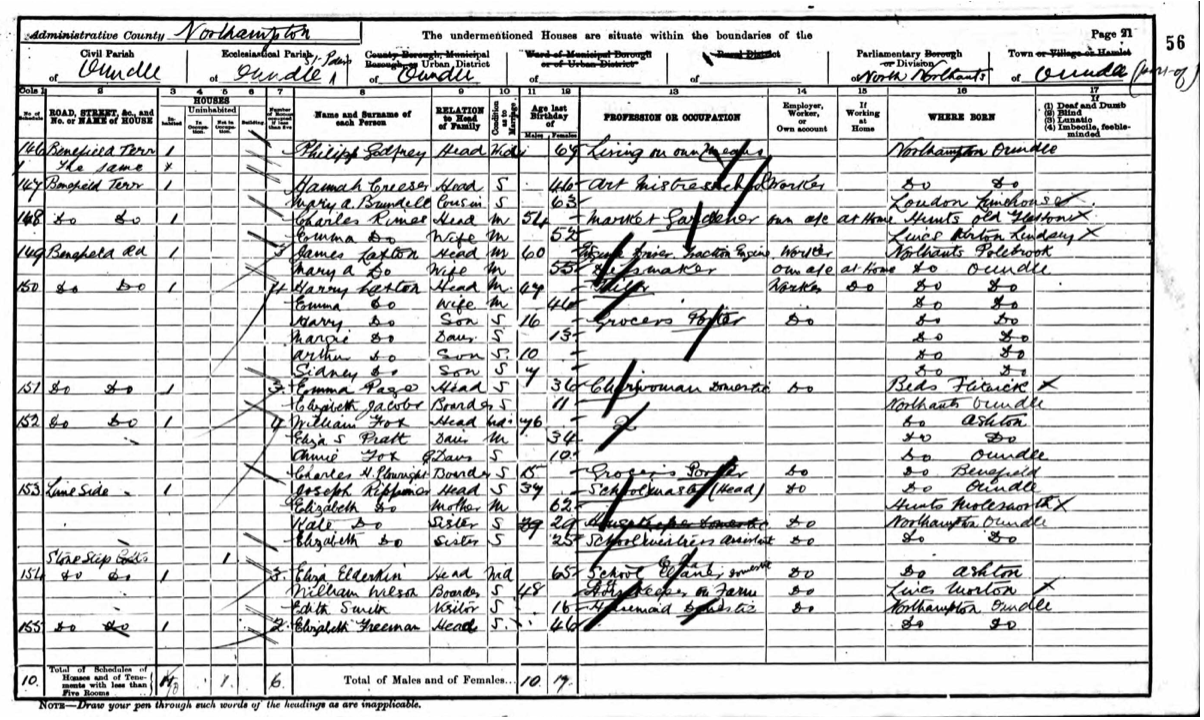
1901 Census [16]
Her parents were alive, in the same town, a few streets away, with a house full of her brothers and sisters. She was not an orphan and she had not been sent far. She had been sent to live with a woman who cleaned other people's houses for a living, close enough to walk home in minutes.
Eleven was too young for the service her sisters had gone into but old enough to be somebody's boarder. Nor was it remarkable on that street: in the next house along a fifteen-year-old grocer's porter was boarding with the Fox family [16]. Arrangements of this kind were private, made between one household and another rather than under the Poor Law. Why the arrangement was made, nobody wrote down, but it was only temporary. She was back at Victoria Yard by the time she married in 1909 [17].
On 2 August that year, at the parish church, she exchanged vows with Robert Edward Butt, an Oundle man of twenty-three who had worked since the previous year on the maintenance staff at Oundle School, looking after the power station [18]. Her brother and sister, William and Agnes Jacobs, witnessed [17]. The couple took four rooms in Morris Yard, off West Street, where the census found them in the spring of 1911: Robert twenty-four, a labourer in engineering at the public school; Elizabeth twenty-one, married two years, no occupation given [19]. Their first daughter, Violet Elizabeth, was born in February 1912 [20].
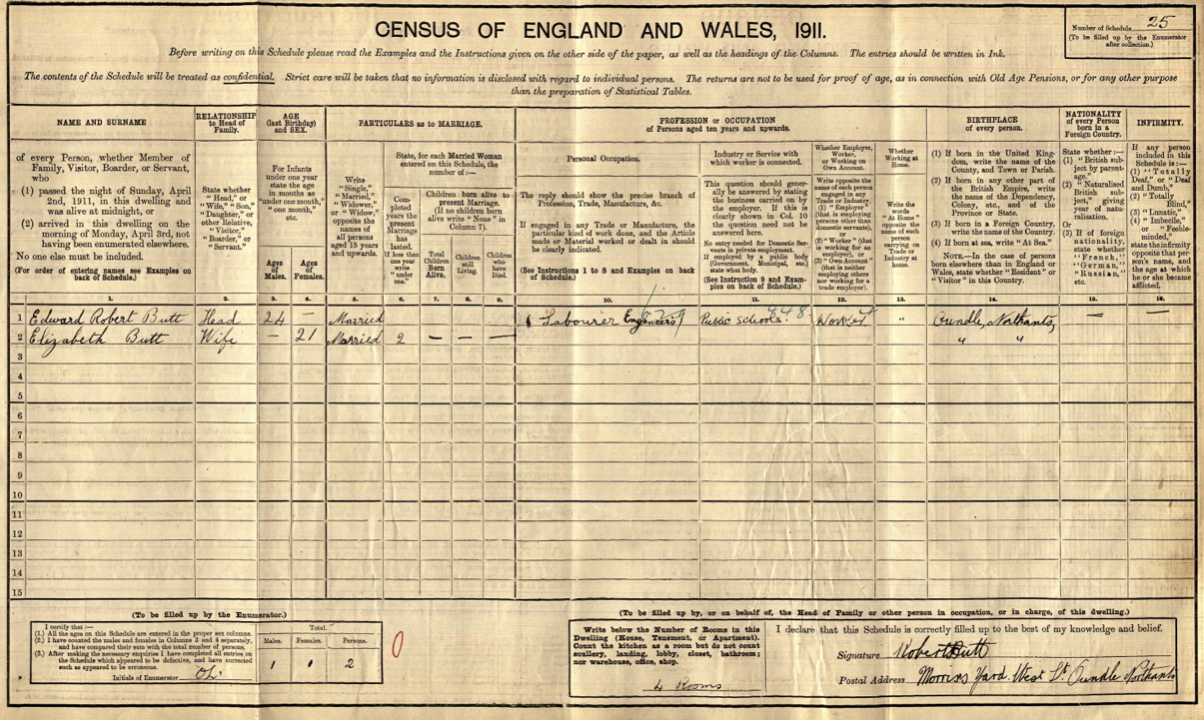
1911 Census [19]
She was pregnant with the second when the war came.
Elizabeth's younger brother George had gone out first, on 13 August, a boy of nineteen who had put down his mother's name as next of kin. Robert was a reservist, which meant he was recalled immediately when war was declared. By mid-September he was in the trenches at Troyon and within twenty-four hours of reaching the front line the German advance had taken him and four hundred and forty-three other men of his battalion [21]. On 24 October George was taken at Ypres [22]. Between them the two men had been in France twelve weeks.
Beatrice Olive was born on the 21st of October, three days before Ypres [23]. Elizabeth was twenty-four with a daughter of two and a baby at the breast. No husband, no brother and no word of either. The weekly papers came out with the men's names in columns headed Killed, Wounded, Prisoners, Missing, and her husband and her brother were in none of them [24].
As the weeks dragged on, missing stayed missing. It was not a verdict. A man reported missing might be found wounded, or a prisoner, or dead, or never accounted for at all, and the answer came at intervals of weeks or months, in a paragraph among other people's paragraphs, between a wounded man in a Bristol hospital and the funeral of a well-known tradesman. And then, in December, the Northampton Mercury reported under "Oundle: Military News" that the parents of Private Robert Butt, West Yorkshires, and of Private George Jacobs, Northants, both of them prisoners, had heard from their sons; that the men were well; and that they complained of not hearing from their friends [25]. Two months, and then a paragraph, and both of them alive.
Letters and parcels were sent to Friedrichsfeld near Wesel, wherever the German army had put Robert that season [26]. Another Oundle prisoner set it out plainly in the Peterborough Standard in the summer of 1916, on a card his parents were willing to see printed. He had been at Munster, acknowledging the Northamptonshire Committee's parcels as they came. Then he was moved. Keep writing to Friedrichsfeld, he told them, but we are at Windau in Russia, working on the railways, up at four and back at half past six, living on next to nothing, two thin blankets. It was a reprisal, he understood, for the way German prisoners were being treated. A man in the same camp wrote home that he would rather have been shot [27].
Things came back. A photographic postcard survives, sent by another prisoner to his own parents, with Robert in the group at Döberitz. From Friedrichsfeld came one of his own: printed by a Berlin studio and posted from the camp, Robert standing against a tree in a wood looking thinner than he had. It is addressed to Mr G. Butt, West Street. Neither is addressed to Elizabeth [28]. What passed between Robert and Elizabeth across four and a half years is unknown. Whatever did pass was read by other people first. Under the Defence of the Realm Act private correspondence was subject to censorship at the British end, and everything leaving a German camp was read before it left.
The war reached Oundle on the night of the 1st of October 1916. The order to take air raid action came to the police at nine in the evening and for nearly three hours nothing happened. At a quarter to twelve Inspector Cameron, standing in Station Road, heard engines coming up from the Huntingdonshire side. The Zeppelin passed the town on its left and went on west; near Rockingham it was fired on, turned north and let go ten incendiaries and seventeen high-explosive bombs into the fields around Kirby Hall and Deene, one of them close to the prisoner-of-war camp at Corby Tunnel. Nobody was hurt. Some telegraph wires came down. At every town in the county the lights had been put out and the special constables stayed on duty until the all-clear at twenty to three in the morning [29]. Twenty miles to the south-west, some ten minutes later, men at Wellingborough and Wollaston were watching another airship come down in flames over Hertfordshire, bright enough to read a watch by [30].
Elizabeth was a quarter of a mile away, from Station Road, with a girl of four and a girl of not quite two, no light, and a husband who had been in German hands for more than two years.
Robert's company went to Libau on the Baltic under the reprisal policy, and parcels were held back a month or six weeks at a time; when they were marched on to Latchen in February 1917 nothing came through until April, by which time more than fifty men had starved. Five hundred went in and seventy-two walked out [31]. She had no means of knowing any of it. What she knew was what the tin cost and how long it had been.
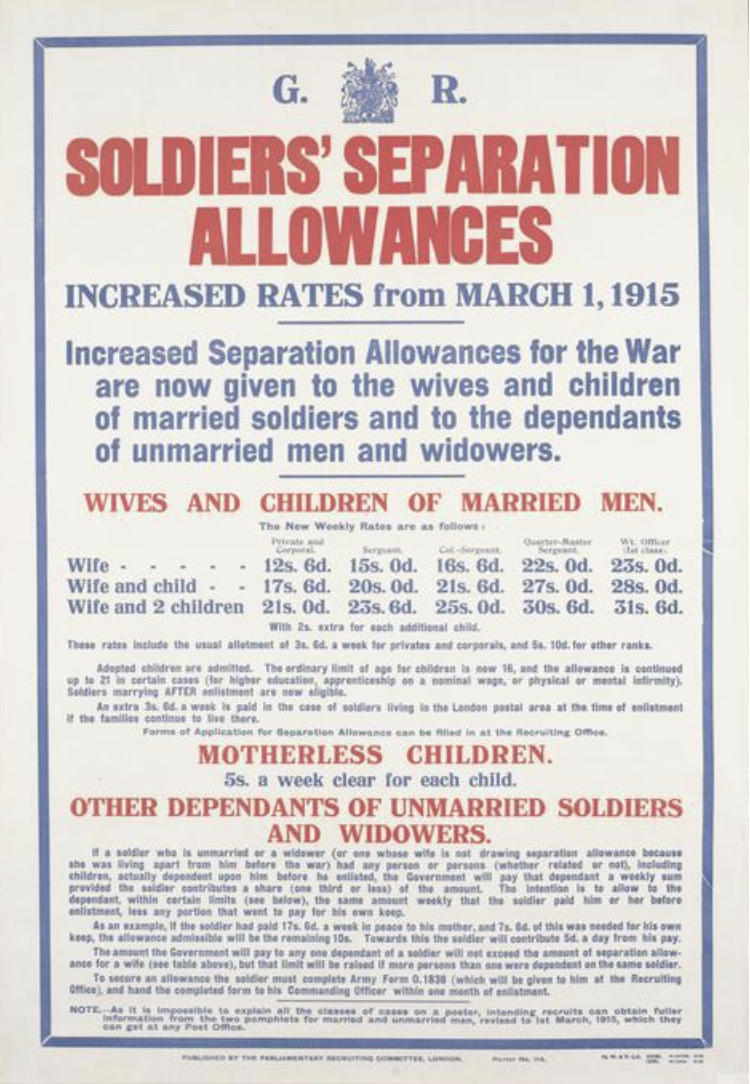
Soldiers’ Separation Allowances Poster [32]
With Robert’s continued absence, what she had was the separation allowance. As a reservist's wife she had been inside the system before the war began, one of about eleven hundred claims a year across the whole army; by that November there were half a million. A private's wife with two children drew 21s a week from March 1915, of which three and six was stopped from her husband's own pay [32].
Until that October it came monthly. After that it came weekly, drawn at the post office against a cheque book of thirteen sheets [33]. Nothing else about the four years was fixed. By the war's end the average working-class family was spending nearly twice what it had spent on food in 1914, and about three-quarters as much again on coal and light [34]. The allowance did not move. Everything it had to buy did: by 1917 a loaf cost twice what it had in 1914, and the bread itself had gone dark and hard as the flour was stretched. Coal was rationed by the number of rooms in the house, and she had four [35].
The town was sending parcels too, £33 for the Soldiers' Christmas Comforts Fund in the autumn of 1918, a hundred and twenty parcels to be despatched, with a flag day for the French Red Cross the same week [36]. Her parcels came out of the same 21s that fed the house. Two Oundle men died in German hands that year, one in August and one the day before the Armistice [37]. It is hard to imagine she read it without thinking of Robert.
Robert came home in January 1919, after four years and five months. Violet had been two when he left and was six when he came back. Beatrice he had never seen at all. Elizabeth had held the rent, the coal, the allowance book and the two children, on a fixed sum in a town where the price of everything moved, and she had answered to nobody about any of it.
What the house was like that winter nobody wrote down. Men came back from Germany and from France with things that had a name by then but no treatment worth much: tremors, amnesia, sleeplessness, nightmares. One of them, asked about it long afterwards, said the breakdowns came at night, that he used to spring up off the bed, and that it frightened his wife [38]. Robert had been more than four years in captivity and had walked out of a camp where most of the men who walked in did not. Elizabeth had no way of knowing what would come through the door, and no way of preparing for it. What it asked of her is not recorded.
What is recorded is the man the town knew for the next thirty years: someone who could tell a good story, usually with an amusing sequel, and who would start one if you stopped him in the street. He kept his letters from Oundle School’s Headmaster and showed them to people for the rest of his life [39].
Robert had been home nine months or so when Grace Ethel was born, on the 2nd of October 1919 [40]. Whatever the four years had cost, the marriage resumed. George came home too [41].
Baby Grace was only five weeks old when Elizabeth's youngest sister, Rose, died at the age of twenty [42]. Her symptoms would have begun with thirst and severe wasting, ending in a diabetic coma in the infirmary at Peterborough, fourteen miles off, a charitable hospital that charged those who could pay and treated the poor where it could. A diagnosis then gave under a year. The only treatment anyone had was to starve the patient, and it killed as often as the disease [43].
Eighteen months later the census was taken [44]. Of the ten brothers and sisters Elizabeth had grown up with, two were dead and most of the rest had scattered. Lucy was at Kettering, married and childless at forty-one. Gertrude was at Swineshead Bridge in Lincolnshire. William was at Tottenham, labouring for a horticultural firm out at Enfield Wash, with a wife and six stepchildren. George was at Orlingbury, keeping cows. Harriett was nearest, at Hemington four miles off, with six sons under thirteen. Two had stayed in the yard: Annie, unmarried at twenty-nine, keeping their parents' house, and Agnes, married to a labourer out of work [45].
And Elizabeth, in the middle of it, thirty-one, with three daughters and a husband in work, and in a trade.
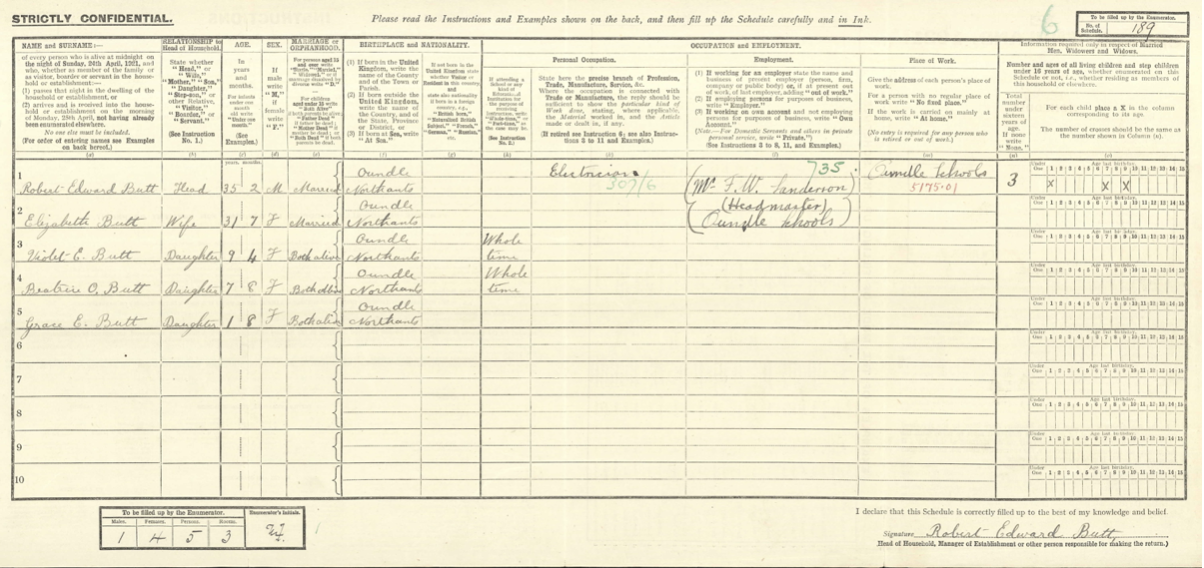
1921 Census [44]
The rest of the yard was in work, or looking for it. Samuel King was a general labourer out of work, living with his wife Ann and sharing their two rooms with her brother Edward Limmage, who kept horses for a farmer, and an adopted boy of thirteen. Alfred Mears was a brewer's labourer at Smith and Company in North Street, his wife Hannah a charwoman at Sydney House, their daughter of nine at school. Two Rawson brothers had houses in the passage: Charles travelled over to Thrapston as a grocer's shop assistant and kept eight people in six rooms; James, single at forty-three, was house porter at Oundle Schools and out of work, alone in three. Only Robert Lilleker, seventy-one, worked on his own account, keeping an inn, with two unmarried daughters in their thirties and a third who had come home widowed with a boy not yet two [46].
Three men out of work in eight households, one of them out of work from the school Robert worked at. Of the eight households in the passage, Elizabeth’s was one of the five with a wage coming in, and one of three with her own family in it.
The following autumn the household grew again. Eileen Dorothy was born at Victoria Yard on the 15th of September 1922, in the same three rooms, and Elizabeth registered her, as she had Beatrice and Grace before her [47]. It made six of them where the previous census had found five: Robert and Elizabeth, Violet at ten, Beatrice at seven, Grace not yet three, and the new baby.
By the time Eileen was born Elizabeth could vote. The question had come to Oundle years before, when she was still a young woman. The National Union of Women's Suffrage Societies, the constitutional wing of the movement, which worked by petition and deplored the window-breaking, held a meeting at the Victoria Hall. Millicent Fawcett came to speak, Lady Knightley of Fawsley presided, and the headmaster's wife sat on the platform. The next summer the pilgrims passed through on their march to London, twenty-five of them in red, white and green, setting out from Oundle for Thrapston. The town had its opposition too: the National League for Opposing Woman Suffrage met under Lady Margaret Proby. She told her audience that the great bulk of domestic women were silent on the vote, and that when the ladies were silent there was little to be said [48].
Both campaigns were led by women of a class above Elizabeth's, and both spoke about women like her rather than to them. The suffrage platform was the town's respectable wives; the silent domestic women the League invoked were the ones in the yards.
A decade on she had the vote, though a partial one. When Parliament first gave women the vote, in 1918, it gave it only to those over thirty, and only to those who or whose husbands held property; younger women and many poorer ones got nothing. The age bar was deliberate. The war had killed so many young men that a vote at twenty-one, the age men had it, would have handed women a majority of the electorate [49]. So Elizabeth voted in her thirties, at 2 Victoria Yard, and she voted not quite as herself: she was entered through Robert's occupation, a wife qualifying on her husband's standing, which was how a married woman voted then if she voted at all [50]. The equal vote came in 1928, when Elizabeth was thirty-eight and Violet sixteen. On the register for that year she was still entered through Robert; on the next year's, the first drawn up after the law changed, she stood in her own name. Their daughter would have it before she was old enough to use it. Whether Elizabeth ever went to a poll, nothing is recorded.
One photograph survives from the years that follow, kept by a descendant of the family. Four of the family stand on the drive outside the Science Building on Glapthorn Road, the block the school had put up in 1914 [51]. Elizabeth stands with gloves in hand beside one of her daughters, too old to be Grace or Eileen and most likely Beatrice, though the print gives no names.
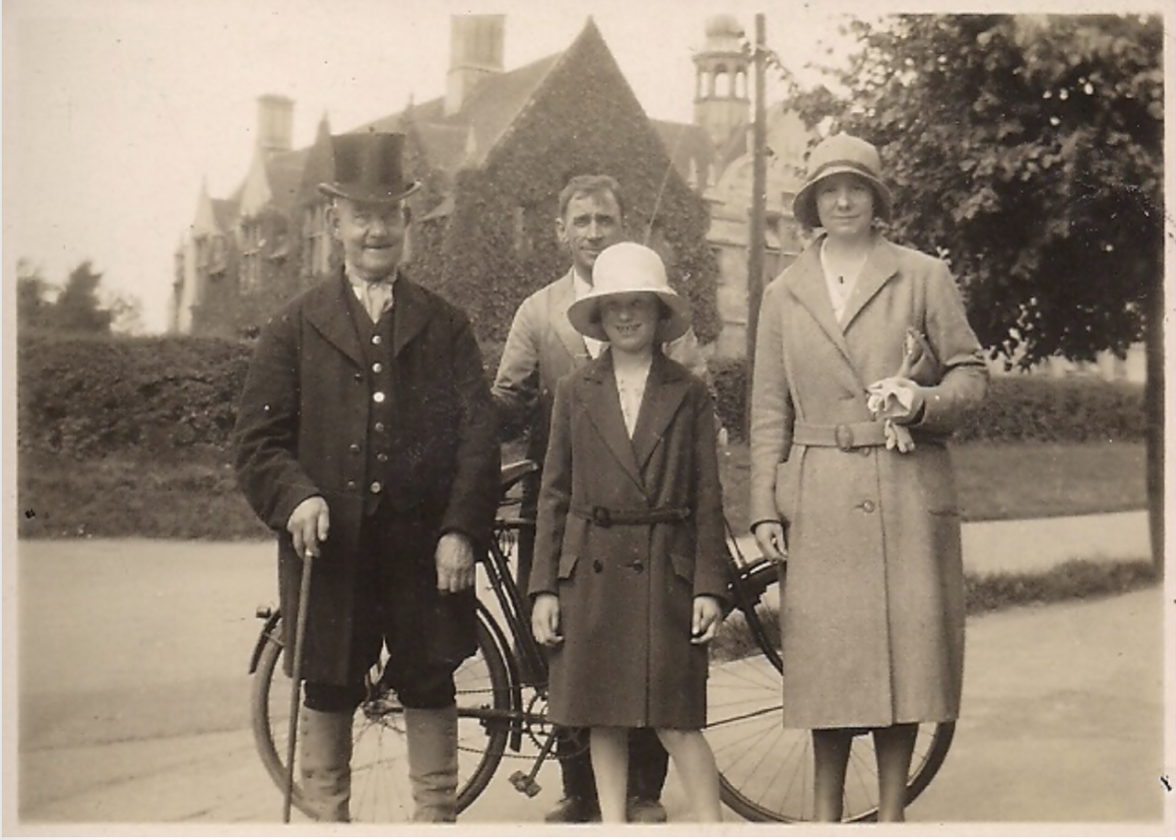
Robert Butt (centre, rear) and Elizabeth (right) with one of their daughters (centre, front), outside the Science Building, Oundle School, c.1920s [51]
After that little else survives. Robert kept the power station and Elizabeth kept the house, and for the better part of a decade nothing about either of them reached the papers.
The first sight of the two of them together in the town's life is in April 1930, at the Club and Institute: eighty-four players at a whist drive, and the knockout won by "Mr. and Mrs. Butt” [52]. She was forty. The daughters were growing up: Violet eighteen, Beatrice fifteen, Grace ten, Eileen seven. It is one evening in the decade, and it shows an ordinary life: a married couple out at cards, winning.
Two years later, when Elizabeth was forty-two and her youngest daughter just ten, a fifth child came, and the first son. Robert Edward was born on the 2nd of October 1932, the last of them, ten years behind Eileen [53]. The family was complete.
She had registered him herself, as she had registered Beatrice and Grace and Eileen before him. Only Violet, the first, had been entered by her father, in the spring of 1912, before the war took him away and gave the task to her [47]. It was a small administrative habit, kept up across twenty years and five children, and it would fall to her once more, three years later, for both her mother and her father.
In the spring of 1935 her father died, and six weeks later her mother.
Robert Jacob went first, on the 13th of May, at seventy-seven, of myocarditis [54]. He had been unwell for months. A death notice called him an old railwayman and recorded that he had been in ill-health for some time before the end [55]. Elizabeth was in the same yard, raising her own family, and had been near her parents for years. It was she who registered the death, the day after it happened, giving the cause and the age and her own address to the registrar. A daughter doors away from a father in months-long decline, and the one who went to report his death, is not likely to have stood aside from his care in the months before it; everything else known of her says she did not.
The funeral was held that Friday, the first part of the service at the parish church, and the paper set down who stood at the graveside: his two sons, William and George; his four daughters, entered as Mrs. H. Coles, Mrs. R. Butt, Mrs. T. Pridmore and Miss A. Jacob; two sons-in-law; two grandsons; and a friend [56]. Mrs. R. Butt was Elizabeth. She was there, one of four daughters among the mourners, and the record for once places her in a room rather than at the foot of a form she had signed.
One name is not in the list. Elizabeth Ann Jacob, his wife of fifty-seven years, does not appear among the mourners at her husband's funeral. She was alive that Friday but she only had six weeks left.
She died on the 24th of June, also seventy-seven, of senile decay, certified by the same doctor who had certified her husband [57]. Elizabeth registered this death too, as she had her father's six weeks before, and as she had her children's births before that.
Both her parents died at 1 Glapthorn Road. Neither of them lived there. The address on each certificate is the place of death, not of residence, and both are separately recorded as of No. 4 Victoria Yard, the court Elizabeth had been born in6. Glapthorn Road had been home to the Oundle Union Workhouse. The block they now died in was its infirmary, put up in 1901 for the sick [58]. The Local Government Act had made the institution, five years before, the district's Public Assistance institution, though the Ordnance Survey still marked it the Poor Law Institution, and it did the work a workhouse infirmary had always done. It was the place a person was taken who was dying and could not be nursed at home, because Oundle had nowhere else to take them [59].
Elizabeth gave her own address, on both registrations, as No. 2 Victoria Yard. Her parents were at No. 4. She was just doors away.
On a Tuesday in May 1938, the Women's Institute organised a house-to-house collection for the British Empire Cancer Campaign, and the paper printed the names of the women who had walked the streets, tin in hand, collecting. Twenty pounds and fifteen shillings was raised. The second name on the list, after Mrs. Fox, is Mrs. R. E. Butt [60]. For nearly fifty years the record had carried her along: a child in a crowded house, a boarder, a wife, a mother, a woman holding an allowance book steady while the price of everything increased. Here she steps out on her own account, to do something for people she did not know. She was not asking to be noticed, but someone thought it worth the ink. From here it does not stop.
A year later, in May 1939, she was out with a tin again, and this time the cause had a shadow over it. The Mothers' Day house-to-house collection was for the Earl Baldwin Fund for Refugees, the national appeal for those fleeing Nazi Germany and Austria; it was carried through by a committee representing every women's organisation in Oundle, Elizabeth among them. The town raised £16 6s. 2d., and £33 with the villages [61]. Twenty years earlier she had sent parcels into Germany to a husband the Germans were holding; now she went door to door for the people that country was driving out. She was collecting in a town that had buried its share of the last war, among women who knew what a German war cost.
It was not an abstract worry that spring. In May a textile workers' union leader told an audience to be ready for war. In the same weeks a mobile police post was approved for Oundle against the coming emergency, the county sanatorium at Creaton was reported to be adding beds and staff, and the town's own Territorial company, B Company of the 5th Northamptonshire Regiment, put on a public demonstration of modern infantry weapons to bring in new recruits [62]. The refugee appeal and the preparations for war were running in the same papers, in the same weeks, in the same town. And in her own house the last war with Germany was not a headline but a memory: a husband four years in a prison camp, a brother taken at Ypres, both of them home from Germany. Whatever was said over the dinner table that spring, it was said by two people who knew exactly what the word meant.
In the middle of it, on an evening in that same May, she played darts. The Oundle Women's Institute team beat Cogenhoe seven games to three in the final of the county competition, at Northampton; Elizabeth was in the team, and Mrs. Laxton was its captain [63]. It was not a new pastime. The Institute had run a darts club for years, distinct from the general membership, and she was in the competitive half of it, the team that travelled and played to win [64]. A good evening out, in a spring that was running short of them. She would still be on that team a very long time afterwards.
Three months later the country was at war.
On the night of the 29th of September 1939 the government took a register of the whole civilian population, house by house. It was not a census. It was a war measure: the record from which identity cards were made, ration books issued once food was controlled, men called up, labour directed, and the movement of an evacuated population tracked [65]. Nearly everything the next six years would ask of a household in Oundle was already implied in the taking of it.
At 113 Benefield Road the enumerator found seven people. Robert, electrical engineer. Elizabeth, unpaid domestic duties, and beside her name, in the column for war work, Women's Voluntary Service, First Aid. Their daughter Grace, married to Arthur Ball of Kettering [66]. And two schoolgirls, sisters, Louisa and Jessica Gates, fourteen and eleven, both born in Islington, three weeks into a war that was emptying London of its children. And the two youngest of the house, Eileen at seventeen and Robert at six [67]. Elizabeth had joined the Women's Voluntary Services and trained for a first-aid post before the enumerator ever reached the door, and she had two London children under her roof.
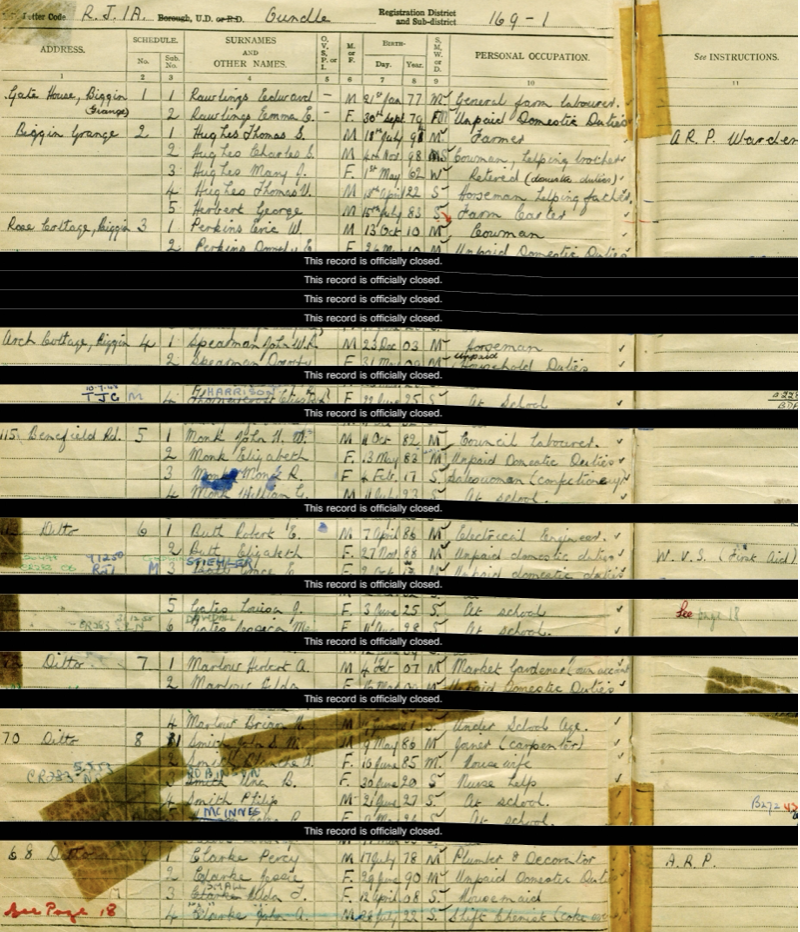
1939 Register [67]
Benefield Road was signing up house by house. There was an air raid warden at Biggin Grange, and another a few doors down at number 68 [68]. The road was quietly organising itself for a war, one household at a time, and her volunteering, which for years had meant occasional collections, was becoming a daily thing.
She was not the only one in the family who signed something that autumn.
The same register that found Elizabeth at Benefield Road found her eldest daughter in Hampstead. Violet was twenty-seven, single, working as a lampshade maker, and against her name, in the same column that carried her mother's first-aid post, stood the Women's Land Army. Her enrolment card gives the second of October as her start date, three days after the register was taken, so she had already put her name down when the enumerator called. She resigned on the twenty-sixth of January 1940, not quite four months on. The card gives no reason [69].
So the register caught the two of them on the same night, at either end of the same evacuation. In Oundle, Elizabeth had taken two London children into her house, out of the city the government was clearing of its young. In London, her own daughter had stayed. What passed between mother and daughter that autumn, if anything did, is not recorded.
What Elizabeth did in the Women’s Voluntary Service (WVS) is not recorded either, not under her own name. What survives instead is the record the centre kept of itself. The Oundle WVS centre's monthly narrative reports run from that first September through to the end of the war [70], written by Ruth Cartwright, the centre organiser, from the Vicarage, and sent to headquarters at 41 Tothill Street, Westminster.
They do not name Elizabeth. They do not name anyone below the organiser who signed them, anywhere in the country, for the whole of the war [71]. That silence is not an accident of Oundle's paperwork. It is the shape of the organisation. The WVS was proud that its members were, in the words of a Ministry of Information film, unspectacular women doing unspectacular jobs, and it kept its records accordingly [72]: a monthly form recording pies, knitting, hampers and lectures, signed at the bottom by typically prominent local women. Leadership of the service was overwhelmingly middle-class, and Oundle's fitted the pattern exactly, Cartwright writing from the Vicarage, Mrs Glover the county organiser from the stables at Pytchley House. The membership was not. The recent work on the service argues that its very practicality, local, specific, undemanding of speeches or subscriptions, made it a way into public life for working-class women [73]. Elizabeth had been boarded out with a charwoman at eleven. In 1939 she put her name to a national organisation, trained in first aid, and was counted.
The reports cannot tell what she did on any given Tuesday. What they can tell is what the women of her centre were doing, in a town of under three thousand [74], in the months and years her name was on its books, and there is no month in which the answer is nothing.
That September, almost every member spent the month preparing for evacuation, setting up houses to receive the children. The arrival was cancelled at three hours' notice. The Hospital Supply Centre started the same month, and it would still be running four years later [75].
In October there were five canteen lectures and eight nursing lectures, with extra meetings for practical work. And on the Friday afternoon of the 27th, the Duchess of Gloucester came to the WVS headquarters at 35 West Street [76].
She arrived soon after three, dressed in pink, with the Hon. Miss Meysey-Thompson, and was welcomed at the door by the centre organiser, Mrs. J. L. Cartwright, and inside by the chairman and clerk of the Urban District Council. This was not ceremonial tourism. Barnwell Manor, a few miles up the road, was the Gloucesters' own house, and the Duchess was a working member of the WVS, not a distant patron of it, seeing her people [77]. In a committee room made cheerful with plants and flowers, Mrs. Cartwright introduced the heads of the centre's work, the canteen, the nursing, the hospital supply, the report centre, a dozen women in all, among them Mrs. A. Laxton, who many years later would still be captaining the Institute darts team Elizabeth played in. The Duchess asked about the evacuee children and their billets, the canteen, the nursing lectures, the hospital supply work and the report centre. Then she went out to the back of the house, where about seventy members were assembled, and walked slowly round, stopping to talk to many of them. She left to cheering [78].
Seventy women in the garden of a house on West Street. Elizabeth was on the centre's books that autumn, and it is hard to think she was anywhere else that afternoon.
The visit was one of four the Duchess made to the district in five weeks. Earlier in October she had come to inspect the ARP first aid points and personnel, the ladies' casualty section, ambulance men, nurses and drivers, and said afterwards that she was agreeably surprised a small town should have such a good turnout and so many volunteers [79]. Two days before she came to West Street she was at Apethorpe, and in the middle of November she was out again round the village posts of the rural district, Ashton, Polebrook, Lutton, Hemington, finishing within sight of her own house at Barnwell, in the Rectory kitchen, which turned out to be the kind of room that suited the treatment of air raid casualties [79].
Elizabeth's own registered duty was first aid. A photograph survives of the Apethorpe post, taken on the October tour: five women lined up in white wrap-over overalls, a dark enamel badge at the lapel, a sixth woman playing the casualty on a stretcher with her head bandaged, and the Duchess in a dark coat and hat at the centre of them. Nobody in it is from Oundle and none of them is Elizabeth. But the overalls are the ones the WVS had introduced the previous winter, the badge is the Civil Defence lapel badge issued from February 1939, and the tableau, a first aid post, a pretend casualty, a royal visitor working down the line, is the thing she had registered herself to do, photographed five miles from her house in the month she did it [80].
Members bought their own uniform. The overcoat and felt hat came first, in June 1939; the tweed two-piece, the maroon blouse and the white wrap-over overalls followed later that year. Not everyone could afford them, and from the summer of 1940 there was a plain green armband with W.V.S. stencilled on it in red for the women who could not. From February 1944 members were allowed a service chevron for each completed year, and those who had no uniform could sew them onto the armband instead. She had joined in 1939, and nothing records her leaving; a member who served the war through earned five chevrons [81].
In November a second course of home nursing lectures was laid on for the women who did not want to sit the examination. It is the category her own Register entry falls into. Members were providing for soldiers in temporary quarters, and the knitting parties were sending their work out to fifteen different official centres [82]. In December the WVS combined with the WI to run a Christmas party for the evacuees and every child in Oundle; a film shown in Oundle School's Great Hall made a net profit of about £15 for wool for the work parties; and keep fit classes were arranged for the evacuees through the holidays. In January 1940 they gave a party for the foster mothers, and the centre collected books, periodicals, cards and puzzles for the hospitals, three hundred by February, sent to men in hospitals and homes across Northamptonshire [83].
In February Beatrice married Sergeant Harold Orton, a dental mechanic [84]. The wedding was arranged around her fiancé's leave, at Wilby parish church, on a Sunday afternoon, the Rector officiating. Surrounded by family, Beatrice was given away by her father and attended by her sister Eileen. The best man should have been the bridegroom's brother, but he was with the Royal Engineers in France, so a member of Wilby Cricket Club stepped in. The report of the wedding does not mention Elizabeth. She was there; she is simply not in the paper.
That same month, of the two hundred and fifty evacuees billeted in the town, about sixty remained, and the work took other forms: a girls' club for the evacuees, communal feeding by the council school's domestic science classes, anti-gossip posters distributed for the Careless Talk campaign, easy chairs collected for the ATS, arrangements to receive the homeless at Glapthorn Road Hospital casualty ward, dancing classes for soldiers, chloramine dressings prepared and wrapped by one work party and sold at a halfpenny each through the town and the schools, and knitting counted by the hundred, five hundred and seventy garments dispatched by April, four hundred and sixty more in June [85]. In April the centre offered to help the Urban District Council with salvage and was told it would be too expensive to do anything. The following month the council arranged the paper collection anyway, and the women did the baling [86]. It was similar work to that she had been doing since before the war, going house to house for a cause, cancer one year and refugees the next, and it was the work she would still be doing as an old woman, with a poppy tin in the cold. Salvage was only the wartime name for it [87].
Then, in September 1940, over two thousand children came through in a single month and were given tea and buns on arrival, two hundred kept in Oundle, the rest sent out to the villages. To the report it is a number. To Elizabeth, who had had two London children at her own table in the war's first weeks, it was not a number at all. Clothes were collected for the evacuated mothers expected with them. They did not come. By October the WVS had equipped and cleaned a canteen for the Forces with the RASC's 704 Company, open six to ten every evening and three to ten at weekends, serving teas and hot suppers, running it and doing the catering. Glapthorn Road Hospital was taken over by the military, and members went in to do the sewing [88]. That same month the Urban Council heard that Oundle now had three hundred official evacuees. The chief billeting officer reported on the hostel in Stoke Road, the only evacuation hostel in the whole county open to receive children, and paid tribute to the voluntary help given by the town's women for its first three weeks. It was short of furniture. A councillor offered a quantity of chairs. The rest of the meeting dealt with the Spitfire Fund, a list of volunteers for the decontamination and rescue party, the wages of nine manual workers, and the resignation of the chief air raid warden on doctor's orders, the new one being D. A. Whitwell, the first aid commandant who had piloted the Duchess round the villages the previous autumn [89].
All of it landed on the same few hundred households, hers among them. One small council, one Monday evening, and on the agenda: three hundred displaced children, a fighter aircraft, decontamination, and who would be in charge if the bombs came.
By the end of 1941 the centre had baled over thirty tons of waste paper in the year, the house-to-house collecting turned into a figure you could weigh. The canteen was open every day from three until ten, and right through the night when there were manoeuvres at the weekend, feeding and bedding the Forces and the Home Guard; it once served tea to the entire cast of the RAF pantomime. Twice that winter, in the blackout of November and December, the members practised receiving the homeless at the Rest Centre, some thirty-two of them, some on duty and the rest playing the refugees. Oundle was never bombed, and the Rest Centre never had to open for real. But the work it rehearsed was the work she had put her name to in 1939 [90]. And in the middle of that year of paper and drilling, at one Institute meeting, Elizabeth won the prize for the best vegetables from a member's own garden [91], a small domestic victory in a spring that had little else to spare.
While the emergencies stayed rehearsals, the ordinary work never let up. Mostly it came down to food. The Institute taught the domestic science of shortage: at one wartime meeting Elizabeth was among the hostesses while another member demonstrated how to make the most of rations [92]. And it was the Institute, in January 1942, that had a telegram of thanks after sending its good wishes to the Duchess of Gloucester's baby son, signed, with the informality of a near neighbour, "Alice", the same Duchess who had walked the back garden at West Street in 1939 and was by now a member of the Oundle sewing party herself [93]. From the beginning of 1943 the Pie Scheme carried hot meat pies out to people working land too far from any canteen to be fed otherwise, and it ran on a familiar division of labour: the WVS baked and the WI sold [94]. Elizabeth was in both, on whichever side of the counter the pies were on.
The rest of it was the ordinary machinery of a centre that never stopped: socks mended for the Forces by the hundred, meals cooked for the Home Guard's camps at Lilford, a "Gas Play" put on twice to show people what to do in a gas attack [95]. None of it has her name on it, but all of it was her sort of work.
By 1944 the town centre had seven WVS Houses standing ready, two pool cars and seven drivers, and thirty fully trained members, in a town of under three thousand people. The seven houses were Oundle's Housewives' Service, and Cartwright said as much on a scrap of paper clipped to a report, answering some query from London: the Housewives' Service consists of WVS houses only, which function only in an emergency. Elsewhere the scheme ran to hundreds of houses in a single town, each with a red WVS card in the window, each with a first aid box, each ready to take in the bombed-out and give them tea and a blanket. Oundle had seven, and each held six wrapped antiseptic bandages and a first-aid booklet the members had made themselves at the start of the war. It was a small town's version of a national scheme, and, like the Rest Centre, it was thankfully never called on [96].
The centre practised with stirrup pumps on the Vicarage lawn. The members cleaned the Rest Centre themselves each month when the district staff could no longer manage it, and found the bedding filthy. And when the salvage drive came round, they went to every house in Oundle, and the town tied for first in the county; the council gave the WVS a £5 prize, and they spent it on overalls, because paper baling is dirty work [97]. It was the same going door to door she had been doing since before the war.
That April the Institute met and made Elizabeth a delegate, and the primroses and violets she had gathered and arranged were sold for the Prisoner of War Fund [98]. She knew what that fund was for better than most of the women in the room. Thirty years before, Robert had gone into a German prison camp in the first weeks of a different war, and she had spent four years sending parcels east into a silence that rarely sent anything back, not knowing for months at a stretch whether he was alive to receive them. The fund existed for the wives and mothers on the far end of that silence now. She gathered the flowers, arranged them, and let them be sold.
Then, in July, the Rest Centre that had never opened for real opened at last. It took thirteen mothers and thirty-one children from the bombed areas of London, at very short notice, for six days, and fed and housed them. The mothers wrote afterwards to say what it had meant; the letters are mentioned in the report but do not survive with it. She had taken London children into her own house in the first weeks of the war. Now the war sent London mothers [99].
In the early weeks of 1945 the centre took an empty shop in the middle of the town and set about collecting for two London districts. The county had adopted Beddington and Wallington, two bombed-out boroughs on the southern edge of London, and Oundle set out to furnish them. The women stopped everybody they knew and asked for goods or money. Passers-by went into the nearest shops and bought a cup, a jug, a casserole, a teapot, and handed them over. Others gave money and the organisers did the buying. Five hundred and sixty articles were collected, and the Northampton Mercury put Oundle on its front page as an example to the rest of the county [100]. It is the plainest surviving picture of what the work looked like: a group of middle-aged women standing in a Northamptonshire street in January, asking strangers for crockery, for people three counties away they would never meet. It is also, exactly, the thing Elizabeth had been doing since 1938, the tin held out, the door knocked on, the cause someone else's. Only the county on the label had changed.
The Forces canteen, the biggest single thing the centre did, did not so much close as run down. It was open every day from three until ten at the start of 1945, appreciated most, the organiser noted, by the wounded soldiers. By the summer it was quiet, the troops gone from the town, the working party meeting three times a week and getting ready to stop. Some of the members went to help the British Legion with its Welcome Home Fund, for the men coming back. In November the Institute held a party for the canteen's past and present helpers, at the same meeting where it made her its press correspondent. Elizabeth was there for both: thanked for the work behind her with one hand, handed the next job with the other [101].
So the war that the narrative reports describe, the canteen, the evacuees, the Rest Centre practices in the blackout, was one she worked through with a husband still at Oundle School, a daughter in the Land Army, a daughter newly married to a soldier, a third daughter of seventeen, and a son of seven at home. None of that is in the record of the work, and neither is she.
The war ended, and one thing she had been doing did not stop. Somewhere in those years she had taken on the canning centre, and she ran it. That was not jam-making. The Institute had gone into food preservation on an industrial footing in 1939, when its headquarters bought sugar direct from the Ministry of Food to stop a bumper fruit harvest rotting; from 1940 the sugar was controlled, everything preserved and sold had to be recorded, and preservation centres were set up in the villages and near the orchards. Canning was the specialist end of it, learned and practised, because a faulty can could explode. Six mobile canning vans were given to the Institute by the American Federation of Business and Professional Women to carry the skill round the country [102]. Elizabeth ran Oundle's, the licensing, the sugar allocation, the records, the equipment, the women, for years, and was still being introduced by it in 1947, when the county's press correspondents were taken round the Mercury offices in Northampton and she made the longest journey of any of them, by train from Oundle, where, the note beside her name said, she had organised a canning centre for some years [103].
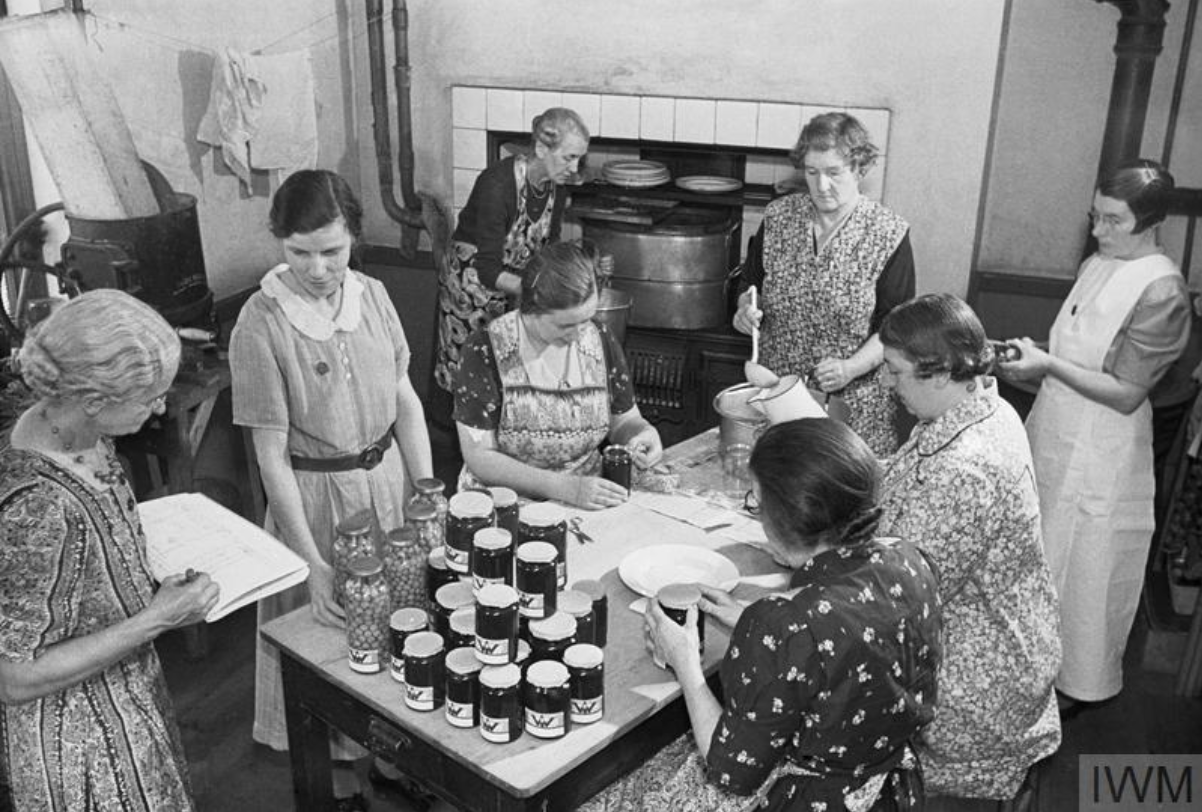
Women's Institute members at a jam-making centre. Image: IWM (D 4857) [104].
That was the shape of it. Elizabeth had come into the WVS in 1939 as a woman who had been boarded out with a charwoman at eleven, and she came out of the war having run a licensed food centre for years, sat as her Institute's delegate to the Albert Hall, and been elected its press correspondent. The record still would not follow her from one Tuesday to the next. But it had stopped being able to lose her.
Robert retired from the school's power station in 1949 [105], after forty years, and for the first time there was a husband in the house through the working day. It closed something in his life outright. Nothing closed in hers. She had been on the Oundle team that beat Cogenhoe at Northampton back in 1939, and seven years after Robert's retirement, in June 1956, the Legion Women's Section decided to form a darts club. Elizabeth won a competition the same evening it was founded [106]. She was sixty-six, seventeen years on from that county final, and whatever she had kept up with a dartboard in the years between, competitively or otherwise, the game had not left her. The year that followed ran through the same rooms and the same Whit Mondays: in June 1957 she ran the darts stall at the Legion's garden fete [107], in September she carried off a prize at the branch's monthly social, where every member had been asked to tell an amusing holiday story [108], and in November she was among the winners at the annual whist drive for the poppy fund, sixteen tables in play and nine pounds raised [109]. None of it was a new life starting late. It was the old one, still being lived, with a dartboard in it now as well as a collecting tin.
In July 1954 she and Robert went down to Portsmouth to see their youngest son, Robert, married to Brenda Dorothy Pluck at St. Cuthbert's Church, Copnor [110]. A photograph of the day survives: the wedding party gathered outside the church door, upward of a dozen people, the bride at the centre in a full veil and a tiered gown, two flower girls in identical pale dresses in front of her. Robert stands near the back, second from the left, thinner and more careful in his bearing than the younger men around him. Elizabeth is in the middle row, third from the right, in glasses, a hat, and a corsage. It is one of the few times that the record shows her leaving Northamptonshire at all.
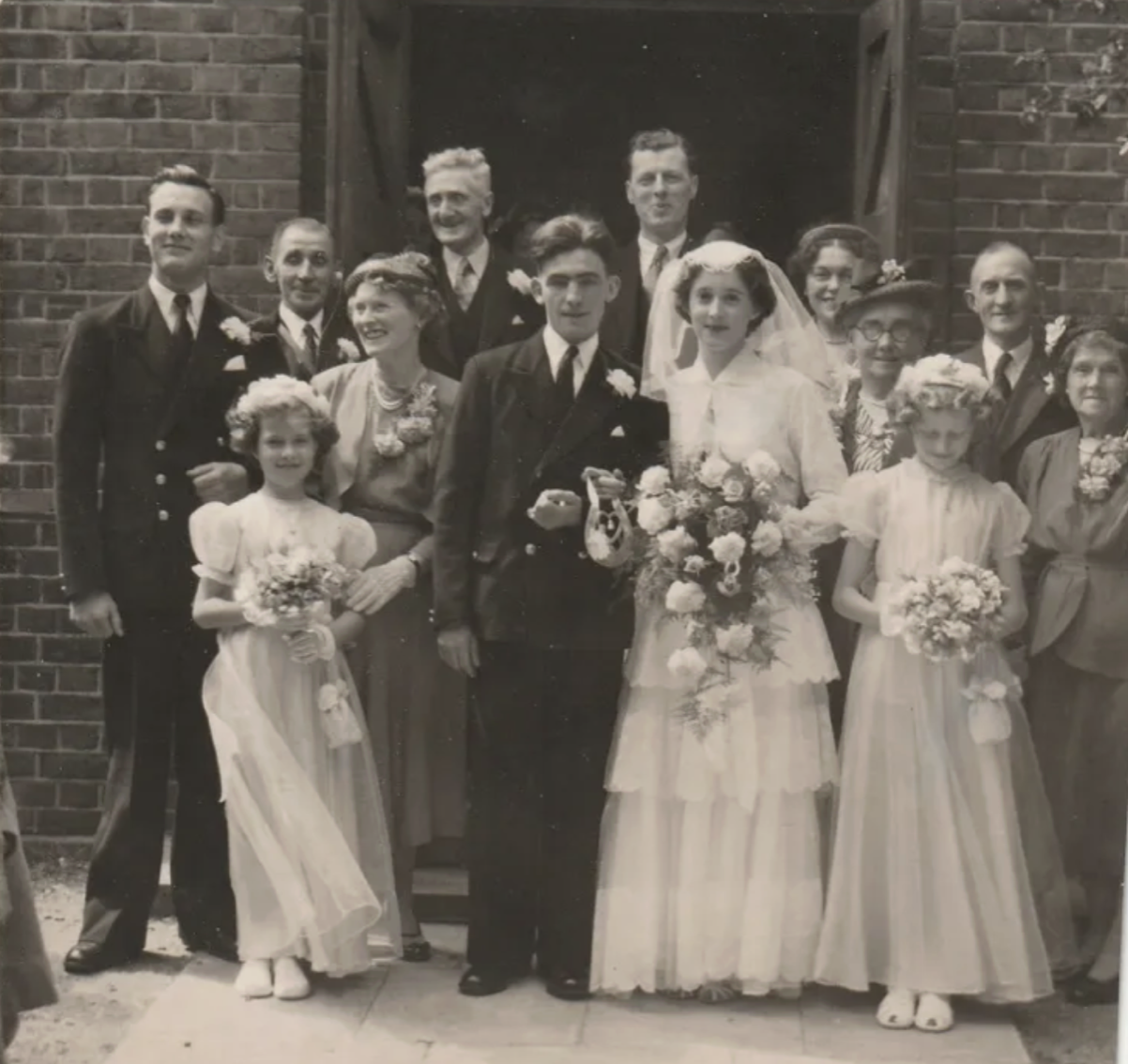
Elizabeth (third from right, middle row, in glasses) and her husband Robert (second from left, back row, visibly frail), at the wedding of their youngest son, Robert, 1954 [111]
In the spring of 1944 she had gathered primroses from the hedgerows and arranged them for the Prisoner of War Fund [98], men behind German wire needing money as much as anyone. Fourteen years later, in May 1958, the Evergreen Club's monthly meeting recorded that Mrs. Butt had gathered over fifty bunches of primroses, sold for the club's own funds [112]. She was sixty-eight, old enough by then to have qualified for the club herself. There was no war behind it this time, no husband in a camp, no fund for other women's husbands. She knew where the primroses were, and she turned them into money for whoever needed help that year. Once that was men behind German wire. Now it was for people little older than she was, in her own town. That November she was out with a tin again, and the paper set down what she brought in against her own road and her own name: Mrs. Butt, Benefield Road, two pounds thirteen shillings and threepence, one line among more than forty in a column that raised a hundred and forty-four pounds for the town [113]. It was the same thing she had done for cancer patients in 1938 and for refugees from Germany in 1939.
That same year, the Peterborough Standard recorded what it called their golden wedding, fifty years, by its reckoning, since they had stood at the parish church [114]. The goodwill was real: telegrams came from the chairman and members of Oundle Urban District Council and from the Legion Women's Section, the branch whose darts club Elizabeth had belonged to since it was founded three years before. The notice recorded them both as Oundleians born and bred, both in fairly good health, and their five children, four daughters and a son, all married by then. Whatever the fifty years had asked of them, it had not broken the marriage or scattered the family it made. Two old Oundleians, and five children all settled with families of their own.
One of those five had travelled further from Oundle than Elizabeth herself ever had. Violet had married in the last winter of the war, at Chelsea in January 1945 [115], to a Hungarian, Frederick Rapoch. By then she had already built something of her own: an interior-decorating firm with clients on stage and screen, a trade she'd talked her way into and which the war later closed down [116]. In September 1952, with the international trade Rapoch worked in turning poor at home, Violet sailed from Liverpool for Montreal with her husband and two young sons [117]. Less than three years later Rapoch died there [118], leaving her a widow three thousand miles from her mother.
Elizabeth did not wait for a convenient season. Some eight weeks later she left Gatwick by air on a Friday and arrived at Montreal the following afternoon, to sit with her newly widowed daughter. She had meant to go by sea: passage was booked on the Saxonia, sailing from Liverpool on the 9th of June. Something changed the plan, and she flew instead [119]. She was a pensioner, and had never before crossed water she could not see the other side of; whatever flying itself meant to her, the noise and the height and the speed of it, it mattered less that Friday than getting to Montreal did. She expected to be away three months, and came home to Benefield Road, and to Oundle, and did not cross the Atlantic again for five years.
In between, she found a cause closer to home. In April 1959 she went to Peterborough as a guest of Oundle British Legion, to the Sunshine Social Club for the Blind at the P.S.A. Hall on Lincoln Road, and was named among the visitors alongside the home teacher for the blind and the secretary of the Blind Association [120]. It does not read, from that single notice, like the start of anything. But it was.
The blind community she had visited as a guest that April had already, by January of the following year, made her one of its own. The annual darts match between the Peterborough Association for the Blind and the Legion Women's Section was held that month at the Legion’s Hall on Brook Street, and the paper's photograph caught Mrs. M. Stevenson, who was totally blind, throwing a dart, with Mrs. Butt beside her, blindfolded because she had sight, captain of the Oundle team [121].
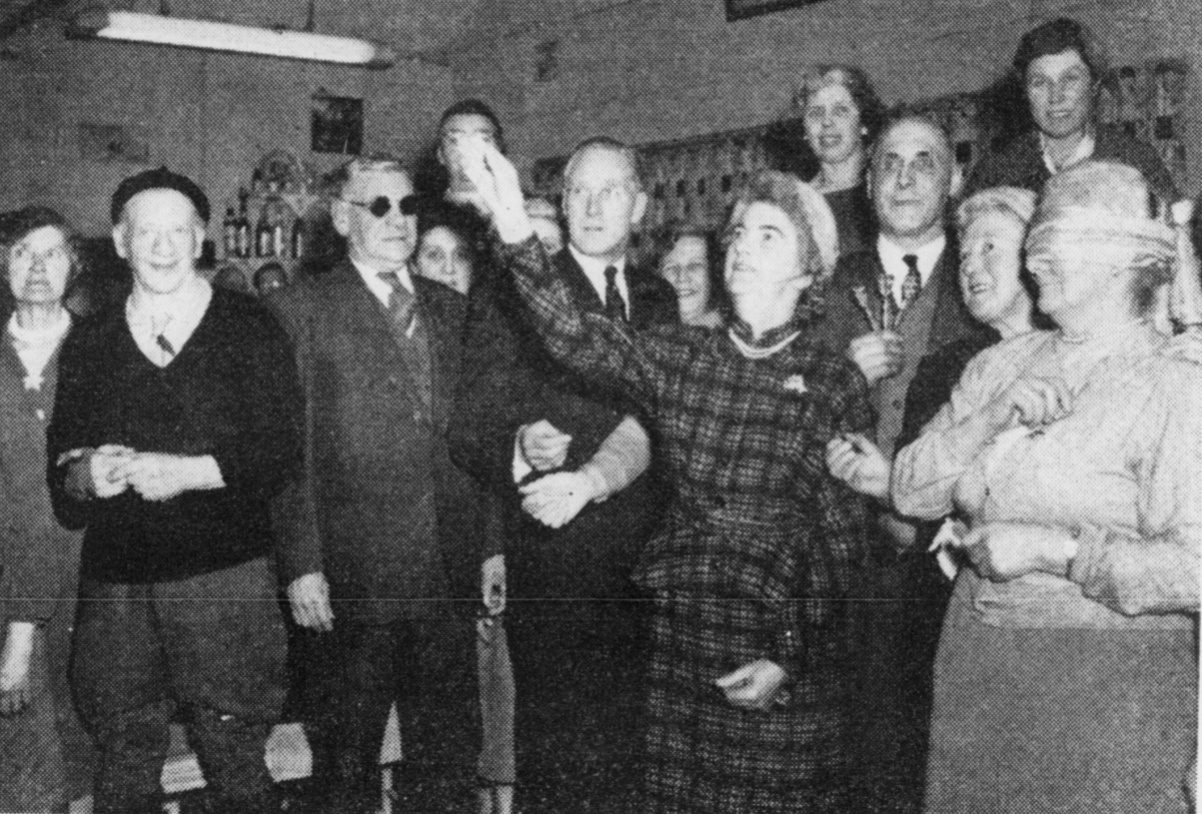
Annual darts match between the Peterborough Association for the Blind and the Women's Section of the Oundle British Legion. Elizabeth, blindfolded, on far right [121]
Five months later she and Robert sailed from Southampton for Montreal on the Saxonia, tourist class, on a single ticket [122], to see Violet, five years widowed now [118] and raising two boys, Andrew and Terry [123]. He was seventy-four and Elizabeth was seventy. The form asked their occupations: she is entered as Housewife, and he, a decade past any ordinary retirement, is still entered as Electrician. Every address she had ever lived at, Victoria Yard, Benefield Road, Morris's Yard, lay within a few streets of the house she was born in; this crossing took her far beyond.
They went up the St Lawrence a year after the Seaway had opened, and by the time they arrived organised sightseeing tours for visitors were already established [124]. Whether Robert and Elizabeth went on one is not recorded, but it is the likeliest way two people with no connection to the region would have come to see it properly, and Elizabeth did see it: she brought it back to Peterborough in her own account of the trip the following spring.
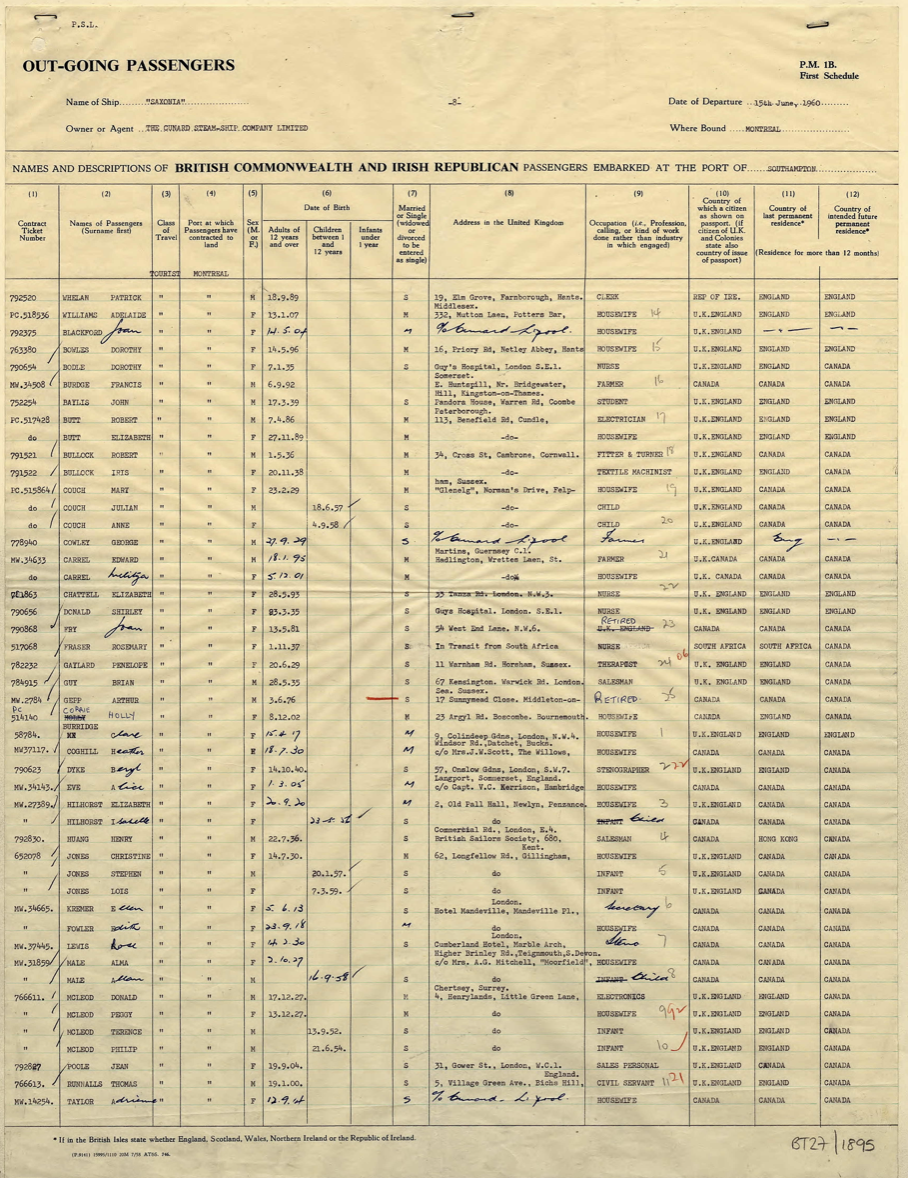
Outward passenger list for the Cunard ship RMS Saxonia, Southampton to Montreal, 15 June 1960. Robert and Elizabeth Butt listed as tourists [122]
They were also taken to see an Indian reservation, almost certainly Kahnawake, called Caughnawaga at the time, the community closest to Montreal and the one most tour buses out of the city would have gone to. Since 1936 the reserve had been home to Chief Poking Fire's Indian Village, run by a Mohawk couple from the community, John and Louise McComber, who packaged their culture for the tourists of the period in the way tourists of the period expected to see it, sold admission and trinkets, and used the money and the standing it brought them to fight for their community's land and rights on the side. The Village was still drawing coachloads of visitors when Elizabeth and Robert made their own crossing in 1960, and would carry on doing so for years afterwards [125]. At seventy, she had spent her whole life in a Northamptonshire market town. None of it had prepared her for a Mohawk ceremony. Whether that was what she saw, or something else on the reserve entirely, the paper names the reservation once, in a list with the Seaway and 'many interesting places,' and gives no more [126].
On the trip, Elizabeth sought out Montreal's blind community herself. She had captained a darts team blindfolded in a hall in Peterborough. Years before that, she had helped raise money at a dance for the Northamptonshire blind [127]. Now she was three thousand miles from home, and she went looking for the same cause anyway. She came home with a message to carry, and in April, standing up in the P.S.A. hall on Lincoln Road, she gave it to them: good wishes from the president and members of an institution for the blind in Montreal [128].
That same summer, Grace, now married to Otto Stiehler [129], took in an eleven-year-old Estonian refugee, one of two girls Southwick and Northborough Women's Institutes had sponsored for a month's holiday, both of whom had spent most of their lives in refugee camps in West Germany, displaced by the Soviet occupation of Estonia, and spoke German rather than English [130]. "When the subject of a refugee child first cropped up at our meetings," Grace told the Advertiser, "I suggested that I could, perhaps, have her here to stay because my husband is German and he gets along fine with her." Her husband, Otto, was German, and family memory says more than any paper does, describing him as a prisoner of war who stayed on afterwards to farm pigs [131]. If that is correct, Grace had married a man of the very nationality that had held her father prisoner for four years, and had taken into her own house a child from the country her mother had once only been able to help from a distance, with a collecting tin at the door. Two decades separated these two acts. The impulse to help, mother to daughter, reads the same.
That December, back in Oundle, she was made assistant secretary of the Legion Women's Section and put on its committee [132], formal office in a branch she had been captaining at darts, informally, for a year already. She was seventy-one. Two months later, in February 1961, the fixture came round again at the same hall on Brook Street, and Oundle lost all three games [133].
The following year, disaster struck the family. Elizabeth's grandson John died with another boy soldier in a fire that destroyed a block of wooden huts at Denbury Camp, near Newton Abbot, Devon. He was sixteen and a Junior Signalman with the Royal Signals Junior Leaders' Regiment barely five months in. He had gone in eager, from Laxton Grammar School straight into the corps the previous September, and he had been home at Christmas and would have been home again at Easter. His last letter reached Southwick Grange on the day he died, wishing his younger sister Grace a happy birthday for the Wednesday to come [134].
Elizabeth was at the funeral five days later, at Southwick parish church, with Robert beside her. The local newspaper named her among the family mourners [135]. She was seventy-two.
After that the local papers have almost nothing, and what she did with the last seven years of her life is unknown.
She died on 15 May 1969, at 81 West Street, Oundle. She was seventy-nine. The death notice said suddenly [136], and the certificate agrees: cardiac failure due to rheumatic aortic valvular disease, certified after a post mortem, no inquest [137].
Eighty-one West Street was not her home. Her usual address is given on the certificate as 113 Benefield Road, where she had lived for at least thirty years67. Number 81 was Claridge & Co., grocers and wine and spirit merchants, a shop that had stood on that street, at one address or another, since before she was born [138].
So she was out. Somewhere between the counter and the door of the grocer's on a Thursday afternoon in May, a heart valve, almost certainly scarred by rheumatic fever in childhood, finally gave out, and she went down on a shop floor in the middle of her own town, with whatever she had gone in for still unbought.
Rheumatic valvular disease is the long consequence of rheumatic fever in childhood, a disease of cold rooms and poor food, common in yards like the one she was born in. Nobody appears to have known she had it. It is a disease that can sit quietly for decades, giving away little beyond breathlessness on a hill or a flight of stairs and a tiredness easy enough to put down to age or overwork, right up until the heart begins to fail outright [139].
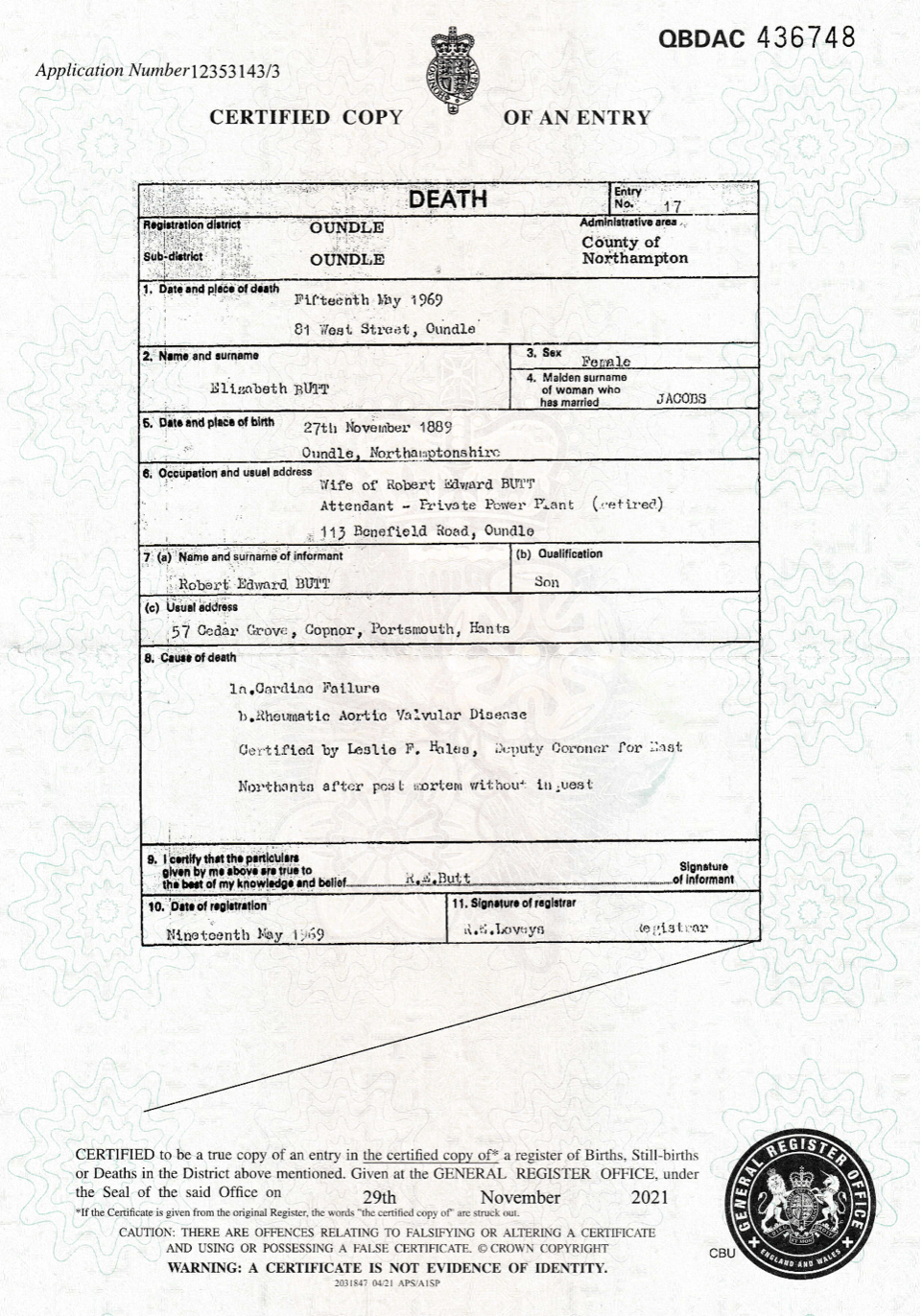
Elizabeth’s Death Certificate [137]
Her occupation on the certificate is recorded as wife of Robert Edward Butt, Attendant, Private Power Plant, retired. The informant was not Robert but their son, who lived more than a hundred and fifty miles away in Portsmouth and had to be sent for, probably because Robert himself was by then too unwell to make the report. Robert lasted seven weeks. He died shortly after on 3 July, at Park Hospital, Wellingborough, of bronchopneumonia, carcinomatosis and cancer of the lungs [140]. In all likelihood, Elizabeth had spent her last months looking after a dying man, much as she had looked after her own parents in their final months thirty-four years before, and went first herself, without warning, on an errand. They had been married almost sixty years. The notice named her five children and asked that flowers go to Crowsons of Barnwell. The funeral was at Oundle Parish Church [136].
Nothing in her life made the national papers except thirty seconds on the Light Programme. What is left is not a record of achievement. It is a record of service: unpaid, unglamorous, and constant, the same kind of work the Women's Voluntary Service existed to organise nationally, keeping ordinary life running while the country's sons, husbands and fathers were away fighting. She had been doing it long before the WVS existed, and she never really stopped.
She went door to door for cancer patients [60] and for refugees from Nazi Germany [61]. She fed soldiers until ten at night in a converted room on West Street, a few doors from where she would die. She picked flowers to buy parcels for men [98] in the kind of camp her husband had come home from, and she stood in a Northamptonshire street in January asking strangers for teapots to send to people in London she would never meet [100].
In November 1958, aged sixty-eight, she walked the length of Benefield Road with a tray of poppies and brought in two pounds thirteen shillings and threepence [113].
At seventy she crossed the Atlantic and came home with a message for a room of blind people in Peterborough from a room of blind people in Montreal [128].
And in February 1961, in a hall in Peterborough, she tied a cloth over her own eyes so that a game against blind opponents would be fair. She lost, then went on the wireless and told the country so, using her thirty seconds to ask them to think about the blind [3].
Explore further…
Elizabeth Jacobs appears in the Paternal Grandfather family tree, alongside her husband Robert Edward Butt and his parents, George William Butt and Rebecca Butt.
Her husband's own captivity, told here from Elizabeth's side, waiting at home for news that rarely came, has its own fuller account in Prisoner of War, which follows Robert through four and a half years in German hands. His father, George William Butt, is the subject of Quietly Rooted.
Elizabeth's war was spent readying Oundle for a bombing raid that never came. A different wartime experience altogether is told in Haunted by Death, which follows Maria Efford Kate Hilker through the Portsmouth Blitz, in one of the most heavily bombed cities in England.
Elizabeth lived to seventy-nine, one of the longer lives in her generation of the family, and died on an ordinary errand rather than after a long decline. Her death sits within the broader Death and Mortality data, which charts how life expectancy shifted across the generations of the family, from Rebecca Butt's thirty-six years to Elizabeth's near-eighty.
References:
[1] ‘Darts Match for the City Blind’, Peterborough Advertiser, 21 February 1961, p. 4.
[2] ‘Win for the Blind in Annual Darts Match’, Peterborough Standard, 24 February 1961, p. 5.
[3] ‘Wilfred and 'Have a Go' at Oundle’, Peterborough Evening Telegraph, 22 February 1961, p. 6.
[4] Eleven children are documented by baptism, birth registration or census: Lucy Ann, baptised at Elton 10 May 1880; Harriett and Gertrude, twins, baptised together at Elton 5 March 1882; and William, baptised at Elton 5 October 1884. Cambridgeshire Archives and Cambridgeshire and Huntingdonshire Family History Society, Church of England Registers of Baptisms, Marriages and Burials, refs HP23/1/2/2 (Lucy Ann p. 92; Harriett and Gertrude entries 755–756) and HP23/1/2/3 (William p. 2), accessed via Ancestry.com, Cambridgeshire and Huntingdonshire, England, Church of England Births and Baptisms, 1813–1924 (Lehi, UT: Ancestry.com Operations, 2025). Eliza was registered in the third quarter of 1887, GRO Oundle vol. 3b p. 218, and baptised at Elton 7 August 1887, same series, entry 60.Her younger siblings: Agnes and Ann, twins, registered in the third quarter of 1892 and entered consecutively in the index, GRO Oundle vol. 3B p. 232, mother's maiden name Rands, and baptised together at Oundle 3 August 1892, entries 669 and 670; George Thomas, baptised at Oundle 30 August 1895; May, baptised at Oundle 18 June 1897; and Rose, baptised at Oundle 18 August 1899, who died at Peterborough in October 1919, aged twenty. Northamptonshire Record Office, Parish Registers, ref. 249P/369, accessed via Ancestry.com, Northamptonshire, England, Church of England Baptisms, 1813–1912 (Provo, UT: Ancestry.com Operations, 2014).
[5] The figure of twelve comes from the household's own return. The 1911 census asked married women for the number of children born alive to the present marriage, the number still living and the number who had died; the entry for this household gives twelve, ten and two (fn. 19). The twelfth child has not been traced.
[6] Birth registration of Elizabeth Jacobs, fourth quarter 1889, Oundle registration district, Northamptonshire, General Register Office, vol. 3B, p. 212, mother's maiden name Rands. The certificate gives the birth as 27 November 1889 at Victoria Yard, Oundle, entry no. 379; father Robert Jacobs, farm labourer; mother Elizabeth Jacobs, formerly Rands; informant the mother; registered December 1889 by Benjamin H. Mash, Registrar.
[7] Baptism of Elizabeth Jacobs, 22 December 1889, in the parish register of Oundle, Northamptonshire, the child of Robert Jacobs and Elizabeth Jacobs of Oundle. Northamptonshire Record Office, Northampton, Parish Registers, reference 249P/369; accessed via Ancestry.com, Northamptonshire, England, Church of England Baptisms, 1813–1912 (Provo, UT: Ancestry.com Operations, Inc., 2014). She was the first of her parents' children to be baptised at Oundle; the five elder children had all been baptised at Elton in Huntingdonshire, the last of them Eliza on 7 August 1887, which places the family's move to Oundle between that date and December 1889.
[8] Ordnance Survey, Northamptonshire sheet XIX.NW, six inches to the mile, revised 1899, published 1901; National Library of Scotland, maps.nls.uk/view/101574646. The sheet shows West Street, the chapel and the built ground running back behind it as they stood in Elizabeth's childhood, though at that scale the individual yards are not named. The 25-inch survey, Northamptonshire XIX.5, revised 1924 and published 1926 (maps.nls.uk/view/114477296), names Victoria Yard and shows it as a passage running north off West Street with the houses set along it, the Chapel abutting to the west and Inkerman Yard beyond. That sheet postdates her childhood by some thirty-five years; the arrangement in the 1890s is inferred from the earlier survey showing the same block already built up. The seven households are from the 1901 census of England and Wales, Oundle, The National Archives, RG13/1457, which enumerates schedules 192 to 198 at Victoria Yard, the last of them the Victoria Beer House.
[9] Marriage of Robert Jacob and Elizabeth Rands, 8 October 1877, All Saints, Elton, Huntingdonshire, entry no. 186: Robert Jacob, minor, bachelor, labourer, of Elton, son of Jesse Jacob, deceased; Elizabeth Rands, minor, spinster, of Elton. Married by banns by Richard Kempthorne, Rector; witnesses James Odis and Letitia Carter. Cambridgeshire Archives and Cambridgeshire and Huntingdonshire Family History Society, Cambridgeshire, England, Church of England Registers of Baptisms, Marriages and Burials, reference HP23/1/3/3; accessed via Ancestry.com, Cambridgeshire and Huntingdonshire, England, Church of England Marriages and Banns, 1754–1950 (Lehi, UT: Ancestry.com Operations, Inc., 2025). Both parties are described as minors, that is under twenty-one; both were born in the autumn of 1857, which puts each of them at twenty on the day.
[10] 1881 census of England and Wales, Lodge Cottage, Elton, Huntingdonshire, The National Archives, RG11, piece 1588, folio 59, p. 3: Robert Jacobs, head, 23, agricultural labourer, born Old Weston, Huntingdonshire; accessed via Ancestry.com, 1881 England Census (Provo, UT: Ancestry.com Operations Inc., 2004). 1891 census, Oundle, Northamptonshire, TNA, RG12, piece 1222, folio 135, p. 8: Robert Jacob, head, 33, bricklayer; accessed via Ancestry.com, 1891 England Census (Provo, UT: Ancestry.com Operations Inc., 2005). 1901 census, Oundle, TNA, RG13, piece 1457, folio 59, p. 27, schedule 195: Robert Jacob, head, 43, platelayer on railway; accessed via Ancestry.com, 1901 England Census (Provo, UT: Ancestry.com Operations Inc., 2005). 1911 census, Victoria Yard, West Street, Oundle, TNA, RG14, piece 8646, schedule 191: Robert Jacob, 54, platelayer L.N.W.; accessed via Ancestry.com, 1911 England Census (Provo, UT: Ancestry.com Operations, Inc., 2011). 1921 census, Victoria Yard, Oundle, TNA, RG15/7789, RD 169 RS 1 ED 20, schedule 191: Robert Jacobs, 64 years 8 months, platelayer, employer the London and North Western Railway, place of work Barnwell; accessed via Ancestry.com, 1921 England Census (Lehi, UT: Ancestry.com Operations, Inc., 2025).
[11] 1891 census of England and Wales, Oundle, Northamptonshire, The National Archives, RG12, piece 1222, folio 135, p. 8, Victoria Yard, West Street: Robert Jacob, head, 33, bricklayer, born Old Weston; Elizabeth, wife, 33; and the children Lucy, 11, Harriett, 9, Gertrude, 9, William, 7, and Elizabeth, 1. Three rooms. Accessed via Ancestry.com, 1891 England Census (Provo, UT: Ancestry.com Operations Inc., 2005).
[12] Marriage of Lucy Jacobs and William Haddon, 3 September 1900, parish church of Oundle, Northamptonshire; Lucy Jacobs, aged 21, daughter of Robert Jacobs. Northamptonshire Record Office, Northampton, Parish Registers, reference 249P/371; accessed via Ancestry.com, Northamptonshire, England, Church of England Marriages, 1754–1912 (Provo, UT: Ancestry.com Operations, Inc., 2014). 1901 census of England and Wales, Court 1 House 2, Gas Street, Kettering, Northamptonshire, The National Archives, RG13, piece 1447, schedule 6: William Haddon, head, 21, labourer at the gas works, and Lucy, wife, 21, born Elton, Huntingdonshire; two rooms. Harriett Jacobs appears as servant, single, 19, general servant domestic, at Crawley Lodge, Hemington, TNA, RG13, piece 1455, schedule 29; the birthplace given there as Hemington is an error, since she was baptised at Elton in 1882. Gertrude appears in the same census as "Gertie Jacobs," servant, single, 19, domestic servant, at The Three Cocks Inn, Lower Street, Kettering, TNA, RG13, piece 1447, schedule 211, with the birthplace given as Old Weston, which was her father's and not hers. Both twins were therefore in service by the spring of 1901, and both Lucy and Gertrude were at Kettering. Census returns accessed via Ancestry.com, 1901 England Census (Provo, UT: Ancestry.com Operations Inc., 2005).
[13] Death certificate of Eliza Jacobs, 29 January 1901, Elton, Huntingdonshire, aged 14, daughter of Robert Jacobs, platelayer on railway; cause of death pneumonia, certified by C. J. Elliott, M.B.; informant the mark of Margaret Hodson, present at the death, Elton; registered on 31 January 1901 by Benjamin H. Mash, Registrar. General Register Office, March quarter 1901, Oundle, vol. 3B, p. 130. Margaret Hodson appears in the 1901 census at Duck Street, Elton, The National Archives, RG13, piece 1456, schedule 94, as the wife of Richard Hodson, general farm labourer, and is recorded as born in Ireland; accessed via Ancestry.com, 1901 England Census (Provo, UT: Ancestry.com Operations Inc., 2005). Two schedules along, at 95, are Mark and Elizabeth Atkins, Elizabeth being Eliza's maternal grandmother, born at Werrington. Whose household Eliza was in at Elton, and how long she had been there, is not recorded.
[14] 1901 census of England and Wales, Oundle, Northamptonshire, The National Archives, RG13, piece 1457, folio 59, p. 27, schedule 195, Victoria Yard: Robert Jacob, head, 43, platelayer on railway, born Old Weston, Huntingdonshire; Elizabeth, wife, 43; William, son, 17; Harriett, 8; Ann, 8; George, 6; Mary, 4; and Rose, 1. Four rooms, eight people. Accessed via Ancestry.com, 1901 England Census (Provo, UT: Ancestry.com Operations Inc., 2005). The daughter entered as Harriett, aged 8, cannot be the Harriett baptised at Elton in 1882, who was nineteen and in service at Hemington on the same night; on age she can only be Agnes, twin of the Ann entered beside her, and the name appears to be an error of the householder or the enumerator.
[15] 1901 census of England and Wales, Benefield Road, Oundle, Northamptonshire, The National Archives, RG13, piece 1457, p. 21, schedule 151: Emma Page, head, single, 36, charwoman domestic, born Flitwick, Bedfordshire; Elizabeth Jacobs, boarder, single, 11, born Oundle. Accessed via Ancestry.com, 1901 England Census (Provo, UT: Ancestry.com Operations Inc., 2005).
[16] 1901 census of England and Wales, Benefield Road, Oundle, Northamptonshire, The National Archives, RG13, piece 1457, schedule 152: the Fox household, including a boarder aged 15, grocer's porter. Accessed via Ancestry.com, 1901 England Census (Provo, UT: Ancestry.com Operations Inc., 2005).
[17] Marriage of Robert Edward Butt and Elizabeth Jacobs, 2 August 1909, parish church of Oundle, Northamptonshire; Robert Edward Butt, aged 23, and Elizabeth Jacobs, aged 20, daughter of Robert Jacobs; witnesses William Jacobs, Agnes Jacobs and Arthur George Wright. Northamptonshire Record Office, Northampton, Parish Registers, reference 249P/372, p. 10; accessed via Ancestry.com, Northamptonshire, England, Church of England Marriages, 1754–1912 (Provo, UT: Ancestry.com Operations, Inc., 2014).
[18] Robert Edward Butt was born at Clark's Yard, Oundle, on 7 April 1886, the youngest child of George William Butt, agricultural labourer, and Charlotte Odam. He began work at Oundle School in 1908 as part of the maintenance and engineering staff and was in charge of the school's power station: 'Valete' article, The Laxtonian (1949), provided by Elspeth Langsdale, Oundle School Archivist.
[19] 1911 census of England and Wales, Morris's Yard, West Street, Oundle, Northamptonshire, The National Archives, RG14, piece 8646: Edward Robert Butt, head, 24, labourer, engineering, public school, born Oundle; Elizabeth Butt, wife, 21, born Oundle, married two years, no occupation recorded. Four rooms. Accessed via Ancestry.com, 1911 England Census (Provo, UT: Ancestry.com Operations, Inc., 2011).
[20] Birth registration of Violet E. Butt, first quarter 1912, Oundle registration district, Northamptonshire, mother's maiden name Jacobs, General Register Office, vol. 3b, p. 351; accessed via Ancestry.com, England & Wales, Civil Registration Birth Index, 1837–1915 (Provo, UT: Ancestry.com Operations Inc., 2006, from FreeBMD). Her date of birth is given as 23 February 1912 in the U.S. Social Security applications and claims index, under her married name Violet E. Duross; accessed via Ancestry.com, U.S., Social Security Applications and Claims Index, 1936–2007 (Provo, UT: Ancestry.com Operations, Inc., 2015). The 1911 census places her parents at Morris's Yard, West Street, Oundle, in the April before her birth: Edward Robert Butt, head, 24, labourer, engineering, public school, and Elizabeth Butt, wife, 21, born Oundle, married two years. The National Archives, RG14, piece 8646; accessed via Ancestry.com, 1911 England Census (Provo, UT: Ancestry.com Operations, Inc., 2011).
[21] Robert's service record does not survive, having been among those destroyed by enemy action in 1940. His movements are reconstructed from the battalion's own diary and from two fixed points in his personal record: his entry to theatre on 8 September 1914, from his medal index card (Private Robert Butt, 7545, West Yorkshire Regiment, Victory, British and 1914 Star, qualifying date 8.9.14; The National Archives, WO 372/3/218142), and his capture at the Aisne on 20 September 1914, from the German prisoner list (fn. 25). For the battalion's movements and its position at Troyon on the night of 19–20 September see the war diary, 1st Battalion West Yorkshire Regiment, August 1914 – May 1919, TNA, WO 95/1618/2. That he moved with the battalion is inference from the two fixed points and is not independently documented. Troyon lies on the Chemin des Dames above the Aisne. The figure of 444 men of the battalion taken prisoner is from the statement of Thomas Mullins to the Committee on the Treatment of British Prisoners of War, TNA, WO 161/100/15, pp. 2437–41.
[22] Medal index card of Private George Jacob, 9693, 1st Northamptonshire Regiment, Victory, British and 1914 Star, date of entry to theatre 13.8.14, remarks "P of W"; The National Archives, WO 372. His capture and next of kin are from the German prisoner list P.A. 18430, Langensalza, dated 19 January 1918, entry 15: "Jacob, George, 9693, Gem., 1 Northampton, Comp. A, Ypres 24.10.14, unverwundet, Cassel; Oundle 10.12.95; Mother, Victoria Yd., West St., Oundle, Northampton"; International Committee of the Red Cross, Agence internationale des prisonniers de guerre, list series C G1 E 04-01, p. 0093. See also the Agency's index card, C G1 E 15-01, p. 0047, filed as "Jacobs, Sold. 9693 Georges, Northamptonshire Rgt.," cross-referring to lists P.A. 6783, P.A. 1000 and P.A. 18430.
[23] Birth registration of Beatrice O. Butt, fourth quarter 1914, Oundle registration district, Northamptonshire, mother's maiden name Jacobs, General Register Office, vol. 3B, p. 302; accessed via Ancestry.com, England & Wales, Civil Registration Birth Index, 1837–1915 (Provo, UT: Ancestry.com Operations Inc., 2006, from FreeBMD).
[24] For the form and periodicity of these columns see Northampton Chronicle and Echo, 8 September 1917, p. 3, "Local Casualties: To-Day's List," and Northampton Mercury, 19 July 1918, p. 7, "Local Casualties: The Week's List." Both arrange the reported men under Killed, Wounded, Prisoners, Missing and Ill, and both show the characteristic movement between categories: men "missing since the Dunes Battle, now reported prisoner," or who "now writes to say he is a prisoner and quite well."
[25] Northampton Mercury, 18 December 1914, p. 7, "Oundle: Military News." The full notice records that a batch of Oundle soldiers had been home on seven days' leave; that Private John Fox, 2nd Northants, was wounded and in Bristol Military Hospital; and that "the parents of Private Robert Butt, 1st Battalion West Yorkshires, and of Private George Jacobs, 1st Northants, both of whom are prisoners, have heard from them, saying they are well. They complain of not hearing from their friends."
[26] Robert was held in more than one camp. The International Committee of the Red Cross list P.A. 274 records him at Döberitz, where a postcard sent home by Private Locke shows him in a group photograph (fn. 27). He was later at Friedrichsfeld near Wesel, from which his own card home was sent (fn. 27), and the German list P.A. 19865, headed Chemnitz and dated 8 February 1918, carries his administrative entry at that date: "Butt, Robert, 7545, Sold., West Yorksh. Rgt., Aisne 20.9.14, [no wound recorded], s.o.; 7.4.86 Oundle Northamptonshire; Robert B., O. N."; International Committee of the Red Cross, Agence internationale des prisonniers de guerre, list series C G1 E 04-01, p. 0100. See also the Agency's index card, C G1 E 15-01, p. 0013, "Butt Robert, Pte. 7545, West Yorksh.," cross-referring to lists P.A. 274 and P.A. 19865.
[27] Peterborough Standard, 24 June 1916, p. 6, "In the Huns' Clutches." Mr. and Mrs. J. W. North of Oundle received a postcard from their son Reg, a prisoner of war, dated 15 May 1916. He had been at Munster Camp until 6 May and had regularly acknowledged the receipt of the Northamptonshire Committee's parcels; he was then transferred to Windau.
[28] Photograph of a postcard sent by Private Locke to his own parents, showing Robert Edward Butt (bottom left) at Döberitz camp; provided by Aline Staes, York Army Museum, 19 August 2021. Postcard from Private R. Butt, 7545, 1st West Yorkshires, Kriegsgefangenenlager Friedrichsfeld, addressed to Mr G. Butt, West Street, Oundle, Northamptonshire, England; undated; a photographic card printed by Photo-Atelier Hans Nagel, Berlin W., Steglitzerstrasse 61, and Charlottenburg, Bismarckstrasse 74/75, showing Robert standing in woodland; a stamped mark across the centre is no longer legible; annotated in pencil in a later hand, "Uncle Bob (Butt)"; provided by Christine Nix, daughter of Ronald Lloyd.
[29] Account of the Zeppelin raid of the night of 1–2 October 1916, reproducing what appears to be a Northamptonshire county constabulary report, in "The Menace of the Zeppelin," Collyweston Historical Society, https://www.collywestonhistoricalsociety.org.uk/the-mennace-of-the-zeppelin (accessed 21 July 2026). Its substance is corroborated by contemporary press: Northampton Mercury, 13 October 1916, p. 4, "The Zeppelin Bombs," records that twelve incendiary bombs from the last air raid had been removed to Kettering and were being exhibited at the Corn Market Hall in aid of the County Red Cross Fund, about two feet long, some in much the same condition as when they fell, having landed in soft ground with the tow round them unburned, others burned out; the count of twelve differs from the ten in the constabulary report. Peterborough Express, 4 October 1916, p. 2, records that ten airships took part in the raid of Sunday night, one destroyed near London and another seen crossing the coast crippled, with many bombs dropped, one man killed, one woman injured and small damage to property.
[30] Northampton Chronicle and Echo, 2 October 1916, p. 3, "Seen from Wellingborough" and "A Wollaston View." A Wellingborough resident with a southward view over open country reported that at about five minutes to twelve he saw what he took for a star assume a larger shape and brighter glow. Practically all the special constables on patrol on the outskirts of the town saw it, as did many men at night work, and reports came in from Irthlingborough, Finedon and Rushden. At Wollaston, men near the water tower said the light was as bright as three or four furnaces in full blast and that the time on a watch could be seen quite clearly.The airship was L.31, commanded by Kapitänleutnant Heinrich Mathy, brought down at Potters Bar in Hertfordshire. Northampton Chronicle and Echo, 4 October 1916, p. 4, "Zeppelin Inquest: Nineteen Bodies Recovered," reports the inquest at Potters Bar Cottage Hospital, at which a police inspector gave the time of the fall as 11.55 p.m. in a field adjoining Oakmere Farm and stated that nineteen bodies had been recovered. The Oundle airship was a different vessel, and the fall at Potters Bar came ten minutes after Inspector Cameron heard engines in Station Road. Wellingborough lies about twenty miles south-west of Oundle. Nothing records whether the fall was visible from Oundle, which is further north than any of the towns from which it was reported.
[31] Statements of Thomas Mullins, The National Archives, WO 161/100/15, pp. 2437–41, and of A. Gibb, TNA, WO 161/100/557, pp. 3390–95, to the Committee on the Treatment of British Prisoners of War, for the Libau reprisal, the march to Latchen in February 1917, the withholding of parcels until April, the deaths from starvation, and the figures of five hundred marched in and seventy-two out. Both are witness statements taken after repatriation rather than contemporaneous records.
[32] "Soldiers' Separation Allowances," poster issued by the Parliamentary Recruiting Committee, London, March 1915; Imperial War Museums, Art.IWM PST 5160, https://www.iwm.org.uk/collections/item/object/28448. Reproduced under the IWM Non-Commercial Licence; Image: IWM (Art.IWM PST 5160). New weekly rates from 1 March 1915 for the wives and children of married men, privates and corporals: wife 12s 6d; wife and child 17s 6d; wife and two children 21s, with 2s extra for each additional child. The rates are stated to include the usual allotment of 3s 6d a week for privates and corporals, so a part of the sum was stopped from the soldier's own pay. The ordinary age limit for children was 16. As the wife of a reservist recalled to the Colours, Elizabeth fell within one of the categories entitled to separation allowance under the regulations in force before 5 August 1914, and did not depend on the wartime extension: John Black, "Behind the Scenes with the Pen and Ink Corps! The role of the Army Pay Services during the Great War," RAPC Regimental Association, https://rapc-association.org.uk/pay-services-history/ww1/pen-and-ink.html.Black notes that pre-war claims across the whole Regular Army numbered about 1,100 annually and had exceeded half a million by November 1914.
[33] Payment of separation allowance was monthly before the war and moved to a weekly issue on 12 October 1914, made at post offices through a postal draft in the form of a cheque book of thirteen sheets. John Black, "Behind the Scenes with the Pen and Ink Corps! The role of the Army Pay Services during the Great War," RAPC Regimental Association, https://rapc-association.org.uk/pay-services-history/ww1/pen-and-ink.html (accessed 21July 2026). The change fell nine days before Beatrice's birth and twelve days before George Jacobs's capture; the first ten weeks of Robert's absence therefore ran under the monthly system.
[34] Working Classes Cost of Living Committee (1918), finding an average increase of about 90 per cent in working-class weekly food expenditure over four years and about 74 per cent in fuel and lighting; cited in Angela Woollacott, On Her Their Lives Depend: Munitions Workers in the Great War (Berkeley: University of California Press, 1994), pp. 117–18. See also Board of Trade figures showing a 61 per cent rise in food prices between July 1914 and July 1916, cited in Rachel Duffett, "Food and the First World War," Everyday Lives in War, University of Hertfordshire, 26 January 2015, https://everydaylivesinwar.herts.ac.uk/2015/01/food/. National figures, cited for the direction and scale of change against a fixed allowance, not as a measure of this household's spending.
[35] By 1917 the price of a loaf had doubled since the start of the war; from April 1917 the government regulated flour extraction, "war bread" at 81 per cent extraction being hard and stale, and by spring 1918 at 92 per cent extraction giving bread a black appearance, with the sale of fresh bread made illegal. Ian Miller, "Food and Nutrition (Great Britain and Ireland)," in 1914-1918-online. International Encyclopedia of the First World War, ed. Ute Daniel et al., Freie Universität Berlin, Berlin 2025, DOI 10.15463/ie1418.11637. Miller also records that rising costs across the war halved consumption of sugar, butter and cheese and severely restricted meat, increasing reliance on tea, bread and potatoes. Coal was rationed by the number of rooms in a house from October 1916; Christine Ball and Nicky Hudson, The Effects of Rationing on the Home Front 1914–1918, West Sussex & the Great War Project, West Sussex County Council, www.westsussexpast.org.uk. That is a local study of Bognor and Chichester and not a primary authority. The four rooms are from the 1911 census (fn. 19). The draft assumes the family remained at that address through the war and applies a national measure to the household on that assumption. Nothing records the family's coal allocation.
[36] Northampton Mercury, 18 October 1918, p. 6, "Oundle": "For the Soldiers' Christmas Comforts Fund, £33 has been collected, and 120 parcels will be despatched." The same column reports a flag day for the French Red Cross held on the Thursday of the previous week raising £19 4s. 10d.
[37] Bertie Frederick Loakes, L/Corporal, 3/9802, 2nd Northamptonshire Regiment, born and resident Oundle, died while a prisoner of war 9 August 1918, buried Niederzwehren Cemetery, Germany; Herbert George Miles Markham, L/Corporal, G/23713, 8th Queen's Royal West Surrey Regiment, born and resident Oundle, died while a prisoner of war 10 November 1918, aged 20, buried Belgrade Cemetery, Namur. Oundle and Ashton War Memorial, New Street, Oundle; transcription and research by Ernie Rusdale, Roll-of-Honour.com, https://www.roll-of-honour.com/Northamptonshire/OundleandAshton.html (accessed 21 July 2026).
[38] Testimony of Thomas Olive, in "Voices of the First World War: Shell Shock," episode 33, Imperial War Museums, https://www.iwm.org.uk/podcasts/voices-of-the-first-world-war/ep-33-shell-shock (accessed 21 July 2026). Olive describes breakdowns occurring at night after his return, springing up off the bed, and his wife being frightened by it. The same episode gathers testimony on the recognition and symptoms of shell shock, including trembling and immobility, and on the case of a man who shut himself away at home after the war and died in an asylum within two years of the Armistice.
[39] Robert's repatriation in January 1919 and his character as remembered in the town: Valete, The Laxtonian (1949), provided by Elspeth Langsdale, Oundle School Archivist. On the letters: the article states that he showed with pride the letters written to him by Sanderson while he was a prisoner of war.
[40] Birth registration of Grace E. Butt, fourth quarter 1919, Oundle registration district, Northamptonshire, mother's maiden name Jacob, General Register Office, vol. 3B, p. 338; accessed via Ancestry.com, England & Wales, Civil Registration Birth Index, 1916–2007 (Provo, UT: Ancestry.com Operations Inc., 2008). The date of 2 October 1919 is given in the 1939 Register (fn. 67). The mother's maiden name is indexed as Jacob rather than Jacobs.
[41] George Jacob was repatriated and had married and settled by 1921. 1921 census of England and Wales, Orlingbury, near Wellingborough, Northamptonshire, The National Archives, RG 15/7702, registration district 166 Wellingborough, sub-district 1, enumeration district 9, schedule 103: George Thomas Jacob, head, 26 years 6 months, born Oundle, married, cowman employed by G. Day, farmer, of Orlingbury; Annie Jacob, 29 years 1 month; Phyllis Margaret Jacob, 1 year 2 months. George was himself the respondent. Accessed via Ancestry.com, 1921 England Census (Lehi, UT: Ancestry.com Operations, Inc., 2025).
[42] Death registration of Rose Jacob, 7 November 1919, at the Infirmary, Peterborough Within Urban District; Peterborough registration district, Northamptonshire, entry no. 172. Female, 20 years, "of West Street, Oundle U.D. Spinster of no occupation. Daughter of Robert Jacob, Railway Platelayer." Cause of death: (1) Diabetes, (2) Coma. Certified by D. N. Dutt, L.R.C.P. Informant: "R. Jacob, Father, West Street, Oundle." Registered 8 November 1919 by T. H. Peach, Registrar. General Register Office. Indexed at England and Wales, Civil Registration Death Index, fourth quarter 1919, Peterborough, vol. 3b, p. 234, giving her age as 20; accessed via Ancestry.com, England & Wales, Civil Registration Death Index, 1916–2007 (Provo, UT: Ancestry.com Operations Inc., 2007).
[43] Before insulin, rapid-onset diabetes of the kind now classed as type 1 carried a life expectancy generally under a year from diagnosis. The presenting symptoms were voluminous urination, up to fifteen litres a day, and unquenchable thirst, followed by wasting and weakness. In the final stages the body, unable to metabolise carbohydrates, burned fats instead and filled with partly burned fatty acids; the resulting ketones showed in the urine and on the breath as a sweet smell likened to rotten apples, and the patient passed through a restless drowsiness into semi-consciousness, then air hunger, then a coma from which there was no recovery. The treatment available in 1919 was the starvation diet developed by Frederick M. Allen from 1915 and promoted by Elliott P. Joslin: a course of fasting followed by sustained under-nourishment, requiring hospital supervision in severe cases, and one which in most cases ended with the patient dying either of the diabetes or of the starvation. Christopher J. Rutty, "Diabetes before 1920," Insulin100, Shared Histories Canada (formerly Defining Moments Canada), 2020, sharedhistories.ca/insulin100/history/context, accessed 21 July 2026; content licensed CC BY-NC 4.0. Compare Larry A. Distiller, "Why do some patients with type 1 diabetes live so long?", World Journal of Diabetes 5, no. 3 (15 June 2014), pp. 282–287, at p. 282, which gives expected survival before insulin as under three years; the shorter figure is specific to rapid onset. This is the general course of the disease and of its treatment. Nothing is recorded of Rose's own symptoms, of when she fell ill, or of what was done for her.
[44] 1921 census of England and Wales, Victoria Yard, Oundle, Northamptonshire; The National Archives, RG 15/[piece to be supplied], registration district 169 Oundle, sub-district 1, enumeration district 20 (Oundle Urban District), schedule 189: Robert Edward Butt, head, 35 years 2 months, electrician, employer Mr F. W. Sanderson (Headmaster), place of work Oundle Schools; Elizabeth Butt, wife, 31 years 7 months, born Oundle; Violet E. Butt, 9 years 4 months; Beatrice O. Butt, 7 years 8 months; Grace E. Butt, 1 year 8 months. Five persons, three rooms. The address is entered as "Victoria, Oundle" and the respondent as Mr R. Butt. Accessed via Ancestry.com, 1921 England Census (Lehi, UT: Ancestry.com Operations, Inc., 2025).
[45] The whereabouts of Elizabeth's brothers and sisters on the night of 24 April 1921 are from the census of that year, accessed via Ancestry.com, 1921 England Census (Lehi, UT: Ancestry.com Operations, Inc., 2025). Lucy Haddon, 41 years 10 months, born Elton, wife of William Haddon, at 8 Railway View, Lower Street, Kettering; two persons in the household; The National Archives, RG 15/7746, RD 167 RS 2 ED 5, schedule 18. Harriett Coles, 39 years 4 months, born Elton, home duties, wife of John Henry Coles, at Hemington, with six sons aged from 12 years 7 months to 1 year 4 months; TNA, RG 15/7786, RD 169 RS 1 ED 13, schedule 74. Gertrude Lewis, 39 years, wife of Samuel C. Lewis, at Swineshead Bridge, Swineshead, Lincolnshire, with three children, the youngest ten months; TNA, RG 15/15250, RD 415 RS 1 ED 19, schedule 34. Her birthplace is indexed as Northampton, which cannot be right: she was baptised at Elton on 5 March 1882 with her twin Harriett (fn. 4). William Jacob, head, 36 years 9 months, born Elton, general labourer, employer W. B. Randall, Park Road Nursery, Enfield Wash, at 676a Seven Sisters Road, N15, Tottenham; with Martha Jacob, 43 years 7 months, and six Blyth children aged 18 to 6; TNA, RG 15/6797, RD 132 RS 3 ED 22, schedule 284. George Thomas Jacob at Orlingbury, near Wellingborough, cowman employed by G. Day, farmer, with his wife Annie and a daughter of 1 year 2 months; TNA, RG 15/7702, RD 166 RS 1 ED 9, schedule 103 (fn. 41). Two remained in Victoria Yard. Annie Jacobs, daughter, 29, single, charwoman, was in her parents' household with them and two grandsons, George Jacobs, 6 years 6 months, born Warmington, and John Jacobs, 3 years 10 months, born Oundle, both entered as having both parents alive; five persons, three rooms; TNA, RG 15/[piece], RD 169 RS 1 ED 20, schedule 191. Agnes Pridmore, 29 years 11 months, was three schedules along with her husband Thomas Pridmore, 29 years 3 months, labourer, out of work; Dorothy Jacobs, daughter, 4 years 2 months, whole time at school; and Kathleen Pridmore, daughter, 7 months; four persons, three rooms; TNA, RG 15/[piece], RD 169 RS 1 ED 20, schedule 193. No 1921 entry has been found for May, and the twelfth child of the 1911 return has never been traced (fn. 5). Eliza died at Elton in January 1901 (fn. 13) and Rose at Peterborough in November 1919 (fn. 42).
[46] The neighbouring households in Victoria Yard on the night of 24 April 1921: 1921 census of England and Wales, Oundle, Northamptonshire; The National Archives, RG 15/[piece], registration district 169 Oundle, sub-district 1, enumeration district 20 (Oundle Urban District); accessed via Ancestry.com, 1921 England Census (Lehi, UT: Ancestry.com Operations, Inc., 2025). Schedule 187: Robert Lilleker, head, 71 years 6 months, inn keeper, own account, at home, born Clayworth, Nottinghamshire; A. W. Lilleker, wife, 69 years 3 months; Marian Lilleker, daughter, 35 years 6 months, single, tailoress, employer Wilkinson & Co., Oundle; Mabel Shielah Lilleker, daughter, 32 years 2 months, single, at home, home duties; Esther Mary Crawley, daughter, 28 years 4 months, widow, home duties; Stanley Crawley, grandson, 1 year 10 months, father dead. Six persons, six rooms. Signed Robert Lilleker. Schedule 188: Alfred Mears, head, 44 years 11 months, brewer's labourer, employer Smith & Co., Brewers, place of work North Street, Oundle, born Oundle; Hannah Mears, wife, 43 years 5 months, charwoman, place of work Sydney House, Oundle, born Warmington; Florence Mears, daughter, 9 years 3 months, whole time at school. Three persons, four rooms. Signed Alfred Mears. Schedule 190: Charles William Rawson, head, 48 years 10 months, grocer's shop assistant, employer C. & H. Tomlinson, Thrapston, place of work Thrapston, born Oundle; Eliza Rawson, wife, 46 years 2 months, home duties, born Tansor; Margaret Martin, stepdaughter, 27 years 9 months, single, domestic servant, private; Fanny Martin, 24 years 10 months, single, domestic servant, private; Annie Martin, 17 years 8 months, single, domestic servant, private; Hilda Mary Martin, 14 years 9 months, domestic servant, private; Stanley George Martin, natural son, 9 years 9 months, whole time at school; Grace Cynthia Rawson, daughter, 4 years 2 months. Eight persons, six rooms. Signed C. W. Rawson. The enumerator has added at the foot of the schedule, against the youngest child, "Parentage doubtful.” Schedule 192: James Rawson, head, 43 years 10 months, single, house porter, Oundle Schools, out of work, born Oundle. One person, three rooms. Signed J. Rawson. Charles and James Rawson were brothers, sons of Samuel Rawson, draper and general dealer, of West Street, Oundle, with whom both were living in 1911: 1911 census of England and Wales, West Street, Oundle, schedule 39, eight rooms; Samuel Rawson, head, 75, widower, draper and general dealer, employer; Charles Rawson, son, 38, single, grocer, employer; James Rawson, son, 34, single, draper's assistant, worker; accessed via Ancestry.com, 1911 England Census (Provo, UT: Ancestry.com Operations, Inc., 2011). Schedule 194: Samuel King, head, 42, married, general labourer, out of work, born Cambridgeshire; Ann King, wife, 39, home duties, born Elton, Northamptonshire [recte Huntingdonshire]; Edward Limmage, wife's brother, 35, single, horse keeper, employer Mr Vicars, farmer, Oundle; Alfred Limmage, adopted child, 13 years 5 months, whole time at school, born Oundle. Four persons, two rooms. Signed Samuel King. The ages of the three adults are entered without months and have been corrected in another hand.
[47] Birth registrations of the children of Robert Edward Butt and Elizabeth Butt, formerly Jacobs, Oundle registration district, Northamptonshire; General Register Office. Violet Elizabeth, born 23 February 1912 at 71 West Street, GRO vol. 3b, p. 351 (first quarter 1912); informant Robert Edward Butt, father, his occupation engineer's labourer. Beatrice Olive, born 21 October 1914, West Street, GRO vol. 3B, p. 302 (fourth quarter 1914); informant Elizabeth Butt, mother, the father entered as Private, 1st Battalion West Yorkshire Regiment (assistant electrician), registered 26 October 1914. Grace Ethel, born 2 October 1919, Victoria Yard, GRO vol. 3B, p. 338 (fourth quarter 1919); informant Elizabeth Butt, mother, the father an electrical engineer, ex-Army. Eileen Dorothy, born 15 September 1922, Victoria Yard, GRO vol. 3B, p. 270 (fourth quarter 1922), registered 16 October 1922; informant Elizabeth Butt, mother, the father School Workshops Mechanic. Certificates in the compiler's possession; the registration indexes give the mother's maiden name variously as Jacobs and Jacob. Robert registered the first child; from Beatrice's birth in October 1914, by which time he had been a prisoner in Germany for a month, Elizabeth was the informant on every subsequent registration, and on both her parents' deaths in 1935. Beatrice's registration on 26 October 1914 fell two days after Elizabeth's brother George Jacob was taken at Ypres and five weeks after Robert's own capture at Troyon.
[48] "'Votes for Women' Question," Northampton Herald, 1 March 1912, p. 8 (the anti-suffrage meeting); "Women's Suffrage Movement: Great Non-Militant Meeting at Oundle," Northampton Herald, 29 March 1912, p. 5 (the NUWSS meeting); and "Women's Suffrage Pilgrimage: Meeting at Thrapston," Northampton Mercury, 18 July 1913, p. 6 (the pilgrimage). None of the three records the presence or the views of Elizabeth or any member of her family; the platforms and named audiences on both sides were drawn from the town's gentry and professional class.
[49] Representation of the People Act 1918 (7 & 8 Geo. 5, c. 64) and Representation of the People (Equal Franchise) Act 1928 (18 & 19 Geo. 5, c. 12). On the age qualification of thirty as a device to keep women from becoming a majority of the post-war electorate: Representation of the People Act 1918 (7 & 8 Geo. 5, c. 64), Parliamentary Archives HL/PO/PU/1/1918/7&8G5c64, and Representation of the People (Equal Franchise) Act 1928 (18 & 19 Geo. 5, c. 12). The 1918 Act enfranchised women aged thirty and over who met a property qualification, while men voted from twenty-one; the age of thirty was set to prevent women from forming a majority of the electorate, which, given the war's losses among young men, they would have done on equal terms. Under it women made up about 43 per cent of the enlarged electorate. UK Parliament, "Representation of the People Act 1918," Living Heritage: Women and the Vote, parliament.uk, accessed 21 July 2026. The 1928 Act removed the age distinction.
[50] Elizabeth Butt appears on the parliamentary electoral register for the Peterborough Division of the Parliamentary County of Northamptonshire, polling district of Oundle, at 2 Victoria Yard, entered next to Robert Edward Butt. On the register for 1928 her qualification is given as HO for both the parliamentary and the local-government vote, that is, qualification through her husband's occupation, the basis on which married women aged thirty and over voted under the Representation of the People Act 1918. On the register for 1929, the first compiled after the Representation of the People (Equal Franchise) Act 1928, her parliamentary qualification is entered as Rw, residence in her own right, her local-government qualification remaining Dw, through her husband. The British Library, Electoral Registers, SPR.Mic.P.94/BL.N.29; accessed via Findmypast, England & Wales, Electoral Registers 1910–1932. The registers record her entitlement and her address, not whether she voted; the 1929 register was that on which the general election of 30 May 1929, the first held under equal suffrage, was fought.
[51] Photograph kept by Christine Nix, a descendant of the family, by whom the family members are identified. Robert Butt stands centre, behind; Elizabeth at the right; the girl at front centre is one of their daughters, most likely Beatrice from her apparent age, though the print carries no names. A fourth figure, an older man in a top hat, is not identified and may not be a member of the family. The setting is the drive before the Science Block of Oundle School, on the Glapthorn Road beyond New Street, a Jacobean-styled building of 1914 with an onion-domed cupola, listed Grade II (Historic England list entry [1039852]). The print is undated; it is placed in the middle or later 1920s from the sitters' clothing and from the density of the ivy on the frontage, compared with a view of the building of about 1950 in which the cupola is the fixed point (Francis Frith collection, photo ref. O103018, "Oundle, School Science Block c.1950," francisfrith.com). Historic England listing content under the Open Government Licence v3.0.
[52] Peterborough Standard, 11 April 1930, p. 12, "Club Whist": a whist drive at the Oundle Club and Institute, eighty-four players, the knockout won by "Mr. and Mrs. Butt."
[53] Birth registration of Robert Edward Butt, 2 October 1932, Oundle registration district, Northamptonshire; General Register Office, December quarter 1932, vol. 3B, p. 202.
[54] Death of Robert Jacob, 13 May 1935, at 1 Glapthorn Road, Oundle; Oundle registration district, Northamptonshire. Aged 77; cause of death myocarditis, certified by B. R. Turner, M.B.; no post mortem. Occupation given as platelayer on the railway. Informant Elizabeth Butt, daughter, of No. 2 Victoria Yard, Oundle. Registered 14 May 1935. General Register Office. Indexed at England and Wales, Civil Registration Death Index, second quarter 1935, Oundle, vol. 3b, p. 215. The certificate gives the address as 1 Glapthorn Road, the place of death. B. R. Turner was Oundle's medical officer of health, and certified both this death and that of Elizabeth Ann Jacob six weeks later (fn. 56).
[55] "Old Railwayman," Peterborough Standard, 17 May 1935, p. 23. The notice records that "the death took place at Oundle on Monday of Mr. Robert Jacob, of 4, Victoria Yard, in his 78th year. He had been in ill-health for some months. For many years he worked as a platelayer on the L.M. and S. Railway." The "some months" of ill-health is the only source that speaks to the length of his final decline. The death fell on Monday 13 May, consistent with "the death took place... on Monday."
[56] "The Late Mr. R. Jacob," Northampton Mercury, 24 May 1935, p. 6; viewed at Findmypast. The report gives the funeral as having taken place "on Friday," the first part of the service at the parish church, and names the family mourners as "Mr. William and Mr. George Jacob (sons), Mrs. H. Coles, Mrs. R. Butt, Mrs. T. Pridmore, and Miss A. Jacob (daughters), Mr. H. Coles and Mr. R. Butt (sons-in-law), Robert and Laurie Coles (grandsons), and Mrs. Rawson (friend)." Mrs. R. Butt is Elizabeth; Mrs. H. Coles her sister Harriett, Mrs. T. Pridmore her sister Agnes, and Miss A. Jacob her unmarried sister Ann (cf. the 1921 census of Victoria Yard, in which Harriett, Agnes and Ann all appear). The death was on Monday 13 May (fn. 54); the funeral "on Friday" was therefore 17 May, reported in the issue of 24 May. Elizabeth Ann Jacob, the widow, is not among the mourners named; she was living, and died six weeks later (fn. 56). Nothing in the record accounts for her absence from the list.
[57] Death of Elizabeth Ann Jacob, 24 June 1935, at 1 Glapthorn Road, Oundle; Oundle registration district, Northamptonshire. Aged 77; cause of death senile decay, certified by B. R. Turner, M.B. Entered as the widow of Robert Jacob, platelayer on the railway. Informant Elizabeth Butt, daughter, of No. 2 Victoria Yard, Oundle. Registered 25 June 1935. General Register Office. Indexed at England and Wales, Civil Registration Death Index, second quarter 1935, Oundle, vol. 3b, p. 218. "Senile decay" was a registration category rather than a specific diagnosis, covering the general failure of an aged patient. The address is the place of death, not of residence.
[58] That the block in which Elizabeth's parents died was the 1901 infirmary, rather than the older workhouse residential wing, is established by the parliamentary debate on the hospital's proposed closure a generation later. Sir Harmar Nicholls, member for Peterborough, distinguished "the Part III accommodation of the building, which is old and outmoded," from "the geriatric hospital, built in 1901, which stands in a quiet part of the countryside," the section his constituents wished to see retained (HC Deb, 24 July 1968, vol. 769, cols. 863–872). The same debate confirms that Oundle depended on this single institution: it was described as "the only institution of its kind in the area of Northamptonshire north east of Kettering," the nearest alternatives lying sixteen to twenty miles off at Kettering and Wellingborough. That dependence, and the absence of any nearer hospital, had held since well before 1935. In the same exchange the Parliamentary Secretary to the Ministry of Health referred to the site both as "a former Public Assistance institution" and as one of "these old workhouses," the two names still current together in 1968, more than thirty years after the deaths recorded here.
[59] The institution at 1 Glapthorn Road had been built in 1836–37 as the Oundle union workhouse, to a design by George Gilbert Scott and W. B. Moffatt on the Kempthorne cruciform plan; the infirmary block was added in 1901 (fn. 61). Under the Local Government Act 1929 (19 & 20 Geo. 5, c. 17) the Poor Law unions were abolished and their institutions transferred to the county councils from 1 April 1930, the workhouses becoming Public Assistance institutions administered, in this case, by Northamptonshire County Council. The Ordnance Survey six-inch sheet revised in 1938 (Northamptonshire XIX.NW, published c. 1948; National Library of Scotland) nevertheless still labels the site "Poor Law Institution," eight years after the transfer, an indication that the statutory renaming had not displaced the older name in ordinary use. On the workhouse building see "Oundle," The Workhouse: The Story of an Institution, workhouses.org.uk, and Northamptonshire Historic Environment Record, monument 2416/19/1.
[60] "Cancer Collection," Peterborough Standard, 27 May 1938, p. 23. A house-to-house collection organised by the Women's Institute for the British Empire Cancer Campaign, held on the Tuesday, raising £20 15s. Elizabeth is named among the collectors as "Mrs. R. E. Butt," under her husband's initials; she appears elsewhere as "Mrs. E. Butt" and "Mrs. R. Butt." The British Empire Cancer Campaign was founded in 1923.
[61] "Oundle," Peterborough Standard, 19 May 1939, p. 23; also Northamptonshire Evening Telegraph, 19 May 1939, p. 7. The Mothers' Day house-to-house collection for the Earl Baldwin Fund for Refugees, carried through by a committee representing every women's organisation in Oundle, "Mrs. R. Butt among them"; the town raised £16 6s. 2d., and £33 with the surrounding villages. The Earl Baldwin Fund for Refugees was launched in December 1938 under the former Prime Minister Stanley Baldwin, to aid those fleeing Nazi Germany and Austria.
[62] On the district's war preparations that spring: "Be Ready for War," Northamptonshire Evening Telegraph, 1 May 1939, p. 6 (a speech by Mr. A. C. C. Robertson of the United Textile Factory Workers' Association); "Territorial Recruiting Centre," Northampton Mercury and Herald, 5 May 1939, p. 18 (B Company, Oundle, 5th Battalion Northamptonshire Regiment, a demonstration of modern infantry arms to encourage enlistment); "War Preparations Mean Police Force Increase," Northamptonshire Evening Telegraph, 18 May 1939, p. 7 (a mobile police post approved for Oundle); "If War Comes...," Northampton Mercury and Herald, 2 June 1939, p. 1 (Creaton Sanatorium to increase beds and staff for a national emergency).
[63] Northamptonshire Evening Telegraph, 23 May 1939, "Darts: Oundle Women's Institute Team Wins"; and Peterborough Standard, 26 May 1939, p. 21, "Women's Institutes: What the Branches Are Doing: Oundle." Oundle W.I. beat Cogenhoe seven games to three in the final of the W.I. Darts Competition at Northampton; the team included Mrs. Butt, with Mrs. Laxton as captain. The two reports cover the same fixture.
[64] "Oundle: Women's Institute," Northamptonshire Evening Telegraph, 13 January 1939, p. 7: the monthly meeting of 10 January 1939 included "a darts competition for members who were not members of the Darts Club," establishing that the Oundle W.I. ran a standing Darts Club distinct from its general membership by that date.
[65] The 1939 Register was taken on 29 September 1939. It was used to produce identity cards, to issue ration books once rationing began in January 1940, and to administer conscription, the direction of labour, and the movement of the evacuated population. The National Archives, research guide, "1939 Register," https://www.nationalarchives.gov.uk/help-with-your-research/research-guides/1939-register/ (accessed 25 July 2026).
[66] Marriage of Grace E. Butt and Arthur B. Ball registered January–March 1939, Kettering registration district, Northamptonshire; General Register Office, vol. 3b, p. 220. Accessed via Ancestry.com, England & Wales, Civil Registration Marriage Index, 1916–2005 (Provo, UT: Ancestry.com Operations, Inc., 2010).
[67] 1939 Register, 29 September 1939, 113 Benefield Road, Oundle Urban District, Northamptonshire: The National Archives, RG 101/6120A (registration district 169-1, enumeration district RJIA, schedule 6). The household numbered seven. The open entries are Robert E. Butt, electrical engineer; Elizabeth Butt, unpaid domestic duties, civil defence role "W.V.S.; First Aid"; their daughter Grace; and Louisa Joan Gates (b. 3 June 1925) and Jessica May Gates (b. 11 August 1928), both born in Islington. Two lines are officially closed, as the records of persons born within the past hundred years and not shown to have died remain closed; by age and household position they are the two youngest children, Eileen Dorothy Butt (b. 15 September 1922) and Robert Edward Butt (b. 2 October 1932). The Register gives Elizabeth's year of birth as 1888; her birth registration, baptism, and death certificate give 1889, which is followed here. The surname is transcribed "Bult" in the Ancestry index. On the Gates sisters, both born in Islington (Louisa Joan baptised at St David, Barnsbury, 21 June 1925; Jessica May registered at Islington, 1928): Northamptonshire was a designated evacuation reception area, and two London-born children in the household three weeks into the war are consistent with the evacuee billeting the Oundle W.V.S. reported the centre undertaking that month.
[68] Air raid wardens on Benefield Road, from the neighbouring schedules of the 1939 Register: Thomas Hughes (schedule 2) and Percy Clarke (schedule 9), at Biggin Grange and 68 Benefield Road (see fn. 66.
[69] 1939 Register, 29 September 1939, Hampstead, London: Violet E. Butt, single, born 23 February 1912, lampshade worker, civil defence role "Women's Land Army." The National Archives, RG 101/235B. Her Women's Land Army service record (The National Archives, MAF 421/1/110, Ministry of Food index cards) gives an employment start of 2 October 1939, at 14 Cranlingford Road, Hampstead, and her resignation on 26 January 1940; the register, taken on 29 September, already records the role, so she had enrolled before the card's formal start.
[70] WVS/WRVS Monthly Narrative Reports, Oundle Urban District centre, Northamptonshire, Royal Voluntary Service Archive & Heritage Collection, reproduced under CC BY-NC-ND licence; © Royal Voluntary Service. The Oundle Urban District reports were signed by Ruth Cartwright, Centre Organiser, of The Vicarage, Oundle. They survive by year under the reference series WRVSA&HC/WRVS/HQ/NR/R3/[year]-NORH/OUN UD: 1939, September–December (ref. .../1939-NORH/OUN UD); 1940, January–October and December, November wanting (ref. .../1940-NORH/OUN UD); 1941, March–May, September/October and November/December (ref. .../1941-NORH/OUN UD); 1942, January/February, March–May, July, August–October and October–December (ref. .../1942-NORH/OUN UD); 1943, January–March, April–June, July–October and October–December (ref. .../1943-NORH/OUN UD); 1944, January–March, April–June, July–September and October–December (ref. .../1944-NORH/OUN UD); and 1945, January–March and April–June (ref. .../1945-NORH/OUN UD). A separate centre served the surrounding Oundle & Thrapston Rural District, signed by M. H. Bellville and filed under the parallel series WRVSA&HC/WRVS/HQ/NR/R3/[year]-NORH/OTS RD; its work is Elizabeth's neither by membership nor by district, and it is cited below only where the rural centre's activity is expressly distinguished from hers. Individual members below organiser level are not named in any report.
[71] Anna Muggeridge, "'Work in the Housewives' Service, like that of a household, seems never to be done': the 'practical politics' of the Women's Voluntary Service in the Second World War," Women's History Review 33, no. 4 (2024), pp. 1–18, open-access version at University of Worcester Research and Publications, https://eprints.worc.ac.uk/13327/ (accessed 25 July 2026); page references are to that version.
[72] The phrase "unspectacular women doing unspectacular jobs" is from the Ministry of Information and Verity film Women's Voluntary Services (1941), IWM UKY 341, quoted in Charlotte Tomlinson, "Rethinking Wartime Citizenship through the Women's Voluntary Services," IWM Blog, 28 February 2023, https://www.iwm.org.uk/blog/partnerships/2023/02/rethinking-wartime-citizenship-through-the-womens-voluntary-services (accessed 25 July 2026).
[73] Anna Muggeridge, "'Work in the Housewives' Service, like that of a household, seems never to be done': the 'practical politics' of the Women's Voluntary Service in the Second World War," Women's History Review 33, no. 4 (2024), pp. 1–18, open-access version at University of Worcester Research and Publications, https://eprints.worc.ac.uk/13327/ (accessed 25 July 2026). Muggeridge argues that while WVS centre organisers were overwhelmingly middle-class, the rank-and-file membership was substantially working-class, and that the service's practicality gave women otherwise tied to the home a route into local public life. Her evidence base is thirteen WVS centres in the Black Country, a heavily industrialised area with a long tradition of married women in paid work, whose social composition differs sharply from a Northamptonshire market town of under three thousand dominated by a public school.
[74] Oundle Urban District's population is given as under three thousand in the WVS Oundle U.D. Narrative Report for January–March 1944; see fn. 70.
[75] WVS Oundle U.D. Narrative Report, September 1939; see fn. 70.
[76] WVS Oundle U.D. Narrative Report, October 1939; see fn. 70.
[77] Barnwell Manor, near Oundle, was the country home of the Duke and Duchess of Gloucester. That the Duchess was a working member of the Oundle WVS, and not merely its patron, is shown by the Peterborough Standard, 2 January 1942, p. 4, "Social & Personal Notes," which records her as a member of the Oundle WVS sewing party and reports the centre's agreement to make a presentation to the infant Prince William of Gloucester; Oundle W.I. received a telegram of thanks signed "Alice."
[78] "Duchess in Pink — Royal Lady Visits W.V.S. Workers at Oundle," Northamptonshire Evening Telegraph, 30 October 1939, p. 2; "Another Royal Visit to Oundle — Duchess of Gloucester at W.V.S. Centre," Peterborough Standard, 3 November 1939, p. 6; and "Duchess at Oundle W.V.S. Centre," Northampton Mercury, 3 November 1939, p. 4. All three report the Friday-afternoon visit to the WVS headquarters at 35 West Street: the Duchess arriving soon after three with the Hon. Miss Meysey-Thompson, welcomed by Mrs. J. L. Cartwright and by the chairman and clerk of the Urban District Council; the committee room decorated with plants and flowers lent by Dr. K. Fisher; the heads of the centre's special activities presented, a dozen women in the Standard and Mercury accounts, among them Mrs. A. Laxton; about seventy members assembled at the back of the house. The WVS October 1939 narrative report dates the visit to the 29th; the three newspapers agree on the Friday, 27 October.
[79] "The Duchess of Gloucester at Oundle — A.R.P. Inspection — 'Agreeably Surprised' at Good Turn-Out," Peterborough Standard, 13 October 1939, p. 11. The Duchess, Dame Grand Cross of the Order of St John, arrived at 3 p.m., received by First Aid Commandant Divisional Supt. D. A. Whitwell and Assistant Lady Divisional Supt. Miss M. Wickham. A separate and earlier occasion from the WVS-centre visit of 27 October.
[80] "Royal Visitor to Village First-Aid Posts — Duchess of Gloucester In Oundle District," Northamptonshire Evening Telegraph, 16 November 1939, p. 4, reporting the Wednesday tour (15 November) of Ashton, Polebrook, Lutton, Hemington and Barnwell, concluding at the Rectory kitchen, Barnwell; and Peterborough Standard, 3 November 1939, p. 8, a photograph of the Apethorpe first-aid post on the tour "of the 25th ult." (25 October). These are rural-district tours and do not bear on Elizabeth's Oundle Urban District centre; they are cited to establish the sequence of the autumn visits.
[81] Photograph, Peterborough Standard, 3 November 1939, p. 8, captioned as the Apethorpe first-aid post on the Duchess's tour of the Oundle-area villages "of the 25th ult." (25 October 1939): five women in white wrap-over overalls with a dark badge at the left lapel, a sixth as a bandaged casualty on a stretcher, and the Duchess in a dark coat and hat. No one is named and no Oundle Urban District member is shown; it is cited for the appearance and practice of a Northamptonshire first-aid post in autumn 1939, not as evidence about Elizabeth.
[82] For WVS uniform, dates of issue and insignia: Royal Voluntary Service Heritage Collection fact sheet WVS Uniform; and the reference site WW2 Civil Defence Uniforms, Insignia, Helmets and Equipment, "Women's Voluntary Services Uniforms & Insignia during WW2." Members bought their own uniform: overcoat and felt hat from June 1939; tweed two-piece, maroon blouse and white wrap-over overalls late 1939; the enamel Civil Defence lapel badge from February 1939, when the organisation was renamed Women's Voluntary Services for Civil Defence; plain green armbands with W.V.S. in red from summer 1940 for members who could not afford a uniform; war service chevrons, one per completed twelve months, permitted from February 1944 and sewable to the armband where a member had no uniform. Elizabeth's WVS membership is documented from the 1939 Register; no record survives of her leaving the service or of what she wore. Five chevrons would have marked a member who served from 1939 to the war's end.
[83] WVS Oundle U.D. Narrative Reports, November 1939 – February 1940; see fn. 70.
[84] Wellingborough News, 9 February 1940: "Married While On Leave — Oundle Bride for Sergeant H. Orton of Wilby." Sergeant Harold Orton, R.A.M.C., elder son of Mr and Mrs W. Orton of "Rose View," Main Road, Wilby, married at Wilby Parish Church on the Sunday afternoon while on short leave; the Rector, the Rev. C. W. Light, officiating; the bride "an Oundle girl, Miss Beatrice Butt," given away by her father and attended by her sister, Miss Eileen Butt; best man Mr John Brookes of Wilby Cricket Club, deputising for the bridegroom's brother Colin Orton, then with the Royal Engineers in France. Harold Orton is described as a dental mechanic by profession, a former captain of Wilby Football Club and of the village cricket club, and for some years a chorister at Wilby Parish Church.
[85] WVS Oundle U.D. Narrative Reports, February–June 1940; see fn. 70. The figure of about sixty evacuees remaining, of two hundred and fifty, is from the February 1940 report; the girls' club, communal feeding by the council school's domestic science classes, and the collection of books for hospitals are also February 1940; the anti-gossip posters and the easy chairs for the ATS, March 1940; the arrangements to receive the homeless at the Glapthorn Road casualty ward, the dancing classes for soldiers, and the chloramine dressings, May–June 1940; the knitting totals (570 garments dispatched by April, 460 more in June) from the April and June 1940 reports.
[86] WVS Oundle U.D. Narrative Reports, April and May 1940; see fn. 70
[87] For the collections referred to, see [fn. 60] (British Empire Cancer Campaign, May 1938) and [fn. 61] (Earl Baldwin Fund for Refugees, May 1939); for her later Poppy Day collecting (fn. 114), where "Mrs. Butt (Benefield Road)" is recorded collecting £2 13s 3d in November 1958.
[88] WVS Oundle U.D. Narrative Reports, September and October 1940; see fn. 70. For the two London children in Elizabeth's own household in 1939 (the Gates sisters), see [Register household note, fn. 67].
[89] "Oundle Has 300 Official Evacuees — First Hostel In County Opened," Peterborough Standard, 25 October 1940, p. 11.
[90] WVS Oundle U.D. Narrative Report, November/December 1941; see fn. 70. For Elizabeth's registered First Aid role, see fn. 67.
[91] Northampton Mercury, 30 May 1941, "Oundle." (Rev. Nellie Leaton spoke; Mrs W. E. Horn won the potato competition; Mrs R. Butt won the prize for the best collection of vegetables from a member's own garden.)
[92] Peterborough Standard, 12 June 1942, "Oundle." (WI meeting, Mrs Mason presiding; demonstration "How to make the most of your rations" by Miss Robinson; Mrs Butt among the tea hostesses.)
[93] Peterborough Standard, 2 January 1942, "Social & Personal Notes". The WVS sewing party, of which the Duchess is a member, agreed to make a presentation to the infant Prince; Oundle WI received a telegram, "Sincere thanks... Alice."
[94] WVS Oundle U.D. Narrative Report, Jan–Mar 1943; see fn 70. (Pie Scheme running six weeks; WVS baking, WI selling.)
[95] WVS Oundle U.D. Narrative Reports, July 1942 (Home Guard camp, Lilford) and Jan–Mar 1943 (Gas Play acted twice); see fn 70.
[96] WVS Oundle U.D. Narrative Reports, Jan–Mar and July–Sep 1944; see fn 70.
[97] WVS Oundle U.D. Narrative Report, Apr–June 1944; see fn 70.
[98] "W.I. Conference / Branch Activities — Oundle," Peterborough Standard, 14 April 1944, p. 4. Mrs. H. Johnson presided over seventy members; Mrs. Weller of Sudborough spoke on the agenda for the annual conference at the Albert Hall, and Mrs. Butt was elected delegate; "Primroses and violets, gathered and arranged by Mrs. Butt, were sold for the Prisoner of War Fund." For Robert Butt's captivity, see fn 25.
[99] VS Oundle U.D. Narrative Report, July–September 1944; see fn. 70.
[100] WVS Oundle U.D. Narrative Report, Jan–Mar 1945 (560 articles); and Northampton Mercury, 23 February 1945, p. 1, "Oundle's Help For 'Blitzed' Areas Sets Fine Example." Note the report gives 560, the newspaper 500.
[101] Peterborough Standard, 23 November 1945, "News of Women's Institutes" (Oundle annual meeting, canteen closed, helpers' party 23 November, "Press corres., Mrs. Butt"). The canteen wind-down facts also draw on the Jan–June 1945 reports (see fn. 70).
[102] On the WI's wartime food-preservation and canning work: "What Did The Women's Institute Do During The Second World War?", Imperial War Museums, https://www.iwm.org.uk/history/second-world-war/home-front/womens-institute (accessed 26 July 2026). The official allocation of sugar to preservation centres, and the WI's part in the effort, are reflected in Parliament: sugar was stated to be available "for fruit preservation to jam manufacturers, canners and fruit preservation centres" (HC Deb 20 May 1941, Fruit Preservation), and the Minister of Food acknowledged the National Federation of Women's Institutes' co-operation in disposing of surplus produce (HC Deb 18 July 1940, Ministry of Food).
[103] "These Rolls Reach From Northampton To Blisworth," Northampton Mercury, 4 July 1947, p. 1. Northamptonshire Women's Institute press correspondents toured the Mercury and Herald offices in Northampton, led by the county chairman Mrs. Gordon Renton; they were shown the creed machines, the linotypes and the rotary presses. "Mrs. Butt made the longest journey for the occasion, by train from Oundle, where she has organised a canning centre for some years."
[104] Women's Institute members at a jam-making centre on the east coast of England during the Second World War. The photograph is not of Oundle: no image of Elizabeth's canning centre is known to survive, and this is reproduced to show the kind of work such a centre involved, the woman at the left keeping the record book of everything preserved. Image: IWM (D 4857). Reproduced under the IWM Non-Commercial Licence.
[105] "Valete," The Laxtonian (1949), p. 50, provided by Elspeth Langsdale, Oundle School Archivist: "Bob Butt, of the Power Station, leaves after 40 years of loyal and whole-hearted service. He had completed six years when the first world war broke out. He joined the Army on August 5th, 1914, and returned in January, 1919, since when most of his work has been concerned with the School electricity supply."
[106] Peterborough Advertiser, 1 June 1956, p. 5, "Women's Legion"
[107] Peterborough Citizen & Advertiser, 14 June 1957, p. 4, "Oundle Contributes £100 More to Legion — Fete has raised £1,500 in the past." Whit Monday garden fete; stallholder list includes "Darts, Mrs. R. E. Butt."
[108] Peterborough Advertiser, 27 September 1957, p. 12, "Women's Legion": monthly meeting, Mrs. P.O.C. Edwards presiding; "Each member told an amusing story about holidays, and games and dancing followed. Competition winners were Mrs. T. Clarke, Mrs. Spurrell, Mrs. Butt, Mrs. Mason-Williams, Mrs. Grant, Mrs. Hogg, Mrs. Marshall and Mrs. Horn."
[109] Peterborough Advertiser, 26 November 1957, p. 7, "OUNDLE": "The local branch of the British Legion held its annual whist drive for poppy-day funds on Thursday, when there were 16 tables in play. £9 1s. 9d. was realised... other winners were: Mrs. Morris, Mrs. B. Pridmore, Mrs. A. Roughton, Mrs. J. Emmerton, Mrs. Smith, Mr. J. Colban (Hemington), Mrs. R. Butt and Mr. H Baxter."
[110] "BUTT—PLUCK," Portsmouth Evening News, 3 August 1954, p. 10, Marriages column: "On July 31st, at St. Cuthbert's Church, Copnor, by the Rev. S. J. L. Lawry, M.A., Robert O.A., R.N., only son of Mr. and Mrs. Butt, of Oundle, Northants, to Brenda Dorothy, only daughter of Mr. and Mrs. A. H. Pluck, 261, Tangier Road, Copnor."
[111] Photograph, Robert and Elizabeth Butt at the wedding of their son Robert, 31 July 1954, St. Cuthbert's Church, Copnor, Portsmouth. Author's private collection.
[112] Peterborough Advertiser, 9 May 1958, p. 8, "Evergreen Club": "The monthly meeting on Thursday was attended by about 40 members.
[113] Peterborough Advertiser, 21 November 1958, p. 21, "OUNDLE": Poppy Day organised by Mrs. L. Mason, £144 0s. 3d. raised across the town; itemised entry "Mrs. Butt (Benefield Road) £2 13s. 3d."
[114] Peterborough Standard, 22 August 1958: "Mr. and Mrs. Robert E. Butt, of Benefield-road, recently celebrated their golden wedding... Both Oundleians, they were married at the Parish Church by the Rev. W. C. Hodgson on August 2nd, 1908... Both enjoy fairly good health. They have four daughters and one son, all married."
[115] England & Wales Civil Registration Marriage Index, Frederic Rapoch and Butt, Chelsea registration district, January–March 1945, vol. 1a, p. 678.
[116] Peterborough Evening Telegraph, 8 September 1952, p. 3, 'Trade is Poor So They Move to Canada': Mrs. F. Rapoch, visiting her parents Mr. and Mrs. R. Butt at 113 Benefield Road before sailing to Canada with her husband and two young sons from Liverpool. Mrs. Rapoch had run an interior-decorating firm whose clients included well-known stage and screen names, work she had entered by chance, successfully undertaking a repair a well-known establishment had turned down, and which ended when the war made the luxury trade impossible; she went into war work as a departmental manager instead. The international market for Rapoch's own trade was reported poor. The Rapochs, then of Ewell near Epsom, were due to break their journey at Greenock, where there was a possibility of meeting Mrs. Rapoch's brother, Petty Officer R. E. Butt, whose ship the Swiftsure was due in the same day.
[117] Outward passenger list, Violet Rapoch, departing England 9 September 1952 for Montreal on the Empress of France, Canadian Pacific; TNA BT 27, series ref. BT27-160482.
[118] England & Wales National Probate Calendar: "Frederick Andrew Julius Rapoch, died 23 April 1955 in Quebec; probate 23 June 1959, London."
[119] Peterborough Advertiser, 24 June 1955, p. 6, 'In Canada': 'Mrs. Robert Butt, secretary of the Evergreen Club, of 113, Benefield Road, left Gatwick by air on Friday and arrived at Montreal on Saturday afternoon. She was to have sailed from Liverpool by the Saxonia on June 9. She expects to be away about three months visiting her daughter, Mrs. Raypock, of Montreal, who was born in Oundle, and has recently been bereaved by the death of her husband.' Rapoch died 23 April 1955 (fn. 119); this notice, published 24 June, places her departure roughly eight weeks later.
[120] Peterborough Advertiser, 10 April 1959, p. 16, "Social club for the blind": "The Peterborough Sunshine Social Club for the Blind met on Friday at the P.S.A. hall, Lincoln Road, Mr. W. Lincoln presiding... visitors were Miss D. Elkington (home teacher for the blind), Mrs. M. Clipsham (secretary of the Blind Association) and Mrs. Butt, Oundle (British Legion)."
[121] Peterborough Evening Telegraph, 28 January 1960, p. 6, "Darts match for the blind”; and Peterborough Advertiser, 29 January 1960, p. 3, "Blind Darts Players in a City Hall”.
[122] Outward passenger list, RMS Saxonia, departing Southampton 15 June 1960 for Montreal, TNA BT 27/1895, p. 8, contract ticket PC.517428: "BUTT ROBERT, M, 7.4.86, M, 113, Benefield Rd, Oundle, ELECTRICIAN"; "BUTT ELIZABETH, F, 27.11.89, M, do, HOUSEWIFE." Both entered with intended country of future residence England, distinguishing them from emigrating passengers on the same page whose column reads Canada.
[123] Peterborough Advertiser, 14 June 1960, p. 21, 'Crossing Atlantic': 'Mr. and Mrs. Robert Butt, of 113 Benefield Road, sail tomorrow in the S.S. Saxonia from Southampton for Montreal, Canada, where they are to visit their daughter, Mrs. Violet Rapoch, and grandchildren, Andrew and Terry. They will be away about three months.'
[124] Official opening ceremonies, June 1959, with Queen Elizabeth II, President Eisenhower, and Prime Minister Diefenbaker taking part; see "Celebrating 60 Years of the St. Lawrence Seaway," Canadian Geographic, https://canadiangeographic.ca/articles/celebrating-60-years-of-the-st-lawrence-seaway/ (accessed 26 July 2026). Charles J. Lazarus, "Ship-Watching Keeps the Tourists Busy on Both Banks of the St. Lawrence Seaway," New York Times, 17 August 1969, https://www.nytimes.com/1969/08/17/archives/shipwatching-keeps-the-tourists-busy-on-both-banks-of-the-st.html (accessed 26 July 2026), describing established viewing points including the St. Lambert Lock opposite Montreal Harbour.
[125] Gerald Reid, "'We Shall Go on Fighting': The Political Activism of Kahnawà:ke Entertainers John and Louise McComber," Canadian Historical Review 106, no. 1 (2023), https://doi.org/10.3138/chr-2023-0035 (abstract only consulted, accessed 26 July 2026); "The Days of Chief Poking Fire," Coolopolis blog, 14 February 2008, https://coolopolis.blogspot.com/2008/02/chief-poking-fire-and-his-village.html (accessed 26 July 2026), dating the Village's opening to 1936 and its continued operation through at least 1967, and identifying its proprietors as John and Louise McComber, a married couple from the Kahnawà:ke community. No source used for this biography places Elizabeth or Robert at the Village specifically; the identification is the likeliest destination given geography, period, and tourist volume, not a documented fact.
[126] Peterborough Advertiser, 7 October 1960, p. 19, 'Back home': 'Mr. and Mrs. Robert Butt, of Benefield Rd., have returned to Oundle after a three-month visit to their daughter in Montreal, Canada. They sailed in the Saxonia on June 16 from Southampton and arrived in Montreal June 22. This was Mrs. Butt's second visit to Canada. They travelled many miles and saw many interesting places, including the Indian Reservation and the Lawrence Seaway.'
[127] Peterborough Standard, 24 May 1940, p. 12, reporting a dance organised by the Women's Institute for the Northamptonshire Town and County Blind Association at the Victoria Hall, 240 present, £12 9s raised.
[128] Peterborough Standard, 28 April 1961, p. 18, "Sunshine Social Club": "Mr. W. Lincoln presided over Friday's meeting of the Sunshine Social Club for the Blind at the P.S.A. Hall, Lincoln-road... Games of darts and dominoes were enjoyed and Mrs. Butt, of Oundle British Legion Women's Section, described her travels in Canada, bringing a message of good wishes from the president and members of the Montreal Institute for the Blind." And Peterborough Advertiser, 28 April 1961, p. 9, "Travel talk to club for the blind," reporting the same meeting: "...a talk by Mrs. Butt, of Oundle, on her travels in Canada. She brought with her the good wishes of the president and members of the Blind Institution of Montreal."
[129] Marriage of Grace E. Butt, previously Ball, and Paul O. Stiehler, registered fourth quarter 1950, Oundle registration district, Northamptonshire; General Register Office, vol. 3B, p. 1304.
[130] Peterborough Advertiser, 12 August 1960, p. 1, "Refugees no longer... Agnse and Maje are here for a month": two Estonian-born girls sponsored for a month's holiday in England by Southwick and Northborough Women's Institutes; Agnse Leitaru, aged eleven, staying with Mr and Mrs Otto Stiehler at Southwick Grange; "Her parents have four other young children and until recently, when they moved, at last, into a home of their own, they lived in a refugee camp near Stuttgart." Both girls "speak little English, German being their main language." Grace Stiehler quoted directly on her reason for offering to host.
[131] Family testimony only via Elizabeth Butt’s grandson, not documented in any paper or record gathered for this account.
[132] Peterborough Advertiser, 9 December 1960, p. 20, "Women's Legion": "The president (Mrs. McMichael), the chairman (Mrs. Laxton), and the secretary (Mrs. Mason), who were all re-elected, gave addresses, and the reports and balance sheet were approved. Mrs. Butt was elected assistant secretary, and Mrs. Welsh treasurer, and the committee for the coming year was elected to comprise Mrs. Marshall, Mrs. Burrows, Miss Taney, Mrs. Gaunt, Mrs. Tayne, Mrs. Welsh, Mrs. Ingram, Mrs. Allen, Mrs. Barrett, Mrs. Brinsley, Mrs. D. Pridmore and Mrs. Butt. The Benefield Road members served refreshments."
[133] Peterborough Evening Telegraph, 18 February 1961, p. 4, "Oundle women and city blind in darts match"; Peterborough Standard, 24 February 1961, p. 5, "Win for the blind in annual darts match"; Peterborough Advertiser, 21 February 1961, p. 4. All three report the same fixture: the Peterborough Association for the Blind's totally blind players (Mrs. M. Stevenson, Mr. J. Canham, Mr. W. Rawlinson, Mr. J. Baines) won all three games against Oundle, "who played with their eyes closed"; Oundle team Mrs. E. Butt (captain), Mrs. M. Lee, Mrs. J. Marshall, Mrs. H. Marlowe, Mrs. S. Spurs.
[134] Peterborough Evening Telegraph, front page, Friday 12 March 1962, "16-Year-Old Dies in Camp Fire — Brother of dead Oundle boy flies home." Image © National World Publishing Ltd, courtesy of The British Library Board. The other boy who died was named as John Albiston, of Kincorth, Morayshire.
[135] Peterborough Evening Telegraph, p. 2, Friday 16 March 1962, "Oundle Boy Soldier's Funeral." Image © National World Publishing Ltd, courtesy of The British Library Board. About ninety attended; the coffin was borne by eight junior soldiers from John's unit. Family mourners named in full: Mr. and Mrs. Otto Stiehler (parents), Corporal Arthur Ball (brother), Mrs. A. Ball, Wellingborough (grandmother), Mr. and Mrs. R. Butt, Wellingborough (grandparents).
[136] Peterborough Evening Telegraph, Friday 16 May 1969, p. 16, "Deaths" column, "BUTT" entry. Image © National World Publishing Ltd, courtesy The British Library Board.
[137] Death certificate of Elizabeth Butt, 15 May 1969, 81 West Street, Oundle; Oundle registration district, entry no. 17. Cause of death: (a) cardiac failure, (b) rheumatic aortic valvular disease, certified by Leslie F. Hales, Deputy Coroner for East Northamptonshire, after post mortem without inquest. Registered 19 May 1969 by R. E. Loveys, Registrar. Indexed at England & Wales, Civil Registration Death Index, 1916–2007, Oundle registration district, second quarter 1969, vol. 3b, p. 1653.
[138] "Claridge and Co., Grocer and Provision Merchants, 81 West Street, Oundle. Established 1888. Mrs. E. M. Smith having disposed of the business to Mr. L. A. Waters, thanks past customers and hopes for a continuance of this goodwill under the new ownership," Peterborough Advertiser, 22 July 1955, p. 14. Image © National World Publishing Ltd, courtesy The British Library Board. See also Robin Rowe, "Public Houses and Sites in Oundle" (Oundle Historical Society, 2022), s.v. "Vine", oundlehistoricalsociety.org.uk/public-houses-and-sites-in-oundle.html, accessed 1 August 2026, on the shop's earlier move from beside the Vine at 5 West Street to 81 West Street.
[139] On the typically gradual and easily overlooked course of rheumatic valvular disease, breathlessness on exertion and fatigue commonly preceding overt heart failure by years or decades: NHS, "Heart valve disease", nhs.uk/conditions/heart-valve-disease/; Mayo Clinic, "Aortic valve disease", mayoclinic.org/diseases-conditions/aortic-valve-disease/symptoms-causes/syc-20355117 (both accessed 2 August 2026).
[140] Robert Edward Butt’ (1969). Certified copy of death certificate for Robert Edward Butt, 3 July 1969. Application number 1209 0924/1. Wellingborough Register Office.
