Restraining Immorality: Rebecca Butt (1834-1870)
All Saints stands on its low rise at the centre of Polebrook, the way a parish church always did in a village of a few hundred souls: not simply a place of worship but the place where a person's life was written down, checked, and made known to everyone else living within sight of its spire. Twice in three years a curate at that font took a child of Rebecca's and left the column for the father blank; the second time, at her son George's baptism, the curate went further and set the word "illegitimate" against the child's name, a word the earlier entry for her daughter Elizabeth had not used. That was not bureaucratic notation. It was a moral judgment, formally entered into a permanent public document. The same institution that recorded a birth was also the one that defined what was forbidden, and it did not trouble to apply the two functions consistently, let alone keep them apart.
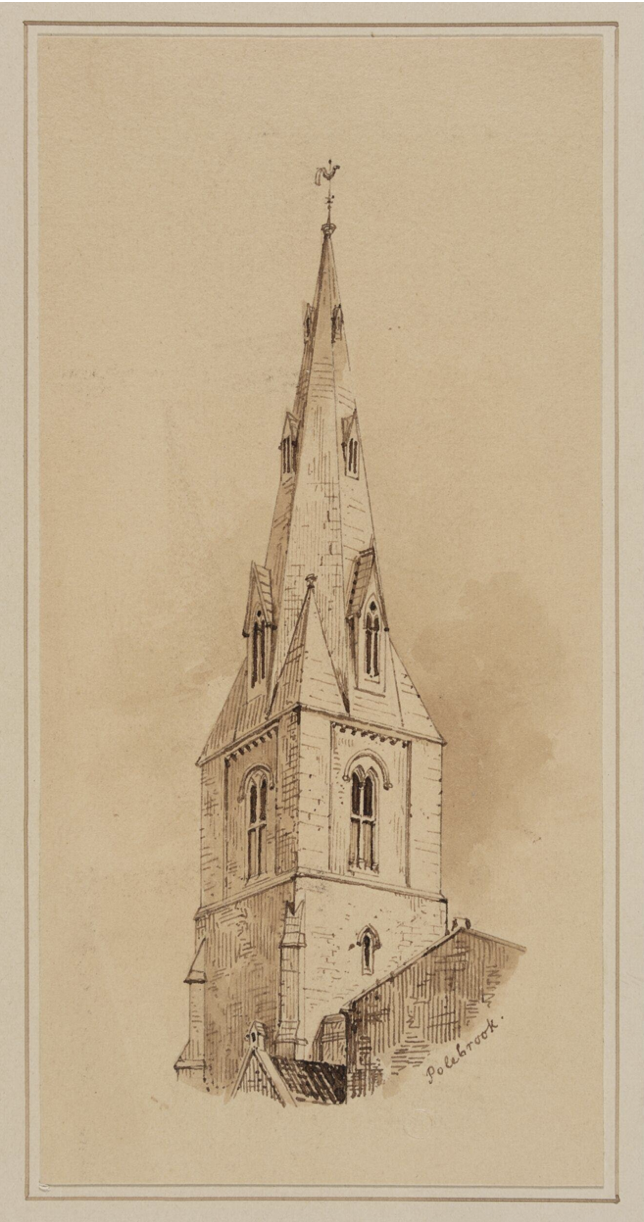
Steeple of Polebrook Church c. 1850 [1]
Between August 1853 and December 1856, Rebecca Butt walked up to that church three times, and each visit added another line to the register: her daughter Elizabeth's baptism, with the father's column left blank [2]; her own wedding to William Seth, in September 1856 [3], her name set down beside a husband's and marked with a cross because she could not write it herself; and her son George's baptism three months later, the column blank again [4]. Three entries in a little over three years: a marriage and two blank columns, one of them, this time, with a word attached. And in a community that size, nothing set down in that book stayed inside it.
This is the frame Rebecca Butt's life has to be read inside: not a private history that happened to leave some public traces, but a life that was, from the moment she first appears in the record as an adult, conducted almost entirely in public, watched by neighbours, entered by clergymen, and governed by a law rewritten in the very year of her birth to decide, in unusually blunt terms, what an unmarried mother owed the parish and what the parish owed her.
By the time Rebecca Butt was a grown woman, the choices open to her had narrowed almost to a single point. She was a marine pensioner's daughter in a small Northamptonshire village, a lacemaker by trade, unable to write her own name, and by May 1856 she had borne two children with no husband and no father named to either. The small respectability of her father's pension and her own skilled work counted for little against that last fact. In the England of the 1850s the combination was close to a sentence. That same law, rewritten the year she was born, made a woman in exactly her position carry the whole cost and the whole shame of an illegitimate child alone, and to make the workhouse the fallback when she could not, and Rebecca now carried that cost twice over. Marriage was very nearly the only door left, and marriage to a woman already encumbered with two children, not one, was harder still to come by.
She began, as everyone did, in a register. On 20 April 1834, in the parish church of Polebrook in the flat country south of Oundle, Samuel Butt and his wife Sarah brought a daughter to be baptised. They named her Rebecca, and the rector, Charles S. Isham, entered her into the register. [5]
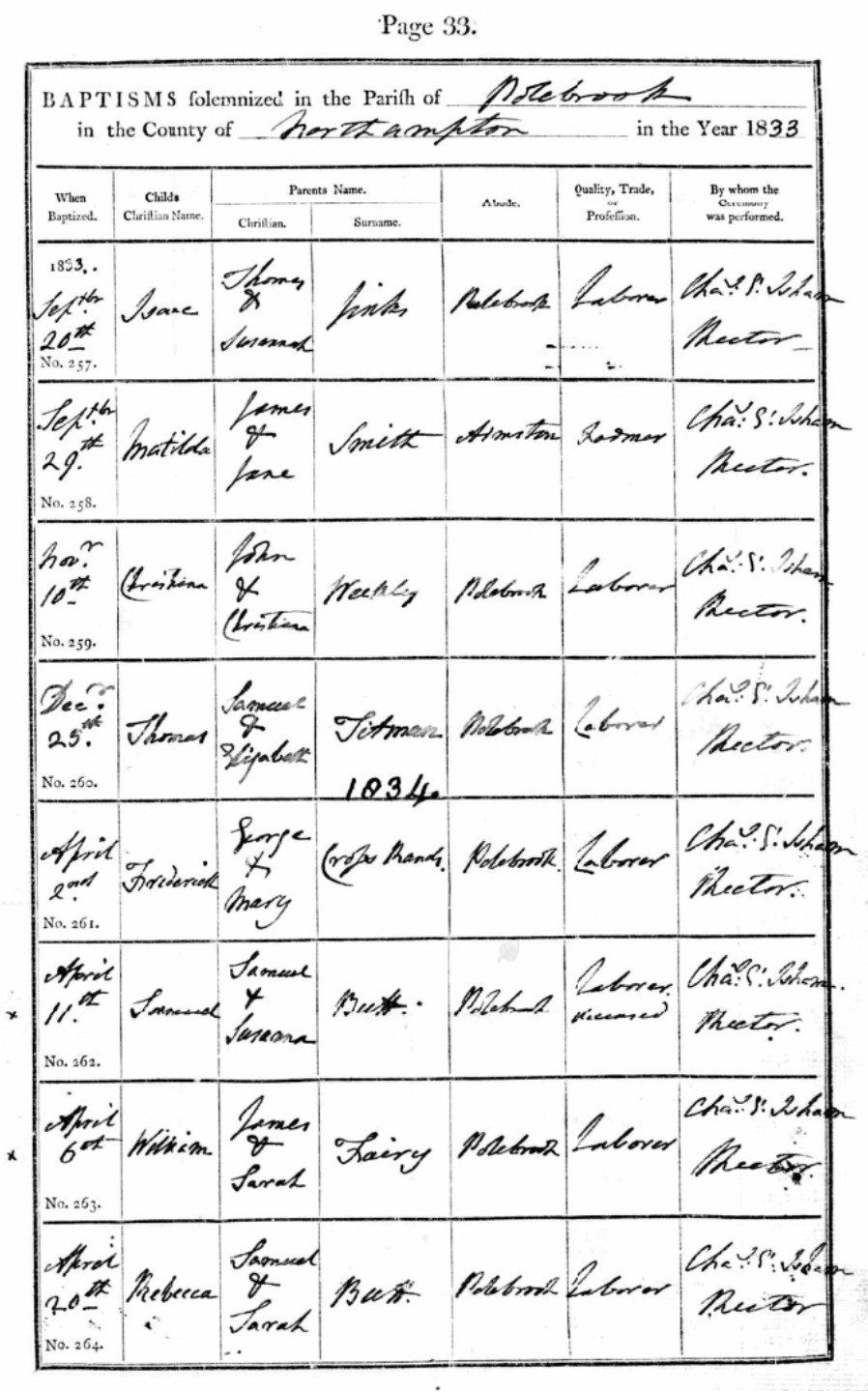
Rebecca’s baptism record [5]
She grew up carrying the name of an elder sister, born in 1819, who had died within the year [6]. She was the second daughter given that name; the first had not lived to keep it. She was not the only child the family lost. A firstborn son, Francis, had died in infancy before her [7], and a younger sister, Lucy, born in 1838, lived only weeks [8]. Three infant deaths, in a family of nine children [9].
Samuel was not just a landless labourer like most of his neighbours. As a young man he had served in the Royal Marines through the war against Napoleon, and had come home to Polebrook with a gunshot wound that left his arm lame [10] and a pension of ten pounds a year [11]. Ten pounds does not sound like much, and it was not, but it was well over a third of what a farm labourer could earn in a year of full work [12], and unlike a labourer's wage it came whether or not a man's arm would let him work. It was this fixed sum, as much as anything, that set the household a notch above the day-labouring poor: not a wage, which stopped with the work, but a floor beneath the family that stayed put. Sarah, born about 1795 in Woodford [13], a few miles off, had married him at Polebrook in December 1816 [14] and never left the parish again. Samuel's own father, William, had been born in Polebrook in 1757 [15], so by the time Rebecca was born the Butt family had been fixtures of the parish for the better part of a century, and the registers show little more than that: one baptism after another entered in the same church, a family rooted in a single place rather than moving with the work as so many labouring families did.
Rebecca grew up inside a family a little more secure than most of those around it, though never far from the edge. Her father was alive through her early childhood; the 1841 census finds the household at Polebrook, Samuel with the pensioner's notation against his name, Sarah beside him, and Rebecca among the children at seven years old [16].
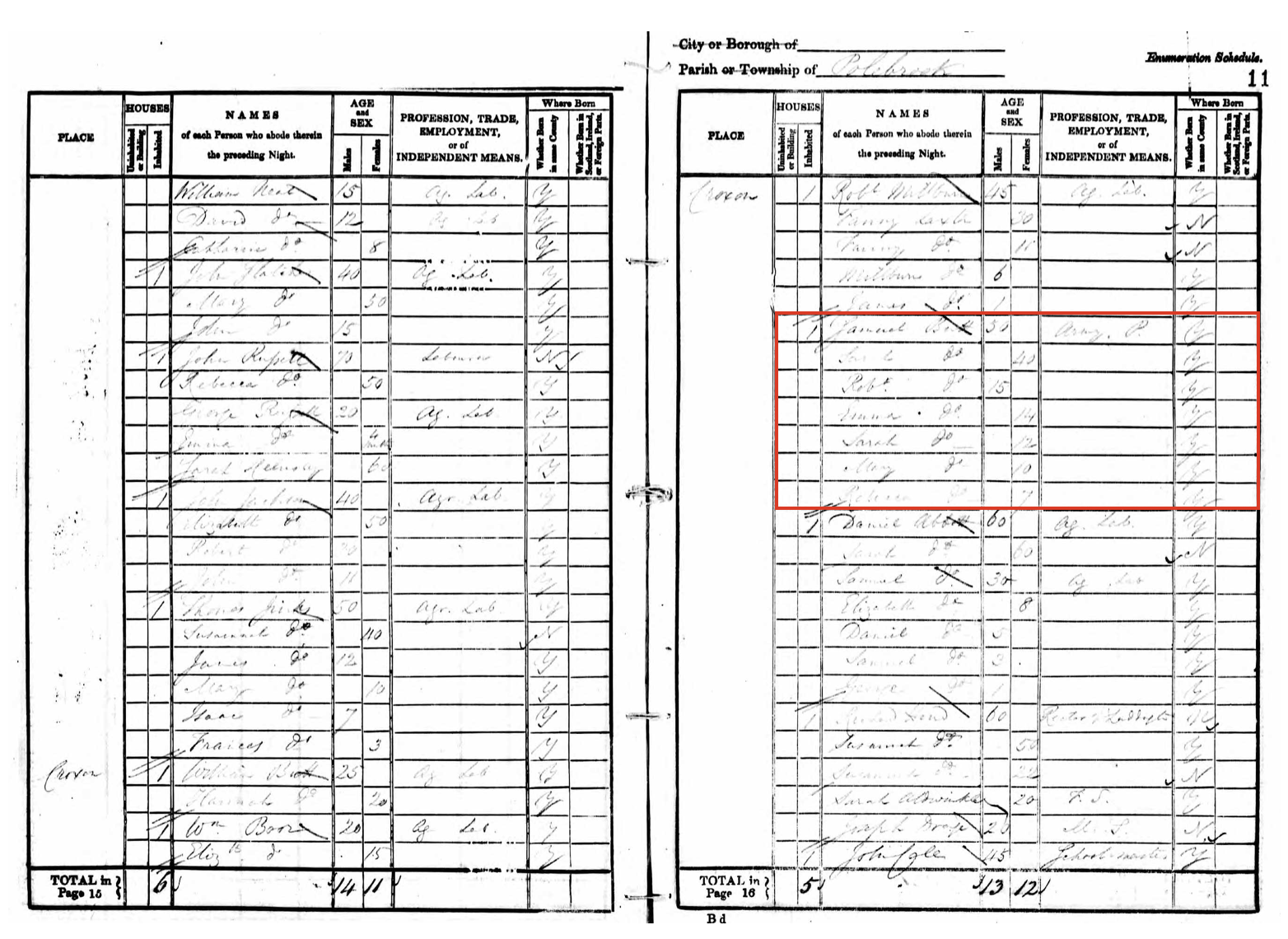
1841 Census - Butt Family indicated by red box [16]
He died in July 1848 [17], when Rebecca was fourteen, and the pension died with him. The household did not merely lose a father; it lost the fixed ten pounds a year that had stood, for more than thirty years, between the Butts and the pure hand-to-mouth of day labour, the equivalent of half a working wage gone at a stroke.
By 1851 the household head is Sarah, aged sixty-one, with three unmarried daughters under her roof: Emma, twenty-four; Mary Ann, nineteen; and Rebecca, seventeen, living next door to the widower Thomas Milbourne and his young family. The younger Butt daughters are entered under a single occupation running down the column: lacemaker. An eight-year-old girl named Lucy is entered in the same household too, not as a granddaughter but as a lodger, Emma’s daughter, and so Sarah's own grandchild and Rebecca's niece, kept at arm's length on the page even as she was kept inside the house [18]. By 1851, whatever cushion Samuel's pension had given the family was gone, and lace was the trade that had taken its place.
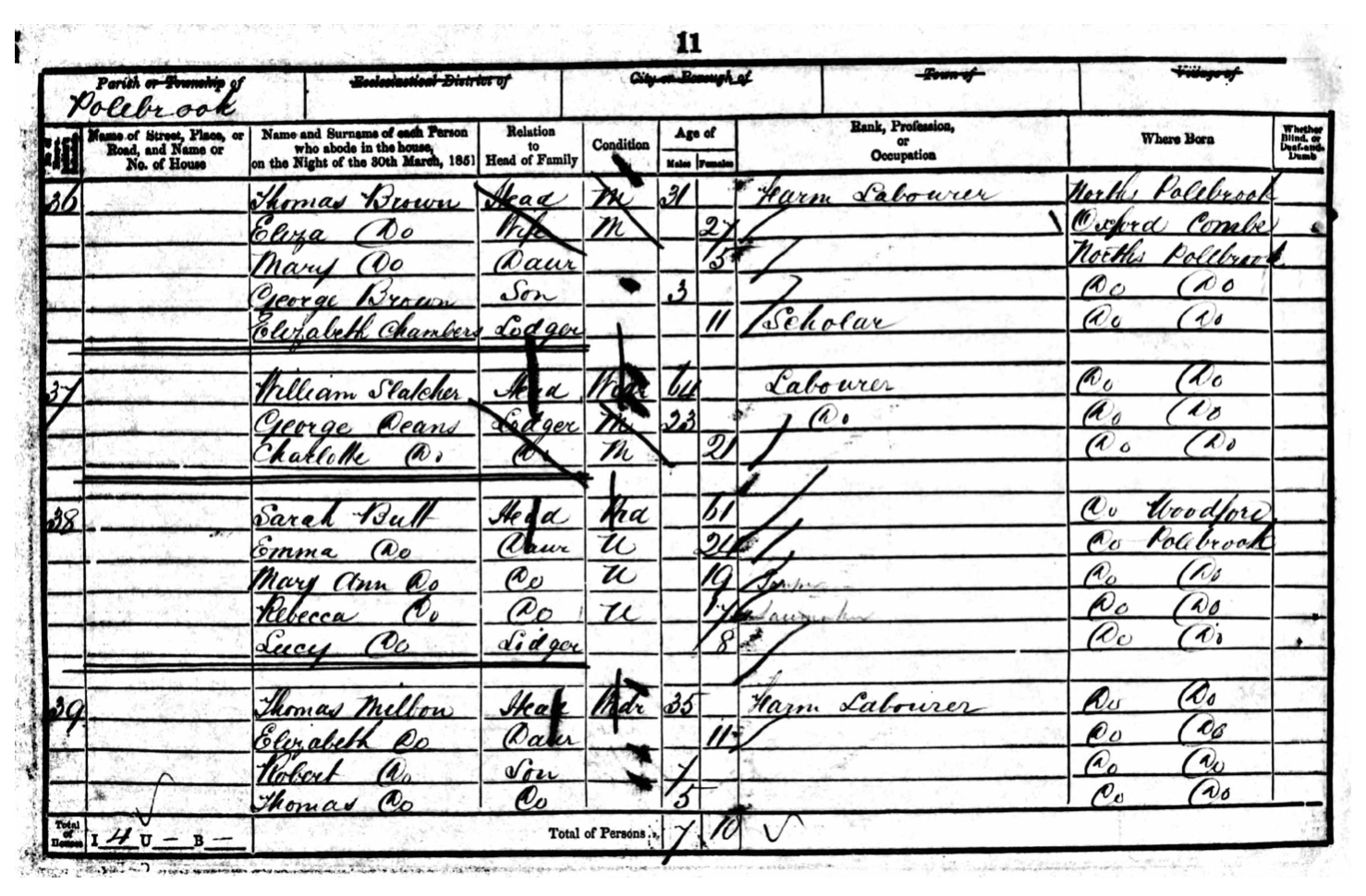
1851 Census [18]
Emma had borne an illegitimate daughter, Lucy, in 1843 [19] and kept her, marrying nine years later. When Rebecca, a decade after Lucy's birth, found herself in the same position, she was repeating something her own family already knew, not stepping into it blind. This kind of continuity has been described, in the historical literature on illegitimacy in English villages, as the mark of a "bastardy-prone" family: not a moral failing peculiar to one woman but a pattern that recurred across sisters and generations in particular households, often poor ones, often where the mother's own mother had known the same [20]. Rebecca grew up in a house where an illegitimate child was a known quantity, not an unimaginable disgrace. That is a different thing from indifference, though, and the record cannot reach far enough into feeling to say how the family truly took it. What it does show is enough to soften any picture of Rebecca as a woman facing something wholly unprecedented.
Illegitimacy itself was not an outlying phenomenon in these years. By the middle of the nineteenth century just under seven per cent of births in England were born outside marriage, the proportion falling across the Victorian decades but still persistent, and in agricultural districts it ran higher than the national figure. In the Oundle district, where Rebecca lived, better than one birth in ten was illegitimate [21]. It was not evenly distributed across society: it clustered in poorer households, in places where women's work was insecure and men's wages uncertain, and it often recurred within the same families [22]. What marked Rebecca's position was not that she bore an illegitimate child, but that she did so under a legal system that had stripped away most of the older means by which its cost might be shared.
The wider parish would not have been indifferent. Polebrook in these years was a village of a few hundred souls, the kind of place where the enumerator counting heads in 1851 was counting neighbours he had known all his life. In such a community nothing about a birth stayed private. Everyone knew whose daughter had gone away and come back, whose child carried no father's name, which households the pattern ran in. A blank in the paternal column of the baptism register was not a discreet administrative gap; it was a public fact, read and remembered by the same people among whom a woman had to go on living, marrying, and raising the child. What Rebecca faced, and what Emma had faced before her, was shaped both by that visibility as much as by the law.
Behind that visibility sat another structure, one that decided where a woman like Rebecca belonged when she could no longer keep herself: the law of settlement. Every person belonged, in the eyes of the poor law, to a particular parish or union, and it was that place, and that place alone, which was obliged to relieve them if they fell on hard times. Since the Poor Removal Act of 1795, simply being poor, or even likely to become poor, was not enough to trigger this obligation; a person had to actually become "chargeable," meaning they had genuinely applied for or required relief, whether through illness, lost work, or a birth with no means to support it, before the parish of settlement bore any responsibility [23]. An unmarried mother without local settlement who became chargeable could be removed back to her own parish, her presence shifted like a liability on a ledger, so that the cost of her and her child fell to whichever parish was legally bound to bear it rather than wherever she happened to be living [24]. This was the machinery that governed a single woman with two children, and marriage cancelled her place in it at a stroke. Rebecca’s wedding in 1856 transferred her settlement to her husband’s parish, fixing responsibility for her and her children in a new place and a new household [25]. It is part of what made marriage not merely desirable but legally transformative: it moved her from a liability the parish might try to remove to a wife whose place was settled.
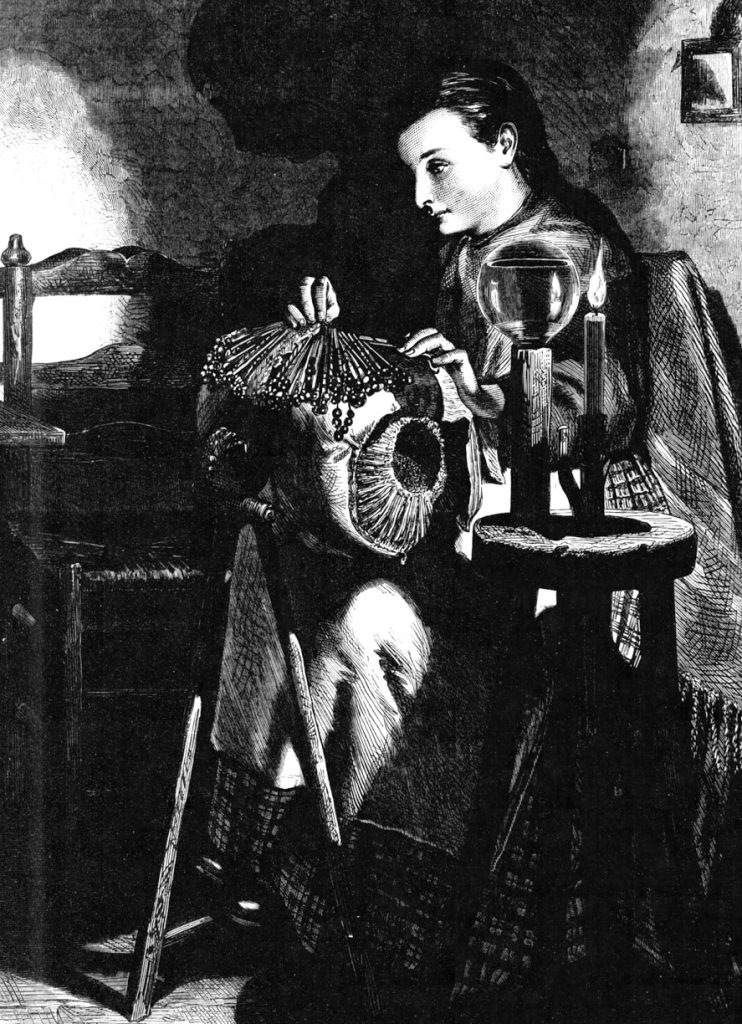
It was shaped, too, by the work that filled her days. When the 1851 census called Rebecca a lacemaker [18] it placed her inside the largest employer of women and girls in the south Northamptonshire villages. Pillow lace was a cottage industry, worked at home or in small "lace schools," and it was neither genteel nor easy. The Reverend Thomas Mozley, who served the lace village of Moreton Pinckney through Rebecca's infancy, left a description of one such school that would have differed little from what she knew: girls sent in from the age of five on a small weekly payment, packed thirty to a small room, kept at their pillows from six in the morning until six at night the year round, arranged in groups around a single candle with water-bottles fixed to concentrate its light onto each child's work [26]. For a year or two a child earned nothing; a skilled woman might make lace that sold in the shops for twenty or thirty shillings a yard [26] and still be unable to clothe her own children or afford to appear at church, because the makers were bound to the dealers on hard terms and obliged to buy their thread from them.
The lace was point ground: the pattern of small flowers and scrolls set on a fine mesh background, each motif outlined in gimp, a thicker thread that lifted the design clear of the net behind it. Everything was made at once, mesh and flowers together, on the same pillow, with pins holding every turn of the thread in place. It was the lace of the region, worked in the villages of Northamptonshire and across into Buckinghamshire and Bedfordshire [27]. Lacemaking was almost always done to singing, and Rebecca and her sisters will have sung too [28].
The work ruined eyes and bent backs, and it was paid in coin so thin that mechanised lace from Nottingham was already undercutting it out of existence [29]. A lace-maker who could earn ten shillings a week in the trade's better years found by the century's turn that five shillings was as much as most could still command; the machines at Nottingham had not merely competed with the pillow but had halved what it could earn [30]. This was the trade Rebecca was raised to, the fine, patient, ill-paid labour of the lace pillow, and it is worth setting beside the softer Victorian image of the lacemaker singing at her cottage window. The skill was real and the poverty was real, and the second was not much relieved by the first.
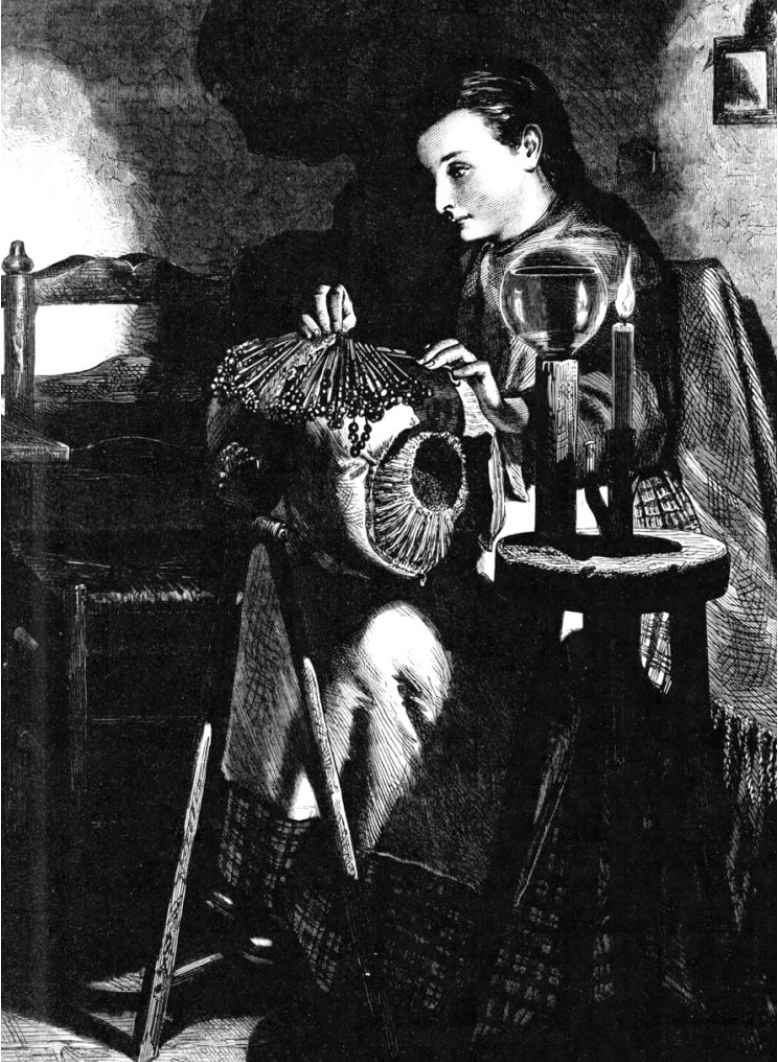
The Pillow-lace Maker” from a picture by James Lobley [31]
Rebecca would have learned the trade as a small child, possibly in a lace school where the teaching was harsh. At Spratton, elsewhere in the county but little different from what a Polebrook girl would have known, a child was set a quota of ten pins a minute and owed an extra hour at the pillow if she fell short by day's end. A girl behind on her count went round the room singing for scraps, "Polly or Betsy, a pin for the poor, / Give me a pin and I'll ask for no more,” and schools sometimes pitted rows of girls against each other in timed competitions, racing the hour-glass on the mantel-shelf to see which row could set its pins fastest. For this the children earned sixpence a day, paid once a month [32].
That world of lace had consequences beyond the purse. The “lace schools” that trained girls in the craft were seldom schools in any broader sense, and time spent at the pillow from early childhood was time not spent learning to read or write. Female literacy was improving across England by mid-century, but in rural districts a substantial minority of women still signed by mark, and among lacemakers the proportion was higher. Rebecca’s cross in the marriage register places her not outside her community but squarely within it, one of many women whose labour required skill of the hands rather than the pen.
The New Poor Law of 1834 arrived in the same year as Rebecca, and it reached directly into the lives of women like her. [33] To feel the force of what it did, it helps to know what it undid. Under the old poor law that governed the decades before her birth, a putative father was pursued. A single woman who bore, or was about to bear, a child likely to fall on the parish could be examined on oath before the magistrates and name the man; a warrant would issue, and he could be bound to indemnify the parish and to pay a weekly sum for the child's maintenance [34]. The system was uneven, and its instinct, however imperfectly realised, was that a father owed his child money, the parish standing good for the sum in the meantime. In Northamptonshire itself, on the eve of the 1834 reform, most parishes that reported the amount gave a mother of a chargeable bastard one shilling and sixpence a week, a modest sum that put the county among the less generous in the country; even that was recovered from the father where the parish could manage it, and fell on the rates where it could not [35].
The reformed law of 1834 reversed that logic entirely: not the father but the mother would now answer for the child. Its bastardy provisions threw the whole cost and shame of an illegitimate child onto the mother. The father was absolved. An illegitimate child became the mother's sole responsibility until the age of sixteen, and in the language of poor relief she was placed in the same category as a widow, expected to keep herself and her child or else enter the workhouse [36]. This was the law in force when Rebecca's own children were born, and it named her, specifically, as the one who owed their keep.
The men who framed the change did not hide its purpose. The point was restraint: to make illegitimacy so burdensome and so disgraceful that fewer women would risk it. The reasoning was that shame, applied to women and to women only, would work where the older pressure on fathers had failed. Lord Althorp told the Commons that requiring mothers to maintain their own children was a benefit to the female population; the Times, that same year, judged existing relief oppressive to the parishes and detrimental to female morals across England [37]. The candour is worth preserving, because it shows the design was not an accident of drafting. Whatever one makes of it now, the effect on a labouring woman, like Rebecca, with a child and no husband was concrete: the father owed her nothing the law would readily enforce, and the parish owed her only the workhouse [38].
Marriage itself did not stand open on equal terms. In rural England the balance between men and women was often uneven, shaped by migration and by the differing demands of agricultural and domestic labour. Women with children faced a narrower field still, competing in effect at a disadvantage in a market that preferred youth, health, and the absence of encumbrance. That Rebecca married at all, and as quickly as she did, places her among those who succeeded in a system where many in her position did not [39].
A softening came in, when Rebecca was ten years old. An amending act gave the mother a route back to the courts, allowing her to apply for a maintenance order against the father. But the route was narrow. She had to name him and prove her claim with corroborating evidence, and the cost and difficulty of doing so made the remedy, in practice, close to useless for most of the women it was meant to help [40]. For a woman whose child's father could not be named at all, whether because he would not own the child or because owning it was impossible, the 1844 door was no door. It would still be closed to her a decade later, when she stood at the font twice with no father's name to give.
Behind all of this stood the workhouse. The reformers of 1834 had meant it to. Their system was built on deterrence: relief in one's own home, the outdoor relief that had cushioned the labouring poor for generations, was to be cut back for the able-bodied, and the real offer to a pauper who could work was increasingly the workhouse and nothing else. Conditions inside were designed to be worse than the meanest independent labour, so that only the truly desperate would accept them, and the unmarried mother was a particular target of that logic. She was not to be comfortably maintained in the village; she was to be made an example, and if she could not keep herself and her child by her own effort, the workhouse was where she and the child would go [41]. How the prospect felt to a poor Northamptonshire woman can be heard in the words of a thirty-six-year-old widow of the neighbouring lace villages, who stood before the Brackley magistrates in February 1857 charged with failing to maintain her four children. She described a stark choice between gaol and the workhouse, and said she would rather die under a furze bush than go into the latter, where a mother was parted from her children and might see them at meals but not speak to them [42].
Yet the workhouse, for all its looming presence in the sources, was not the only resource the poor possessed. Survival rested as much on kin and neighbour as on law. Households stretched to take in children, as Sarah Butt’s had done; lodgers were folded into domestic economies; food, care, and small sums moved across doorsteps in ways the record rarely captures. These networks did not remove the pressure the law applied, but they could soften its edge, and it was within such arrangements that many women managed to remain outside the workhouse altogether.
The workhouse was not the darkest of the roads a cornered woman could be driven down. The same reform that stripped the father of liability had helped feed, in the towns, a trade that exploited the desperation the Bastardy Clause manufactured: the plight of a mother who could neither keep her child nor earn with it in her arms [43]. It was the trade the Victorians came to call baby-farming: women who advertised in the newspapers to take an unwanted infant off a mother's hands, for a weekly sum or a single lump payment [44], and some of whom had no intention of keeping it alive [45]. Infants passed this way were kept quiet on cheap opiates and thin milk [46], and when they died, as they were meant to, their small bodies were wrapped in newspaper and left in a street or a river [47]. Rebecca was a village woman, not a city one, and nothing in the record suggests she ever came near such a fate. But it stands in the history of her time as the far edge of what her position could mean, the road that other women, trapped as she was, were driven down. Yet she kept both her children and found another way. Women in the same bind, and no less determined, lost theirs.
The danger was not only economic. For a woman of Rebecca's class the years of her fertility were years of physical risk: childbirth before antisepsis or reliable help killed women routinely, and there was no dependable way to prevent a pregnancy [48]. The Victorian ideal that fixed a woman to the home was in part a response to these brute facts, less a sentiment than a survival arrangement, marriage offering a woman the protection of a household and a wage across the very decades when her body was most exposed. For Rebecca, who had already borne two children outside marriage, that arithmetic pressed harder still.
Against that, marriage was not merely desirable but nearly the only means of stability the system left to a labouring woman with a child. A husband meant a wage, a settlement, a household, a name for the child, and distance from the workhouse gate [49]. This is the structure beneath Rebecca's life in the middle 1850s. It is worth stating plainly what it does and does not tell us. It does not tell us what Rebecca felt, or what she decided, or why. It tells us the shape of the cage she was standing in: a legal and economic space arranged so that an unmarried mother carried everything, a father who stayed silent carried nothing, and the workhouse waited for anyone who could not carry enough [50]. Everything that follows in her story happened inside that cage.
By the record's account Rebecca bore her first child, Elizabeth, around 1853. The baptism at Polebrook names Rebekah Butt as mother and leaves the father's column blank [2]. Three years later came a son. George William was born on 26 May 1856 and baptised at Polebrook that December, and his register entry too leaves the space for a father empty [4]. Two children, then, across three years, both illegitimate on the face of the record, both carrying their mother's surname.
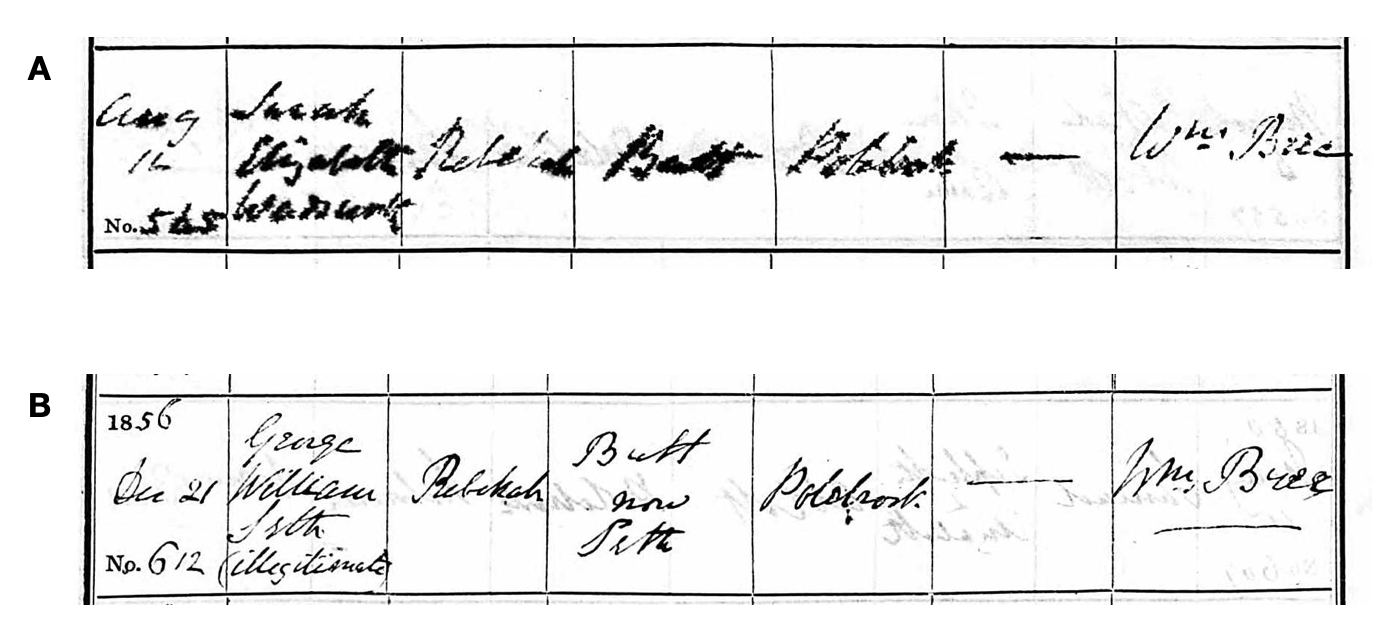
Baptism records for (A) Elizabeth Butt and (B) George Butt [2,4]
Rebecca's life becomes more legible when set beside the wider family network around her. George's father was a Milbourne, and the man in question was most likely Thomas, not his brother John, who lived some miles off at Cotterstock and left no trace of ever being in her sphere [51]. Thomas was no stranger to her. By 1852 he had become her own brother-in-law, marrying her sister Emma [52], and it was within that marriage, not outside it, that George came to be conceived. Emma bore Thomas four children in the years bracketing George's birth, Samuel, Sarah, and Jane, the eldest arriving in 1852 and the third in the same summer George himself was conceived [53], with a fourth, Hannah, following in 1857 [54].
Whatever passed between Rebecca and Thomas in the summer of 1855, it did not happen between strangers. It happened inside a household she could not have avoided even had she wished to, at a gathering, a doorstep, a shared wall between next-door lives, with a man some eighteen years her senior who by then had children of his own scattered across two marriages and a wife of his own expecting a child within weeks of whatever passed between him and her sister.
Nothing in the record says what that was between them. It may have been a passionate hidden liaison. It may have been coercion dressed up afterward, as silence. A woman in Rebecca's position, with a man that much older and that firmly settled at the centre of her family's life, may have had little real power to refuse him, whatever the shape of what passed between them. What the record shows is only this: that Rebecca carried both children's cost and stigma alone.
Emma had borne Thomas's third child only weeks before, or within weeks after [53]. Rebecca's silence carries a weight no ordinary illegitimacy case would have. Emma's marriage to Thomas had created a relation of affinity that gave any connection between him and Rebecca a particular legal and moral danger. The Church of England treated a wife's sister as within the prohibited degrees, and the Marriage Act 1835 had made any marriage within those degrees absolutely void from the outset, a bar not lifted until 1907. Marriage between them was therefore impossible in life and would have remained so had Emma died [55]. That made whatever had passed between Rebecca and Thomas not merely socially scandalous but legally and ecclesiastically transgressive, and it goes far to explain why no father was ever named for George in any official record. A bastardy proceeding would have required Rebecca to name the man under oath, bringing into the open both the adultery and the incest by affinity that the law and the church alike recognised as serious wrongdoing, and to do so in the same small parish where her sister was, at that very time, raising his children. In that setting, the absence of a paternal name is not a gap in the evidence so much as a predictable product of the social and legal risk involved. It is exactly the kind of silence that would be expected where any public acknowledgment of paternity would have risked exposing an adulterous relationship, and one that was incestuous by affinity as well, whether what lay behind it was chosen by both or by only one of them. No one else's name was ever asked for. No one else's was ever given.
On 15 September 1856, less than four months after George's birth, Rebecca married William Seth at Polebrook, by banns [3]. The marriage was solemnised by the curate William Bree, the same man who would christen George that December and enter him, and his mother, as "Rebekah, Butt now Seth" [4]. William was a bachelor and a labourer of the parish, entered as the son of Thomas Seth, baker; she was recorded as Rebekah Butt, spinster, daughter of Samuel Butt, labourer. The whole entry is in the curate's hand, as are the others on the page; only Rebecca's carries a cross, in the space where her name should have been, with "her mark" written around it. The two witnesses were Thomas Milbourne and Matilda Russell.
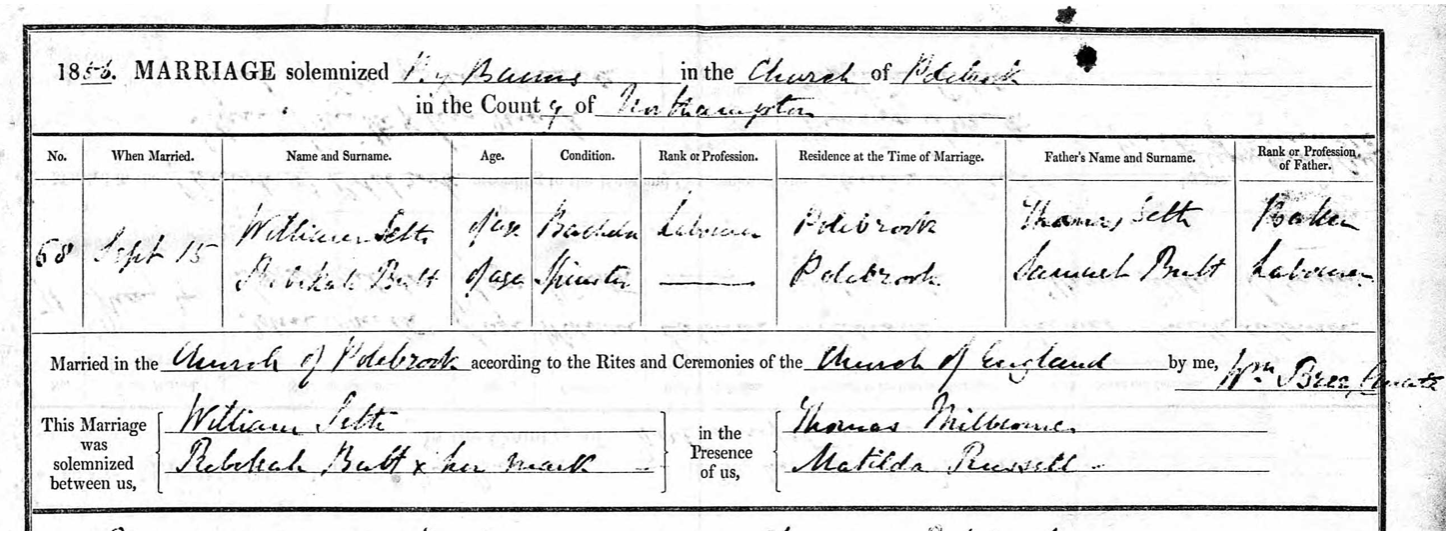
Rebecca Butt’s Marriage Record [3]
Thomas Milbourne stood as a witness that day. Less than four months after bearing his child, Rebecca stood at the altar to marry another man, and the man argued to be her son's father stood beside her as she did it, witness to the marriage that would give the boy a different name and a different story. Whether his presence was an act of quiet acknowledgment, a family closing ranks around an arrangement everyone privately understood, or nothing more than the ordinary fact that a sister's husband was on hand to witness a wedding, the record cannot say. But the coincidence, if it is one, is remarkable: the two people who between them had the most to keep hidden stood at the same register on the same day, and then went on living a few miles apart for the rest of both their lives, Milbourne settled with Emma and their children, Rebecca never far from either, without his name ever once appearing against the boy.
The speed of the marriage is the first thing to notice. A woman with one illegitimate child and now a second, exposed by the 1834 law to the full cost of both, had powerful reason to regularise her position, and marriage was very nearly the only means the system left open to her. Most mothers of illegitimate children who married did not marry the father. And a woman who kept her children was markedly less likely to marry at all: nearly half of the mothers with two or more children living with them never married, against about one in ten of those whose children had died or been taken in elsewhere [56]. Rebecca kept both of hers, and married regardless. The pressure the law created is likely part of what drove the marriage, but it would be wrong to state it as her motive, and it says nothing of William's.
He had reasons the register cannot recover, though it hints at where he stood. Entered on the marriage record as the son of Thomas Seth, baker, William cannot in fact be tied to any such father. The only baptism that fits him, at Lutton in May 1835, gives a single parent, Mary Seth, and leaves the father's column blank, and no William Seth born to married parents appears nearby to take its place [57]. By 1841 the boy was in the Oundle Union workhouse [58]. He had come into the world, in other words, exactly as Rebecca's own two children had, illegitimate and fatherless on the page, and had already been inside the house the New Poor Law held in reserve for people like them. A more respectable suitor might have balked at a woman with two children and no husband; William had been that child himself, and knew better than most where her road led if no one married her. The house waiting for Rebecca and the children was the one he had been inside as a boy. The record does not say what passed between them. It does say they married within four months of George's birth.
Marriage changed the shape of Rebecca's life. Whatever had pressed on her before, the household that appears in the 1861 census is a settled one: William Seth, agricultural labourer, aged twenty-six and born at Lutton, with Rebecca his wife, aged twenty-seven and born at Polebrook. Elizabeth is there too, entered as a boarder and still under her mother's old surname of Butt, aged eight; George appears as a Seth, aged four; and two younger Seth boys, Robert aged three and Edward aged one, complete the household [59]. More children followed through the 1860s: Martha, Emma, and a John Thomas baptised at Lutton in 1866 [60].
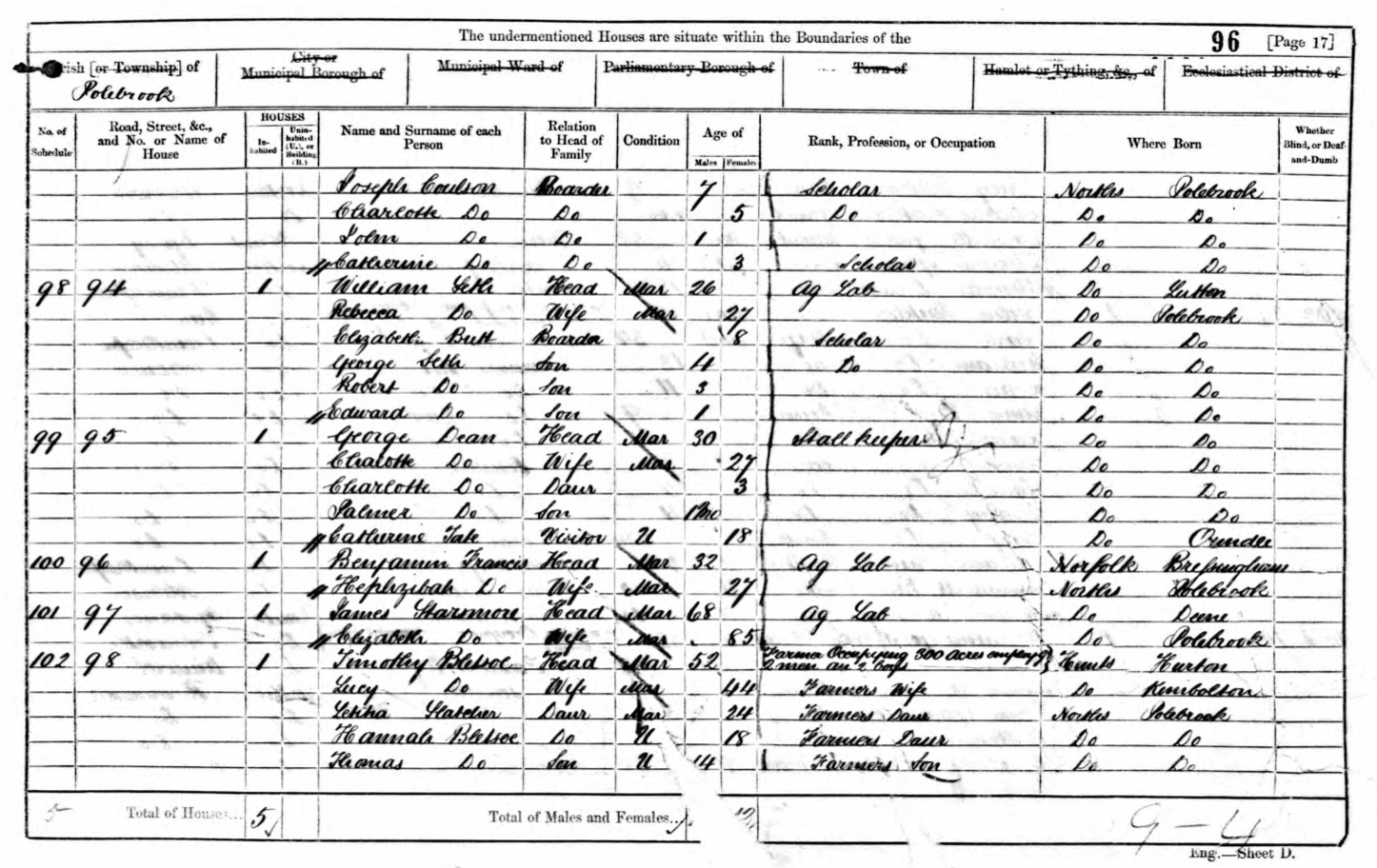
1861 Census [59]
An agricultural labourer’s wage in these years was modest and uncertain, and subject to the seasons, with winter bringing underemployment or none at all [61]. Earnings could be supplemented by irregular work, by the labour of wives and children, or by recourse to parish relief at the margins [62,63]. A labourer’s household could be stable without ever being secure, and the difference between the two was felt most sharply when illness, drink, or a run of poor employment tipped it out of balance.
John Thomas's baptism60 marks a move. By the middle of the decade the family had left Polebrook for Lutton, William's home ground, a few miles east across the same flat clay country toward the Huntingdonshire border.
Lutton was a smaller place than Polebrook, and a stranger one on the map. Where Polebrook counted some five hundred people, Lutton held fewer than two hundred, and the parish straddled the county line, part of it in Northamptonshire and part over the border in Huntingdonshire, so that a single village answered to two counties at once. For the purposes that touched a family like the Seths, though, the division made little difference: the whole parish lay within the Oundle registration district and the Oundle Poor Law Union [64], the same jurisdiction that would end up dealing with this family's troubles in the years ahead. It was a small parish and getting no larger: something over a hundred and eighty souls, in fewer than fifty houses, on some fifteen hundred acres of which the manor and the living alike belonged to the Fitzwilliams, the great landowning family of the district. It was the kind of village where a few hands held most of the ground and the rest of the parish worked it. Much of that ground had been enclosed and hedged into private fields long before, and what open field remained, three large fields in the west of the parish, was being divided up and fenced by Act of Parliament in the mid-1860s, in the very years the Seths arrived, so that the last of the old common land was going under the plough as private holdings just as Rebecca came to live on it [65].
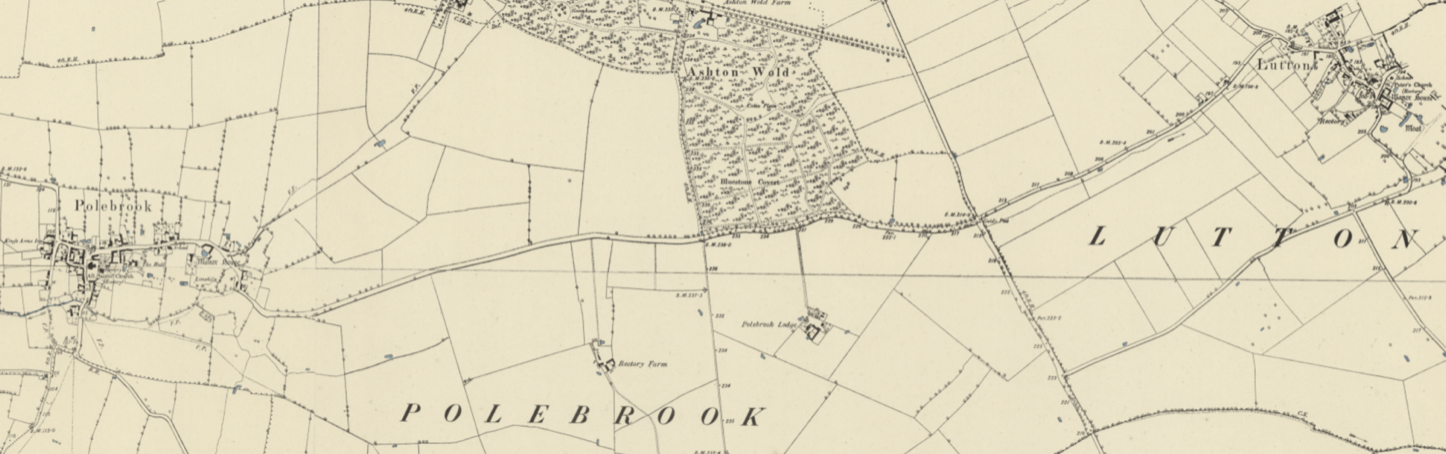
Polebrook and Lutton villages, some three miles apart across the flat clay country south of Oundle [66]
Work, marriage and kin drew labouring families between parishes, and very likely drew this one. Whatever settlement question the move might once have raised had been settled a decade earlier: marriage had transferred Rebecca's settlement to William's in 1856, and by the mid-1860s the old machinery of removal had in any case been loosened, first by long-residence protections and then, in 1865, by a shift of both settlement and cost from the parish to the union [67]. Families shifted between neighbouring parishes, rarely leaving a wide geographic footprint but constantly adjusting their place within it. The move to Lutton was one of these: a continuation, carried along the lines of work and family that structured the countryside.
In March 1867 the gaol committals list William Seth of Lutton, three weeks' hard labour, for leaving his child chargeable to the parish [68]. Five months later it was Elizabeth’s turn before the same bench. A mother with no real say over her own household had even less over a fourteen-year-old daughter, and in the autumn of 1867 that daughter found herself before the Oundle bench. Elizabeth was charged that season, with her half-brother George, for stealing potatoes, and, called a “most incorrigible child”, was sentenced to fourteen days and then four years in a reformatory [69]. The place fell through, the school at Allesley declining to receive her, and when the fourteen days were complete, she went free [70]. Rebecca was alive to see it, her daughter going the way the parish had always half expected an illegitimate girl to go.
The decade was settled, but not quiet in every quarter, and the parish's own records keep that from being smoothed over. William appears in the Oundle petty-sessions columns of the Northampton Mercury more than once, and always for the same weakness. In February 1868 he was committed for fourteen days, in default of a twelve-shilling penalty, for being drunk and refusing to leave the Milton Arms at Lutton; the paper noted he had been a source of trouble to the police, and the county gaol's list of committals for that fortnight records the same man taken in the same week for being drunk and riotous [71]. Later that year he was before the bench again, committed for a month in default of a two-pound penalty, having been very drunk and disorderly at Tansor feast and refusing to leave the White Horse Inn; previous convictions were proved against him [72]. These are small entries, the ordinary furniture of a rural sessions column, but what they record is a labouring man who drank, and who at intervals drank himself into the dock and the gaol, across the years when Rebecca was keeping his house and bearing his children. William, a fatherless boy raised in and out of the workhouse, was not a man the age equipped for steadiness. The drink reads less as a departure from that beginning than a continuation of it. Whether his drinking touched Rebecca, and how, remains unknown.
These appearances in the petty sessions belong to a wider change in rural life, and the change is part of why these insights can be seen at all. The decades after 1840 saw the spread of county police forces, Northamptonshire's among them [73], and with them a closer regulation of behaviour that had once passed with less remark. Drunkenness, disorder, a child left chargeable, a blow struck in a yard: these were increasingly matters for the constable, the bench, and the local paper, written down where before they would have stayed inside the family. The same lives lived a generation earlier would have left almost none of this. What the record catches of the Seth household, then, is not a sign that it was worse than its neighbours' but a rare shaft of light into the kind of domestic life that usually went unwritten.
A different entry reaches Rebecca not through anything she did but through what she was to the people in it: a mother, and a wife. In December 1868, sixteen months after Elizabeth’s potato theft, William was back at the Oundle bench. He was charged with neglecting to maintain an illegitimate child of his wife's. The report is brief but exact in its wording: the girl had gone to the Union just as the Board were leaving and been told to come back, and on the following Saturday had been taken in as a case of destitution. Because it emerged on her admission that her stepfather had in fact given her food on the day she set out for Oundle, the case was dismissed and Seth cautioned rather than punished [74]. The phrase the court used, "an illegitimate child of his wife's," reaches back across the whole of Rebecca's story. The child was Elizabeth.
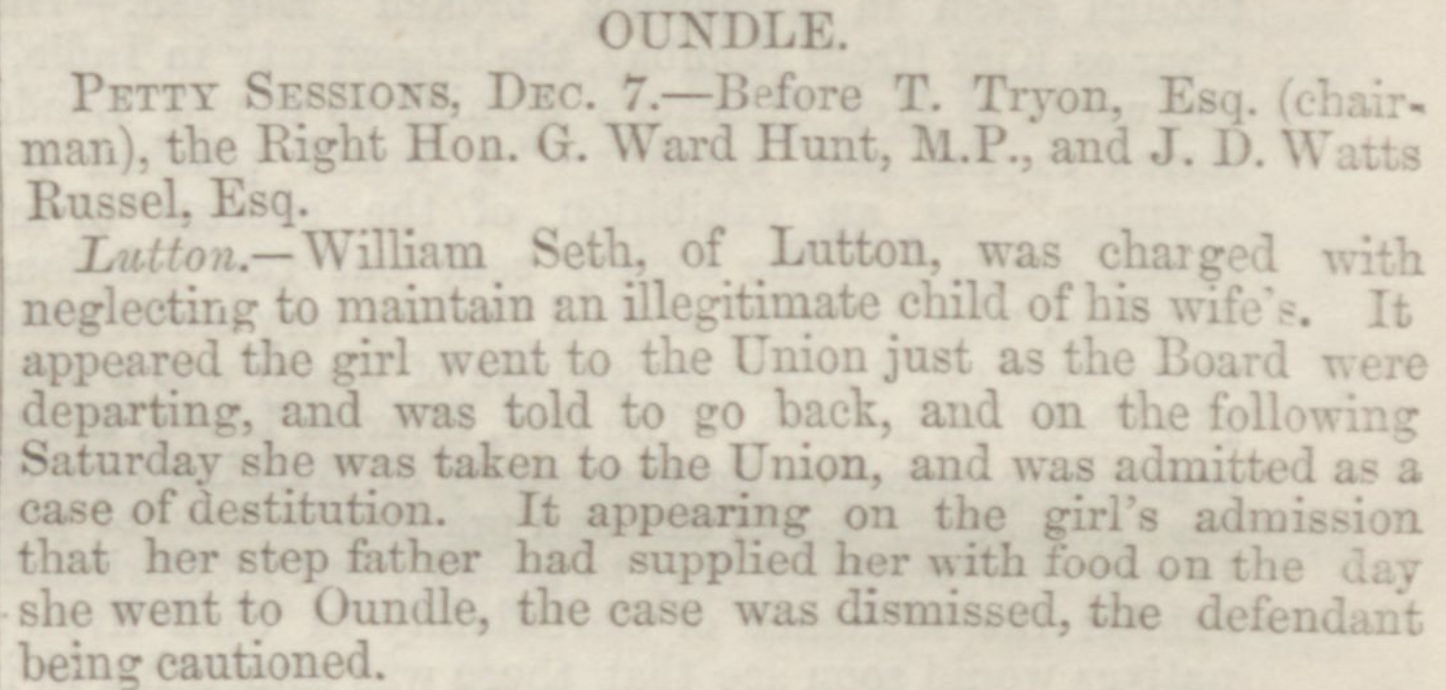
William Seth charged with neglecting Elizabeth [74]
There is an irony in it the record leaves unresolved. The man now before the bench for an illegitimate child left chargeable had been an illegitimate child himself [57], and had known that same Union house as a boy [58]. And the case shows something the wedding never touched: Rebecca's marriage had settled her own position, but it had done nothing for Elizabeth’s, and years later, the difference still mattered. On paper the girl was illegitimate still, fifteen years after her baptism, and it was that unchanged fact, nothing new, that sent her to the Union board and her stepfather to the bench.
That Elizabeth reached that door alive at all is its own small marker. Rural districts like this one generally fared better against infant death than the industrial towns [75], but the pattern reversed sharply for a child like her: research into illegitimacy and infant mortality in this period finds that children born outside marriage died at markedly higher rates than legitimate ones, wherever they were born, a consequence of the same practical bind the 1834 Act had placed their mothers in [76]. Diarrhoeal disease, respiratory infection, and the childhood fevers, measles, scarlet fever, whooping cough, carried off a great many infants regardless of where they were raised [77]; an illegitimate child, dependent on a mother who had to earn as well as nurse, faced them with less shelter than most. What softened those odds, where anything did, was kin and neighbours. That both of Rebecca's children survived their first years to appear in census and court records was not a thing the age guaranteed.
Rebecca herself does not appear in either proceeding, not as complainant, not as witness, not even as the wife whose child was at issue; the record speaks only of William and of the Union board. It is worth asking what room she had to act, in this matter or any of the others being decided over her head in these years. By December 1868 she had another infant close at hand: Emma Jane had been baptised at Lutton the year before [60], and a woman with a child that young, and several more besides Elizabeth still under her roof, was not a woman easily placed to leave a marriage, to report a husband, or to seek redress on her own account, even had the law given her one to seek. It did not. A wife's standing against her own husband in these years was almost nonexistent: she could not sue him in her own name, could not hold property apart from him. The one order the Oundle bench could have made in her favour required that William had deserted her, and he had not. Drunkenness, neglect, a stepdaughter sent to the workhouse door and back: none of it, on its own, gave a wife anywhere to go [78]. Whether Rebecca watched these proceedings with anger, with resignation, or with something she kept from showing at all, the sources do not say. What can be said is narrower and, in its way, harder: whatever she felt, she had almost nothing she could do about it that the law would recognise, and an infant and several other children to feed regardless of what her husband did in the meantime.
Trouble found Elizabeth again eighteen months later. On the night of 10 March 1869 a fire broke out in Mr Blott's stackyard at Papley, destroying a wheat hovel and two stacks of straw; Elizabeth, now sixteen, was apprehended on suspicion of setting it, brought before the Oundle bench, and remanded [79].
None of this showed in the returns the enumerator carried from door to door. The census asked only for names, ages, occupations, and by those categories the Seth household at Lutton looked no different from its neighbours: a labourer, his wife, six children under one roof, the ordinary shape of a rural family. It did not ask about a fortnight in Northampton gaol, or a stepdaughter sent nearly to the workhouse, or a daughter under a reformatory sentence that never quite took hold. The paperwork and the reality were not the same thing. Rebecca had been living the second for the better part of a decade, and by the time the Papley fire brought Elizabeth before the bench again, she had less than a year left. She died at Lutton on 24 January 1870, aged thirty-six, the register giving the cause as diseased heart and entering her as the wife of William Seth, labourer [80].
Rachel Birdett was the informant, a neighbour whose family the following year's census places in the house next door [81]; the entry was made on 26 January [80]. Rebecca was buried at Lutton the next day, the service taken by the rector C. J. Gibbon [82]. The burial register puts her age at forty, four years adrift of the figure her own baptism gives. The Northampton Mercury carried a brief notice of her death on 5 February, giving her age correctly, the same figure the death register recorded [83].

Rebecca’s Death Record [80]
Thirty-six is young. "Diseased heart" was a registration category rather than a diagnosis, and it covered a range of conditions [84]. In these years heart failure commonly followed damage to the valves left by rheumatic fever, an illness of childhood or youth that could take decades to kill; it was not the degenerative disease the phrase suggests now, and its diagnosis was among the hardest in medicine [85]. That the cause was certified means a doctor supplied it rather than the family. What it cannot account for is everything that came before it. By the time she died Rebecca had borne at least seven children, two of them before she had a husband to help support them, and had spent a working life bent over a lace pillow before that, the kind of labour that wore down eyes and backs for a shilling or two a week. She had also kept a household through a decade of her husband's drinking, his fines, his spells in the county gaol, and whatever those absences and that behaviour asked of a wife left to hold the rest together. Whether it was the childbearing, the years at the lace, the strain of the marriage, or simply an illness, there is no telling. We cannot know what those years cost her.
What the register records, quietly, is who was in the room. Not the husband, not a child, but the woman from next door, who signed, as Rebecca herself would have, by mark. Whether she was a particular friend of Rebecca's or simply the nearest woman able to come when called is past knowing. But Rebecca had spent her working life among women doing the same trade, a lacemaker alongside her sister Mary Ann twenty years before [18], and it would be no surprise if women she had worked and lived beside for years were also among those who came to her at the end. What William's absence from the entry amounts to is left open; a man so often in the dock for drink [68,69] may simply have been no help at a deathbed, or may not have been home at all. The document fixes just this: it was another woman, not the husband, who closed the account of Rebecca's life, and she closed it in a hand as unlettered as Rebecca's own.
She left William Seth a widower with a young family, and left her children without the one person who had once stood between them and the world. After she died, the record of Elizabeth darkens further. In September 1872 William was convicted of assaulting a neighbour, Mary Ann Miller, who had come out of her house on hearing a disturbance and was struck in the face with his fist, hard enough to draw blood; another woman pulled her indoors for protection, and an elderly witness said the language had been “most fearful”. Giving evidence, Elizabeth said more than that: he had been beating her too, that same night, inside the house [86]. It was not his first conviction, nor his third, but one more in a pattern of drunkenness and violence reaching back to the earliest years of the marriage. Rebecca was no longer there to protect her children.
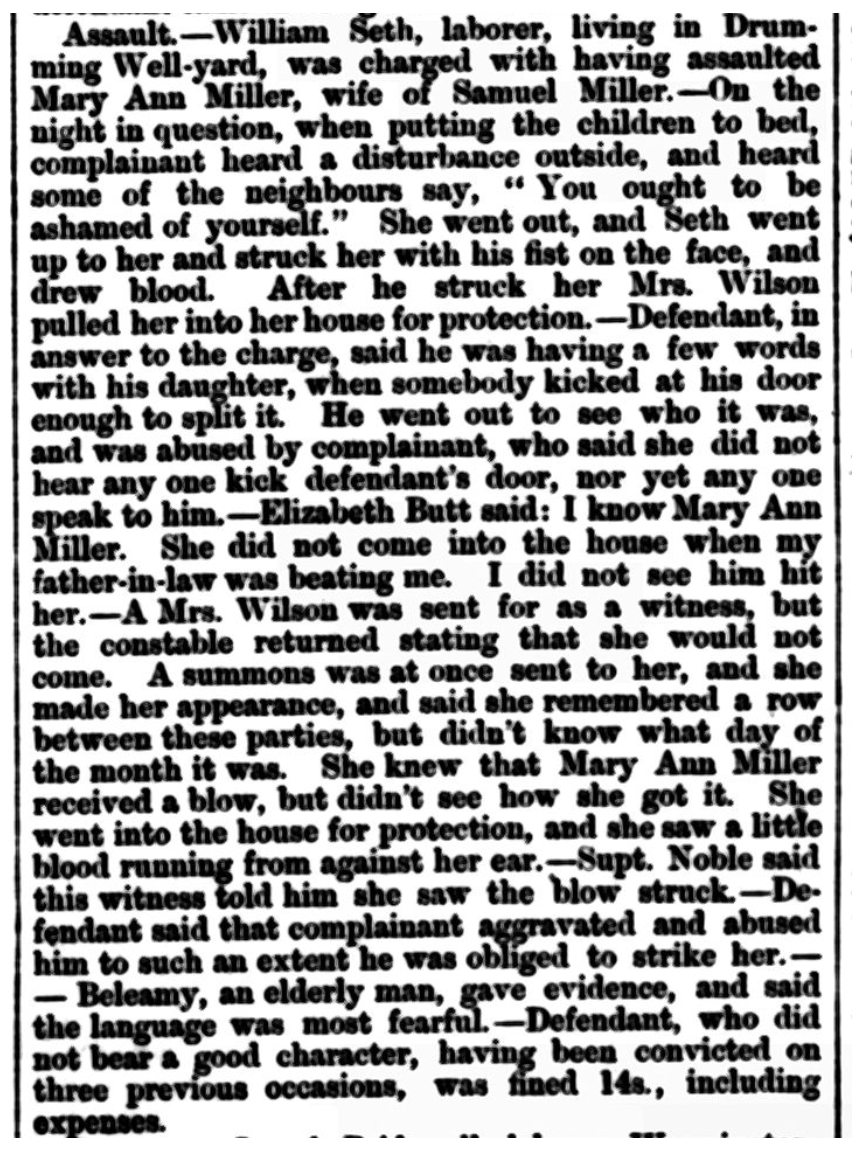
William Seth charged with assaulting Mary Ann Miller [86]
Whether Rebecca could have changed any of it, had she lived, is a question that cannot be answered. She had borne this daughter alone and carried her through the hardest years a mother in her position could face, and watched her, in the last months of her own life, brought before the bench on suspicion of arson [79]. What came after Rebecca was gone she did not see: the girl beaten at home by the man Rebecca had married. Rebecca herself was never marked down as a victim of William's violence; she had died of her diseased heart with a neighbour at the bedside [80], and nothing places his hand on her. But a man who beat the child cannot be assumed to have spared the mother.
And it was not only Elizabeth. Rebecca had held a whole household together, and once she was gone it began to fracture. By 1871 George, fourteen, had gone into service at Barnwell, living in as an indoor farm servant on another man's land [87], the preferable fate for a boy in his position, and perhaps the only alternative to the workhouse. One of the younger Seth girls, born in wedlock, held on longer, but by 1881 she too was a pauper in the Oundle workhouse at thirteen, alone on the page among strangers [88], and vanishes from the record after. William himself is harder to follow. He appears in the 1871 census [89], appears before the Oundle bench repeatedly through the middle of the decade [86,90], and then slips out of the record, whether through death, departure, or a common name too hard to trace.
Rebecca's mother Sarah, by contrast, lived to see another branch of the family endure. Rebecca's elder sister Emma had married Thomas [52], and that marriage created a long-lived household, one that weathered the deaths of several of its children and held together regardless across four decades. Sarah lived out the last twenty years with Emma and Thomas [91], dying under that roof in February 1888 at ninety-seven [92]. The notice of her death counted ten children, forty-six grandchildren, seventy-three great-grandchildren and ten great-great-grandchildren: 139 descendants in all [93].That kind of endurance was denied to Rebecca, who left behind not a settled lineage but a set of children trying to find their own footing.
Both Elizabeth and George lived to marry, and each, coming to it, faced the same empty space where a father's name should go. Neither left it empty. Elizabeth entered hers as St Swithin Wadsworth Butt, farmer [94]. The sainted forename and the farmer's standing were invention, unfounded in any record that survives, but the Wadsworth was not new: it was a name Rebecca herself had given the child at the font [2], found nowhere else in the family and carried by no one but Elizabeth, and now built into the father she supplied for herself. George, marrying at Oundle two years before, had done the quieter version of the same thing, borrowing a real Polebrook farmer's name to fill the space where the truth he did not have belonged [95]. Between them, independently, they arrived at the same answer to the same inherited blank: not silence, but invention.
Rebecca bore two base-born children and answered for both, named in every register, marked in the parish's memory, held by the law to the whole cost of their keeping. The men in the same story answered for none of it. Elizabeth's father is not so much as a name, unless it is the Wadsworth that Rebecca gave the child at the font, and perhaps set there to mark him; if so, it is the only trace of him there is, and it names nothing that can be followed. Milbourne, if the evidence is read rightly, had fathered a child with his wife's sister and then stood as a witness at the wedding that closed the matter, and no register ever set his name against the boy. William, who unlike either of them had broken the law outright, drunk and riotous and violent by turns, was fined and gaoled a fortnight here and a month there and otherwise left to himself. The law framed to restrain immorality bore down on the one person in the story who had done nothing worse than bear children, and left the rest of them to their own devices.
What is known of Rebecca is little, and none of it is happy. She was born poor in a parish that had rewritten its poor law the year of her birth, and she lived the whole of her short life inside the cage that law had built for women like her: made to carry two children alone that it excused their fathers from, driven toward a marriage it left her small room to refuse, and held there, through a decade of her husband's drinking, until her heart gave out at thirty-six. She did not escape it, and she was not meant to. The law had been written precisely to hold women in her position exactly where she was held, and it held thousands of them, most now beyond recovering, their names in no register anyone has thought to read. Rebecca is one who can still be reached, not because her life was different from theirs but because a single thread of it ran down the years to someone who went looking. She never learned to write her name; the cross she made at her wedding is as close to her own voice as the record comes. That it can be set down now changes nothing for her. What it does is let one of those lives be seen entire, and stand for the many that cannot.
Explore further…
Rebecca Butt appears in the Paternal Grandfather family tree, which traces the full Butt line through Polebrook and Lutton.
Her son George William Butt is the subject of Quietly Rooted, the biography that follows his journey from agricultural labourer to school gardener.
Rebecca died at thirty-six, one of the shortest lives in her generation of the direct line. Her death sits within the broader Death and Mortality data, which charts how life expectancy and cause of death shifted across generations of the family. Her mother Sarah outlived her by eighteen years and died at ninety-seven, one of the longest lives recorded in the same family.
Rebecca worked as a lacemaker in a trade that was already contracting by the time she reached adulthood. That work is recorded in the Paternal Ancestral Occupational Trees.
Her life ran between two Northamptonshire villages five miles apart, Polebrook and Lutton, one long enclosed and one still completing enclosure in her lifetime. Both are mapped in Ancestral Locations.
References:
[1] John Drayton Wyatt, Steeple of Polebrook Church, pen and ink and wash drawing, ca. 1850–1880, Victoria and Albert Museum, London, accession no. D.431-1891, https://collections.vam.ac.uk/item/O923055/steeple-of-polebrook-church-drawing/.
[2] Baptism of Sarah Elizabeth Wadsworth Butt, 14 August 1853, Polebrook, Northamptonshire, parish registers, reference 271P/3, Northamptonshire Record Office, Northampton; digital image, Northamptonshire, England, Church of England Baptisms, 1813–1912 (Provo, UT: Ancestry.com Operations, 2014).
[3] Marriage of William Seth and Rebekah Butt, 15 September 1856, Polebrook, Northamptonshire, bishops' transcripts, Northamptonshire Record Office, Northampton; digital image, Northamptonshire, England, Church of England Marriages, 1754–1912 (Provo, UT: Ancestry.com Operations, 2014).
[4] Baptism of George William Butt, 21 December 1856, Polebrook, Northamptonshire, bishops' transcripts, Northamptonshire Record Office, Northampton; digital image, Northamptonshire, England, Church of England Baptisms, 1813–1912 (Provo, UT: Ancestry.com Operations, 2014).
[5] Baptism of Rebecca Butt, 20 April 1834, Polebrook, Northamptonshire, parish registers, reference 271P/3, Northamptonshire Record Office, Northampton; digital image, Northamptonshire, England, Church of England Baptisms, 1813–1912 (Provo, UT: Ancestry.com Operations, 2014).
[6] An earlier Rebecca Butt, daughter of the same Samuel and Sarah Butt, was baptised at Polebrook on 19 January 1819 and buried there three days later on 22 January 1819; the subject of this biography, baptised in 1834, was evidently named after this infant. Baptism of Rebecca Butt, 19 January 1819, Polebrook, Northamptonshire, parish registers, reference 271P/3; and burial of Rebecca Butt, 22 January 1819, Polebrook, bishops' transcripts; both Northamptonshire Record Office, Northampton; digital images, Northamptonshire, England, Church of England Baptisms, 1813–1912 and Burials, 1813–1912 (Provo, UT: Ancestry.com Operations, 2014).
[7] Francis Butt, another child of Samuel and Sarah Butt, was baptised at Polebrook on 21 September 1817 and buried there five days later on 26 September 1817. Baptism of Francis Butt, 21 September 1817, and burial of Francis Butt, 26 September 1817, both Polebrook, Northamptonshire, bishops' transcripts, Northamptonshire Record Office, Northampton; digital images, Northamptonshire, England, Church of England Baptisms, 1813–1912 and Burials, 1813–1912 (Provo, UT: Ancestry.com Operations, 2014).
[8] Lucy Butt, another child of Samuel and Sarah Butt, was baptised at Polebrook on 27 May 1837 and buried there on 30 May 1838, aged about one year. Baptism of Lucy Butt, 27 May 1837, Polebrook, Northamptonshire, parish registers, reference 271P/3; and burial of Lucy Butt, 30 May 1838, Polebrook, parish registers, reference 271P/8; both Northamptonshire Record Office, Northampton; digital images, Northamptonshire, England, Church of England Baptisms, 1813–1912 and Burials, 1813–1912 (Provo, UT: Ancestry.com Operations, 2014).
[9] Samuel and Sarah (Robinson) Butt had nine children. Eight were baptised at Polebrook, Northamptonshire: Francis (bp. 21 September 1817, bur. 26 September 1817); Rebecca (bp. 19 January 1819, bur. 22 January 1819); Edward (bp. 16 April 1820); Robert (bp. 5 July 1823); Emma (bp. 4 June 1826); Sarah Elizabeth (bp. 31 May 1829); Rebecca (bp. 20 April 1834, the subject of this biography, named after the elder Rebecca who had died in infancy); and Lucy (bp. 27 May 1837, bur. 30 May 1838). All baptism and burial records, Polebrook, Northamptonshire, parish registers (references 271P/3 and 271P/8) and bishops' transcripts, Northamptonshire Record Office, Northampton; digital images, Northamptonshire, England, Church of England Baptisms, 1813–1912 and Burials, 1813–1912 (Provo, UT: Ancestry.com Operations, 2014). The ninth child, Mary Ann Butt (b. abt 1831), has no surviving Polebrook baptism record but is documented as their daughter through her marriage — which names Samuel Butt as her father (marriage of George Jolley and Mary Ann Butts, 25 December 1854, Ecton, Northamptonshire, parish registers, reference 114P/224, Northamptonshire Record Office) — and through the 1841 and 1851 censuses, the latter recording her as daughter in the household of the widowed Sarah Butt at Polebrook (1841 Census, TNA HO107/808/9, folio 11, p. 16; 1851 Census, TNA HO107/1746, folio 216, p. 11); digital images, Ancestry.com.
[10] Attestation of Samuel Butt, aged 15, born Polebrook, Northampton, Royal Marines; discharged 6 January 1815 with a lame arm from a gunshot wound. Royal Marines: Description Books, reference ADM 158/211/43, The National Archives, Kew. He was admitted to the Royal Hospital Chelsea out-pension nine days later, on 15 January 1815 (see [pension footnote 11]), consistent with discharge on grounds of disability.
[11] Samuel Butt, army pensioner (Private), admitted to pension 15 January 1815, died 4 July aged 56. UK, Royal Hospital Chelsea: Returns of Payment of Army and Other Pensions, reference WO 22/74, The National Archives, Kew; digital image, UK, Royal Hospital Chelsea Returns of Payment of Army and Other Pensions, 1842–1883 (Lehi, UT: Ancestry.com Operations, 2023).
[12] The comparison is approximate. Contemporary wage data records the agricultural labourer's pay by the week rather than the year: in the 1832 Rural Queries the predominant winter wage was 9s. to 10s. a week (Margaret Lyle, "Regional agricultural wage variations in early nineteenth-century England," Agricultural History Review 55, no. 1 (2007), pp. 97–98), while by the 1890s an ordinary labourer averaged 15s 11d a week (Nicola Verdon, "Skill, Status and the Agricultural Workforce in Victorian England," History 104 (2019), accepted manuscript, https://shura.shu.ac.uk/24898/, citing the 1893–4 Royal Commission on Labour). A full year of such work therefore yielded somewhere in the region of £25 to £40.
[13] Baptism of Sarah Robertson, 14 September 1795, Woodford by Thrapston, Northamptonshire, parish registers, reference 371P/16, Northamptonshire Record Office, Northampton; digital image, Northamptonshire, England, Church of England Baptisms, Marriages and Burials, 1532–1812 (Provo, UT: Ancestry.com Operations, 2014).
[14] Marriage of Samuel Butt and Sarah Robinson, 5 December 1816, Polebrook, Northamptonshire, bishops' transcripts, Northamptonshire Record Office, Northampton; digital image, Northamptonshire, England, Church of England Marriages, 1754–1912 (Provo, UT: Ancestry.com Operations, 2014).
[15] Baptism of William Bott, 10 April 1757, Polebrook, Northamptonshire, bishops' transcripts, Northamptonshire Record Office, Northampton; digital image, Northamptonshire, England, Church of England Baptisms, Marriages and Burials, 1532–1812 (Provo, UT: Ancestry.com Operations, 2014). William Bott married Susan Malpot at Polebrook on 1 October 1786 (marriage of William Bott and Susan Malpot, 1 October 1786, Polebrook, bishops' transcripts, same source); their son Samuel, baptised at Polebrook on 15 December 1789, son of William and Susan Bott, was the father of the present subject's line (baptism of Samuel Bott, 15 December 1789, Polebrook, bishops' transcripts, same source). The surname appears as Bott in these eighteenth-century registers and settles to Butt in Samuel's adult records.
[16] 1841 Census of England, Polebrook, Northamptonshire, TNA HO107/808/9, folio 11, p. 16; digital image, Ancestry.com.
[17] Death of Samuel Butt, 21 July 1848, Polebrook, Northamptonshire, aged 60, labourer, cause of death asthma (not certified); Mary Gilder present at the death. General Register Office, death registration, Oundle registration district, September quarter 1848, vol. 15, p. 205.
[18] 1851 Census of England, Polebrook, Northamptonshire, TNA HO107/1746, folio 216, p. 11, schedule 38; digital image, Ancestry.com.
[19] Baptism of Lucy Butt, 15 October 1843, Polebrook, Northamptonshire, parish registers, reference 271P/3, Northamptonshire Record Office, Northampton; mother recorded as Emma Butt, no father named; digital image, Northamptonshire, England, Church of England Baptisms, 1813–1912 (Provo, UT: Ancestry.com Operations, 2014).
[20] Alan Macfarlane, "Illegitimacy and Illegitimates in English History," in Peter Laslett, Karla Oosterveen and Richard M. Smith (eds), Bastardy and Its Comparative History (London: Edward Arnold, 1980), pp. 71–85, available at: https://www.alanmacfarlane.com/TEXTS/bastardy.pdf. Macfarlane traces the recurrence of illegitimacy within particular poor families across siblings and generations.
[21] Illegitimacy ratio (illegitimate births as a percentage of all births), Oundle registration sub-district, 1861: 10.58 per cent; the illegitimate birth rate for the same district and year was 29.48 per 1,000 unmarried women aged 15–49. Populations Past: Atlas of Victorian and Edwardian Population, https://www.populationspast.org/, accessed [18 July 2026]. Ratios are calculated from legitimate and illegitimate live births in the Registrar General's Annual Reports, averaged across the census year and the years either side. Populations Past gives the mid-nineteenth-century national ratio as just under 7 per cent in England, falling to around 4 per cent by 1901, and notes that illegitimacy ratios were generally higher in agricultural areas, a pattern linked to particular farming systems and local cultural norms. Oundle stood above the national level on both measures, so its elevated ratio does not merely reflect low legitimate fertility.
[22] On the wider interpretation of these figures see Alice Reid, Eilidh Garrett and Hanna Jaadla, "Did anyone have sex before marriage in the past?", Top of the CamPops blog, Cambridge Group for the History of Population and Social Structure, 3 October 2024, https://www.campop.geog.cam.ac.uk/blog/2024/10/03/sex-before-marriage/: the authors identify the north Midlands among the regions of high non-marital fertility in 1861, and argue that the illegitimacy ratio understates pre-marital sexual activity, since most illegitimate births were first births to as-yet-unmarried women and, adding pre-nuptially conceived first births, more than half of first-born children in many periods were conceived outside wedlock.
[23] On the law of settlement and its operation, see the debates on the Poor Law Amendment Bill, Hansard, HC Deb 9 May 1834, "Amendment of the Poor Laws (England)," https://api.parliament.uk/historic-hansard/commons/1834/may/09/amendment-of-the-poor-laws-england, where settlement and bastardy were treated together as defects of the existing system, and a member objected that under settlement law a man fallen into misfortune in old age might be removed to a birthplace he had not seen since infancy. On the requirement that a person be actually chargeable rather than merely likely to become so, following the Poor Removal Act of 1795, and on the affiliation regime it underpinned, see Samantha Williams, "The Maintenance of Bastard Children in London, 1790–1834," Economic History Review (2015).
[24] The Poor Law Amendment Act 1834 provided that a child born a bastard should follow the settlement of its mother until it acquired a settlement in its own right: clause 69 as read in Committee, Hansard, HL Deb 31 July 1834, "Poor Laws' Amendment," https://hansard.parliament.uk/Lords/1834-07-31/debates/40711d99-15f9-4e60-907f-275abd061552/PoorLawsAmendment. As finally enacted the rule ran to the child's sixteenth birthday: Hansard, HC Deb 11 August 1834, "Poor Laws' Amendment," reporting the Lords' amendments, https://api.parliament.uk/historic-hansard/commons/1834/aug/11/poor-laws-amendment. Rebecca's settlement was therefore also Elizabeth's and George's throughout their childhood.
[25] A wife took her husband's settlement on marriage; Rebecca's marriage to William Seth on 15 September 1856 [see Footnote 3] therefore moved her settlement, and responsibility for her, to his parish. The position of the children she brought with her was less straightforward in practice: Elizabeth was recorded under her mother's surname as a boarder in the household in the 1861 census [footnote 59], and in December 1868 William was charged at the Oundle petty sessions with neglecting to maintain "an illegitimate child of his wife's," the case being dismissed with a caution [footnote 74].
[26] Thomas Mozley, Reminiscences, Chiefly of Towns, Villages and Schools, 2nd edn (London: Longmans, Green, 1885), vol. 2, p. 223, https://hdl.handle.net/2027/uc2.ark:/13960/t0tq5sr6n. Mozley was perpetual curate of Moreton Pinckney, Northamptonshire, from 1832 to 1836, and his account of the village lace school was written from recollection some fifty years later. On Mozley's Moreton Pinckney years see also "Of Pigs and Lacemakers: The Reverend Thomas Mozley's Reminiscences of Moreton Pinckney, 1832–36," Lace in Context, https://laceincontext.com/of-pigs-and-lacemakers-the-reverend-thomas-mozleys-reminiscences-of-moreton-pinkney-1832-36/, accessed [17 July 2026].
[27] On East Midlands point-ground lace, made across Northamptonshire, Buckinghamshire and Bedfordshire, and combining a Lille-derived ground with Mechlin-derived patterns outlined in a thicker gimp thread, see Jean Leader, An Introduction to Bucks Point Lace (The Lace Guild), https://jeanleader.net/publications/extracts/bucksbook.pdf; "Buckinghamshire lace," Encyclopædia Britannica, https://www.britannica.com/art/Buckinghamshire-lace, noting that the lace was known as "English Lille" as late as 1809; and "History of Lace-making," Cowper and Newton Museum, Olney, https://cowperandnewtonmuseum.org.uk/lacemaking/, following Thomas Wright, The Romance of the Lace Pillow (1919), for the derivation of Bucks point from Mechlin patterns on Lille ground.
[28] On singing at the pillow, Thomas Sternberg, The Dialect and Folk-Lore of Northamptonshire (London and Northampton: John Russell Smith, 1851), s.v. "Lace-Songs," records that lacemaking was almost always accompanied by singing; see also "Lacemakers' Songs: The Ballads of 'Sir Hugh' and 'Long Lankin'," Lace in Context, https://laceincontext.com/lacemakers-songs-the-ballads-of-sir-hugh-and-long-lankin/ (accessed 18 July 2026).
[29] 5,800 lacemakers recorded in Northamptonshire in 1851; hand-lace decline beginning in the 1840s as machine lace spread. Chelveston Parish Council, "Lace Makers," https://www.chelveston-pc.gov.uk/lace-makers, accessed [17 July 2026].
[30] Thomas Wright, The Romance of the Lace Pillow (Olney: H. H. Armstrong, 1919), p. 241: lace-making "has never been a well paid industry"; the worker fared best in the Yak period, when she could make ten shillings a week, while at the time of writing few lace-makers could earn more than five shillings a week.
[31] The Pillow-Lace Maker," wood engraving after James Lobley, The Graphic, 11 March 1871. Image via Threads of Power, Bard Graduate Center: https://exhibitions.bgc.bard.edu/threadsofpower/files/2022/09/LA-1111-The_Graphic__An_Illustrated_Weekly_Newspaper_Sat__Mar_11__1871_-Large-copy-e1663109785199.jpg, accessed 18 July 2026.
[32] Thomas Wright, The Romance of the Lace Pillow (Olney: H. H. Armstrong, 1919), p. 106-107
[33] Hansard, HL Deb 31 July 1834, "Poor Laws' Amendment," https://hansard.parliament.uk/Lords/1834-07-31/debates/40711d99-15f9-4e60-907f-275abd061552/PoorLawsAmendment.
[34] Samantha Williams, "The Maintenance of Bastard Children in London, 1790–1834," Economic History Review (2015). Under the old law the parish was responsible for finding the alleged father, bringing him before the magistrates and extracting maintenance, any shortfall falling on the poor rates; the magistrates set the amount after examining the woman and the named man, and then issued an order of affiliation and maintenance, which the man could contest: Margaret A. Lyle, "Regionality in the Late Old Poor Law: The Treatment of Chargeable Bastards from Rural Queries," Agricultural History Review 53, no. 2 (2005), pp. 144–46.
[35] Lyle, "Regionality in the Late Old Poor Law," table 1, p. 149. Of the fourteen Northamptonshire parishes that answered question 47 of the 1832 Rural Queries, twelve reported an allowance of eighteen pence a week, giving a county average of 19.1d against a national average of 20.7d, placing the county in the lower third of the forty counties ranked.
[36] Dorothy L. Haller, "Bastardy and Baby Farming in Victorian England" (1989–90), on the imposition of sole maternal responsibility to the age of sixteen, the absolution of the putative father, and the placement of unmarried mothers in the widow category for the purposes of relief. The rule that a bastard followed its mother until sixteen was enacted after debate in the Lords: Hansard, HL Deb 31 July 1834, "Poor Laws' Amendment," https://hansard.parliament.uk/Lords/1834-07-31/debates/40711d99-15f9-4e60-907f-275abd061552/PoorLawsAmendment; and HC Deb 11 August 1834, reporting the Lords' amendments.
[37] Haller, as above: Lord Althorp's "boon to the female population" (Times, 20 June 1834); Times, 25 February 1834, on relief as oppressive to parishes and detrimental to female morals.
[38] Haller and Williams, as above; and UK Parliament, "Living Heritage: The 1834 Poor Law," on the deterrent principle and the workhouse test. Lyle notes that some parishes had already set bastardy allowances deliberately low as punishment and deterrent before 1834, and that the Commissioners recommended low allowances to discourage what their report called the "crimes" of bastardy, despite returns showing the tactic had not reduced bastardy where tried: Margaret A. Lyle, "Regionality in the Late Old Poor Law," Agricultural History Review 53, no. 2 (2005), pp. 153–54.
[39] Cathy Day, "Illegitimacy and its Effects on Marriage Prospects in Eighteenth and Nineteenth Century Rural England," Local Population Studies 106 (2021), pp. 43–56.
[40] Sir Robert Peel, introducing the Bill, told the Commons that no change short of reverting to the law of bastardy as it stood before 1834 would satisfy public opinion, though he had an insuperable objection to that law; he proposed instead to relieve the Poor Law entirely of its connection with bastardy, placing the mother of an illegitimate child in the same condition as a destitute widow and giving her, on the analogy of Scots law, power to apply to two magistrates within six months of the birth for maintenance against the father, to a maximum of four shillings a week: Hansard, HC Deb 10 February 1844, "Poor-Law Amendment," https://api.parliament.uk/historic-hansard/commons/1844/feb/10/poor-law-amendment. In committee the remedy was criticised as illusory, one member arguing it would not enable a woman to maintain her child or keep her out of the union house and was a remedy in words only, another that the six-month limit should be extended to twelve: Hansard, HC Deb 5 July 1844, "Poor Law Amendment," https://api.parliament.uk/historic-hansard/commons/1844/jul/05/poor-law-amendment. See also Dorothy L. Haller, "Bastardy and Baby Farming in Victorian England" (1989–90), on the corroboration requirement.
[41] Haller, "Bastardy and Baby Farming"; UK Parliament, "Living Heritage: The 1834 Poor Law," on the deterrent principle, the restriction of outdoor relief to the able-bodied, and the workhouse test of less eligibility.
[42] Banbury Guardian, 12 February 1857, p. 3, quoted at Lace in Context, https://laceincontext.com/.
[43] Joanne Pearman, Bastards, Baby Farmers, and Social Control in Victorian Britain (PhD thesis, University of Kent, 2017), https://kar.kent.ac.uk/62866/. Pearman argues that the bastardy provisions of the New Poor Law served not to deter women from bearing illegitimate children but to remove the practical help that might have allowed them to keep and care for those children, so that entrusting a child to another woman for payment became one of the few remaining courses open. The thesis draws on the Old Bailey Proceedings, Home Office, Criminal and Metropolitan Police series at The National Archives, the Canterbury Union minute books, and the Berkshire Record Office.
[44] James Greenwood, The Seven Curses of London (London: Stanley Rivers and Co., 1869), ch. III, "Baby-Farming," pp. 29ff, viewed in the Project Gutenberg transcription of the 1869 edition, https://www.gutenberg.org/ebooks/45585. Greenwood counted eleven separate advertisements for the care or adoption of other people's children in a single issue of one London daily, a paper read chiefly by working women, the terms offered running weekly, monthly or yearly. Answering the advertisements himself under an assumed name, he was told by one adopter that the child would be taken and no questions asked of the party, the money handed over and no questions asked of him, the exchange to be made at a coffee-house so that neither need learn the other's address. Greenwood was a campaigning journalist and the chapter is his own investigation rather than a survey; it is cited here for what he saw and was told.
[45] Pearman, Bastards, Baby Farmers, as above. Pearman argues against the view of baby farming as, in Ruth Homrighaus's phrase, a form of infanticide performed on unwanted children, holding instead that it comprised a complex set of practices, that many of those who came to public attention were convicted of murder but not all baby farmers were guilty of that offence, and that the term itself was pejorative.
[46] On the general practice: Kristin Hussey and Luke Pomeroy, "The Addictive History of Medicine: Opium, The Poor Child's Nurse," Science Museum Blog, 25 April 2012, https://blog.sciencemuseum.org.uk/the-addictive-history-of-medicine-opium-the-poor-childs-nurse/. Opiates were given to infants across working-class England, in at least ten branded preparations, among them Godfrey's Cordial; laudanum and paregoric were sold with recommended infant doses printed on the label. Medical officers of the period held opium to be a major cause of infant death, and by starvation rather than overdose, a child kept in continued narcotism being disinclined to feed and so imperfectly nourished. Punch published "The Poor Child's Nurse" in 1849. On the use of the same drugs in the trade, see footnote 47.
[47] Western Daily Press, 26 September 1870, p. 3, "The Judge's Sentence," reporting the sentencing of Margaret Waters at the Central Criminal Court. Lord Chief Baron Kelly found that Waters had been convicted, after a trial of nearly three days, of the greatest crime that can be committed by any human being; that she had shamefully and scandalously neglected to provide the child with sufficient food and nourishment, had administered to it drugs calculated to put an end to its life, and had denied it any medical attendance; and that of four other children at least three had been done to death through her and those who assisted her. Kelly rejected the statement Waters had made in mitigation. Waters had placed advertisements for adoption, taking premiums for the children she received; a bottle of laudanum was found by Sergeant Richard Relf of the Lambeth division on entering her house at Frederick Terrace, Brixton. She was hanged at Horsemonger Lane on 11 October 1870; her sister Sarah Ellis received eighteen months' hard labour for obtaining money by false pretences.
[48] On the risks of childbearing see Irvine Loudon, "Deaths in Childbed from the Eighteenth Century to 1935," Medical History 30 (1986), pp. 1–41, table 1, p. 3: maternal mortality in England and Wales ran at 4.9 deaths per 1,000 births in 1851–55, 4.6 in 1856–60, 4.8 in 1861–65 and 4.6 in 1866–70, the years spanning Rebecca's childbearing. Geoffrey Chamberlain, "British maternal mortality in the 19th and early 20th centuries," Journal of the Royal Society of Medicine 99 (2006), pp. 559–63, gives comparable earlier figures from Schofield's study of thirteen English parishes: 10.5 per 1,000 for 1700–50, 7.5 for 1750–1800 and 5.0 for 1800–50. These reported rates are likely to be too low. Chamberlain notes that registration of cause of death became mandatory only in about 1870, and Alice Reid, "How dangerous was childbirth in the past?", Top of the CamPops blog, Cambridge Group for the History of Population and Social Structure, 19 September 2024, argues that the figures for 1850 to 1930 may understate the true ratio by as much as half, since up to thirty per cent of maternal deaths were not identifiable as such from the certified cause and the English and Welsh returns counted only direct maternal causes. What distinguished death in childbirth, as Chamberlain observes, was that it took women who had been well until they conceived. Reid sets the risk in proportion: childbirth was never the leading cause of death among adult women, but during the birth and the weeks following it a woman faced around six times her ordinary risk of dying, a danger inescapable once she was pregnant and met again with each confinement. On antisepsis, Chamberlain notes that face masks were not used in obstetrics until the 1920s and that masks and gloves were recommended at every delivery only in 1929.
[49] On marriage a wife took her husband's settlement, and responsibility for her passed to his parish: see footnote 25.
[50] On the imposition of sole maternal responsibility and the absolution of the putative father under the bastardy provisions of 1834, see footnotes 23 and 24; on the narrowness of the 1844 remedy, see footnote 40; on the deterrent design of the workhouse, see footnotes 41 and 42. On the difficulty a mother of illegitimate children faced in the marriage market, Cathy Day, "Illegitimacy and its Effects on Marriage Prospects in Eighteenth and Nineteenth Century Rural England," Local Population Studies 106 (2021), pp. 43–56.
[51] Incest, Illegitimacy, and Inference: Untangling the Paternity of George William Butt of Polebrook, a private DNA and documentary parentage study by Louise Butt (March 2026), argued to the Genealogical Proof Standard and concluding that Thomas Milbourne of Polebrook, an uncle of George's by marriage, was his highly probable biological father, a finding assessed as highly probable rather than proved. The identification of Thomas Milbourne over his brother John rests on documentary and genetic evidence set out in full there; John's residence at Cotterstock and absence of any connection to Rebecca is established in the 1851 and 1861 censuses for that parish.
[52] Marriage of Thomas Milburne and Emma Butt, Polebrook, 10 May 1852, entry no. 54; Northamptonshire Record Office, Northampton, England; "Northamptonshire, England, Church of England Marriages, 1754–1912," Ancestry.com Operations, Inc., Provo, UT, 2014.
[53] Jane Milbourne was baptised at Polebrook on 23 September 1855 [footnote 54]. George William Butt was born on 26 May 1856 [footnote 4], placing his conception in the latter part of August 1855. The registers give baptism rather than birth dates for the Milbourne children, so Jane's birth cannot be fixed exactly; a September baptism is consistent with a birth in late August or early September.
[54] Baptisms of the children of Thomas and Emma Milbourne at Polebrook, Northamptonshire: Samuel, 18 July 1852, parish registers, reference 271P/3; Sarah, 16 July 1854, bishops' transcripts; Jane, 23 September 1855, bishops' transcripts; Hannah, 29 March 1857, parish registers, reference 271P/3. Hannah was buried at Polebrook on 26 January 1858, aged ten months: parish registers, reference 271P/8. All Northamptonshire Record Office, Northampton; digital images, Northamptonshire, England, Church of England Baptisms, 1813–1912 and Burials, 1813–1912 (Provo, UT: Ancestry.com Operations, 2014). The surname is entered variously as Milburn, Milburne and Milbourne across these registers and appears in other forms elsewhere in the record; the standardised form Milbourne is used throughout this account.
[55] Marriage Act 1835 (5 & 6 Will. IV, c. 54), s. II, enacting that all marriages thereafter celebrated between persons within the prohibited degrees of consanguinity or affinity should be absolutely null and void, https://www.legislation.gov.uk/ukpga/Will4/5-6/54/enacted. A wife's sister fell within those degrees under the Church of England's Table of Kindred and Affinity; the bar was not lifted until 1907.
[56] Cathy Day, "Illegitimacy and its Effects on Marriage Prospects in Eighteenth and Nineteenth Century Rural England," Local Population Studies 106 (2021), pp. 43–56, table 2, p. 52, and table 3, p. 53. Day reconstituted the populations of two Wiltshire parishes, Stourton and Kilmington, across 1754 to 1914, recovering 319 illegitimate births to 221 mothers. Of the 176 mothers whose lives could be traced to marriage, death or the age of fifty, 87 married a man other than the father and 49 married the father. The decisive variable was whether the children lived with her: 44.2 per cent of mothers with two or more co-resident children never married, and 19.2 per cent of those with one, against 10.9 per cent of those with none and 9.5 per cent of women who had borne no illegitimate child at all. Fathering an illegitimate child carried no comparable penalty: of 82 identified fathers, one remained permanently unmarried.
[57] William’s baptism and negative searches. Baptism of William Seth, Lutton, Northamptonshire, 10 May 1835, mother Mary Seth, no father named (Northamptonshire Baptisms / England Births & Baptisms 1538–1975, viewed at Findmypast). A search of the same databases for a William Seth born to married parents in the Lutton and Oundle district returns no candidate displacing this entry; a search for a Thomas Seth of the baker's trade (the father named on the 1856 marriage register) returns no match. The identification rests on William's own statement of Lutton as his birthplace (footnote 59) together with the absence of any competing baptism.
[58] 1841 Census of England, Oundle, Northamptonshire, TNA HO 107/808/7, folio 39, p. 4, line 22, enumeration district Oundle Union Workhouse; digital image, Ancestry.com. "Wm Seth", aged six, born in Northamptonshire, is entered among the inmates. The census establishes his presence in the workhouse on the night of 6 June 1841; it does not show how long or how often he was an inmate.
[59] 1861 Census of England, Polebrook, Northamptonshire, TNA RG 9/961, folio 96, p. 17, household schedule 98; digital image, Ancestry.com. William Seth, head, 26, agricultural labourer, born Lutton, Northamptonshire; Rebecca Seth, wife, 27, born Polebrook; Elizabeth Butt, boarder, 8, born Polebrook; George Seth, 4; Robert Seth, 3; Edward Seth, 1.
[60] Later children of William and Rebecca Seth. Martha Matilda Seth, birth registered Oundle registration district, first quarter 1864, mother's maiden surname Butt: GRO index, vol. 3b, p. 211; England and Wales Births 1837–2006, viewed at Findmypast. Baptisms at Lutton, Northamptonshire, bishops' transcripts, Northamptonshire Record Office, Northampton; digital images, Northamptonshire, England, Church of England Baptisms, 1813–1912 (Provo, UT: Ancestry.com Operations, 2014): John Thomas, 1 April 1866; Emma Jane, 2 June 1867.
[61] The census category into which William Seth was entered in 1861, agricultural labourer, covered men hired by the week or day, regularly employed but liable to short days and interruptions according to season and weather, as against the constant or core men who worked with livestock across the whole year: Nicola Verdon, "Skill, Status and the Agricultural Workforce in Victorian England," History 104 (2019), accepted manuscript, https://shura.shu.ac.uk/24898/.
[62] Outdoor relief, meaning payments in cash and kind to paupers remaining in their own homes rather than residential relief in the workhouse, remained the ordinary form throughout Rebecca's lifetime. In the Oundle Poor Law Union between 1860 and 1870 it accounted for roughly eighty-five to ninety per cent of all those relieved, a share consistently above the figure for England and Wales; the sharp decline in the union came only from the late 1880s. GB Historical GIS / University of Portsmouth, Oundle Poor Law Union/Registration District (RegD/PLU) through time | Historical Statistics on Work & Poverty | Rate: Outdoor Poor Relief, A Vision of Britain through Time, https://www.visionofbritain.org.uk/unit/10139491/cube/OUTDOOR_PAUPER, accessed 18 July 2026. The site notes that central government's efforts to reduce numbers on outdoor relief from the 1830s had only limited effect, and that most workhouse inmates were there through old age, sickness or orphanhood.
[63] Where farmers contracted work out by the task, it was commonly understood that family teams would complete it. Reporting in 1843, Commissioner Vaughan recorded that in a man's task-work the woman shared much of his labour and the boy all of it; women turned and cocked hay behind the scythemen and gathered the wheat into sheaves behind the mowers, while children made the bands to bind the corn. Piecework of this kind was the ordinary labourer's chief means of raising his weekly earnings, and one from which the core men were usually excluded. Verdon, "Skill, Status and the Agricultural Workforce," as above, citing Reports of Special Assistant Poor Law Commissioners on the Employment of Women and Children in Agriculture, B.P.P. 1843, XII, p. 134.
[64] Oundle Registration District, created 1 July 1837, comprised the sub-districts of Fotheringay, Oundle, and Weldon; Lutton, both its Huntingdonshire and Northamptonshire portions, lay within it from creation until the district's abolition in 1974. UK BMD, "Oundle Registration District," https://www.ukbmd.org.uk/reg/districts/oundle.html, accessed 18 July 2026.
[65] Lutton (or Luddington-in-the-Wold): acreage, population, houses, and ownership from John Marius Wilson, The Imperial Gazetteer of England and Wales (Edinburgh: A. Fullarton, 1870), vol. 4 (L–M), p. 219, s.v. "Lutton" (1,509 acres; Northamptonshire portion population 163 in 37 houses, Huntingdonshire portion population 33 in 6 houses, total population 196 in 43 houses; manor and living both held by the Hon. G. W. Fitzwilliam), digitised original viewed at the Internet Archive, https://archive.org/details/imperialgazettee04wils/page/219. Polebrook population (488) from the same Gazetteer, vol. 5, p. 630, viewed at FamilySearch, https://www.familysearch.org/library/books/records/item/578571-the-imperial-gazetteer-of-england-and-wales. Enclosure of the parish's remaining open fields, by 1864 confined to the western part of the parish, then divided into three large fields, by Act of Parliament of 1864 (NRO, Enclosure Map, 1864); the rest of the parish had certainly been enclosed by the late seventeenth century and probably earlier (NRO, map of Lutton, 1690). An Inventory of the Historical Monuments in the County of Northampton, vol. 1, Archaeological Sites in North-East Northamptonshire (London: HMSO, 1975), pp. 65–67, viewed at British History Online, https://www.british-history.ac.uk/rchme/northants/vol1/pp65-67.
[66] Ordnance Survey, Six-inch to the mile, England and Wales, 1st edition: Northamptonshire Sheet XIX.NE & XX.NW (surveyed 1885, published 1885) and Huntingdonshire Sheet IX.NW (surveyed 1885–1887, published 1887), joined and georeferenced. National Library of Scotland, Georeferenced Maps, https://maps.nls.uk/geo/explore/#zoom=15.0&lat=52.47376&lon=-0.39677&layers=257&b=ESRIWorld&o=100, accessed 18 July 2026.
[67] Poor Removal Act 1846 (9 & 10 Vict. c. 66) introduced irremovability after five years' continuous residence in a parish. The Irremovable Poor Act 1861 (24 & 25 Vict. c. 55) reduced this to three years. The Union Chargeability Act 1865 (28 & 29 Vict. c. 79), which received royal assent on 29 June 1865 and came into force on 25 March 1866, reduced the qualifying period to one year and made the union, rather than the parish, the area of settlement and the unit chargeable for relief. See "The Old Poor Law," The Workhouse: The Story of an Institution, https://www.workhouses.org.uk/poorlaws/newpoorlaw.shtml, accessed 18 July 2026; and Union Chargeability Bill, Hansard, HC Deb 20 February 1865, https://api.parliament.uk/historic-hansard/commons/1865/feb/20/union-chargeability-bill.
[68] "Commitments to Northampton County Gaol": William Seth, three weeks' hard labour, for leaving his child chargeable to the parish, at Lutton. Northampton Mercury, 23 March 1867; viewed at Findmypast.
[69] "Oundle. Petty Sessions, August 19th," under "Lutton": Geo. Seth and Elizabeth Butt, of Lutton, charged with stealing potatoes, the property of Mr S. Martin; the girl committed for fourteen days, then to a Reformatory for four years. Northampton Mercury, 24 August 1867; viewed at Findmypast.
[70] Report of the Visiting Justices of Northampton County Gaol to Quarter Sessions: failure of justice in the case of Elizabeth Butt; the Allesly school having declined to receive her, she was set at liberty at the expiration of her fourteen days. Northampton Mercury, 1 May 1869; viewed at Findmypast.
[71] Northampton Mercury, 15 February 1868, "Oundle. Police, Feb. 8," and "Commitments to the Northampton County Gaol," same issue; viewed at Findmypast.
[72] Northampton Mercury, 26 September 1868, "Oundle. Police, Sept. 23"; viewed at Findmypast.
[73] County Police Act 1839 (2 & 3 Vict. c. 93) empowered county magistrates to establish a rural constabulary, though the Act was permissive rather than compulsory; between 1839 and 1853 only 28 of the 56 English and Welsh counties had done so. Northamptonshire adopted the Act and formed its county police force in January 1840, on the proposal of the magistrate William Ralph Cartwright, MP. Her Majesty's Inspectorate of Constabulary, The History of HMIC: The First 150 Years, 1856 to 2006 (2006), pp. 8–9, https://assets-hmicfrs.justiceinspectorates.gov.uk/uploads/the-history-of-hmic-the-first-150-years.pdf, accessed 18 July 2026.
[74] "Oundle. Petty Sessions, Dec. 7": William Seth, of Lutton, charged with neglecting to maintain an illegitimate child of his wife's; case dismissed, defendant cautioned. Northampton Mercury, 12 December 1868; viewed at Findmypast.
[75] Populations Past: Atlas of Victorian and Edwardian Population, https://www.populationspast.org/, accessed 18 July 2026: risks of death in early childhood were lowest in agricultural areas and considerably higher in the urban industrial districts. The Oundle sub-district recorded an infant mortality rate of 119.69 deaths per 1,000 live births in 1861 (ibid.), close to the national average of the period rather than below it. The rural advantage was not uniform: Andrew Hinde and Victoria Fairhurst, "Why was Infant Mortality so High in Eastern England in the mid Nineteenth Century?", Local Population Studies 94 (2015), pp. 48–66, find infant mortality in some rural districts of the East Riding, Cambridgeshire and Norfolk exceeding that of the Lancashire mill towns before the 1860s, with smaller affected areas in Northamptonshire.
[76] Alice Reid, Ros Davies, Eilidh Garrett and Andrew Blaikie, "Vulnerability among Illegitimate Children in Nineteenth Century Scotland," Annales de démographie historique 111, no. 1 (2006), pp. 89–113, at p. 89: children born out of wedlock in the eighteenth and nineteenth centuries were around twice as likely to die before their first birthday as those born within marriage, citing the Registrar-General's Thirty-Eighth Report (1875), Smith (1993) and Woods, Watterson and Woodward (1988). On the mechanism, p. 90: unmarried mothers usually had lower disposable income and poorer housing, and were more likely to be forced out to work, which in turn tended to mean earlier weaning than was good for the infant and recourse to unsuitable childcare. The authors' own Skye data show the penalty was not constant, illegitimate infants there being disadvantaged chiefly during the economic hardship of the 1880s, which they read as evidence that vulnerability turned on the strength of family and poor-law support rather than on illegitimacy in itself.
[77] Populations Past, Early Childhood Mortality Rate (footnote 73) attributes the decline in early childhood mortality from the 1870s onward to falling death rates from childhood infectious diseases including scarlet fever, whooping cough and diarrhoea.
[78] A wife had no separate legal personality at common law and therefore could neither sue her husband nor hold property independently of him. The protection order referred to is that under s. 21 of the Matrimonial Causes Act 1857 (20 & 21 Vict. c. 85), https://www.legislation.gov.uk/ukpga/Vict/20-21/85/pdfs/ukpga_18570085_en.pdf, by which a deserted wife resident in the country could apply to justices in petty sessions, provided the desertion was without reasonable cause; the order protected only the earnings and property she acquired after the desertion began. Magistrates could make no such order where a husband had been convicted of aggravated assault on his wife until s. 4 of the Matrimonial Causes Act 1878 (41 & 42 Vict. c. 19), https://www.legislation.gov.uk/ukpga/Vict/41-42/19/pdfs/ukpga_18780019_en.pdf, which required in addition that the wife's future safety be found to be in peril. The Married Women's Property Act 1870 (33 & 34 Vict. c. 93), https://www.legislation.gov.uk/ukpga/Vict/33-34/93/enacted, came into operation on 9 August 1870, after Rebecca's death, and in any event its protections were limited; for example, s. 1 concerned earnings from separate employment.
[79] "Oundle": fire in Mr Blott's stack-yard at Papley on the 10th; Elizabeth Butt, aged 16, apprehended on suspicion, taken before the Oundle Bench and remanded. Northampton Mercury, 20 March 1869; viewed at Findmypast.
[80] Death of Rebecca Seth, 24 January 1870, Lutton, aged 36, wife of William Seth, labourer; cause "diseased heart," certified; informant the mark of Rachel Birdett, present at the death; registered 26 January 1870. General Register Office, death registration, Oundle registration district, March quarter 1870, vol. 3b, p. 151.
[81] Birdett household, Lutton, Northamptonshire, 1871 Census of England, TNA RG10/1511, folio 5, p. 1, household schedule 6; digital image, Ancestry.com. The Seth household is entered at schedule 5 on the same page.
[82] Burial of Rebecca Seth, 27 January 1870, Lutton, Northamptonshire, bishops' transcripts, age given as 40, service by C. J. Gibbon, Rector; Northamptonshire Record Office, Northampton; digital image, Northamptonshire, England, Church of England Burials, 1813–1912 (Provo, UT: Ancestry.com Operations, 2014).
[83] "Deaths": at Lutton, on the 24th, Rebecca, wife of Wm. Seth, aged 36. Northampton Mercury, 5 February 1870; viewed at Findmypast.
[84] "England — Causes of Death at different Periods of Life in the Year 1870," females, Class III, Order 2, no. 3, "Heart Disease, &c.": 12,362 deaths at all ages. Thirty-Third Annual Report of the Registrar-General of Births, Deaths, and Marriages in England. Abstracts for 1870 (London: HMSO, 1872), p. 121; digitised copy, HathiTrust, https://babel.hathitrust.org/cgi/pt?id=iau.31858027145170. The supplementary table at p. 124 records that causes of death were tabled under 116 heads, some of which group distinct diseases together.
[85] Paul Clayton and Judith Rowbotham, "How the Mid-Victorians Worked, Ate and Died," International Journal of Environmental Research and Public Health 6 (2009), pp. 1235–53, at p. 1245: heart failure in the period generally followed damage to the heart valves caused by rheumatic fever and was not a degenerative disease; angina pectoris does not appear in the Registrar-General's records as a cause of death until 1857. On the diagnostic difficulty, Alain Contrepois, "Towards a History of Infective Endocarditis," Medical History 40 (1996), pp. 25–54, at p. 50, quoting Osler's Gulstonian Lectures of 1885, and at p. 41 on the ineffectiveness of the treatments then available.
[86] "Assault": William Seth, labourer, of Drumming Well yard, charged with assaulting Mary Ann Miller; struck her in the face and drew blood; Elizabeth Butt gave evidence for the defence; three previous convictions proved; fined 14s. Peterborough Standard, 14 September 1872, p. 5; viewed at Findmypast.
[87] 1871 census of England, St Andrews, Barnwell, Northamptonshire, registration and sub-registration district Oundle, enumeration district 4, household schedule 54; household of James Smith (63), Charlotte Smith (60), Charlotte A Smith (23), Eliza Rowlidge (17), and George Butt (16, servant, born Polebrook, Northamptonshire). TNA, RG 10, piece 1510, folio 72, page 9 (GSU roll 829773); digital image in 1871 England Census (Ancestry.com Operations Inc., 2004). George Butt was born 26 May 1856 [footnote 1], so was actually 14 years of age on census day (April 2nd, 1871).
[88] Emma Seth, 13, pauper, born Lutton, Northamptonshire, entered as a scholar among the inmates of the Union House, Glapthorne Road, Oundle. 1881 Census of England, Oundle, Northamptonshire, TNA RG11/1585, folio 35, p. 22, enumeration district 11; digital image, Ancestry.com.
[89] William Seth, head, 38, born Lutton, Northamptonshire, with Robert (13), Edward (11), Martha (7) and Emma (4). 1871 Census of England, Lutton, Northamptonshire, TNA RG10/1511, folio 5, p. 1, household schedule 5; digital image, Ancestry.com.
[90] "Petty Sessions, Monday": William Seth alias "Roosian," labourer, of Oundle, charged with being drunk and disorderly at John Setchell's butcher's shop, West Street; several previous convictions proved; fined 17s. 4d., in default one month; committed. Peterborough Advertiser, 13 February 1875, p. 3; viewed at Findmypast.
[91] Sarah Butt in the Milbourne household at Polebrook, entered as mother-in-law to Thomas Milbourne: 1861, aged 66, TNA RG9/961, folio 90, p. 6, schedule 31; 1871 (indexed as "Sarah Rutt"), aged 78, TNA RG10/1510, folio 101, p. 13, schedule 76; 1881, aged 89, widow, TNA RG11/1584, folio 87, p. 9. All Polebrook, Northamptonshire; digital images, Ancestry.com.
[92] Death of Sarah Butt, 7 February 1888, Polebrook, aged 97, widow of Samuel Butt, labourer; cause "decay of nature," certified by W. B. Calcott, M.R.C.S.; informant Ann Milbourn, daughter-in-law, present at the death; registered 8 February 1888. General Register Office, death registration, Oundle registration district, March quarter 1888, vol. 3b, p. 158.
[93] Death notice of Mrs Sarah Butt at Polebrook, aged 97; Lincoln, Rutland and Stamford Mercury, 17 February 1888, p. 6; viewed at Findmypast.
[94] Marriage of Sarah Elizabeth Wadsworth Butts (Elizabeth Butt) and Thomas Kingshott, West Tarring parish church, Sussex, 28 January 1878; the bride a spinster of 21, signing by mark; father of the bride given as "St Swithin Wadsworth Butt, farmer." Original register, West Sussex Record Office, Chichester (Sussex Parish Registers, ref. Par 193/1/3/2); digital image in West Sussex, England, Church of England Marriages and Banns, 1754 to 1936 (Ancestry.com Operations, 2022).
[95] Marriage of George William Butt (entered as "John William Butt") and Charlotte Odam (entered as "Oldham"), St Peter's, Oundle, 11 September 1876, entry no. 122, after banns, R. R. Cobbold officiating; both parties signed by mark; father of the groom given as Henry Hunt, farmer, of Polebrook; father of the bride given as William Odam, labourer; witnesses Thomas Odam and Elizabeth Butt (by mark). Original register, Northamptonshire Record Office, Northampton; digital image in Northamptonshire, England, Church of England Marriages, 1754 to 1912 (Ancestry.com Operations, 2014). The "Oldham" spelling is treated as a phonetic error by the officiant, the bride being illiterate.