
ERA 01
Out of Africa
315,000 - 24,000 years ago
From the earliest traces of our species in Africa to the first small groups who crossed into Europe, this era begins at the common human root shared by all four of our lines.
The first era begins before Ursula, Xenia, Oisin and Wodan existed as distinct genetic lines. It follows the emergence of Homo sapiens in Africa, the early movements beyond the continent, the first arrival of modern humans in Europe and the Gravettian world in which some of the branches this project later traces begin to come into view.
In This Era
01
Deep Origins
Before the journey began
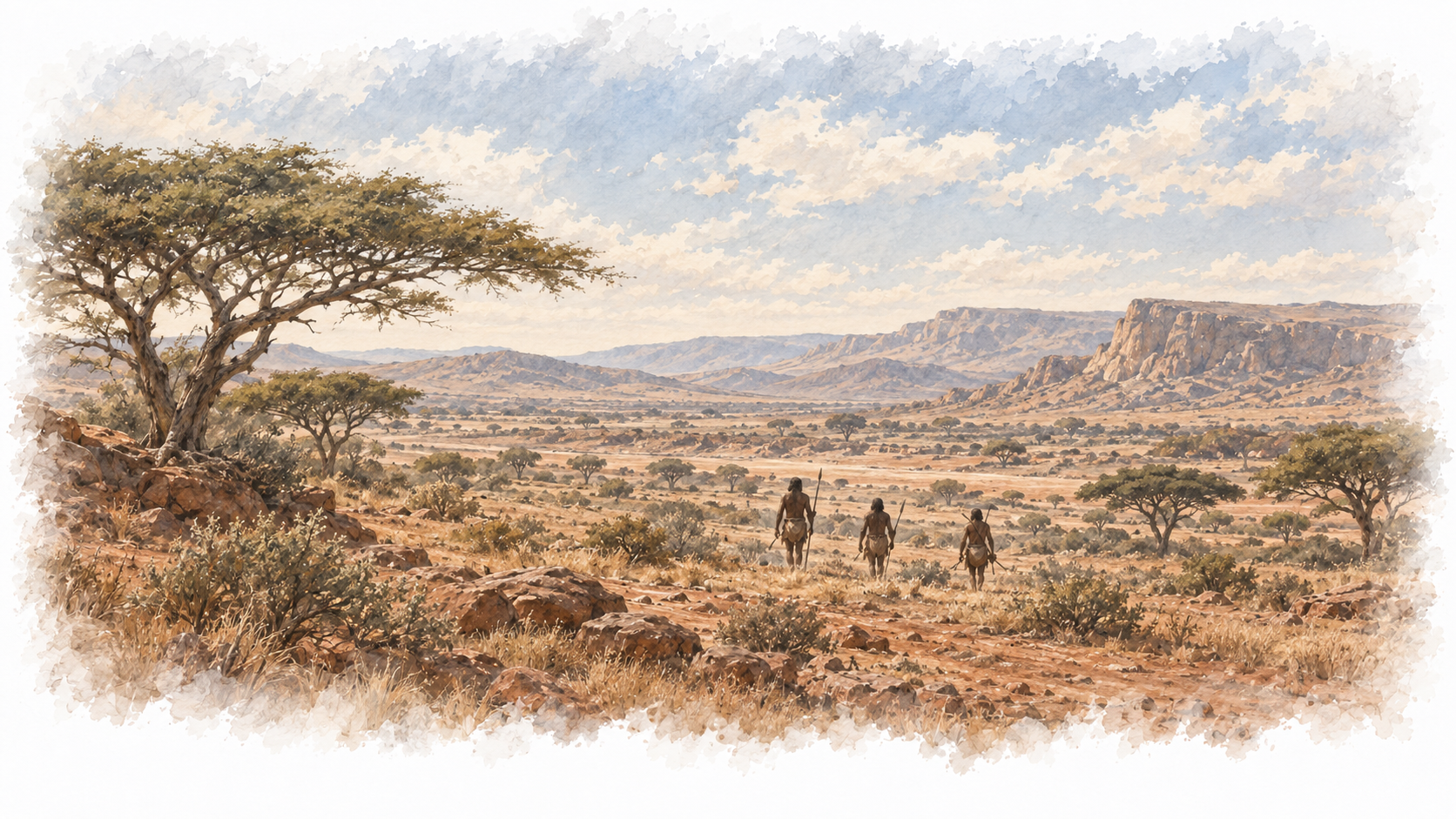
Long before there were names, dates or parish registers to record them, our ancestors were already on the move. The fossil record indicates that Homo sapiens evolved from earlier hominin populations in Africa. Human remains from Jebel Irhoud, 100 kilometres west of Marrakech in Morocco, associated with Middle Stone Age artefacts dated to approximately 315,000 years ago, are among the oldest currently known fossils attributed to our species, and along with other fossil discoveries, indicate early humans populated vast areas across Africa. Their combination of modern facial features and more archaic cranial morphology suggests modern humans evolved gradually across Africa as a whole, rather than emerging suddenly in one region.
The fossil record previously showed that anatomically modern humans dispersed out of Africa into the near east between 100,000-130,000 years ago but these assumptions are now being challenged. Analysis of a 180,000-year-old jawbone from the Misliya Cave, in Israel, shows much earlier periods of human migration out of Africa, and a skull from Apidima Cave, in southern Greece, has also been read by some as evidence of an early Homo sapiens presence in Eurasia, possibly more than 210,000 years ago, though the fossil survives only in fragments, and specialists remain divided over both what species it represents and how old it truly is.
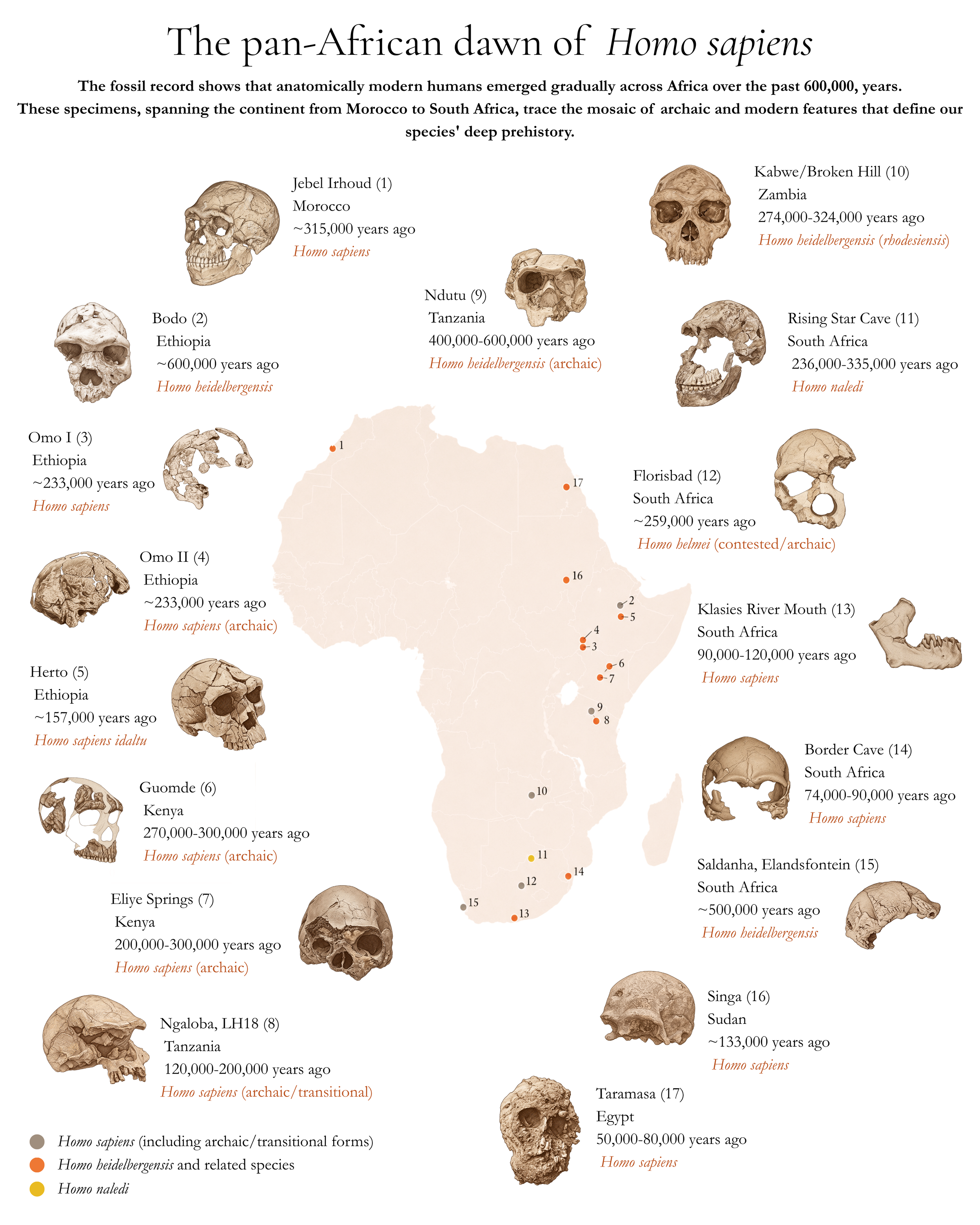
Seventeen fossil specimens from across Africa. Ancient remains span roughly 600,000 to 50,000 years ago, illustrate the mosaic, geographically dispersed emergence of our species. Dates are the best current published estimates and remain subject to revision for several specimens. Site locations are plotted from published coordinates.
Markers are colour-coded by species: orange for Homo sapiens (including archaic/transitional forms), grey for Homo heidelbergensis and related or debated forms (including H. rhodesiensis and the contested H. helmei), and yellow for Homo naledi, a distinct, small-brained lineage that overlapped in time with early Homo sapiens but sits outside our direct ancestral line.
A few specimens carry additional caveats: Singa shows pathological bone deformation rather than typical morphology; Florisbad's H. helmei classification remains debated; and Omo II, Guomde, Ndutu, Florisbad, and Klasies River Mouth are represented only by partial or fragmentary remains, as shown in their illustrations.
These early movements were not random: recent studies conclude that dramatic climate fluctuations reduced aridity and created favourable environmental conditions enabling multiple waves of human migration from northeastern Africa across the Arabian Peninsula and the Levant region (the eastern Mediterranean) into Asia and beyond,. There is no evidence, though, that these early travellers left descendants who survive today.
From around 70,000 years ago, and for tens of thousands of years before the final dispersal, humans within Africa itself were exploiting an increasingly wide range of habitats, from dense forest to arid desert. Archaeological sites across the continent spanning the preceding 120,000 years reveal this widening ecological range, and it is this flexibility, rather than any single technological breakthrough, that is thought to have equipped the population that eventually left Africa to succeed where earlier dispersals, evidenced only by fossils with no living descendants, had failed. The routes north into the Levant themselves opened and closed repeatedly rather than remaining a single lasting corridor, tracking the same climatic rhythm in a series of distinct windows.
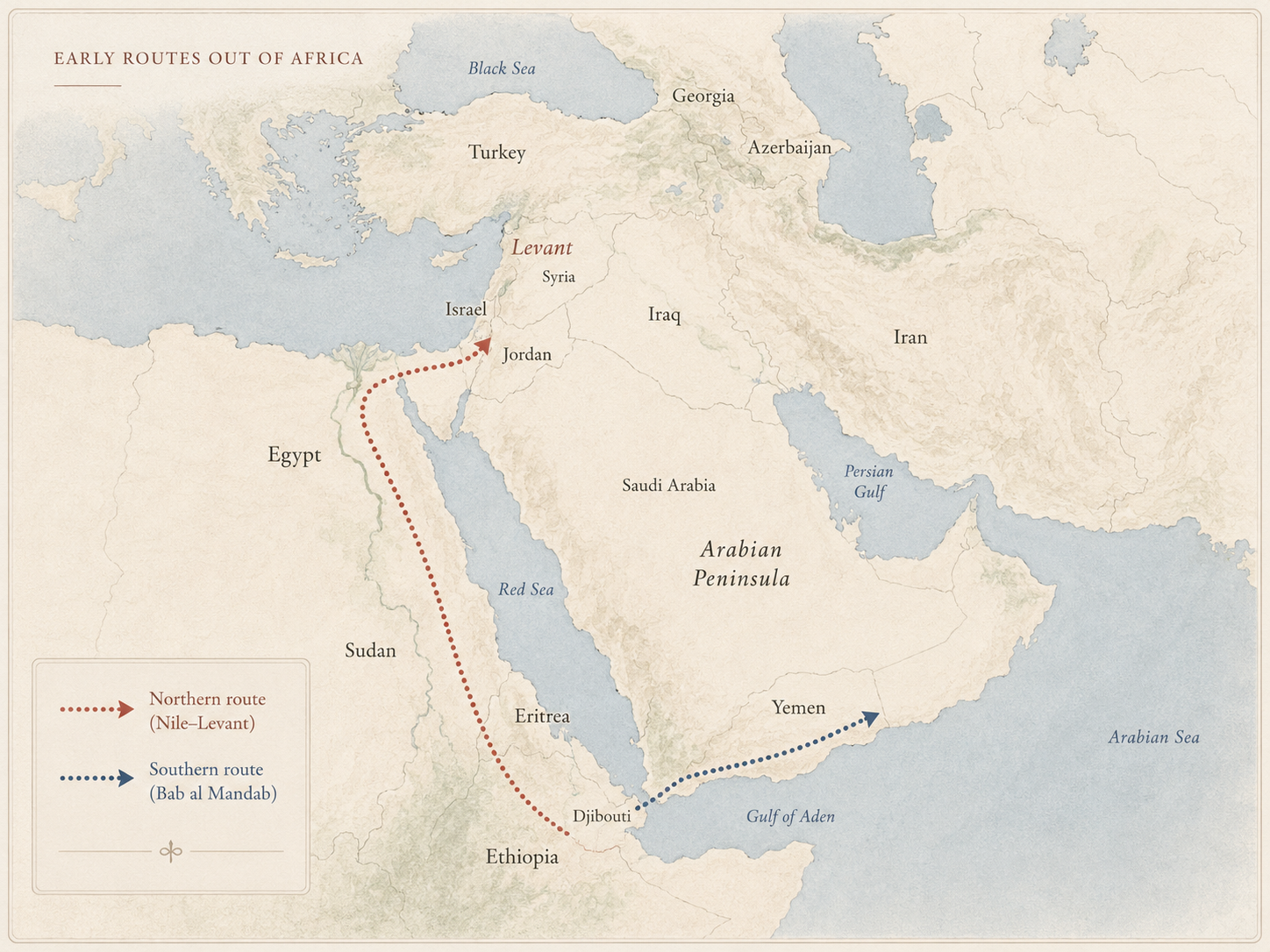
Possible dispersal routes out of Africa. The northern corridor followed the Nile and Sinai into the Levant; a southern route may have crossed the Bab al-Mandab into Arabia. Both would have opened and closed repeatedly as climate changed.
Genetic evidence suggests that once these migrants reached the wider Arabian region they did not move on swiftly. They appear to have remained there for as long as 30,000 years, adapting to their new environment: strong genetic evidence of natural selection acting on at least 57 separate genes dates to this period, including genes related to fat metabolism, neural development, skin, and the function of cilia, the microscopic hairlike structures found throughout the body. This long pause was followed by a major episode of interbreeding with Neanderthals, and then, after 50,000 years ago, by the much more rapid expansion that carried their descendants across the rest of Eurasia and as far as Australia. A handful of rare mitochondrial lineages survive today among populations still living along the southern Arabian coastline, thought to be direct descendants of those who stayed behind rather than joining the wider expansion.
It is one particular thread within this vast dispersal, the one that led north and west out of the Levant into Europe and, in time, to Britain, that connects to my own ancestors, and through them, to my family today.
02
Out of Africa
From emergence to migration
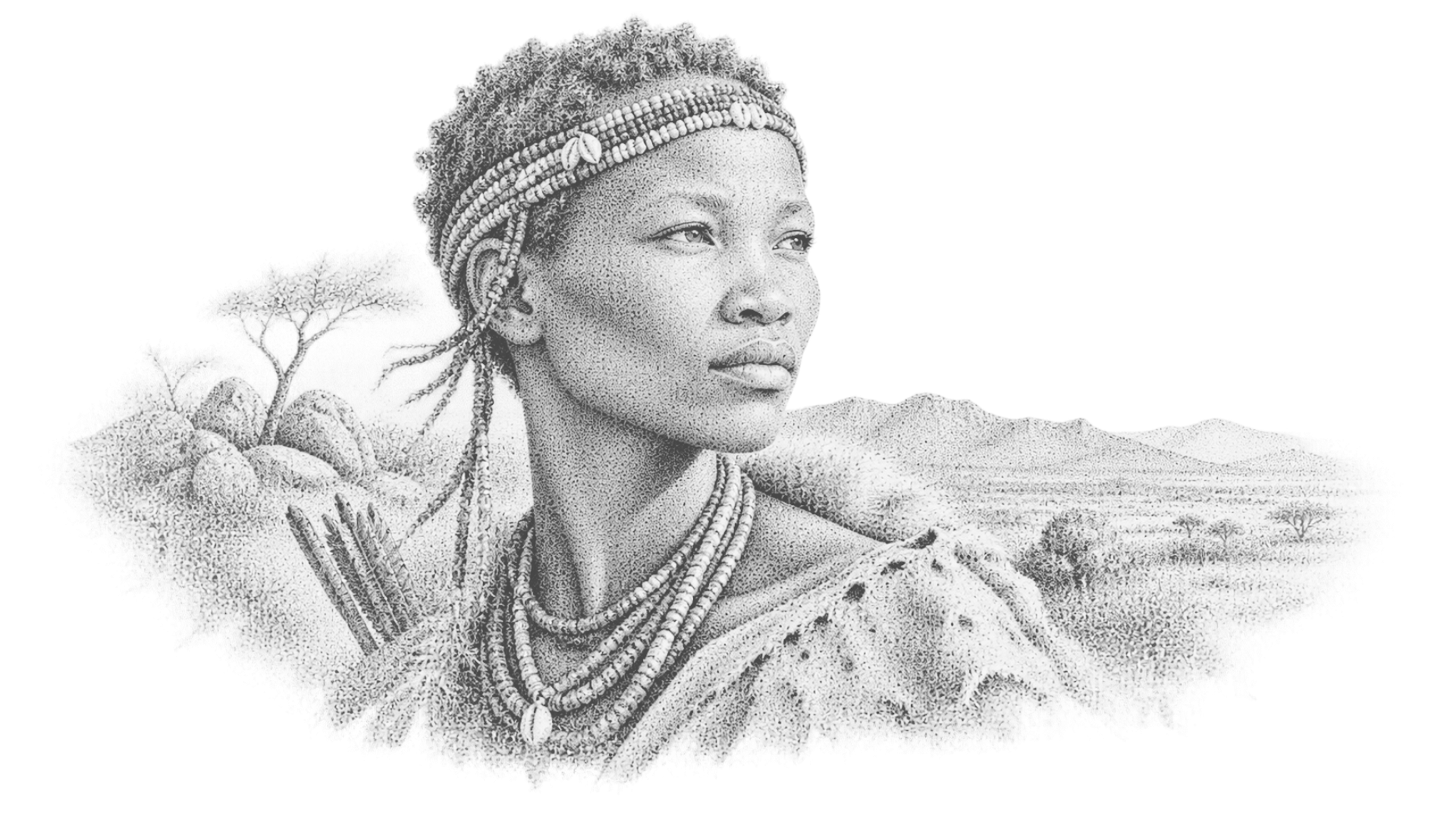
All living humans can trace their ancestry to a single woman, 'Mitochondrial Eve’. Genetic estimates place her living around 180,000 years ago. She was not the first woman of our species, nor the only woman alive at the time, but the most recent woman from whom the mitochondrial DNA of everyone alive today has been passed down through an unbroken maternal line.
A parallel line of descent runs through the male line alone, carried from father to son on the Y chromosome. The most recent common ancestor along this paternal thread, known as Y-chromosomal Adam, lived much earlier, around 252,000 BCE. Like Eve, he was neither the first man of our species nor the only man alive at the time, but simply the most recent man from whom the Y chromosomes of living men ultimately descend, a title that can itself shift through history as other male lines die out.
A recent controversial study suggests Eve and her family may have lived around the Makgadikgadi–Okavango palaeo-wetland of southern Africa, south of the Zambezi River and sprawling across what is now the Kalahari region in Botswana. This was a very different Africa from the one we know today. Climate repeatedly reshaped its lakes, grasslands and deserts, opening routes between regions and closing them again. Eve's distant descendants lived as hunter-gatherers in this shifting landscape, developing new technologies and ways of adapting to very different environments.
Eve's mitochondrial DNA survived through her daughters, and their daughters after them, gradually accumulating the mutations that created new branches of the maternal family tree. One of the earliest of these, haplogroup L0, survives today particularly among Khoe-San populations of southern Africa. Another line eventually led to 'Lara', the ancestral mother of haplogroup L3, whose branch emerged around 68,000–58,000 BCE. Her descendants would become central to the next great chapter in the human story.
Adam himself is thought to have lived far to the west of Eve's wetland homeland, most likely somewhere between what is now Cameroon and Nigeria, in Africa's north-western quadrant. The clue lies not in a grave but in the living: haplogroup A00, the deepest surviving branch of the Y-chromosome tree, is found today only among a small number of populations in that region. No burial carrying this earliest branch has ever been recovered. Adam's resting place, unlike Eve's, remains entirely unknown,.
Adam's Y chromosome survived in much the same way, passed from father to son as generations came and went and new mutations carried his descendants along different paths. One of the deepest surviving lines is represented here by Amadlozi, the ancestral father of haplogroup A, whose descendants remained within Africa. Much later, another part of Adam's family tree divided again. One path would lead to Thang-la's haplogroup D0 and Eshu's haplogroup E, while another would eventually give rise to haplogroup F, ancestor of most of the major Y-chromosome lineages found outside Africa today.
Despite sharing names that suggest otherwise, Eve and Adam were never a couple, and almost certainly weren't contemporaries: the genetic estimates place Adam considerably earlier than Eve. Neither was the only woman or man alive at the time. They are simply the most recent common ancestors of the mitochondrial and Y-chromosome lines that have survived to the present. Other maternal and paternal lines that existed alongside theirs eventually died out, leaving Eve's mtDNA and Adam's Y chromosome as the points to which the surviving lines can ultimately be traced.
The genetic evidence is particularly revealing here. Earlier populations of Homo sapiens had ventured beyond Africa long before this, leaving archaeological and fossil traces across parts of Eurasia, but these earlier dispersals appear to have made little or no genetic contribution to the later expansion from which living non-African populations principally descend.
By around 70,000 years ago, however, something important had changed within Africa. Human populations were beginning to occupy a much wider range of environments, from forests to increasingly arid landscapes, giving them a degree of ecological flexibility that may have helped later populations succeed beyond the continent7. Climate continued to reshape the landscapes through which they moved, periodically making some regions more hospitable and others less so.
It was against this backdrop that the expansion beyond Africa gathered pace. On the maternal side, descendants of Lara's L3 lineage were among those whose mitochondrial DNA would be carried out of Africa and across Eurasia. On the paternal side, the family tree was dividing too. Thang-la's D0 lineage had separated from the wider D family by around 69,000 BCE, while Eshu's haplogroup E followed another early path. Elsewhere on the tree, haplogroup F emerged, becoming the ancestor of most of the major Y-chromosome lineages found outside Africa today.
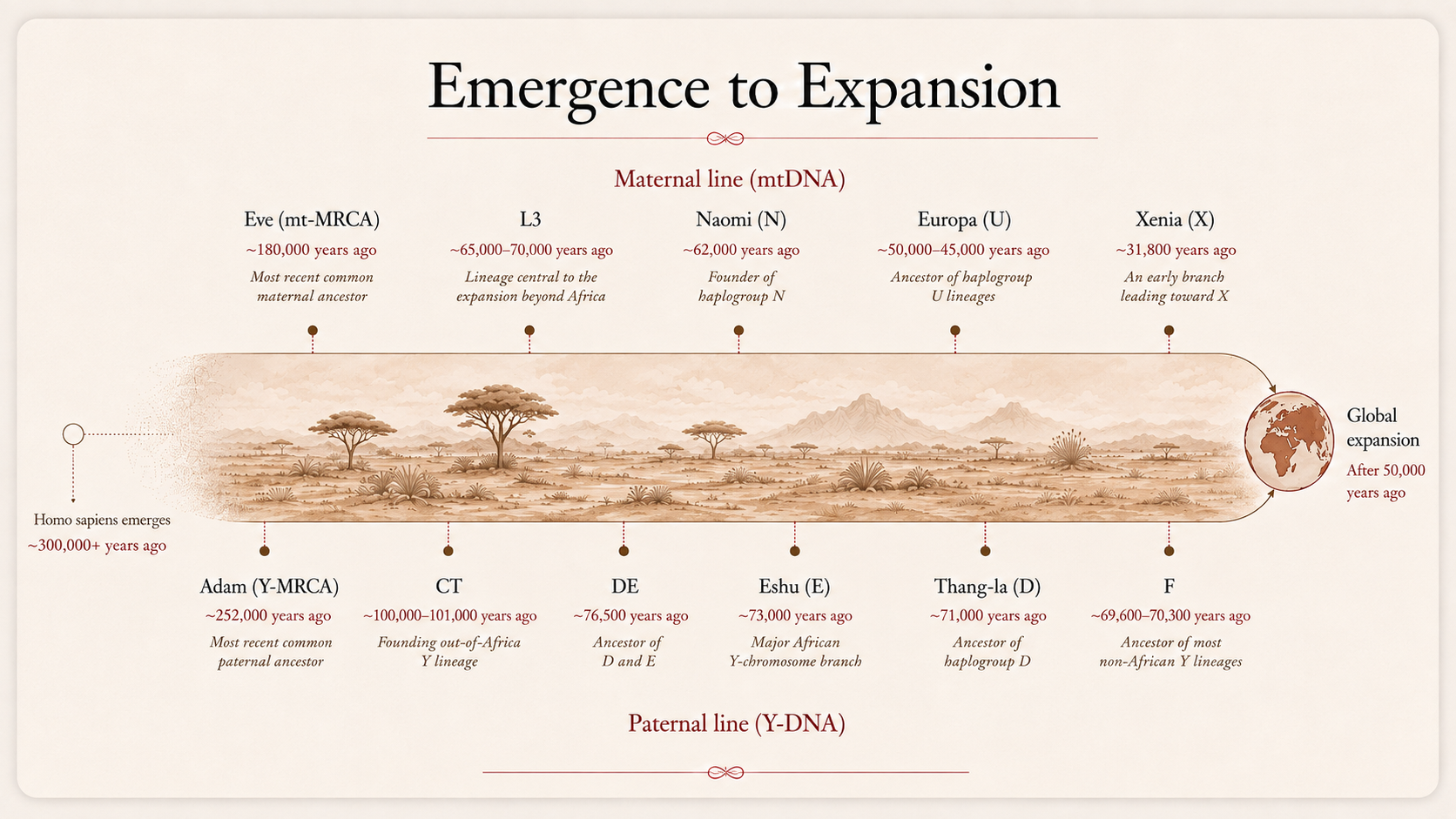
Maternal and paternal lines through Africa's deep past. Two parallel timelines trace the deepest confirmed branch points on the maternal and paternal lines leading to the family lines told elsewhere on this page. Eve and Adam were never a couple, and are not the origin of humanity, only the most recent common carriers of one single unbroken line each, among countless contemporaries whose own lines continue in other ways. Ages shown are best current published estimates and remain subject to revision as methods improve.
As populations spread into Southwest Asia, their genetic lines continued to diverge. Around 60,000 BCE, Lara's descendants gave rise to Naomi's haplogroup N, one of the great maternal lineages carried beyond Africa. One route lay north, through what is now the Sinai and into the Levant. Though this landscape is desert today, during warmer, wetter interludes it supported grassland and wetland environments capable of sustaining human populations on the move. At Wadi Gharandal, in the southern Levant, stone tools found alongside ancient wetland sediments have been dated to around 84,000 years ago, physical evidence of people passing through this corridor during one such window. Further south, arid conditions, along with the Rub'al Khali desert and Asir mountains as major barriers, closed off corridors from the Arabian Peninsula to the Levant and likely encouraged migration towards Southern Asia. As Naomi's descendants spread farther across southern and western Asia, her maternal line divided again. One branch led towards Xenia's haplogroup X, while another gave rise to Rohani's haplogroup R and, later, Europa's haplogroup U, carrying us towards the two maternal lines that survive in this family today.
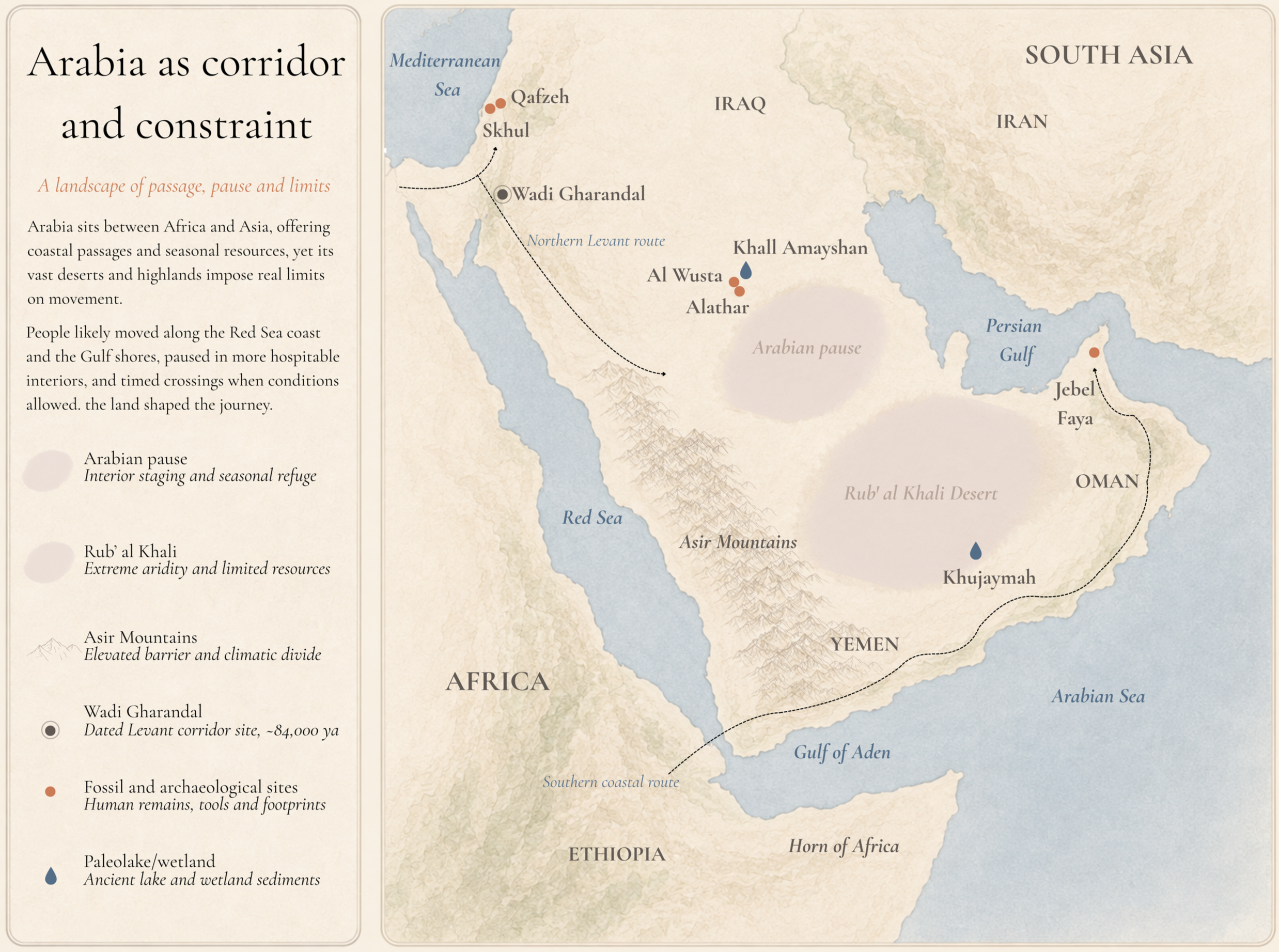
Shaping the routes of migration. Wadi Gharandal, Skhul, and Qafzeh mark a documented northern passage through the Levant, while Jebel Faya anchors the southern route's endpoint on the Arabian Peninsula's far coast. Between them, the Rub' al Khali and the Arabian pause were shaped by extreme aridity, corridors of passage rather than places to settle, while paleolake sites such as Khall Amayshan and Khujaymah point to the rare wetter interludes that briefly made movement through the interior possible.
The routes were never certain, and the crossings were never guaranteed, but it is the branch that succeeded, moving into Europe, that leads, eventually, to my own family's story.
03
Into Europe
Arrival to innovation
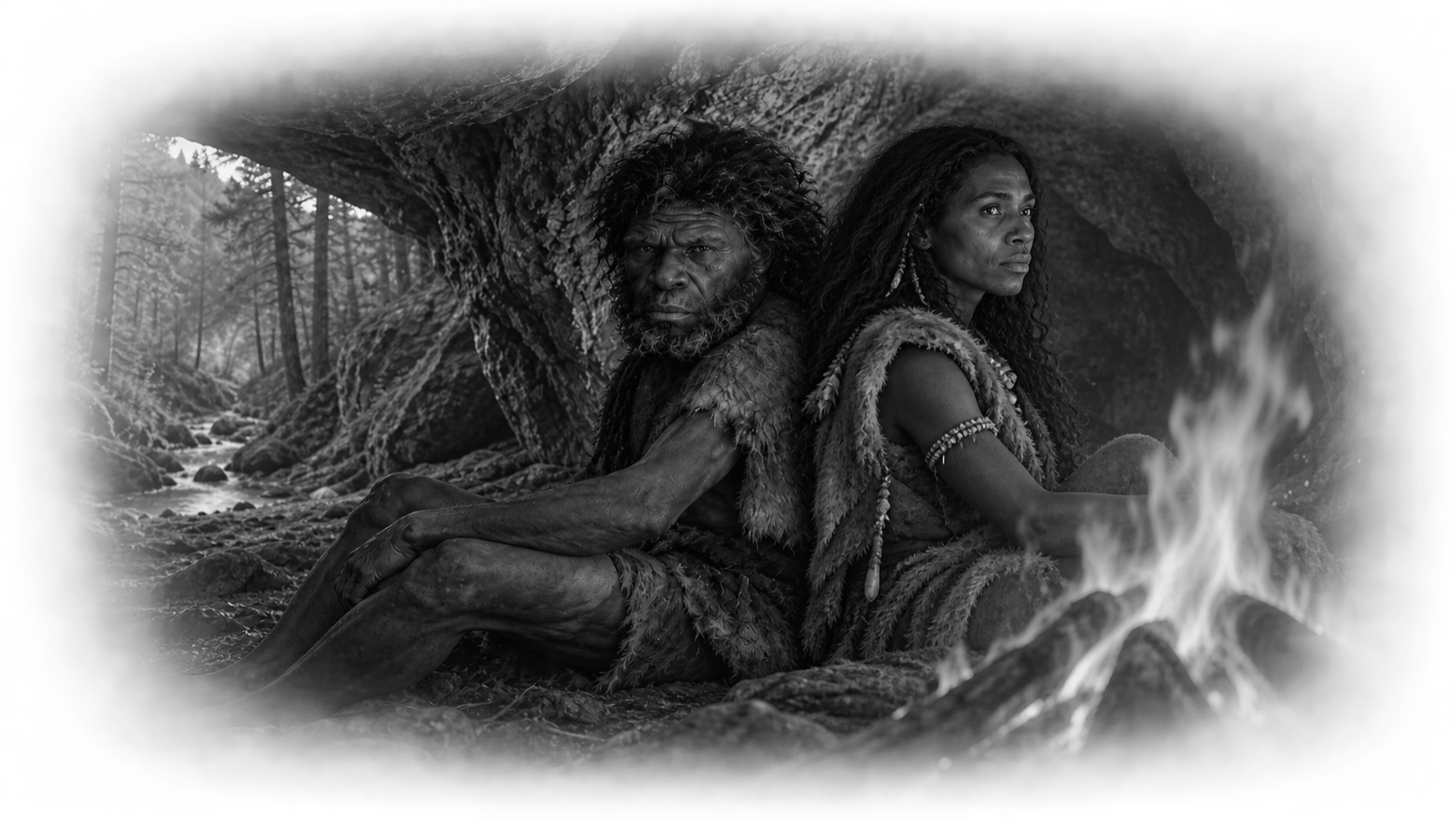
Modern humans began establishing themselves in Europe around 50,000 to 45,000 years ago. While some of Naomi's and Rohani's descendants continued east through Iran and Pakistan towards the Indus Valley, others turned north and west instead, following the same long dispersal that was carrying people across the whole of Eurasia during this period. Those who reached Europe embraced specialised stone tools, figurative artwork like cave paintings and rock sculptures. It was during this period, around 48,000–43,000 BCE, that Rohani's descendants gave rise to Europa's haplogroup U, the maternal lineage from which Ursula's U5 would later emerge and, ultimately, the line carried by Ann Williams and her female descendants.
Some of the earliest directly dated evidence for the dispersal of Homo sapiens across the mid-latitudes of Eurasia comes from Bacho Kiro Cave in Bulgaria. Excavations there in 2015 produced spectacular finds, including thousands of animal bones, stone and bone tools, beads and pendants, and the remains of five humans dating to around 46,000–43,000 years ago. These artefacts provide a vivid picture of life at the cave some 45,000 years ago, highlighting the lifestyles of these hunter-gatherers and their ability to exploit their environment.
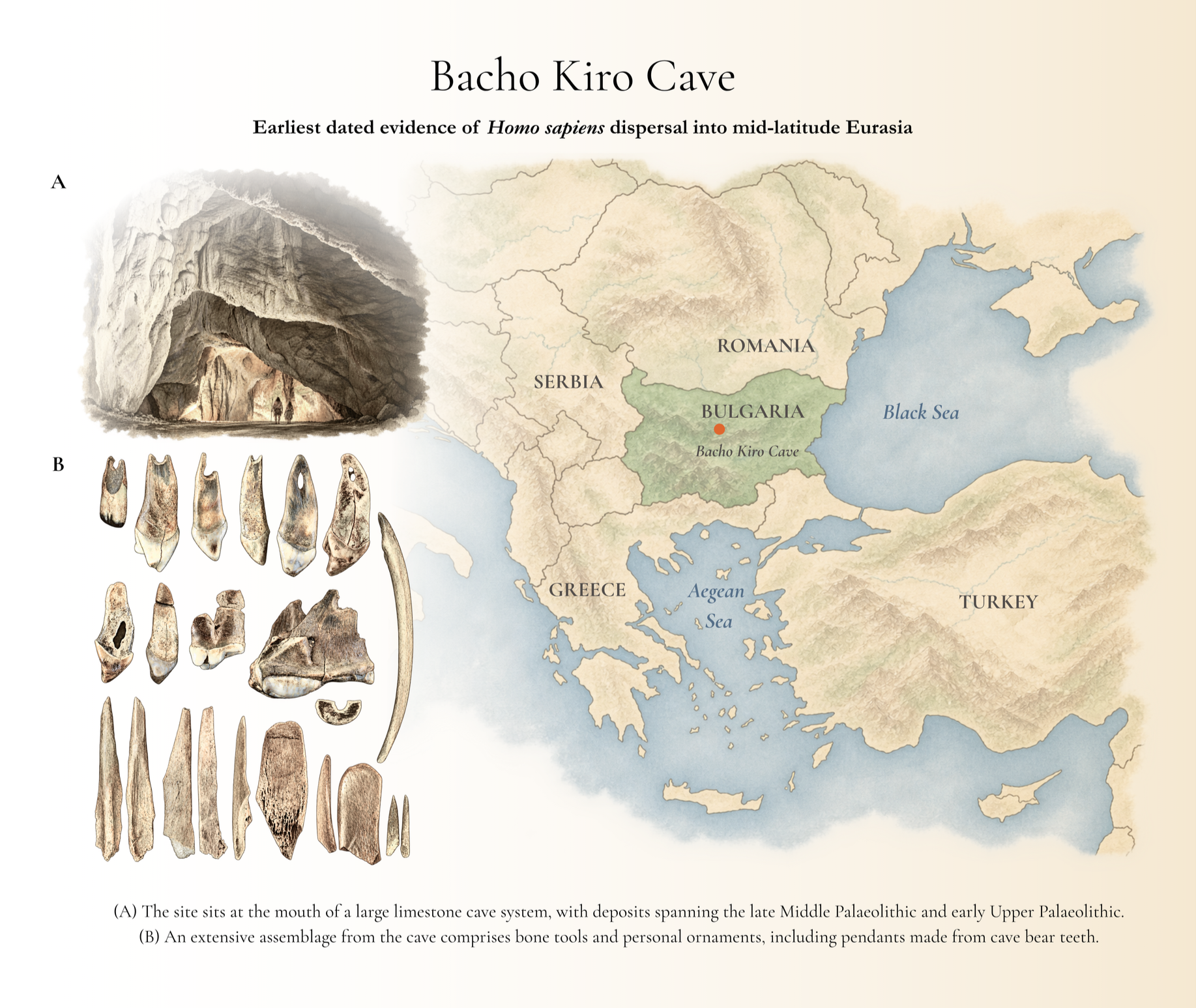
Site formation, geographic location, and material culture of Bacho Kiro Cave, Bulgaria
These pioneer groups rapidly dispersed into a Europe still inhabited by Neanderthals, and the two populations did more than simply encounter one another: genetic evidence from Bacho Kiro shows that some of these early modern humans had Neanderthal ancestors only a few generations back in their own family histories. For several thousand years the two human populations overlapped in Europe, before Neanderthals disappeared from the archaeological record around 40,000 years ago, probably through a complex mix of demographic, climatic and ecological factors, leaving Homo sapiens as the only surviving human population on the continent.
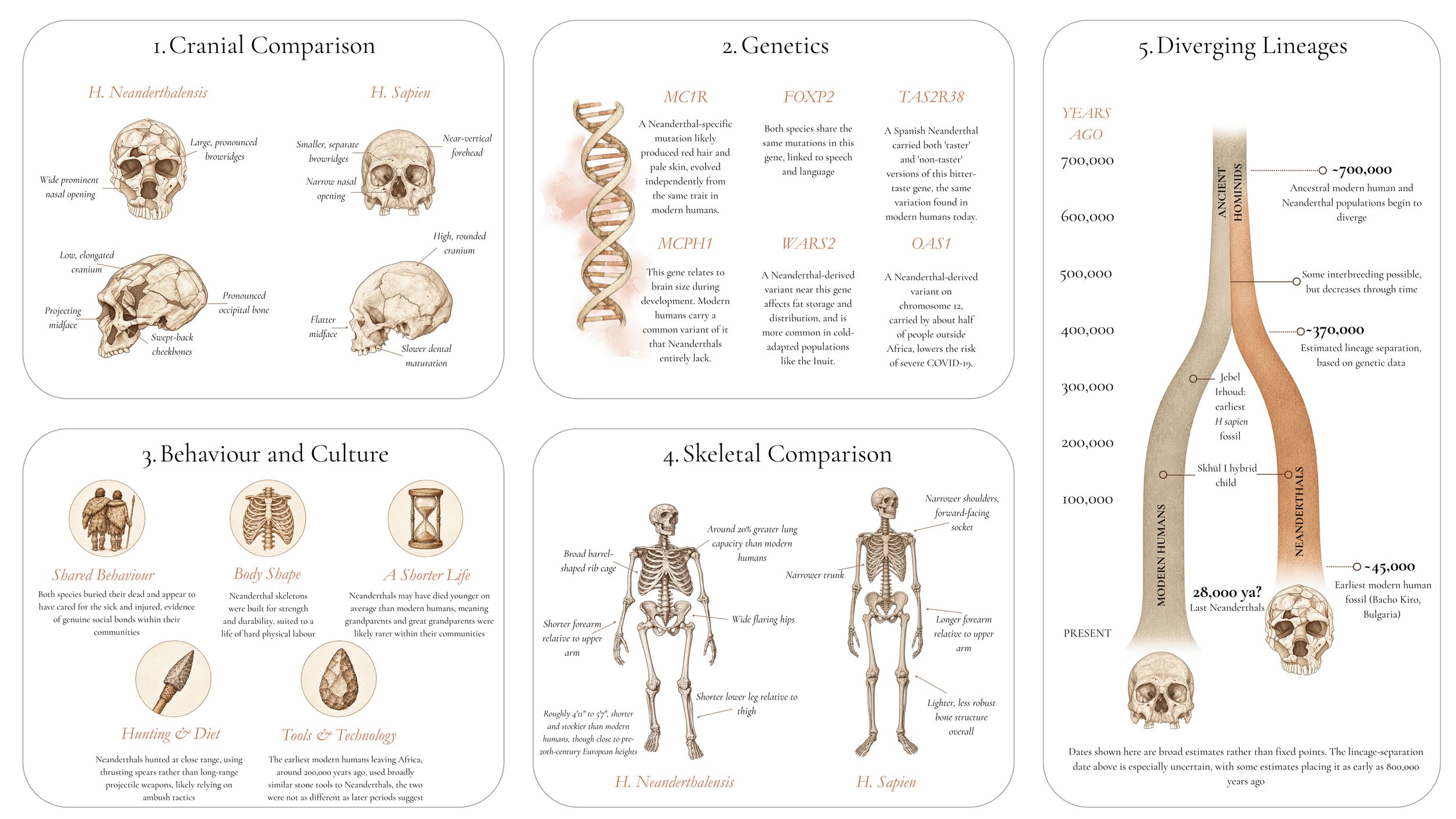
Comparative anatomy, genetics, behaviour, and evolutionary relationship between Homo neanderthalensis and Homo sapiens.
The Bacho Kiro remains also preserve an important part of the paternal story. Genetic analysis found that the men among them carried two distinct Y-chromosome lineages, one belonging to an early form of haplogroup F and the other to haplogroup C1, descendants of Adam's own line and among the earliest paternal evidence from the modern humans spreading across Europe. These were not isolated pioneers. Other groups were moving rapidly across the continent, reaching what is now Germany within a few thousand years and perhaps pushing farther west towards the British Isles.
As modern humans became established across Europe, the Upper Palaeolithic brought important technological advances, including increasingly specialised stone tools and fine-edged blades, alongside the growing use of bone, antler and other materials. It was also a time of remarkable artistic innovation, as seen in cave paintings found across Asia as well as Western Europe, alongside carved figurines and personal ornaments, testifying not only to advances in technologies and tools but also to a striking level of cultural and intellectual achievement. Europa's descendants were among the populations living through this changing world, during a period of population growth and expansion in which her haplogroup U diversified into nine major numbered groups, U1 through U9, whose descendants are now found among people with ancestral origins throughout Europe, Asia and Africa.
One of these was U5. Around 28,000 BCE, Ursula (haplogroup U5), daughter of Europa's lineage and ancestor of the modern Grant line, emerged. Her descendants would become deeply associated with the hunter-gatherer populations of Ice Age Europe, surviving the climatic upheavals that followed before spreading widely across the continent. Unlike the much deeper genetic ancestors in this story, Ursula's emergence brings us tantalisingly close to people whose actual remains have survived. At Dolní Věstonice in what is now the Czech Republic, two people buried around 30,000 BCE carried her U5 marker. Not far away, at Krems-Wachtberg in Austria, another individual living at much the same time carried U5 too. We cannot claim these people as direct ancestors, but their DNA allows us to glimpse her lineage in real people for the first time, living among the Gravettian communities of Central Europe at almost exactly the time U5 itself was emerging.
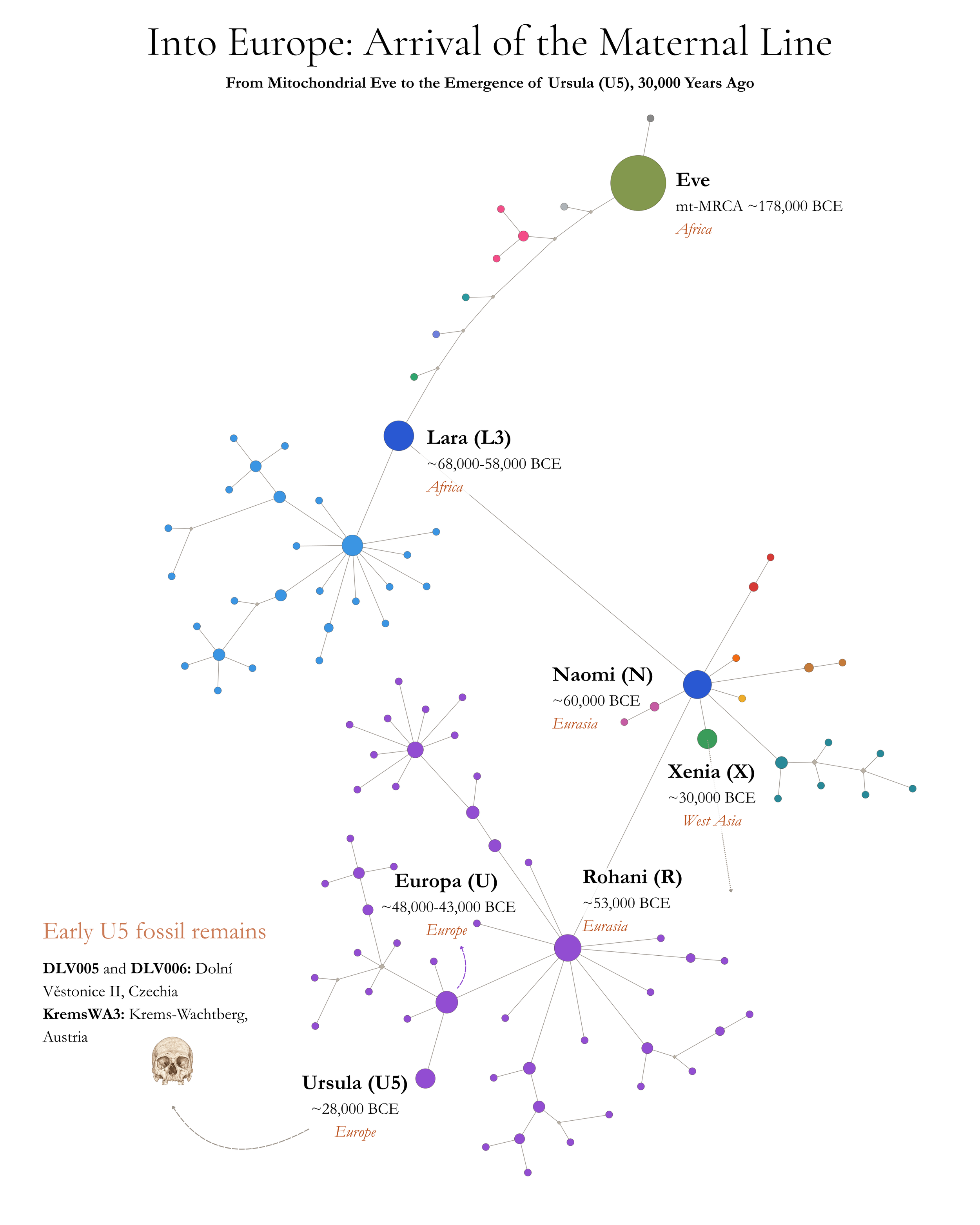
Maternal (mtDNA) haplogroup network, with sibling lineages shown alongside the traced line of descent. Molecular clock estimates Ursula's emergence; individuals from Dolní Věstonice II and Krems-Wachtberg are the earliest confirmed fossil remains known to carry the U5 marker itself.
The world these people inhabited was growing colder as Europe moved towards the height of the last Ice Age. Across Central Europe, open steppe and tundra supported mammoths and other large game, and Gravettian hunter-gatherers became remarkably adept at exploiting this harsh landscape. Dolní Věstonice and neighbouring Pavlov were more than temporary stopping places: their inhabitants built shelters, maintained hearths, hunted and processed mammoths, fashioned tools from stone and bone, and even worked with fired clay and fibres. Together, the extraordinary archaeology of these sites brings us closer to the everyday lives of the communities among which these ancient genetic lines have now been found. The archaeology of the Dolní Věstonice-Pavlov complex does indeed include substantial settlements, mammoth remains, hearths, fired clay and evidence of textile production.
Nor was Ursula's maternal line the only one of this family's four genetic threads already present in this Gravettian world. At nearby Pavlov, part of the same remarkable concentration of Ice Age settlements in Moravia, a male individual carried Y-haplogroup I, placing him within Wodan’s ancient paternal lineage, from which the I-L161 line would descend and, much later, the modern Durrant line. For the first time in this story, ancient DNA places both one of the maternal lines and one of the paternal lines followed by this family among populations living in the same region of prehistoric Europe.
Reaching Europe was no small feat, and not every line that set out survived the journey. Those that did belonged to skilled, resourceful people, well equipped for the Gravettian world that lay ahead.
04
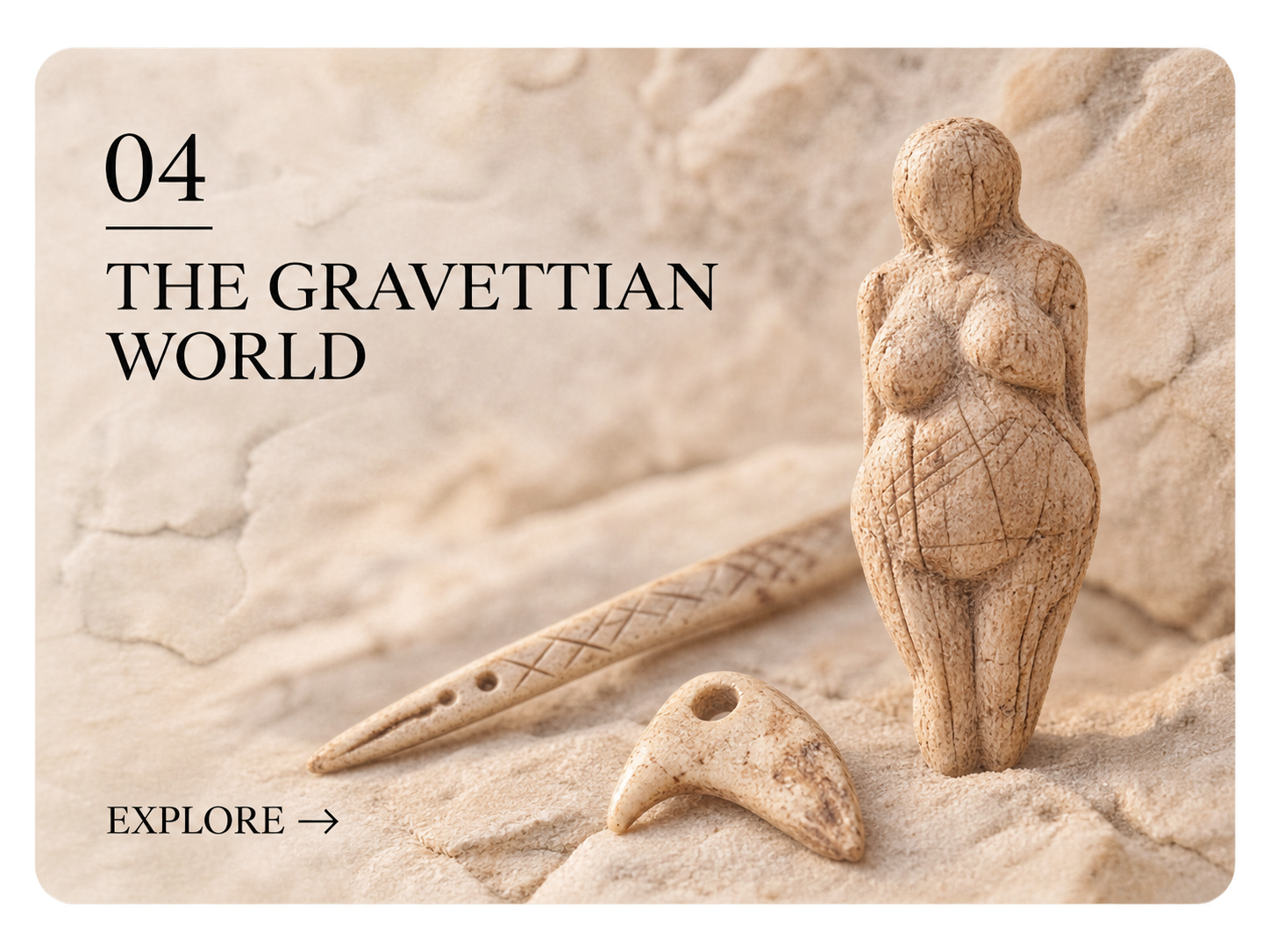
The Gravettian World
Art, adaption and ancestry
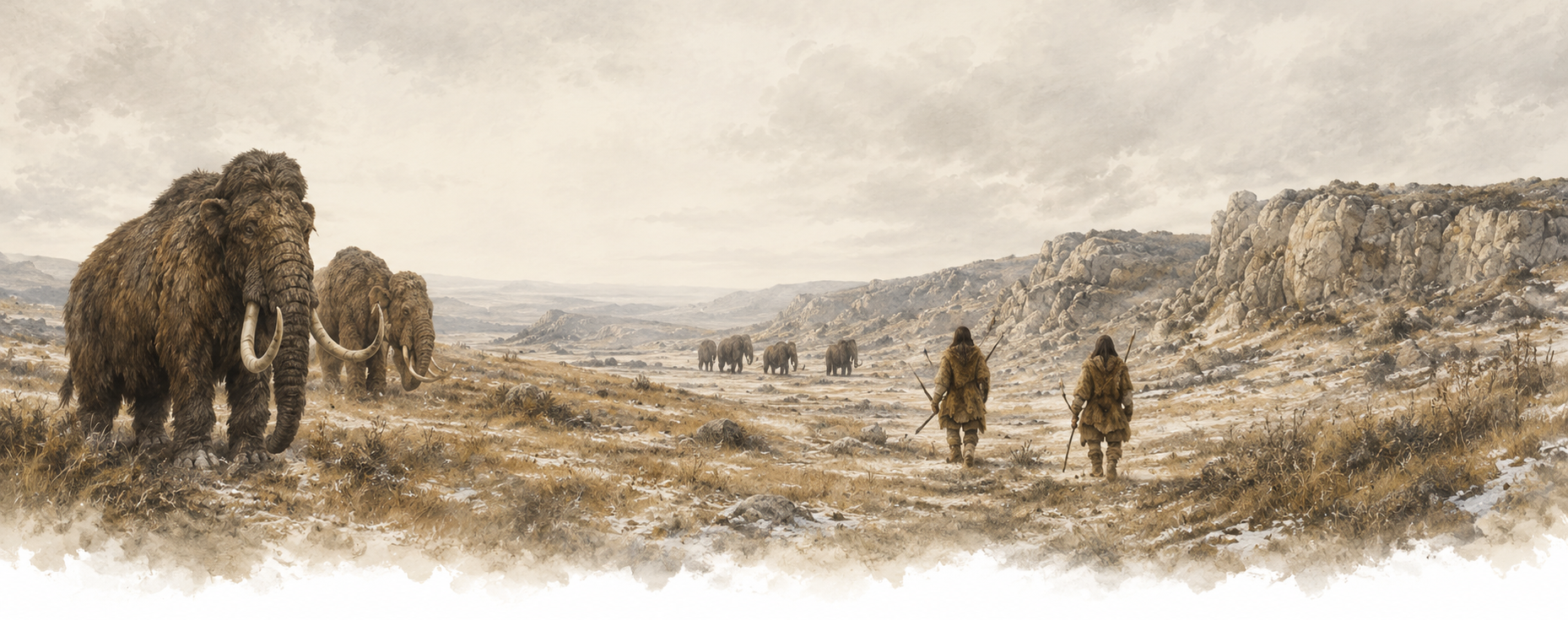
Members of the Gravettian culture wore shells as ornaments, sewed clothing with bone needles, created stylised 'Venus' female figurines with elaborate headdresses and exaggerated breasts and buttocks, and left their distinctive art and artefacts from Spain to western Russia. The Gravettian were characterised by a stone-tool industry in which small pointed blades were used for big-game hunting, including bison, horse, reindeer and mammoth. These hunter-gatherers also practised specialised hunting, selective butchery and food storage. Yet despite these widely shared cultural traditions, ancient DNA reveals that the people associated with the Gravettian were not one genetically homogeneous population. Two distinct groups have been identified: the Fournol cluster in western and southwestern Europe, including France and Spain, and the Věstonice cluster across central-eastern and southern Europe, including the Czech Republic and Italy.
Painted, Carved and Engraved
The Gravettian left a rich material record across their world, from painted cave walls to carved figurines and etched bone. Three examples, drawn from opposite ends of Gravettian Europe, give a sense of that range.
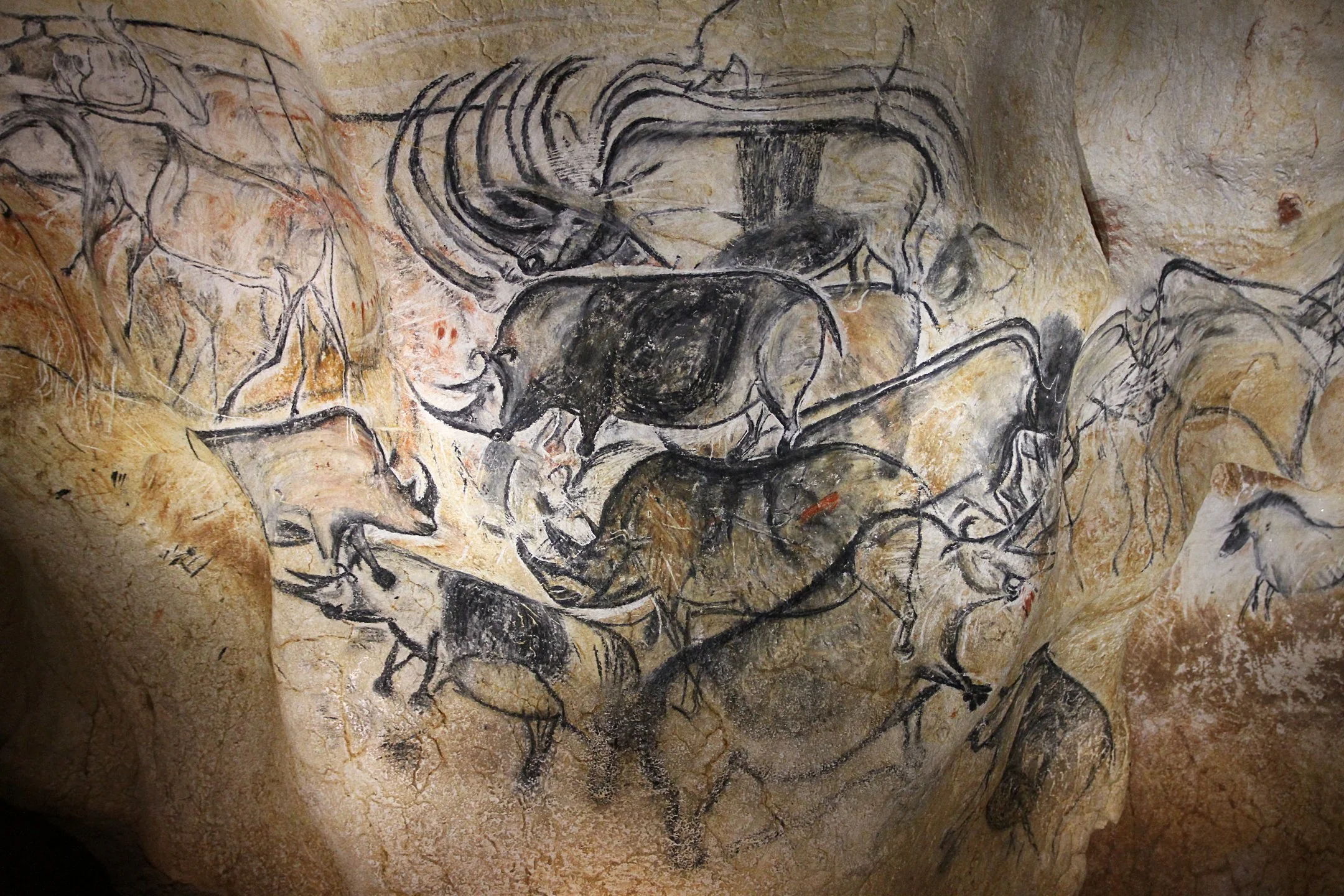
Panel of the Rhinos, Chauvet-Pont-d'Arc Cave, France
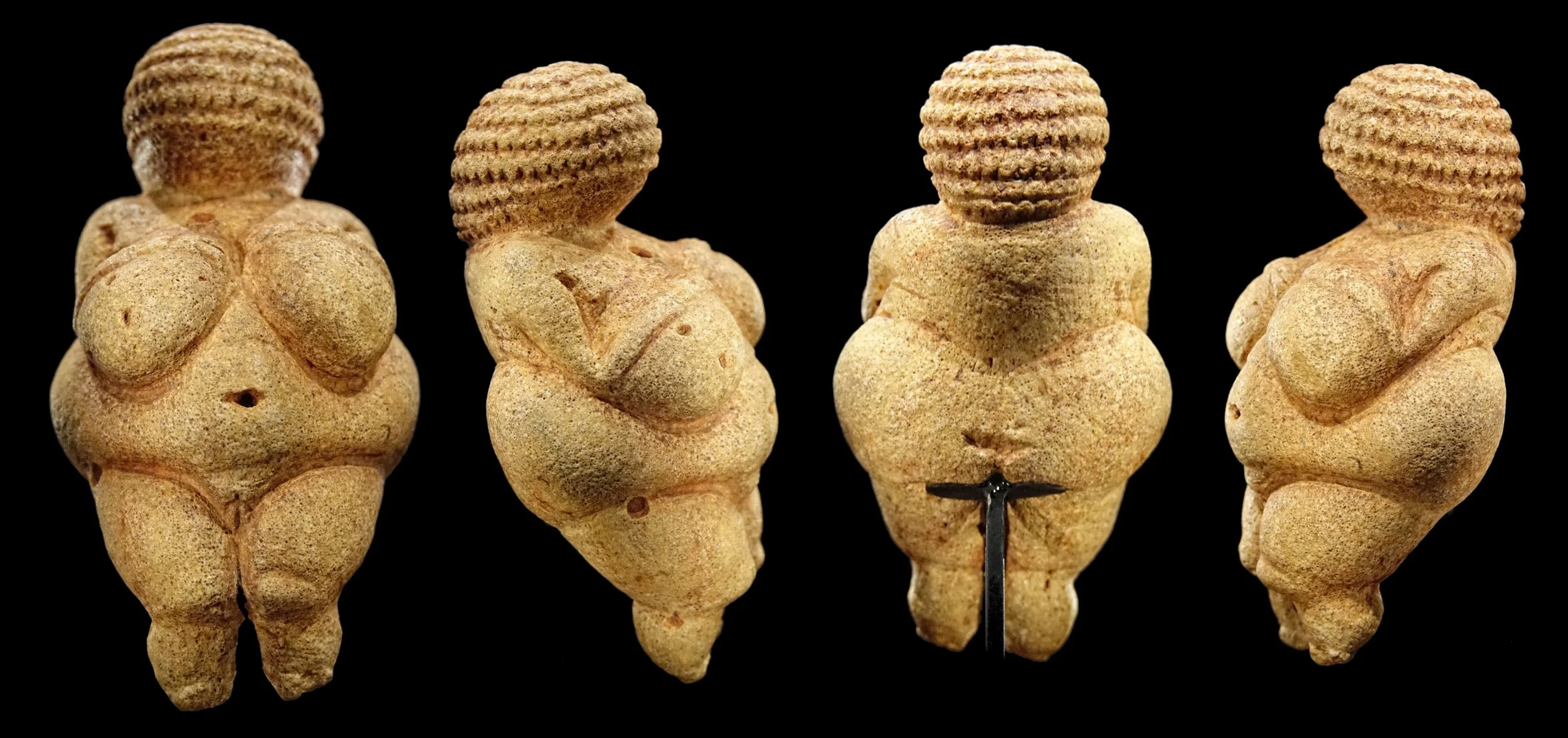
Venus of Willendorf, Austria
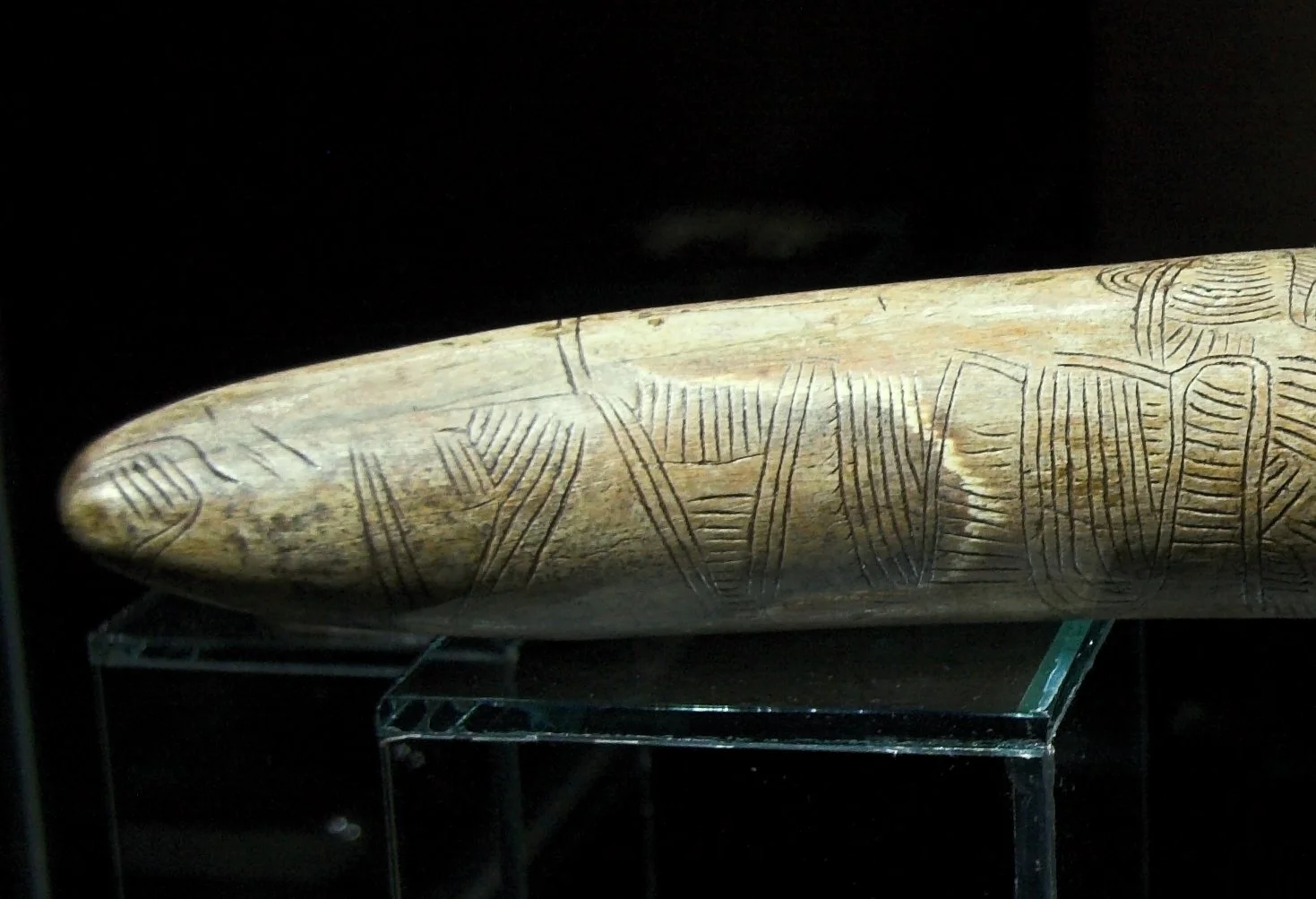
Engraved mammoth tusk from Pavlov, Czech Republic
The eastern Gravettians included communities highly adapted to life on the mammoth steppe, and nowhere is this more striking than at Předmostí, an exceptional prehistoric site in what is now the Czech Republic. This was a productive but unforgiving landscape, supporting enormous herds of large game as Europe moved towards the increasingly severe conditions that would culminate in the Last Glacial Maximum. Předmostí occupied a particularly important position at the southern entrance to the Moravian Gate, one of the great natural corridors through Ice Age Central Europe, through which animals and people could move between the Danube region and the northern European plain.
Around 30,000 years ago, people lived there amid an enormous assemblage of mammoth remains, with mammoth forming an important part of both their subsistence and the wider material culture of the Moravian Gravettian. Stable-isotope analysis confirms that mammoth meat formed a major part of the human diet, while cut and impact marks on the bones of large canids show that these animals were also butchered and consumed.
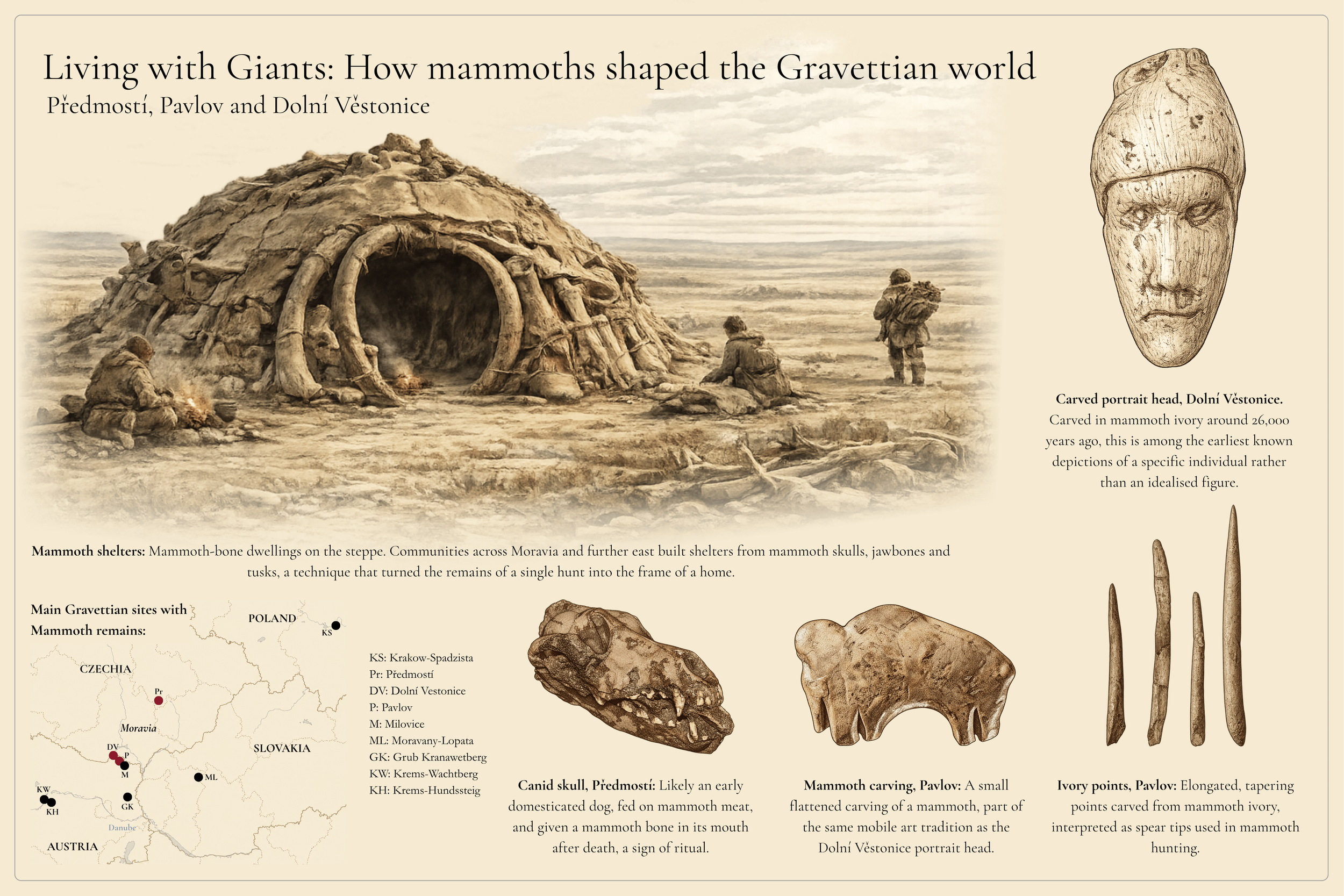
Material evidence for mammoth's role in Gravettian daily life. Illustrations based on archaeological finds from Dolní Věstonice, Pavlov and Předmostí, redrawn from archaeological sources; site locations after Brugère, Fontana & Oliva (2009).
Yet Předmostí was more than a hunting settlement. Human remains accumulated in a remarkably small burial area beneath the prominent limestone outcrop of Skalka, perhaps through repeated burials over time rather than a single event, with some of the dead partly covered by mammoth shoulder blades. For people whose lives were shaped by the movement of animals across a vast Ice Age landscape, returning to the same place with their dead suggests an enduring attachment to particular places.
Předmostí belonged to the same wider central European Gravettian world as nearby Dolní Věstonice and Pavlov, all part of an extraordinary concentration of Ice Age communities in Moravia, and the landscape in which both Ursula's and Wodan's ancient genetic lines have been found.
These two Gravettian populations, so alike in culture yet so different in ancestry, were not living in total isolation from one another. A group of individuals found at Goyet in Belgium carried ancestry drawing on both the Fournol and Věstonice populations, evidence that people and genes moved between these genetically distinct Gravettian worlds. That genetic distinction would become particularly important as Europe's climate continued to deteriorate. The western Fournol ancestry survived the upheavals that followed and contributed to later hunter-gatherer populations. The Věstonice ancestry associated with the communities of central and southern Europe, by contrast, disappears as a distinct, identifiable ancestry from the European populations sampled after the Ice Age. This was the same eastern Gravettian world in which ancient DNA has placed both Ursula's U5 and Wodan's haplogroup I.
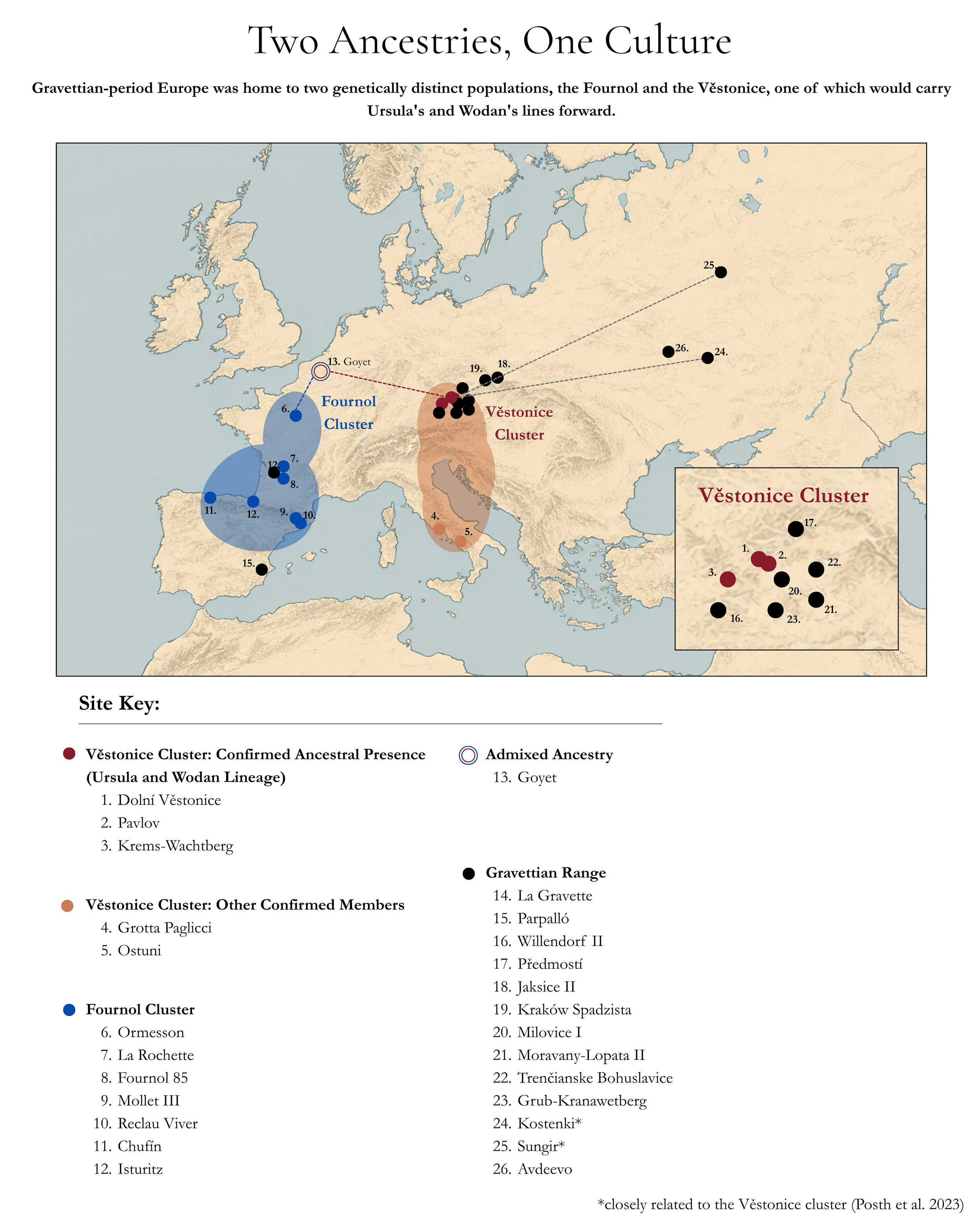
Gravettian Genetic Clusters and Their Sites. Twenty-six Gravettian-period sites across Europe, coloured by genetic cluster: the Věstonice cluster (including Dolní Věstonice, Pavlov and Krems-Wachtberg, where Ursula's and Wodan's own tested lineages have been confirmed), the Fournol cluster, Goyet's admixed ancestry between the two, and thirteen further sites significant to the Gravettian culture but not genetically clustered. Dashed lines to Kostenki and Sungir mark sites "closely related to" the Věstonice cluster without being confirmed members, distinct from Goyet's dashed lines, which show confirmed admixture between both clusters. Genetic cluster assignments follow Posth, C. et al. 2023 and Gelabert, P. et al. 2025, with additional admixture evidence for Krems-Wachtberg and Ostuni from Bennett, E.A. et al. 2019. Gravettian-culture attribution for individual sites follows Wojtal, P. et al. 2020; Wild, E.M. et al. 2021; Villotte, S. et al. 2019; Pericot García, L. 1942; Nigst, P.R. et al. 2022; Antl-Weiser, W. 2009; Zheltova, M.N. 2015; and Bader, O.N. 1978.