
ERA 02
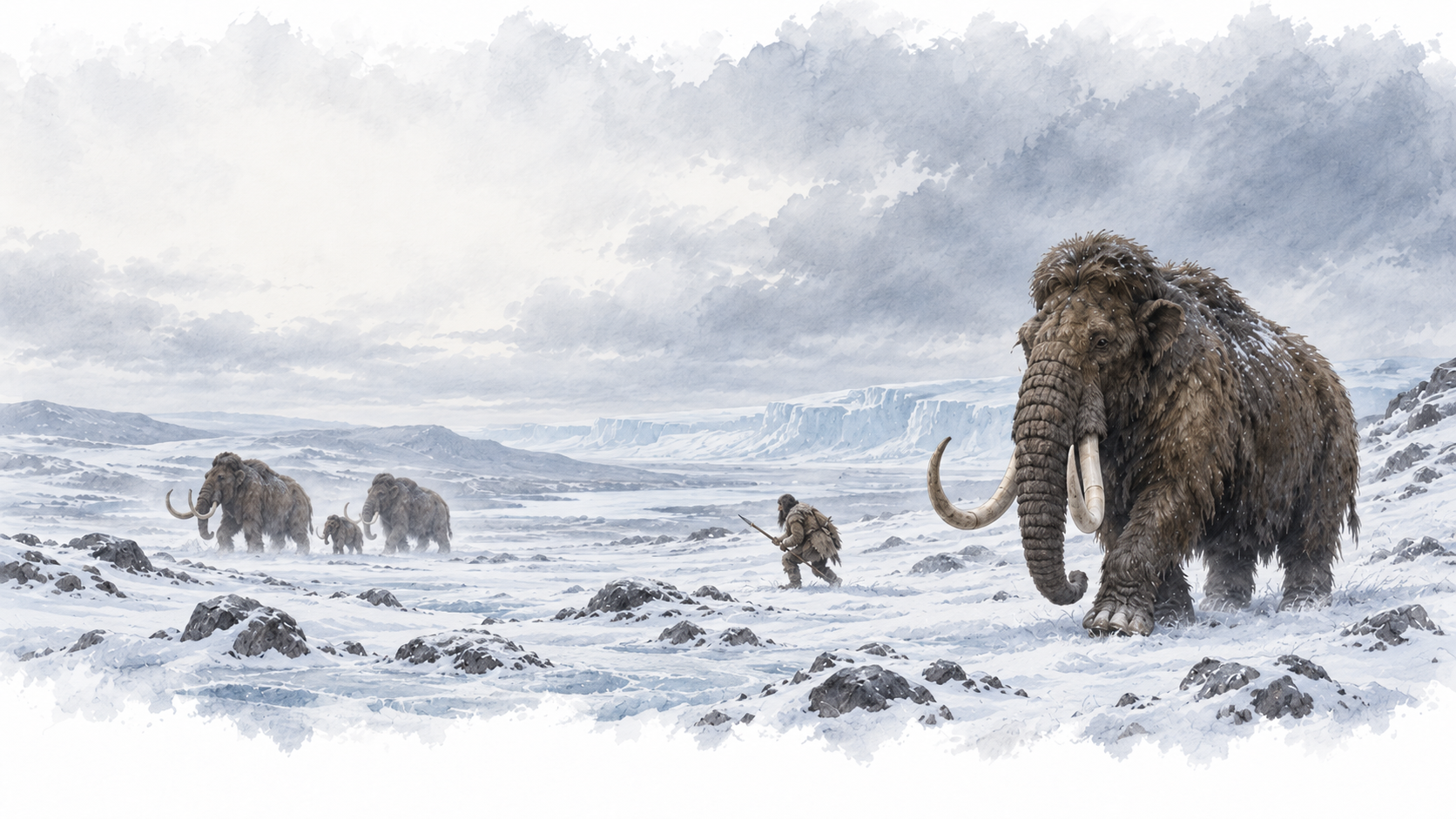
The Ice Age World
30,000 - 11,700 years ago
From the depths of the last Ice Age to the retreat of the ice thousands of years later, this era follows the people who endured the coldest millennia Europe has ever known.
From the depths of the Ice Age to its retreat thousands of years later, this era follows Ursula, Xenia, Oisin and Wodan through the coldest millennia Europe has ever known.
In This Era
05
Xenia Emerges
Divergence and a distant refuge
Around 30,000 BCE, probably in West Asia, Xenia emerged bearing the mutation that defines haplogroup X27, the beginning of a maternal line that would, many thousands of years later, narrow to X2c, the specific branch carried by Ann Wilde and her female descendants. She and Ursula were, in a sense, distant cousins, both descended ultimately from Naomi's line, yet their paths could hardly have diverged more sharply. While Ursula's descendants were already living among the Gravettian communities of Central Europe at places like Dolní Věstonice and Pavlov, Xenia's early story remained centred much farther east, in West Asia and the Near East.
Over the thousands of years that followed, Xenia's descendants divided into two great families, X1 and X2. The first remained concentrated principally in North and East Africa and the Near East, while X2 spread much farther across Eurasia, eventually reaching from Europe through western and Central Asia and into Siberia. It was within this far-ranging X2 family that X2c, the line leading eventually to Ann Wilde, would emerge, although exactly when and where that particular branch first appeared remains uncertain.
The contrast with Ursula becomes particularly striking in the ancient DNA record. U5 is already visible among the hunter-gatherers of Ice Age Europe, while Xenia’s lineage remains far more elusive in the DNA record among the Mesolithic hunter-gatherers so far sampled from Europe or North Africa. Even today, her wider maternal family is one of Europe's rarer haplogroups, generally occurring at only a few per cent or less of the population. Its distribution and diversity instead point towards a much deeper history extending eastwards into the Near East and across western Eurasia.
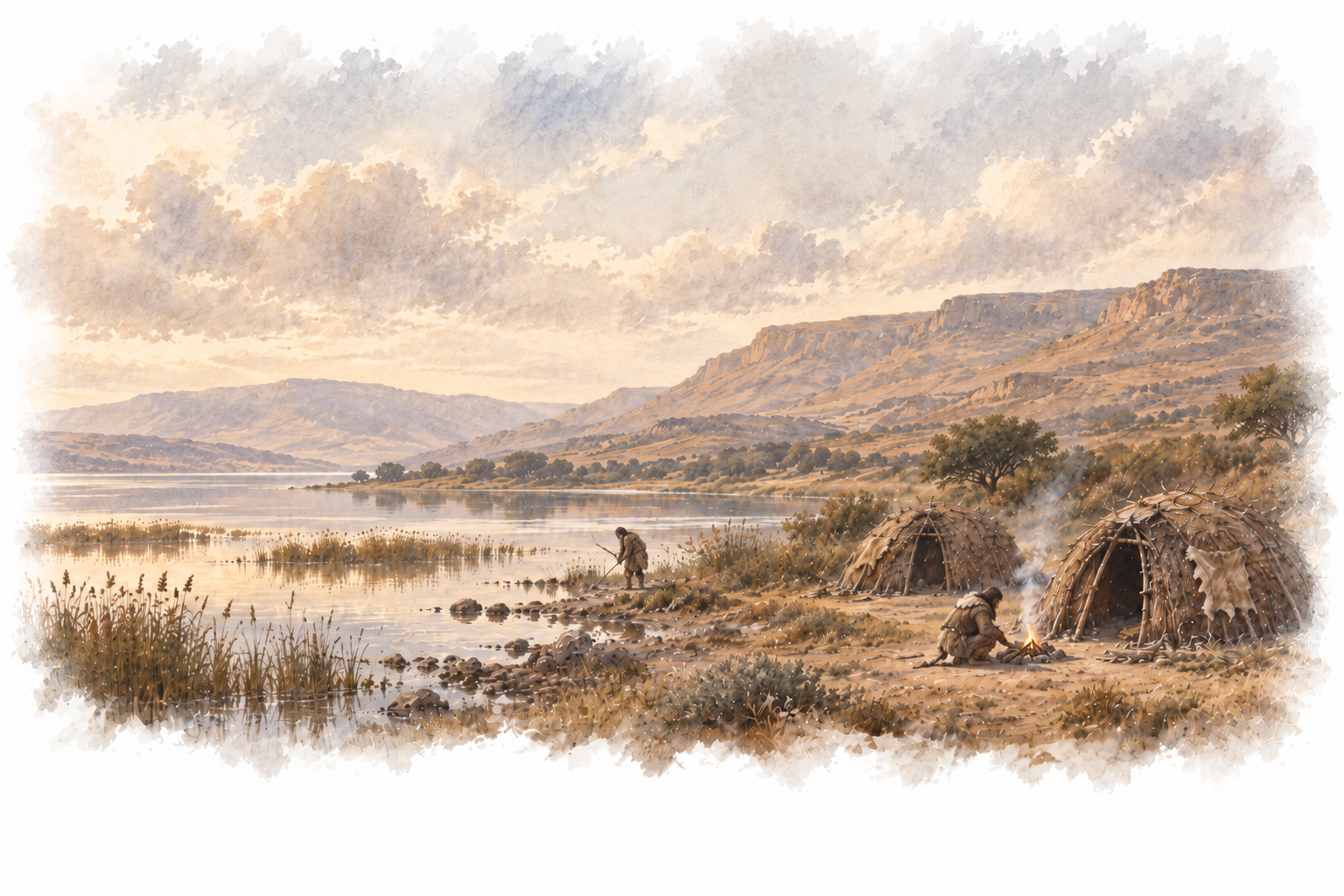
Something of the world in which her lineage remained can be glimpsed at Ohalo II, a submerged fisher-hunter-gatherer camp on the shore of the Sea of Galilee, occupied around 23,500–22,500 years ago, at the height of the Last Glacial Maximum. Its brush huts, hearths and remarkably preserved plant remains, including some of the earliest known processing of wild cereal grains, show a community exploiting a rich and varied habitat rather than merely enduring the cold. No ancient DNA links Ohalo II itself to Xenia's line, but it offers a rare, concrete picture of the kind of Levantine world her lineage continued to inhabit through this period.
One remarkable echo of that history survives among the Druze of the Levant. Xenia's wider maternal lineage occurs there at unusually high frequency and diversity, particularly among the Druze of Galilee, where more than one in five people sampled carried X and both X1 and X2 were represented. Their long history as a relatively isolated community appears to have preserved genetic patterns that became much rarer elsewhere, leading researchers to describe the Galilee Druze as a genetic refugium, preserving something of the older genetic landscape of the Near East.
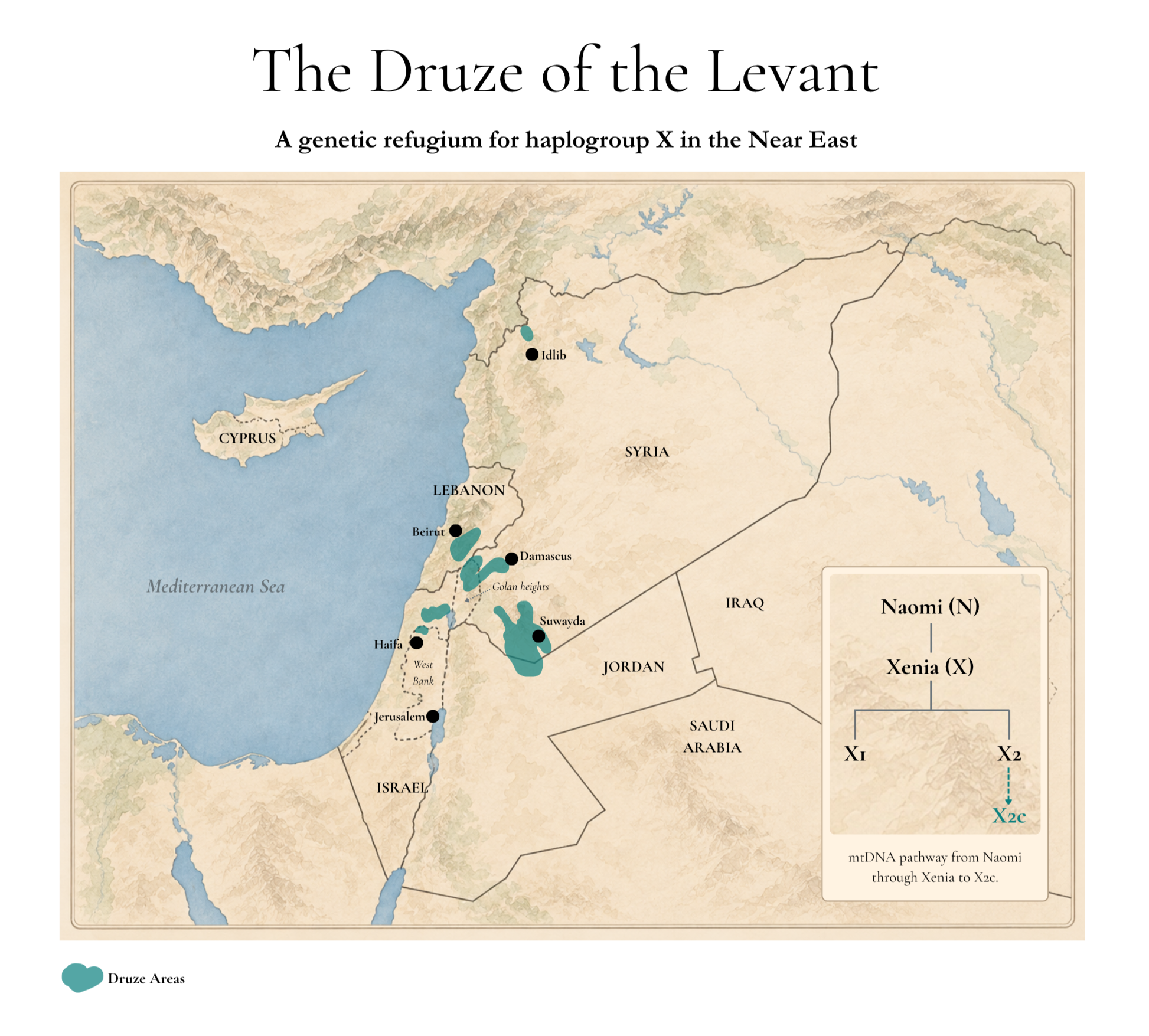
Present-day Druze communities and the X2c pathway. Haplogroup X occurs at unusually high frequency and diversity among present-day Druze communities, particularly around Galilee, a pattern researchers attribute to the community's long history of relative isolation, which preserved older genetic patterns that became rarer elsewhere in the region. Inset: mtDNA pathway from Naomi through Xenia to X2c, the branch carried by Ann Wilde and her descendants. Borders and Druze population areas after Yavorsky, E. (2025). The Israeli, Lebanese, and Syrian Druze since October 7: An Analytical Framework. New Lines Institute.
For now, however, the X2c branch within Xenia's wider maternal lineage remains elusive in the ancient DNA record, its early history still hidden somewhere within this much wider West Asian story.
Far from the mammoth-hunters of Moravia, her story took shape beside water instead of ice, built on fish and wild grain rather than tusk and bone.
06
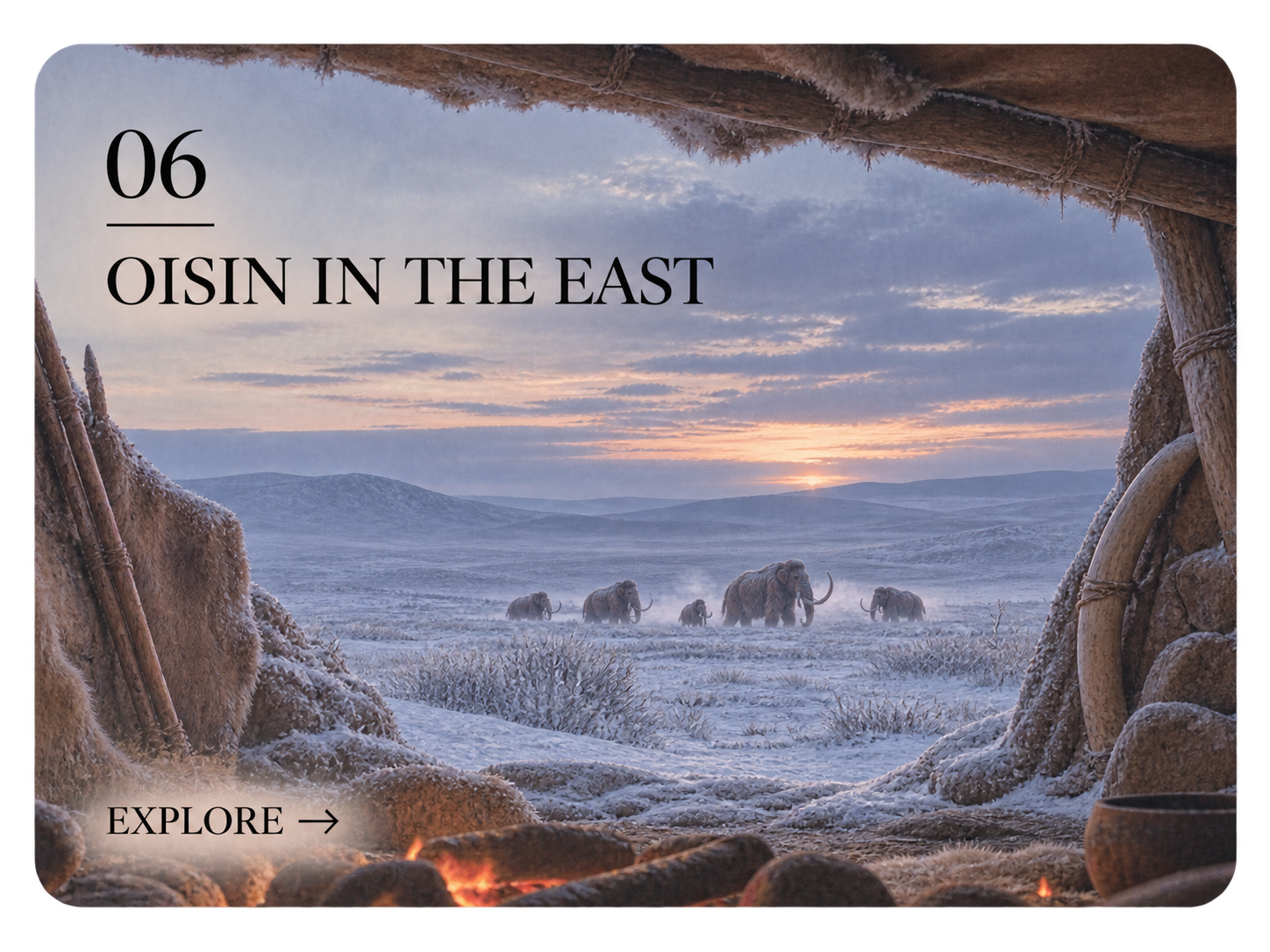
Oisin in the East
Roots in Siberia
While Wodan’s line was already present among the Gravettian communities of Central Europe, the paternal family that would eventually lead to Oisin was taking shape in a very different part of the world. Haplogroup R, from which Oisin’s own line ultimately descends, emerged around 27,000 BCE. Its earliest history is difficult to pin to a single place, but some of its most remarkable early evidence comes not from Europe at all, but from the vast plains of Central Asia and Siberia.
At Mal’ta, near Lake Baikal in south-central Siberia, a young boy was buried between 22,473 and 21,941 cal BCE. Known today as Mal’ta Boy, or MA-1, he carried an early form of haplogroup R, the wider paternal family from which Oisin’s own line descends48. He was only around three or four years old when he died, and his burial offers an extraordinary glimpse into the world in which this ancient lineage was living. What was long read as a single unusual burial is now understood to have been two children together, an infant's remains placed alongside the older child's. He was laid in a stone-lined grave over red ochre, accompanied by an extraordinary collection of objects: a necklace of around 120 beads with a central and six smaller pendants, a bird-shaped pendant, a decorated plaque, a bracelet, and flint tools. The wider Mal'ta collection contains more than 13,000 artefacts, including hundreds of objects fashioned from bone and ivory, ornaments and the remarkable human figurines for which the site became famous.
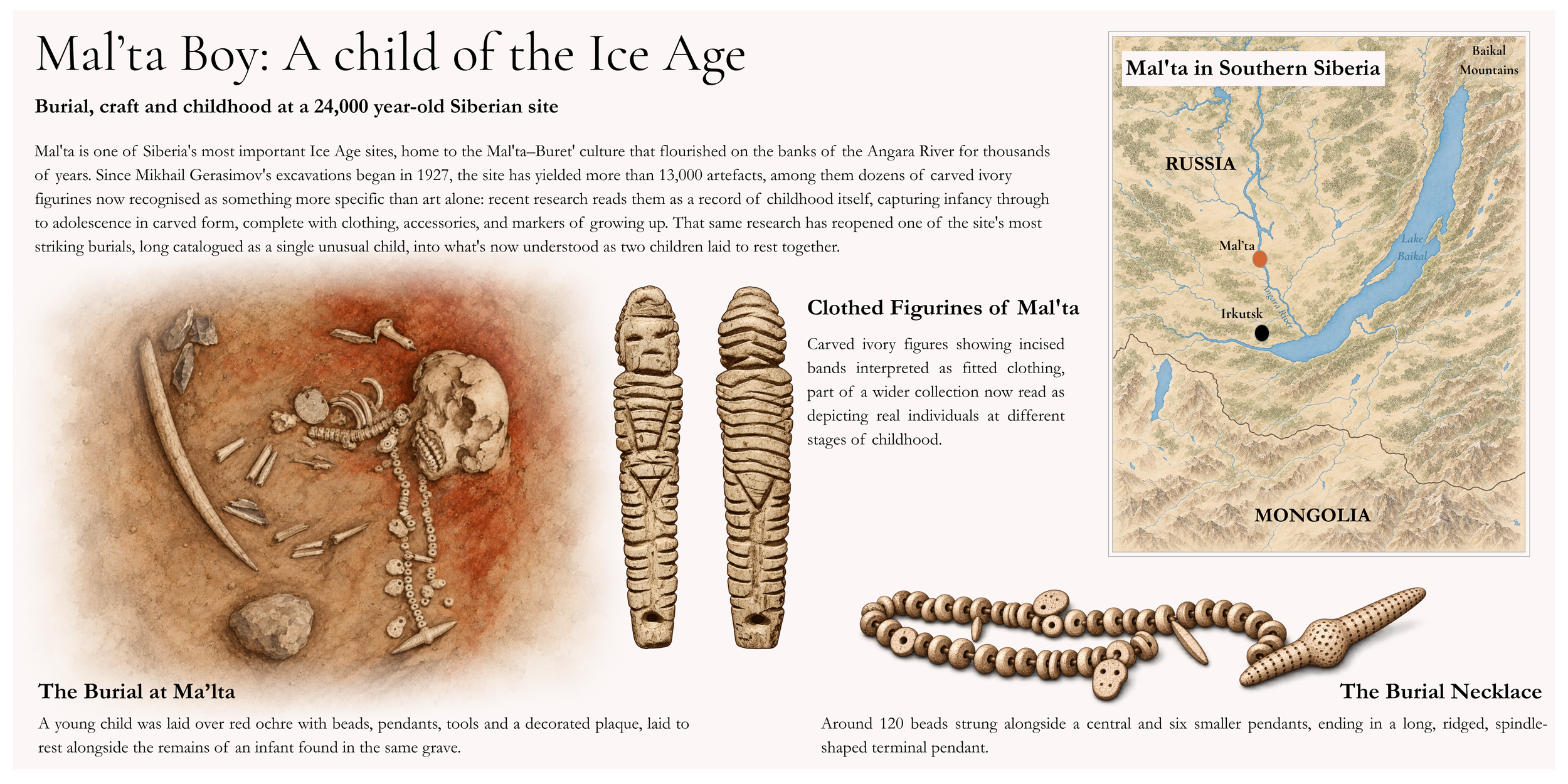
Grave goods, craft, and geography from a Siberian Ice Age burial. Illustrations based on archaeological finds and museum records from Mal'ta (Gerasimov excavations, 1927 onward; Hermitage Museum collection); burial and figurine reconstructions are illustrative depictions, not direct reproductions. Map: Mal'ta lies southwest of Lake Baikal, on the Angara River near Irkutsk.
Despite thousands of kilometres separating Siberia from Central Europe, Mal'ta's carved female figurines closely resemble those found at Dolní Věstonice and Pavlov, part of a much broader Palaeolithic artistic tradition of carving ivory, bone and antler that stretched across the continent. It's tempting to read that resemblance as a sign of shared ancestry, but the genetic evidence says otherwise: no direct connection has been found between the Mal'ta population and the people of Dolní Věstonice, suggesting the similarities in style arose through cultural contact or coincidence rather than common descent. Whatever carried these shared artistic traditions across such enormous distances, it was not, on the evidence so far, Wodan's or Ursula's own kin.
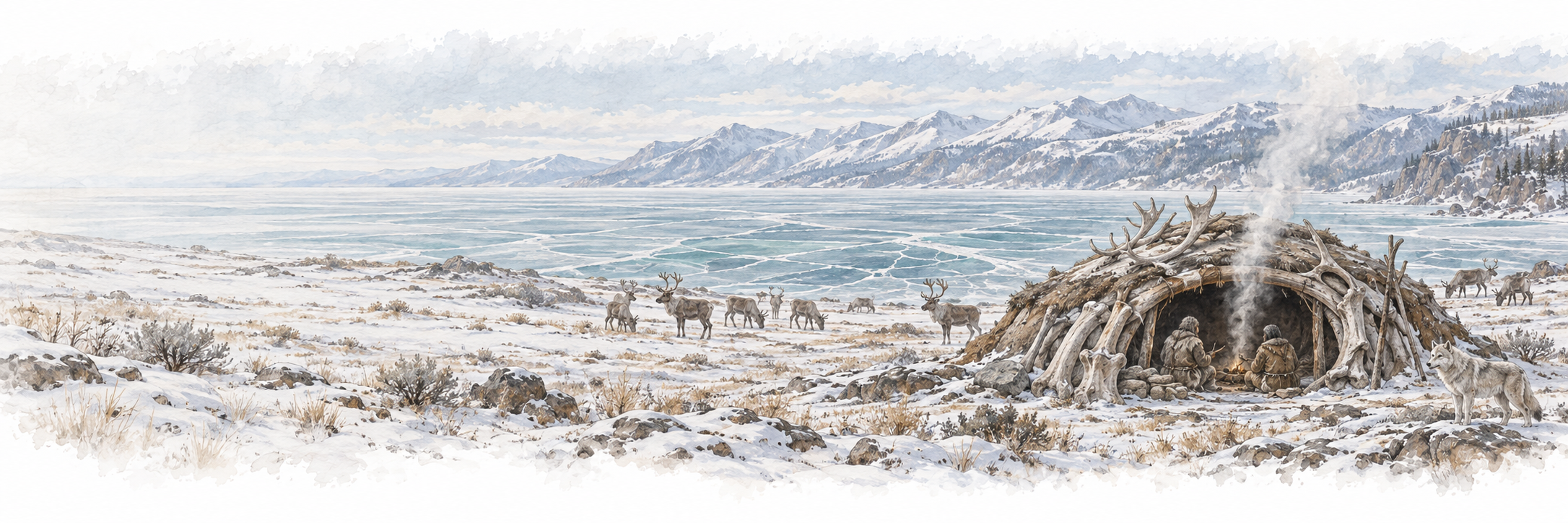
This was no empty frozen wilderness. Reindeer, mammoth, woolly rhinoceros, bison, horse, wolf, Arctic fox and other animals shared the landscape, while people lived in substantial dwellings with central hearths and storage pits. Dug partly into the ground and walled with the bones of mammoth and rhinoceros, their roofs framed with reindeer antler and likely covered with hide and sod, these semi-subterranean houses would have offered real protection against Siberia's relentless cold and wind. By the time Mal'ta Boy lived, the world had entered the severe climatic conditions of the Last Glacial Maximum. Thousands of kilometres to the west, immense ice sheets covered much of northern Europe; here, on the other side of Eurasia, people had built their own sophisticated Upper Palaeolithic world.
Mal’ta Boy’s importance reaches far beyond the objects buried with him. His Y chromosome belonged to a basal form of haplogroup R, distinct from every later branch of the lineage identified elsewhere in the ancient DNA record, making him one of the earliest known people descended from Oisin’s paternal line to appear in the ancient DNA record. Genetic analysis also revealed ancestry closely related both to later western Eurasians and to the ancestors of Native Americans, making him a key early representative of what became known as Ancient North Eurasian ancestry. While Ursula and Wodan were already part of Europe's Ice Age story, Oisin's deeper roots lay thousands of kilometres to the east, among the hunter-gatherers of Siberia. With Mal'ta Boy, three of the four lines are anchored to an actual named individual. Only Xenia's remains unaccounted for.
Thousands of kilometres from the ice sheets of Europe, on the edge of a frozen lake in Siberia, Mal'ta Boy stands as the earliest confirmed root of Oisin's paternal line.
07
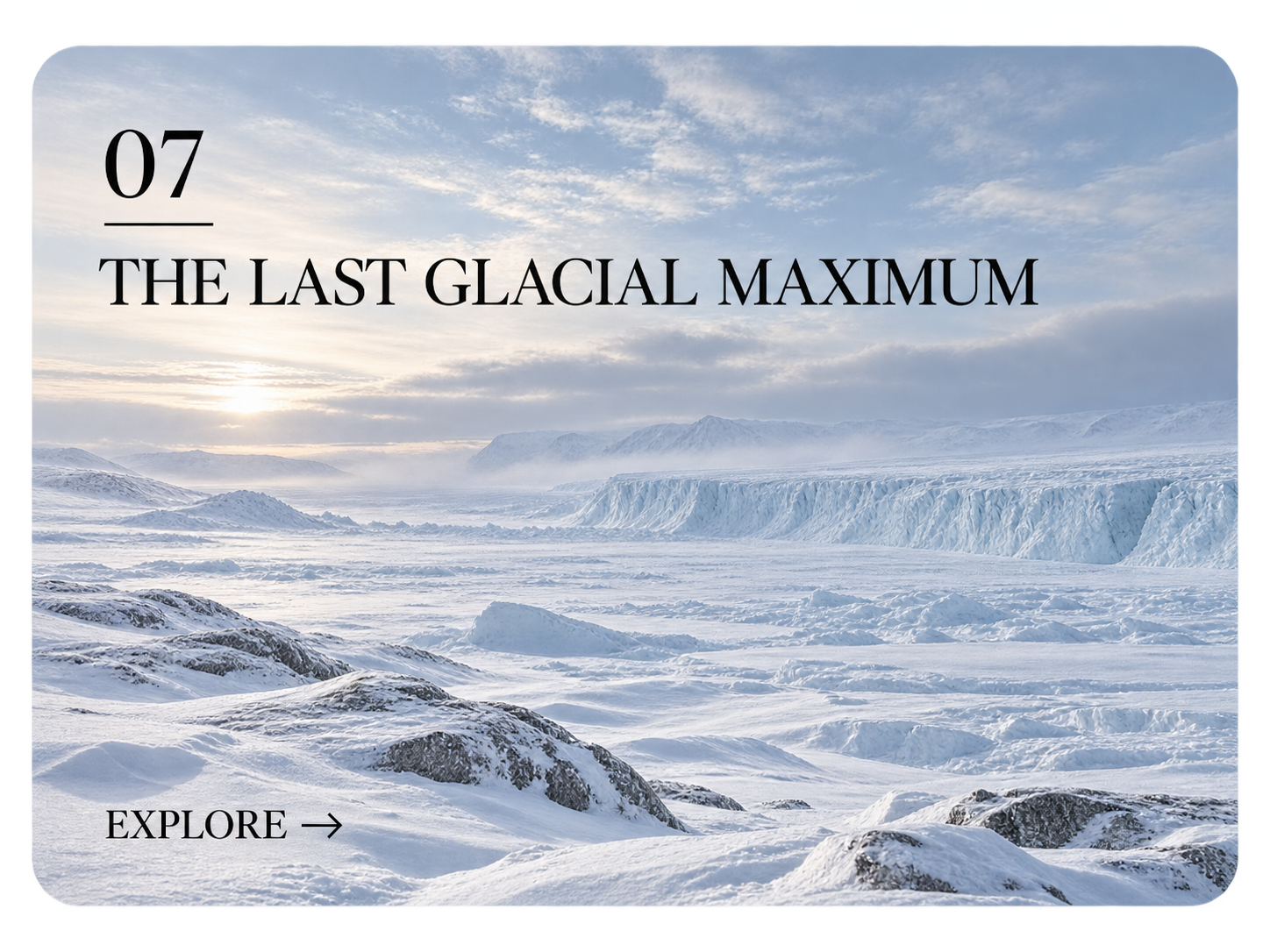
The Last Glacial Maximum
Isolation, endurance and survival
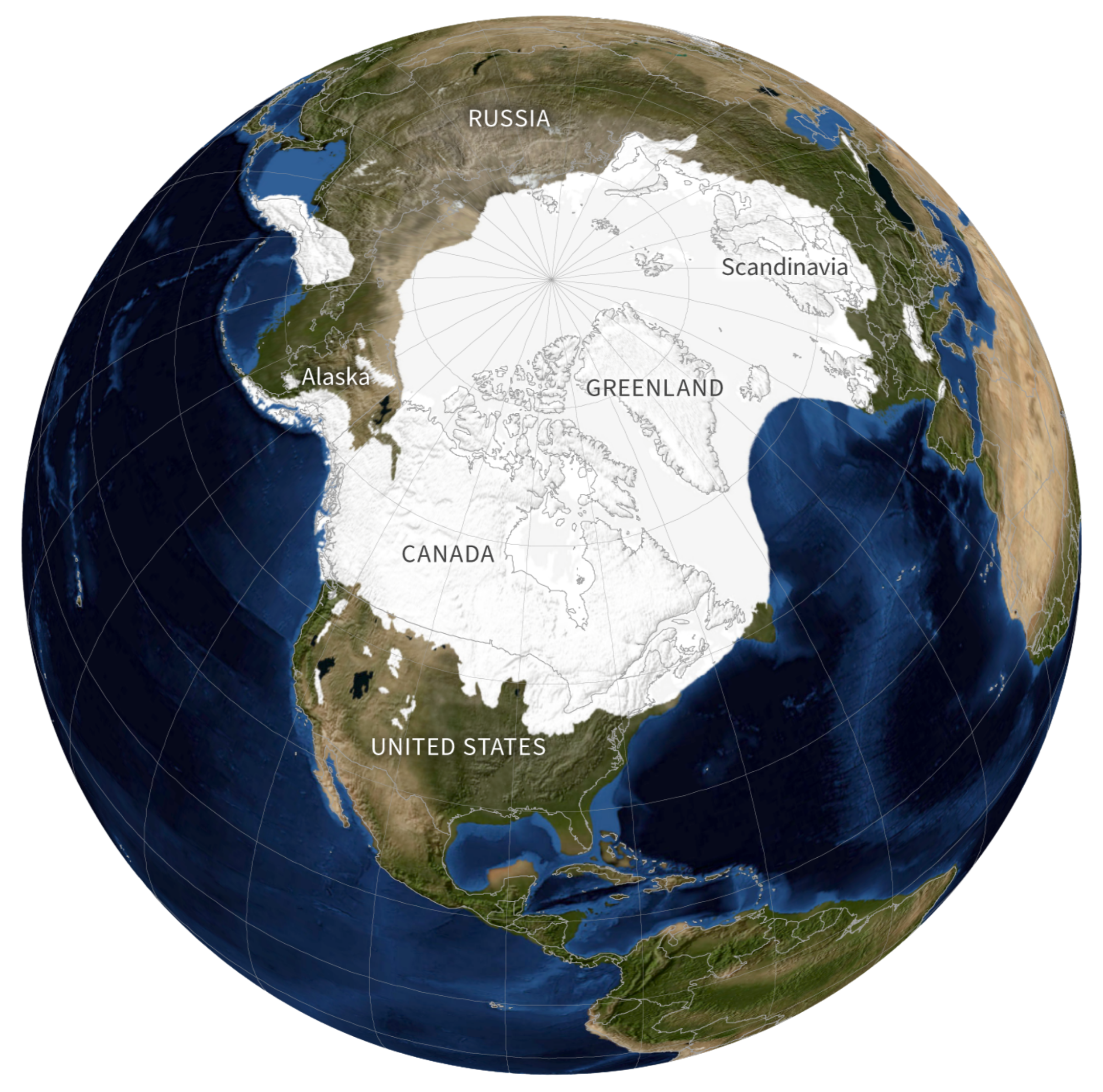
19,000 BCE
Roughly 20,000 years ago, the Earth was in the grip of the most severe phase of the last Ice Age. The Last Glacial Maximum, lasting from around 26,500 to 19,000 years ago, saw immense ice sheets spread across much of North America and northern Eurasia. In North America, the southern margin of the ice reached deep into the Midwest, as far as present-day Iowa; in Europe, it extended into Germany and Poland; while in Asia, extensive mountain glaciation covered parts of the Tibetan Plateau and the mountain ranges of Central Asia, from the Zagros to the Altai. So much water was locked into ice that sea levels fell by around 120-130 metres, exposing vast areas of land now beneath the sea, while average global temperatures were about 6°C colder than today.
Across much of northern Europe, whole landscapes disappeared beneath the ice, while elsewhere conditions deteriorated into cold, wind-scoured tundra and steppe. Human populations contracted dramatically into a handful of glacial refugia, warmer and more sheltered pockets farther south where enough plant and animal life persisted to sustain them. Most important were the Franco-Cantabrian region of northern Spain and southwestern France, the Mediterranean margins of Iberia, Italy and the Balkans. These were not simply temporary camps occupied for a few bitter winters, but regions in which communities survived across generations while enormous territories farther north became sparsely inhabited or were abandoned.
NOAA Climate.gov Data: NOAA SOS
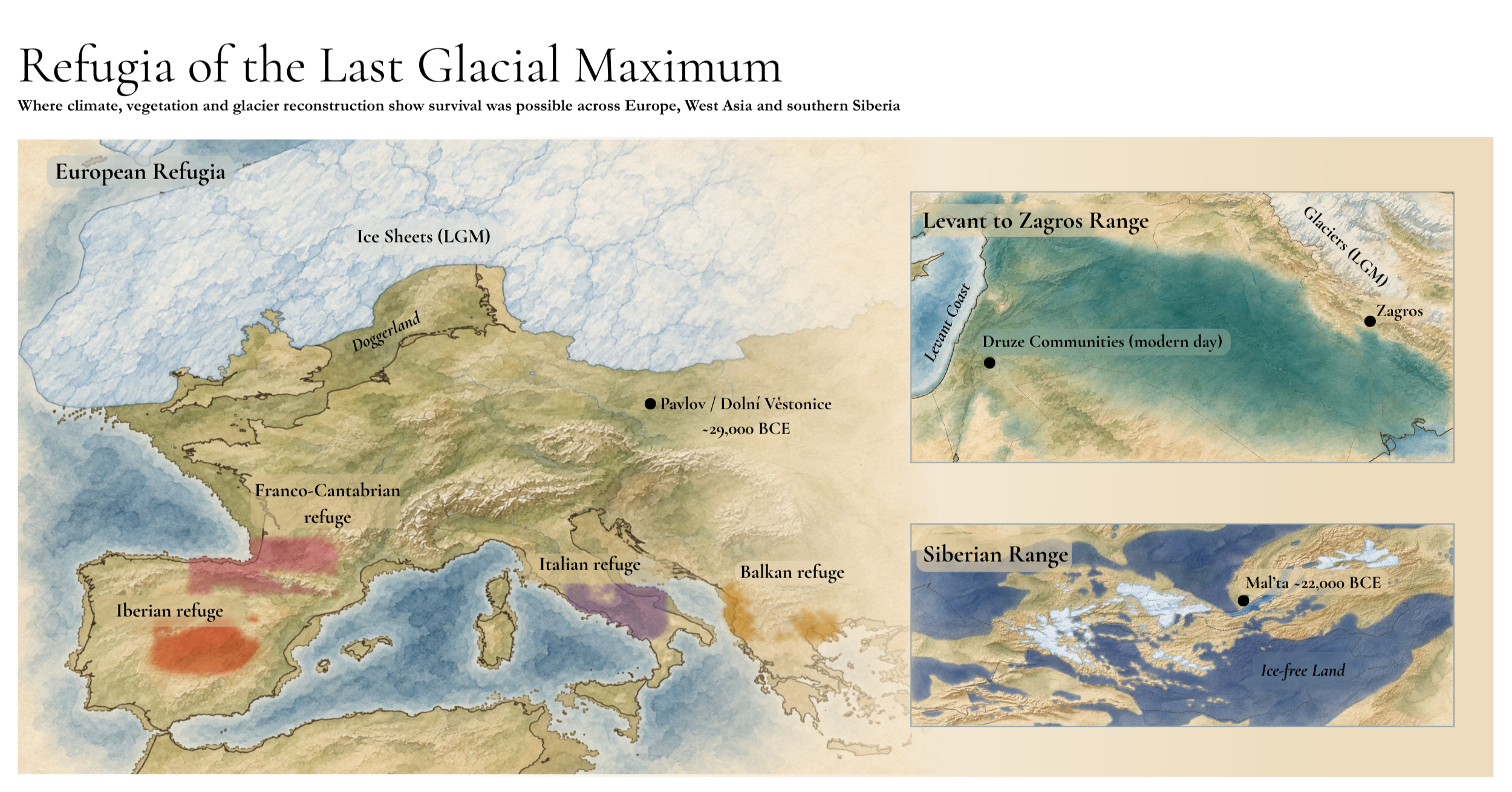
Reconstructed Boundaries of Survival. Each region shown here represents a place where people withstood the most extreme climate conditions of the Last Glacial Maximum, reconstructed from real physical data rather than estimation. The four European zones are bounded by reconstructed coldest-month temperatures, adjusted for the lower sea level of the time, which exposed additional coastal land now submerged. Real mountain terrain shapes these boundaries directly: the Balkan refuge (gold), has an irregular outline that unlike the clean-edged zones further west, reflects genuine climatic exclusion by the mountains within it, not an artistic choice. The same temperature threshold applied to West Asia found no true gap between the Levant coast and the Zagros foothills, so the region (teal), is shown as the single continuous range the data actually supports, with digitised glacier extents excluding the genuinely ice-bound ground of the Zagros high peaks and Anatolia. Oisin's Siberian range (navy), meets no comparable temperature threshold: conditions there remained too severe throughout the period to define a boundary by warmth at all. It is defined instead by real vegetation data, with glaciated terrain and mountain systems excluded, marking where the ground stayed open and ice-free rather than where it was ever mild. Full sourcing for each dataset is set out in the Evidence section. The black markers depict real, dated evidence. Pavlov and Dolní Věstonice sit outside every shaded zone, marking Ursula's and Wodan's earliest confirmed ancestors, before any refuge existed. Mal'ta falls within the Last Glacial Maximum itself. Xenia has no ancient individual yet found for this period, so her marker shows the Druze communities of the Levant.
Even within this long cold spell, the climate itself did not simply freeze into place. Ice-core and marine-sediment records show a repeating rhythm of abrupt swings layered on top of the Ice Age’s slower deep-freeze: rapid warming episodes known as Dansgaard-Oeschger events alternating with sudden, sharper cold snaps, while Heinrich events saw enormous discharges of icebergs carry debris far out into the North Atlantic. These changes could unfold astonishingly quickly, sometimes over decades rather than centuries, repeatedly shifting vegetation, animal ranges and the limits of habitable ground.
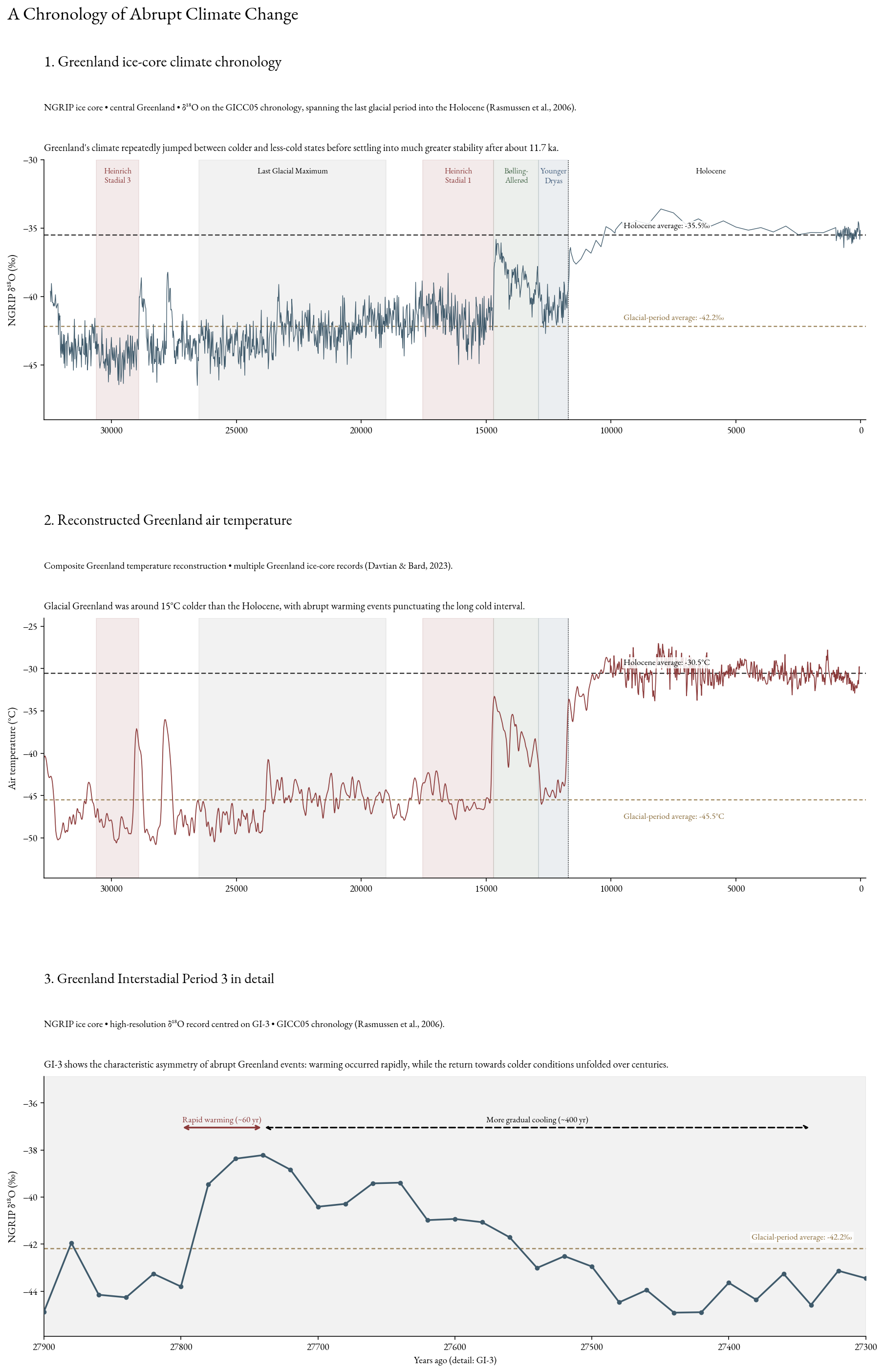
Greenland ice-core and temperature records. NGRIP δ¹⁸O and reconstructed Greenland air temperatures provide the chronological and climatic framework for the regional comparisons, showing repeated abrupt shifts during the last glacial period and the transition into the Holocene.
How each of the four lines weathered that crisis differed enormously.
The refugia were not culturally uniform. In the west, the Franco-Cantabrian world developed the distinctive Solutrean tradition, renowned for its exceptionally finely worked stone projectile points, while farther east the Epigravettian developed from the earlier Gravettian world in Italy and the Balkans. As habitable ground expanded and contracted, people and the animals they depended upon could move beyond the safest parts of the refugia, carrying materials, techniques and ideas between communities that harsher conditions had pushed apart.
For Ursula, survival of the Ice Age can be seen most clearly in her wider maternal family. U5 was already present among the Gravettian people of Central Europe before the climate reached its maximum severity, and ancient DNA shows that this maternal lineage survived the enormous population upheavals that followed, becoming one of the characteristic lineages of later European hunter-gatherers.
A remarkable trace of this wider maternal family has recently emerged from a very different kind of evidence. At Covarón Cave in Asturias, within the Franco-Cantabrian region, ancient human DNA has been recovered not from a skeleton but directly from unpigmented cave-wall surfaces close to prehistoric rock art. Two samples yielded mitochondrial DNA belonging to U5a’b, within the same wider maternal family as Ursula. The DNA cannot yet be securely dated to the Last Glacial Maximum or attributed to the people who made the nearby art, so it is not evidence that Ursula’s own line occupied the cave. What it does show is that genetic traces of this ancient maternal family can survive on surfaces touched by prehistoric people even where no human bones remain.
Wodan’s own line appears to have weathered the same crisis farther east. His wider paternal family, haplogroup I, was already present at Pavlov before the cold reached its maximum. Its I2 branch in particular has been linked to an Ice Age refuge in the Balkans and eastern Europe, not far from the wider region in which Wodan’s lineage had already appeared. This raises the intriguing possibility that his paternal family survived the worst of the Ice Age by retreating southwards into the same broad southeastern European refuge. Of the four refugia, the Balkans was the most exacting: its jagged extent is shaped directly by the mountains within it.
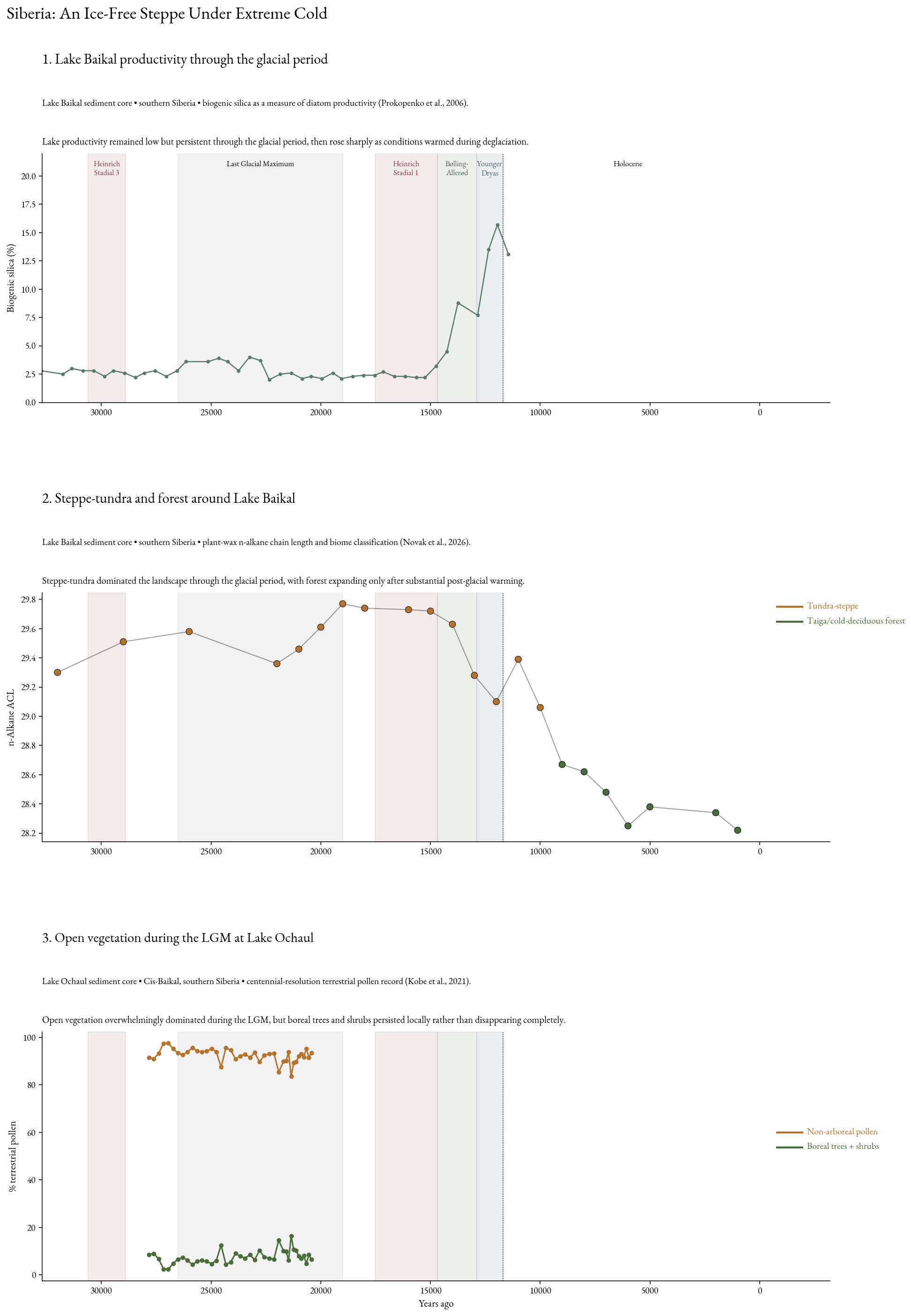
Oisin’s world was different again. His deeper paternal family remained far to the east across Siberia and Central Asia, where extreme cold combined with very low rainfall to prevent the vast continental ice sheets seen across northern Europe. Instead, huge areas became part of the mammoth steppe, a cold, dry grassland supporting mammoth, reindeer, horse and other large herbivores, Oisin’s paternal line therefore endured the Last Glacial Maximum in a harsh but largely ice-free landscape. Coldest-month temperatures across this range still fell to between minus twenty-seven and minus forty degrees, far beyond anything survivable by the standard that defined the refugia of Europe. Real alpine glaciers did exist within it, in the Altai, the Sayan and the mountains close to Baikal itself, but the vast steppe between them remained open and passable. What sustained Oisin's people here was not shelter from the cold, which nowhere in this landscape existed, but a landscape that stayed walkable and huntable despite it.
Xenia’s wider maternal family lay farther south in West Asia, beyond the great European ice sheets but not beyond the effects of the Ice Age. Much of the interior became colder and drier, with open steppe replacing richer vegetation, while a single continuous stretch of more sheltered ground, running from the Levant coast to the Zagros foothills, continued to support people, animals and plants through the worst of the climate. Archaeological sites such as Palegawra Cave in the Zagros of northern Iraq show that hunter-gatherers were living in this region during the Last Glacial Maximum, using caves and rock shelters and exploiting the plants and animals available around them. Genetic evidence suggests that Xenia’s wider X2 maternal family began spreading more widely across Eurasia around or just after the Last Glacial Maximum, probably from the Near East. No Ice Age burial carrying her own X2c branch has yet been identified, but together the genetic and archaeological evidence gives us a much clearer picture of the West Asian world in which her maternal story continued.
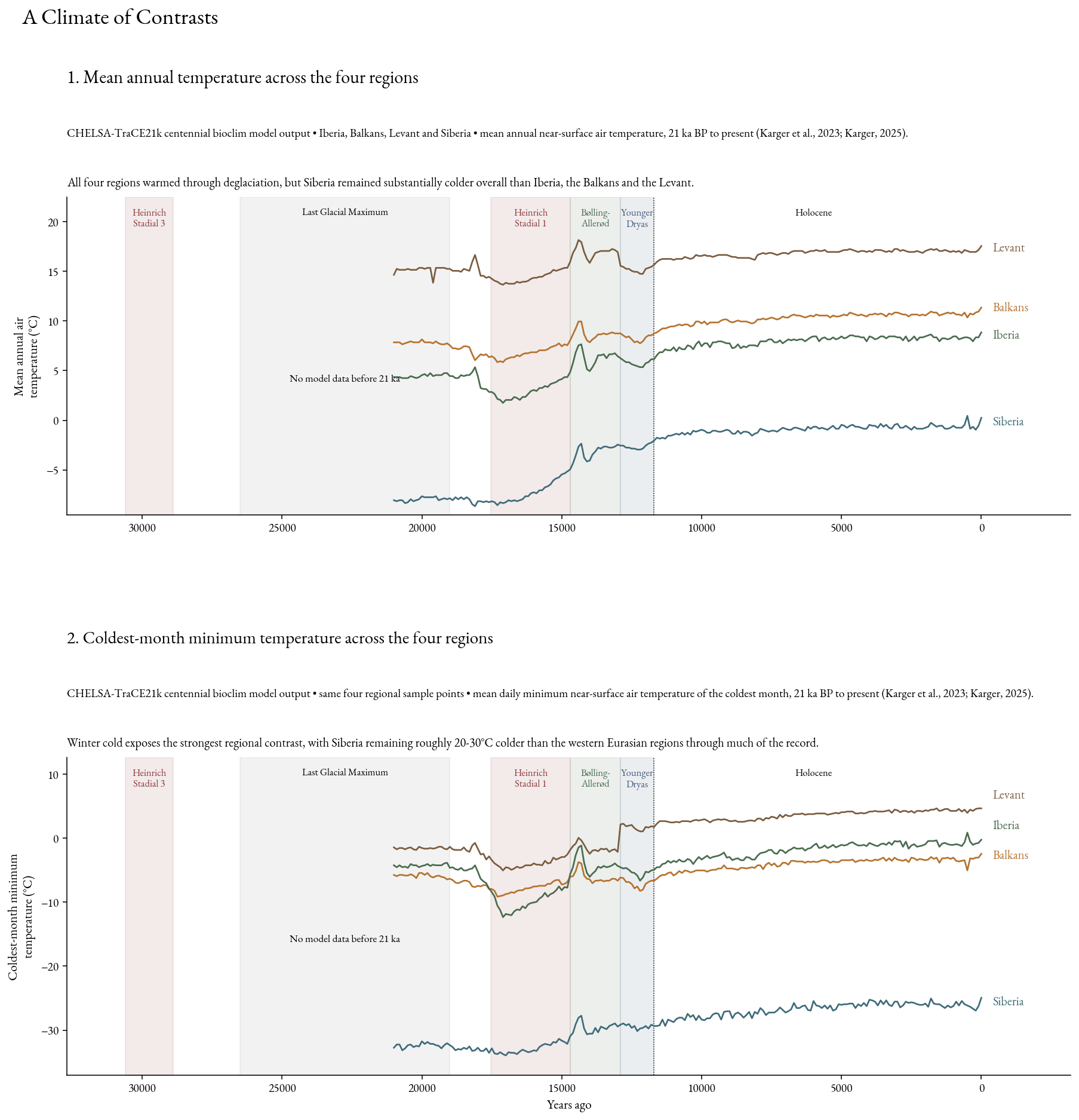
CHELSA-TraCE21k regional temperature reconstructions. Modelled mean annual temperature and coldest-month minimum temperature are compared across Iberia, the Balkans, the Levant and Siberia from 21 ka BP to the present, placing the four regions on the same climatic scale.
-
![]()
Iberia: marine temperature and pollen records
Marine sediment and terrestrial pollen records show how sea-surface temperature, woodland and open vegetation changed through the glacial period and deglaciation. -
![]()
Balkans: pollen, speleothem and climate reconstructions
Records from Lake Ohrid, Sofular Cave and Tenaghi Philippon combine vegetation, hydroclimate and seasonal climate evidence across the southern Balkans and Black Sea margin. -
![]()
Levant: pollen and hydroclimate records
Dead Sea and Soreq Cave records trace changes in desert-steppe vegetation, Mediterranean woodland and regional hydroclimate through the last glacial period. -
![]()
Siberia: lake productivity and vegetation records
Lake Baikal and Lake Ochaul records combine aquatic productivity, plant-wax biomarkers and pollen to reconstruct the open, cold environments of southern Siberia.
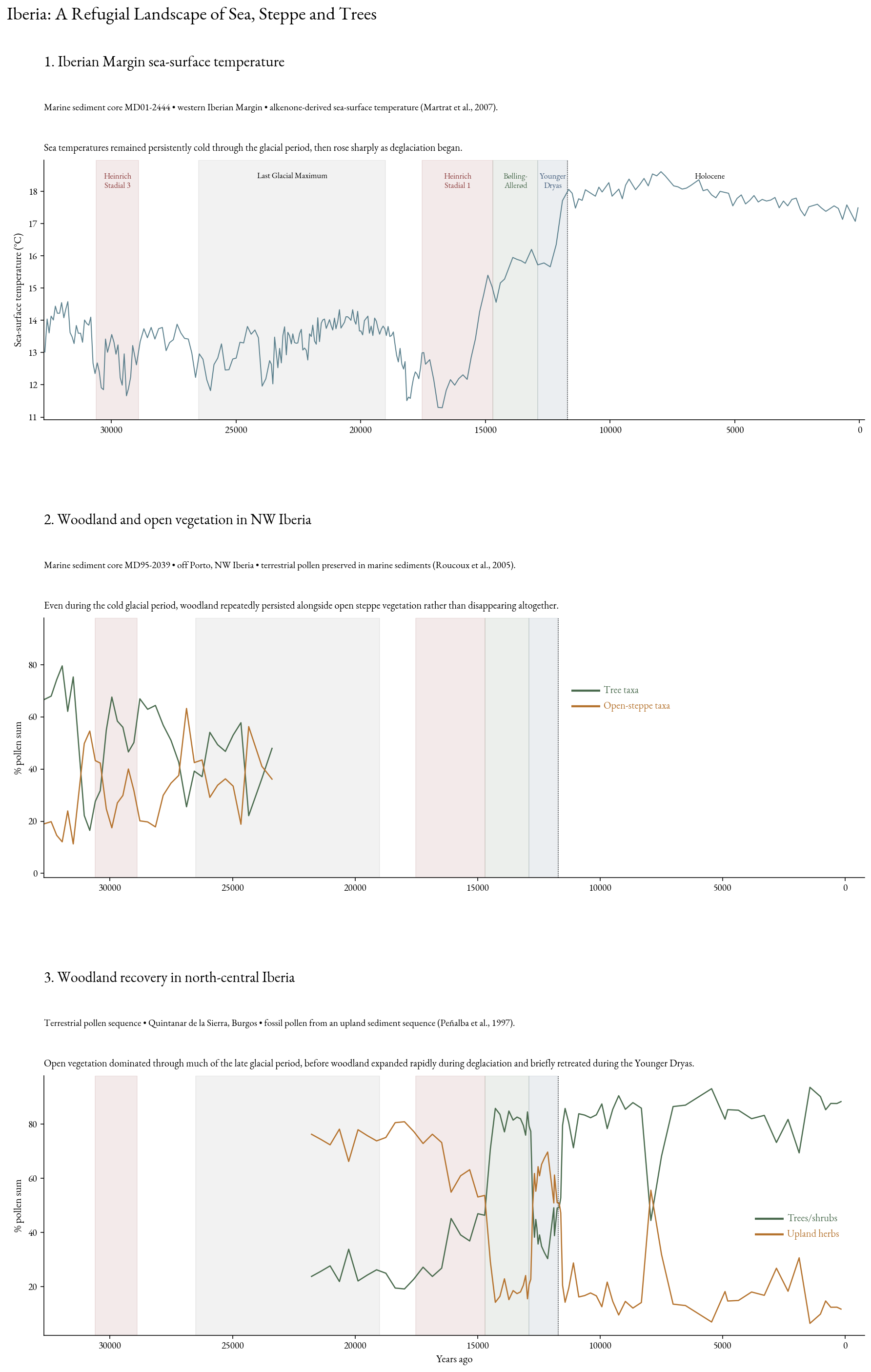
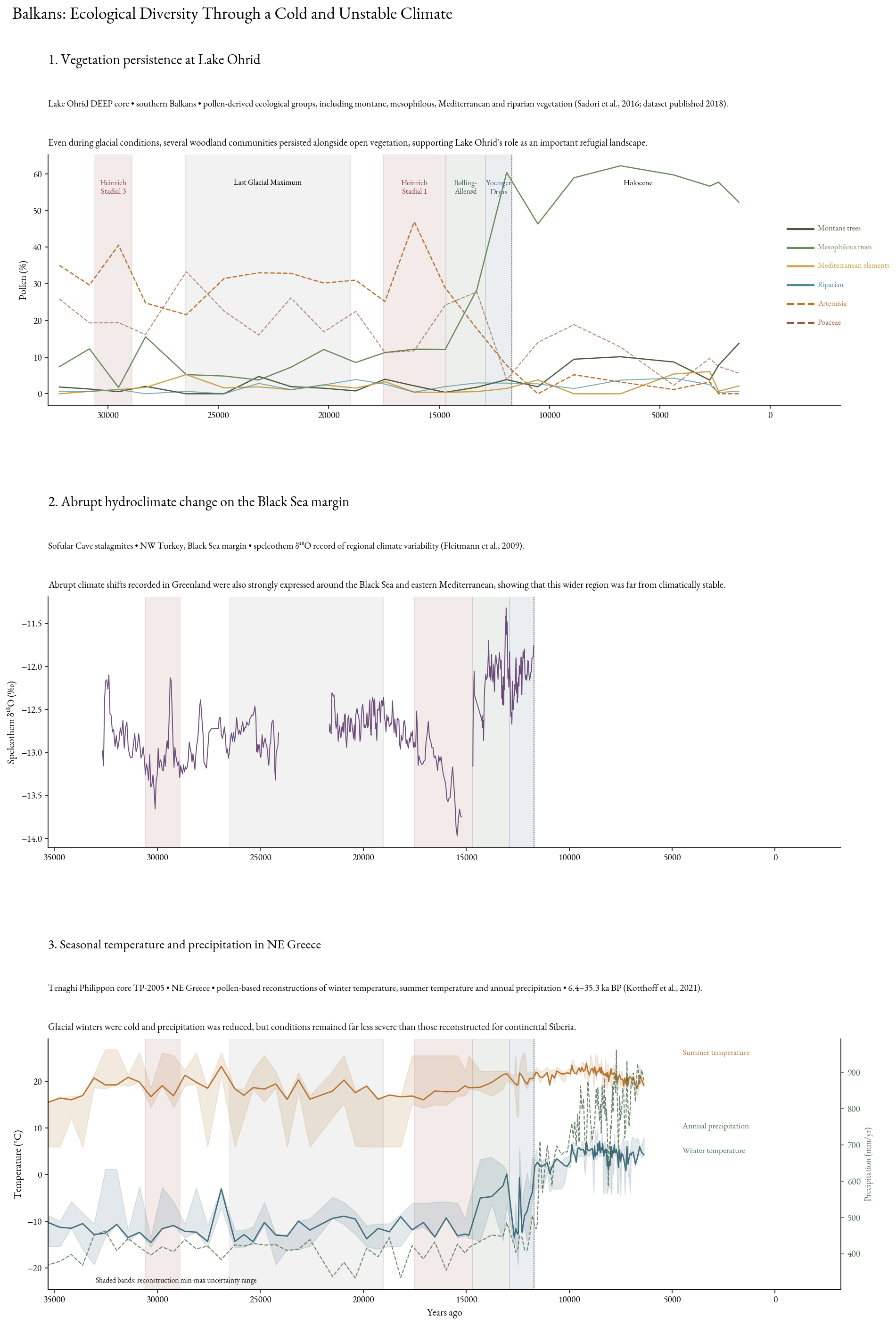
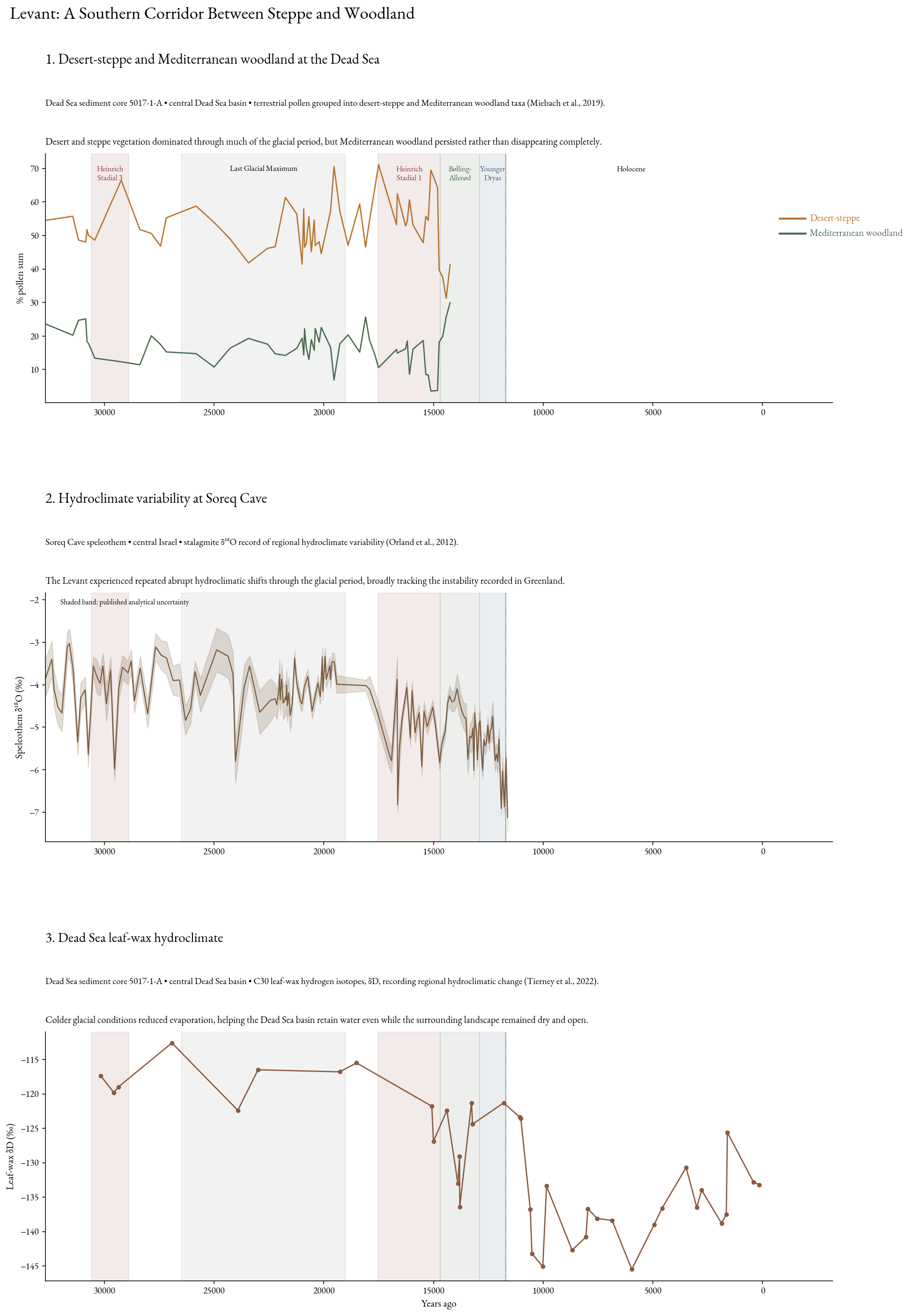
Ursula and Wodan both likely moved south from their shared Gravettian world into the refuges of Europe. Oisin's line had no single refuge to retreat to; instead, people moved north and south across the open steppe, following game across a landscape that remained harsh wherever they went. Xenia's line barely moved at all, already settled within a broad zone that the Ice Age left largely undisturbed.
By around 19,000 years ago, the Last Glacial Maximum was beginning to loosen its grip. The ice would not disappear quickly or smoothly, and dramatic climatic reversals still lay ahead, but across Eurasia the geography of human possibility was starting to change. The long contraction was ending, and movement back into the abandoned landscapes of Europe was about to begin.
Four lines endured the same Ice Age in four different worlds. When the thaw finally came, each travelled their own path into a changing landscape.
08
When the Ice Retreated
From Refugia to Recolonisation
By around 19,000 years ago, the great ice sheets were beginning to retreat, but Europe did not simply return to the world that had existed before them. Tundra and steppe gradually gave way to grasslands, scrub and woodland, animals returned to territories they had abandoned, and people began spreading northwards again from the regions in which they had survived the coldest millennia. Ancient DNA shows that this was not simply the return of the same people to the same places. Europe’s population was being reshaped as different hunter-gatherer groups expanded, met and sometimes replaced one another.
The warming itself was anything but smooth. Around 14,700 years ago, temperatures rose abruptly at the beginning of the Bølling-Allerød warm period, transforming environments across Europe. Regional records show that the scale of this warming varied considerably from place to place, with changes of several degrees in some areas rather than a uniform rise across the continent. Then, around 12,900 years ago, the climate lurched sharply backwards. The Younger Dryas brought a return to much colder conditions, particularly across northern and western Europe, where summer temperatures in the north may have been around 6°C lower than today. The cold lasted for more than a thousand years before another rapid warming around 11,700 years ago finally marked the beginning of the Holocene.
Against this shifting background, Oisin’s paternal line appears in western Europe for the first time. At Villabruna, in the foothills of the Dolomites in northern Italy, a hunter-gatherer buried between 12,190–11,770 BCE carried R-L754/R1b1a, part of the direct paternal lineage traced here from Oisin. We might call him Orso. More than ten thousand years after Mal’ta Boy had carried the deeper R lineage in Siberia, that paternal line had now appeared in western Europe in the remains of a real individual.
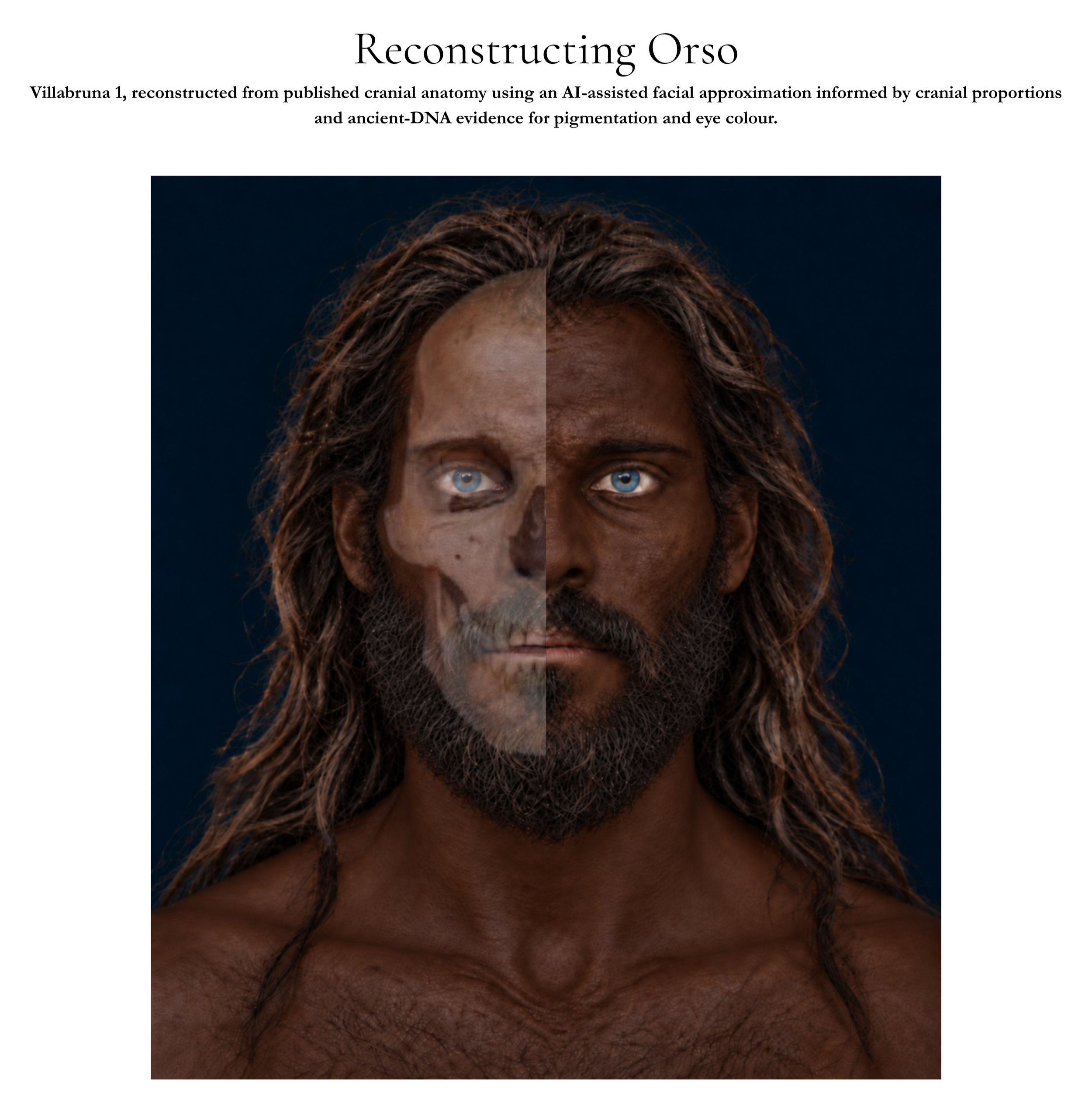
Villabruna 1: skull to face. Left: cranium of Villabruna 1, the individual behind Orso, R1b1's earliest confirmed European carrier, found at Ripari Villabruna, Italy (Vercellotti, G., et al., 2008, used under CC BY-NC 4.0). Right: facial approximation. The preserved cranium of Villabruna 1, an adult male aged approximately 25 years and dating to around 14,000 years ago, provides the anatomical basis for this evidence-informed facial approximation. Cranial form and proportions were informed by the osteological study of Vercellotti et al. (2008), while pigmentation was informed by ancient-DNA evidence reported for Villabruna in Fu et al. (2016). The reconstruction incorporates the ancestral alleles at SLC24A5 (rs1426654) and SLC45A2 (rs16891982), two major loci associated with lighter skin pigmentation in present-day Europeans, together with the derived variant at the HERC2/OCA2 locus (rs12913832) strongly associated with blue eye colour. The resulting portrait is an AI-assisted, evidence-informed approximation rather than a definitive likeness; soft tissue, hair and other features that cannot be recovered directly from the cranium or genome remain interpretive.
Orso was part of a much broader population movement already under way. Villabruna-related ancestry was present in Italy by at least 17,000 years ago, and from around 14,000 years ago spread much more widely through central and western Europe. By the time Orso was buried, people carrying this ancestry were already becoming an important part of the post-Ice Age hunter-gatherer population across much of the continent.
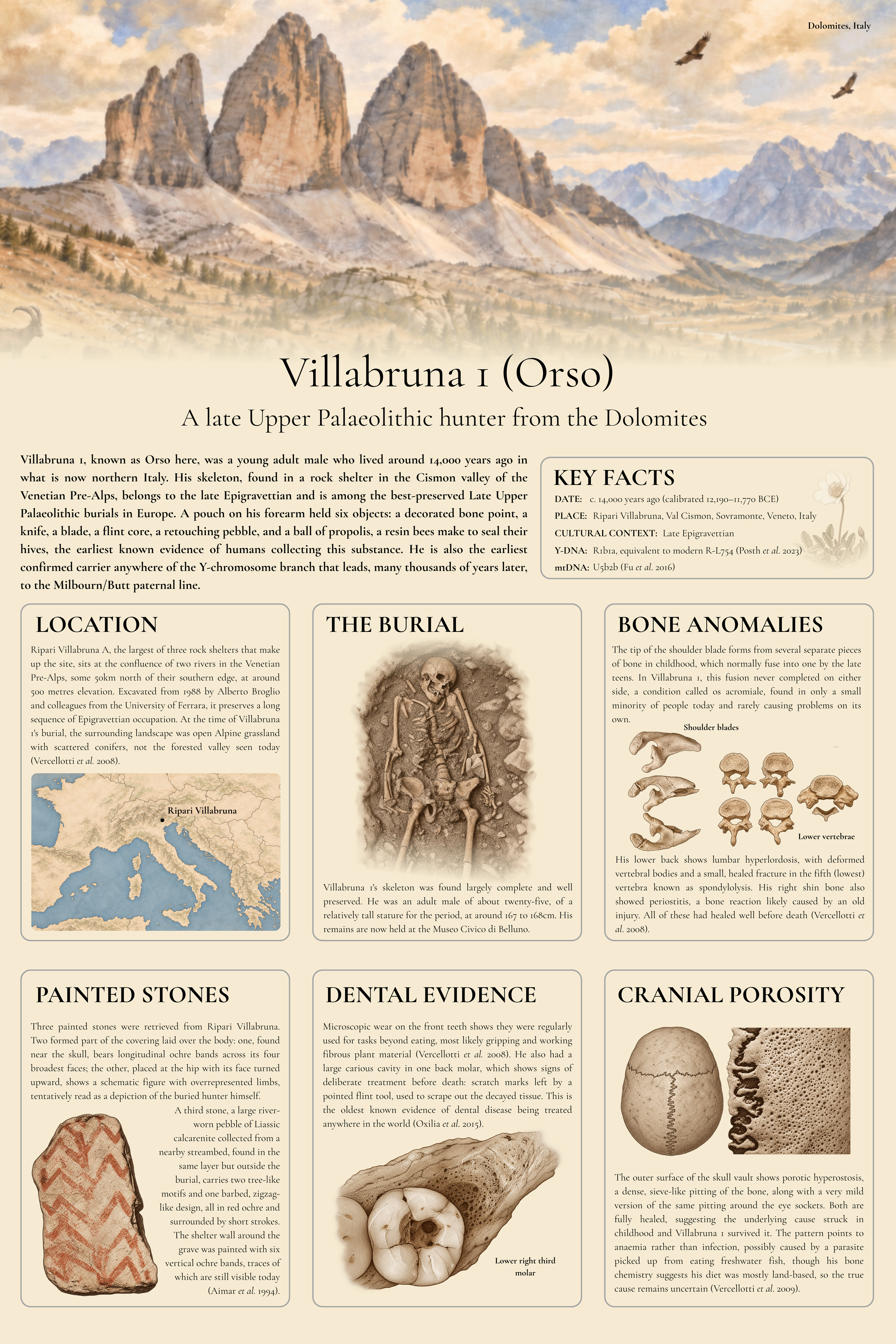
Villabruna 1: at a glance. A summary of the archaeological, skeletal and genetic evidence for Villabruna 1, the individual behind Orso, R1b1a's earliest confirmed European carrier, found at Ripari Villabruna, Italy. The location map is built from real elevation data (SRTM15+, via OpenTopography) and Natural Earth boundary data. The burial, dental and skeletal illustrations are evidence-informed reconstructions based on published photographs (Vercellotti et al. 2008; Oxilia et al. 2015), not direct reproductions of those images. The painted stones panel is based on Aimar et al. (1994)'s original excavation description, cross-checked against photography from the Museo MUVAR, Sovramonte. Full citations for each finding appear within the relevant panel.
These people may also have looked rather different from many Europeans living there today. Among Villabruna-related hunter-gatherers, genetic variants associated with blue or light-coloured eyes were extremely common, while two of the major variants associated with lighter skin pigmentation were still almost entirely absent. This suggests that at least some of them combined darker skin with light eyes, one of several combinations found among Europe’s prehistoric hunter-gatherers.
Skin pigmentation continued to change over the thousands of years that followed. Lighter-pigmentation variants increased at different times in different European populations rather than spreading across the continent in a single wave. One important evolutionary pressure was the balance between protection from ultraviolet radiation and the need for enough UV exposure to make vitamin D at higher latitudes. Ancient DNA shows that one major light-skin variant began increasing in frequency from around 13,000 years ago.
Their physical build was changing too. Early Upper Palaeolithic Europeans had often been remarkably tall: average adult male stature has been estimated at around 174 cm, compared with roughly 164 cm among Mesolithic Europeans, a difference of about ten centimetres,. The greatest reduction appears to have taken place after the Last Glacial Maximum, with a smaller further decline into the Mesolithic. Ancient DNA suggests that at least part of this longer-term change had a genetic component rather than simply reflecting nutrition or living conditions.
Farther east, hunter-gatherer populations also carried ancestry connected to the Ancient North Eurasians of Siberia. As these eastern and western populations encountered one another, they mixed, adding another layer to the genetic reshaping of post-Ice-Age Europe. By the beginning of the Holocene, the continent was already very different from the one that had entered the Last Glacial Maximum.
At the far northwestern edge of this changing world lay a territory that was not yet an island. Britain was still connected to continental Europe by a broad expanse of dry land, and people were beginning to move back into landscapes from which humans had been absent for thousands of years.