
The Evidence
THE GENETIC, ARCHAEOLOGICAL AND DOCUMENTARY FOUNDATION OF THIS ANCIENT ORIGINS STORY
This guide brings together the ancient DNA samples, genetic branches, archaeological contexts, dates, published sources, and the palaeoclimate and palaeoenvironmental data used to reconstruct the world around them, used to trace the four family lines through the past. It distinguishes between direct-line evidence, collateral branches, inferred genetic waypoints and documented modern relatives, and sets out the evidence behind the narrative as clearly as possible.
This is not a new scientific study, and it doesn't claim to be one. It is a documented family history that places four modern, genetically tested inheritance lines alongside published ancient genomes, established phylogenetic trees, and archaeological evidence, and tries to show, as honestly as possible, where each documented line actually sits within that wider record. Every ancient individual named on this page is treated as a genetic waypoint or a piece of supporting context, not as a proven ancestor, unless the evidence genuinely supports something more specific than that. The aim throughout has been to make the evidence traceable and legible to a general reader, while keeping the distinction between genetic relatedness and proven genealogy visible at every step, rather than letting one quietly stand in for the other.
The Four Lines

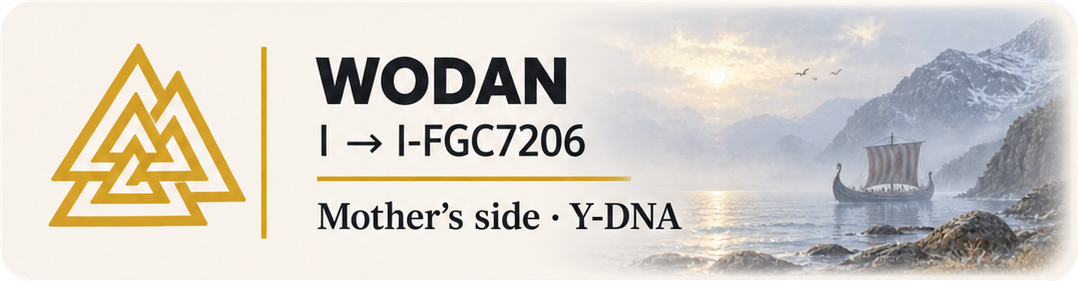

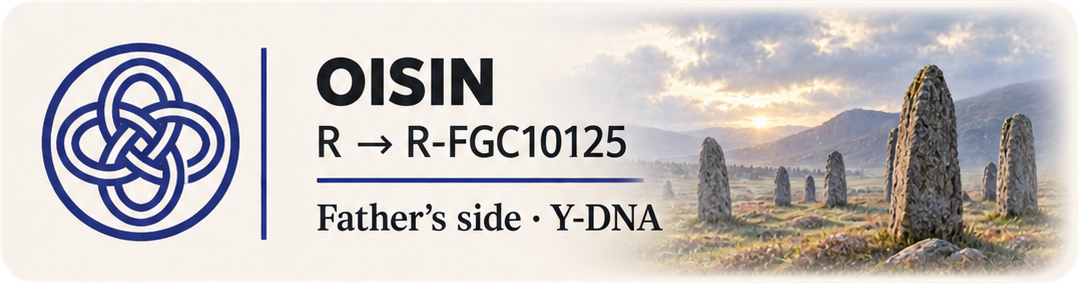
Four genetic lines carry the story: Ursula, Xenia, Oisin and Wodan. They are not historical individuals, but names used here for four lines of inheritance identified through DNA testing in my family, two maternal and two paternal.
Their tested markers provide the present-day anchors from which the story is traced backwards through ancient DNA, archaeology and documented genealogy.
Understanding the Evidence
How to interpret the branches, ancient individuals and gaps used throughout Ancient Origins.
The Evidence Guide brings these different layers together, from deep ancestral branches and the four family lines to ancient genetic waypoints, collateral branches and the modern tested relatives who anchor each line today.
Use it as a reference while reading Ancient Origins: when an unfamiliar name appears in the story, this is where to see what genetic branch it represents, what evidence supports it and where it sits in relation to the family line.
How to Read the Evidence Guide
The tables distinguish between several kinds of genetic evidence. These terms describe where an entry sits in relation to the family line, not whether the person was a documented genealogical ancestor, and the table itself may word each entry more specifically.
Inferred ancestor: A reconstructed branching point on the genetic tree, rather than an excavated individual.
Ancient DNA carrier: A real archaeological individual whose DNA has been sequenced and who carried the stated genetic branch.
Direct-line waypoint: An ancient DNA carrier whose genetic position lies on the phylogenetic route towards the family’s tested result. It marks a real position on the same genetic line, but does not prove a parent-to-child connection with the modern family.
Sibling / collateral branch: An individual who shares an earlier branch of the lineage but sits outside the precise route towards the family’s tested result.
Modern tested representative: A living relative whose mtDNA or Y-DNA result provides the present-day anchor for the line.
Sharing a haplogroup or lying on the same genetic branch does not, by itself, prove that an ancient individual was a direct genealogical ancestor.
Genetic position is not genealogy
The named ancient individuals in Ancient Origins mark positions on a genetic tree, not a proven family tree. When the narrative describes Odryn as “one of Owen’s descendants”, or Oretus as “one of Odal’s own descendants”, it means that Odryn’s tested marker lies genetically downstream of Owen’s, and Oretus’s downstream of Odal’s, on the branching structure of the Y chromosome. It does not mean that a documented chain of individual parents and children connects them.
No burial record or family tree links these ancient individuals in the way that documentary records connect recent generations. Two people can carry markers on the same genetic branch, one upstream of the other, without either being the other’s actual genealogical ancestor.
Direct line and collateral branches
A haplogroup is a family of related genetic branches, not a single individual. Someone may share part of a maternal or paternal genetic history with the modern family while lying on a different downstream branch of the tree.
The Evidence Guide therefore distinguishes between individuals whose genetic position lies on the phylogenetic route towards the family's tested result and individuals belonging to sibling or collateral branches that diverged earlier. Neither category, by itself, proves that an ancient individual was a genealogical ancestor. Both can help show where and when the wider genetic family existed, but they do not carry the same evidential meaning.
Names used in the guide
Ursula, Xenia, Oisin and Wodan are the running names for the four family lines themselves. A smaller number of names, including Urte, Odryn, Waska, Wictus, Wiros and Ormr, identify particular ancient genetic waypoints used within those stories. Xanthe is different again: she represents the inferred woman in whom X2c first arose rather than a known individual recovered from a burial.
The names are therefore tied to clearly defined positions within the genetic story, rather than being introduced simply because a new archaeological site, migration or period enters the narrative.
Evidence guide
Every name used across this story is gathered here, from the deep ancestral branches shared across humanity to the ancient individuals, branching points and modern tested relatives that anchor the four family lines today.
Deep Roots The deeper maternal and paternal branches from which the four family lines emerge
| Name | Haplogroup / Marker | Contextual descriptor | Evidence status | Site / Sample | Date | Date type | Reference |
|---|---|---|---|---|---|---|---|
| Eve | mtDNA root | Deep-Pleistocene inferred maternal ancestor of the mitochondrial genomes of living humans | Inferred Inferred phylogenetic ancestor |
—- | ~178,000 BCE | Molecular-clock coalescence estimate | Rito et al. 2013 |
| Adam | Y-DNA root | Deep-Pleistocene inferred ancestor of the Y chromosomes carried by living human males | Inferred Inferred phylogenetic ancestor |
—- | ~252,000 BCE | Molecular-clock coalescence estimate | Karmin et al. 2015 |
| Amadlozi | Y-DNA A | Deep African Y-chromosomal A-lineage representative, marking one of the deepest surviving branches of the Y-chromosomal tree | Inferred Inferred phylogenetic lineage |
—- | —- | —- | Haber et al. 2019 |
| Thang-la | Y-DNA D0 | Deep African D0-lineage representative, belonging to a lineage that branches close to the root of the DE/D family | Inferred Inferred phylogenetic lineage |
—- | ~69,000 BCE for the D0/D split | Y-chromosomal coalescence estimate | Haber et al. 2019 |
| Eshu | Y-DNA E | Deep African representative of Y-haplogroup E, a major early branch of the Y-chromosomal tree | Inferred Inferred phylogenetic lineage |
—- | —- | —- | Haber et al. 2019 |
| F | Y-DNA F | Deep Y-chromosomal branching-point lineage ancestral to the major non-African F-derived haplogroups | Inferred Inferred phylogenetic lineage |
—- | —- | —- | Scozzari et al. 2012 |
| Lara | mtDNA L3 | Inferred maternal ancestor of mtDNA L3, the major African maternal lineage from which later M and N lineages derive | Inferred Inferred phylogenetic ancestor |
—- | ~68,000-58,000 BCE | Molecular-clock coalescence estimate | Soares et al. 2012 |
| Naomi | mtDNA N | Inferred maternal ancestor of mtDNA N, the major Eurasian branch of the mtDNA tree from which most non-African maternal lineages descend | Inferred Inferred phylogenetic ancestor |
—- | ~60,000 BCE | Molecular-clock coalescence estimate | Soares et al. 2009 |
| Rohani | mtDNA R | Inferred maternal ancestor within mtDNA R, an early Eurasian branch descending from N | Inferred Inferred phylogenetic ancestor |
—- | ~53,000 BCE | Molecular-clock coalescence estimate | Metspalu et al. 2004 |
| Europa | mtDNA U | Ice Age inferred maternal ancestor of the mtDNA U lineage, an early major Eurasian maternal branch | Inferred Inferred phylogenetic ancestor |
—- | ~48,000-43,000 BCE | Molecular-clock coalescence estimate | Fu et al. 2013 |
Ursula's Line U5 → U5a1a1 mtDNA · maternal grandmother's maternal line
| Name | Haplogroup / Marker | Contextual descriptor | Evidence status | Site / Sample | Date | Date type | Reference |
|---|---|---|---|---|---|---|---|
| Ursula | U5 | Ice Age inferred ancestor of mtDNA U5 | Inferred Inferred phylogenetic ancestor |
— | ~28,000 BCE | Molecular-clock coalescence estimate | Behar et al. 2012 |
| — | U5 (same as Ursula herself) | Gravettian individuals from Dolní Věstonice II carrying mtDNA U5 | Ancient DNA Ancient DNA carriers |
Dolní Věstonice, Czechia (DLV005 (male)); (DLV006 (male)) | DLV005: ~29,197–28,918 BCE; DLV006: ~29,159–28,898 BCE | Radiocarbon (cal.) / archaeological context | Posth et al. 2023 |
| — | U5 (same as Ursula herself) | Gravettian individuals from the Krems-Wachtberg burial site | Ancient DNA Ancient DNA carrier |
Krems, Lower Austria (KremsWA3 (male)) | ~29,300–28,740 BCE | Radiocarbon (cal) | Fu et al. 2016; Teschler-Nicola et al. 2020 |
| Uska | U5a1 | Early Holocene Iron Gates hunter-gatherer, providing an early archaeological anchor for the U5a1 branch | Ancient DNA Ancient DNA carrier |
Padina, Iron Gates, Serbia (I5242) | 8,805–8,355 cal BCE | Radiocarbon (cal) | Mathieson et al. 2018 |
| Ukara | U5a1a | Eneolithic individual carrying the downstream U5a1a branch; earliest ancient carrier used here to mark this branch | Ancient DNA Ancient DNA carrier |
Kartal, Lower Danube, Ukraine (KTL006) | 4,157–3,959 cal BCE | Radiocarbon (cal) | Mallick et al. 2024 |
| — | U5a1a | Early Bronze Age ancient carrier of U5a1a from the Volga–Manych steppe | Ancient DNA Ancient DNA carrier |
Vostochny-Manych-3, Republic of Kalmykia, Russia (I32866 (female)) | ~2950 BCE | Archaeological/contextual | Mallick et al. 2024 |
| — | U5a1a | Middle Bronze Age ancient carrier of U5a1a associated with the Cetina culture | Ancient DNA Ancient DNA carrier |
Rudine, Cetina Valley, Croatia (I18747 (male)) | ~2,000-1,600 BCE | Archaeological/contextual | Lazaridis et al. 2022 |
| Urte | U5a1a1 | Eneolithic Volga-steppe carrier from the Khvalynsk pastoralist horizon representing the earliest ancient evidence used here for the U5a1a1 branch | Ancient DNA Ancient DNA carrier; named eldest representative |
Khlopkov-Bugor, Volga Steppe (I6301 (female)) | 5,213–5,035 cal BCE | Radiocarbon (cal) | Lazaridis et al. 2025 |
| —- | U5a1a1 | Additional Eneolithic Volga-steppe carrier of U5a1a1 | Ancient DNA Ancient DNA carrier |
Khvalynsk II, Volga Steppe (I6736) | 4,987–4,797 cal BCE | Radiocarbon (cal) | Anthony et al. 2022 |
| — | U5a1a1 | Early Bronze Age British carrier of U5a1a1 with substantial surviving Neolithic British ancestry | Ancient DNA Ancient DNA carrier |
Windmill Fields, County Durham (I1767 (male)) | 2202–1978 cal BCE | Radiocarbon (cal) | Olalde, I., et al.. 2018 |
| —- | U5a1a1 | Middle Bronze Age British carrier of U5a1a1; also carries Y-DNA placing him at R-DF13, downstream of R-L21 | Ancient DNA Ancient DNA carrier |
Biddenham Loop, Bedfordshire (I7577 (male)) | 1386–1123 cal BCE | Archaeological/contextual | Olalde, I., et al.. 2018 |
| — | U5a1a1 | European carriers demonstrating the continued presence of U5a1a1 from the Bronze Age through Roman-period and Viking-period contexts | Ancient DNA Ancient DNA carriers |
Tanderup, Denmark (CGG107525 (male); Asnæs, Denmark (CGG107441 (male)); Valkenburg, Netherlands (CGG107746 (male)); Bogøvej, Denmark (CGG106780 (female)) | CGG107525: 1397–1264 BCE; CGG107441: 1–200 CE; CGG107746: 39 BCE–114 CE; CGG106780: 750–1050 CE | Radiocarbon (cal) / archaeological-contextual | McColl et al. 2024, bioRxiv preprint, unrefereed |
| — | U5a1a1 | Late Iron Age British maternal relatives carrying Ursula's exact U5a1a1 lineage; both also carried different collateral branches of R-DF13 | Ancient DNA Ancient DNA carriers; third-degree maternal-line relatives |
Winterborne Kingston, Dorset (WBK06, male; WBK18, male) | WBK06: 147 cal BCE–61 cal CE; WBK18: 153 cal BCE–21 cal CE | Radiocarbon (cal) | Cassidy et al. 2025 |
| —- | U5a1a1 | Roman London carrier of Ursula’s exact maternal lineage; also carries a paternal branch downstream of R-DF13 within Oisin’s wider paternal family | Ancient DNA Ancient DNA carrier |
Shoreditch, London (C12038, male) | c. 100–300 CE | Archaeological/contextual | Silva et al. 2026, bioRxiv preprint, unrefereed |
| —- | U5a1a1 + additional mitochondrial variant | Roman British carrier of Ursula’s maternal branch at Bainesse Farm | Ancient DNA Ancient DNA carrier |
Bainesse Farm, near Catterick, North Yorkshire (C12877) | c. 200–400 CE | Archaeological/contextual | Silva et al. 2026, bioRxiv preprint, unrefereed |
| —- | U5a1a1 | Roman British carrier of Ursula’s maternal lineage from the Lankhills cemetery | Ancient DNA Ancient DNA carrier |
Lankhills, Winchester, Hampshire (C11301) | c. 300–400 CE | Archaeological/contextual | Silva et al. 2026, bioRxiv preprint, unrefereed |
| —- | U5a1a1 + 12352G | Roman/Sub-Roman British carrier of U5a1a1 at Winterborne Kingston; no demonstrated genealogical link to the earlier WBK06/WBK18 maternal family | Ancient DNA Ancient DNA carrier |
Winterborne Kingston, Dorset (WBK26, female) | 260–538 cal CE | Radiocarbon (cal) | Cassidy et al. 2025 |
| —- | U5a1a1 | Iron Age Finnish water-burial carrier associated with the Levänluhta population | Ancient DNA Ancient DNA carrier |
Levänluhta, Isokyrö, Finland (JK1970 (female)) | 300-800 CE | Archaeological/contextual | Lamnidis et al. 2018 |
| —- | U5a1a1 | Viking-Age Danish carrier of Ursula’s exact maternal branch; a second U5a1a1 individual from Bogøvej, distinct from CGG106780 | Ancient DNA Ancient DNA carrier |
Bogøvej, Langeland, Denmark, Grave S (VK320, male) | Viking Age | Archaeological/contextual | Margaryan et al. 2020 |
| — | U5a1a1 | Modern British family-line representative with a documented mtDNA U5a1a1 test result | Modern DNA Modern mtDNA SNP-array test |
England | Present | Modern Living mtDNA test | Living DNA Motherline result, Sirius v2 SNP array |
Cousins & sibling branches
Ancient DNA carriers from collateral branches within Ursula's wider maternal family.
| Name | Haplogroup / Marker | Contextual descriptor | Evidence status | Site / Sample | Date | Date type | Reference |
|---|---|---|---|---|---|---|---|
| — | U5a2 | Mesolithic Welsh cave-burial individual carrying the U5a2 branch, a collateral branch of U5a | Ancient DNA Ancient DNA carrier; sibling branch |
Kendrick's Cave, North Wales (Kendricks_074 (male)) | ~11,550 BCE | Archaeological/contextual | Charlton et al.. 2022 |
| — | U5a1c | Early Holocene Iron Gates forager carrying the U5a1c branch, a collateral branch within U5a1 | Ancient DNA Ancient DNA carrier; sibling branch |
Padina 22, Serbia (I5240) | 9,140–8,570 cal BCE | Radiocarbon (cal) | Mathieson et al. 2018 |
| — | U5a1a1g | Iron Age French individual, Hallstatt period, carrier of the U5a1a1g branch, relationship to the modern family below U5a1a1 unresolved | Ancient DNA Ancient DNA carrier; collateral branch |
Parançot, Jura, Bourgogne-Franche-Comté, France (CGG023704) | 610–450 BCE | Archaeological/contextual | McColl et al. 2024, bioRxiv preprint, unrefereed |
| Cheddar Man | U5b1 | Late Mesolithic western European hunter-gatherer carrying the U5b1 branch, a major sibling branch of U5a | Ancient DNA Ancient DNA carrier; sibling branch |
Gough's Cave, Somerset (I6767 (male)) | 8,607–7,982 cal BCE | Radiocarbon (cal) | Brace et al. 2019 |
Xenia's Line X → X2c mtDNA · paternal grandmother's maternal line
| Name | Haplogroup / Marker | Contextual descriptor | Evidence status | Site / Sample | Date | Date type | Reference |
|---|---|---|---|---|---|---|---|
| Xenia | X | Deep ancestral mtDNA X lineage from which the X2 branches ultimately descend | Inferred Inferred phylogenetic ancestor |
— | ~30,000 BCE | Molecular-clock coalescence estimate | Behar et al. 2012 |
| Xanthe | X2c | Inferred maternal ancestor of the X2c branch leading to the modern family-line lineage | Inferred Inferred phylogenetic ancestor |
—- | Earlier than the dated X2c1 carriers; exact branch age unresolved | Inferred | —- |
| —- | X2c | Modern British family-line representative with a documented mtDNA X2c test result | Modern DNA Modern mtDNA SNP-array test |
England | Present | Modern Living mtDNA test | Living DNA Motherline result, Sirius v2 SNP array |
Wider family & downstream branches
Ancient DNA carriers from sibling and downstream branches within Xenia's wider maternal family.
| Name | Haplogroup / Marker | Contextual descriptor | Evidence status | Site / Sample | Date | Date type | Reference |
|---|---|---|---|---|---|---|---|
| Kennewick Man | X2a | Major branch of X2, separate from X2c | Ancient DNA Ancient DNA carrier; sibling branch of X2c |
Kennewick Man, USA (K1) | ~9000 years ago | Radiocarbon (cal) | Rasmussen et al. 2015 |
| — | X2b | Major branch of X2, separate from X2c | Ancient DNA Ancient DNA carrier; sibling branch of X2c |
Çatalhöyük, Türkiye (cch230, female) | Early Neolithic | Archaeological/contextual | Yüncü et al. 2025 |
| —- | X2c1 (a branch within X2c) | Downstream branch within X2c, demonstrating ancient diversification of the X2c lineage | Ancient DNA Ancient DNA carriers; subclade of X2c; first-degree relatives |
Niedertiefenbach, Hesse, Germany (KH150620/NT148, male; KH150622/NT130, female; KH150623/NT135, male) | ~3,300–3,200 cal BCE | Radiocarbon (cal), Bayesian chronological model | Immel et al. 2021 |
| —- | X2c1 | Chalcolithic northern Italian carrier of the X2c1 branch | Ancient DNA Ancient DNA carriers; subclade of X2c |
Remedello di Sotto, Italy (RISE489 (male)) | 2,909–2,576 BCE | Radiocarbon (cal) | Allentoft et al. 2015. |
| —- | X2c1 | Late Neolithic/Early Bronze Age Danish carrier of X2c1 | Ancient DNA Ancient DNA carriers; subclade of X2c |
Gerdrup, Denmark (VK214) | 2,011–1,774 BCE | Radiocarbon (cal) | Margaryan et al. 2020 |
| —- | X2c1 | Viking Age Swedish carrier of X2c1 | Ancient DNA Ancient DNA carrier; downstream sibling branch of X2c |
Varnhem, Sweden (VK395) | 900–1200 CE | Archaeological/contextual | Margaryan et al. 2020 |
| — | X2c1a | Early medieval British carrier of a downstream branch of X2c; first ancient British carrier used here for Xenia’s wider maternal family | Ancient DNA Ancient DNA carrier; downstream branch within X2c |
Lincoln Eastern Bypass, Lincolnshire (C13538, male) | Early medieval | Radiocarbon / archaeological context | Silva et al. 2026, bioRxiv preprint, unrefereed |
| — | X2c2 | Downstream sibling branch within X2c, separate from X2c1 | Ancient DNA Ancient DNA carrier; downstream sibling branch of X2c1 |
Sandomierz, Poland (VK494) | 900–1100 CE | Archaeological/contextual | Margaryan et al. 2020 |
Oisin's Line R → R-FGC10125 Y-DNA · paternal grandfather's paternal line
| Name | Haplogroup / Marker | Contextual descriptor | Evidence status | Site / Sample | Date | Date type | Reference |
|---|---|---|---|---|---|---|---|
| Oisin | R | Ice Age inferred ancestor of Y-haplogroup R | Inferred Inferred phylogenetic ancestor |
—- | ~27,000 BCE | TMRCA estimated | Karmin et al. 2015 |
| Mal’ta Boy | R-M207/R* | Upper Palaeolithic Siberian hunter-gatherer associated with the Mal'ta–Buret' culture | Ancient DNA Ancient DNA carrier |
Mal'ta, Siberia, Russia (MA-1) | 22,473–21,941 cal BCE | Radiocarbon (cal) | Raghavan et al. 2014 |
| Orso | R-L754/ R1b1a | Late Ice Age western European hunter-gatherer and the oldest currently documented ancient representative of the R-L754 branch in this lineage | Ancient DNA Ancient DNA carrier; named eldest representative |
Villabruna, northern Italy (I9030) | 12,230–11,830 cal BCE | Radiocarbon (cal) | Fu et al. 2016 |
| —- | R-L754/ R1b1a | Later ancient carrier of the same R-L754 branch | Ancient DNA Ancient DNA carrier |
Ekaterinovskiy-Mys, Samara River (I6064) | c. 5,400 BCE | Radiocarbon / archaeological dating | Mallick et al. 2024 |
| —- | R-L754 | Later Eneolithic Volga-steppe carrier of the same R-L754 branch | Ancient DNA Ancient DNA carrier |
Khvalynsk II, Volga steppe (I6736, male) | 4,987–4,797 cal BCE | Radiocarbon (cal.) | Anthony et al. 2022 |
| Odal | R-M269 | Late Steppe Eneolithic North Caucasus individuals; among the earliest currently documented R-M269 carriers | Ancient DNA Ancient DNA carriers; named eldest representative |
Stavropol, Russia (Konstantinovskiy 4 (KST001)) and (Nevinnomyskiy 3 (NV3003)) | KST001: 3,939–3,709 cal BCE; NV3003: 3,776–3,652 cal BCE | Radiocarbon (cal) | Ghalichi et al. 2024 |
| Oretus | R-P312 | Early Copper Age Iberian carrier of R-P312 from the El Hundido burial complex | Ancient DNA Ancient DNA carrier |
El Hundido, near Burgos, Spain (EHU002) | 2,562–2,306 BCE | Radiocarbon (cal) | Olalde et al. 2019 |
| Owen | R-L21 | Early British Beaker carrier of R-L21 associated with the Boscombe Bowmen | Ancient DNA Ancient DNA carrier |
Amesbury Down, Wiltshire (I2417) | ~2,500-2100 BCE | Archaeological/contextual | Olalde et al. 2018 |
| Odryn | R-DF13 | Early Bronze Age British carrier of R-DF13 from northern Britain | Ancient DNA Ancient DNA carrier |
Dryburn Bridge, Scotland (I2568) | 2,288–2,037 BCE | Radiocarbon (cal) | Patterson et al. 2022; Dunwell 2007 |
| —- | R-DF13 | Seven additional confirmed Bronze Age British carriers demonstrating the wider presence of R-DF13 in Britain | Ancient DNA Ancient DNA carriers |
Lechlade-on-Thames (I12786, I12935); Yarnton (I2445); Amesbury Down (I2597); Figheldean (I5513); Birkrigg (I20997); Trumpington Meadows (I3256) | Bronze Age, individual dates vary | Radiocarbon / archaeological contextual | Patterson et al. 2022 |
| —- | R-DF13 | Additional ancient British R-DF13 carriers represented in the wider genomic datasets | Ancient DNA Ancient DNA carriers |
Dairy Farm, Willington, South Derbyshire (I2452); West Deeping, Lincolnshire (I2453); River Thames Skulls, Mortlake, London (I5377); Biddenham Loop, Bedfordshire (I7576); Elbolton Cave, North Yorkshire (I16403); Thornholme, East Riding of Yorkshire (I18606); Rowbarrow, Wiltshire (I19858) | I2452: 2,199–2,032 cal BCE; I2453: 2,290–2,038 cal BCE; I5377: 1,895–1,693 cal BCE; I7576: 1,209–1,005 cal BCE; I16403: c. 1,600–1,350 BCE; I18606: 1,919–1,742 cal BCE; I19858: 1,532–1,431 cal BCE | Radiocarbon (cal) / archaeological contextual | Patterson et al. 2022 |
| — | R-DF13 | Middle Bronze Age British carrier of R-DF13; also carries Ursula's U5a1a1 maternal lineage | Ancient DNA Ancient DNA carrier |
Biddenham Loop, Bedfordshire (I7577) | 1,386–1,123 cal BCE | Radiocarbon (cal) | Olalde et al. 2018 |
| — | downstream branch of R-DF13 | Roman London carrier of Oisin’s wider paternal family; also carries Ursula’s exact U5a1a1 maternal lineage | Ancient DNA Ancient DNA carrier |
Shoreditch, London (C12038, male) | c. 100–300 CE | Archaeological/contextual | Silva et al. 2026, bioRxiv preprint, unrefereed |
| Ormr | R-L1335 / R-L1065 | Viking Age Norwegian carrier of the L1335/L1065 branch, within the upstream lineage leading towards the later FGC10125 branch | Ancient DNA Ancient DNA carrier |
Oppland, Norway (VK386) | 800–1,100 CE | Archaeological/contextual | Margaryan et al. 2020 |
| —- | R-L1335 / R-L1065 | Early modern North Atlantic carrier of the L1335/L1065 branch, representing a parallel branch within the wider lineage rather than the documented route towards FGC10125 | Ancient DNA Ancient DNA carrier; parallel/cousin branch |
Faroe Islands (Faroe 3 (VK242)) | c. 1,500-1,700 CE | Archaeological/contextual | Margaryan et al. 2020 |
| — | R-FGC10125 | Modern tested representative of the downstream FGC10125 branch. Provides the present-day terminal point of the documented family Y-line. | Modern DNA Modern Y-DNA SNP-array test |
England | Present | Modern Living DNA Y-DNA test | Living DNA Fatherline result, Sirius v2 SNP array |
Cousin & sibling branches
Ancient DNA carriers from collateral branches within Oisin's wider paternal family.
| Name | Haplogroup / Marker | Contextual descriptor | Evidence status | Site / Sample | Date | Date type | Reference |
|---|---|---|---|---|---|---|---|
| —- | R-BY575 | Early Bronze Age British carrier of a deeply resolved downstream DF13 branch, demonstrating the presence of the DF13 lineage in Britain by the early Bronze Age | Ancient DNA Ancient DNA carrier; sibling-branch representative |
Low Hauxley, Northumberland, England (KD070) | 2,464–2,209 cal BCE | Radiocarbon (cal) | Dulias et al. 2022 |
| —- | collateral branches within R-DF13 | Late Iron Age British carriers of different collateral paternal branches within Oisin’s wider R-DF13 family; both also carried Ursula’s exact U5a1a1 maternal lineage | Ancient DNA Ancient DNA carriers; collateral branches |
Winterborne Kingston, Dorset (WBK06, male; WBK18, male) | WBK06: 147 cal BCE–61 cal CE; WBK18: 153 cal BCE–21 cal CE | Radiocarbon (cal) | Cassidy et al. 2025 |
Wodan's Line I → I-FGC7206 Y-DNA · maternal grandfather's paternal line
| Name | Haplogroup / Marker | Contextual descriptor | Evidence status | Site / Sample | Date | Date type | Reference |
|---|---|---|---|---|---|---|---|
| Wodan | I | Ice Age inferred ancestor of Y-haplogroup I | Inferred Inferred phylogenetic ancestor |
— | ~27,000 BCE | TMRCA estimated | Karmin et al. 2015 |
| — | I | Upper Palaeolithic Gravettian carrier of Y-haplogroup I from the Pavlov settlement complex in Central Europe | Ancient DNA Ancient DNA carrier |
Pavlov, Czechia (Pavlov1) | ~29,300–27,500 BCE | Archaeological /radiocarbon context | Fu et al. 2016 |
| Waska | I-L161.1 | Early Neolithic western European carrier of I-L161.1, representing one of the earliest known branches of the L161 lineage | Ancient DNA Ancient DNA carrier |
Els Trocs, Spain (I0412) | ~5,308–5,080 cal BCE | Radiocarbon (cal) | Mathieson et al. 2015 |
| —- | I-L161.1 | Second Early Neolithic carrier of I-L161.1, same branch as Waska | Ancient DNA Ancient DNA carrier |
Lingolsheim, France (SX33) | ~4,766–4,601 BCE | AMS / radiocarbon | Furtwängler et al. 2020 |
| Wictus | I-FGC7113 / L161 | Earliest ancient carrier identified for the Duxford branch; biological father of Wiros | Ancient DNA Ancient DNA carrier; first-degree kinship |
Duxford, England (DUX008 (male)) | ~100–125 CE | Archaeological /radiocarbon context | Scheib et al. 2024 |
| Wiros | I-FGC7206 | First known ancient carrier of the downstream FGC7206/Y3723 branch; biological son of Wictus | Ancient DNA Ancient DNA carrier; first-degree kinship |
Duxford, England (DUX001) | ~100–125 CE | Archaeological /radiocarbon context | Scheib et al. 2024 |
| — | I-FGC7206 | Living relative, matches Wiros directly | Modern DNA Modern Y-DNA SNP-array test |
England | Present | Modern Living DNA Y-DNA test | Living DNA Fatherline result, Sirius v2 SNP array |
Cousin & sibling branches
Ancient DNA carriers from collateral branches within Wodan's wider paternal family.
| Name | Haplogroup / Marker | Contextual descriptor | Evidence status | Site / Sample | Date | Date type | Reference |
|---|---|---|---|---|---|---|---|
| —- | I-L1195 / M284 | Early Neolithic British collateral lineage within Y-haplogroup I. The M284 branch had separated from the M423/L161 route leading to Wodan much earlier in the paternal tree | Ancient DNA Ancient DNA carriers; distant collateral branch |
Hazleton North, Gloucestershire, England (multiple males in reconstructed pedigree) | c. 3695–3650 cal BCE | Modelled monument chronology | Fowler et al. 2022 |
| Cheddar Man | I-M423 / I2a | Mesolithic British carrier of the M423 branch within Y-haplogroup I, representing an early British cousin lineage on the wider route from which Wodan’s later L161 branch descends | Ancient DNA Ancient DNA carrier; cousin branch |
Gough's Cave, Somerset, England (I6767) | 8,607–7,982 cal BCE | Radiocarbon (cal) | Brace et al. 2019 |
| —- | I-A8742 / I-L161 | Early Neolithic northern British carriers of a close collateral branch within Wodan’s wider I-L161 paternal family. Their branch shares ancestry with the modern Durrant route through I-FGC7094 before diverging | Ancient DNA Ancient DNA carriers; close collateral branch |
Tulach an t’Sionnaich, Caithness, Scotland (I2634); Holm of Papa Westray North, Orkney, Scotland (I2637) | I2634: 3707–3528 cal BCE; I2637: 3623–3371 cal BCE | Radiocarbon (cal) | Cummings et al. 2026; YFull YTree |
| — | I-Y3749 | Neolithic Dutch carrier identified at the Y3749 level, representing the sibling branch that diverges from the route leading through Y3722 to FGC7206; position below Y3749 unresolved | Ancient DNA Ancient DNA carrier; sibling branch, downstream position unresolved |
Nieuwegein-het Klooster, Netherlands (I12091 / NGKL10-ID1) | ~4,400–4,250 BCE | Radiocarbon (cal) | Olalde et al. 2026; YFull YTree |
| —- | I-Y3749 / FGC7139 | Late Neolithic German carrier of the Y3749/FGC7139 branch, representing a sibling branch of the lineage leading through Y3722 and FGC7206 | Ancient DNA Ancient DNA carrier |
Esperstedt, Germany (I0172 / ESP24) | 3360–3086 BCE | Radiocarbon (cal) | Haak et al. 2015; YFull YTree |
| —- | I-Y14619 | Scandinavian branch descending from I-Y3749 and therefore collateral to the branch leading through I-Y3722 to FGC7206 | Ancient DNA Ancient DNA carriers; sibling branch |
Jorløse Mose, Denmark (NEO23); Svinninge Vejle, Denmark (NEO898); Vibygards Mose, Denmark (NEO935) | ~3,500 BCE | Radiocarbon / archaeological dating | Allentoft et al. 2024; YFull YTree |
Researching the Evidence
How the genetic, archaeological, chronological and environmental evidence was found, checked and assessed.
-
Wherever possible, an ancient individual's genetic data was verified directly against the original published paper rather than relying on a secondary summary, genealogy website or public lookup tool. Public tools such as FamilyTreeDNA's "Ancient Connections" can be useful starting points, but they are discovery tools rather than substitutes for the published ancient-DNA evidence itself. Where a particular ancient individual appears on this page, the genetic connection was traced back to the original study or dataset and, where available, to the accompanying supplementary data.
-
For cross-checking and for systematic searches across large numbers of individuals, this research also drew on the AADR, a curated compendium maintained by the Reich Lab at Harvard that reprocesses published ancient genomes through a consistent analytical pipeline. This is particularly useful because different original studies sometimes use different methods or levels of resolution when assigning haplogroups. The AADR therefore provided an additional way of checking whether a proposed placement on one of the four family lines was supported by the available ancient-DNA data.
-
Ancient DNA is fragmentary and degraded. Ancient-genome studies commonly report a "coverage" figure, indicating how many times positions in the genome were independently read, alongside estimates of possible modern contamination. Low coverage can make a very precise haplogroup assignment less secure because the relevant downstream mutations may not have been recovered at all. These factors were considered when assessing how much confidence to place in a genetic result, particularly where a highly specific branch assignment depended on limited ancient DNA.
-
Mitochondrial and Y-chromosome haplogroups form branching genetic trees. Some ancient individuals can be resolved only to a broad, early branch because their DNA is incomplete or was not sequenced deeply enough, while others can be placed much farther downstream. When assessing whether an ancient individual genuinely belonged on one of the four family lines, the published level of resolution was checked rather than assuming that a broad haplogroup call automatically identified the family's more specific branch. Different studies and databases can also use different names for equivalent or closely related positions on the tree, so those relationships were cross-checked where necessary.
-
This research also used genetic-genealogy databases, haplotree browsers and community-maintained tools that can sometimes provide more detailed branch assignments than a published paper itself. These tools are valuable, but they are not peer-reviewed and their automated calls can occasionally overstate precision, particularly for low-coverage ancient genomes. Where a claim from one of these sources could be checked against the original study, its supplementary data, the underlying sequencing evidence or a curated resource such as the AADR, that check was made before deciding whether and how the claim should be used on this page.
-
Not every search produces a result. Where a particular genetic marker has been searched for across the available ancient-DNA evidence and no matching individual has been identified, that is treated as a genuine limit of the current evidence rather than something to fill with assumption.
A negative search therefore means only that no published ancient genome examined for this project has yet been found carrying that marker. It does not mean that the lineage itself was absent from the past.
-
Ancient DNA survives and is recovered unevenly. Whether someone's DNA survives at all depends on burial conditions, soil chemistry and chance. Whether those remains are excavated and sequenced depends on where archaeologists have worked, which individuals were sampled and what questions particular research projects were designed to answer.
The four family lines illustrate that limitation in different ways. On Xenia's line, C13538 shows that the downstream X2c1a branch was present in early medieval Britain, but the modern family result resolves only to X2c, so the particular downstream maternal route leading to the Wilde family remains unknown. On Oisin's line, no ancient genome examined for this project has yet been identified carrying the family's tested R-FGC10125 marker.
These are limits of the ancient DNA so far recovered, sequenced, published and examined for this project, not limits on what actually happened in the past. A marker not found in the datasets searched here should therefore be read as “not yet found”, never as “was never there”.
-
Ancient DNA research is advancing rapidly, and the picture presented here can only reflect the evidence available when this page was researched and updated. New excavations continually add individuals to the ancient genetic record, while improvements in DNA recovery, sequencing and analysis can produce more detailed results from remains that have already been studied. Haplogroup trees and ancient-DNA databases are also revised as new samples and mutations are identified, so the placement or interpretation of an individual can change even when the archaeological discovery itself has not. The reconstruction presented here is therefore a snapshot of an evolving body of evidence, based on the published data, databases and analytical tools available to me, and on my own interpretation and cross-checking of them. Where the evidence changes, or better evidence becomes available, the conclusions on this page may need to change with it. That is a necessary consequence of following a scientific record that is itself still being built. I have tried throughout to represent the evidence accurately and to distinguish clearly between what the data demonstrates and what I have inferred from it; any errors of interpretation, transcription or synthesis are mine alone.
-
Genetic evidence can trace branches through time, but it cannot by itself reconstruct the landscapes in which those populations lived. The Ice Age chapters therefore combine published palaeoclimate and palaeoenvironmental datasets with spatial reconstructions of glacial refugia to build a broader picture of conditions across Eurasia.
All of the climate graphs are built from published numerical data. The underlying records come from established repositories including PANGAEA, the NOAA/NCEI World Data Service for Paleoclimatology, and the Neotoma Paleoecology Database. Regional temperature comparisons use CHELSA-TraCE21k, a transient palaeoclimate model reconstruction covering the last 21,000 years; its published scale, offset and units were confirmed directly from the archive's own file metadata, and its chronological convention was independently checked against the methodology described in the original paper, rather than assumed from a secondary description.
The records come from very different environmental archives, including Greenland ice cores, marine and lake sediment cores, fossil pollen sequences, cave speleothems, biogenic silica and plant-wax biomarkers. Each captures a different part of the environmental story. Some record temperature directly or indirectly; others reflect vegetation, hydroclimate, atmospheric dust or ecological change. They are treated as complementary lines of evidence rather than as interchangeable measurements.
The graphs are plotted from the published source data rather than reconstructed visually from existing figures. Values are retained as reported, and gaps remain visible where the underlying datasets contain no observations, rather than being smoothed or interpolated across. Where a record contains a genuine break, such as a dated hiatus in a speleothem's growth, that break is shown as a gap in the line rather than joined across. Where new series are derived from published data, such as combining individual pollen taxa into broader woodland, steppe or tree/shrub categories, those groupings are calculated directly from the source counts rather than estimated from a chart, and follow groupings the original researchers themselves proposed wherever a paper defined them. Where a paper also reported its own summary statistic for a derived value, that figure was recalculated independently from the raw data as a check before use.
Published dataset descriptions were not always taken at face value. Where possible, the chronological range and content of a dataset were checked against the original study or its supplementary data rather than relied upon from a summary title or abstract alone. In at least one case, this check showed that a dataset's own title described a narrower time span than the data it actually contained; the graph reflects the verified range confirmed in the data itself, not the title.
A common chronological framework, and a consistent set of shaded bands marking major climatic episodes such as Heinrich Stadials, the Bølling-Allerød and the Younger Dryas, is used across every figure so that events can be compared directly between regions. Greenland ice-core records provide the principal reference chronology, while regional records from Iberia, the Balkans, the Levant and Siberia show how those wider climatic shifts were expressed in very different local environments.
-
The refugia maps were built as geospatial syntheses rather than copied from a single published map, combining several separate, real geographic and climate datasets. Modern coastlines come from Natural Earth, via geojson-maps.kyd.au. The lower Ice Age coastline, showing the extra land exposed by the drop in sea level, including the ground between Britain and mainland Europe, is drawn from Assis et al. (2017, Bio-ORACLE v2.0) bathymetry data. Ice-sheet extent comes from Batchelor et al. (2019, Nature Communications). The shaded relief showing the shape of the land itself is a Natural Earth dataset (Tom Patterson/NACIS), derived from NASA SRTM elevation data; its coverage extends east into Siberia, so the same relief layer forms the base of the Baikal map as well as the European one.
The four European refuge zones, Franco-Cantabrian, Iberian, Italian and Balkan, were drawn using a single, consistent test applied evenly across the map: was this ground's coldest month warmer than −5°C during the Ice Age, using the CHELSA-TraCE21k climate reconstruction? Wherever the answer was yes, within the general area each refuge is known from the literature to have occupied, that land was included. The same threshold was tested against all candidate regions, including areas ultimately excluded, before the final zones were drawn, so no zone was drawn more generously than another.
The Siberian map around Lake Baikal was built differently, since the question there was not where conditions stayed mild, nowhere in this landscape did they, but where the ground remained open, ice-free and passable despite extreme cold. Rather than a temperature threshold, this zone was drawn using the region's own geography: the outline of Lake Baikal itself, and the boundary of major glaciated mountain areas in the Altai, Sayan and Baikal ranges, drawn from GLACIMONTIS (Lima et al., 2025), a published global database of mountain glacier extents at the Last Glacial Maximum, which were excluded from the zone. What remained, open steppe and tundra-steppe ground capable of supporting large grazing animals and human movement, centred on the broader southern Siberian region around and east of the lake rather than its shoreline, forms the mapped range.
The refuge zones are deliberately broad. They mark areas identified in the literature as having remained viable, occupied or ecologically stable through the coldest part of the Ice Age, not precise borders in the way a modern country has borders.
Neither the graphs nor the maps are meant to place a particular maternal or paternal lineage at an exact site or within a precise shaded zone. Their role is to set out the wider environments those lines were living in, so the genetic and archaeological evidence has a landscape to sit within.
As with the genetic evidence, palaeoclimate and palaeoenvironmental datasets are periodically revised and extended; the reconstruction presented here reflects the data available and verified at the time of writing.
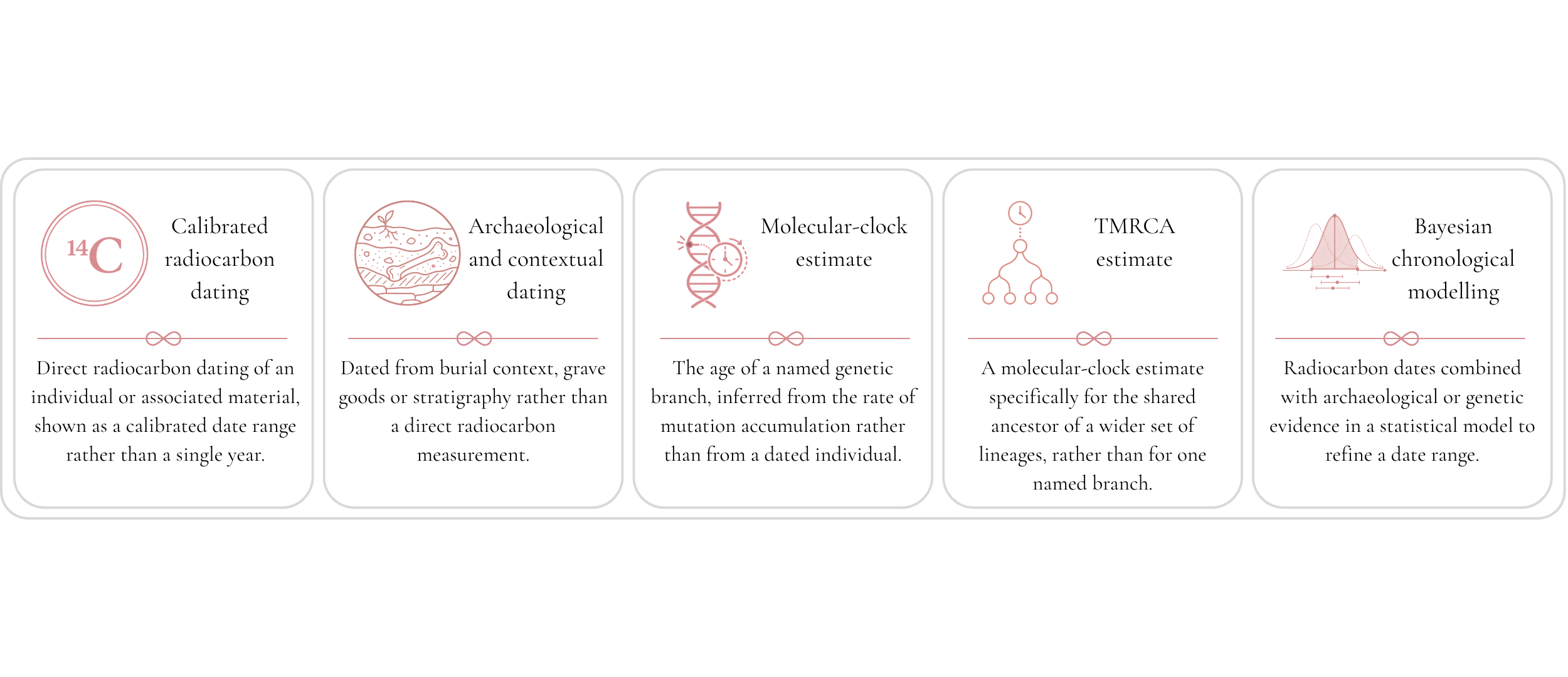
Dating the Evidence
How the different kinds of dates used throughout the Evidence Guide should be interpreted
A note on dates
Two ways of expressing time appear throughout this site: "years ago" and BCE.
"Years ago" is used for broad, rounded figures, the kind of timeframe that places an event in the sweep of prehistory rather than pins it to a specific year. BCE is used for more precise dates, counted backward from the year 1 (there is no year 0), the same convention as BC.
Scientific papers aren't always consistent in what "years ago" actually means. Many express it as BP (Before Present), a fixed reference point of 1950, chosen because it predates nuclear testing distorting carbon-14 levels. Others use it more loosely, simply meaning "before now." Where a source's convention isn't stated, this site treats "years ago" as BP by default for consistency, rather than calculating from today's date, since a moving reference point would make dates drift over time as the site is revisited in later years. So "years ago" and BP are treated as the same thing throughout, and both convert to BCE the same way.
The conversion:
BCE = years ago (BP) − 1,950
For example: 14,190 years ago → 14,190 − 1,950 = 12,240 BCE.
For the handful of very deep-time, wide-uncertainty root-ancestor dates (where a source gives a range like "254,000 years ago, 95% CI 192,000–307,000"), the converted figure is additionally rounded to the nearest 1,000 years, since false precision would misrepresent how uncertain these estimates really are: 30,000 years ago → 30,000 − 1,950 = 28,050, rounded to ~28,000 BCE. Dates tied to an actual excavated individual, with a specific calibrated range, are converted but not rounded.
Original Sources
The published research behind Ancient Origins.
Ancient Origins draws on peer-reviewed ancient-DNA studies, archaeological research, curated datasets and a small number of clearly identified preprints. A full bibliography of the sources used across the project is available to download below.
ⓘ The bibliography reflects the sources used in researching the current version of Ancient Origins and will be updated as the project develops.
GENETIC EVIDENCE
Ancient DNA studies and curated genetic datasets
ARCHAEOLOGICAL RESEARCH
Excavations, material culture and site reports
DATING EVIDENCE
Radiocarbon dates and chronological frameworks
PEER-REVIEWED RESEARCH
Published scientific studies assessed through peer review
Ready to follow the story?
The evidence sets out what can be traced. The journey brings those genetic threads back into the landscapes, migrations and lives through which they passed.